
Do You have Aphantasia or Hyperphantasia?

by James Wallace Harris

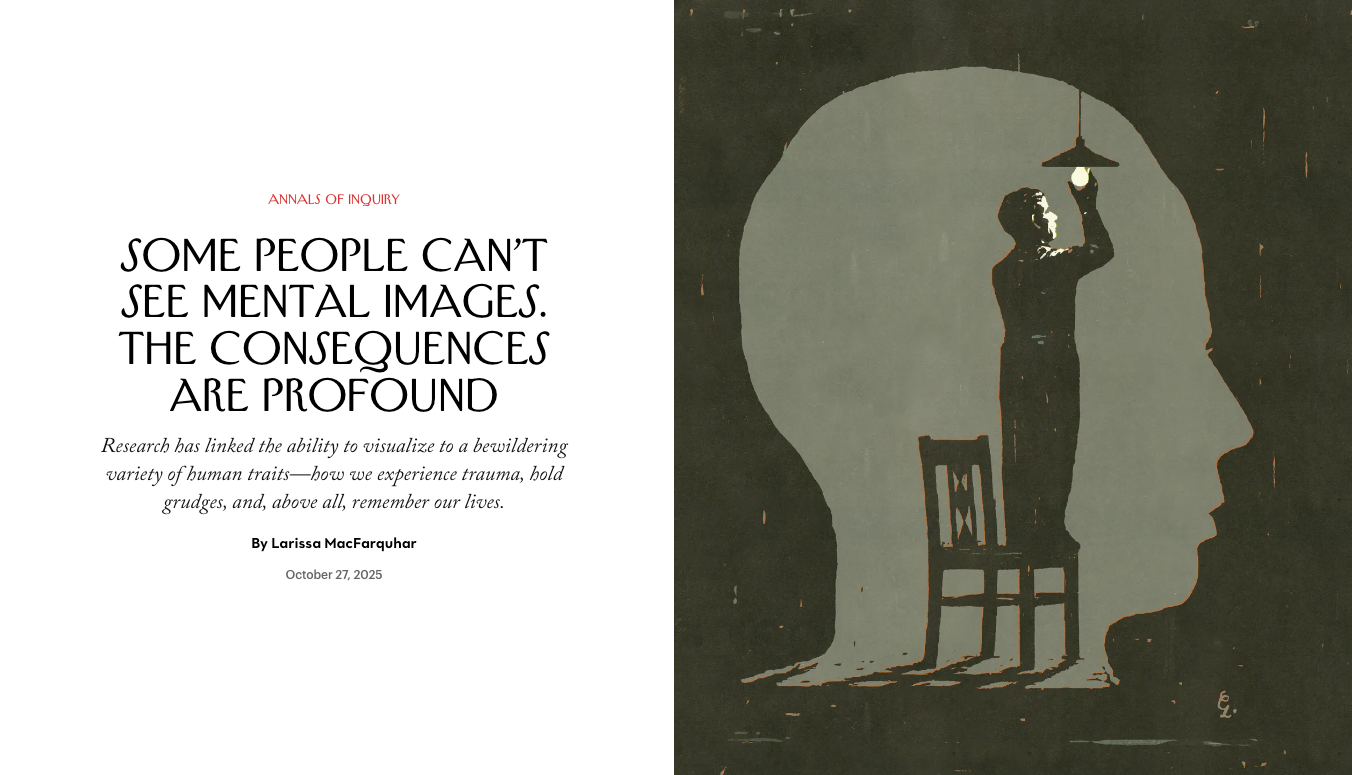
If you don’t know what aphantasia or hyperphantasia then you should read “Some People Can’t See Mental Images. The Consequences Are Profound.” by Larissa MacFarquhar in The New Yorker. Unfortunately, it’s behind a paywall, so I’m going to reiterate the high points to encourage you to find a copy. I highly recommend subscribing to the magazine or Apple News+.

The article is about a condition called aphantasia, one that I have. I wrote about that when I first discovered it in 2016. This new article by MacFarquhar describes the condition and its discovery in much greater depth than I have previously read. It also describes the opposite of this condition, hyperphantasia.

If you don’t know what aphantasia and hyperphantasia are, then you need to read this article if you have a certain kind of mindset such as artist or scientist, have trouble remembering the past, have difficulty recognizing faces, feel disconnected from your self, think you might be autistic, and many other personality traits that make you wonder if you’re different.

Aphantasia is the inability to remember mental images. Most people can close their eyes and recall a scene from their life. The face of a loved one, their desktop at work, the home they lived in as a child. About 2-3 percent of people can’t. But it turns out there all many degrees of not being able to see mental images, including some people who are overwhelmed with mental imagery. That condition is called hyperphantasia.

This article taught me a great deal about this condition I didn’t know. From my previous readings, I simplistically thought aphantasia meant one thing, but it’s not. For many people with the condition, they can’t remember their own past. I can. In fact, I’m obsessed with my past. I was particularly impressed what aphantasia did to artists and scientists.

I’m not like the extreme members of The Aphantasia Network or the people interviewed in the book Aphantasia: Experiences, Perceptions, and Insights by Alan Kendle. That’s comforting, but I still miss mental memories. Yet, I’m lucky. Some people have aphantasia so severe they can’t remember anything about their past, and they feel like living corpses.

For most of my life, I assumed everyone perceived reality pretty much the same if all their sense organs were healthy. Of course, I knew some people had better sight or hearing than others, but I assumed what we perceive was the same reality. That’s because I naively thought we observed reality directly.

I now know we don’t. Our senses are used to construct a model of reality inside our heads. And we all model reality differently. This is called our Umwelt. I highly recommend reading An Immense World by Ed Yong if you want to learn more about that.

MacFarquhar’s article explores how the ability to recall mental images affects our personality, memory, sense of self, and our Umwelt. When I first learned that I lacked the common ability to consciously recall mental images, I felt deprived. Some call it mental blindness. MacFarquhar suggests I would be a different person if I had what I missed. More than that, aphantasia affects people in various ways, and I could have been very different in other ways.

MacFarquhar begins her article by profiling Nick Wakins. He thought he was normal, but couldn’t understand why other people could remember their past and he couldn’t. He abstractly knew about his earlier life from what people told him and photographs. He started researching his condition and discovered that some 19th century scientists had discovered people like him. Then in the 1970s, psychologists again explored visual memory, but it didn’t go far.

In 2010 Adam Zeman and colleagues published research in Neuropsychologie about “blind imagination.” The journalist Carl Zimmer wrote an article for Discover magazine. That caused dozens of people recognizing the condition in themselves to contact Zeman. Zeman coined the term aphantasia with the help of a friend, and published “Lives without imagery–Cogential aphantasia” in Cortex in 2015.

That inspired an article in The New York Times and Zeman got around seventeen thousand emails. It was around this time that I heard about it and wrote my blog piece.

Zeman was now hearing about many related conditions that people claiming to have aphantasia experience. Since 2015 a tremendous wealth of research has gone into this topic, information I didn’t know about. Larissa MacFarquhar does a fantastic job of catching me up.

This article is as exciting as anything Oliver Sacks wrote about. He also had aphantasia. And it’s more than just visual memories. It also relates to being remember sound, smells, tastes, and touches.

We all peceive the world tremendously different.

Nick Wakins thought he was absolutely normal until he uncovered this research. Nick has a PhD. He didn’t know what he was missing until he researched how other people peceived. We seldom compare notes like that.

Melinda Utal had an extreme case of no past memory that is very sad:

One of Kendle’s interviewees was Melinda Utal, a hypnotherapist and a freelance writer from California. She had trouble recognizing people, including people she knew pretty well, so she tended to avoid social situations where she might hurt someone’s feelings. When she first discovered that she was aphantasic, she called her father, who was in the early stages of Alzheimer’s disease and living in a nursing home in Oregon. He had been a musician in big bands—he had toured with Bob Hope and played with Les Brown and his Band of Renown. She asked him whether he could imagine a scene in his head, and he said, Of course. I can imagine going into a concert hall. I see the wood on the walls, I see the seats, I know I’m going to sit at the back, because that’s where you get the best sound. I can see the orchestra playing a symphony, I can hear all the different instruments, and I can stop it and go backward to wherever I want it to start up and hear it again. She explained to her father what aphantasia was, how she couldn’t see images in her mind, or hear music, either. On the phone, her father started to cry. He said, But, Melinda, that’s what makes us human.

Melinda had an extremely bad memory for her life, even for an aphantasic. She once had herself checked for dementia, but the doctor found nothing wrong. She had become aware when she was in second grade that she had a bad memory, after a friend pointed it out. In an effort to hold on to her memories, she started keeping a journal in elementary school, recording what she did almost every single day, and continued this practice for decades. When, in her sixties, she got divorced and moved into an apartment by herself, she thought it would be a good time to look through her journals and revisit her younger days. She opened one and began to sob because, to her horror, the words she had written meant nothing to her. The journals were useless. She read about things she had done and it was as though they had happened to someone else.

MacFarquhar profiles many people for her long article, but I was particularly taken by two artists she interviewed. Sheri Paisley had aphantasia:

Among the e-mails that Zeman received, there were, to his surprise, several from aphantasic professional artists. One of these was Sheri Paisley (at the time, Sheri Bakes), a painter in her forties who lived in Vancouver. When Sheri was young, she’d had imagery so vivid that she sometimes had difficulty distinguishing it from what was real. She painted intricate likenesses of people and animals; portraiture attracted her because she was interested in psychology. Then, when she was twenty-nine, she had a stroke, and lost her imagery altogether.

To her, the loss of imagery was a catastrophe. She felt as though her mind were a library that had burned down. She no longer saw herself as a person. Gradually, as she recovered from her stroke, she made her way back to painting, working very slowly. She switched from acrylic paints to oils because acrylics dried too fast. She found that her art had drastically changed. She no longer wanted to paint figuratively; she painted abstractions that looked like galaxies seen through a space telescope. She lost interest in psychology—she wanted to connect to the foundations of the universe.

On the other hand, Clare Dudeney had hyperphantasia.

In talking to a friend of hers, an aphantasic painter who was one of Zeman’s research subjects, Clare had realized that she was the opposite—hyperphantasic. Her imagery was extraordinarily vivid. There was always so much going on inside her head, her mind skittering and careening about, that it was difficult to focus on what or who was actually in front of her. There were so many pictures and flashes of memory, and glimpses of things she thought were memory but wasn’t sure, and scenarios real and imaginary, and schemes and speculations and notions and plans, a relentless flood of images and ideas continuously coursing through her mind. It was hard to get to sleep.

At one point, in an effort to slow the flood, she tried meditation. She went on a ten-day silent retreat, but she disliked it so much—too many rules, getting up far too early—that she rebelled. While sitting in a room with no pictures or stimulation of any kind, supposedly meditating, she decided to watch the first Harry Potter movie in her head. She wasn’t able to recall all two hours of it, but watching what she remembered lasted for forty-five minutes. Then she did the same with the other seven films.

An interesting aspect of new research is showing that some people have aphantasia since birth, but others acquire it later in life, often due to a physical injury. Other reseach suggests that visual memory is better in children and women, and that many children might have hyperphantasia. I believe I did see mental images when I was young. And other studies suggest that taking drugs brings back the ability to create mental imagery. I can testify to that. I used to get great flashes of imagery when I got high. Other studies show that people repress the ability to create mental imagery because of psychological trauma. All of this makes me wonder if I could retrain myself to create mental pictures in my head.

It is quite common for people with aphantasia to dream with vivid imagery, although others claim their dreams are thin and dark. As I’ve gotten older, my dreams have become dark and shadowy. However, the other night I had a dream that was intensely vivid, bright, and colorful. I was even aware in the dream to a slight degree. I said to myself that I was in a dream and I couldn’t believe it was so damn real. It felt so real that I was afraid I couldn’t get back to my old life. I was on a street looking at buildings I didn’t know, and was worried that if I became stuck in the dream I wouldn’t know where to go. I was quite relieved to wake up.

Scientists who are very good at thinking abstractly often forget how to create mental imagery. And some even theorize that spending so much time reading and staring at words have ruined our capacity to create mental pictures.

At first I envied people with hyperphantasia until I read this:

Hyperphantasia often seemed to function as an emotional amplifier in mental illness—heightening hypomania, worsening depression, causing intrusive traumatic imagery in P.T.S.D. to be more realistic and disturbing. Reshanne Reeder, a neuroscientist at the University of Liverpool, began interviewing hyperphantasics in 2021 and found that many of them had a fantasy world that they could enter at will. But they were also prone to what she called maladaptive daydreaming. They might become so absorbed while on a walk that they would wander, not noticing their surroundings, and get lost. It was difficult for them to control their imaginations: once they pictured something, it was hard to get rid of it. It was so easy for hyperphantasics to imagine scenes as lifelike as reality that they could later become unsure what had actually happened and what had not.

I believe I’ve copied as much of this article as I ethically should.

I’m using this blog to encourage you to go read the article. I’m also encourage people to subscribe to magazines. If you want good information it costs. We need to get away from always assume information should be free. Free information on the web is corrupting our society. Subscribing to magazines supports the spread of better information.
My new effort at home schooling myself is to read one great article a day from magazines with solid editors. I look for articles that expand my mental map of the world. This one certainly has.

JWH
Ancestry.com Isn’t What I Expected

by James Wallace Harris, 1/6/25

I joined Ancestry.com so I could upload old family photos. I thought they should be saved somewhere because all my family photos will be thrown away after I die. Many of my photographs have already been converted into digital files, so I figured it would only require looking up the person and uploading the files for that person.

Because the government knows so much about us, I assumed that kinship relationships for the last three or four generations would already be in the Ancestry.com system. That was a big false assumption.

Ancestry.com claims to have over 60 billion records. I don’t know if that’s 60 billion different pieces of paper or 60 billion references to individuals. The trick using Ancestry.com is to start with a name and then use all its records to verify the identity of each person. It’s not easy. You can’t trust any one record. You need to find several records with connecting information that’s already been previously validated.

My assumption was recent family members would be known and family from the past would be harder to identify. It turned out that parents, siblings, cousins, and grandparents are hard to verify but once I did, Ancestry.com offered a lot of hints about my great-grandparents, and their ancestors. However, the hints need to be verified. Those hints are probably based on distant relatives in the past, working up family trees, and those trees might not be accurate.

I was shocked by how many people have similar names, with similar dates of birth and death, coming from the same part of the country. I could very easily add photos of people who were not the people photographed.

Before I joined Ancestry.com and used it, I thought family trees were already well established, and I could quickly upload all my family photos. That won’t be the case.

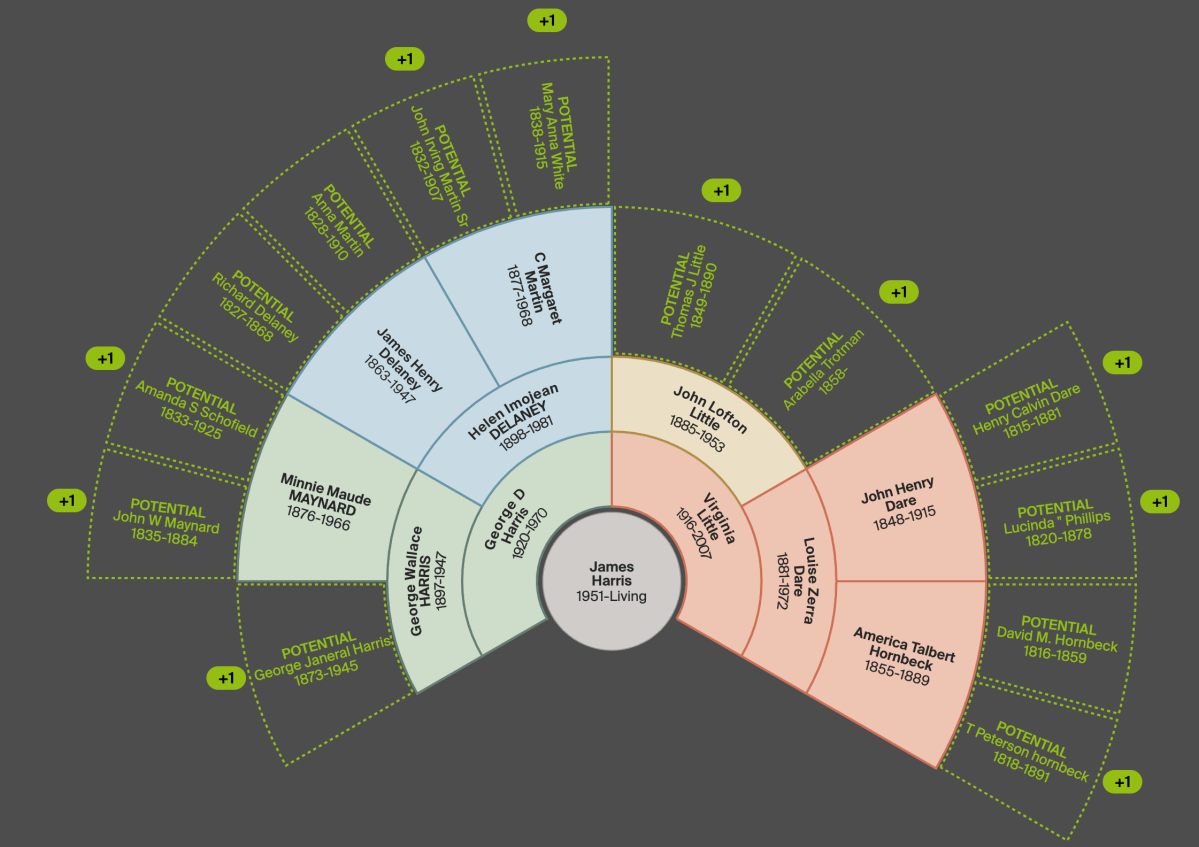
Just to cover my parents, grandparents, great-grandparents, and great-great-grandparents, I’ll need to research and identify 30 people. I only knew four of them. If I go back to another generation, that would add 32 more people. This completely ignores aunts, uncles, and cousins from each generation. Adding them to my family three would mean researching another hundred people, maybe two hundred.

Another assumption I had before working with Ancestry.com was the belief that building a family tree would help me get to know my ancestors. It hasn’t worked out that way. Finding names and dates to add to my tree reveals nothing about those people.

Genealogy is interesting and even educational. It’s revealing in unexpected ways. It shows that blood is not thicker than water. Kinship is meaningless. Actual interactions with each other are everything.

I’m not sure if saving my photographs will be of any real value. I’ll save them anyway, but I’m uncertain if anyone will care. Now I understand why so many people I’ve talked to about this project said they had zero interest in genealogy. They instinctively knew that people they never met were just meaningless names and dates on a chart

However, learning genealogy offers other rewards. It teaches research skills. It reveals how society knows and remembers people. Pursuing genealogy shows the limits of identity and identification. Unless a person is worthy of a biography, history only knows us by our names, marriages, addresses, birthdates, and death dates. And don’t those details say absolutely nothing about true selves?

Maybe I’m wrong. As I dig into the past, maybe I’ll find revelations I never expected.

By the way, genealogy should benefit greatly from AI.

JWH

What To Do With Family Photos That No One Wants?

by James Wallace Harris, 12/30/24

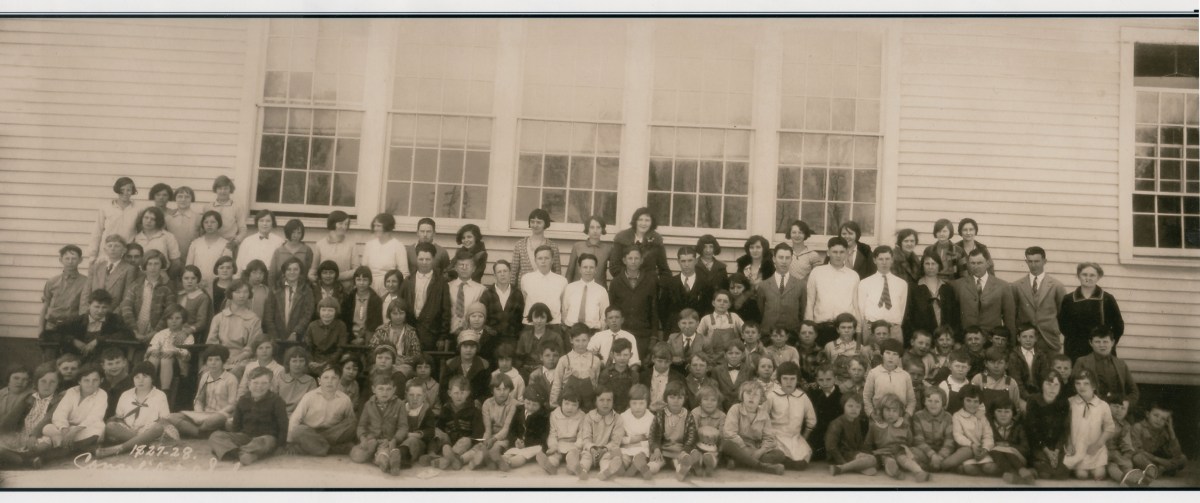
I have a box of old photos and photo albums that contain pictures of people from six generations. I inherited the family photos from my father’s and mother’s side of the family. My wife and I have no children, and my sister recently informed me that her son and granddaughters have no interest in the past. When I die, I’m sure that box of history will be thrown away.

It seems wrong to destroy such historical artifacts. Online research recommends trying to donate old photos to historical or genealogy organizations. I was horrified by one site’s recommendation: to burn them. But then, wouldn’t that be like cremation? I guess that’s more dignified than letting them rot in the landfill?

Sadly, no one wants to remember these people. I always thought one of the main reasons people believed in heaven was their desire to see family and friends again. Maybe that’s not true. I’m also reminded of the sentiment, that as long as you remember a person, they will not die. I never met many of the folks in my family photos, but I have wondered about them.

I have digitized most of my family photos. Sometimes I even set my computer background to use random pictures from that folder to remind me of all the people who are gone. Every ten minutes I see another moment from the past where people I share DNA pose to be remembered.

I have used scans of these photos for this blog in the past. I wrote “The Burden and Responsibilities of Family Photos,” “My Father Would Have Been 100 Today,” and “My Mother Would Have Been 100 Today.” I had hoped that some of their friends I never knew would have discovered those pages and left a comment, but that didn’t happen.

I joined Ancestry.com which allows uploading photos. It’s a slow process because I have to verify details and family connections, and I try to add as much information as possible to each image. My initial subscription is for three months, so I’ll try to scan, document, organize, and upload all the photos I can within that period. It’s kind of expensive.

Once the work is completed at Ancestry.com I might join other genealogical sites to upload the photos at each.

After that, I’ll box them all up carefully, and leave a note for whoever goes through my stuff to ask my sister’s descendants if they want them one last time.

You’d think there would be a national archive that collected old photos and certain kinds of documents for future historians.

If you don’t have anyone to leave your family photos, what will you do with them?

JWH

Meditating on a Meme

by James Wallace Harris, 11/28/24

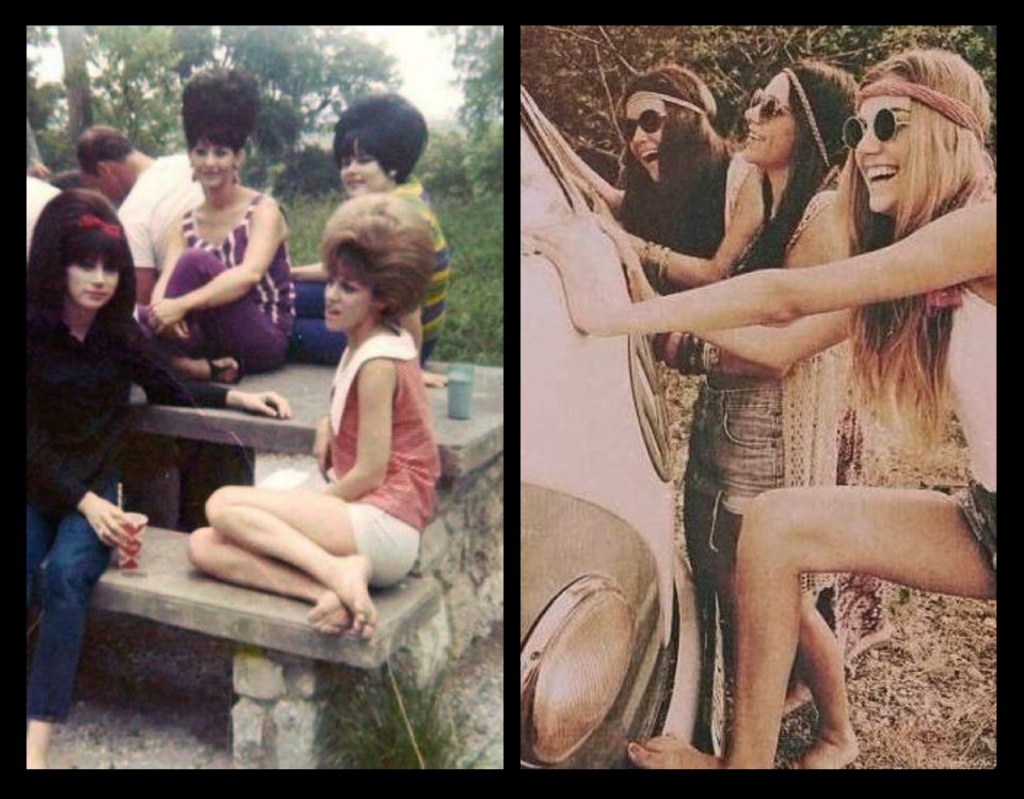
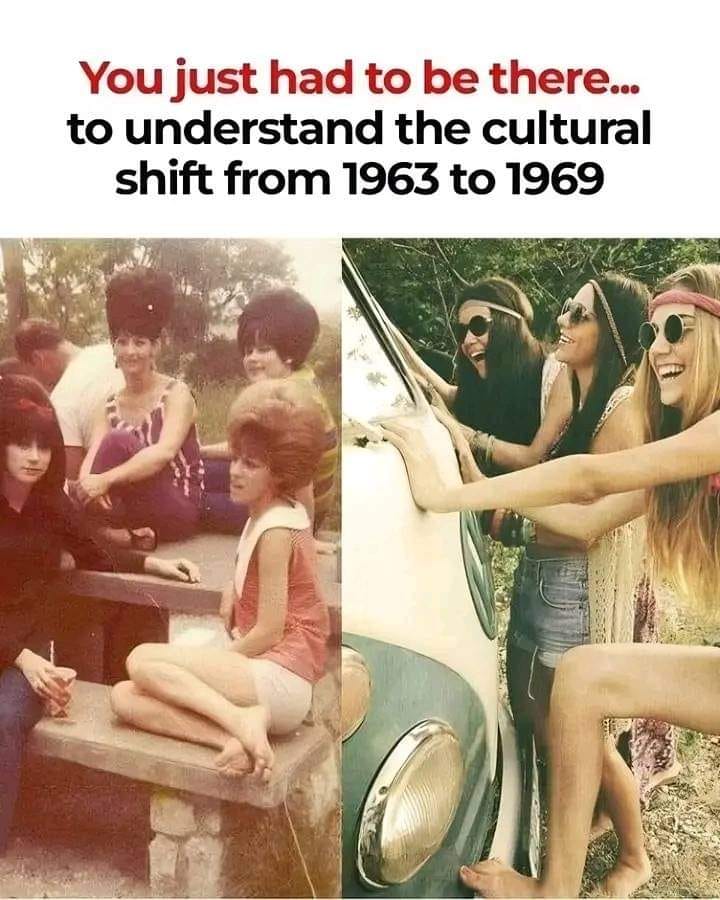
Seeing the above photos as a meme on Facebook made me think about how much people, society, and pop culture changed in the 1960s.

If a picture is worth 1,000 words, then are two pictures only worth 2,000 words? I don’t think so, I think it’s 1,000 words times 1,000 words, or 1,000,000 words. I could easily write that many from all the ideas my mind has generated since I began meditating on those photos.

Here’s the original meme from Facebook:

I was eight on 1/1/60 and eighteen on 12/31/69. I have always thought the longest years of my life were from 1963 to 1969 because so much happened to me and the world I lived in during that time. For folks who didn’t grow up in the sixties, it was much more than what you can learn from watching Grease or American Graffiti and contrasting it with Hair or Woodstock.

When I first saw the meme above I instantly thought about how rock and roll music of the 1950s ended up becoming the rock music of Woodstock. I’ve tried several times just to write an essay about that, but after typing over 5,000 words, I realize I’ve barely hinted at what I could say. That’s too long for a blog post.

I recommend that you find two photos that bracket your adolescent years or the decade you identify with the most and meditate on them. Start with remembering every place you lived and what you did each year. Remember your family and friends, your pets, your homes, your schools and workplaces, the clothes you wore, all the activities you pursued, everything you wanted to buy. Then write the shortest essay that makes it all coherent. You will then feel the mental anguish I am feeling right now.

Then branch out in your meditations. The easy and fun things to contemplate are the changes in pop culture — how music, movies, books, TV shows, games, and technology evolved over ten years. But then move on to the political and social changes. That’s when things get heavy. Can you connect your firsthand experiences with all those external events? Have you ever compared the life you lived to what you saw on the TV news every night?

Every one of us has the life experience to write a Proust-size novel and has lived through enough social change to write a series of history books about the formative decade of our lives. If you don’t think so, meditate more on the two photos you have selected.

I turned seventy-three on Monday, and getting old has made me more susceptible to memes about the past. My memories are fading away so I desperately want to cling to them. Emotions gnaw at me to make sense of everything I’ve experienced. The urge is to put it all down in words, but I don’t have what it takes to do the job and do it precisely.

There is an undefinable mental barrier that keeps me from organizing my thoughts into coherent histories. And I’m not talking about writing something worthy of publication for others to read, but just producing a narrative that makes sense of things for myself about myself and what I’ve learned. The older I get, the more I want to understand.

This essay started out about when rock and roll music became rock music. After several drafts and much contemplation, I narrowed it down to the summer of 1965 when I first heard Bob Dylan’s “Like a Rolling Stone” on the radio. As I kept trying to document my theory, I realized I could write a whole book on it.

Then as I was researching the subject, I found that Andrew Grant Jackson had already published the book I wish I had written, 1965: The Most Revolutionary Year in Music. His book is what I wanted to write in this essay when I first saw the meme above.

The Kindle edition is currently $2.99, and it’s a perfect example of what I’m talking about when I suggest we should chronicle our lives. Even if you don’t buy the book, read the sample at Amazon. I feel the format of organizing the narrative around a month-by-month description of what was happening is a great template to use for writing about memories.

JWH

Do You Plan to Bequeath Any of Your Computer Files in Your Will?

by James Wallace Harris, 11/20/23

I currently have 71,882 files in Dropbox. Will anyone want any of those digital documents after I die?

Let’s say I go on a Döstädning rampage (Swedish death cleaning) of my digital possessions, would there be anything left that I’d want anyone to have?

Most people consider their photographs to be among their most cherished digital possessions. I have 5,368 of those — some of those photos go back to four generations in our families. Susan and I have no children. We made copies of those photos for our relatives one Christmas, although I’m not sure if any of those relatives wanted them. I imagine them groaning at their pile of digital junk growing larger.

Would a genealogical database want old photographs? I know people interested in their ancestry spend a lot of time looking for old documents online. I wonder if I have any photos, letters, or documents that would be of interest to people in the future researching their past?

I have 28,811 digital scans of old science fiction and pulp magazines that took me years to collect. Most of them are easily found online, so I doubt they will be wanted. But what if the Internet Archive servers were shut down for lack of funding? Will there be kids in the future wishing they had a complete run of Astounding Science Fiction? Or will that desire die with the generation that grew up reading the stories that were first published in that magazine?

There are certain documents relating to money that my wife will want, but she will prefer printed copies. When my mother died, and Susan’s folks died, I scanned a bunch of family documents. I haven’t looked at them in years, and Susan has never asked about them. Still, would they be of value to anyone? What will future historians want to know about ordinary people?

I wonder how long my blogs will exist after I die. I’ve known bloggers who have died, and I can still read their blog posts, but some of writers were published at online companies that went under. I know I used a couple of those sites, and I can’t even remember the names of the companies.

I have over a thousand Kindle books, and over a thousand Audible audiobooks in Amazon’s cloud. Is there any way for me to leave those libraries to other people?

And if no one in the future will want my digital files, do I need to hang onto them now? Why do I keep them? Why do I give Dropbox $119 a year? When I retired, I made copies of all the computer programs I wrote. I put them on several drives just to be sure. I put those drives in the closet. Several years later I went to check on them and every one of those hard drives was dead. I have a friend whose computer hard drive died recently. She had always backed everything up with Apple’s Time Machine. However, when she restored her files, many were corrupted. It’s hard to preserve digital files for a long time. Backup programs and online backup services aren’t 100% reliable.

When humanity stored our past on paper, some of it got saved. Not much, but some. I get the feeling that since we switched to storing stuff digitally, even less will survive. I have a handful of paper photographs that my great grandparents, grandparents, and parents took. So does Susan. I wonder who we should give them to?

Every day I spend a few minutes going around the house looking for things to throw away or give away. I need to start doing that with my computer files. I spent a lifetime gathering stuff, both physical stuff, and digital stuff. It’s funny now that I’m trying to reverse that progression of acquisitions.

I wonder when I was young if I had somehow known for sure that my older self would be getting rid of all the stuff I was buying back then, would I have bought so much stuff in the first place? How much stuff have I bought or saved because of FOMO (fear of missing out)? And how much did I really miss out?

JWH