Peter Leyden claims that America undergoes 80-year cycles, which he calls epochs, with peaks of upheaval that last 25 years. The past peak was after World War II, from 1945 to 1970. Leyden claims we’re entering a new peak in 2025 that should last until 2050. He zeroes in on artificial intelligence, clean energy, and bioengineering as the driving forces. I’m not big on predicting the future or seeing patterns in history, but there are ideas in his theory that are worth contemplating. I do believe we’re living through a historic period of change.
David Brooks claims America is moving away from thinking of itself as an idea that inspires the world to a homeland that we should defend. Brooks has moved away from being a traditional conservative to becoming a spiritual guru who teaches morality. I find all his recent speeches to be both uplifting and inspirational. Brooks feels the changes we are experiencing are undermining our individual characters and altering our collective national character.
CBS News asks if we’re moving into a new Gilded Age. But this time, the oligarchs are far richer and much more powerful. There is a synergy between this documentary and the videos of David Brooks and Peter Leyden. Everyone feels a massive paradigm shift coming. In 2025, I believe we’re living through the largest social and political upheaval since 1968.
If history does go through cycles, can we alter their course? The average person does not have much power. But in 2026, we do get to vote, and again in 2028. I believe the Democrats lost in 2024 because they had no clear vision. Being against Trump is not a political plan. In 2024, the Americans voted for Darwinian rule. Let the strong thrive and the weak die. The current administration is enacting laws to make the rich richer and the poor poorer. Essentially, civilization on the cheap. They appeal to greed. They appeal to resentment. They believe everyone should be responsible only for themselves.
It’s a very Darwinian philosophy. There’s no way we could call America a Christian Nation anymore. This is what America wanted through a fair and square election. But now that they are seeing what it means, do they want to keep it?
I don’t think we should wait until 2026 or 2028 to decide what we want. The Republicans won by clearly defining their goals in 2024. Democrats need to produce their own version of Project 2025. Project 2028 needs to be specific, and all Democrats need to support it. It can’t be too radical. It will need to be liberal yet practical. It needs to appeal to independents and old-style conservatives.
I have no idea what that plan should be, but I wish it would be something David Brooks would back. It needs a moral foundation because, as much as I accept the scientific theories of Darwin, I don’t think survival-of-the-fittest makes for an appealing political philosophy.
I suppose because humans have always reproduced like bunnies, we’ve always ignored an essential aspect of sexual reproduction and gender. Statistically, we need every female to have more than two children. Because some women can’t have children, and because some girls die before reaching reproductive age, to keep the population steady during current conditions requires 2,100 babies to be born to every 1,000 women. That number varies depending on the state of medicine and the number of catastrophes.
In 2024, 1,626 babies were born to every 1,000 women in the United States. That’s not enough. If we continued at that rate, we’d eventually become extinct. In many other countries, that number is much smaller than 1,626.
Why aren’t these statistics common knowledge? Why didn’t we learn them when our parents (or peers) taught us about sex? It’s a heavy responsibility to know that we should all have children. My wife and I didn’t have children. Most of my friends didn’t have children. Why did we all start doing our own thing and forget this essential aspect of life?
It’s unfair that the burden of maintaining the species falls on women. To maintain the current population, every woman needs to have two children, and one in ten needs to have three. That’s assuming all women can have children. The practical need is for all women to have three children. Few women want that today.
Males don’t escape responsibility either. The species could get by with fewer males for making babies, but we need males to support the raising of children. I suppose a feminist utopia could get by with an exceedingly small number of males, or even none if women perfected cloning, but the statistics of maintaining the species are the same even if males weren’t needed.
However, we have evolved into a society/culture that doesn’t want enough children. What does that mean? Should we make people have more babies?
I wrote about this yesterday. However, the impact of these numbers didn’t hit me until 3:11 am last night.
For humanity to survive, we must deal with climate change, environmental sustainability, capitalism, inequality in all forms, artificial intelligence, and reproductive stability.
Theoretically, we could solve all these problems, but I doubt we will. The obvious solution is that civilization will collapse, and we’ll fall back into previous kinds of social organizations. It’s a fascinating challenge to imagine a society that can solve all these problems. However, can you imagine any future where all fertile women must have three children, and all men must become dedicated fathers? I can’t.
The human race needs to act radically differently. Is that possible?
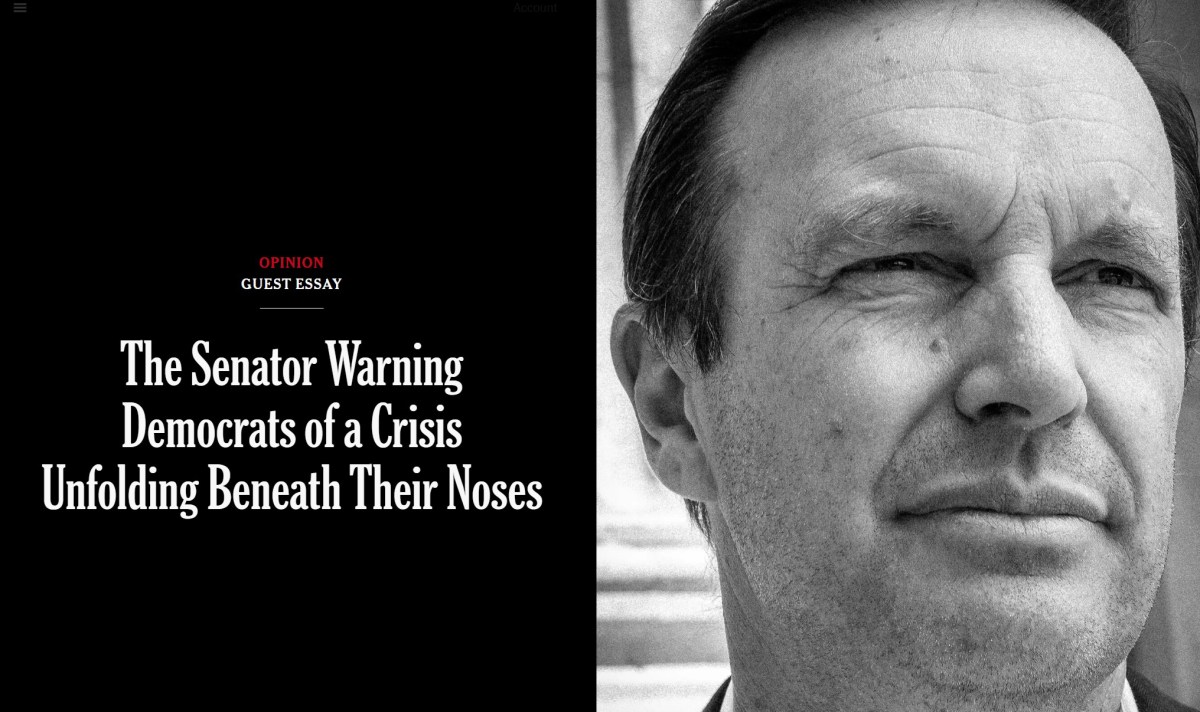
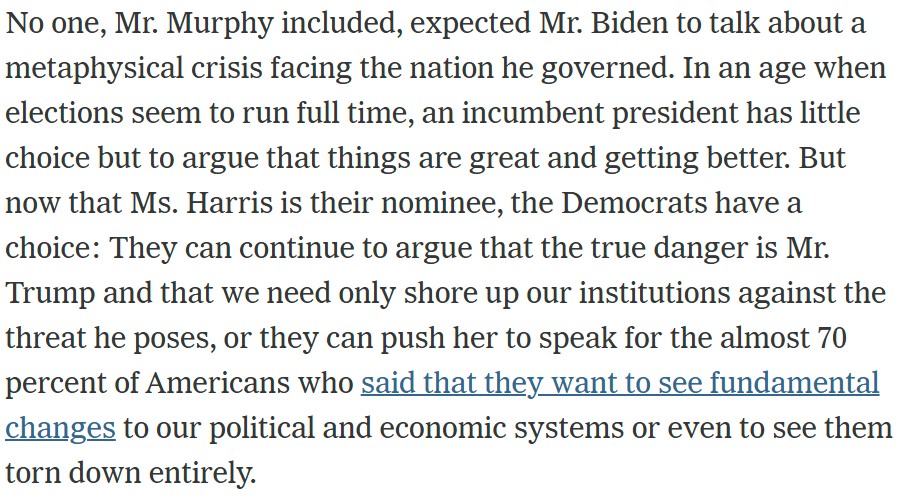
On Monday, August 19th, the New York Times ran a guest editorial by James Pogue about Senator Chris Murphy of Connecticut, entitled “The Senator Warning Democrats of a Crisis Unfolding Beneath Their Noses” which I found intriguing but hard to understand. It appears to suggest that Republicans are going to put limits on neoliberalism. That’s impossible for me to believe.
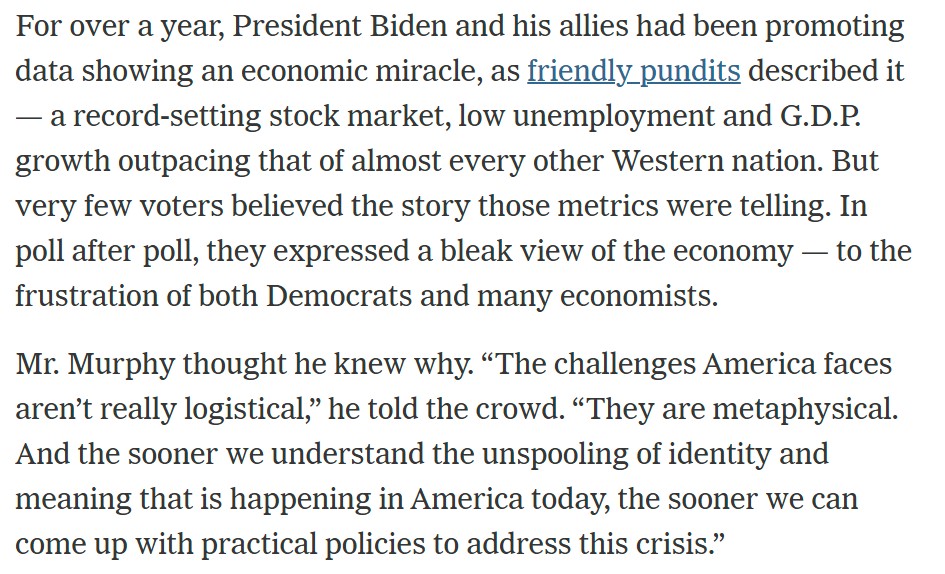
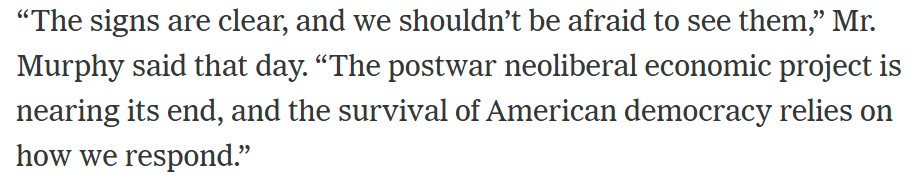
That’s a rather interesting statement, that the problems we face today aren’t logistical but metaphysical. Pogue then goes to say the subject of Murphy’s speech was “the fall of American neoliberalism.” I’ve read several articles over the last few years that mentioned the same thing. Neoliberalism is a virulent form of capitalism pushed by Ronald Reagan and Margaret Thatcher. It’s an economic philosophy embraced by Republicans, but Bill Clinton went along with it when he got his chance. So did Obama. It was Trump who appeared to put on the breaks Neoliberalism when he was elected, and Biden even followed Trump in some ways. So, some pundits are now suggesting the tide has turned.
But has it? Isn’t prosperity through economic success what Republicans and Democrats both want? Pogue goes on to summarize:
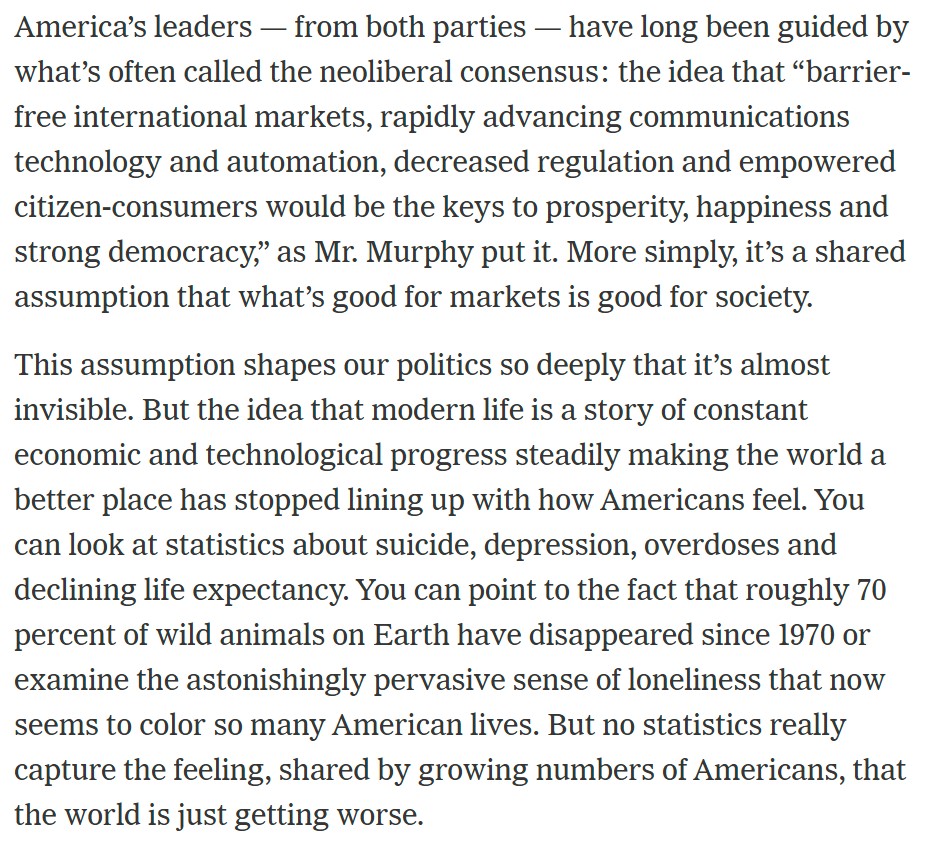
Okay, I understand this. Civilization is collapsing and ultimately capitalism is a Ponzi scheme that will fall apart as the one percent squeezed all the wealth out of the ninety-nine percent. But I assumed we need to fix neoliberal capitalism, not reject it. It’s the only system that creates jobs and freedom. We just needed to make it more equitable and friendly to the environment. I assumed that’s what the Democrats want, but evidently according to this essay it’s not the solution the Republicans want.
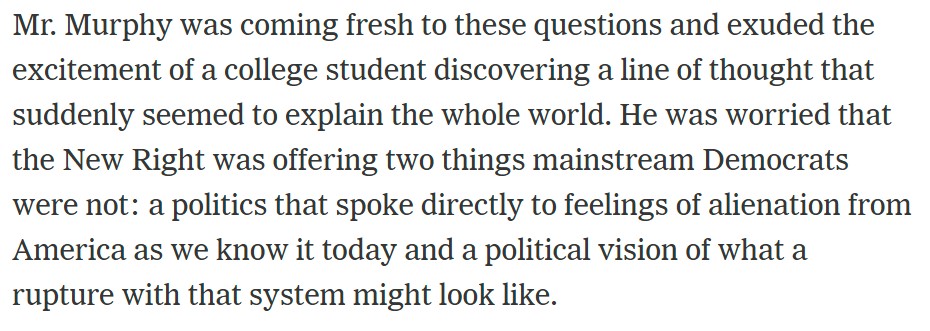
Pogue says Murphy defines it as a metaphysical problem that masks a spiritual crisis, one that Donald Trump has tapped into. Trump recognizes this unhappiness and appeals to it. Murphy says Democrats have trouble even admitting that it exists. But where does neoliberalism come in? Trump heads the Republican party, and isn’t that party the guardian angel of neoliberalism?
How can a political party overcome a spiritual crisis and still race full steam ahead with capitalism? Pogue summarizes Murphy’s recognition of the problem that the Democrats need to address:
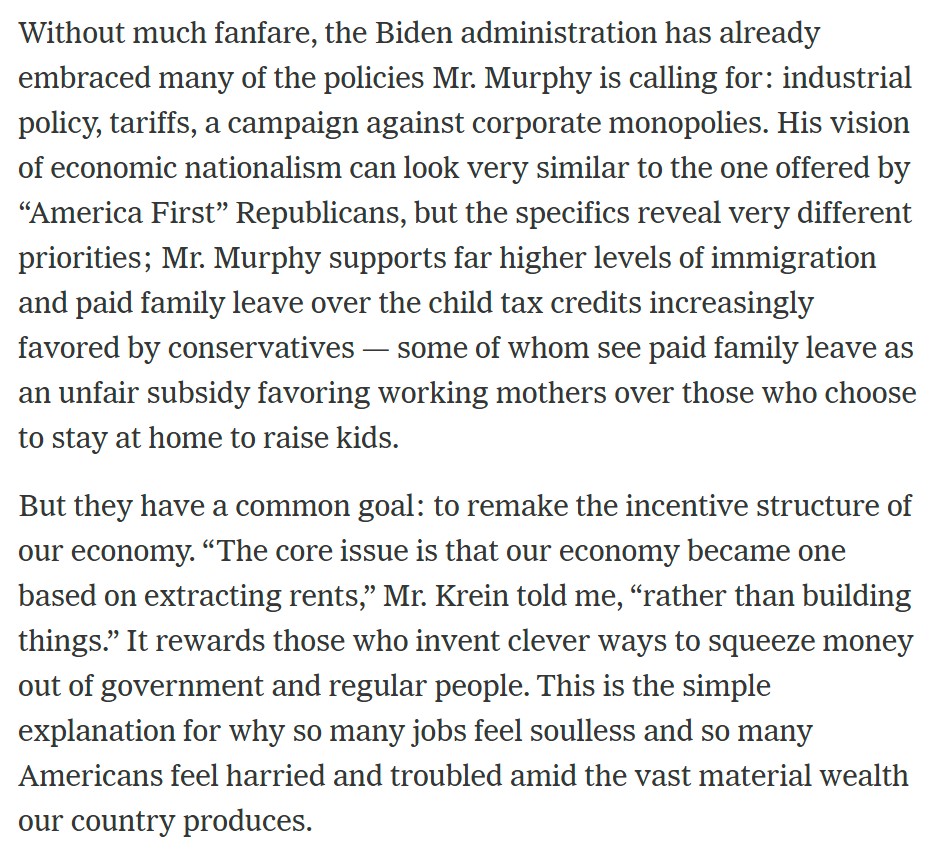
This makes things even more puzzling. I can understand where Democrats might want to regulate capitalism, making it more socialistic and ecological, but how can Republicans alter their religion to help the dissatisfied?
Murphy brings up Project 2025 but is that really a solution to the spiritual crisis he’s pointing at? Ever since FDR and the New Deal, Republicans have been wanting to undo it, and LBJ’s Great Society too. But wasn’t Neoliberalism a response to the Great Depression? But does Project 2025 offer a solution to Murphy’s problem? Isn’t it just consolidating power. It doesn’t claim to undo neoliberalism. Although, it hopes to rewind our sociological makeup back to the 1920s.
To me, the Republicans want to avoid taxes and regulations so they can make as much money as possible. They want private property protected and they want national security. Neoliberalism gives them all of that, so why would they want to undo it? I don’t think they do.
Lately, I’ve been reading books on the French Revolution and Napoleon. The French Revolution tried to create a democratic society based on Enlightenment ideals. The revolutionaries wanted to get rid of the aristocracy and the church. Napoleon believed democracy would just allow a class of wealthy to replace the aristocracy, and that either would need to keep the church because the church kept the poor from destroying either the aristocracy or the wealthy. Napoleon didn’t care for democracy and felt a hereditary aristocracy was a better system for maintaining order. He reinstated the church.
Aren’t the Republicans wanting to be the new aristocrats, and aren’t they embracing the faithful to protect them? Trump and the Republicans want to consolidate power. Is their promise of law and order going to solve the spiritual crisis that Murphy describes?
If the Republicans win in 2024, roll out their Project 2025 plan, and succeed at killing off the Democratic Party, they aren’t going to solve those spiritual problems Murphy points to. They will deregulate capitalism more, cut taxes for themselves, and go back to distilling American wealth from the ninety-nine percent to the one percent. They might make some Americans happier by legislating behavior, but I’m pretty sure they won’t put the breaks on neoliberalism.
Republicans will face a real revolution, like the one in 18th-century France. And we’ll discover the same problems as the French discovered. Between the fall of the Bastille and the coronation of Napoleon, they tried many kinds of governing theories based on the desires of the different factions of the population. None of them worked.
I believe the spiritual crisis Murphy points to has always been with us. There’s no form of government that makes most of the population satisfied. That the pendulum always swings between hope and the apocalypse but never reaches either. Murphy is saying that Trump and the Republicans are swinging the pendulum towards hope. That might even be true for some, but it doesn’t mean the pendulum will reach a point and make their followers happy.
I don’t think Trump is really offering an alternative to neoliberalism economics, but just appealing to isolationism, xenophobia, racism, and is anti-LGBTQ+.
Would it be cruel of me to point out that Christians have been waiting for the Rapture for over two thousand years. Republicans have been in the desert for forty years waiting to get into the promise land. They feel they are remarkably close. Religion and politicians have been promising to deliver people into the land of milk and honey for two hundred thousand years. We’ve never gotten there yet so why believe it now?
The essay goes on for a great length, but it finally gets down to talking about what the Democrats can do in response. I worry that the Democrats might promise pie-in-the-sky. I think we need to get away from believing political parties will save us.
Democrats and Republicans vilify each other, often to extreme. Each have legitimate complaints and desires.
The whole country needs to rethink what it wants, and not trust either party. I think Trump supporters should expect to be let down. I don’t think either party can solve the spiritual crisis that Murphy describes. We have a polarized political system that is stuck with always leaving half the voters unhappy.
I don’t know if we can fix our system, or even start over with a new one that works. But my gut tells me the present two-party system won’t ever succeed. I doubt a one-party system would either. I’d like to see more democracy, not less. We need to decide everything with referendums but change what a winning majority is from 50% to 66%. We need to move closer to a consensus rather than polarization. I think that might be possible with referendums, but not with political parties. Just study opinion polls. Political parties have succeeded in making minority rule work.
I want the Democrats to win in November, but I don’t expect them to solve the spiritual crisis Murphy describes. I just expect they will provide less turmoil over the next four years. Civilization will continue to head towards collapse. Theoretically, we might avoid that, but not with our present political system.
I also think whether the Democrats or Republicans win, they are just going to slightly modify neoliberal economics. The pandemic taught us that we shouldn’t depend on globalism for vital products, but corporations aren’t going to give up on global markets or moving jobs around the world to where labor is cheap. We’ll deploy some tariffs, but then we’ve always had. But the basic tenet of neoliberalism, that capitalism generates prosperity through unhindered commerce won’t end. Capitalism is destructive to the environment, and unkind to economic losers. By its very nature, capitalism generates inequality. The Americans who are suffering the spiritual crisis Murphy describes won’t be saved.
If we evolved a system based on referendums and larger winning majorities, the political parties would slowly fade away. Philosophers have always worried about democracy leading to mob rule. I’m not sure that would be true if we increased the size of the winning majority. It would force us to cooperate. It’s too easy to create minority rule with a fifty percent winning majority.
Our present situation is due to the wealthy getting what they want. Like Napoleon said, they are the new aristocrats, and they aren’t going to give up their power, privilege, and position. Any political or economic solution to help those suffering from the spiritual crisis that Murphy worries about will have to include the power of the wealthy in their equations.
Before neoliberalism was a period where the rich were taxed more heavily, and we had a larger middle class. I doubt Trump wants to use that solution. Neoliberalism wants to stop anything that gets in the way of the rich making money. I can’t believe anyone believes that any political movement will hinder that.
Murphy is right in that the Democrats don’t deal with the issue. But I don’t believe the Republicans are offering a solution either. I think they’re just lying to get elected. Trump’s isolationist policies will create some jobs, but other policies will do away with more jobs. And if he really deports millions of illegal immigrants it will make a huge dent in the economy. Even then, those policies aren’t altering neoliberialism.
I think Murphy and others have put their finger on the problem, but I don’t see anyone offering a solution that will work. Neoliberalism has made greed almost unstoppable. I say almost, because revolutions and apocalypses do happen.
To solve Murphy’s spiritual crisis, we need a lot more jobs and a lot less inequality. Unfortunately, this era also coincides with artificial intelligence, robots, and increased automation. The dream of capitalism has always been to do away with labor, and technology is getting closer and closer to doing that.
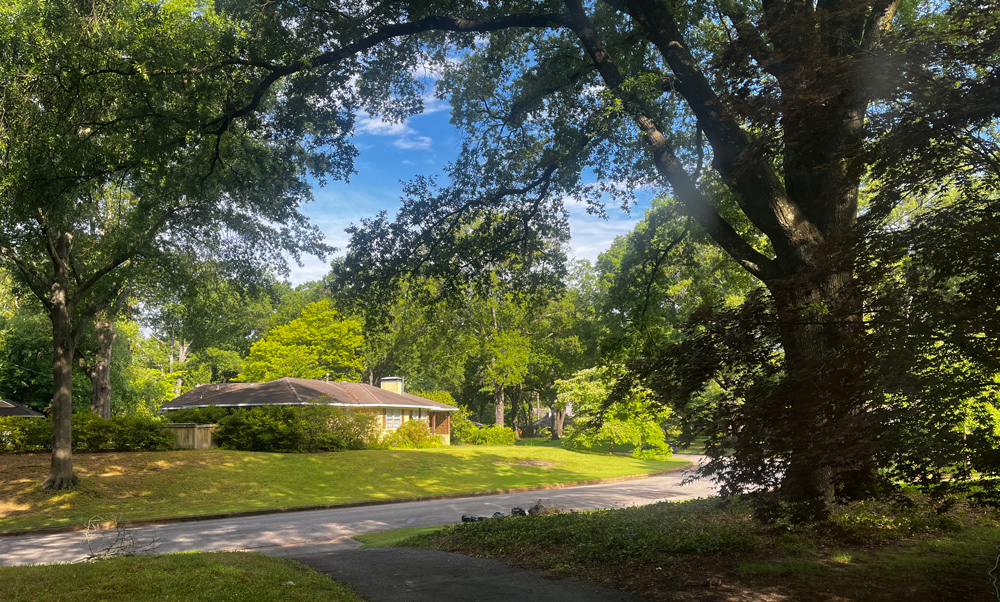
The picture above was taken from my dining room window. Not much is happening. It’s quiet and peaceful. In my den, looking through the sixty-five inch window of my television screen, I see so much turmoil and suffering. The fall of civilization is what’s happening.
One of my favorite novels is called The Door into Summer because the cat in the story hates New England winters and asks to see what’s out every door hoping to find one that leads to summer. I can open my front door and walk out into summer. It’s 77 degrees outside right now – not bad at all for July in a year that might become the hottest year on record. So, why do I spend my days watching television when all it does is to depress me?
The need to know what’s happening is a burden. The belief that I can control anything through knowing more is an illusion and deception. However, there are wars going on all around me and I don’t know if I can sit them out. My friend Anne lives in a nice neighborhood too, but last week there was a shooting at the house one over from hers. Yesterday was the 4th of July, and we heard plenty of fireworks. But we also heard plenty of guys shooting off their guns.
Crime and climate change are getting nearer all the time. What if I looked out my window and saw this:
Thousands of people are seeing this everyday around the world because of hurricanes, tornadoes, floods, and fires. In a decade it could be millions seeing such sites every day. Can we learn anything to avoid that future?
There is a cultural war happening all over the world and the battles are being fought in polling booths. Popularism wants to rewind the clock on progressive progress. To understand this, watch this talk by David Brooks. It’s one of the most uplifting things I’ve seen on my television screen in a very long time.
If you listen to Brooks, you’ll understand what the conservatives want to do with their Project 2025 plan and why. They believe it is their door into summer. If they succeed, I believe 1/20/2025 will be remembered like 4/12/1861 or 6/28/1914. It would be so much easier for my mental health to quit watching TV, but is that really an option? I can understand why Christians are fighting so hard for their way of life. I would have no problem surviving in their utopia if they got everything they wanted. But millions of people wouldn’t, and it will lead to civil war and self-destruction.
The world is going nuts while the environment is going down the drain. On one hand, I can’t stop watching this slow-motion apocalypse. One the other hand, I just want to look out my window or read a science fiction novel.
Years ago, I read This Changes Everything by Naomi Klein. It was a passionate plea to act on climate change because if we didn’t everything would change. Her new book, Doppelganger, is a metaphor about our polarized society and what keeps us from changing even though Klein still makes a case that we need to change.
Between reading these two books I gave up all hope that humanity would change. I read Doppelganger as further proof that we won’t change even though Klein again passionately expresses the rational reasons why we should. I also believe we all need to change, but sadly, I don’t believe we will.
Doppelganger begins with Naomi Klein explaining how people on the internet often confused her with Naomi Wolf, a once respected feminist who is now considered a conspiracy crank. Klein uses the idea of the doppelganger as a metaphor for how to relate to our opposites, whether male/female, black/white, liberal/conservative, religious/atheist, Christian/Jew, Israeli/Palestinian, etc.
Klein goes to great lengths to make the metaphor work in several situations, but I found that distracting. What the book does exceptionally well is to ask: How do we decide what to do when half of us disagree with the other half? We all assume there is one truth, but everyone sees a different side of it.
In many chapters Klein makes Wolf seem ridiculous, but there are quite a few places where Klein recognizes Wolf’s point of view, or even gives her credit for being right.
I believe that extremists on the left act like naive young children, while extremists on the right act like selfish young children. In other words, I believe Klein is unrealistically hopeful, while Wolf is self-centeredly overly positive.
I must assume Klein writes her books believing we can still change. With Doppelganger she’s hoping that if we can get together and endeavor to understand each other we can make rational compromises. That would be lovely if she were successful and right. I believe Klein is right but won’t be successful.
We are doing essentially nothing towards controlling climate change. Wars, collapsing economies, and weather catastrophes are on the increase. Our responses are becoming more irrational, rather than wiser. We must face the fact that evolution works on all levels, and Darwinian conflict will always prevail.
The strong are going to take what they want at the expense of the weak. To solve all the problems Klein covers in her books would require overcoming our Darwinian natures and everyone acting for everyone else’s good. I no longer believe we’re capable of such altruism.
In the early days of Christianity, its philosophy was anti-Darwinian. But modern Christians have lost all their compassion. Christianity has been dissolving for centuries. The compassionate Christians gave up on God and became liberals, and the ones left became conservatives who rewrote Christian ideals with serving rationality that backs evolution.
In other words, I believe early Christianity, and 20th-century secular humanism were two times in history where we tried to fight our Darwinian natures, and in both instances, the movements failed.
We’re not going to change.
Not to end on a completely depressing note, I’ll try to offer a somewhat positive idea. Since we won’t change, the environment will. How can we use our Darwinian nature to build hardened societies that can survive climate catastrophes? Don’t read too much hope into that. What I’m saying is how can the strong survive the coming changes we chose not to avoid?




 Auxiliary Memory