Age vs. Ability

by James Wallace Harris

We’re told that scientific studies show that we peak mentally and physically early in life but is that true for all our abilities. Where does wisdom come in? If I found a magic lamp and a genie offered me three wishes I might wish for the physical agility of Simone Biles, or the stamina of Beth Potter, or I might ask for the language ability of Amor Towles, or the political and economic savvy of Robert Reich, or even wish for the historical wisdom of Yuval Noah Harari, or the scientific brilliance of Sabine Hossenfelder. Unfortunately, there are no magic lamps with wish granting genies. I must live with who I am.

If I peaked mentally and physically in my late teens or twenties, whatever my best abilities were, they weren’t memorable. What’s weird is I don’t want to be young again, not if I must give up everything I learned. And I suppose whatever I’m afraid of losing might be called wisdom. Is wisdom the defining ability of being old? I don’t think so. I don’t think I’m particularly wise, nor do I know any older folks who seem all that wise. Wisdom might be undefinable, undetectable, and only perceived by the individual, and even that perception is relative.

If we consider the current U.S. presidential election, and the five people taking part in the televised debates are 40, 59, 60, 78, and 81 years old. Disregarding their political philosophy, it was obvious they had a range of cognitive abilities. The younger ones spoke more precisely, responded better to questions, were quicker to compose thought out responses, and overall expressed themselves better.

But what about wisdom. The two oldest candidates did promote what they believed from a lifetime of experience, but would we call wisdom? All the candidates show abilities needed to be politicians, which involve long scheduled days with tremendous amount of social interaction. That is impressive. I’m 72, and I couldn’t do what either the 78- or 81-year-olds do. Just a few days of political campaigning would kill me. However, I’ve got to assume, that the younger candidates have an easier time with those long days on the campaign trail.

But back to me and you. I was reading an article in the New York Times the other day about how memory loss isn’t the only sign of onset dementia. It said having trouble doing your finances, sleeping poorly, going through personality changes, having trouble driving, and losing the ability to smell are other signs that your brain isn’t firing on all cylinders.

This made me to ask myself: Is there anything I can do better now than when I was younger? Well, maybe writing essays. Okay, I’m having trouble thinking of other things. I feel I’m a better reader. And since I started playing the games on the New York Times games app every day I’ve gotten better at Wordle, Connections, Mini Crossword and Sudoku. I should admit I might have reached a plateau with all of those games.

My guess is over weeks and months I figured out how to apply all my existing abilities with those games and reached a certain level of proficiency. That felt like I was improving, which is a good feeling when you’re 72. However, I noticed that although I can finish every Sudoku game in a matter of minutes on the easy level, I have never been able to finish any game at the medium level.

When I discovered that, I’ve switched from playing the easy mode every day to the medium mode. I eventually sensed that my innate abilities let me discover several methods of solving the easy level Sudoku puzzles, but I never had the abilities that involve the more complex methods of solving the medium level puzzles. The challenge I gave myself was to studying Sudoku tutorials and learn those methods. I’ve tried for the past week, but so far, I’ve failed. I sense there are methods I could apply, and I almost grasp a couple of them when studying the tutorials, but when I try to apply in a daily game, I forget what they were.

So far, I don’t think I’m having problems with the five non-memory issues the New York Times identified that were early signs of dementia. But would I recognize a decline in those areas if I did?

I avoid driving at night or on freeways. I can do it, but it causes anxiety. One thing I do now that I’m older is avoid anxiety. So, should I check that box? I do fine with my finances, but I just do what’s required, I don’t try to improve my situation. I have weird sleeping habits because of problems with frequent peeing, but I feel like I’ve adapted and don’t feel sleep deprived. I think I still smell things simply fine. I can smell the cat shit several rooms away when a cat poops in their box. Does that give me a passing score? And I think I’ve gone through some personality changes, but I assume they were due to adapting to being retired.

I feel I’m pushing myself harder and I’m more disciplined than when I was younger. However, I know I can’t do what I used to do and have little stamina.

Overall, I’d say I have far less abilities than when I was younger, but I feel better adapted to being old than I did at being young. I still feel like I’m honing the abilities I care about, even though I’ve giving up on everything else.

Is getting old just streamlining our abilities to do more with less?

JWH

When Tsundoku Meets Döstädning

by James Wallace Harris, 7/9/24

Tsundoku is a Japanese term for buying books and magazines far faster than you can read them. Döstädning is a concept from Sweden that translates into death cleaning, advice for how to get rid of your stuff before making other people do it after you die.

At 72, I figure it’s my time to turn the tide of tsundoku into a wave of döstädning. Last year I took many shopping bags of books to give to the Friends of the Library so I could shelve every book in my house. I had finally reached the equilibrium of perfectly filled bookshelves with no books lying on desks, tables, nightstands, or floors. It felt so good.

Today I gathered all the books lying on desks, tables, nightstands, and floors and had to stack them on top of my bookshelves again. I’m losing the battle with tsundoku again.

I don’t get out much anymore. I take my turn going to the grocery store every other week, and I go to the Friends of the Library Bookstore once a week. I buy books I think I want to read before I die, but I’ve already own enough books to last me until the middle of the twenty-second century.

Instead of coming home with two or three books every week from the Friends of the Library Bookstore I need to take two or three books to donate. That would still give me an outing every week. I guess I could continue to buy books so long as I always donated more books than I purchase.

If I knew some Japanese and Swedish people, I’d ask them to produce a phrase that means “döstädning my tsundoku.”

I need to develop a system for death cleansing my bookshelves. One idea came to me while reading A Gentleman in Moscow by Amor Towles. The story is about a Russian aristocrat, Count Alexander Rostov, who is sentenced to life imprisonment in the Metropol hotel after the Russian revolution. But instead of remaining in his luxury suite, Count Rostov is forced to live in a tiny garret once used by the servants of the aristocracy. He keeps one book with him to read, Michel de Montaigne’s Essays. What a wonderful book to read in that situation.

That reminded me I needed to finish my copy of Montaigne’s complete essays.

And it gave me another idea too. I need to read books that are most suited for an aging guy waiting for the guy with the scythe to show up. Books that make me feel philosophical positive about my life and help me understand the decline of civilization. I feel A Gentleman in Moscow is most suited. I would call it a fairytale for old folks, something Charles Dicken, Robert Louis Stevenson, and Tolstoy might have collaborated on if they were living in our century. It is a delightful yarn about a man growing old imprisoned in a hotel while the twentieth century changed outside his window.

I need to start thinning my book collection of books aimed at young people, unless they are books I read when I was young and want to remember them from an aged vantage point.

I need to read books that make me feel good about getting older. I need to jettison books that don’t deserve to be among the last books I read. Even if I live another couple of decades, I doubt I can squeeze in more than a thousand books, and that leaves me a couple thousand to abandon. If I live only another five years, I might finish 250 reading at my peak pace when I was younger, but more than likely, less than two hundred, since I’m now reading less every year.

Some days I don’t feel like I’ll make it to eighty, and on other days feel, gee, I might make it to ninety. I need to save those books suitable for someone in their 70s or 80s, and thin out the others.

It would be fun to see my library shrink over time, each year further distilled into a smaller collection of greater books, so in my last year I read only classics that fully reveal their depths to readers about to depart this planet.

Now, I think I have a system I can work with. It sounds logical and doable. I’ll have to report back in the future if it works. When I get in there pulling out books one by one, and asking myself if they are worthy of reading in my elder years, I might think every volume I already own is perfectly suited.

JWH

Why I Deleted Facebook and Twenty Other Apps from My iPhone

by James Wallace Harris, 4/21/24

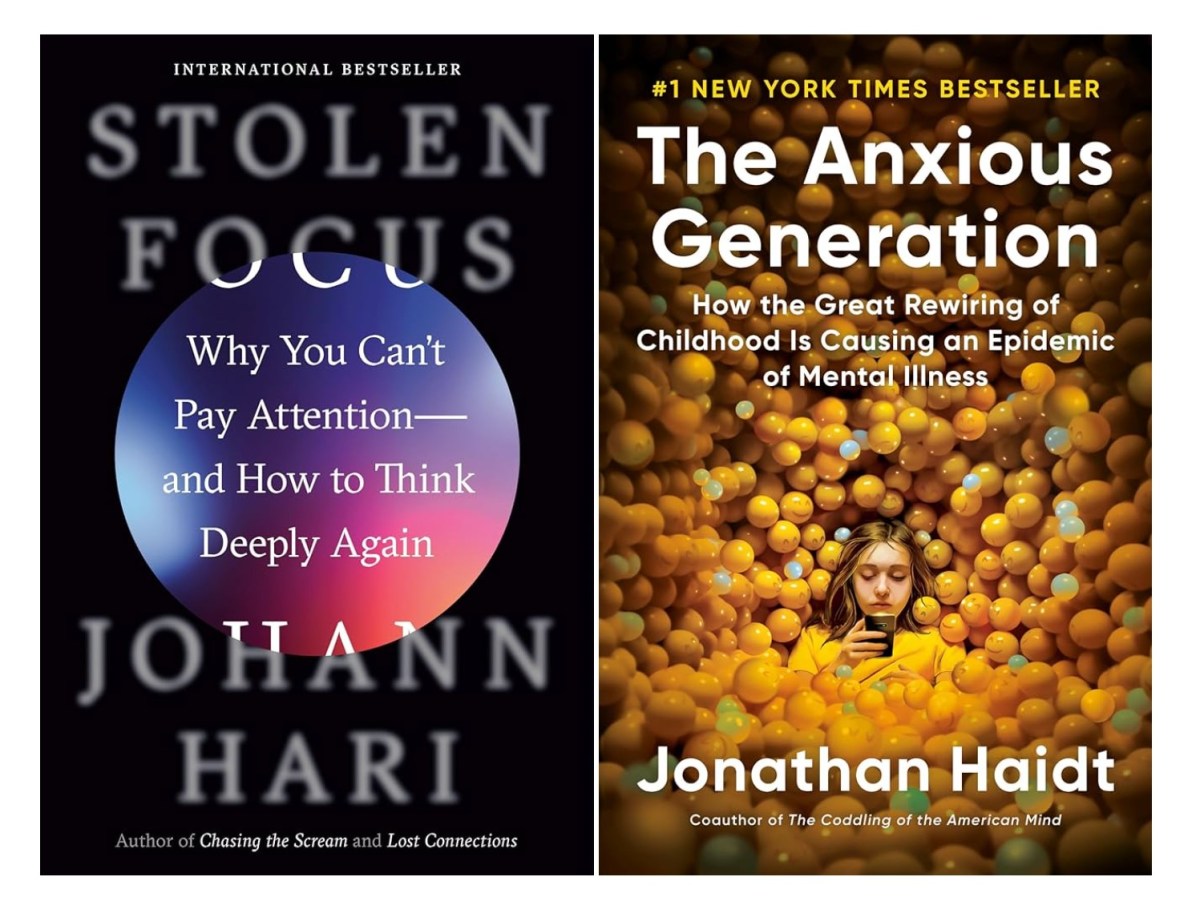
Lately, I’ve been encountering numerous warnings on the dangers of the internet and smartphones. Jonathan Haidt is promoting his new book The Anxious Generation. Even though it’s about how there’s increase mental illness in young girls using smartphones, I think it might tangentially apply to an old guy like me too.

Haidt was inspired to write his book because of reports about the sharp rise in mental illness in young people since 2010. That was just after the invention of the iPhone and the beginnings of social media apps. Recent studies show a correlation between the use of social media on smartphones and the increase reports of mental illness in young girls. I’m not part of Haidt’s anxious generation, but I do wonder if the internet, social media, and smartphones are affecting us old folks too.

Johann Hari’s book, Stolen Focus, is about losing our ability to pay attention, which does affect me. I know I have a focusing problem. I can’t apply myself like I used to. For years, I’ve been thinking it was because I was getting old. Now I wonder if it’s not the internet and smartphones. Give me an iPhone and a La-Z-Boy and I’m a happy geezer but not a productive one.

So, I’ve decided to test myself. I deleted Facebook and about twenty other apps from my iPhone. All the ones that keep me playing on my phone rather than doing something else. I didn’t quit Facebook, or other social media accounts, just deleted the apps off my phone. I figure if I need to use them, I’ll have to get my fat ass out of my La-Z-Boy and go sit upright at my desktop computer.

This little experiment has had an immediate impact — withdrawal symptoms. Without Facebook, YouTube, and all the other apps I kept playing with all day long, I sit in my La-Z-Boy thinking, “What can I do?” I rationalized that reading the news is good, but then I realized that I had way too many news apps. With some trepidation, I deleted The Washington Post, Ground News, Feedly, Reddit, Instapaper, and other apps, except for The New York Times and Apple News+.

I had already deleted Flipboard because it was one huge clickbait trap, but couldn’t that also be true of other news apps? They all demand our attention. When does keeping current turn into a news addiction? What is the minimum daily requirement of news to stay healthy and informed? What amount constitutes news obesity?

I keep picking up my iPhone wanting to do something with it, but there’s less and less to do. I kept The New York Times games app. I play Mini Crossword, Wordle, Connections, and Sudoku every morning. For now, I’m rationalizing that playing those games is exercise for my brain. They only take about 20-30 minutes total. And I can’t think of any non-computer alternatives.

I still use my iPhone for texting, phoning, music streaming, audiobooks, checking the weather, looking up facts, reading Kindle books, etc. The iPhone has become the greatest Swiss Army knife of useful tools ever invented. I don’t think I could ever give it up. Whenever the power goes out, Susan and I go through withdrawal anxiety. Sure, we miss electricity, heating, and cooling, but what we miss the most is streaming TV and the internet. We’ve experienced several three-day outages, and it bugs us more than I think it should.

One of the insights Jonathan Haidt provides is his story about asking groups of parents two questions?

  1. At what age were you allowed to go off alone unsupervised as a child?
  2. At what age did you let your children go off unsupervised?

The parents would generally say 5-7 for themselves, for 10-12 for their children. Kids today are overprotected, and smartphones let them retreat from the world even further. Which makes me ask: Am I retreating from the world when I use my smartphone or computer? Has the iPhone become like a helicopter parent that keeps me tied to its apron strings?

That’s a hard question to answer. Isn’t retiring a kind of retreat from the world? Doesn’t getting old make us pull back too? My sister offered a funny observation about life years ago, “We start off life in a bed in a room by ourselves with someone taking care of us, and we end up in bed in a room by ourselves with someone taking care of us.” Isn’t screen addiction only hurrying us towards that end? And will we die with our smartphones clutched tightly in our gnarled old fingers?

Is reading a hardback book any less real than reading the same book on my iPhone screen, or listening to it with earbuds and an iPhone? With the earbuds I can walk, work in the yard, or wash dishes while reading. Is reading The Atlantic from a printed magazine a superior experience than reading it on my iPhone with Apple News+?

Is looking at funny videos less of a life experience than playing with my cat or walking in the botanic gardens?

Haidt ends up advising parents to only allow children under sixteen to own a flip phone. He would prefer kids wait even longer to get a smartphone till they complete normal adolescent development, but he doesn’t think that will happen. I don’t think kids will ever go back to flip phones. The other day I noticed that one of the apps I had was recommended for age 4+ the App Store.

Are retired folks missing any kind of elder years of psychological development because we use smartphones? As a bookworm with a lifelong addiction to television and recorded music, how can I even know what a normal life would be like? I’m obviously not a hunter and gatherer human, or an agrarian human, or even a human adapted to industrialization. Is white collar work the new natural? Didn’t we live in nature too long ago for it to be natural anymore?

Aren’t we quickly adapting to a new hivemind way of living? Are the warnings pundits give about smartphones just identifying the side effects of evolving into a new human social structure? Is cyberization the new phase of humanity?

There were people who protested industrialization, but we didn’t reject it. Should we have? Now that there are people rejecting the hivemind, should we reject it too? Or jump in faster?

For days now I’ve been restless without my apps. I have been more active. I seeded my front lawn with mini clover and have been watering and watching it come in. I contracted to have our old bathtub replaced with a shower so it will be safer for Susan. I’ve been working with a bookseller to sell my old science fiction magazines. And I’ve been trying to walk more. However, I’ve yet to do the things I hoped to do when I decided to give up my apps.

It’s hard to tell the cause of doing less later in life. Is it aging? Is it endless distractions? Is it losing the discipline of work after retiring? Before giving up all my apps, I would recline in my La-Z-Boy and play on my iPhone regretting I wasn’t doing anything constructive. Now I sit in my La-Z-Boy doing nothing and wonder why I’m not doing anything constructive. I guess it’s taken a long time to get this lazy, so it might take just as long to overcome that laziness.

JWH

I Gleaned Two Useful Bits of Wisdom from YouTube This Morning

by James Wallace Harris, 3/18/24

The first insight applies to internet addiction. I constantly check several apps on my iPhone all day, and regularly browse YouTube on my television. It’s gotten to be a terrible habit, even though it’s so satisfying.

The first video made an analogy to rats and internet use. If you provide a button to a caged rat that when pressed provides a food pellet, the rat will eat its fill and then stop pressing the button. But if you set the button to randomly provide a food pellet the rat will constantly push the button. The analogy is we constantly check the internet hoping to get a reward, but because we don’t always find something rewarding, we keep checking. I believe that describes my internet habit.

I’m going to take his advice and set a limited time to enjoy browsing. But for the other times I’ll only use the internet when I know I want something specific.

The second piece of advice is about To-Do lists. The guy on the video said if your To-List is too long, you’ll avoid using it. And that’s true for me. I use the same To-Do list app he uses, Todoist. So, I went and rescheduled most of my tasks for the future, and just left five on the main page. I might even reduce it to three. Or even one. I want to try extremely hard and get more things done, even if it’s only one thing a day.

It’s ironic that I found these two insights that are perfect for me by browsing. I think it’s important to do some internet browsing, but I was like a rat in a cage always pushing the button hoping that I’d get a reward. There’s just not that many truly significant rewards to be had on the internet every day.

I hope I can apply these two insights and stick to using them. I might even add them to my habit tracker. Since I started using it, I’ve been doing seven core habits for 151 days straight.

JWH

I’m Too Dumb to Use Artificial Intelligence

by James Wallace Harris, 1/19/24

I haven’t done any programming since I retired. Before I retired, I assumed I’d do programming for fun, but I never found a reason to write a program over the last ten years. Then, this week, I saw a YouTube video about PrivateGPT that would allow me to train an AI to read my own documents (.pdf, docx, txt, epub). At the time I was researching Philip K. Dick, and I was overwhelmed by the amount of content I was finding about the writer. So, this light bulb went off in my head. Why not use AI to help me read and research Philip K. Dick. I really wanted to feed the six volumes of collected letters of PKD to the AI so I could query it.

PrivateGPT is free. All I had to do was install it. I’ve spent days trying to install the dang program. The common wisdom is Python is the easiest programming language to learn right now. That might be true. But installing a Python program with all its libraries and dependencies is a nightmare. What I quickly learned is distributing and installing a Python program is an endless dumpster fire. I have Anaconda, Python 3.11, Visual Studio Code, Git, Docker, Pip, installed on three computers, Windows, Mac, and Linux, and I’ve yet to get anything to work consistently. I haven’t even gotten to part where I’d need the Poetry tool. I can run Python code under plain Python and Anaconda and set up virtual environments on each. But I can’t get VS Code to recognize those virtual environments no matter what I do.

Now I don’t need VS Code at all, but it’s so nice and universal that I felt I must get it going. VS Code is so cool looking, and it feels like it could control a jumbo jet. I’ve spent hours trying to get it working with the custom environments Conda created. There’s just some conceptual configuration I’m missing. I’ve tried it on Windows, Mac, and Linux just in case it’s a messed-up configuration on a particular machine. But they all fail in the same way.

I decided I needed to give up on using VS Code with Conda commands. If I continue, I’ll just use the Anaconda prompt terminal on Windows, or the terminal on Mac or Linux.

However, after days of banging my head against a wall so I could use AI might have taught me something. Whenever I think of creating a program, I think of something that will help me organize my thoughts and research what I read. I might end up spending a year just to get PrivateGPT trained on reading and understanding articles and dissertations on Philip K. Dick. Maybe it would be easier if I just read and processed the documents myself. I thought an AI would save me time, but it requires learning a whole new specialization. And if I did that, I might just end up becoming a programmer again, rather than an essayist.

This got me thinking about a minimalistic programming paradigm. This was partly inspired by seeing the video “The Unreasonable Effectiveness of Plain Text.”

Basically, this video advocates doing everything in plain text, and using the Markdown format. That’s the default format of Obsidian, a note taking program.

It might save me lot of time if I just read the six volumes of PKD’s letters and take notes over trying to teach a computer how to read those volumes and understand my queries. I’m not even sure I could train PrivateGPT to become a literary researcher.

Visual Studio Code is loved because it does so much for the programmer. It’s full of artificial intelligence. And more AI is being added every day. Plus, it’s supposed to work with other brilliant programming tools. But using those tools and getting them to cooperate with each other is befuddling my brain.

This frustrating week has shown me I’m not smart enough to use smart tools. This reminds me of a classic science fiction short story by Poul Anderson, “The Man Who Came Early.” It’s about a 20th century man who thrown back in time to the Vikings, around the year 1000 AD. He thinks he will be useful to the people of that time because he can invent all kinds of marvels. What he learns is he doesn’t even know how to make the tools, in which to make the tools, that made the tools he was used to in the 20th century.

I can use a basic text editor and compiler, but my aging brain just can’t handle more advance modern programming tools, especially if they’re full of AI.

I need to solve my data processing needs with basic tools. But I also realized something else. My real goal was to process information about Philip K. Dick and write a summarizing essay. Even if I took a year and wrote an AI essay writing program, it would only teach me a whole lot about programming, and not about Philip K. Dick or writing essays.

What I really want is for me to be more intelligent, not my computer.

JWH