
Reading With a Purpose

by James Wallace Harris, 11/12/25

I used to keep up with the world by watching NBC Nightly News with Lester Holt, reading The New York Times on my iPhone, and bingeing YouTube videos. I felt well-informed. That was an illusion.

I then switched to reading The Atlantic, New York Magazine, The New Yorker, and Harper’s Magazine. I focused on the longer articles and developed the habit of reading one significant essay a day. That has taught me how superficial my previous methods were at informing me about what’s going on around the world. Television, the internet, and newspapers were giving me soundbites, while articles provide an education.

However, I still tend to forget this deeper knowledge just as quickly. I don’t like that. I feel like I learn something significant every day. What I’m learning feels heavy and philosophical. However, it drives me nuts that I forget everything so quickly. And I’m not talking about dementia. I think we all forget quickly. Just remember how hard it was to prepare for tests back in school.

I’ve watched dozens of YouTube videos about study methods, and they all show that if you don’t put information to use, it goes away. Use it or lose it. I’ve decided to start reading with a purpose.

At first, I thought I would just save the best articles and refer to them when I wanted to remember. That didn’t work. I quickly forget where I read something. Besides, that approach doesn’t apply any reinforcing methods.

I then thought about writing a blog post for each article. It turns out it takes about a day to do that. And I still forget. I needed something simpler.

I then found Recall AI.

It reads and analyzes whatever webpage you’re on. Providing something like this for today’s article by Vann R. Newkirk II, “What Climate Change Will Do to America by Mid-Century:”
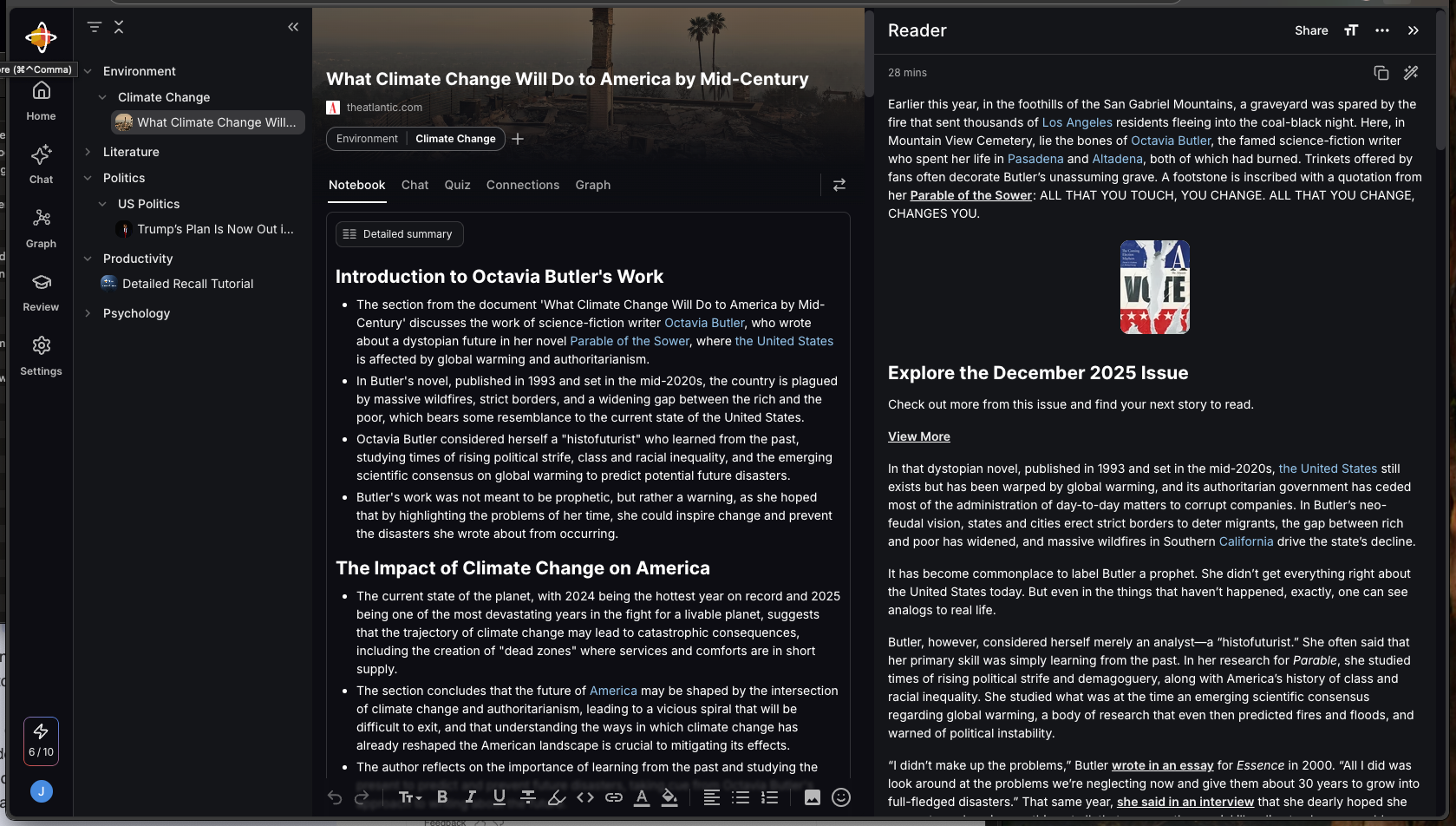
Recall allows me to save this into a structure. But again, this is a lot of work and takes a lot of time. If I were writing an essay or book, this would be a great tool for gathering research.

Recall is also great for understanding what I read. Helpful with quick rereading.

This morning, I got a new idea to try. What if I’m trying to remember too much? What if I narrowed down what I wanted to remember to something specific?

Within today’s article, the author used the term “climate gentrification” referring to neighborhoods being bought up because they were safer from climate change, and thus displacing poor people. The article mentions Liberty City, a poor neighborhood in Miami, with a slightly higher elevation, bought up by developers moving away from low-lying beachfront development.

I think I can remember that concept, climate gentrification. What if I only worked on remembering specific concepts? This got me thinking. I could collect concepts. As my collection grew, I could develop a classification system. A taxonomy of problems that humanity faces. Maybe a Dewey Decimal system of things to know.

I use a note-taking system called Obsidian. It uses hyperlinks to connect your notes, creating relationships between ideas. I could create a vault for collecting concepts. Each time I come across a new concept, I’d enter it into Obsidian, along with a citation where I found it. That might not be too much work.

I picked several phrases I want to remember and study:

  • Climate gentrification
  • Heat islands
  • Climate dead zones
  • Insurance market collapse
  • Climate change acceleration
  • Economic no-go zones
  • Corporate takeover of public services
  • Climate change inequality
  • Histofuturism
  • Sacrifice zones
  • Corporate feudalism

Contemplating this list made me realize that remembering where I read about each concept will take too much work. I have a browser extension, Readwell Reader, that lets me save the content of a web page. I could save every article I want to remember into a folder and then use a program to search for the concept words I remember to find them.

I just did a web search on “climate gentrification” and found it’s already in wide use. I then searched for “corporate feudalism,” and found quite a bit on it too. This suggests I’m onto something. That instead of trying to remember specifically what I read and where, I focus on specific emerging concepts.

Searching on “histofuturism” brought up another article at The Atlantic that references Octavia Butler: “How Octavia Butler Told the Future.” Today’s article by  Vann R. Newkirk II is also built around Octavia Butler. This complicates my plan. It makes me want to research the evolution of the concept, which could be very time-consuming.

The point of focusing on key concepts from my reading is to give my reading purpose that will help me remember. But there might be more to it. Concepts are being identified all the time. And they spread. They really don’t become useful until they enter the vernacular. Until a majority of people use a phrase like “climate gentrification,” the reality it points to isn’t visible.

That realization reinforces my hunch to focus on concepts rather than details in my reading. Maybe reading isn’t about specific facts, but about spreading concepts?

JWH
Has Retirement Made Me Lazy, Or is the Laziness a Byproduct of Aging?

James Wallace Harris, 6/22/25

Before I retired in 2013, I assumed I’d have all the time in the world to do everything I ever wanted once my 9-to-5 burden was lifted. However, I have done less and less each year. I’m still disciplined about doing my chores and meeting my responsibilities, but the discipline needed to pursue my hobbies and pastimes is dwindling away.

I’m not depressed, I eat right and exercise regularly, and I have a positive outlook. I just don’t spend my free time on hobbies like I once did. Instead, I churn through the YouTube videos or play on my iPhone during idle moments. I hear that’s also a problem for kids, so maybe it’s not aging, but it feels age-related.

Why do I think that? Well, for one, it seems like people slow down when they get older. Here’s what happens. I’ll be working on an objective I consider fun. For example, I got a new Ugreen NAS and was setting it up to use Jellyfin as a media server. The task is tedious because it’s new and has a steep learning curve. I work at it for a bit, feel tired, and decide to put it away for the day. When I was younger, I could work on a tedious problem for hours. Now I can’t.

Do I quit quickly because my older mind can’t handle the task? Or has all that web surfing, channel hopping, and doom scrolling weakened my discipline? I became addicted to audiobooks in 2002 and have read less since, is another example.

This is a kind of chicken-and-egg problem. Has technology weakened my mind? Or was my mind slowing down, and technology is a useful adaptation? I have read more books since the advent of Audible.com.

Here’s another bit of evidence. When I worked full-time, I did far more after work than I do with unlimited free time in retirement. I didn’t have an iPhone back then. Why didn’t I put the same number of work hours into my hobbies after I retired? Did being free of work responsibilities ruin my discipline?

I shouldn’t agonize over this problem if doing less is part of aging. However, does retiring make us age faster? Is technology making us lazier? I have no answer.

I could test things by limiting my screen time. My emotional reaction to that idea is about what a thirteen-year-old feels when a parent tells them they need to cut back on their screen time.

I’m constantly thinking about aging. Philosophically, it’s an interesting concept. Comparing it to the old nature vs. nurture debate, I would consider aging a problem of decay vs. mind. We know we will all end up as worm food. The challenge is to be the most interesting and creative worm food before we’re eaten. The insidiousness of aging is accepting that it’s time to be eaten.

JWH

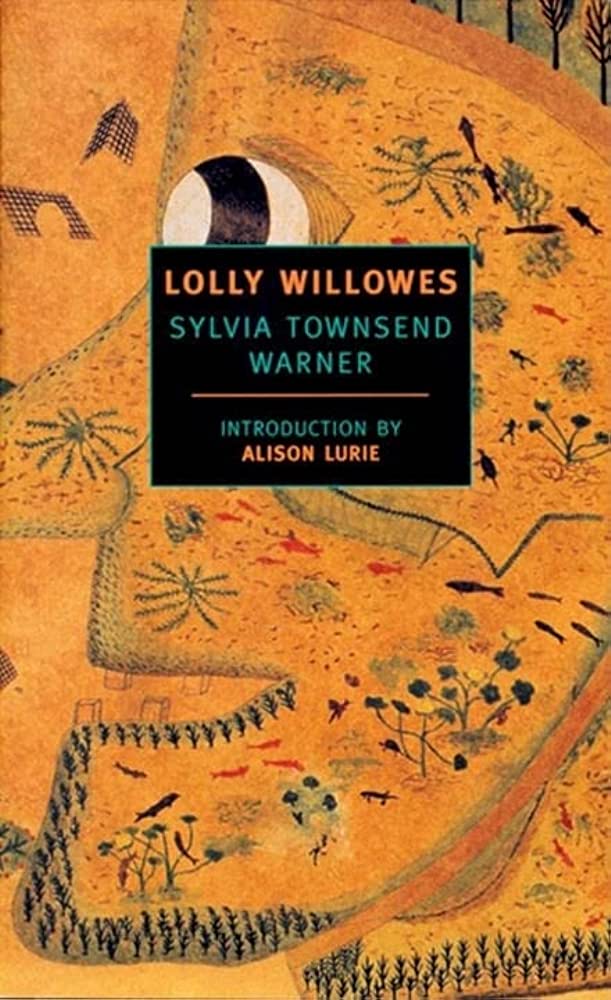
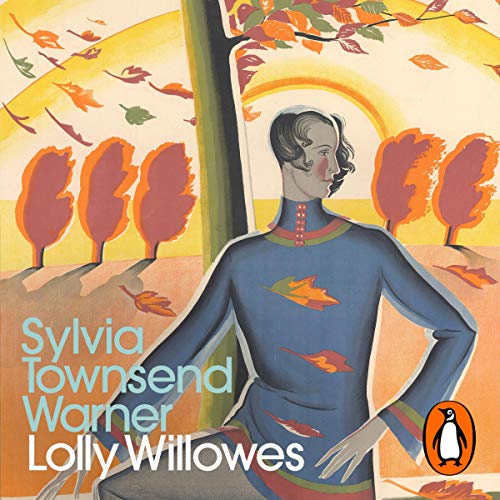
Lolly Willowes by Sylvia Townsend Warner

by James Wallace Harris, 8/20/24

Sometimes you find yourself deep within the rabbit’s hole before you realize you’ve fallen into one.

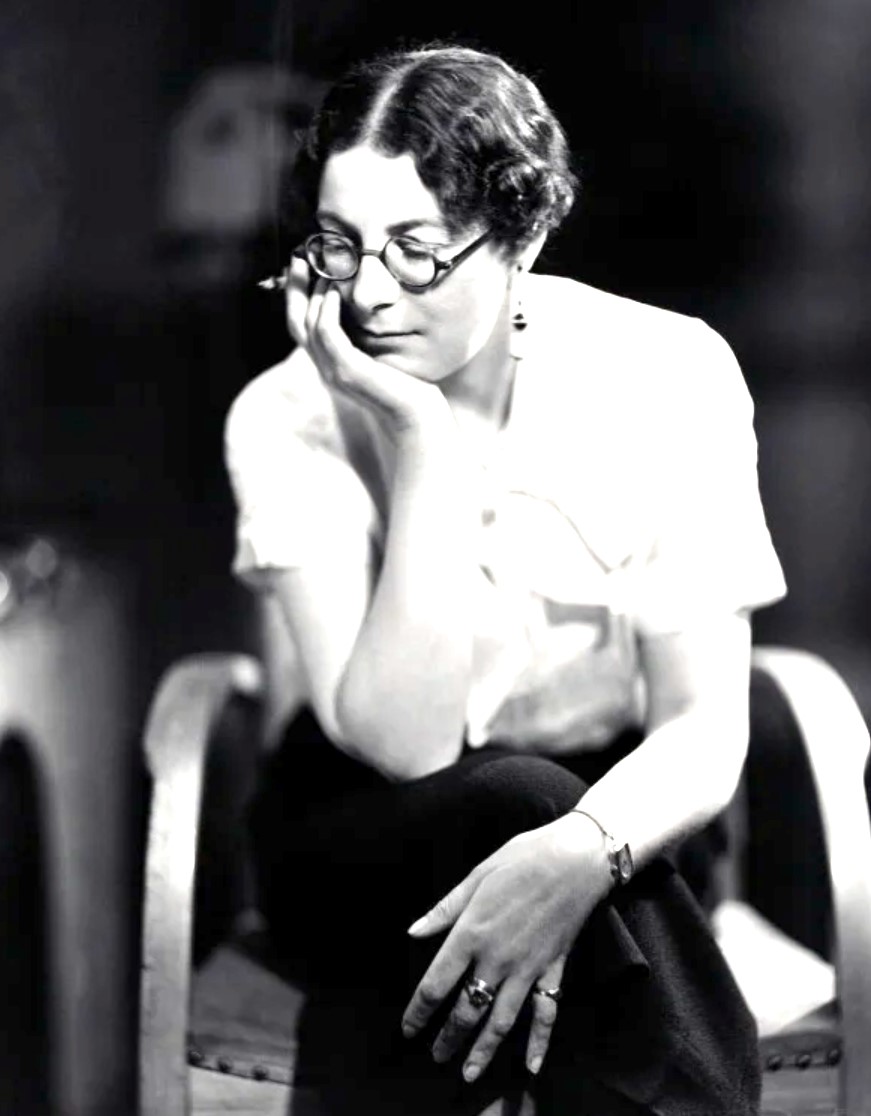
I wish I had read the biographical entry for Sylvia Townsend Warner in Wikipedia before I read Lolly Willowes. It was her first novel, published in 1926. Warner was born in 1893 in Middlesex, England. She was greatly influenced by her father, a successful scholar, who died in 1916. Lolly Willowes is about Laura Willowes’ life after her father died. The story begins when Laura, called Lolly by her family, is twenty-eight, a spinster, who is forced to live with her brother’s family and take care of his children.

Warner was just five years older than Laura when she wrote Laura’s story, and unmarried. In the second part of the novel, Laura is forty-seven and lives a vastly different life. After Warner wrote Lolly Willowes she became involved with a life-long lesbian relationship. Warner authored many novels, many short story and poetry collections, worked in a munitions factory during WWI, became a communist, traveled to Spain twice during the civil war working with the Red Cross, and had a long productive life in several fields, including writing a biography of T. H. White. She died in 1978 at age 84.

In 1926 Sylvia Townsend Warner imagined it would take Laura twenty years before she could free herself from the roles society defined for her. Warner didn’t wait that long. I finished Lolly Willowes yesterday, and today I read the biographical piece in Wikipedia. It inspired me to order a biography on Warner by Claire Harman.

I bought Lolly Willowes by Sylvia Townsend Warner because the Kindle edition by NYRB (New York Review Books) was on sale for $1.99. NYRB is famous for reprinting forgotten classics. I often buy them when they go on sale, but what really sold me on Lolly Willowes is the blurb claimed it was the very first Book-of-the-Month Club selection. A quick peek at Wikipedia told me the novel was an early feminist classic, an international bestseller when it came out, and it was about witches and Satan. The book’s subtitle, “The Loving Huntsman” refers to the devil.

The NYRB edition is no longer available on Amazon, but since the novel is in the public domain, there are many editions available, including one for forty-nine cents. NYRB’s site still lists four novels by Warner, including Lolly Willowes, which does have a nice introduction by Alison Lurie.

Now, after all that build up, I’m not sure I can recommend this novel. Sometimes, forgotten classics are forgotten for a reason. The first half of this book tells us about Lolly’s upbringing and background. And it’s told rather than shown, meaning it’s a long narrative description. It’s not until Laura’s nieces and nephews grow up and have children of their own, becoming Aunt Lolly to a new generation, that she finally rebels. Laura moves to Great Mop, a small hamlet, to live alone. It’s here where she discovers she wants to become a witch and befriends the Devil.

At the beginning of the story we feel sorry for Lolly because she’s unmarried at twenty-eight. For most of the story we feel sorry for Lolly because for the next two decades she’s trapped as a live in aunt, in a role she doesn’t want. Then at forty-seven she defies everyone to go live on her own. It’s interesting that Warner has Laura gaining her freedom around the time of menopause. I am reminded of the sociological study, Sex and the Seasoned Woman by Gail Sheehy. Sheehy profiled women who felt that after menopause they no longer had to put husband or children first, and were finally free to pursue their own life. This fits with the novel.

Lolly Willowes came out in 1926, three years before Virginia Woolf’s A Room of One’s Own. Late in Lolly Willowes Lolly tells the Devil, “It’s to escape all that–to have a life of one’s own, not an existence doled out to you by others….” Doesn’t that remind you of Woolf’s classic title?

It’s this impassioned speech that Lolly makes to the Devil that finally launches the novel into orbit. It’s a shame that it comes so late in the story. I even wonder if readers would benefit from reading it before starting Lolly Willowes. It might make all the rambling story that comes before it more powerful.

Here is that speech. Don’t read it if you think it will spoil the story. She is addressing the Devil.

“Is it true that you can poke the fire with a stick of dynamite in perfect safety? I used to take my nieces to scientific lectures, and I believe I heard it then. Anyhow, even if it isn’t true of dynamite, it’s true of women. But they know they are dynamite, and long for the concussion that may justify them. Some may get religion, then they’re all right, I expect. But for the others, for so many, what can there be but witchcraft? That strikes them real. Even if other people still find them quite safe and usual, and go on poking with them, they know in their hearts how dangerous, how incalculable, how extraordinary they are. Even if they never do anything with their witchcraft, they know it’s there—ready! Respectable countrywomen keep their grave-clothes in a corner of the chest of drawers, hidden away, and when they want a little comfort they go and look at them, and think that once more, at any rate, they will be worth dressing with care. But the witch keeps her cloak of darkness, her dress embroidered with signs and planets; that’s better worth looking at. And think, Satan, what a compliment you pay her, pursuing her soul, lying in wait for it, following it through all its windings, crafty and patient and secret like a gentleman out killing tigers. Her soul—when no one else would give a look at her body even! And they are all so accustomed, so sure of her! They say: ‘Dear Lolly! What shall we give her for her birthday this year? Perhaps a hot-water bottle. Or what about a nice black lace scarf? Or a new workbox? Her old one is nearly worn out.’ But you say: ‘Come here, my bird! I will give you the dangerous black night to stretch your wings in, and poisonous berries to feed on, and a nest of bones and thorns, perched high up in danger where no one can climb to it.’ That’s why we become witches: to show our scorn of pretending life’s a safe business, to satisfy our passion for adventure. It’s not malice, or wickedness—well, perhaps it is wickedness, for most women love that—but certainly not malice, not wanting to plague cattle and make horrid children spout up pins and—what is it?—‘blight the genial bed.’ Of course, given the power, one may go in for that sort of thing, either in self-defense, or just out of playfulness. But it’s a poor twopenny housewifely kind of witchcraft, black magic is, and white magic is no better. One doesn’t become a witch to run round being harmful, or to run round being helpful either, a district visitor on a broomstick. It’s to escape all that—to have a life of one’s own, not an existence doled out to you by others, charitable refuse of their thoughts, so many ounces of stale bread of life a day, the workhouse dietary is scientifically calculated to support life. As for the witches who can only express themselves by pins and bed-blighting, they have been warped into that shape by the dismal lives they’ve led. Think of Miss Carloe! She’s a typical witch, people would say. Really she’s the typical genteel spinster who’s spent herself being useful to people who didn’t want her. If you’d got her younger she’d never be like that.”

Warner, Sylvia Townsend. Lolly Willowes (New York Review Books (Paperback) Book 5) (pp. 149-150). New York Review Books. Kindle Edition.

Even though I bought the Kindle edition, I listened to the audiobook edition because it was part of my Spotify subscription. Hearing this speech came across far more dramatically than I can read it in my head.

I find it fascinating that Sylvia Townsend Warner could be so accepting of Lolly selling her soul to the devil. I must assume it was her way of saying how awful being confined by the traditional woman’s role was to her. Yet, Warner also portrays the Devil as Lolly’s master. Has she not traded one form of servitude for another? The biographical piece in Wikipedia also said that Warner wrote essays against the church.

Lolly Willowes does have a great deal of details about middle class life in England in the late 19th and early 20th century. I’ve always enjoyed those kinds of details about English life. There were many passages that reminded me of D. H. Lawrence. Unfortunately, I didn’t feel the story was consistently told as a singular work of art. And the novel seldom featured dramatic dialog.

Lolly Willowes is not a modern novel even though it came out in 1926. I felt it was closer in style to George Elliot, but Lolly Willowes lacks the depth of Dorothea Brooke, but then Warner’s novel is only five hours on audio, and Middlemarch runs around thirty-five hours.

If you’re into English novels, especially those written by women, then give Lolly Willowes a try. However, if you want a solidly fun book about an English woman on her own, reading Miss Buncle’s Book by D. E. Stevenson, which came out in 1934. It’s interesting how different women can be just seven years later.

I must admit, that the more I read about Sylvia Townsend Warner, the more likely I am to reread Lolly Willowes in the future. Like many books, multiple readings brings out depths missed with just one reading. I may have missed a lot.

JWH

Will People Change vs. Can People Change?

by James Wallace Harris, 2/28/24

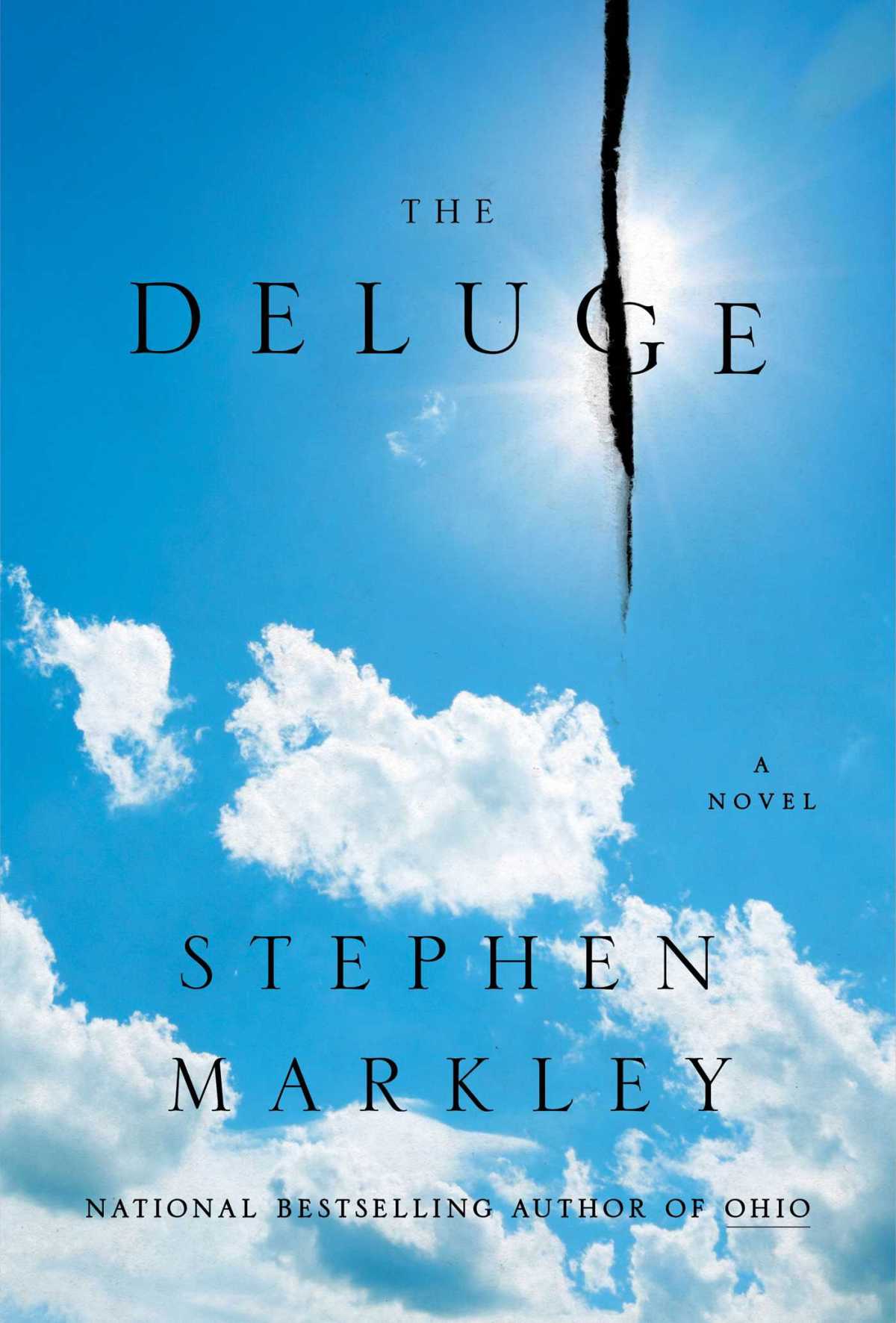
I just finished listening to The Deluge by Stephen Markley, a book that speculates on what the next sixteen years could be like. The book is almost nine hundred pages in print, and over forty hours on audio. Reading this book feels like it’s compressed the last twenty years of polarized political conflict into a forty-hour long disaster film. It’s intense.

Markley uses a large cast of characters to dramatize how people on the left and right will battle for control over the next five U.S. presidential election cycles. Most of the story involves two groups of characters, those working within the political system, and those who decidedly don’t. Markley portrays an ultrasecret ecoterrorist group that works to force change by violent acts versus a dedicated group of political wonks that labor in Washington to influence both parties. Dynamic women characters lead both groups. (By the way, I disliked both women. The only character I cared about was a drug addict in Ohio, who Markley uses as a kind of everyman.)

To further spice up the story, Markley explores the growing power of computer surveillance, artificial intelligence, privacy, and how everyone can be tracked.

I’m not going to review the details of The Deluge because I want to use my reading experience to talk about a specific response to reading the book. I’ll link major book reviews at the end in case you’re considering reading the book. I can say liberals will be terrified by the conservatives in this story, and conservatives will by horrified by these fictional liberals.

The Deluge is about climate change. We could have solved that problem by now if we had acted promptly twenty years ago. The government could have added a tax on all fossil fuels and then raised it slowly month by month. For example, by adding ten cents to the federal tax on gasoline each month. If we had started this in the year 2000, gasoline would be approaching $30 a gallon today. That would have forced people and corporations to make the changes needed.

That tax revenue could have been used to overhaul the power grid and for developing renewable energy technologies. If we had taxed carbon properly, we wouldn’t be fighting over climate change today. That didn’t happen. It didn’t happen because the people who owned trillions of dollars in fossil fuel reserves made sure it didn’t happen. They built a political and religious coalition to fight with them to protect that wealth.

All that’s beside the point now. What Markley envisions is the breakdown of the United States over the next sixteen years so it’s obvious to all we need to do something. The Deluge includes dramatic scenes of a massive fire that destroys Los Angeles, a massive flood that overwhelms the Midwest, and a massive hurricane that devastates east coast states. These events caused the insurance industry to collapse, leading to economic chaos. Markley doesn’t overplay all this. His fictional disasters are realistic, only somewhat larger than what we’ve already experienced, killing just hundreds or a few thousand people in each event, but having an enormous impact on politics and the economy.

Reading The Deluge makes readers ask themselves: Will American change soon? But I ask: Can people change at all?

Before reading this novel, I had seen two insightful videos about climate change that ask the same questions. The first video makes a careful case saying people don’t change and if there is a solution for avoiding climate change it must work with the psychology of how people act. The second video summarizes the first video with impressive summations of it and this tweet. (I wish I could summarize what I watch and read this well.)

Over the two hundred thousand years that our species have existed on this planet, we haven’t changed. Our societies and technologies change, but not us. Over those two hundred thousand years we have developed four major cognitive tools to understand reality: religion, philosophy, mathematics, and science. Only science using mathematics has consistently proven it can consistently describe reality. If you don’t believe that I wouldn’t fly in an airplane.

Science is not black and white. It’s statistical and hard to understand. But science has overwhelmingly shown that adding more CO2 to the atmosphere is turning up the temperature. The parts per million of CO2 in the air acts like a thermostat. Add more CO2 turns up the temperature. The only way to return to the weather we liked in the past is to return to the CO2 levels of the 1960s, but we keep adding more. The only way to stop adding CO2 is to completely stop using fossil fuels. And if we want to turn down the thermostat, we need to remove CO2, which isn’t easy. That’s why taxing carbon is the only way to force us to change, but we won’t do that, because it’s not in our psychology.

However, The Deluge suggests when things get bad enough, we’ll change. It ends hopefully. People even have hope for their children and grandchildren.

Personally, I don’t think we will change. If you want to know what the next sixteen years could be like, read The Deluge. If you believe people can change, and we’ll do the right thing eventually, read The Deluge. If you don’t believe we’ll change, I wouldn’t bother with the book unless you like looking at train wrecks. And if you suffer from depression, I suggest avoiding reading this novel at all costs. I seldom get even the slightest depressed, but this book bummed me out.

Reviews:

JWH

Reading Vonnegut’s Slaughterhouse-Five at Ages 18, 55, and 72

by James Wallace Harris, 2/8/24

When I first read Slaughterhouse-Five by Kurt Vonnegut back in 1970 I thought of it as an antiwar novel. The Vietnam War overshadowed everything back then, and I was old enough to be drafted. 1970 was the year M.A.S.H. and Catch-22 came out in the movie theaters. I went to see Catch-22 and was so blown away that I bought the book, read it in a day, and then went to see the movie version again. I didn’t read the book version of M.A.S.H. for another year but saw the film in 1970 too. Ever since I’ve thought of Slaughterhouse-Five, Catch-22, and M.A.S.H. as the trilogy of anti-war novels of my generation. The books were all about hating war.

When I read Slaughterhouse-Five again, in 2006 when I was 55, I listened it on audio. That time it was a completely different novel. That time it was hilarious. It was over-the-top silly, slapstick, and viciously satirical. At that time I focused on the Tralfamadorians and Kilgore Trout, and Vonnegut’s commentary on science fiction. In 2006 I noticed the antiwar parts, but they didn’t seem to be the primary point of the novel. They were still horrifying, but I found it hard to take Slaughterhouse-Five as a serious novel about WWII. That happened to me last year when I tried to reread Catch-22.

Now in 2024, when I’m 72, I listened to the book again. This time the story was bittersweet, heavy on the bitter, gentle on the sweet, and deeply philosophical. This time Slaughterhouse-Five was a condemnation of humanity. It was dark, very dark, but strangely not depressing. Both Billy Pilgrim, the protagonist, and Vonnegut were accepting that humans do horrible things and there is nothing we could do about it. This time it was obvious that Vonnegut believes we have no free will, and the best we can do in life is enjoy those moments when life is pleasant. This time around Slaughterhouse-Five was incredibly stoic.

When I read Slaughterhouse-Five the first time I thought the main goal of the novel was to horrify readers that we bombed Dresden in 1945 and make them outraged. I thought Vonnegut was testifying to an Allied war crime. This time around I realized Vonnegut wasn’t doing that at all. He was completely accepting that we had to bomb Dresden.

I think both times before, I thought Billy Pilgrim was a stand-in for Vonnegut. However, this time it was quite explicit that Billy Pilgrim and Vonnegut were distinctly two different characters in the book. At the end of the audiobook, there was a ten-minute conversation between Vonnegut and another unnamed WWII vet. In that conversation Vonnegut even tells us the name of the man he based Billy Pilgrim on.

The vet Vonnegut was talking to kept trying to praise Vonnegut, and Vonnegut kept deflecting the compliments. But one thing the other guy said stood out. He said that all of Vonnegut’s books were in print because they have multigenerational appeal. Since I have read the book when I was young, middle aged, and old, I can attest to that.

When I read Slaughterhouse-Five back in 1970, I thought the book was a protest. It was Vonnegut telling his readers that we need to change. And back then I thought humans could change. When I read it in 2006, I still had hope that humanity could evolve into something better. But in 2024, I didn’t find Vonnegut protesting at all. Vonnegut advised acceptance. Why didn’t I see that at 18?

Slaughterhouse-Five is neither an antiwar novel, nor even a misanthropic novel. In 2024 it seems obvious that Vonnegut was saying we have no choice but to accept the life we’re given, both as an individual and as a species.

Vonnegut was around 42 when Slaughterhouse-Five was published in 1969. How is it he now seems like a wise old man when I read it at 72 in 2024? Every time I read Slaughterhouse-Five I thought of Kurt Vonnegut as a modern-day Mark Twain. I was very into Twain when I was young, but I pictured him as a bitter old man from his later fiction and autobiography.

I wonder now if Vonnegut eventually turned bitter like Twain. Even though for the 2024 reading many scenes felt bitter, now that I write this, I’m not even sure that’s what Vonnegut intended. Could he have intended a total beatific point of view? I need to rewatch the 2021 documentary about Vonnegut called Unstuck in Time. And I need to read And So It Goes: Kurt Vonnegut: A Life by Charles J. Shields.

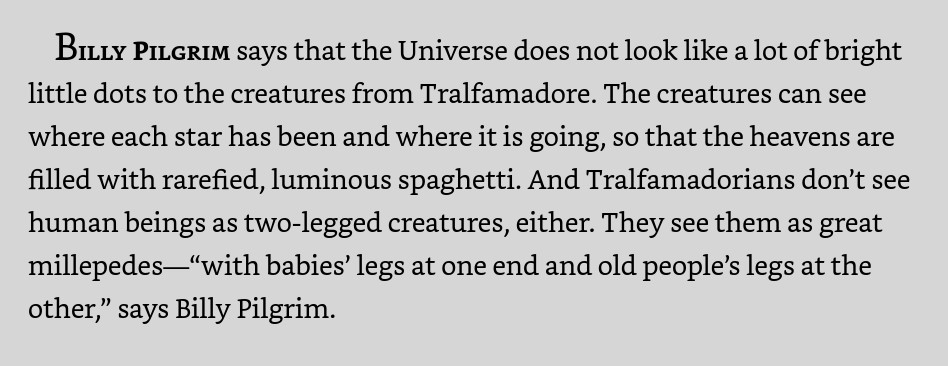
This time around I’ve been thinking more about the Tralfamadorians, the alien race who kidnaps Billy Pilgrim in a flying saucer and takes him to their home world where they exhibit him in a zoo. The Tralfamadorians don’t see time like we do. Existence is all of one piece.

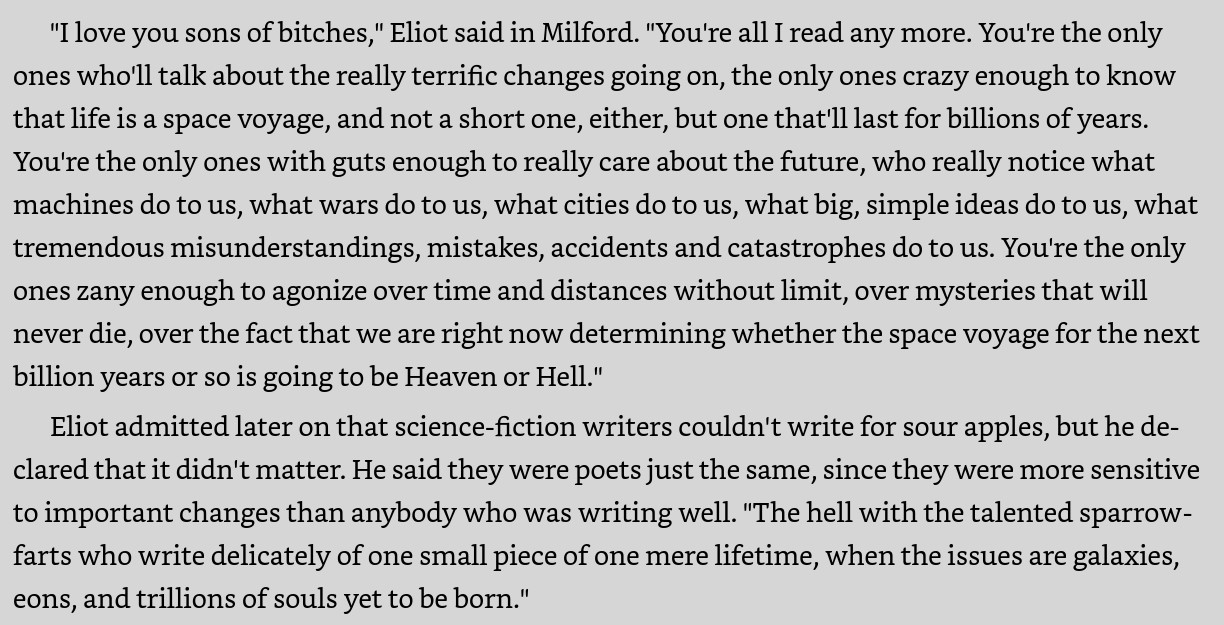
These aliens are like Zen Masters. Vonnegut uses them as enlightened teachers. But then, he gives a rather pitiful assessment of science fiction with his portrayal of Kilgore Trout. However, in a later novel, God Bless You, Mr. Rosewater, where Kilgore Trout is again featured, its hero, Elliot Rosewater attends a science fiction convention and gives this speech.

Science fiction didn’t come across so positively in Slaughterhouse-Five. Kilgore Trout wrote dozens of books that never sell. He’s a surly old man who makes his living by managing paperboys. Billy Pilgrim finds Kilgore Trout’s books only by accident. One time he finds four of them in a porn bookstore used as window dressing.

Wikipedia has an illuminating entry on Kilgore Trout. It says Vonnegut based Kilgore on Theodore Sturgeon. I’ve always wanted to know more about Theodore Sturgeon. Sturgeon’s fiction suggests he’s both eccentric and beat.

There are certain writers that haunt me. I think Vonnegut is becoming one of the ghosts that I need to get to know a whole lot better. And I might need to give Catch-22 and M.A.S.H. another read too.

JWH