Peter Leyden claims that America undergoes 80-year cycles, which he calls epochs, with peaks of upheaval that last 25 years. The past peak was after World War II, from 1945 to 1970. Leyden claims we’re entering a new peak in 2025 that should last until 2050. He zeroes in on artificial intelligence, clean energy, and bioengineering as the driving forces. I’m not big on predicting the future or seeing patterns in history, but there are ideas in his theory that are worth contemplating. I do believe we’re living through a historic period of change.
David Brooks claims America is moving away from thinking of itself as an idea that inspires the world to a homeland that we should defend. Brooks has moved away from being a traditional conservative to becoming a spiritual guru who teaches morality. I find all his recent speeches to be both uplifting and inspirational. Brooks feels the changes we are experiencing are undermining our individual characters and altering our collective national character.
CBS News asks if we’re moving into a new Gilded Age. But this time, the oligarchs are far richer and much more powerful. There is a synergy between this documentary and the videos of David Brooks and Peter Leyden. Everyone feels a massive paradigm shift coming. In 2025, I believe we’re living through the largest social and political upheaval since 1968.
If history does go through cycles, can we alter their course? The average person does not have much power. But in 2026, we do get to vote, and again in 2028. I believe the Democrats lost in 2024 because they had no clear vision. Being against Trump is not a political plan. In 2024, the Americans voted for Darwinian rule. Let the strong thrive and the weak die. The current administration is enacting laws to make the rich richer and the poor poorer. Essentially, civilization on the cheap. They appeal to greed. They appeal to resentment. They believe everyone should be responsible only for themselves.
It’s a very Darwinian philosophy. There’s no way we could call America a Christian Nation anymore. This is what America wanted through a fair and square election. But now that they are seeing what it means, do they want to keep it?
I don’t think we should wait until 2026 or 2028 to decide what we want. The Republicans won by clearly defining their goals in 2024. Democrats need to produce their own version of Project 2025. Project 2028 needs to be specific, and all Democrats need to support it. It can’t be too radical. It will need to be liberal yet practical. It needs to appeal to independents and old-style conservatives.
I have no idea what that plan should be, but I wish it would be something David Brooks would back. It needs a moral foundation because, as much as I accept the scientific theories of Darwin, I don’t think survival-of-the-fittest makes for an appealing political philosophy.
It annoys me more and more that I can’t recall names and nouns. I don’t worry yet that it’s dementia because most of my friends have the same problem. But I’ve been thinking about my ability to remember and realized that I’ve never been good at remembering things.
I know I have aphantasia, which means I can’t visualize mental images in my head. I wonder if there’s a connection between not visualizing images and poor memory? People with astounding memory often use mental images as mnemonics.
The ability to remember is on a spectrum. On one end of this range, are rare individuals with photographic memories, while at the other end, are a tiny group with no short-term memories.
My new theory. One possible reason I have poor memory is my education. More precisely, how my personality approached learning as a kid. I considered K-12 a thirteen-year prison sentence. I paid just enough attention to pass tests. I mostly got Cs and Bs, with a rare A and D. I remembered things just long enough to pass a test.
I was never motivated to remember for the long haul.
I do like to learn. I’ve read thousands of books. Of course, most of them have been science fiction, but I also love nonfiction. However, information leaves me as fast as I consume it.
I’m starting to wonder if I would have a better memory if I had developed a different approach to school and learning. Primary and secondary education aim to give kids a well-rounded education. And in college, over half the courses are required.
The idea is we should learn as much as possible about the world. Is that a valid approach? After school and college, we specialize in whatever our work requires, and become selective about what we study for fun. Those subjects are what we remember best.
Reality is too big to know everything. What we need to learn is how to coexist with reality. We need the knowledge to fit in and survive. Would knowing more about fewer subjects help? Or would memorizing the deep dynamics of how things work better yet?
I do believe the more we know, the wiser we are. But there are limits to what we can understand and memorize.
I’m currently reading Nexus by Yuval Noah Harari. In chapter 2, Harari shows how fiction drives our societies, not truth. We live by stories we want to believe. It’s much easier to vaguely understand fiction than to learn the details of reality. For example, more people accept The Bible than biology. That suggests a natural tendency to minimize how much we know.
That would be okay if the Earth were sparsely populated. But we live in dense, complex societies racing at the speed of computer networks and artificial intelligence. Living by fiction is fine if the year is 500 BCE, but we live in 2025. CE.
Let me give one example of what I mean by learning less to know more. I’ve been reading American history books to understand how our society got to now. That gives me a certain level of wisdom about our problems. However, I’m also reading about French history, especially the French Revolution and 19th century history. Seeing the parallels ups my level of understanding. But do I need to read the history of every country now and then? What I see is common dynamics. Reading more histories will give me more examples of the same dynamics.
The same is true of religion. I like studying the history of the Bible. I’ve also studied Buddhism and Hinduism. As I do, I see common dynamics at work. Harari’s new book Nexus points out the common dynamics of society and history.
The educational philosophy I experienced growing up pushed me to memorize a million details. What I needed to understand and remember is the fewer dynamics of reality.
People like to live by fiction because it’s easier. Politics is currently overwhelmed by fiction. Read Nexus to understand why I say that. The question we have to answer is if we can reject fiction.
Real information is seeing patterns in reality. Wisdom is seeing patterns in the patterns. The only real cognitive tool we’ve ever developed to understand reality is science. However, it’s statistical, and hard to learn and understand. We live in a time of simplex thinking. People see or are told about one pattern and they accept that as a complete explanation of reality. All too often, that pattern is based on a cherished story.
We can’t live by memes alone. Nor can we live by infinite piles of memorized details. The only way to understand is to observe consistent patterns. But it has to be more than two or three. That can lead to delusions. Even anecdotal evidence of ten occurrences could still deceive. How can this lead to learning more from less? It’s a paradox.
Last year, I read a three-volume world history. It provided hundreds of examples of strong man rule over thousands. of years. But how many kids, or citizens can we get to read a three-volume world history? Would a listing of these leaders, including the wars they started, and the numbers of people who died because of their leadership be just as effective? Would all the common traits they shared help too? Such as wanting to acquire more territory, or appeals to nationalism?
Could we create a better educational system with infographics and statistics? I don’t know. I do know I tried to process too much information. I also know that I only vaguely remember things. Memory has limits. As does wisdom.
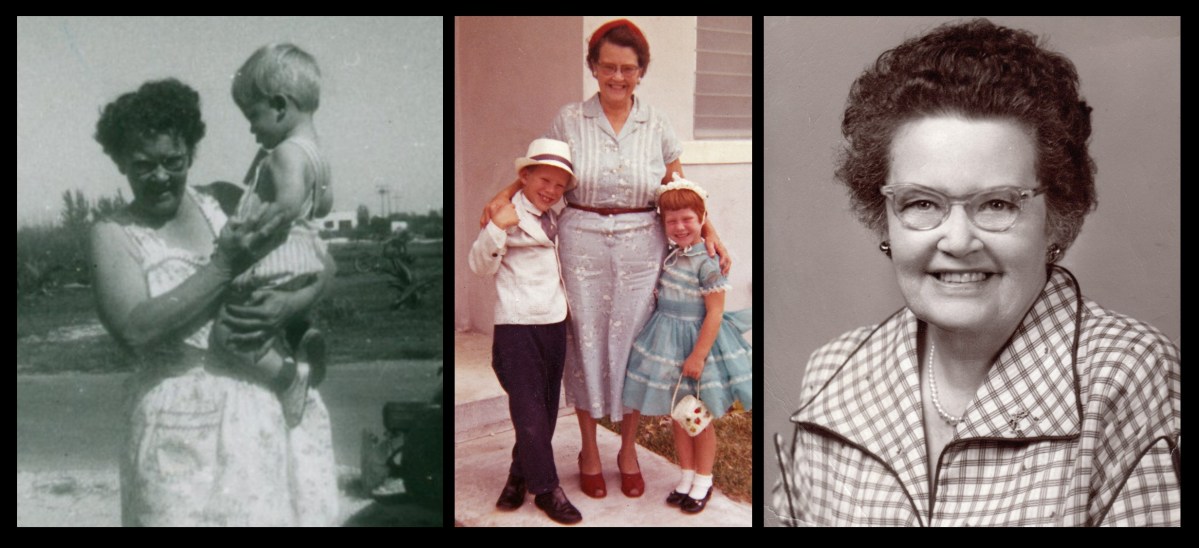
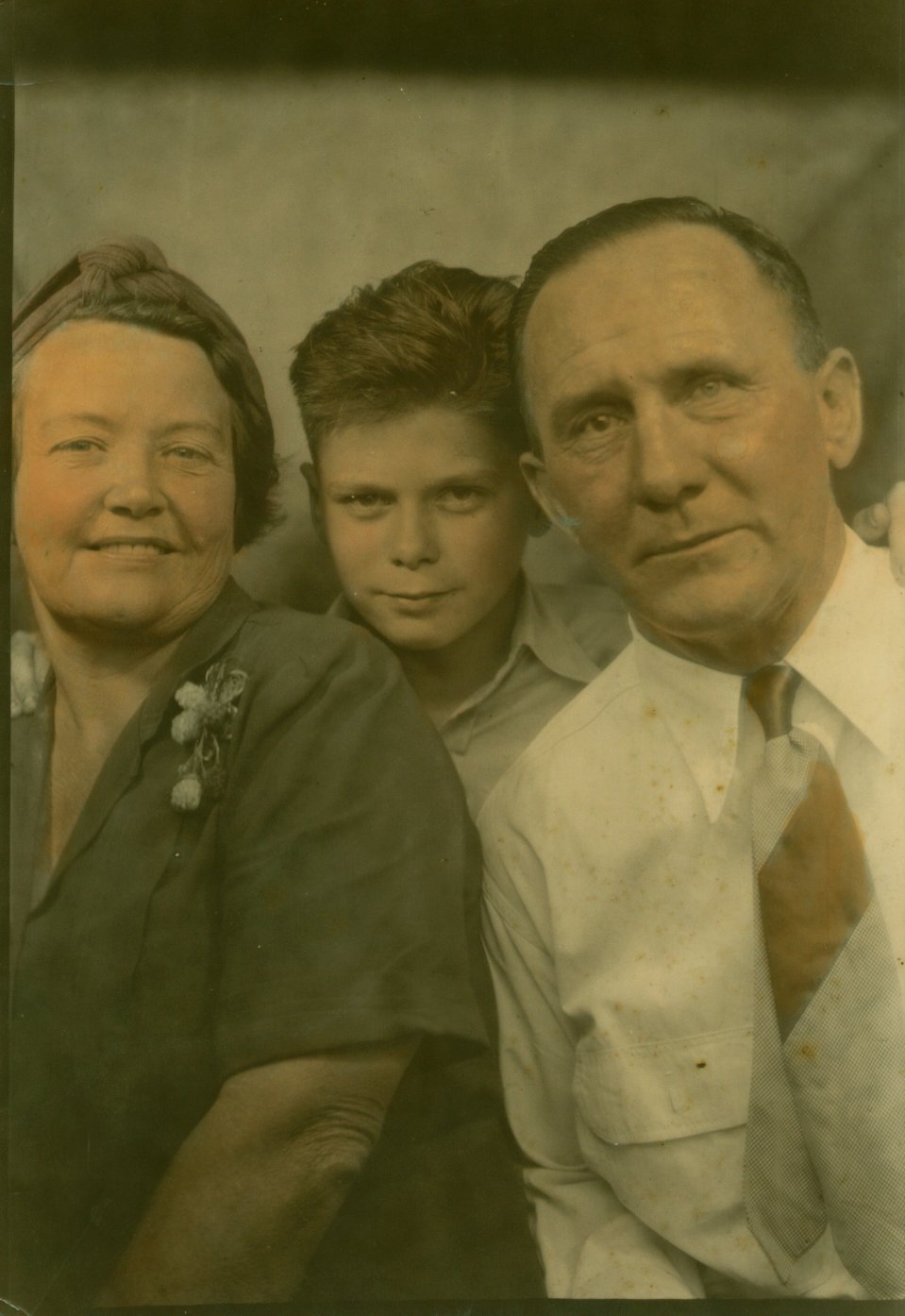
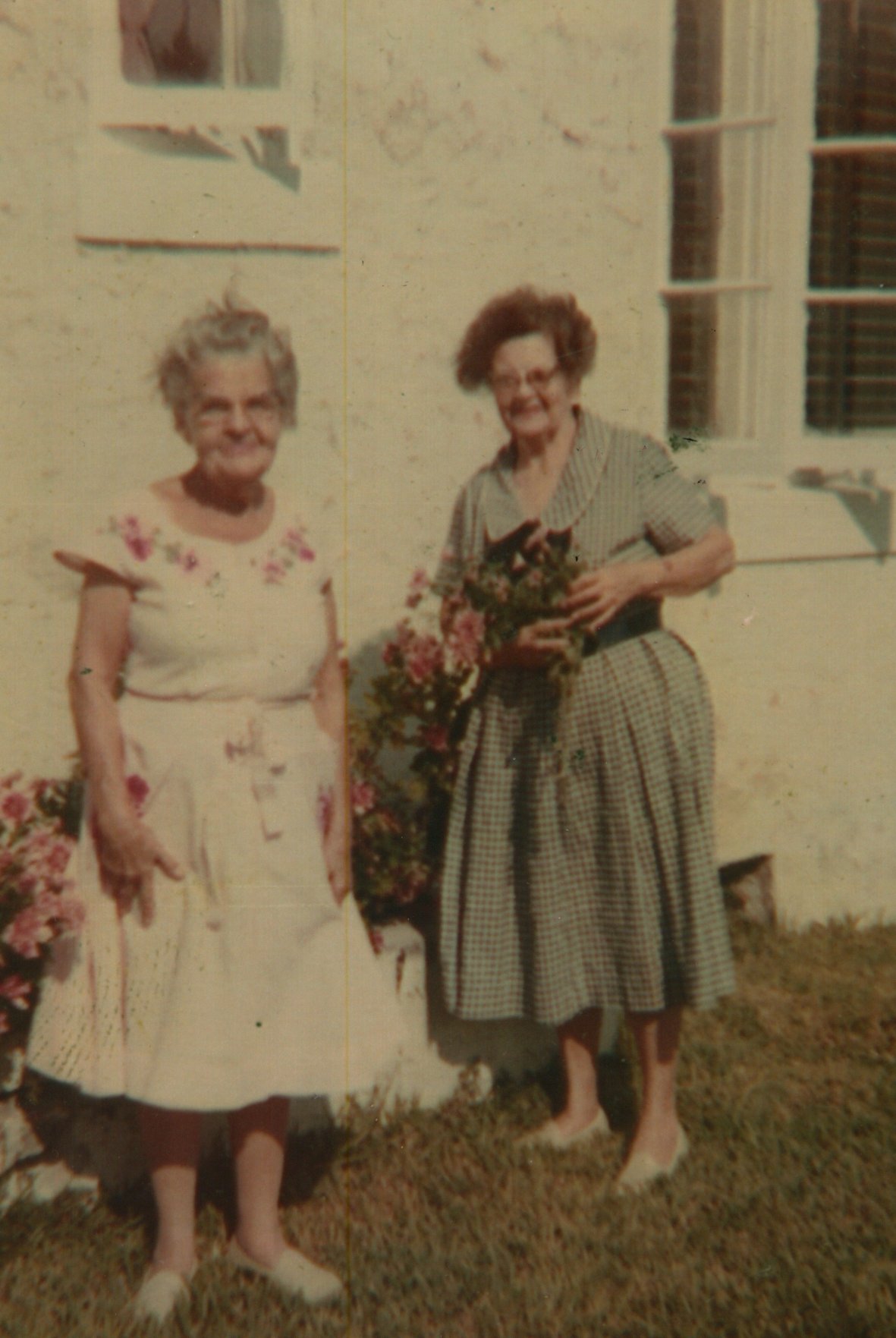
This essay is about memory and history. What can I remember? What can I document with photographs or research with Ancestry.com? What can I find on the internet? I want to know as much as possible about Helen Harris. I plan to update this page as I find more information. The photo on the left at the top of the page is me with my grandmother around 1953. I was her first grandchild. The next photograph is of my grandmother with me and my sister in 1959. The last picture is just the best portrait I have of her. I believe it was taken in the 1960s.
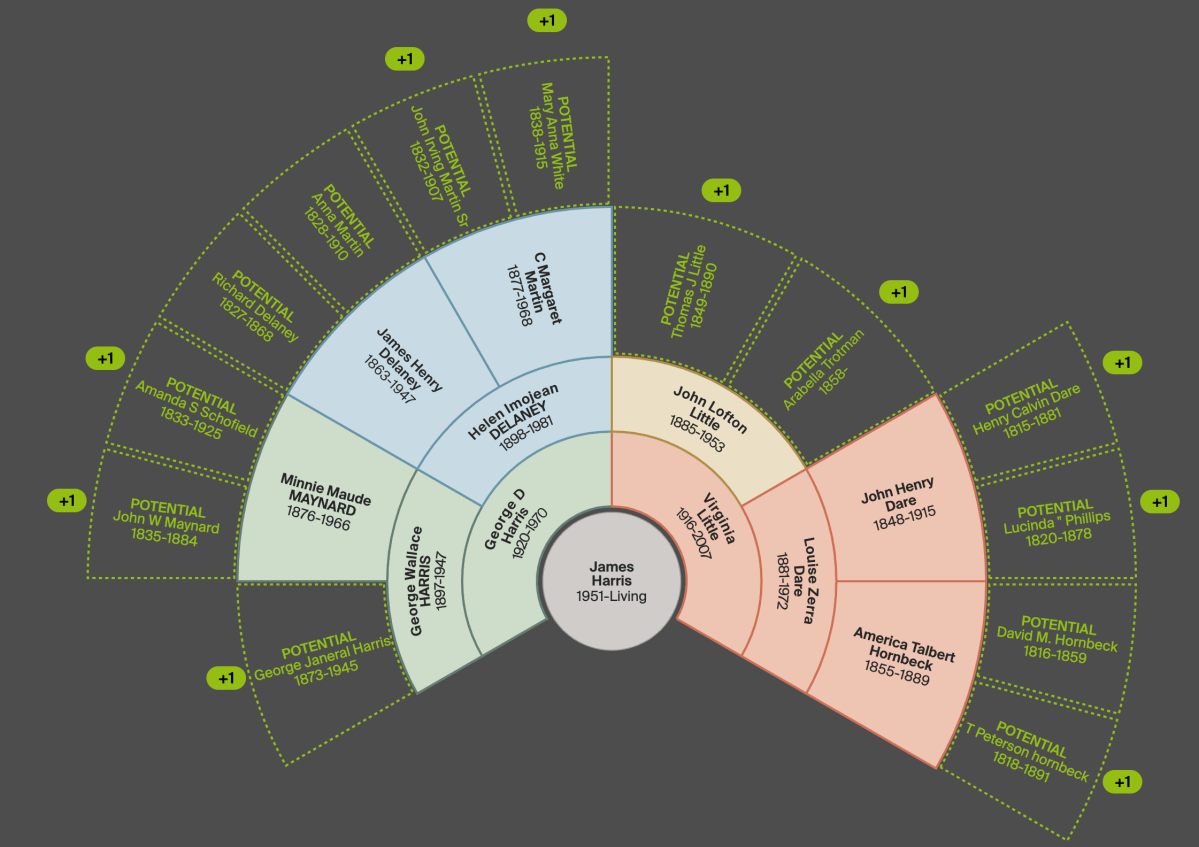
Helen Harris was my grandmother, my father’s mother. I’m learning to use Ancestry.com by researching her records. This essay aims to show how genealogy research works and to push my memory to remember everything I can about my paternal grandmother. I’m also using clues I found on Ancestry.com to research on Google. Here is the current state of my family tree.
I’m going to start with my grandmother’s birth and work forward in time.
1900 United States Federal Census (June 20, 1900)
I cannot find a birth certificate for my grandmother. I discovered on Google that Indiana didn’t require birth certificates until 1907 (but some counties had them as early as 1882). I’m not exactly sure where my grandmother was born. The first official document that lists my grandmother is the 1900 United States Federal Census.
Helen is listed as a granddaughter living with John I. Martin and Mary A. Martin, her maternal grandparents. My grandmother’s mother is listed as Margarete Delany and her father James Delany lived with them. Delaney was spelled without the e. Spellings, especially first and last names were often inconsistent in historical documents.
They lived on 484 Third Street, Hoopeston, Grant Township, Vermilion County, Illinois. The census was taken on June 20, 1900. My grandmother’s grandfather was born in Ireland in 1848. His wife came from Ireland in 1857. I don’t know if they were married in Ireland or America. That puts me five generations from being an immigrant on that side of the family?
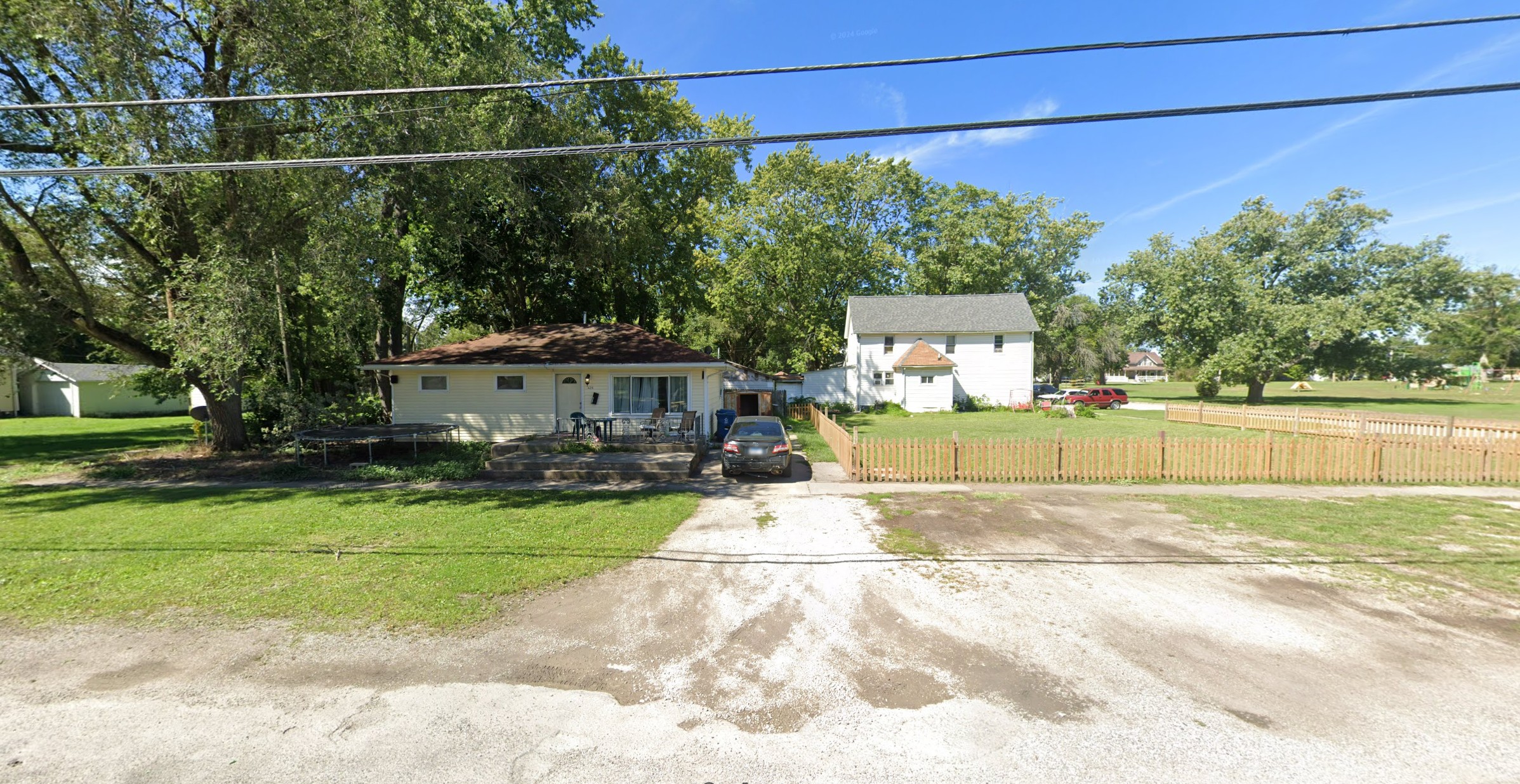
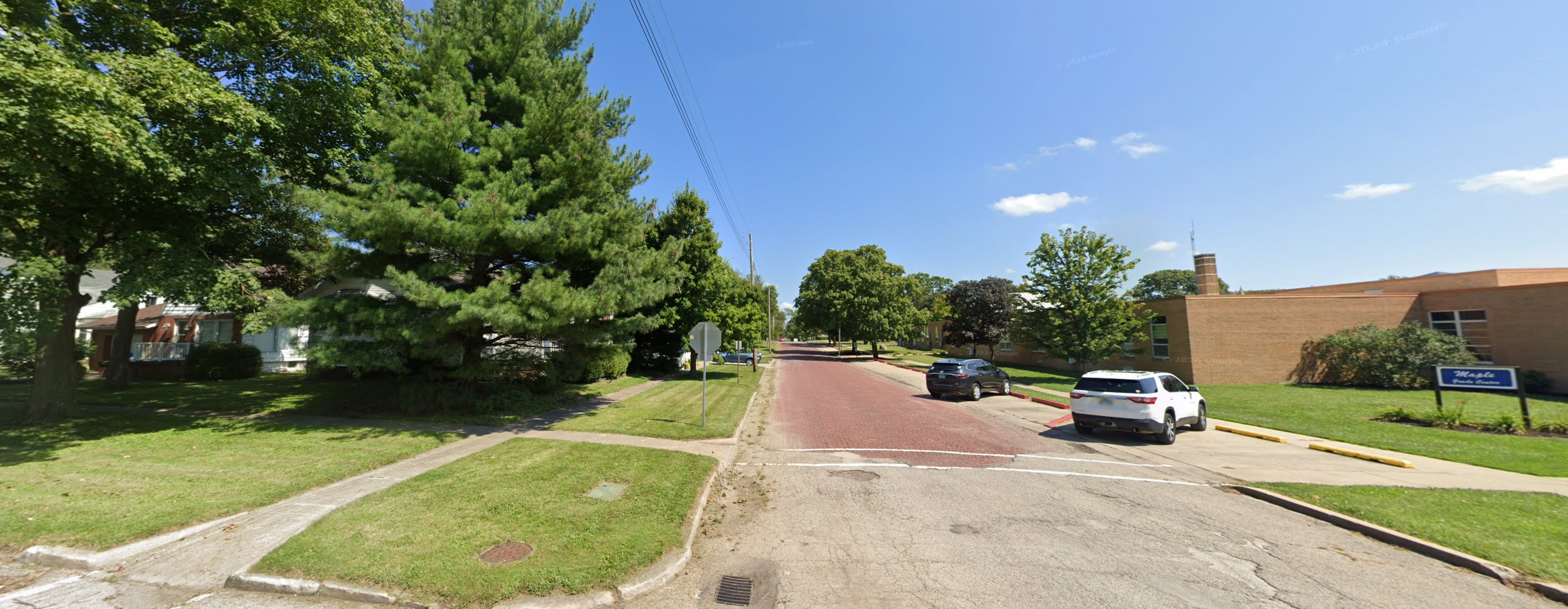
Third St. Hoopeston is now divided between north and south. There’s no telling where 484 would have been. This photo shows a 2024 view of 452 and 498 of N. Third. The house in the back looks old. Maybe 498 could have once been 484?
This is about where 484 S. Third Street should be.
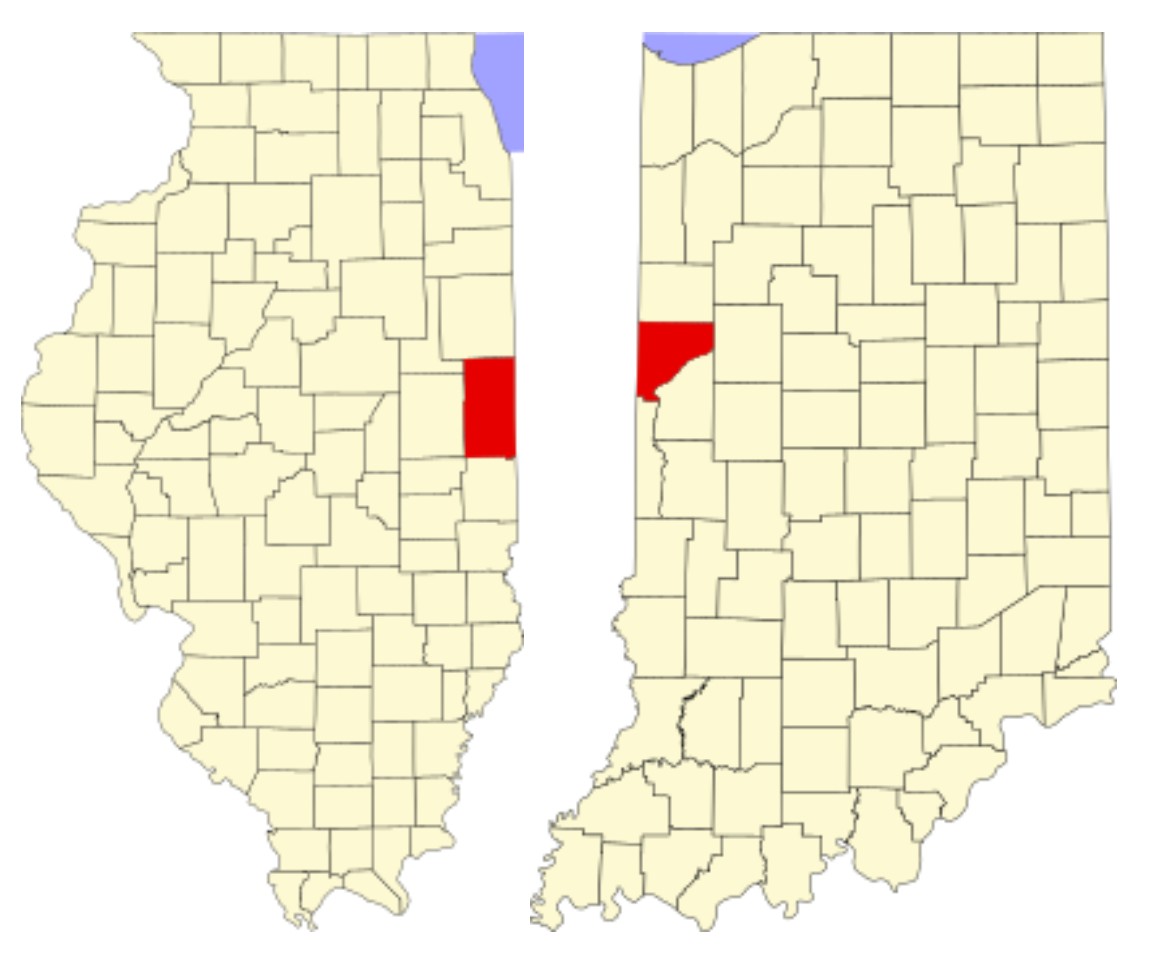
This brings up the question: Why was my grandmother living in Illinois at one year and seven months when she was born in Indiana? Vermilion County is right on the border with Warren County, Indiana. Evidently, it’s close enough for dating. I wish I knew where my grandmother was born.
1910 United States Census (April 10, 1910)
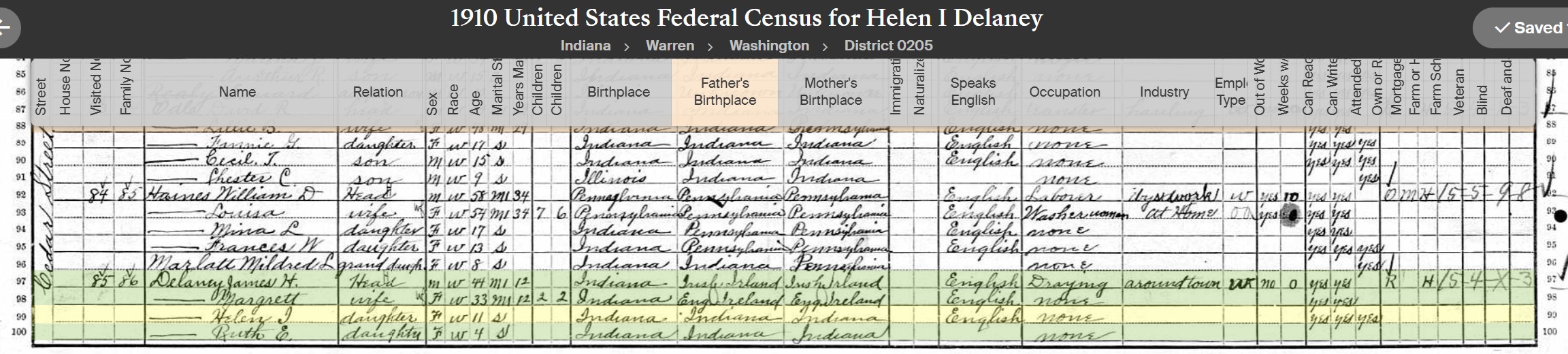
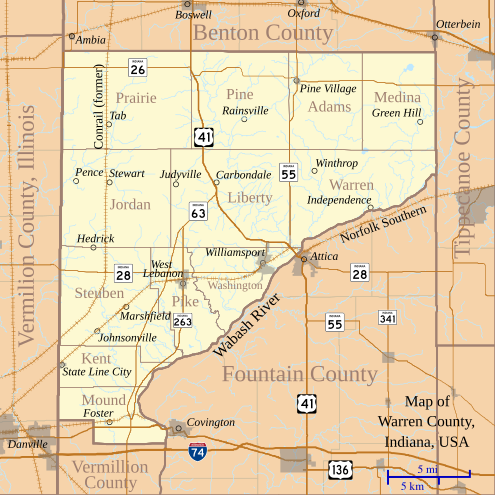
Helen Harris was 11 and living on Cedar Street, Williamsport, Washington Township, Warren County, Indiana. Her father was listed as James H. Delaney (44) and her mother Margrett Delaney (33). My grandmother now had a 4-year-old sister Ruth. That validates real life because my grandmother had a sister Ruth. The names have different spellings. This map shows how close they were to Vermilion County, Illinois, and the location of Williamsport. In 1910, the town’s population was only around 1,200.
I was always told she was born in Indiana, but I can’t validate that in any way. Was Williamsport her birthplace and family home? Later records claim she was born Helen Imojean Delaney on November 28, 1898, to James Henry Delaney (1863-1947) and C. Margaret Martin (1877-1968). I might find out more when I research Margeret Martin.
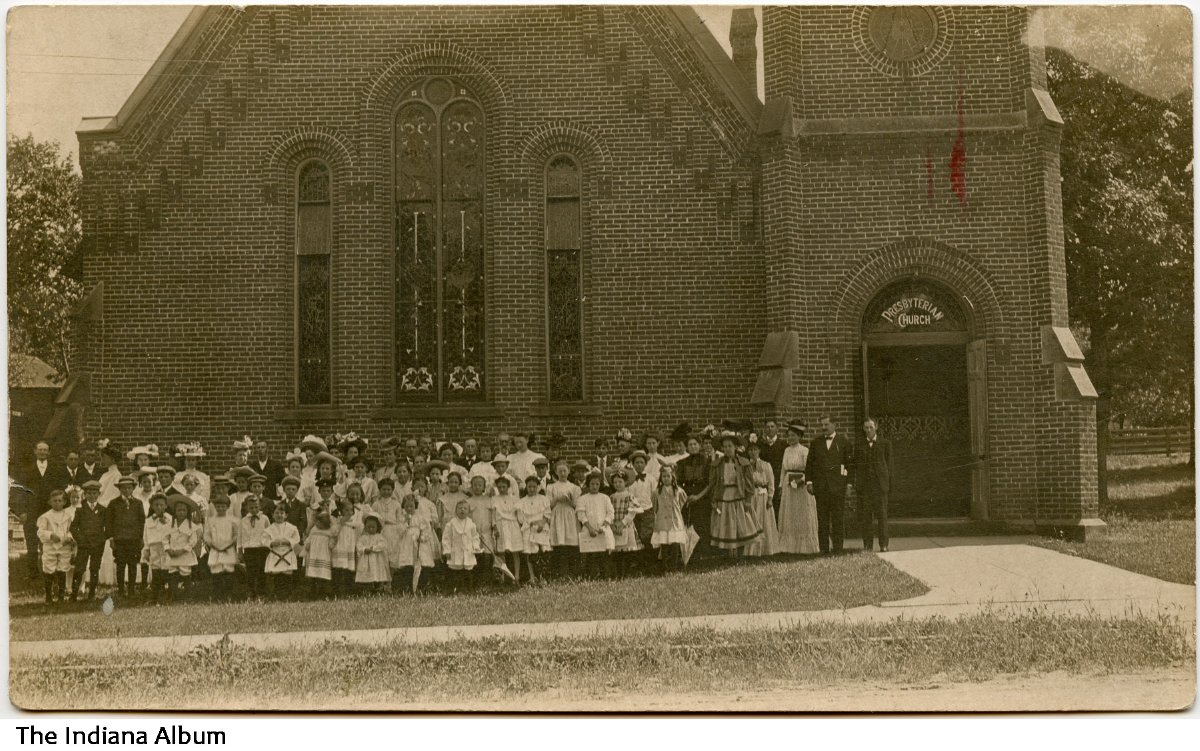
Here is a photograph from Williamsport in 1910. My grandmother would have been eleven. I wonder if she is in this group of people? How far can I go with this research? Just how many pieces of evidence of our lives do we leave behind? I wonder if I drove to Williamsport if I could find more clues?
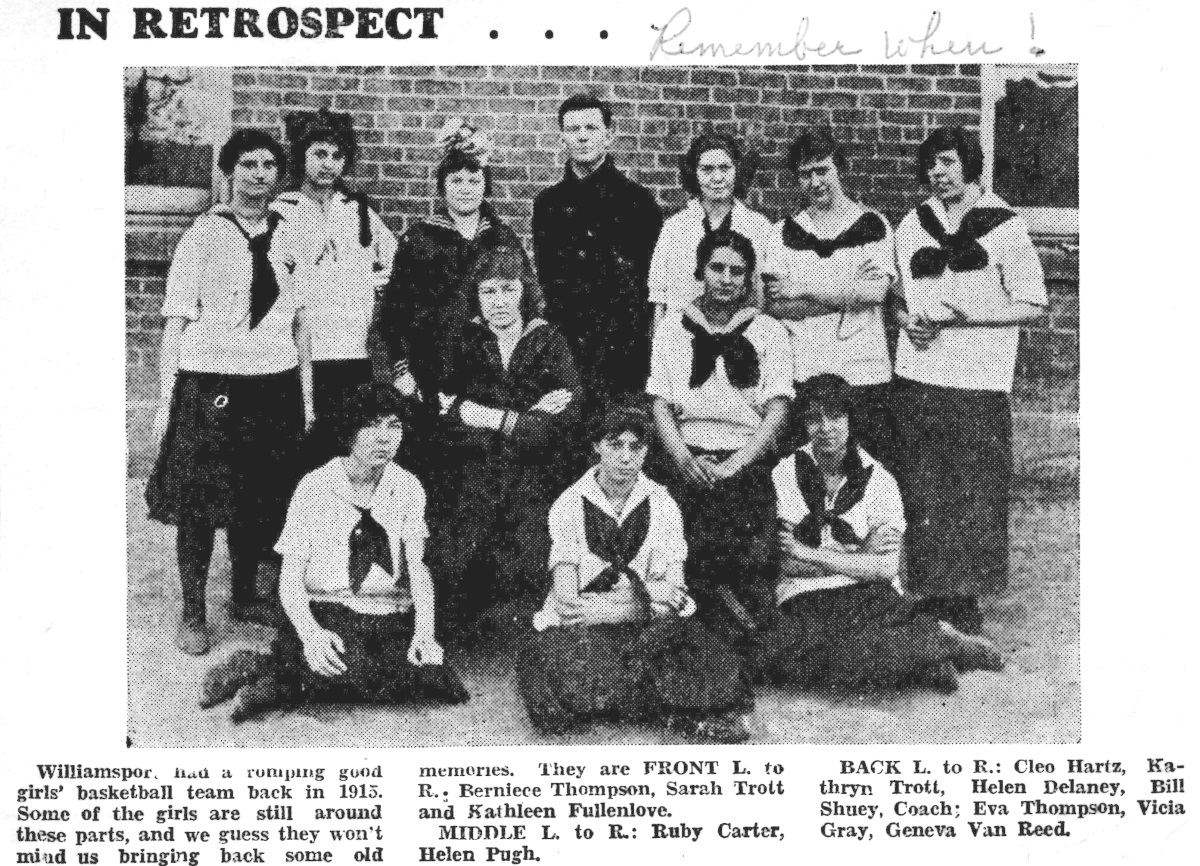
My next bit of evidence comes from 1915. I don’t know where this clipping came from. It appears to be a look at the past. My grandmother is about 16. She’s third from left in the back, wearing the weird hat. It’s the earliest photograph I have of her. (Strangely, I also have an old newspaper photograph of my mother on a basketball team.)
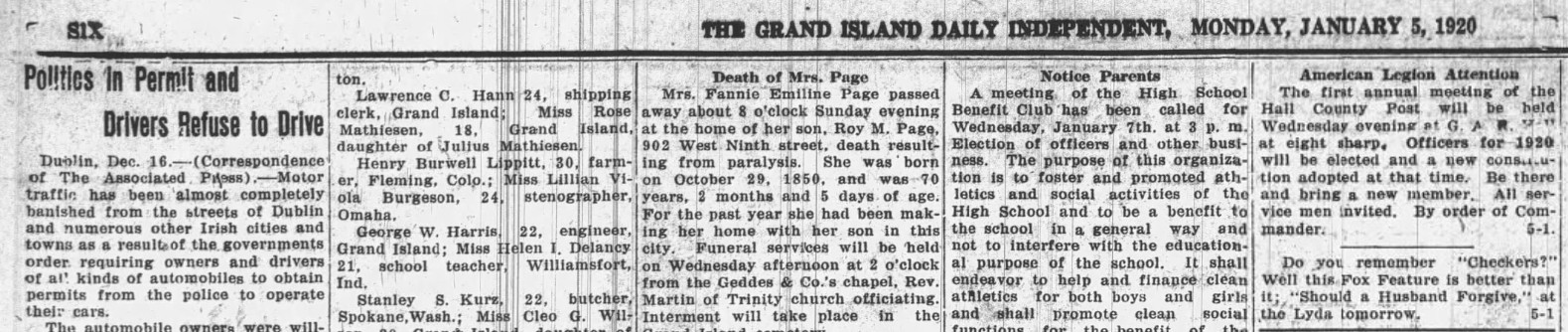
The next record I can find about my grandmother is a marriage notice in The Grand Island Daily Independent for Monday, January 5, 1920. Helen Delaney married George W. Harris, 22, an engineer. She is listed as 21 and a school teacher.
I wonder what they mean by an engineer? Was he a college graduate? After he moved to Florida, my grandfather worked as a border agent. Supposedly, his picture was once in Life Magazine arresting illegal aliens coming in by boat. My grandmother once told me she had been a schoolteacher in a one-room schoolhouse. So that fits. My father, George Delaney Harris, their first child was born on October 12, 1920.
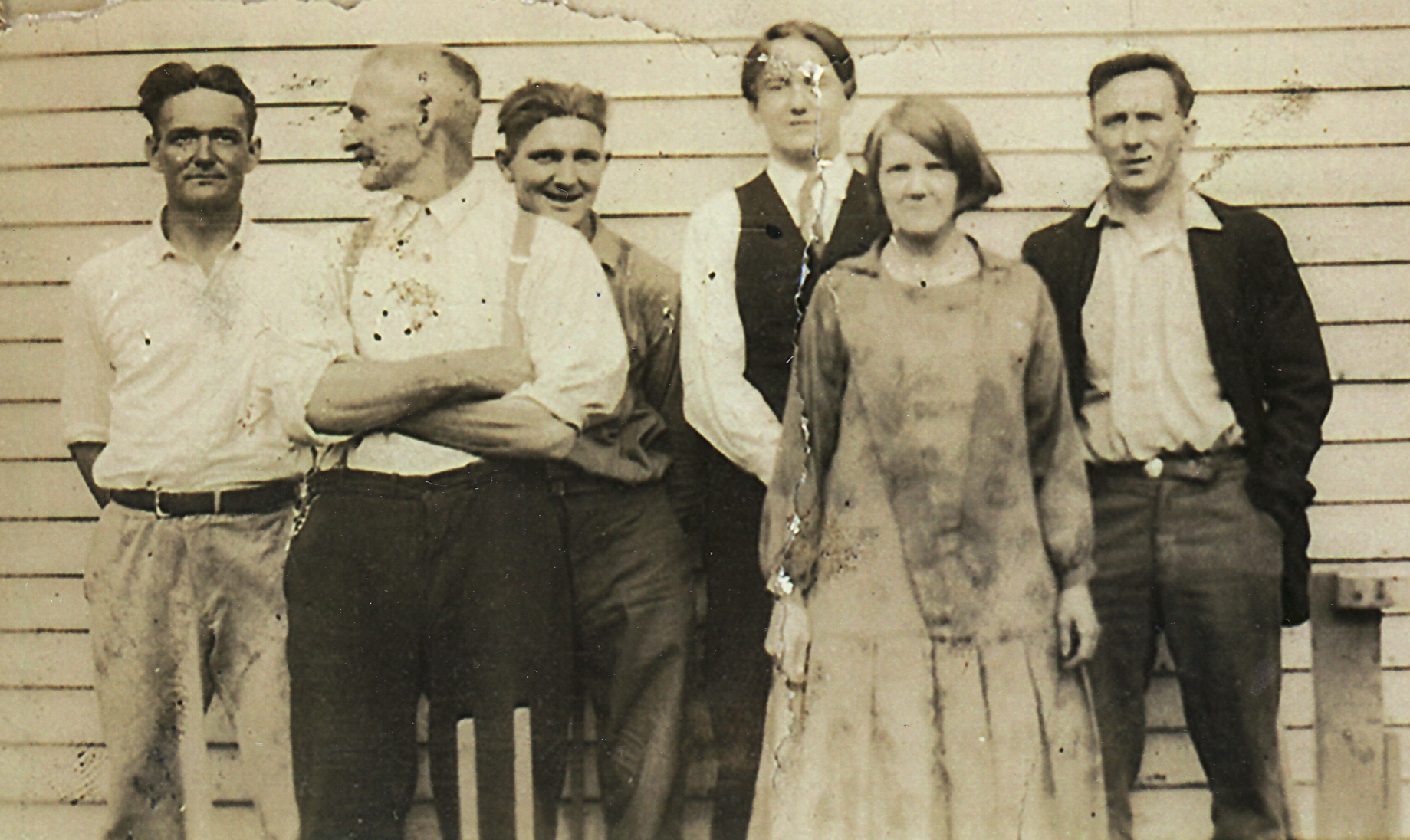
How did she meet a man from Nebraska? This is the earliest photo I have of my paternal grandfather, George W. Harris. He is on the far right. Those are his parents and brothers, my great-great-grandparents. He looks older than 22 there, so I’m guessing it was after 1920.
1920 United States Federal Census (June 2, 1920)
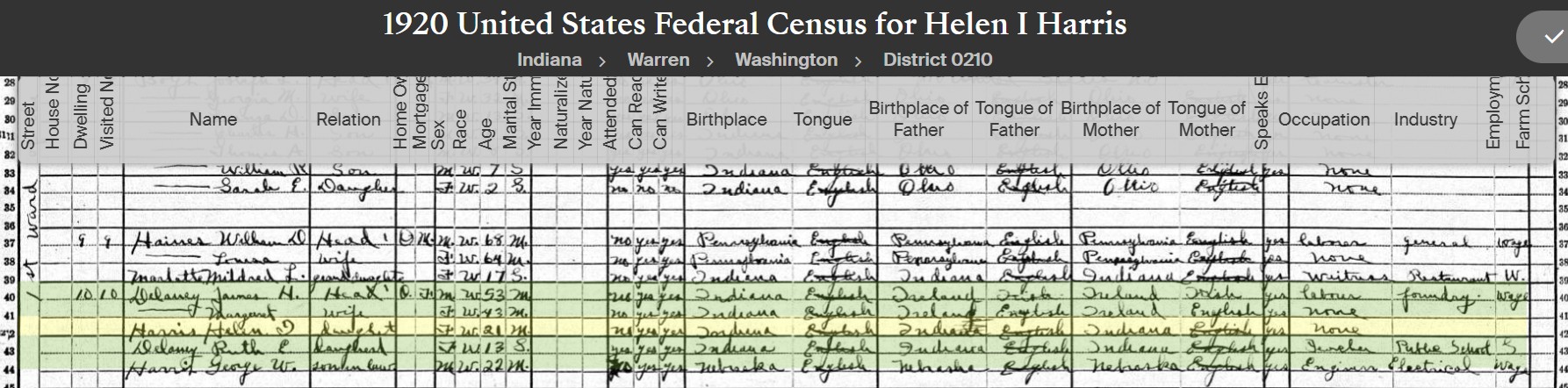
My grandmother and grandfather are living with her parents in Williamsport, Indiana. Was the Nebraska newspaper notice of their marriage just a notice, and they weren’t living in Nebraska? Or had they gone there to marry, and then returned to Indiana to live? My grandmother is unemployed, but my grandfather is now an electrical engineer.
Sometime during the 1920s, they move to Florida. I have no proof of when or where. The next record to validate their existence does put them in Florida. I’d love to know the story behind the move.
1930 United States Federal Census (April 4, 1930)
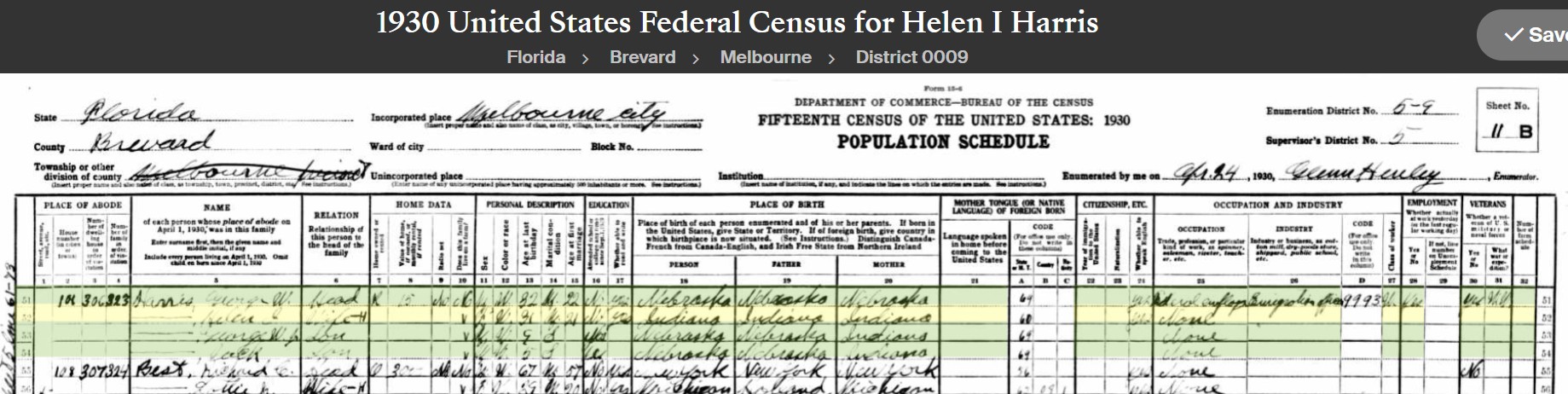
I never heard anyone in the family saying they lived in Melbourne, Florida in Brevard County. The census document says they live at 101 “Wolfe” Street. But I’m not sure of the handwriting. Can’t find a Wolfe street. My grandfather’s occupation is now listed as a federal employee and an emigration officer. That fits with family stories. My grandmother is still unemployed, but now has a second son, my uncle Jack.
1935 Florida Dade County Census
They rented a house at 193 NW 54th St. My grandfather was a federal inspector. All three sons are now here, including my Uncle Bob. My dad was 14.
1936 City Directory
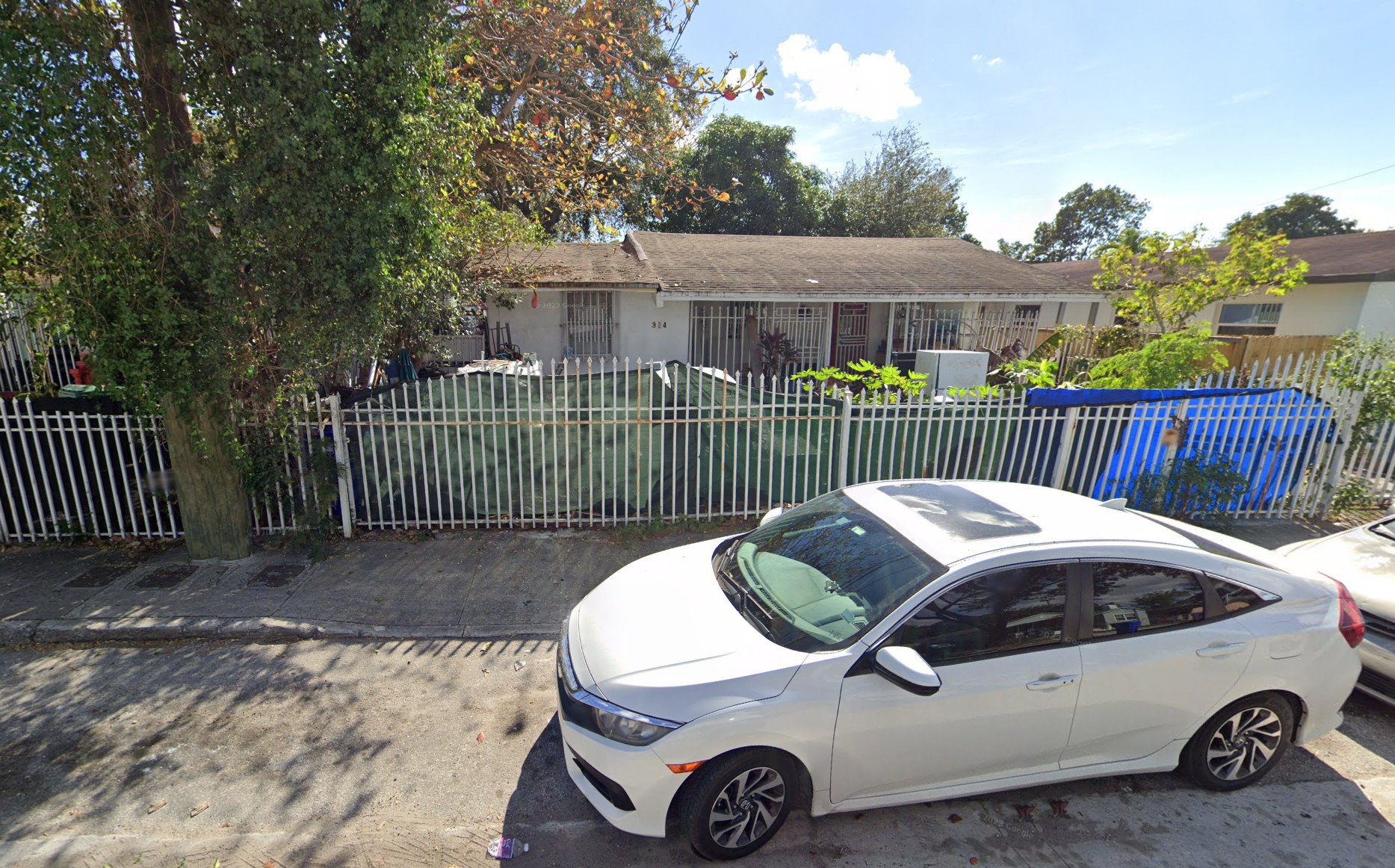
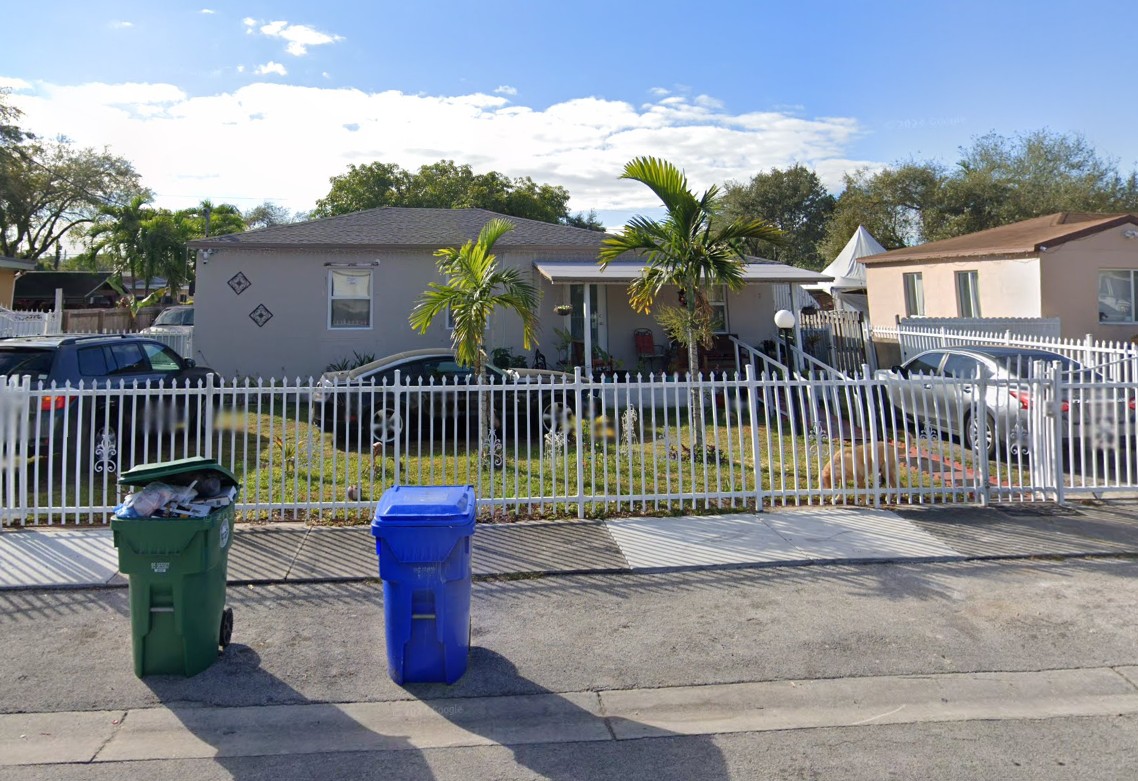
My grandmother is listed as living at 324 NW 53rd Street in Miami. Here is a current Google Maps Streetview photo. This
1940 United States Federal Census (April 8, 1940)
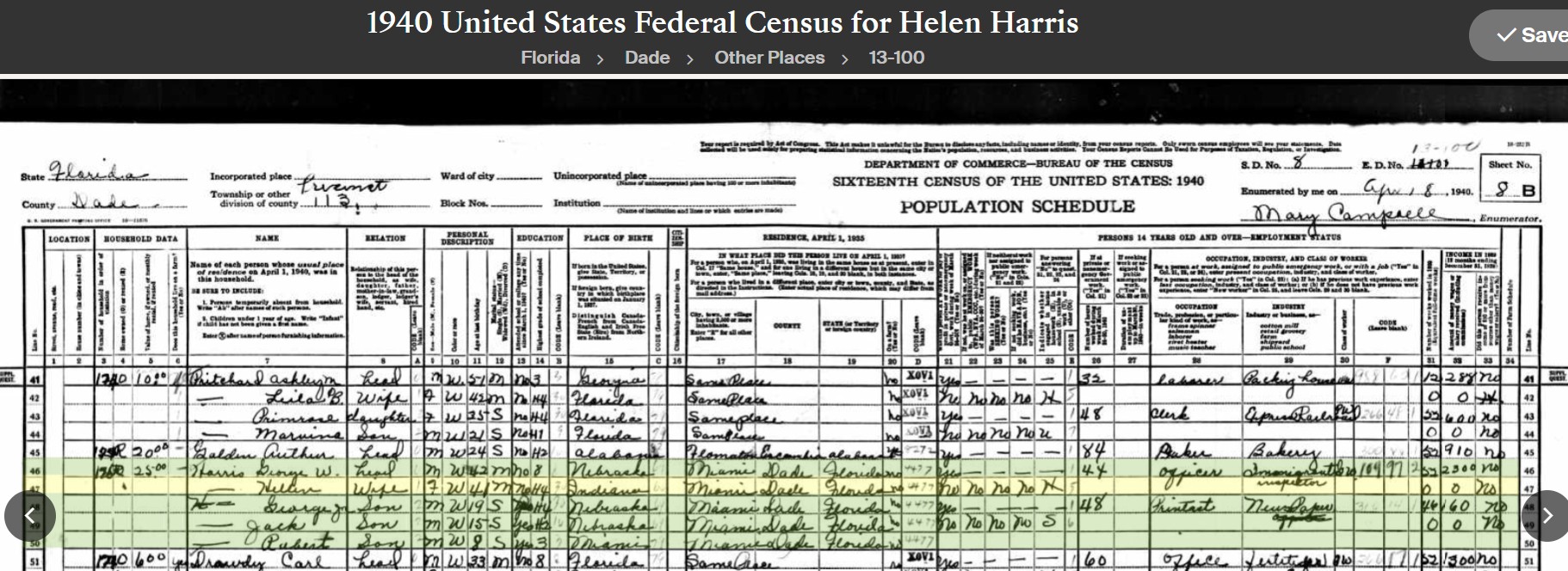
They are now living in Dade County, where Miami is located. However, I can not make out the township. I would love to know their address. I remember visiting my grandmother in a little house in the early 1950s. My grandfather had died in 1947.
My grandfather is now an Immigration Inspector, and my father, 19, works for a newspaper. I have a clipping from a Miami newspaper, describing my father studying advertising layout in high school. I won’t include it here, just evidence for my grandmother. Uncle Jack is 15 and Uncle Bob is 8. I have one photo from around this time. My Uncle Bob is in the middle, and he looks like a teen, so I’m guessing it’s around 1945?
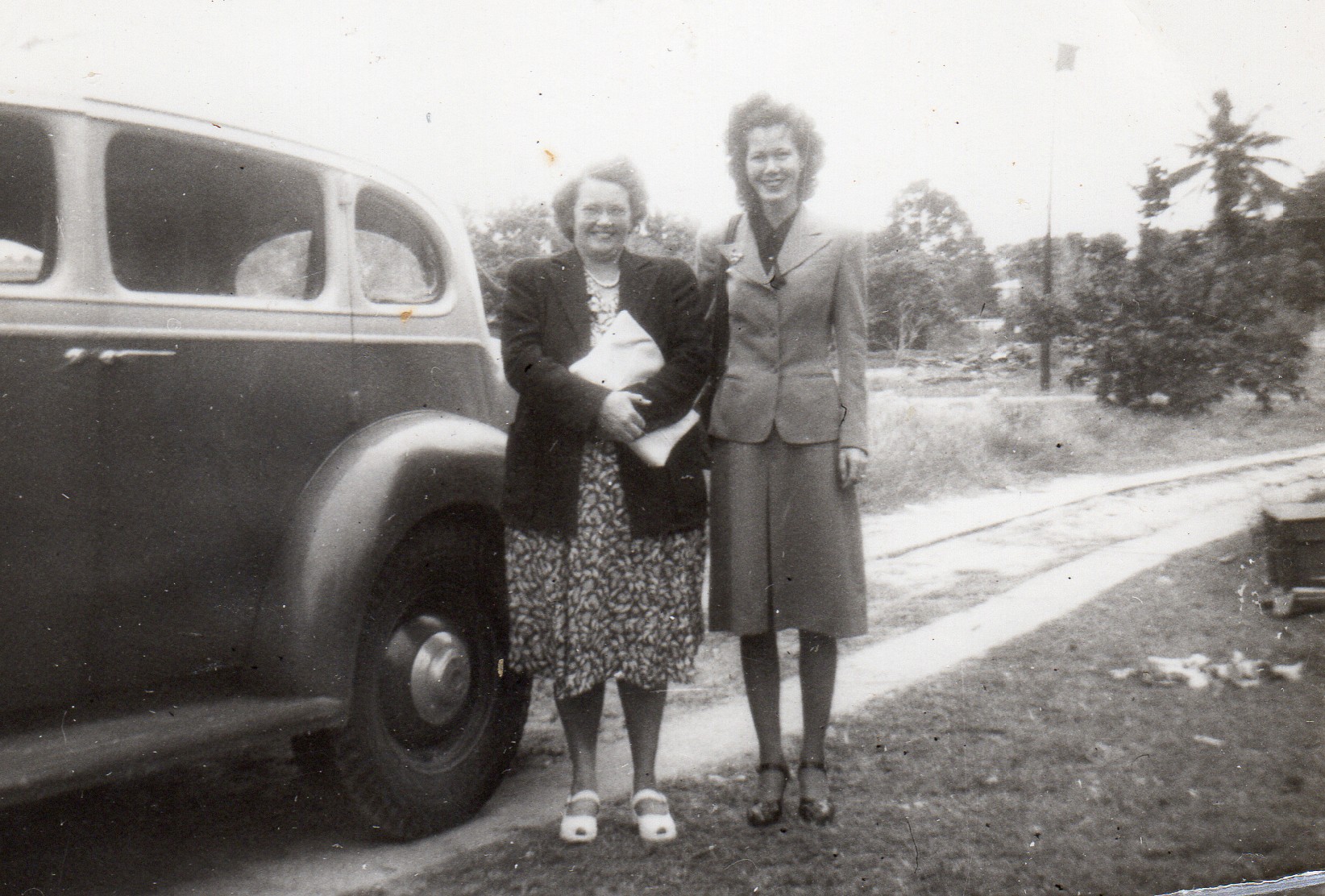
Here’s a picture of my grandmother with my mother. My mother and father got married in 1945. I assume this photo was taken before I was born in 1951.
1953 City Directory
My grandmother is listed as living at 1131 NW 55th Terrace in Miami. I would have turned two that year. I remember visiting her in the mid-1950s, in a small house. This could have been it. Evidently, she was living alone by then. Here’s what it looks like from Google Maps Streetview. My memory is of a house on a corner surrounded by lots of trees looking like the two below.
I can’t find any more resources on Ancestry.com for my grandmother. She’s not in the 1950 United States Federal Census, and Ancestry.com doesn’t seem to have access to censuses from 1960 forward. Nor can I find any more city directories. I wonder if my grandmother didn’t fill out a 1950 census. She was a widow by then, and I assume her three boys had moved out.
My Memories
I mainly grew up around Miami Florida. That’s where my father’s side of the family had been living since the 1920s, or so I thought. However, my father and his father were from Nebraska, and his mother and family were from Indiana. I never knew how my father’s parents met. That’s the kind of mystery you wish pursuing genealogy would answer but doesn’t. My grandfather died before I was born, so I have no memory of him, and very few stories.
My earliest memory of my grandmother, Helen Harris, is visiting her in a tiny house in an old section of Miami. Back in the 1950s, Miami seemed mostly new housing divisions, but sometimes we’d visit older sections that were probably built in the 1920s or 1930s. I’d love to know where that house was located. This was probably mid 1950s.
My next memory of my grandmother was visiting her at an old apartment on 8th Avenue, which I believe is Flagler, and is now considered part of Little Havana. She was the manager, and this was in the late 1950s or early 1960s. The place was old. I loved roaming the old interior halls, with the ancient musky-smelling rugs, and talking to the old people living there.
Around 1959 my mother was diagnosed with TB and was sent to stay at a sanatorium in Valley Forge, Pennsylvania. My father was in the Air Force and stationed in Canada. So my grandmother moved into our house in Hollywood, Florida to care for Becky and me for about six months. I have several memories from this time. (The center picture at the top of the page is from this time.)
After that, she moved to an apartment complex on Bayshore Avenue, right on Biscayne Bay. She stayed there, I believe until she died in 1981. But I’m not positive. My father died in 1970 and my mother, sister, and I moved to Memphis, Tennessee. I only saw my grandmother a couple more times after that when I would visit Miami to see a friend. The last time was in 1978 when I got married and took my wife Susan to meet her.
Most of the other memories I have of Helen Harris were when she came to family Thanksgiving and Christmas dinners. I did stay with her several times at the apartments on Flagler and Bayshore Drive.
I do have some specific memories. When my grandmother kept Becky and me in 1959, I was seven, and sometimes still wet the bed. She knew I admired her large leather-bound zip-up 3-ring notebook which she used to organize all her bills and paperwork. She told me when she came that if I didn’t wet the bed while she was there she’d give me her notebook when she left. I got that notebook. My parents should have tried bribing me earlier.
One of the most exciting memories I have of my grandmother is when I stayed with her at the apartments she was managing. I had seen the 1958 movie, A Night to Remember about the Titanic, and told her about it. She introduced me to an old lady living at the apartments who had been on the Titanic as a child. Years later, I wondered if I could track down who that lady was. I don’t remember her name.
I can’t remember too many details about my grandmother’s personality. She was jolly and I loved her. She collected glass figurines of dogs, so my sister and I always gave her a little dog figurine for her birthday or Christmas. I remember seeing her several times reading a book about the medicinal value of honey. She also talked about Edgar Cayce, the psychic. I can’t remember anything else she liked. I don’t recall her watching TV, playing music, or reading novels.
In 1965, I stayed with her at the Bayshore Drive apartments. I remember helping her clean out an apartment. I found an old tackle box which she let me keep. She didn’t see that it had a switchblade knife in it. I loved that knife and took it to school with me. I never told any grownups about it. I use the tackle to fish off the sea wall. While I was staying with her I would gather coconuts and unhusk them. I sold a dozen coconuts to a vegetable stand in Homestead for 50 cents each.
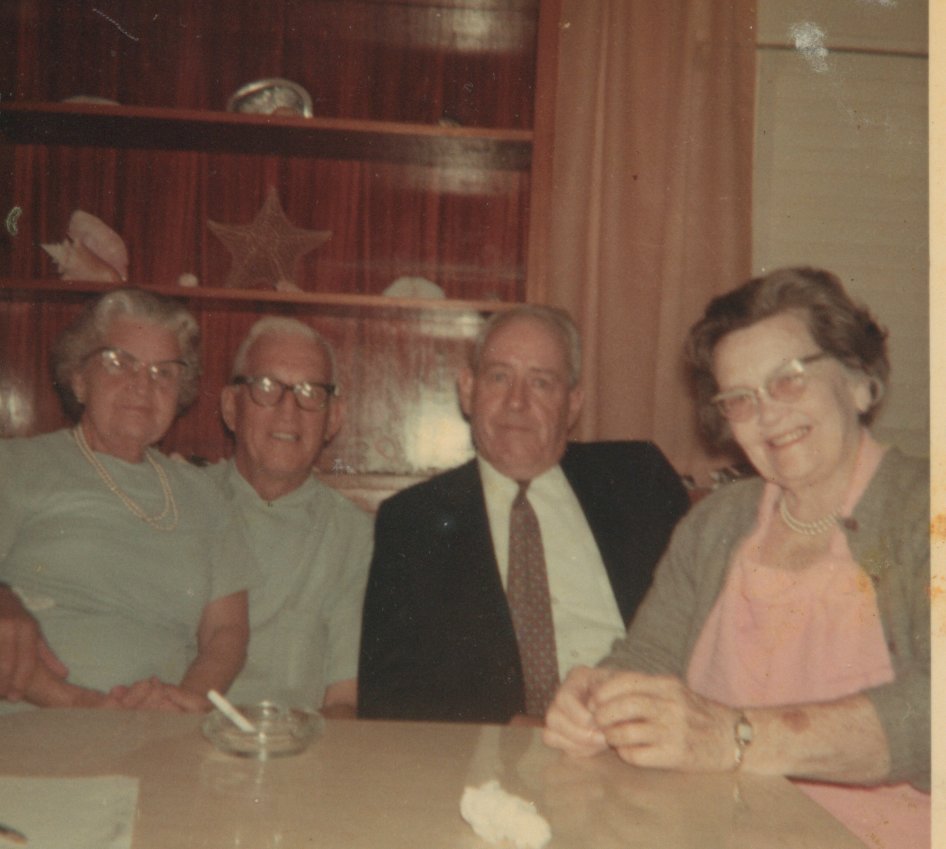
I remember she had friends named John and Alice. I believe we rented their house for a couple months in 1958 before we moved into our house in Hollywood, Florida. I think this might be Alice and John on the left, but I’m not sure. The other man was named Ollie. But that’s all I know.
The next photo might be the last photo I have of my grandmother. I believe it’s with her sister Ruth but it might be Alice. It was taken at the Bayshore Drive apartments, I believe in the 1970s. The last time I visited my grandmother was in 1978. I had just married Susan and we had gone down to Miami so I could introduce her to my grandmother.
Helen Harris died in 1981. I regret not calling or writing her more. If I had known I would one day be writing this essay I would have asked her a lot more questions. And I would have saved more documentation.
The faithful believe they will be reunited in heaven with their loved ones. That would be nice, but I’m not a believer. We’re often told that those who pass will live as long as someone remembers them. Helen Harris might be down to three people who remember her, maybe four. If by chance you do, leave a comment. I might have hordes of unknown relatives that remember her.
One last memory. Once my grandmother told me about her high school class. It was small. I want to say thirty people. She said they had agreed to a tontine, and the last person living would get some object I’ve now forgotten. Over the years, I wonder who won the tontine. I wonder if genealogy research could lead me to her graduation class.
We leave behind very little which proves that we were once here. Eventually, it all fades away.
I joined Ancestry.com so I could upload old family photos. I thought they should be saved somewhere because all my family photos will be thrown away after I die. Many of my photographs have already been converted into digital files, so I figured it would only require looking up the person and uploading the files for that person.
Because the government knows so much about us, I assumed that kinship relationships for the last three or four generations would already be in the Ancestry.com system. That was a big false assumption.
Ancestry.com claims to have over 60 billion records. I don’t know if that’s 60 billion different pieces of paper or 60 billion references to individuals. The trick using Ancestry.com is to start with a name and then use all its records to verify the identity of each person. It’s not easy. You can’t trust any one record. You need to find several records with connecting information that’s already been previously validated.
My assumption was recent family members would be known and family from the past would be harder to identify. It turned out that parents, siblings, cousins, and grandparents are hard to verify but once I did, Ancestry.com offered a lot of hints about my great-grandparents, and their ancestors. However, the hints need to be verified. Those hints are probably based on distant relatives in the past, working up family trees, and those trees might not be accurate.
I was shocked by how many people have similar names, with similar dates of birth and death, coming from the same part of the country. I could very easily add photos of people who were not the people photographed.
Before I joined Ancestry.com and used it, I thought family trees were already well established, and I could quickly upload all my family photos. That won’t be the case.
Just to cover my parents, grandparents, great-grandparents, and great-great-grandparents, I’ll need to research and identify 30 people. I only knew four of them. If I go back to another generation, that would add 32 more people. This completely ignores aunts, uncles, and cousins from each generation. Adding them to my family three would mean researching another hundred people, maybe two hundred.
Another assumption I had before working with Ancestry.com was the belief that building a family tree would help me get to know my ancestors. It hasn’t worked out that way. Finding names and dates to add to my tree reveals nothing about those people.
Genealogy is interesting and even educational. It’s revealing in unexpected ways. It shows that blood is not thicker than water. Kinship is meaningless. Actual interactions with each other are everything.
I’m not sure if saving my photographs will be of any real value. I’ll save them anyway, but I’m uncertain if anyone will care. Now I understand why so many people I’ve talked to about this project said they had zero interest in genealogy. They instinctively knew that people they never met were just meaningless names and dates on a chart
However, learning genealogy offers other rewards. It teaches research skills. It reveals how society knows and remembers people. Pursuing genealogy shows the limits of identity and identification. Unless a person is worthy of a biography, history only knows us by our names, marriages, addresses, birthdates, and death dates. And don’t those details say absolutely nothing about true selves?
Maybe I’m wrong. As I dig into the past, maybe I’ll find revelations I never expected.
By the way, genealogy should benefit greatly from AI.
I recently read An Unfinished Love Story by Doris Kearns Goodwin. It’s about how Doris and her husband Richard went through dozens of boxes containing papers that Richard saved from his time as a speechwriter for John F. Kennedy, Lyndon Baines Johnson, Eugene McCarthy, and Robert Kennedy. Richard was in his eighties and wanted to write a memoir about those times. Doris agreed to help him.
The book is subtitled “A Personal History of the 1960s.” An Unfinished Love Story resonates with me because I lived through that decade too. I’m now rereading their book closely. I want to comprehend what happened in the 1960s and reconcile it with my memories. I do that by looking up original sources mentioned and studying them.
However, I’ve hit a cognitive barrier. I’ve never been a great student, much less a scholar. I have trouble focusing. I can’t stick to any subject long enough to comprehend it. These failings are getting worse as I age.
I’ve discovered a tool that helps me understand my limitations. Maybe it will help me overcome them. That tool is Google NotebookLM. It’s an AI tool that digests information. You link to web pages or upload your documents, and it will analyze that content and then create several kinds of summaries.
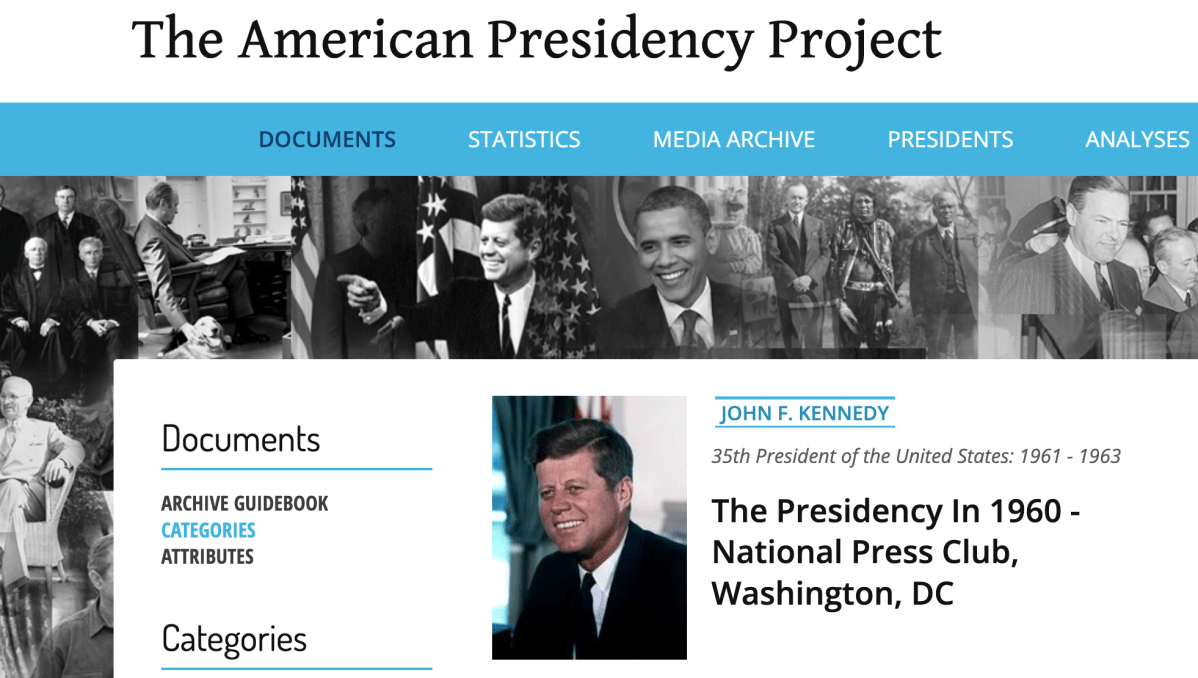
I tested Google NotebookLM with a speech that Richard Goodwin helped write for John F. Kennedy when he was campaigning for president in 1960. It was given at the National Press Club on January 14, 1960. You can read it here. I also gave it this article about that speech. NotebookLM then generated several files that summarized the content of those two documents. The most startling was an AI-generated podcast. You can listen to it here. (You’ll need a free Google account, but anyone using Google email should already be logged in.)
That podcast sounds like an NPR segment. It’s spooky how real the two people sound. But the technology to produce this artificial conversation isn’t what I want to showcase. It’s how NotebookLM understood the speech. It’s a level of reading comprehension that I envy. If I spent a week studying that speech I don’t think I could reach that level of understanding.
Damn, damn, damn!
First of all, Kennedy’s speech was a distillation of extensive knowledge of American political history by Kennedy, Richard Goodwin, and Ted Sorensen. Kennedy expected his audience to decode that knowledge, and to understand his plan for the coming decade. I doubt few did, especially at the level that NotebookLM did.
From reading An Unfinished Love Story, I believe Richard Goodwin could process knowledge like NotebookLM, which is why he was such a brilliant speechwriter. I can’t do anything like that. From this experience, I want to study the results produced by NotebookLM to see if I can learn from it.
Even when I think I understand what I read, I doubt I comprehend even ten percent. I’m quite sure a scholar could write a five-hundred-page book just about that one speech.
NotebookLM created several results. I want to study what it does and see if I can learn to use its techniques.
Here is the summary version.
Briefing Doc: John F. Kennedy's Vision of the Presidency
Sources:

"All notes 12/11/2024" (Study Guide and FAQ on Kennedy's Speech)
"Pasted Text" (Full Text of Kennedy's Speech at the National Press Club, January 14, 1960)
Excerpts from "The Presidency in 1960 (Remarks at the National Press Club) | Teaching American History"
Main Themes:

Active and Engaged Presidency: Kennedy argues for a strong, proactive president who actively shapes policy and drives the national agenda. He rejects a "detached, limited concept of the Presidency" in favor of a leader willing to "place himself in the very thick of the fight."
Legislative Leadership: The president must be an active participant in the legislative process, not simply a "casual bystander." This includes initiating legislation, collaborating with Congress, and using his influence to ensure passage of vital bills.
Party Leadership: Kennedy believes the president must be an active leader of his political party, utilizing its resources and working closely with party leadership to advance his agenda and strengthen the democratic process.
Moral Leadership: The president must not only represent prevailing sentiment but also inspire the nation, set a high ethical standard, and mobilize the public to address challenges and seize opportunities.
Key Ideas and Facts:

Critique of Eisenhower: Kennedy contrasts his vision with Eisenhower's perceived passivity, arguing that the nation needs a more engaged leader for the challenges of the 1960s. He criticizes Eisenhower's preference to remain above politics, stating, "no President, it seems to me, can escape politics."
Historical Examples: Kennedy invokes presidents like Lincoln, Theodore Roosevelt, and Wilson as exemplars of his ideal. He highlights their willingness to use presidential power, exert legislative leadership, and champion moral causes.
Constitutional Vision: While acknowledging the importance of Congress and cautioning against executive overreach, Kennedy views the presidency as the driving force in the American system. He stresses the president's unique role in foreign policy and domestic policy initiation.
Four Key Roles: Kennedy outlines four essential roles for the modern president: Chief Executive, Legislative Leader, Party Leader, and Moral Leader. Each role requires active engagement and a willingness to utilize the full resources of the office.
The Lincoln Anecdote: Kennedy uses the story of Lincoln signing the Emancipation Proclamation to illustrate the kind of decisive and resolute leadership he believes is essential for the presidency. "Lincoln's hand did not tremble. He did not hesitate. He did not equivocate. For he was the President of the United States."
Important Quotes:

On the need for an active president: "The American Presidency will demand more than ringing manifestoes issued from the rear of the battle. It will demand that the President place himself in the very thick of the fight."
On the president's role as Chief Executive: "He must be prepared to exercise the fullest powers of his office – all that are specified and some that are not."
On the importance of legislative leadership: "The President must initiate policies and devise laws to meet the needs of the nation. And he must be prepared to use all the resources of his office to ensure the enactment of that legislation – even when conflict is the result."
On the president's responsibility as party leader: "If he neglects the party machinery and avoids his party's leadership – then he has not only weakened the political party as an instrument of the democratic process – he has dealt a blow to the democratic process itself."
On the importance of moral leadership: "We will need in the sixties a President who is willing and able to summon his national constituency to its finest hour."
Discussion Points:

To what extent does Kennedy's vision of the presidency align with the principles of a constitutional republic?
Does Kennedy sufficiently address the potential risks of an overly powerful executive branch?
How does Kennedy's vision compare to the presidencies that followed him?
This briefing document summarizes the main themes and key ideas of John F. Kennedy's vision for the presidency. It is important to note that this is just one interpretation of his speech, and further analysis and discussion are encouraged.
Here is a FAQ it generated:
FAQ: John F. Kennedy's Vision of the Presidency
1. What is the central theme of John F. Kennedy's speech at the National Press Club?
This speech, delivered in January 1960 during his presidential campaign, focuses on Kennedy's vision for the modern presidency. He argues that the American people deserve to understand a candidate's philosophy regarding the presidency because it shapes their approach to all other issues.

2. How does Kennedy differentiate his view of the presidency from President Eisenhower's?
Kennedy critiques the "detached, limited concept of the Presidency" he observed during the Eisenhower administration. He advocates for a more active and engaged president who proactively addresses pressing issues and drives the national agenda. He contrasts this with Eisenhower's perceived passivity and delegation of responsibilities.

3. What historical examples does Kennedy use to illustrate his preferred presidential model?
Kennedy invokes figures like Abraham Lincoln, Theodore Roosevelt, and Woodrow Wilson as exemplars of strong, effective presidents. He highlights their willingness to utilize the full extent of presidential power, exert legislative leadership, and champion moral causes, even at the risk of political unpopularity.

4. According to Kennedy, what are the essential roles of a modern president?
Kennedy outlines several key roles:

Chief Executive: A hands-on leader who actively manages government departments, resolves conflicts, and makes crucial decisions, particularly in foreign policy.
Legislative Leader: A president who proactively shapes legislation, collaborates with Congress, and uses their influence to ensure the passage of vital bills.
Party Leader: A president who actively engages with their political party, utilizing its machinery and leadership to advance their agenda and strengthen the democratic process.
Moral Leader: A president who inspires the nation, sets a high ethical standard, and mobilizes the public to address critical challenges and seize opportunities.
5. How does Kennedy view the relationship between the president and Congress?
While acknowledging the importance of Congress's legislative role and cautioning against executive overreach, Kennedy believes the president should actively lead and collaborate with Congress. He emphasizes that the president must be prepared to use all available resources to secure the enactment of crucial legislation.

6. What is Kennedy's stance on the president's role as a party leader?
Kennedy rejects the notion that a president should remain aloof from politics. He believes the president must embrace their role as party leader, engaging with the party machinery and working closely with party leadership to advance their agenda and strengthen the democratic process.

7. What is the significance of the Abraham Lincoln anecdote in Kennedy's speech?
Kennedy concludes by recounting Lincoln's unwavering commitment to the Emancipation Proclamation, even when facing internal opposition. He uses this story to illustrate the decisive and resolute leadership he aspires to embody as president.

8. What message does Kennedy aim to convey to the American people through this speech?
Kennedy seeks to persuade the public that the nation needs a strong, proactive president who will actively engage in solving national and international problems. He aims to differentiate himself from Eisenhower's approach and assure voters that he is the leader the times demand.
Here is a quiz it created:
The Presidency in 1960: A Study Guide
Quiz

Instructions: Answer the following questions in 2-3 sentences each.

According to John F. Kennedy, what is the central issue that should be addressed in the 1960 presidential campaign?
Why does Kennedy argue that good intentions are not enough to make a successful president?
What is the "restricted concept of the Presidency" that Kennedy critiques?
What does Kennedy mean when he says that the next president must be the "Chief Executive in every sense of the word"?
Why does Kennedy believe that the president must be an active legislative leader?
How does Kennedy contrast the legislative leadership styles of Theodore Roosevelt and Calvin Coolidge?
What criticism does Kennedy offer of President Eisenhower's approach to party leadership?
Why does Kennedy believe that Abraham Lincoln is a good example of party leadership?
How does Kennedy define the president's role as a moral leader?
What specific historical example does Kennedy use to illustrate the kind of decisive leadership he advocates for?
Answer Key

Kennedy argues that the central issue of the 1960 campaign is the Presidency itself. He believes the public needs to understand how a candidate views the role, powers, and limitations of the office.
Kennedy uses the examples of Woodrow Wilson and Warren G. Harding, both considered good men, to illustrate that good intentions alone are insufficient for presidential success. Different conceptions of the Presidency can lead to vastly different outcomes.
The "restricted concept of the Presidency" refers to a passive approach where the President primarily reacts to events rather than actively shaping them. Kennedy argues this approach is inadequate to address the challenges of the 1960s.
Kennedy believes that being "Chief Executive in every sense of the word" means actively engaging with complex problems, initiating action, and taking responsibility for the outcomes of his administration.
Kennedy argues that the President must be an active legislative leader to ensure the enactment of policies that meet the nation's needs. He contends that Congress should not dominate the executive branch nor should the President shy away from conflict with Congress.
Kennedy contrasts Theodore Roosevelt, who actively fought for his legislative agenda even at the cost of Congressional popularity, with Calvin Coolidge, who took a more passive approach and ultimately failed to advance key initiatives.
Kennedy criticizes Eisenhower's preference to remain above politics, arguing that a president cannot avoid politics and must actively engage with his party to advance his agenda and the democratic process itself.
Kennedy cites Lincoln's passionate engagement in politics, even closely following the results of state elections, as a model for how a president should actively lead his party.
Kennedy defines the president's role as a moral leader as one who goes beyond representing current sentiment and instead inspires the nation to meet challenges and achieve great ideals.
Kennedy uses the example of Lincoln signing the Emancipation Proclamation, despite potential backlash, to highlight the kind of resolute and decisive leadership he believes is essential for the presidency.
Essay Questions

Analyze Kennedy's vision of the modern presidency. What are its key characteristics? How does it differ from the "restricted concept of the Presidency" he criticizes?
Evaluate Kennedy's assessment of the presidencies of Theodore Roosevelt and Calvin Coolidge. How do their approaches to legislative leadership exemplify his broader arguments about the office?
To what extent does Kennedy's call for a "moral leader" in the White House align with the principles of a constitutional republic? Discuss the potential benefits and risks of such leadership.
Kennedy claims that "legislative leadership is not possible without party leadership." Analyze this statement, considering the relationship between the president, Congress, and political parties.
Compare and contrast Kennedy's conception of the presidency with another president or political thinker of your choice. How do their views converge and diverge? What might account for these differences?
Glossary of Key Terms

Chief Executive: The role of the President as head of the executive branch of government, responsible for enforcing laws and overseeing the administration of government agencies.
Legislative Leadership: The President's role in influencing the legislative process, proposing legislation, working with members of Congress, and advocating for the passage of bills.
Party Leadership: The President's role as leader of his political party, setting the agenda, mobilizing support, and working to elect party members to office.
Moral Leadership: The President's role as a national figurehead who sets a moral tone for the country, inspires citizens, and advocates for ethical principles.
Restricted Concept of the Presidency: A passive approach to the presidency where the president primarily reacts to events and defers to Congress or other actors.
Bully Pulpit: A term coined by Theodore Roosevelt to describe the presidency as a platform from which to advocate for policies and ideas.
Grand Alliance: A reference to the alliance of nations that fought against the Axis powers in World War II, emphasizing the president's role as a global leader.
Divided Government: A situation in which the presidency and Congress are controlled by different political parties.
Emancipation Proclamation: A presidential proclamation issued by Abraham Lincoln in 1863 that declared the freedom of slaves in Confederate-held territory.
Here is an outline of sources:
John F. Kennedy's Vision of the Presidency: A Table of Contents
Source 1: Excerpts from "All notes 12/11/2024"

The Presidency in 1960: A Study Guide
Quiz: A series of 10 short-answer questions designed to test comprehension of John F. Kennedy's vision of the presidency as articulated in his 1960 National Press Club speech.
Answer Key: Provides concise answers to the quiz questions, summarizing Kennedy's arguments regarding the importance of presidential leadership, the limitations of a passive approach, and the need for active engagement in legislative, party, and moral matters.
Essay Questions: Poses 5 in-depth essay prompts that encourage critical analysis of Kennedy's vision of the presidency, his assessment of historical presidencies, the role of moral leadership, and the relationship between the president, Congress, and political parties.
Glossary of Key Terms: Defines 10 essential terms related to presidential powers and roles, including "Chief Executive," "Legislative Leadership," "Party Leadership," "Moral Leadership," and "Restricted Concept of the Presidency," providing a conceptual framework for understanding Kennedy's arguments.
FAQ: John F. Kennedy's Vision of the Presidency
8 Frequently Asked Questions and Answers: Addresses key aspects of Kennedy's National Press Club speech, including his central theme, critiques of Eisenhower's approach, historical examples used, essential roles of a modern president, and the relationship between the president and Congress. This section provides a concise overview of Kennedy's arguments.
Source 2: Excerpts from "January 14, 1960 - Senator John F. Kennedy speaks at National Press Club, Washington, DC."

Fragment 1: This excerpt captures Kennedy's criticism of the Eisenhower administration's "restricted concept of the Presidency," highlighting the need for a more active and engaged approach to address the challenges of the 1960s.
Fragment 2: This segment emphasizes the need for a president who actively engages in the legislative process, contrasting this with a "casual bystander" approach that Kennedy deems insufficient.
Source 3: Excerpts from "Pasted Text"

Introduction: Sets the stage for Kennedy's argument by highlighting the importance of understanding a candidate's vision of the presidency and framing it as the central issue of the 1960 campaign.
Critique of the Eisenhower Administration: Kennedy critiques the "detached, limited concept of the Presidency" he observed during the Eisenhower years, arguing for a more active and engaged presidential role.
The Demands of the Times: Kennedy outlines the challenges facing the nation, both domestic and foreign, and argues that they require a strong, proactive president.
The President as Chief Executive: This section emphasizes the president's role as a hands-on leader who actively manages government, resolves conflicts, and makes crucial decisions, particularly in foreign policy.
The President as Legislative Leader: Kennedy argues for a president who actively shapes legislation, collaborates with Congress, and uses their influence to ensure the passage of vital bills.
The President as Party Leader: Kennedy rejects the notion of a president staying above politics and stresses the importance of engaging with the party machinery to advance an agenda and strengthen the democratic process.
The President as a Moral Leader: This section highlights the president's role as a national figurehead who sets a moral tone for the country, inspires citizens, and mobilizes the public to address critical challenges.
The Example of Abraham Lincoln: Kennedy concludes with a powerful anecdote about Lincoln's unwavering commitment to the Emancipation Proclamation, emphasizing the decisive and resolute leadership he aspires to embody as president.
Source 4: Excerpts from "The Presidency in 1960 (Remarks at the National Press Club) | Teaching American History"

Context and Introduction: Provides historical background and sets the context for Kennedy's speech, emphasizing the significance of his remarks within the broader history of the American presidency.
Kennedy's Speech Excerpts: Features key excerpts from Kennedy's National Press Club address, focusing on his critique of Eisenhower's approach, his vision for the modern presidency, and the importance of active leadership in various roles.
Discussion Questions: Poses thought-provoking questions that encourage readers to analyze Kennedy's conception of the presidency, his use of historical examples, and the relationship between the president and Congress.
Footnotes: Provides explanatory notes on historical figures and events mentioned in Kennedy's speech, enhancing understanding and facilitating further research.
This table of contents provides a detailed overview of John F. Kennedy's vision of the presidency as articulated in his 1960 National Press Club speech and related sources, offering insights into his beliefs about presidential leadership, the role of the president within the constitutional order, and the challenges facing the nation at the dawn of the 1960s.
Many people will use NotebookLM to help them write, or even let NotebookLM create their content. I watched one YouTuber use NotebookLM to produce a blog and podcast. I don’t want AI doing my work. I want to learn how to work at an AI level.




 Auxiliary Memory