Can Rereading THE WONDERFUL WIZARD OF OZ Help Me Remember What It Was Like to Be Ten Years Old?

by James Wallace Harris, 12/5/25

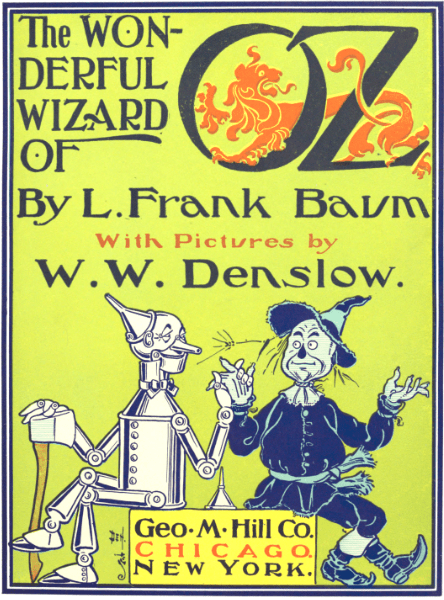
While watching Wicked, I struggled to recall the excitement I felt when I first read the Oz books at age 10 back in the summer of 1962. I wanted to know whether the fantasy world Wicked created matched the one L. Frank Baum created in his fourteen Oz novels.

The barrier to making this comparison is memory. Memories are highly unreliable. Plus, we overwrite our memories every time we recall them, so am I really remembering 1962, or just the last time I thought about reading the Oz books as a kid?

Like most of my brain excavations, I have to rely on logic and deduction instead. I also look for corroborating evidence. I spent many days on this problem, and here are my results.

The Oz books were the first novels I discovered on my own. For various reasons, I concluded this was the summer between the 5th and 6th grades. My family lived on base at Homestead Air Force Base, and I found the Oz books in the children’s wing of the base library. They were old and worn.

The first novel I remember is Treasure Island by Robert Louis Stevenson, which my mother read to me in the third grade. I started using libraries in the fourth grade, but read nonfiction books about airplanes, space travel, cars, and animals.

I remember roaming up and down the fiction section at the base library and discovering the Oz books. I had no idea who L. Frank Baum was, nor did I have any idea when they were written. I didn’t know about copyright pages or genres. I saw “Oz” on the spines and connected those books to the 1939 film, The Wizard of Oz, which I had seen on television every year since the 1950s.

I did not know the word fantasy. I doubt I understood the concept of fiction. In other words, these books were an exciting discovery. To compound that excitement, they were all set in the same fictional universe. They were my Harry Potter books. L. Frank Baum had tremendous world-building skills.

Analytically, I know that at ten, I didn’t know much about the world. My vocabulary was limited. And I was unaware of most concepts and abstractions. My previous beliefs in fantasy – Santa Claus, the Easter Bunny, and the Tooth Fairy had caused me great embarrassment in first grade when a girl called me a baby for mentioning them. I was five, she was six.

In other words, I knew Oz did not exist, even though Baum created so many wonderful details to make it believable. I remember wanting Oz to exist, but I knew it didn’t. I don’t think I grasped the idea of fantasy at that time. All I knew was that the books created an artificial reality in my mind that was mesmerizing.

Watching Wicked and then rereading The Wonderful Wizard of Oz this week let me compare the two versions of Oz, but I couldn’t compare my initial reactions. Wicked is quite colorful, creative, and contains many elements of the original stories, but it no longer worked on me as the Oz books had in 1962. And that’s to be expected, since I’m 74, long past the age for fairytales.

My quest changed. I now wanted to know how my ten-year-old self saw the world. Rereading The Wonderful Wizard of Oz gave me very few clues.

My contemplations led me to some ideas, though. I have damn few memories of life before age five. I have zillions of memories dating from age five to twelve. I started thinking about them, and a revelation came to me.

Before age five, I theorize our minds are like LLMs (large language models). Those AIs can take in information and react to it, but they are unaware of the world. After five, but before puberty, we develop some self-awareness, but it’s very limiting. It isn’t until around twelve or thirteen that we start thinking for ourselves.

Here’s my main bit of evidence. As a child, my mother told me about God and took my sister and me to Sunday School and church. I just accepted what I was told. But when I was twelve, I started thinking about what they were telling me about religion. I didn’t buy it. I considered myself an atheist by 1964, when I was thirteen, maybe fourteen.

In my thirties, when I was working in a library, I came across an article that said that some librarians in the 1950s felt the Oz books gave children unrealistic expectations about life, and pulled the books from their shelves.

When I read that, I knew it had been true for me. The Oz books led me to science fiction, a genre that also inspired unrealistic expectations regarding the future that have proven to be unrealistic.

Here’s the thing: I was being told two fantasies at age ten. The first was from The Bible, and the second from the Oz books. Looking back, I see that my young self began to reject religion at age ten because I preferred the stories from L. Frank Baum. I wasn’t aware that I was comparing two fantasies; I just preferred one over the other.

Then I discovered science fiction. Concurrently, I was also discovering science. That gave me the illusion that science fiction was reality-based. When I consciously rejected religion, I thought I was choosing science. However, in recent decades, I’ve realized I had substituted science-fictional fantasies for religious fantasies.

I realize now that the Oz books had the power of Bible stories on me at age ten. The reason why so many people are true believers as adults is that they were programmed as children. Wicked doesn’t have that kind of power over me today. I can’t remember what that power felt like, but I do remember that for a few weeks in 1962, the ideas in the Oz books set my mind on fire. Rereading The Wonderful Wizard of Oz did not reignite that fire because I’m no longer a believer in anything.

I’ve often wondered if I hadn’t been lied to about Santa Claus, the Easter Bunny, and the Tooth Fairy, and thus had not experienced humiliation at discovering they were lies, and if I also hadn’t discovered Oz books, would I have accepted the Bible stories as truth as a kid and believed them now?

JWH

Reading at 13 vs. 73

By James Wallace Harris, 10/19/25

At thirteen, I read books entirely differently than I do now at seventy-three. I think everyone does, but it’s not apparent why. Our memory gives us the illusion that we’ve always been the same person. But if we think about it, there is plenty of evidence that we couldn’t have been.

I’ve been thinking about the difference between my younger reading self and my older reading self while writing a review of The Foundation Trilogy by Isaac Asimov for my other blog. Every so often, I reread a book I read as a teenager. For some books, it’s a nostalgic return to a familiar, comfortable place. For most books, it’s just vague recollections.

My first realization from trying to reconstruct my reading mind at age 13 was to remember that I read very fast. I consumed books like potato chips. Reading was like casually watching TV. Words just flowed past my eyes, and I didn’t always pay attention to every word. I just read to find out what happened.

I have a fond memory of reading The Foundation Trilogy, but a limited one. I liked the idea of a galactic empire in decline. However, the only chapter I can remember is the first one, “The Psychohistorians.” It wasn’t until decades later that I learned that the trilogy was a fix-up novel based on nine stories running from short stories to novellas.

Thinking about it now, I realize that most of the ideas in the book didn’t mean much to me at 13. I had not studied or read about the Roman Empire, Asimov’s inspiration. Actually, I probably didn’t know what an empire was either. Nor did I understand all the references to nobility, aristocracy, and politics.

As a teenager, I mostly read science fiction books. I did read some popular science books too. My awareness of the world and my vocabulary were limited. However, I didn’t know that. And I wasn’t the kind of person who looked up words I didn’t know. What’s weird is that I was a kind of know-it-all.

One way to judge my teenage brilliance was that my favorite TV show at the time was Gilligan’s Island. When I catch that show today, I can only assume I was brain-dead back then.

I’ve tried to reread The Foundation Trilogy twice now. The first time was in 2015, and now in 2025. In both cases, I could only finish the first book of the trilogy. I loved the first story, but with each additional story, I detested them more.

At first, I thought that Asimov’s most famous books were just bad. But I’ve known people smarter than me, and just as old, who say they still loved the Foundation series. One woman in our reading group said the Foundation stories were a great comfort to reread. And I recently heard that twenty million copies of the series have been sold.

Not only was my current reading self different from my younger reading self, but I’m out of step with millions of readers. This got me thinking about the different modes of reading.

I think the most basic mode is just to let fiction flow over you. You read whatever pleases you. And you don’t think about why.

Then, as we age, we become more judgmental. We learn more about life and reading. We develop a process of natural selection by rejecting what we don’t like. We don’t think much about why we don’t like what we don’t like. We just evolve into a reading machine that knows what it likes.

Two other reading modes are: English teachers or literary critics. These are very critical modes, and often they take the fun out of reading. I think as I’ve gotten older, my reading habits have taken on a bit of these two modes. While in them, it’s all too easy to shoot Asimov down.

However, I’ve discovered another mode recently when I read “Foundation” for the fourth time. “Foundation” was the first story published in the series in 1942. While reading this story yet again, I kept admiring Asimov for where he succeeded and not where he failed.

In my rereadings, I’ve always come to the series wanting to love it. And I’ve always been disappointed by how much I didn’t. But with this reading, I worked to think like Asimov. What was he trying to do, and how did he go about doing it?

I’m in the process of documenting this for my other blog, Classics of Science Fiction. I’m writing this now because the other post is going to take a long while to complete.

I never would have put this much effort into reading a story when I was a teen. Or any time before I was 73.

One reason I dislike this story in recent years is my skepticism. I don’t believe humans will ever travel to the stars, much less form a galactic empire. Another reading mode I’m trying to develop is to read with the mind of a person from when the story was first published.

Trying to read like Asimov thought and how science fiction fans felt in 1942 is difficult. I’m reminded of Samuel R. Delany’s concepts of simplex, complex, and multiplex that he described in his story Empire Star. I started out as a simplex reader and eventually evolved into a complex one. Now I’m moving into a multiplex reader.

Multiplex thinking often involves holding contradictory viewpoints. I really dislike the Foundation stories. But if I work at it and look at them in just the right way, I can like them too. It’s hard. It’s a Sisyphean struggle learning to admire something that triggers so many annoyances, but I’m working on it.

JWH

My Attachment to Old Magazines

by James Wallace Harris, 9/6/25

I’ve always loved magazines. I worked six years in the periodicals department of a university library. As a kid, I loved all kinds of magazines. Even before I could read, my sister and I found a pile of old magazines in the attic of the house my parents were renting. The pile was as high as we were. It was old picture magazines, like Life and Look. Becky and I loved looking at the pictures. Magazines were like television, showing us people and places we’d never seen.

Later on, when I had a few coins, I’d buy magazines like Popular Science and MAD. Eventually, I discovered science fiction magazines. My favorite was The Magazine of Fantasy & Science Fiction, but I also loved Galaxy, Analog, Amazing, and Fantastic. I eventually subscribed to the first three around 1968. I also loved finding old issues at used bookshops for a dime or quarter.

By 1975, I had collected more than three-fourths of F&SF’s back issues. By then, I had also acquired pulps going back to 1928. Holding those magazines made me feel like I owned a piece of the past. I loved that. But in 1975, I had to sell my magazine collection.

Then in the 2010s, I started collecting those old magazines again through eBay. I eventually found 90% of the issues of F&SF published before 1975, and about 30% of those published after that. I also picked up about 95% of Galaxy.

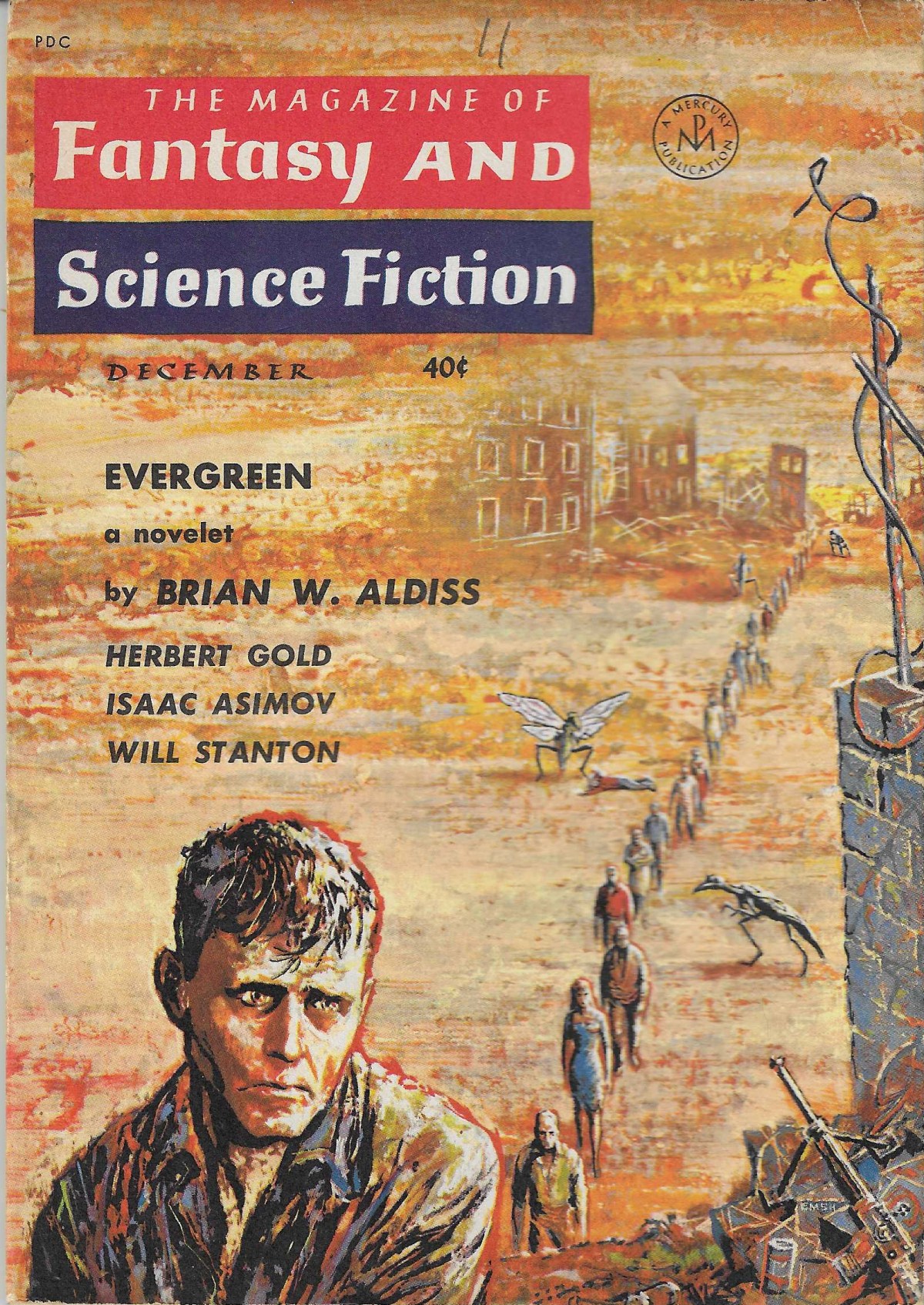
Today, I started thinking about selling those old magazines. I took down the December 1961 issue of F&SF and read the beginning of each story. Every story hooked me, but I didn’t keep reading. I have this tremendous attachment to these old magazines, but I also feel a great need to have fewer possessions.

I have scans of all these magazines that I read on my tablet. In fact, it’s easier to read the scans than the original paper copies. The paper copies are becoming fragile. They are collector items, and I don’t want to hurt them.

I considered donating my magazine collection to the Friends of the Library, but I worry they won’t receive the love they deserve. I’m arranging to sell them on eBay. That way, a collector will acquire them. But it’s disturbing me to do this.

When I held the December 1961 issue of F&SF, it triggered a wave of nostalgia. It hurt me to imagine parting with it. I don’t value things. My truck is 26 years old. My watch cost $15. My clothes are Amazon Basics. I see no point in gold or diamonds. There’s nothing I own that’s expensive or trendy. If I’m not using something, I give it away.

If I had the choice between having the Mona Lisa on my wall or a complete run of F&SF, I’d pick the magazines.

Why am I so attached to these old magazines? It’s not the content because I have digital copies of all of them.

The best answer I can think of is this: Holding them recalls the past that no longer exists. If I didn’t have them, I wouldn’t have that connection to the past. Their covers are like photographs that remind me of who I used to be. Buying them on eBay was like buying back part of me that no longer exists.

I need to let them go. I feel like the kid in an old movie who has to free a wild animal they rescued. I rationalize to myself that whoever buys them will love them in the same way I have.

Over the last decade, since I’ve been retired, I’ve been trying to recapture my past by buying things I once owned. But I don’t want to be some old boomer dude living in the past.

Psychologically, I didn’t think I’d live this long. Now that I’m 73, I’m wondering, what if I live another decade or two? I don’t want to waste all that time living in the past.

I wonder if we recall who we were when it feels like the end is approaching. I’m not feeling that now. I wonder if I will buy another run of F&SF when I’m 88?

JWH

Do You Trust What You Read?

by James Wallace Harris, 8/4/25

Yesterday I tried to remember what I thought about as a young kid. I recall a few incidents when I was three, but I don’t start having many memories until I was around twelve or thirteen. The earliest age I can recall being philosophical is from that same period. Before twelve, I can’t remember thinking about things. I probably did. Very young kids are notorious for asking why.

But then I thought of something. It was around age eleven or twelve that I started reading books. The first books I chose were nonfiction about airplanes, space travel, dinosaurs, submarines, cars, and other things that boys like in the fourth and fifth grades. Fourth grade was 1960-1961. I turned ten in late 1961. In the fifth grade (1961-1962), I discovered fiction. Especially, the Oz books by L. Frank Baum and the Tom Swift, Jr. series. In the sixth grade (1962-1963), I got hooked on biographies and a few science fiction books.

It seems obvious that reading inspires thinking.

It was around the sixth grade, or the beginning of the seventh grade, that I can remember thinking about the world. During the seventh grade, and into the eighth, I became an atheist. I remember agonizing over that issue. What I heard in church and from my mother didn’t match what I was experiencing. Nor did it match what I was learning in school or what I was reading. I didn’t read any books on religion or against religion. All the ideas I consumed, especially from books, made me think.

Here’s the kicker. I read a lot of crappy books with crappy ideas, and they infected me. Ideas about flying saucers, reincarnation, ESP, and remembering past lives, like in Bridie Murphy. Most of this came from my uncles, my father’s two brothers.

After rejecting religion, I eventually rejected the occult, spiritualism, and psychic abilities. I rejected them because I read more science books and science fiction. I was skeptical of what was in the science fiction books, but I wanted to believe many of SF’s stupid speculations about the future. The genre promised a more exciting reality that competed with religion.

I didn’t become truly skeptical until many years later. Maybe when I encountered the magazine, The Skeptical Inquirer.

The point I’m trying to make, with this long introduction, is to explain how I was overwhelmingly influenced by what I read. Even after a lifetime of skepticism, I’m easily swayed by concepts I got through books and magazines.

Of course, I’m also susceptible to ideas from my peers, television, and the Internet. Whenever I hear about a neat concept, one that sounds like it helps explain reality, I want to embrace it. I’m easily persuaded by intellectuals and studies that claim to be scientific.

Decades ago, I decided that science was the only cognitive tool humans had developed to explain reality in any consistent fashion. Science is statistical. It doesn’t offer conclusive answers. To truly understand science requires a great deal of science and mathematics. I don’t have those skills. I depend on popular science, and that isn’t the same thing. Accepting an idea based on popular science is similar to being religious and taking a theological concept on faith.

The only way to be scientifically minded without being a scientist is to look for the most consensus among scientific authorities. And this is true for understanding everything that doesn’t fit under the scientific microscope, such as politics, law, ethics, and creating a sustainable society.

Since 2016, I’ve decided that humans are all delusional, including myself. There are dozens, if not hundreds, of ways to be deluded. I decided I couldn’t trust the Internet or television. That I would only trust quality periodicals that had solid editorial policies. Unfortunately, such magazines and newspapers are going out of business.

People no longer want to pay for information. Television and the Internet have conditioned Americans to consume free information. And if you can’t see how that is destroying us, then that’s another delusion you are suffering from.

Humans eagerly embrace untrue concepts that support their desires. We even have labels for that delusion: confirmation bias, wishful thinking, motivated reasoning, and cognitive dissonance reduction.

I’m reminded of what the Jeff Goldblum character said in the movie, The Big Chill. “I don’t know anyone who could get through the day without two or three juicy rationalizations. They’re more important than sex.”

I want to separate myself from my rationalizations. The only way I can think to do that is by reading significant research. What I think depends on what I read. That means being extra careful with selecting my reading.

It also means I need to support the periodicals doing the best job of explaining reality.

JWH

The Young Adult Novels That Shaped My Childhood

by James Wallace Harris, 7/22/25

I’ve been amazed by how fanatical young people have become over their favorite pop cultural icons. My wife and I watch Jeopardy every day, and the clues are often based on successful pop culture franchises. Comics and young adult novels dominate, especially at the movie theater. Billions of dollars are spent by their fans, and children and young people often identify with certain characters.

At first, I thought all of this was new. The Beatles had worldwide fame, but I can’t think of any fictional characters that were as popular in the 1960s as those that have emerged in the 21st century. Star Trek and Star Wars fandoms began to evolve in the 1970s, but it wasn’t until the advent of the World Wide Web that they achieved pop culture universality.

Many consider science fiction fandom the first. It began in the late 1920s and by 1939 had its first World Convention. However, we’re only talking hundreds. I considered myself a science fiction fan in junior high, but it wasn’t until the 10th grade that I met another fan in person. That was 1967.

Looking back, I realize it was YA novels that made me a fan, too. At seventy-three, I wonder if I would have had a different life if I had discovered the works of another author first.

I realize now that reading books was my way of coping with the stress of growing up. Just after JFK’s assassination in November 1963, my family began to fall apart. In 1963-1964, I attended three different 7th-grade schools, and two 8th-grade schools, in two states, and lived in four different houses. My parents became obvious alcoholics, their marriage began to unravel, and my dad had his first heart attack. Somehow, I remained a happy kid.

Just before I turned thirteen, when I began the 8th grade in September 1964, I discovered the young adult novels of Robert A. Heinlein. They didn’t use the term young adult back then, but called them books for juveniles. Juvenile delinquency was also a common phrase back then. Before that, they were called books for boys. There were also books for girls. Gender roles were specific back then. This was when newspapers divided job listings into “Men Wanted” and “Women Wanted.”

Discovering Robert A. Heinlein and science fiction gave me a positive outlook on life and my future. I especially identify with the Heinlein juveniles. I remember at the time believing Heinlein would have a literary reputation similar to Mark Twain by the time the 21st century rolled around. That hasn’t happened. Heinlein is often shunned by modern readers of science fiction. I accept much of the criticism regarding his adult novels published after 1960, but I still embrace his young adult novels and other work published before 1960.

Charles Scribner’s Sons, famous for publishing Hemingway, F. Scott Fitzgerald, and Thomas Wolfe, first published the twelve Heinlein juveniles between 1947 and 1958. The Heinlein juveniles were highly regarded by librarians and schools. I discovered them because my 8th-grade teacher put them on her approved reading list. She required our class to read three novels, three magazine articles, and three newspaper articles every six weeks. If we didn’t, she lowered our grade one letter. If we read five of each, she raised our letter grade by one letter. I always read the five of each because I’m terrible at diagramming sentences and understanding grammar. That upped my C to a B each report card.

For over sixty years now, I have been grateful to this teacher. Sadly, I can’t remember her name.

I keep hoping YouTube book reviewers will read Heinlein’s juveniles and reevaluate their judgment on Heinlein. Over the decades, I’ve read memoirs by scientists, writers, and astronauts about how they loved the Heinlein juveniles when they were young, and the impressions the books made on them.

I’ve been meaning to reread all the Heinlein juveniles again and judge them without the influence of nostalgia. Has sentiment clouded my perspective? I fear my love of these books is similar to how people embrace religion when young. Ideas often brainwash us in youth, and it’s almost impossible to deprogram ourselves. Our species suffers from delusions. No one is free of being fooled by beliefs. For every individual, it’s a matter of how delusional.

At seventy-three, I’m taking a hard look at what science fiction did to my mind and personality. I’m starting with the Heinlein juveniles because I believe they were at the Big Bang of my becoming self-aware.

Before I got into science fiction, I consumed the Oz books by L. Frank Baum. I read an article in my thirties about how some libraries pulled the Oz books off their shelves because the librarians worried they gave children unrealistic expectations about life. At the time, I thought that was silly. However, I realized I had grown up with many unrealistic beliefs about life. At the time, I believed the Heinlein juveniles had made me more realistic. Four decades later, I know that was wrong too.

When I took computer programming classes, they taught us the term GIGO – garbage in, garbage out. Have all the pop cultural fantasies we’ve consumed caused our delusional adult beliefs? Humans have always been susceptible to religious fantasies. Haven’t we just replaced those with pop cultural fantasies?

I love the Heinlein juveniles. Why? If I understood why, would I still love them?

JWH