Corrupt Biblical Archaeology

by James Wallace Harris, Saturday, August 17, 2019

Yesterday I encountered two reports of Biblical scholarship that depressed the hell out of me. I’m an atheist, but I find historical biblical research fascinating. The first encounter was with the new issue of Harper’s Magazine and its story “Common Ground: The politics of archaeology in Jerusalem” by Rachel Poser, a senior editor for the magazine. (Harper’s offers one free article a month to read behind its paywall, so if you click the link it will count.) Poser’s report is about how right-wing activists have coopted archeology to justify Israel’s reclaiming land in Jeruselum. It’s a long, but fascinating report about right-wing politicians and zealots corrupting the science of archaeology, and their feuds with secular scholars who are seeking an unbiased understanding of the past.

My second encounter was last night on Netflix with the third episode of The Bible’s Buried Secrets entitled “The Real Garden of Eden.” Host Francesca Stavrakopoulou, Professor at the University of Exeter makes a rather strained case that a garden in a palace of ancient Jeruselum was the Garden of Eden, and Adam was their king. Stavrakopoulou uses almost no quotes from Genesis and builds her argument with an hour’s worth of archaeological evidence that seems flimsy at best. I can’t prove she’s wrong, but I’ve heard much better theories.

In both of these encounters with Biblical archaeology, it was obvious that science was being corrupted by shoehorning evidence to fit a cherished hypothesis. Of course, for thousands of years, humans have used ancient scripture as a kind of legal precedent to justify their claims. In both the article and documentary, archaeologists cherry-picked their findings and didn’t offer opposing evidence, either from valid scientists or their counterpart ax-grinders.

If you read the articles returned in this Google search, you’ll see many challenges to Stravrakopoulou’s hypothesis. Everyone has an opinion, everyone has a theory, everyone has their evidence. There are scholars who pursue rigorous biblical scholarship and biblical archaeology, but how do we tell the cranks from honest academics?

Actually, a good place to start is Wikipedia’s entry on The Garden of Eden. At least it summarizes the complexity of the problem. Rachel Poser’s description of Elad’s effort to prove the biblical David existed and the sites Elad’s archaeologists were excavating belong to David’s kingdom are simplistic in their logic and evidence. Stavrakopoulou case for Eden is also simplistic. And if you pay attention to any of the popular documentaries about biblical history and archaeology, they’re often simplistic too. Everyone seems to be trying to deceive other people into accepting their pet theories. Is there any way of not being conned?

First of all, does the Garden of Eden or King David really matter to the modern world? I would distrust anyone who uses any biblical history as validation for any present-day disputes over morality, ethics, land, laws, etc. They are only academic issues. Researching history, and evaluating it with archaeological evidence is a fun intellectual pursuit. But if you use it for any kind of justification of action, then it’s a complete fallacy.

I find it insane that modern minds use ancient thoughts to rationalize how we should live today. We should have laws against using old beliefs for legal precedent. Read Poser’s article. It’s horrifying how we’re using three-thousand-year-old fables to kill each other.

To Christians and Jews, the world began four thousand years ago, and they struggle to overlay that fantasy onto reality. They ignore the fact that more ancient civilizations surrounded the Levant even at the time of Genesis. Even when Adam and Eve were supposed to be walking in the Garden of Eden humans had been around for hundreds of thousands of years, or that David’s Kingdom was an itty-bitty bump in the road between two vast empires.

I don’t know why western civilization is so focused on the tiny Holy Lands of the Bible when Earth is thousands of times bigger. It’s as if we all have a kind of history myopia that fails to see the planet and its history as a whole. I think the main problem is we’re raised with only one set of myths. Would we be more rational if our parents sent us to a different church/temple/synagogue/mosque/shrine every week as a child? Our insanity seems to come from trying to rationalize one viewpoint at the exclusion of all others.

The story of the Garden of Eden in the Book of Genesis is a wonderful work of literature from pre-history. It’s a fascinating challenge to try to understand why it was written, by who, and when. But imagine if three thousands years from now, people revered a copy of Gone with the Wind as their only source of American history.

One solution might be to invite Asian archaeologists to dig up the Holy Lands, ones who had never been exposed to The Bible.

JWH


The Young Are Politically Active Again

by James Wallace Harris, Tuesday, August 13, 2019

Last night I watched the two most recent episodes of The Weekly, a new TV show from The New York Times that premieres on FX Sunday nights and then go to streaming the following day on Hulu. There’s a fascinating contrast between episode 8 “Hard Left” which shows mostly young women activists on the left campaigning hard for The Green New Deal, and episode 9 “Down the Rabbit Hole” with mostly male activists on the extreme right making political change in Brazil. Young people are getting elected in Brazil because of their YouTube skills. Young liberals are making swift progress coopting the 2020 Democrats using political theater that would have made Abbie Hoffman proud.

Despite their polar philosophies, both sides use social media to a savvy degree. This is why I highly recommend reading LikeWar, a new book about the political weaponization of social media. It’s also why I recommend The Great Hack currently streaming on Netflix. The 2016 election results caught most people by surprise. If you want to stay ahead of the game for 2020 you need to understand how political tactics evolved on the web. If you only watch the nightly news you’re going to be clueless again.

I don’t think the young have been as politically active since the 1960s. The episode “Hard Left” is about how the Sunrise movement is forcing the Democrats to move far to the left and splitting the party. “Down the Rabbit Hole” is about how YouTube’s algorithms help the extremists on the right around the world.

What’s interesting is how the young are aligning themselves with older political extremists. I remember the passions of the activists of the 1960s, and I think that’s happening again. There seems to be a new generation gap, with young extremists on the far left and right, with most of the older Baby Boomers in the middle seeking compromise. The young aren’t in a compromising mood. Things will probably get much nastier.

But watch both episodes, it’s also about gender, starkly revealed in these two documentaries. Once again, the males don’t come off well.

I have a feeling that most folks my age will be horrified by these new radicals. I’m glad to see them. Our time is almost over, the future belongs to the young. Whether they are right or wrong, left or right, they need to take responsibility. I admire the Sunrise movement, they realize inheriting a liveable planet is up to them because our generation ain’t going to do shit.

But isn’t it odd that all this coincides with the 50th anniversary of Woodstock? Civil rights, second-wave feminism, and the ecology movement all peaked back then too. I saw a lot of the 1960s in the two episodes of The Weekly. But watching The Great Hack is something different. It’s like watching science fiction.

The above photos are of Rhiana Gunn-Wright and Kim Kataguiri.

peace-300x300

JWH

Owning a Piece of History

by James Wallace Harris, Friday, August 9, 2019

A few weeks ago I watched “Galileo’s Moon” on the PBS show Secrets of the Dead. It was about a copy of Sidereus Nuncius (1610) by Galileo showing up for sale, one of the most famous science books in history, and it even had Galileo’s signature. The show was about how antiquarian book dealers and scientists worked to authenticate rare books. I thought it would be wonderful to own such a significant piece of history, and it disturbed me that rich people could buy these timeless treasures for themselves.

I’ve long wanted to own a rare scientific book and wondered if I could afford any volume published before 1700. Books by Galileo run in the hundreds of thousands to the millions. I’m sure I could probably find something I could afford, but it’s doubtful I would have ever heard of it.

During the course of the show, they interviewed Marino Massimo De Caro whose home was a museum to Galileo, astronomy, and space history. I realized if you’re going to own such unique treasures you have to preserve and maintain them. Anything that’s over 400 years old needs to be protected so it might exist for another 400 years, or even 4,000 years. I couldn’t handle that responsibility.

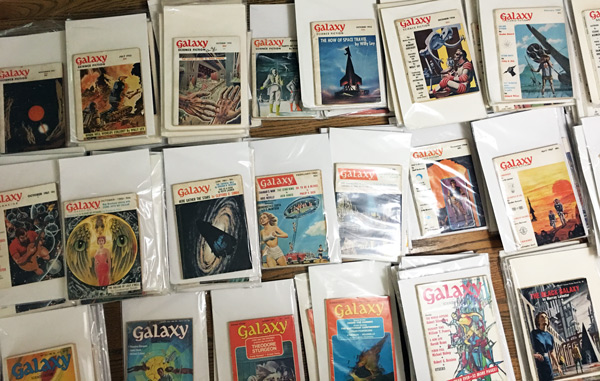
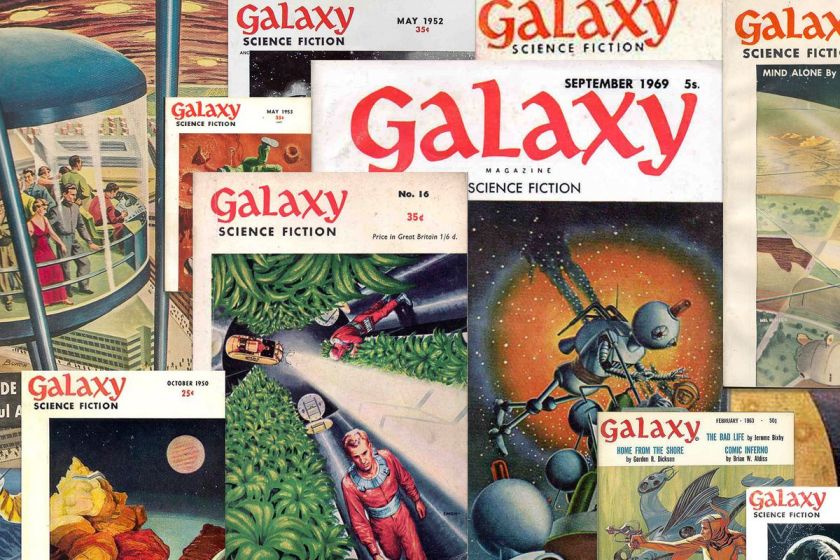
Then I saw three lots of Galaxy Science Fiction on sale at eBay. I already have access to all its issues as digital scans, so I didn’t need reading copies. However, I decided it would fulfill my desire to own something historic. Of course, old science fiction magazines won’t be historic to 99.9999% of Earthlings, but among the people who know the history of science fiction magazines, they would be. There were 355 issues published between 1950 and 1976 and I got 165 of them, just under half. Quite a purchasing coup.

One reason I even checked eBay to see if they were available is that I’m reading, Galaxy Magazine: The Dark and the Light Years by David L. Rosheim. And I read it because I just finished reading The Way the Future Was a memoir by Frederik Pohl who edited Galaxy in the 1960s. Between those two books and other science fiction histories I’ve been reading, I know how important Galaxy Science Fiction was to the genre in the 1950s and 1960s. I started reading Galaxy in the mid-1960s and had collected many back issues then. By 1971 I was even trying to collect the earliest science fiction magazines. My first purchase of pulps was four issues of Amazing Stories from 1928. Amazing Stories began in April 1926 and was the first science fiction magazine. In 1975 I sold all my magazines and decided not to collect anything anymore. Owning objects is a burden, especially stuff that takes a lot of movers to relocate.

In the last couple of years, I’ve rekindled my love of old science fiction magazines but I’ve satisfied my need for them with digital scans I get off the internet. If I hadn’t seen that program about Galileo I doubt I would have had that hunger to own something old. But it’s given me great delight to bid for them on eBay and win the bid. And it’s been big fun going through the issues. But I now realize I’m in the same situation as big-time collectors of rare books – how do I protect and preserve my pieces of history?

I got these Galaxy magazines pretty cheap, so they aren’t precious. But they are historical in a tiny way, and they are disappearing. Most people throw away magazines. I bet my wife will throw these magazines away when I die. I’ll need to make a provision in my will to give them to someone who will cherish them too. However, I would assume such people would also be dying out, but a few lovers of old magazines are born in every generation.

On Facebook, Twitter, and eBay I meet people who collect much older magazines. Today I met a young man online who collects 19th century Dime Novels. If these issues of Galaxy are preserved, there will be a handful of people in the 22nd century that will want them. I could increase their value if I would track down and buy all the other issues too. I might, but I’m already feeling the burden of their weight on my Buddhist soul. I will probably enjoy these issues for a couple years and then sell them.

Even if I could afford a copy of Sidereus Nuncius, I doubt I’d want to own it long. Old stuff really belongs in museums and libraries so everybody can enjoy them.

Galaxy magazines from The Verge

JWH (Happy Birthday Jim Connell)


Keeping Up In The 21st Century

by James Wallace Harris, Thursday, August 8, 2019

I’m reading a rather disturbing book, LikeWar: The Weaponization of Social Media by P. W. Singer and Emerson T. Brooking. It’s disturbing for a number of reasons. First, it shows how completely out of touch I am. Second, it’s very relevant about today’s politics, problems, and conflicts, but makes me realize that I don’t have the tech skills I thought I had – and I’ve been working with computers since 1971. And it’s about a new stage in human communications that I might not be able to join or want to join. I might need to accept I’m too old and let a new stage of human consciousness pass me by.

It’s very difficult to explain why people need to read this book. But here’s a setup that might help. It’s my take on things but relates to what I learn from the book. It’s about the different stages of communications.

  1. Language. This gave us a tremendous boost compared to the other animals, and it’s probably why we’re sentient.
  2. Writing. Let us store knowledge and communicate at a distance.
  3. Printing. Let us mass-produce knowledge.
  4. Telegraph. Let us communicate over distances very fast. This was a tremendous boom for business, war, and journalism.
  5. Telephone. Faster two-way communication without codes.
  6. Radio. The beginning of mass communication. For example, LikeWar quotes Joseph Goebbels saying the Nazis couldn’t have gained power without radio.
  7. Television. More effective mass communication. Truly transformed society.
  8. Computers. They magnified our thinking power and speed.
  9. Networks. Created a world-wide digital nervous system.
  10. Social media. Mass communication with mass participation, or two-way mass communication. LikeWar is about how social media is transforming politics, crime, business, and war. One example LikeWar uses is ISIS, which used social media to overpower traditional national powers.

If you don’t have social media skills you’ll be left behind. Most people’s reactions will be, “Too bad, I don’t care about Facebook.” LikeWar provides significant evidence that all future political power will come from the people who can master social media. LikeWar showed how Trump gained his power with Twitter. Don’t dismiss that out of hand. Singer and Brooking make a powerful case for it being true.

I’m 67 and barely use social media. I blog, I keep up with family, friends, fellow hobbyists on Facebook, I use Twitter to keep up with news about science fiction. That’s essentially nothing. Here’s an example of what I’m talking about. When I was growing up I watched the CBS News every night to follow the Vietnam War. The news was about 24-48 hours old. Some people today keep up with wars in real-time, watching people conduct war using the internet to outmaneuver people conducting war at television and print journalism speeds. LikeWar showed how ISIS used social media users worldwide as recruits in their local battles.

In other words, in any field of endeavor, any conflict, if you’re using print, radio, or television to keep up you’re way behind. We really are developing a global hive mind, and it involves new skills. I can use the excuse that I’m too old to chase that bus. But younger people or older folks who want to compete can’t. And I think that’s stressful. I think a lot of stress in our society is because we’re stratifying by the speed in which we can compete.

I’ll predict there will be a new class of Luddites, those people who choose not to race at social media speeds. But it means giving up power. We’ve had wealth inequality forever, and education inequality for hundreds of years, but what LikeWar envisions is a new kind of inequality. I’m not sure what percentage of the population will be able to keep up.

LikeWar

JWH


Growing Old With Dolly Levi

I first encountered Dolly Levi in The Matchmaker a 1958 film starring Shirley Booth. There was no singing and dancing. This was back in the sixties and I was still in my teens. I identified with Barnaby and Minnie and felt Cornelius and Irene were older, in their twenties. Dolly and Horace were very old, like my mom and dad. I could imagine myself as the youngest romantic couple and assumed I’d be in Cornelius second stage of getting married romance soon enough. But at that age, it was quite disturbing to imagine Shirley Booth and Paul Ford in bed together, to imagine later life-stages of romances. I didn’t sympathize with Dolly then. I didn’t understand she was an older woman making a romantic comeback. I didn’t realize the story was about the other end of a lifetime looking back towards my end.

I’ve never seen a Broadway play. And over my lifetime, I’ve seen less than ten musicals performed in a theater. I have seen quite a few famous film musicals but it took me years to acquire the taste for them. I didn’t see Hello Dolly! with Barbra Steisand when it came out in 1969. Maybe the first musical I saw was the film On a Clear Day You Can See Forever in 1970, which also starred Streisand. I went because of the story but ended up liking the singing. That led to seeing Funny Girl and Hello Dolly! All-in-all I probably saw five musicals on film in the 1970s. At the time I equated them with music for the elderly. Old people’s music featured big bands with trumpets and trombones, while young people’s music was made by a group of four or five with guitars and saxes.

I hadn’t known it at the time, but my first real encounter with Dolly Levi was in 1964 when I heard Louis Armstrong sing “Hello Dolly!” but I didn’t recognize what the song was about then. I loved Armstrong’s voice, and he was a cool old black guy, which in some ways made him more acceptable to my twelve-year-old self. My parents hated my music, rock ‘n’ roll, so I hated their music, even though it didn’t have a name. Frank Sinatra, Dean Martin, Doris Day, Nat King Cole, Peggy Lee were all oldster crooners to me from way back when. Somewhere from being young to growing old, I learn to love their music too.

I’ve been listening to as many versions of “Hello Dolly” I can find on Spotify. I’ve reached an age where I love to hear how music is interpreted by different arrangements. When I was growing up peer-pressure convinced me to shun music that wasn’t written and composed by the performer. Back in the sixties, at the beginning of the singer-songwriter era, we felt it was inauthentic for an artist to sing other people’s songs. That was silly. All the great rock ‘n’ roll I loved in the 1950s and early 1960s was usually written by lyricists working with composers and performed by solo artists and groups. Even The Beatles and The Rolling Stones started out doing covers.

One of the best features of Spotify is to search on song titles to find all the cover versions of a song. A great song can have over a hundred different recordings. I’ve had two versions of “Hello Dolly” in my “Top 1000” playlist for years – the one by Louis Armstrong and the other by Bobby Darin. For some reason this weekend I played over a dozen versions of “Hello Dolly!” I never got tired of it and was constantly delighted by the different arrangements, instruments, and singers.  Thinking about why I enjoyed this song so much was very revealing in so many ways, both about the song and it’s many arrangements, and about myself. The whole listening experience was enlightening about growing older. And, as I listened to the lyrics over and over Dolly Levi came to life.

Dolly Levi existed before the song, Broadway musical and Hollywood movie. Thornton Wilder created Dolly Gallagher Levi for The Merchant of Yonkers in 1938, but it was inspired by earlier plays. Wilder revised the play and retitled it The Matchmaker which premiered in London in 1954 and New York in 1955. Ruth Gordon played Dolly first on Broadway before Shirley Booth played her on film in 1958.

Then on January 16, 1964, a Broadway musical, Hello Dolly! was created from the play with Carol Channing as the original singing Dolly Levi. This is where the songs I keep playing originated. However, there are two original versions, one sung by Dolly in the play with a chorus of waiters. It runs for about six minutes. In late 1963 at the producers request Louis Armstrong recorded a different version of the stage “Hello Dolly!” from the male point of view as if one of the waiters got a solo. Armstrong’s version was released on January 1964 and eventually breaking The Beatles three-song streak of holding the #1 position of Billboard Hot 100. This was his most successful hit song, and it stayed at the top of the charts for nine weeks.

After Carol Channing, many famous singers and actresses have played Dolly Levi. There’s a long thread on Broadway World about Dolly Levi’s age. The Barbra Streisand fans rationalize Dolly should be in her twenties because Streisand was 26 when she played Dolly, but they seem to naively miss the point of the play and lyrics. Dolly is a woman of a certain age, one who wants to hear her favorite songs from way back when, one who went away into her personal haze, one who has come back hoping tomorrow will be brighter than the good old days. The role was written for Ethel Merman, who would have been 56 in 1964. She turned it down but accepted it when she was 62. It turns out Bette Midler is the oldest Dolly Levi, at 71. Carol Channing was 43 when she began the role, but 74 the last time she played it.

I think Dolly Levi’s story is supposed to be about being older and looking back, and that’s how I feel about why I like the song so much. I supposed for realism sake, Dolly should be in her forties, maybe fifties, an age I’m well past, but like Dolly, I love to hear old songs from way back when. I still want tomorrow to be brighter than today. In other words, I’ve finally reached an age where the song’s meaning is at it’s most significant perspective.

But it’s not just the words that make me contemplate the perspectives of age. The various Broadway recordings of the play and its revivals have one kind of sound. A 1960s Broadway orchestra sound that took me a lifetime to appreciate. I first got into jazz in the early 1970s, which took me back through the decades until I could enjoy ragtime. Louis Armstrong’s version of “Hello Dolly!” has a banjo and a ragtime/Dixieland feel, also reminding me of Armstrong’s best music of the 1930s. Many versions have the arrangement of Las Vegas acts from the 1950s and 1960s, like those by Frank Sinatra and Bobby Darin. There’s a version by Herb Albert and the Tijuana Brass, a version with strings for the Lawrence Welk state of mind, and there’s even a version sung in French by Petula Clark. Harry Connick Jr. even brings a modern interpretation.

I’ve made a playlist of “Hello Dolly!” covers. I hope you have Spotify to hear it. (You can sign up for the free account if you don’t.) Crank up the volume. The music sounds best played loud over large surround-sound speakers. It still sounds wonderful on headphones but I prefer the aural soundstage created by speakers. The song evokes happiness and is upbeat which explains its enduring popularity. Most of the musical arrangements are for big bands or orchestras, although it works well with small combos. The various arrangements and Broadway recordings show how a good melody and lyrics can be creatively interpreted in endless ways.

The longer versions are how the song is performed by lead actresses on stage with a chorus of waiters. The shorter versions are usually male solo singers, although some female vocalists sing the short version. It also helps to see how the song was choreographed.

I chose this Bette Midler clip because of the quality of the film clip and how well it shows the staging of the song. I wished I could have found a film clip of Carol Channing from 1964.

Most people listen to music as a background filler. I listen to music like I’m intently watching a movie. Most people can’t get into a crazily obsessed state of mind like I can. It takes patience, practice, and concentration. I kid my friends that they have ants in their pants because they can’t just sit and listen to music. I’ve written this essay for them, to try and explain why I can sit absolutely still for an hour mesmerized by one song played twelve times. When you get deep into a song, time slows down and there is so much to discover.

JWH