Reading History Books About Events I Originally Watched on Television

by James Wallace Harris, 12/8/24

The 1960 U.S. presidential election is the first one I remember, but just barely. I was eight years old. My father was for Nixon and my mother for Kennedy. I decided I liked Kennedy because he was younger, more dynamic and had a good-looking wife. Even at eight, good looking women were often a deciding factor. I remember getting in a fight in the school playground because I was for Kennedy and the other kid was for Nixon. Neither of us got to decide the issue because a teacher pulled us apart.

During the Kennedy years I didn’t watch TV news. I would sometimes stay home from school to watch the Mercury space launches. Back then the TV news departments of each network would take over all broadcasting. In the first half of the 1960s, the space program was about the only real-world activity I paid any attention to.

I did pay some attention during the Cuban Missile Crisis in 1962, mainly because I lived on Homestead Air Force Base, and everyone talked about it constantly. I remember having duck and cover drills at Homestead Air Force Base Elementary, but I was disappointed when there were no real A-bombs dropped. (I was very immature for my age.)

I didn’t become a news watcher until Kennedy’s death. I remember that weekend, my family watched the news constantly, and the following week too. That’s when I started following Walter Cronkite. I turned twelve three days after Kennedy was shot.

The news also became exciting in February of 1964 when The Beatles came to America. It was during 1965 that older boys I knew began worrying about being drafted, and I started paying attention to news about Vietnam.

The CBS Evening News was my main source of information about life beyond my own little world during the 1960s. I sometimes got to see The Today Show on NBC because my mother watched it while making breakfast. I liked that show because I found Barbara Walters hot. (Okay, I’ve already said I was a weird kid.) Sometimes I would watch news specials or documentaries. While in the ninth grade (1965-66) I had a civics course. But for the most part I just wasn’t that aware of what was going on in the world except for Top 40 AM music.

I don’t remember reading the paper, The Miami Herald, until 1968. I did start to read magazines in 1965, but that was haphazard. People would give my parents copies of Life, Time, Newsweek, Look, Saturday Evening Post, and National Geographic from time to time, and I found them fascinating. On my own, after 1965, I would buy Popular Science, Popular Mechanics, and MAD Magazine. During twelfth grade (1968-69) my English teacher got me interested in literary fiction, and I subscribed to Saturday Review with money I made from working in a grocery store. I really didn’t understand it though. In late 1968 or early 1969, I got hooked on Rolling Stone magazine and sometimes bought Creem when it started publishing.

A whole lot of what I knew about the counterculture came from Life Magazine.

If you think about it one way, television and magazines offered a fairly diverse view on what was happening in the world, but squinted at it another way, it was a rather limited view.

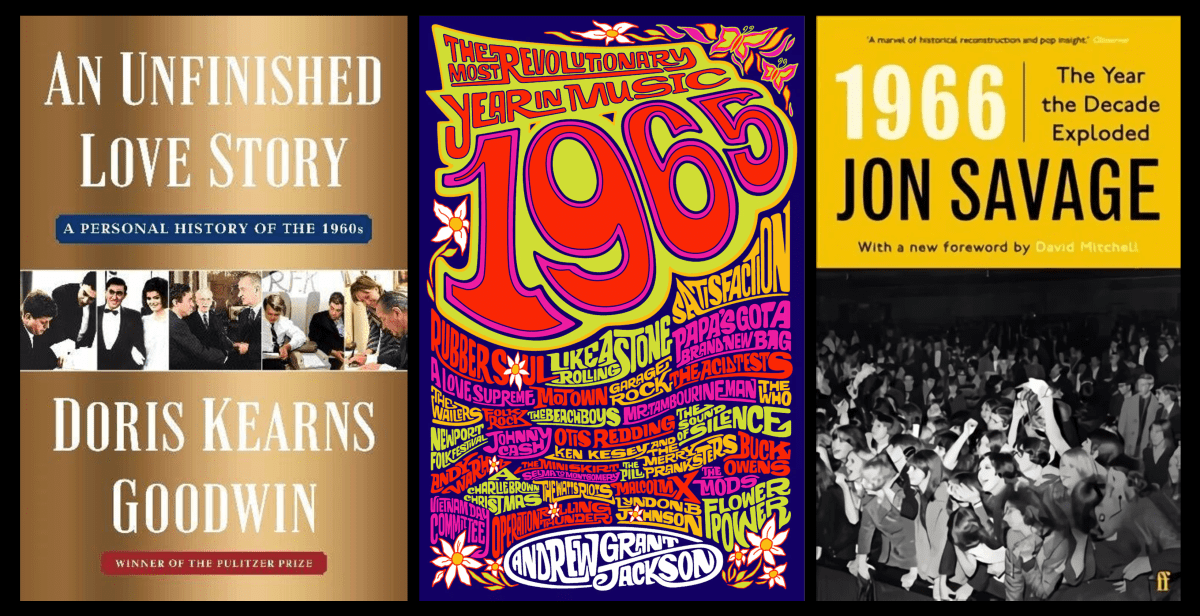
In December 2024, I’ve been reading three books about the 1960s that explore events I encountered in two minute stories on TV, or read about in a few pages in a magazine when they first happened. Some of those short snippets of current events made huge impressions on me as a kid. They shaped who I thought I was. The history books makes me realize I was mostly uninformed.

The reality of the 1960s is I was a kid going to school every day except for long summer vacations. I started 1960 in New Jersey but moved to Mississippi then to Florida then to South Carolina back to Florida, then Mississippi again, and back to Florida. I went to thirteen different schools during the 1960s. The only newsworthy event I saw live was the launch of Apollo 8. I had a chance to see Kennedy in 1962 when he came to Homestead Air Force Base. They let us out of school to see him, but me and my friends went fishing instead. My sister was at Dinner Key Auditorium when Jim Morrison flashed the crowd. I got to meet an astronaut in 1968, but I’ve forgotten which one. And this is hardly newsworthy. I got to see Cream play during their farewell tour in 1968. Oh, and I attended one SDS rally.

In other words, I experienced the legendary Sixties mostly via AM radio, television, and magazines. I did have long hair sometimes, and I sometimes messed around with drugs, but I was hardly a hippie or a radical. I did get into the counterculture more in the 1970s, but that’s another story.

The point of this long-winded essay is I’m now reading history books about years I lived through. I can contrast my memories to behind the scenes accounts of things I got from soundbites. That’s quite enlightening.

We live with the illusion that we think we understand what is real and true. We delude ourselves that we make decisions on relevant information. But we don’t. If I could have read the history books about the sixties I’m reading in old age when I was young, I could have gotten closer to seeing reality.

Timothy Leary and Aldous Huxley, two heroes of my youth, claimed that LSD opened the doors of perception, and that might be true on a nonverbal level, but a deep reading of history books is far greater at revealing reality that we can comprehend on a verbal level.

Lately, I’ve been reading that reading is going out of fashion with young people. That’s a shame. Even back when I was a teen, and only got superficial understandings about the events around me from superficial news sources, it did make me more aware.

The three books above are filling in details on things happening around me as I was growing up. I’m reminded of Bob Dylan’s “Ballad of the Thin Man.”
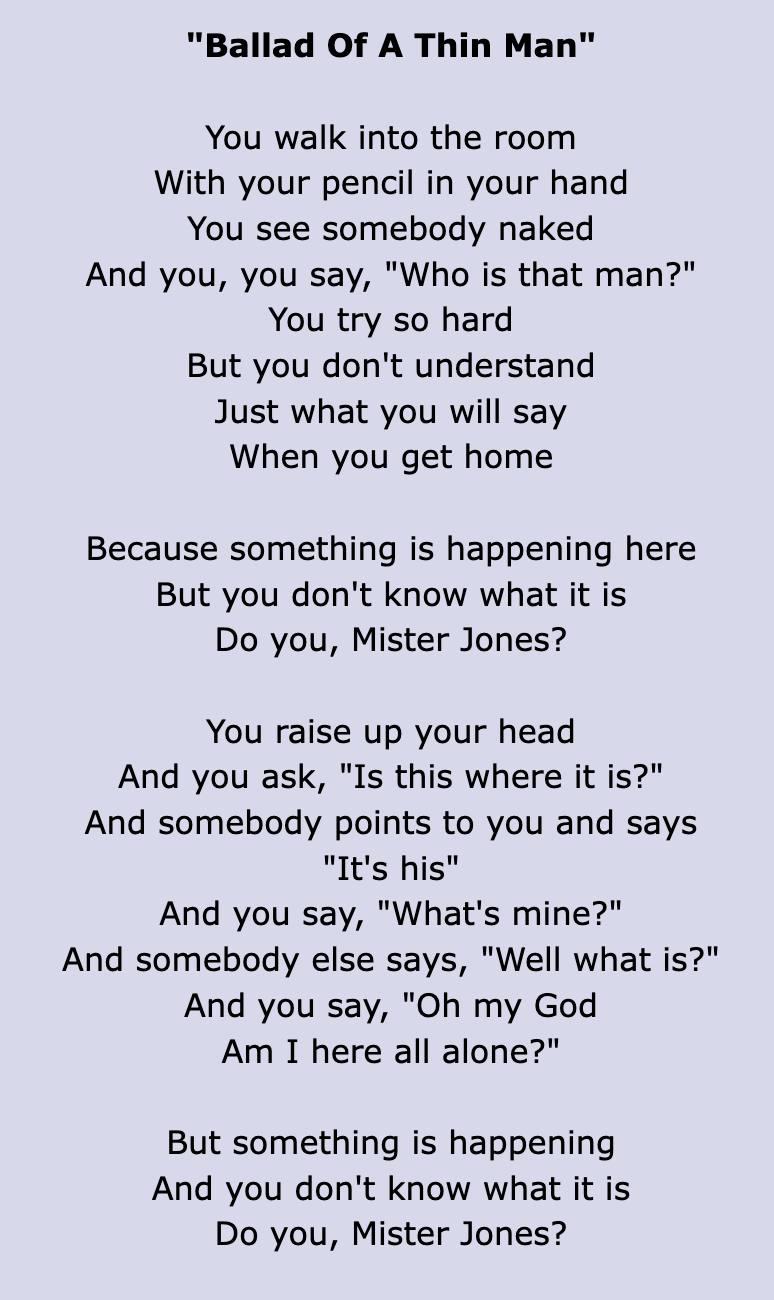
I realize I’ve been Mr. Jones my whole life, and I’m still trying to figure out what happened.

JWH

Exotic Dances: “The Karbardinka” and “Only This Green”

by James Wallace Harris, 8/10/24

YouTube is the TV channel I watch the most of any streaming video platform. I’m constantly finding something new and interesting. Last night I found videos of dances from unknown countries. At first, I thought they were from Russia and China, but that might not be the case.

They each appeal to me for two reasons. First, and most strongly, was the music. And second was the visuals of the dance and costumes. Both seem to be a mixture of old cultural heritages of costumes and musical instruments mixed with modern music and staging.

The first video is labeled “Caucasian Show in the Kremlin | Kabardinka Show • Ancient Princely Dance ‘Kafa’.” It looks Russian, but when I looked up Kabardinka dance on Wikipedia it took me to Circassian dance. It said it comes from Turkey. Wikipedia states, “There are several dances including the kabardinka. The version of this dance performed in Turkey is called Kafkas, from Kafkasya, the Turkish word for the Caucasus Mountain region that was home to the Circassian people before the Circassian genocide. Another similar dance is called the lezginka.”

Evidently, this is an extremely popular dance. Here is another stage of the dance, labeled “Ensemble ‘Kabardinka’ – princely dance ‘Uork kafa’.” This video has a longer description that was more informative than the Wikipedia article.

The video shows a stage version of the ancient Kabardian noble dance "Werk kafe" performed by the state academic dance ansmable "Kabardinka".

At first glance, the dance seems simple. The audience accustomed to representing the Caucasus with Lezginka, most likely, will not even understand what they saw. (It's not surprising).

Huerk kafe is a dance of the Kabardian (Circassian) aristocracy. This class of people was limited by strict protocol and codes, which naturally manifested itself in dance. Aristocrats were forbidden to show emotions, freedom of movement, turn their backs to their partner, touch and much more.

Despite the status, the guys' clothes are ascetic as possible. High origin was distinguished only by rich ammunition, which, in addition to all other elements, included the main one - checker. In the Caucasus, to fight, as well as, by the way, to dance, was a privilege. Therefore, in the appearance of men, checkers has a special place. Another distinctive element was the sleeve. Its length also indicated the status. It was impossible to do dirty household work with such a sleeve, which is very indicative. But this was also a practical application - the long sleeve prevented accidental contact between a guy and a girl.

The women's suit, unlike the men's suit, was full of luxury. In addition to the rich embroidery and the sleeves already mentioned, the status of the girl was demonstrated by the second swing sleeve and a high hat. Representatives of princely surnames additionally wore wooden shoes - Ph'e wake, which elevated them above those present. In the original images, the height of such shoes could reach 20 centimeters, which is still impressive.

Despite the above, the main decoration of the aristocrats was modesty and dignity. This made Circassian dances so beautiful, and the Circassians themselves famous all over the world.

If you can, you should watch these videos on a large screen television with good audio. They are impressive. Once I found the first video, YouTube started showing me others, basically variations of the same dance but with different costumes. Here is a more modern version of the dance.

As usual with YouTube, if it thinks you like one thing, it will show you similar things. This dance is even more spectacular, but harder to research because here’s the title: “文化自信,中国东方演艺集团《只此青绿》演活了千里江山图《2021哔哩哔哩跨年晚会》花絮.” I think of it as the dance of the leaning women.

I used Shazam to look up the music. I found an album on Spotify but not Tidal. But even on Spotify they used the Chinese characters. Like the Karbardinka, there are many variations of this dance on YouTube. Because they often come with a year, I wonder if it’s an annual performance like The Nutcracker.

I Google “文化自信,中国东方演艺集团《只此青绿》演活了千里江山图” but only got responses in the Chinese character set that Google didn’t offer to translate. I clicked on one return and then Google offered to translate. I’ll quote part of it:

At the turning point of inspiration, the romantic encounter between famous paintings and dance art has given "A Thousand Miles of Rivers and Mountains" a new expression that is beyond the world. Since the premiere of "Only This Green" - the dance painting "A Thousand Miles of Rivers and Mountains", the "green fever" has been rising, and many "green fans" have even performed across the city. Not only that, "Only This Green" has also gone from offline to online, from inside the circle to outside the circle, which has aroused extensive and heated discussions. Such a "phenomenal" storm of "national tide aesthetics" did not gradually slow down with the end of the premiere, but drove the development of "green" related peripherals, tourism and cultural and creative products with the trend of "wave".

Well, I guess I’ve gotten green fever. It’s nice to know that the dance is called “Only This Green.” With that title I was able to find a research paper on the dance that explained everything. Ah, the wonders of the internet. The dance is based on the painting “Thousand Miles of Rivers and Mountains” which I used at the top of this post.

The first version was dated 2021. Here’s the 2022 version.

I tried to find performance from earlier and later years, but couldn’t. If you can, leave a link.

There are over two hundred countries, and thousands more if you look back at history, so there should be many more cultural dances for me to discover on YouTube.

JWH

Watching YouTube vs. The Great Courses Plus

by James Wallace Harris, 8/1/24

For several years now, YouTube has been my favorite TV diversion. I could always find something to watch quickly, and the videos were usually short, so YouTube didn’t demand much. I was first hooked by channels about 8-bit computers, but quickly subscribed to channels about all my favorite subjects. If I showed interest in any topic, YouTube would offer me lots more along the same vein.

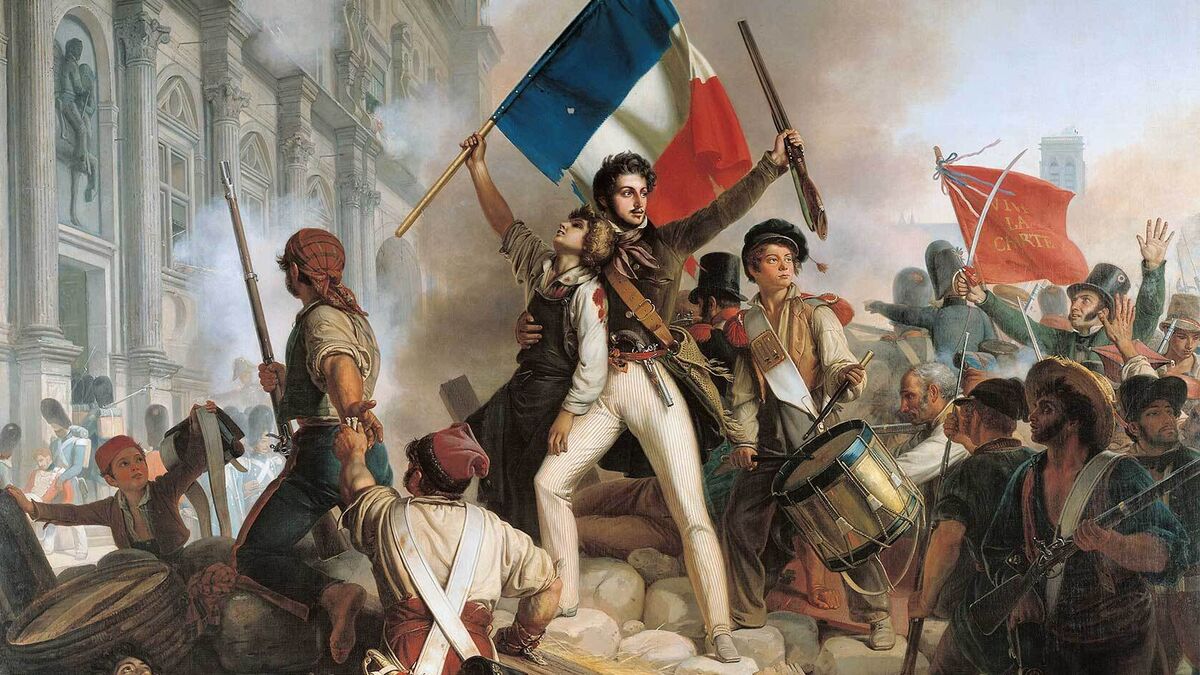
Recently I started reading The Story of Civilization: The Age of Napoleon, Volume 11 by Will and Ariel Durant and became fascinated by the French Revolution. I got on YouTube, searched on that topic, and found tons of videos to watch. There were short videos by amateur historians and professional documentaries like this old one from The History Channel.

However, it was of exceptionally low video quality, 240p, which is unpleasant to watch. But there were other videos, by what I assume are individual YouTubers, in higher resolution, and with particularly good production values, such as this one by Asha Logos.

Or here’s another one from History Weekly. I don’t know if this is a professional outfit, or another lone YouTuber, but it’s also of high quality.

These videos supplement my reading with added information and lots of visuals. However, I wonder about the validity of the information. Should I trust an amateur historian, or even history on The History Channel. The History Channel produces a lot of shows on flaky history, or even crap history.

I decided to subscribe to The Great Courses Plus and watch Living the French Revolution and the Age of Napoleon which is taught by an actual history professor, Dr. Suzanne M. Desan from the University of Wisconsin who specializes in 18th century France. Dr. Desan covers the topic in forty-eight thirty-minute lectures. She has few visuals, so I’m mostly watching her lecture. It’s like a college course.

The Great Courses Plus is $20 a month ($15 if you pay quarterly, or $12.50 if you pay yearly). However, I decided to get it through Amazon Prime for $7.99 a month. Amazon Prime gets a smaller subset of all the courses at The Great Courses Plus, but it did have this one. I’ve found plenty of courses on Amazon Prime version, but I think I’ll eventually join the full version, since it has a lecture series on Voltaire, I want to see that’s not in the Amazon Prime collection.

Another way to get Living the French Revolution and the Age of Napoleon is through Audible.com. It’s an audio only version of the lectures (24 hours and 47 minutes), but it does come with a .pdf textbook for the course. I don’t get the textbook through my Prime subscription, but I would if I subscribed directly to The Great Course Plus. The textbooks for The Great Courses tend to be concise summaries of the lecture that are easy to read and reference. They’re a wonderful way to look back on the details that I quickly forget.

I now find myself watching the Great Courses lectures rather than turning on YouTube. I tend to watch YouTube in idle moments, a kind of random grazing of odd information. Often I end up watching fun but useless stuff.

So, I’ve started switching to the lectures on the French Revolution. This is more satisfying. I don’t even have to watch a whole lecture, so it’s like YouTube, it can be very casual. However, it makes me feel more focused than when I’m watching YouTube. I’m not saying watching YouTube is bad, or that I’m going to give it up. But the Great Courses lectures offer a nice alternative. It feels like I’m getting back to my book. That I’m progressing towards something which is satisfying.

I also like switching between my book and lectures. The two histories reinforce each other, but they also focus on different details. I’m already anxious to read even more about the French Revolution, and The Enlightenment. And I want to read about Voltaire and Rousseau. I’ve already started with YouTube videos, but I crave lecture series and books to get more details.

I knew next to nothing about the French Revolution or Napoleon. And what I did know came from fiction by Dickens and Tolstoy, or from movies. Just knowing about The Terror gives a false sense of what happened.

I now see a synergy between history books, lectures, and YouTube videos.

I showed The Great Courses Plus to my friend Annie yesterday, and now she wants to watch a lecture series together. We watched movies and television shows together, but it’s gotten hard to find things to watch, at least things we both want to see. The lectures open a new avenue of something to do together.

My next goal is to learn to take notes. I feel like I’m learning something valuable, but I’m not sure how much I’ll remember. With the book, lectures, and videos I’ve been trying to remember certain details. I want this TV watching to be more than just idle time killing. My brain is getting flabby as I age, so I’m trying to exercise it.

I can’t find a sample video of Dr. Desan’s lecture, but here is a sample video with three other lecturers at The Great Courses Plus (previously named Wondrium).

I’m finding studying history to be a great escape from worrying about the real world. We’re living through some exciting history, but it’s also unnerving, and stressful. I find lots of comparisons with today’s politics in the French Revolution. That’s consoling in a way. However, things Trump is saying makes me worry about another version of The Terror.

JWH

Leave It to Beaver (1957-1963)

by James Wallace Harris, 7/17/24

Susan and I are watching the entire run of Leave It to Beaver. We’re currently in the sixth and final season, about to finish all 234 episodes. We watch two episodes a night, so that means we’ll complete six years of the original broadcast in 117 days. Back then they had thirty-nine episodes per season.

We’ve watched Jerry Mathers (Beaver) and Tony Dow (Wally) grow up. When the series begun in 1957, Beaver was seven and in second grade. Wally was thirteen in the eighth grade. Six years apart, but six years later, Beaver was in the eighth, but Wally was in the twelfth, four years apart. Evidently, the producers didn’t want Wally going off to college. Mathers and Dow were only three years apart in age in real life. Dow was born in 1945, and Mathers in 1948.

Leave It to Beaver premiered on October 4, 1957, the same day that Sputnik I went into orbit. I had just entered first grade and was five. I don’t remember seeing Leave It to Beaver as a kid in the 1950s. It wasn’t until sometime in the 1960s that I saw an episode, and I didn’t see it often. Susan didn’t watch it as a kid either.

In other words, we’re not watching Leave It to Beaver for nostalgic reasons. I’m not sure why we got hooked on it. We were just looking around for something to watch, and I suggested the show as something pleasant we both might like. Susan doesn’t like shows with violence (although I’ve got her to watch the Fargo series recently). I think I picked Beaver because Susan loved watching Andy Griffith so much.

I do have nostalgic memories of family shows like Make Room for Daddy, Father Knows Best, The Donna Reed Show, The Adventures of Ozzie and Harriet, and My Three Sons from the late 1950s and early 1960s, so it’s odd we picked Leave It to Beaver. We even signed up for Peacock with no ads so we could watch it without ads.

I can’t promise that Leave It to Beaver is one of the greatest TV shows ever. It’s pleasant. We like the actors and characters. The stories are quite simple, very pro-family, very didactic. The stories are also repetitive. For example, there are several episodes about Beaver getting a pet he can’t keep, including an alligator, rat, donkey, and a very ugly monkey. There were many shows where Beaver friends convince him they should all go to school wearing something weird, like a sweatshirt with a horrible monster on it, or show up for a special event not wearing a coat and tie, and Beaver shows up as the gang planned but the others don’t, making him look stupid. Another common plot was for Beaver’s friends to talk him into doing something he shouldn’t.

Most of the episodes had a message. Often it was: When your parents tell you something it is for your own good. But fairly frequently, there were shows about how parents should listen to their kids sometimes, because sometimes their kids knew better.

I remember Leave It to Beaver being about only the kids, sort of like Peanuts. But half the show is about Ward and June. I guess as a kid I just didn’t pay attention to adults, either in real life or on TV.

One of my favorite episodes has Beaver getting in an argument with a bigger kid and uses a cuss word. Of course, the school bell rings when Beaver says the word, but his teacher, Miss Landers, heard what he said. Miss Landers is shocked and sternly informs Beaver he’s in big trouble. Miss Landers tells Beaver to bring a guardian to school to meet with her. Ward is off on a business trip, and Beaver can’t bring himself to tell June what he said, so he convinces Wally to come to school as his guardian. Miss Landers accepts Wally because she doesn’t want Beaver to tell June what he said either.

Even though we time travel back to the 1950s and early 1960s when we watch Leave It to Beaver, it doesn’t feel nostalgic. It feels more archeological. The show just reminds me of how things were so different back then.

I thought I’d find episodes I would remember but I haven’t. The closest any episode felt like I had seen it before was the one when Beaver and Wally play the stock market. I do remember as a kid watching a TV show where the kids learn about the stock market, but I can’t swear it was on Leave It to Beaver. Maybe it was, maybe it wasn’t.

Quite often while watching other old TV shows I’ll tell Susan, “Oh, I’ve seen this one.” But that’s never happened with Beaver. But the intros and closing credit scenes to all six seasons seem burned into my memory, but not the stories themselves. I guess I remember the visuals and not the plots.

It’s weird to watch a show from the first to the last episode. I’ve done that several times now. It’s also kind of painful. Older TV shows depended on every episode being entirely self-contained. This approach leant itself to formulaic scripts, which was true with Leave It to Beaver. I’ve read that Beaver was the first show to have a finale, which was a unique episode. But for the most part, there was a commonality to every other episode.

As far as I can remember every episode featured the staircase. Most featured front or back door meetings, breakfast table meetings, dinner table meetings, doing the dishes together, sitting around the bedroom, living room, or den. For most seasons we saw Ward and June kiss in each episode. That seemed to fall off in the last couple of seasons. All four of the main actors had standard facial expressions and used specific body language in every show.

One thing I remembered wrong was the Eddie Haskell (Ken Osmond) character. I remember him as a juvenile delinquent, the bad boy. But the show portrays him as a sympathetic loser, on the pathetic side, one who tries too hard, has too much ego, and probably has bad parents.

Beaver had very few guest stars, which was what I enjoyed when watching the entire nine years of Perry Mason. However, a few of the actors, like Miss Landers (Sue Randall) I’ve seen on other shows. I saw her on Perry Mason. Of course, Fred Rutherford (Richard Deacon) went on to be Mel on The Dick Van Dyke Show.

Watching old TV shows from the 1950s and 1960s reveals an alternate reality that we all observed back then. The Beaver often mentioned the TV shows that were on when Leave It to Beaver was on the air, even making inside jokes about the competition. And to a degree it makes fun of other pop culture of the 1950s and 1960s. But it was very gentle. I even saw a science fiction magazine a couple of times. I’ve often wondered when science fiction was first mentioned in pop culture.

The show covered the phases of childhood and adolescence that kids were going through back in the 1950s and early 1960s. Leave It to Beaver went off the air in 1963, before the famous Sixties began. This photo meme on Facebook conveys that stark change perfectly.

Watching Leave It to Beaver explores the times before that cultural shift.

JWH

What I See Outside My Window vs. What I See on My TV Screen

by James Wallace Harris, 7/5/24

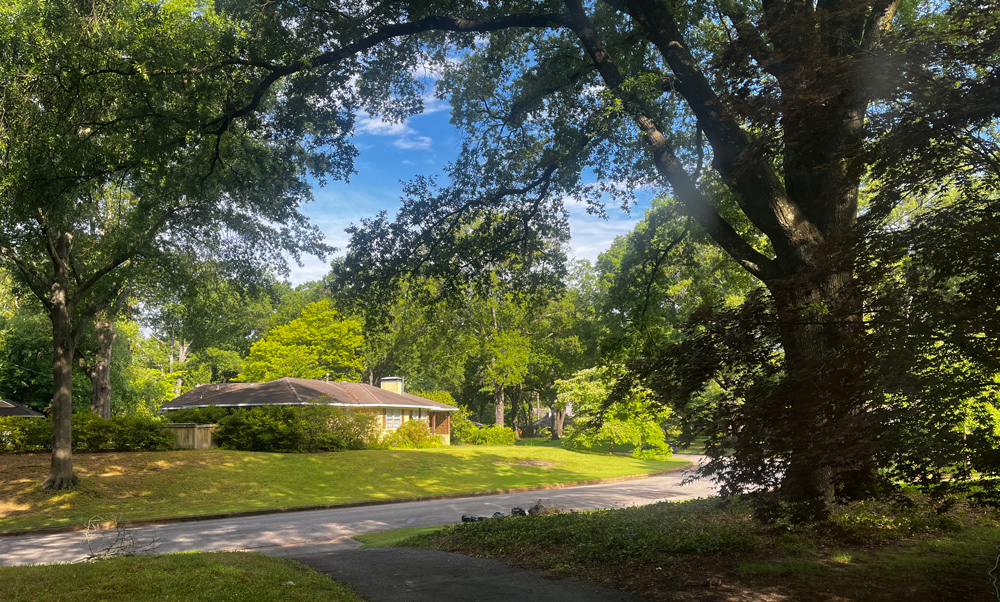
The picture above was taken from my dining room window. Not much is happening. It’s quiet and peaceful. In my den, looking through the sixty-five inch window of my television screen, I see so much turmoil and suffering. The fall of civilization is what’s happening.

One of my favorite novels is called The Door into Summer because the cat in the story hates New England winters and asks to see what’s out every door hoping to find one that leads to summer. I can open my front door and walk out into summer. It’s 77 degrees outside right now – not bad at all for July in a year that might become the hottest year on record. So, why do I spend my days watching television when all it does is to depress me?

The need to know what’s happening is a burden. The belief that I can control anything through knowing more is an illusion and deception. However, there are wars going on all around me and I don’t know if I can sit them out. My friend Anne lives in a nice neighborhood too, but last week there was a shooting at the house one over from hers. Yesterday was the 4th of July, and we heard plenty of fireworks. But we also heard plenty of guys shooting off their guns.

Crime and climate change are getting nearer all the time. What if I looked out my window and saw this:

Thousands of people are seeing this everyday around the world because of hurricanes, tornadoes, floods, and fires. In a decade it could be millions seeing such sites every day. Can we learn anything to avoid that future?

There is a cultural war happening all over the world and the battles are being fought in polling booths. Popularism wants to rewind the clock on progressive progress. To understand this, watch this talk by David Brooks. It’s one of the most uplifting things I’ve seen on my television screen in a very long time.

If you listen to Brooks, you’ll understand what the conservatives want to do with their Project 2025 plan and why. They believe it is their door into summer. If they succeed, I believe 1/20/2025 will be remembered like 4/12/1861 or 6/28/1914. It would be so much easier for my mental health to quit watching TV, but is that really an option? I can understand why Christians are fighting so hard for their way of life. I would have no problem surviving in their utopia if they got everything they wanted. But millions of people wouldn’t, and it will lead to civil war and self-destruction.

The world is going nuts while the environment is going down the drain. On one hand, I can’t stop watching this slow-motion apocalypse. One the other hand, I just want to look out my window or read a science fiction novel.

JWH