Why We Can’t Trust Digital to Remember

In The Map of Knowledge Violet Moller describes how the works of Euclid, Galen, and Ptolemy were collected, translated, transcribed, and preserved over over the centuries. Most of the works from the ancient world have been lost. We have the Arab civilization to thank for preserving much of what we have from ancient Greece after the fall of Rome, and before the emergence of the modern western civilizations.

When humans first develop writing we wrote on stone, wood, clay, wax, and metal, but eventually invented the more convenient papyrus and paper for scrolls and books. We’re still finding ancient works of papyrus like the Dead Sea Scrolls, and we’re still translating steles from antiquity that archaeologists unearth. In other words, our data can potentially last for thousands of years.

On the other hand, it’s surprising how quickly it can disappear. Since the dawn of the internet age how many digital content providers have gone bust leaving their customers without access to the works they bought? Remember Microsoft’s Zune player? Microsoft phased it out which is okay, but they also turned off the servers handling the digital rights, meaning owners of that content were locked out of their digital libraries. Over the years I’ve bought books, movies, television shows, songs, albums, etc. from various online sellers that have disappeared. Much of it was without DRM, but I didn’t back it up. Since then most of that content has been lost between all my computer upgrades.

Today I only buy digital content from Amazon because that company is so big I hope it will never go out of business. But it if did, I’d lose thousands of ebooks, audiobooks, movies, television shows, songs, and albums. So far it appears that Amazon (and their company Audible) have saved everything I bought, even when the work went out of print. But sometimes I think I owned something I can’t find in my Amazon library. So far I think it’s me because in the early years I bought so much from other companies that I now misremember what I bought from Amazon. But I never can be sure.

Many years ago I decided to go paperless and scanned my files to .pdf documents. My mother had saved all my report cards and I scanned those too, throwing away the originals away. I can no longer find those files. I thought they were on DropBox. When you have hundreds of thousands of digital files it’s hard to know when a few thousand disappear. I’ve been putting everything on Dropbox for years, and they’ve always seemed very reliable. Again, I can’t tell if I could have accidentally deleted those files, or something in their system ate them.

I recently discovered my Yahoo email has all disappeared. I used Yahoo to save backups of important emails, but I seldom went to the site to look at these old emails. I just discovered Yahoo deletes your content if you haven’t access your account for one year. Dang. Also, I used to have access to all my oldest emails at Outlook. But now Outlook only shows recent years. If you get to the bottom of a folder you can request Outlook to show more, but I’m not sure if they save everything anymore.

What’s needed is a program that catalogs all my files and tells me when some go missing. I don’t do backups because I assume I have my files locally and on Dropbox and that’s good enough. I used to save backups to external hard drives, but keeping up with such backups is a pain. I recently threw out six hard drives. They had been sitting in my closet for years, but when I checked them they no longer worked.

I also worry about all my financial records. All the companies I do business with begged to stop sending me paper copies so they could go digital. Now I wonder about the wisdom of that. I realize if I died I’m not sure if my wife would know where all my 401K savings are located. But if I only saved on paper and my house burned down, where would we be too?

I’ve read a few articles in the news lately saying if you read the fine print we don’t own our digital content. We can’t resale it or lend it, but what about accessing our purchased content forever? What if a publisher goes out of business? What if a publisher selling through Amazon goes out of business, is Amazon responsible for maintaining that digital content forever for its customers?

And what happens to my 1,400+ essays if WordPress shuts down? One of my blogs, Lady Dorothy Mills, is about a woman writer from the 1920s whose work is almost completely forgotten. I started a website about her decades ago, and I used to get 1-2 emails a year asking about her. It’s been years since I’ve had a query. Only a handful of her books come up for sale every year. Even printed books have no guarantee of surviving. If I really wanted to save my essays I should print them out. I don’t though. I hate saving paperwork.

We are becoming completely reliant on saving data digitally. After our civilization collapses, and they all do, how will future scholars like Violet Moller write about us? A book from this century could last a thousand years. But even if a hard drive could last a thousand years, would people in 3019 have a PC to run it?

Or will future civilizations carefully preserve our digital data someway? For years I tried to save the files I created on my Commodore 64 or Atari ST to my early PC programs like WordPress. Even as late as 2013 when I was still working I’d get requests to convert 1980s Apple II discs so the files could be read on Macs. It was seldom possible.

We talk about plastics surviving for thousands of years. I wonder if it’s possible to produce a new kind of paper that’s nearly indestructible, including fire and water proof? That way, anything we really wanted to save we’d print on the new DuroPrint format. Or can we design solid-state drives that can hold their bit positions forever?

I’m at an odd point in my life. I have a lifetime of books I’ve collected that run in the thousands. They included printed books, ebooks, and digital audiobooks. I’ve actually saved too many books. I figure I might live another 10-20 years and I want to thin out my collection to just what I need as I fade away. I also want to start deleting digital files and paper files of things I no longer need. What a huge task. I’ll probably delete 99 out of a 100 items, but for that one, I’ll want it to survive no matter what, and be discoverable by someone after I die.

I feel like I’m moving towards an Omega Point where I will die with just the exact books and documents I need. It’s the opposite of building a library or filing system. I’m not sure I need to leave any of my books or papers to anyone. I’ll give away my books before I die, and my wife will need only a few papers. But I do worry about a few rare objects I own, like the Lady Dorothy Mills books, or rare science fiction fanzines. I’ve been scanning the fanzines for the Internet Archive. I should probably scan the Mills books too.
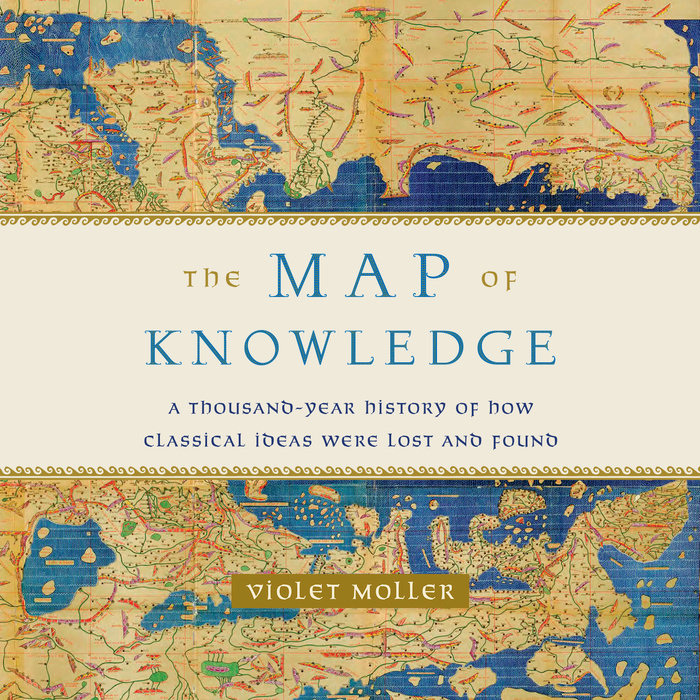
The Map of Knowledge by Violet Moller

JWH


Keeping Up In The 21st Century

by James Wallace Harris, Thursday, August 8, 2019

I’m reading a rather disturbing book, LikeWar: The Weaponization of Social Media by P. W. Singer and Emerson T. Brooking. It’s disturbing for a number of reasons. First, it shows how completely out of touch I am. Second, it’s very relevant about today’s politics, problems, and conflicts, but makes me realize that I don’t have the tech skills I thought I had – and I’ve been working with computers since 1971. And it’s about a new stage in human communications that I might not be able to join or want to join. I might need to accept I’m too old and let a new stage of human consciousness pass me by.

It’s very difficult to explain why people need to read this book. But here’s a setup that might help. It’s my take on things but relates to what I learn from the book. It’s about the different stages of communications.

  1. Language. This gave us a tremendous boost compared to the other animals, and it’s probably why we’re sentient.
  2. Writing. Let us store knowledge and communicate at a distance.
  3. Printing. Let us mass-produce knowledge.
  4. Telegraph. Let us communicate over distances very fast. This was a tremendous boom for business, war, and journalism.
  5. Telephone. Faster two-way communication without codes.
  6. Radio. The beginning of mass communication. For example, LikeWar quotes Joseph Goebbels saying the Nazis couldn’t have gained power without radio.
  7. Television. More effective mass communication. Truly transformed society.
  8. Computers. They magnified our thinking power and speed.
  9. Networks. Created a world-wide digital nervous system.
  10. Social media. Mass communication with mass participation, or two-way mass communication. LikeWar is about how social media is transforming politics, crime, business, and war. One example LikeWar uses is ISIS, which used social media to overpower traditional national powers.

If you don’t have social media skills you’ll be left behind. Most people’s reactions will be, “Too bad, I don’t care about Facebook.” LikeWar provides significant evidence that all future political power will come from the people who can master social media. LikeWar showed how Trump gained his power with Twitter. Don’t dismiss that out of hand. Singer and Brooking make a powerful case for it being true.

I’m 67 and barely use social media. I blog, I keep up with family, friends, fellow hobbyists on Facebook, I use Twitter to keep up with news about science fiction. That’s essentially nothing. Here’s an example of what I’m talking about. When I was growing up I watched the CBS News every night to follow the Vietnam War. The news was about 24-48 hours old. Some people today keep up with wars in real-time, watching people conduct war using the internet to outmaneuver people conducting war at television and print journalism speeds. LikeWar showed how ISIS used social media users worldwide as recruits in their local battles.

In other words, in any field of endeavor, any conflict, if you’re using print, radio, or television to keep up you’re way behind. We really are developing a global hive mind, and it involves new skills. I can use the excuse that I’m too old to chase that bus. But younger people or older folks who want to compete can’t. And I think that’s stressful. I think a lot of stress in our society is because we’re stratifying by the speed in which we can compete.

I’ll predict there will be a new class of Luddites, those people who choose not to race at social media speeds. But it means giving up power. We’ve had wealth inequality forever, and education inequality for hundreds of years, but what LikeWar envisions is a new kind of inequality. I’m not sure what percentage of the population will be able to keep up.

LikeWar

JWH


Like and Sharing Society

by James Wallace Harris

Today we like each other by clicking a Facebook icon and share by inviting others to view images and videos that trigger our strong emotions. Oh, we still share by getting together for an activity or like each other with hugs and kisses, but it seems less often, doesn’t it?

In David Brooks’ latest column at The New York Times he says:

When communication styles change, so do people. In 1982, the scholar Walter Ong described the way, centuries ago, a shift from an oral to a printed culture transformed human consciousness. Once, storytelling was a shared experience, with emphasis on proverb, parable and myth. With the onset of the printing press it became a more private experience, the content of that storytelling more realistic and linear.

As L.M. Sacasas argues in the latest issue of The New Atlantis, the shift from printed to electronic communication is similarly consequential. I would say the big difference is this: Attention and affection have gone from being private bonds to being publicly traded goods.

That is, up until recently most of the attention a person received came from family and friends and was pretty stable. But now most of the attention a person receives can come from far and wide and is tremendously volatile.

In primitive societies, whole groups would live in one big room. Over time families moved into their own separate dwellings, but often were multigenerational. Then we invented the nuclear family. And now people often live alone in apartments. We connect by computers to create virtual social bonds. It’s kind of weird when you think about it.

This also reminds of the classic 1909 science fiction story by E. M. Forster called “The Machine Stops.” Eighty years before the WWW Forster imagined humans ultimately living alone in rooms connected to each other by a machine. Read this story, it will amaze you.

These trends sound like a sad progression of human evolution, but I believe there are reasons why we’ve chosen our paths. Primitive people worked together with a common goal of survival. Everyone had to contribute. The same was true to a lesser degree during the era of multigenerational families. Even during the early era of nuclear families, we had much to keep us together. But once everyone had a different job that took them into a different direction, and we developed our own personal interests and goals, things came apart. Even as late as the 1950s and 1960s families still had a lot of shared experiences. With only one television parents and kids would gather around it in the evenings. They ate their dinners together while watching Ed Sullivan or Lassie. Kids would go to school, and parents would go to work, but they still found countless shared interests to spend time together.

What separated me from my family in 1962 was a clock radio. But also my father worked two jobs and my mother one, so they disappeared for most of the day. Yet, when they were home, I began retreating to my room to listen to Top 40 Rock ‘n’ Roll and reading science fiction while they watched The Beverly Hillbillies with my sister.

Brooks dates our divergence with the computer, but I think it came earlier with other technologies. When I got that clock radio and my sister got a portable record player we went our different ways. By the 1970s many families had multiple television sets, so each family member took to their separate rooms to watch only what they loved. We stopped making the effort to sit through shows other people loved. In the 1980s personal computers came out and we divided again. Walkmans, MP3 players, audiobooks, tablets, smartphones, they’ve all given us ways to isolate ourselves into pursing highly unique art forms.

Anthologies-web

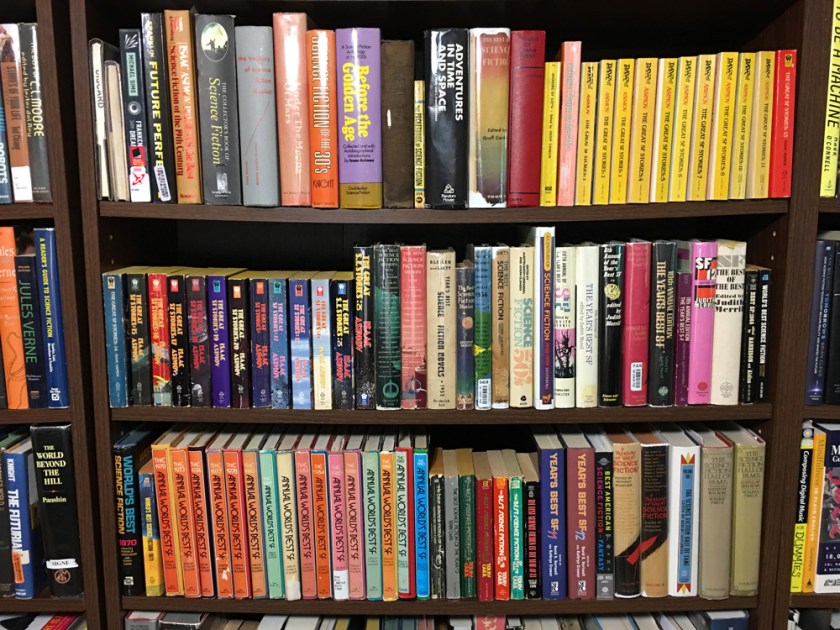
Think about all the interests and hobbies that only you love. Above is a photo of what currently separates me from other people. My fascination with reading old science fiction short stories and studying their history culls me off from the rest of humanity. By Brooks’ distinction, I’m defined by both print and digital technologies, but I also love hearing these stories read by professional narrators, so that connects me with an oral tradition too. But when I listen, I’m wearing headphones that shut me off from the rest of reality, although I’d love to know someone who’d like to listen to the stories with me.

When Susan, my wife comes home from work we sometimes eat together, and sometimes not. We faithfully watch the NBC Nightly News and Jeopardy that we recorded on our TiVo, and then she goes to the living room to watch her shows and I stay in the den to watch mine. We got married in 1978, and through 2008, we had one television set, and we’d watched the same shows together every night.

In 2008 Susan took a job out of town, and for ten years we watched television separately and we learned exactly the kind of TV that resonated with our personalities. I developed a number of friends who came over to watch TV with me, and I learned that friendship was a VENN diagram of shared TV shows. No two people have exact tastes. When Susan moved back permanently last year she brought her own TV, so we had two. We also had two Rokus, and subscriptions to several streaming TV services that allowed us to watch exactly what we want to watch when we wanted to watch. We had also learned to binge-watch different kinds of shows. Taste in TV now separates us.

We do find other ways to share. We’ve been doing game nights with friends. Last night was a game night, and the four of us all talked about the TV shows we watched. It was kind of funny because our tastes overlapped in various combinations. If I wanted companionship to watch my TV shows, I might need to call a dozen different people, and some nights I’d still be watching TV alone.

When TV was broadcast, most of my friends watched the same shows. Now with over 500 scripted TV shows being produced every year, friends connect by the few unique shows we each share a love to watch. And I often feel I disappoint people when I tell them I don’t like the shows they love. It was damn surprising how much The Game of Thrones united people.

I really enjoy having friends over to watch shows together, but that seldom happens anymore. For ten years my TV buddy Janis and I shared a love of several shows and we’d get together and watch them 3-4 times a week. But Janis has moved to Mexico, and most of my other friends don’t want to come over to watch TV that regularly.

I have a handful of internet friends who also love the old science fiction anthologies, and we have a group email address we use to discuss them. I’m also in two online book clubs where we discuss books daily by email. I guess these replace my water cooler friends from my work days.

Facebook is constantly attacked in the news nowadays, but it’s a very useful tool for keeping up with family and friends. Knowing that someone else likes the same cat videos as I do is nice. Not much of a bond, but at least it’s a shared affinity. What really bonds people is raising a family or a career that forces you to work intimately with other people. Susan and I never had kids, and my work days are over. My friend Mike and I work on a computer/web project together, and that’s a great way to connect.

It’s funny, but I think the single thing that brings me and my friends together now is our collective worry about getting old, and our constant talk of bodily functions. Nothing bonds aging baby boomers like a conversation about constipation.

Lately, I’ve wondered about retirement villages. Would moving to a 55+ community would create new kinds of social bonds? I’ve wondered if it would create the social structures I had back in my K-12 years. Would playing Pickleball and Four Square everyday undo all the specialized isolation that TV and computers created? Who knows, maybe I could find other people to watch Perry Mason, or even share a love of 1950s science fiction like these guys:

JWH

Say Goodbye to the Internet in Your Will

by James Wallace Harris, Monday, April 9, 2018

I’ve been using the internet long enough to have online friends pass away. I’m in one online book club that has had three members die. I’ve had other internet friends just disappear, and I’ve wondered what has happened to them. Sometimes on Facebook family members will post a goodbye. I greatly appreciate that when it happens.

Quite often I don’t know where my internet friends live. And even when I do, the standard of publishing an obituary in the local paper seems to be fading along with print journalism.

Last Will

There is much anger directed at Facebook in recent weeks. However, Facebook is how many people stay in contact with friends and family. Few reports count all the positive benefits of Facebook. As many as two billion people use the service. In recent years, Facebook is often how I find out internet friends are sick, dying, or have passed away. It’s become the new obituary page.

We all need to leave login credentials to our social media groups in our wills with instructions to contact these sites after our death. And even provide a parting farewell to publish.

Social media is often dismissed as shallow. Maybe it is, maybe it’s not. Maybe we should make it better.

JWH


Should I Delete Facebook?

by James Wallace Harris, Friday, March 23, 2018

Cambridge AnalyticaI’ve seen at least a dozen stories about people deleting their Facebook account because of the Cambridge Analytica scandal. Just now I read two news stories about Elon Musk deleting Space-X and Tesla pages from Facebook even though they had millions of followers. There’s lots of anti-Facebook sentiment percolating on the web right now with many users jumping ship.

But how many? Facebook has two billion users. Even if a hundred million people quit in protest will it matter? There have always been folks who grumped about Facebook. They are much like snobs who sneer at watching television. I look at TV and Facebook every day. Not much, in either case, but they both provide their little pleasures. And, little pleasures count for a lot in our social security years.

People fear Facebook because of identity theft or invasion of their privacy. But is any place safe on the internet? And if you read about Cambridge Analytica you’ll see that people happily filled out forms and shared them with friends. You’d have to be an idiot to not know that everything you do on the internet is monitored. No one pays to use Facebook. Have you ever wondered how Facebook makes its money? Our habits and opinions are valuable. Keeping America supplied with cat videos is expensive, so Facebook has to make its money someway.

When I’m on the internet I assume Big Brother and all his brothers and sisters are watching. I don’t care that they know I love cat videos and scans of old science fiction magazine covers. I have no idea what that information reveals about me politically or fiscally.

Before people rush to delete their Facebook account out of some kind of misguided protest, I think they should analyze what they get out of the service. Facebook keeps me in contact with relatives and friends I seldom or never see anymore. Facebook keeps in contact with people around the world that have the same esoteric interests as I do. And I enjoy seeing a half-dozen funny videos every day. They’re as good as a dose of Geritol.

For example, I’ve been reading old science fiction stories from the pulp magazines. I’ve made three online friends in South Africa, England, and here in the U.S. that also like to read such stories. I don’t know how many people left on this planet still love to read science fiction short stories in old pulp magazines, but Facebook has helped me find them. Facebook also keeps me in contact me with relatives I haven’t seen in fifty years.

Besides, Facebook helps me keep tabs on my wife. She always checks in wherever she goes.

I also find it very pleasant to share cartoons, videos, songs, beautiful photos, sayings, etc. with other people. For example, here’s one called Millennial Job Interview that has a passing dig at Facebook. I thought pretty damn funny and very revealing about modern times. Evidently, the young consider Facebook a hangout for older people. That might be true because most of my Facebook friends are older. And most of the people who write about deleting their Facebook accounts are younger. Should we consider this anti-Facebook movement an ageist attack on Baby Boomers?

I wonder if Big Brother finds what we share more revealing about our personalities than the facts typed into queries like Cambridge Analytica’s? For many people I know, what they share on Facebook reveals more about themselves than they reveal in person.

I share a lot on Facebook. My friends and family must think I’m odd from some of the content I post. However, I use both Facebook and Twitter as external memory banks. My biological memory is beginning to fail. I wish Facebook existed when I was young so I could scroll back into the past. When I scan through my timeline it’s like a stream-of-consciousness of what tickled my fancy. I’m sure if Big Brother applied a powerful artificial intelligence program to my timeline it could psychoanalyze my posts and provide me with the ads customized for my personality.

But you want to know something funny? If you asked me if there were ads on Facebook I’d tell you no. My mind is so good a tuning out ads that I don’t see them on web pages anymore. I do use an ad blocker, but they aren’t completely effective. I do know there are ads because I see them when I consciously go looking for them. But psychologically I don’t remember ads on Facebook. That might hurt them more than deleting my account. Sorry, Mark.

I suppose I could quit Facebook. Many who have quit Facebook claim their lives are so much better for it. Maybe mine would be better too, but I sure would miss those cat videos.

JWH