Meditating on a Meme

by James Wallace Harris, 11/28/24

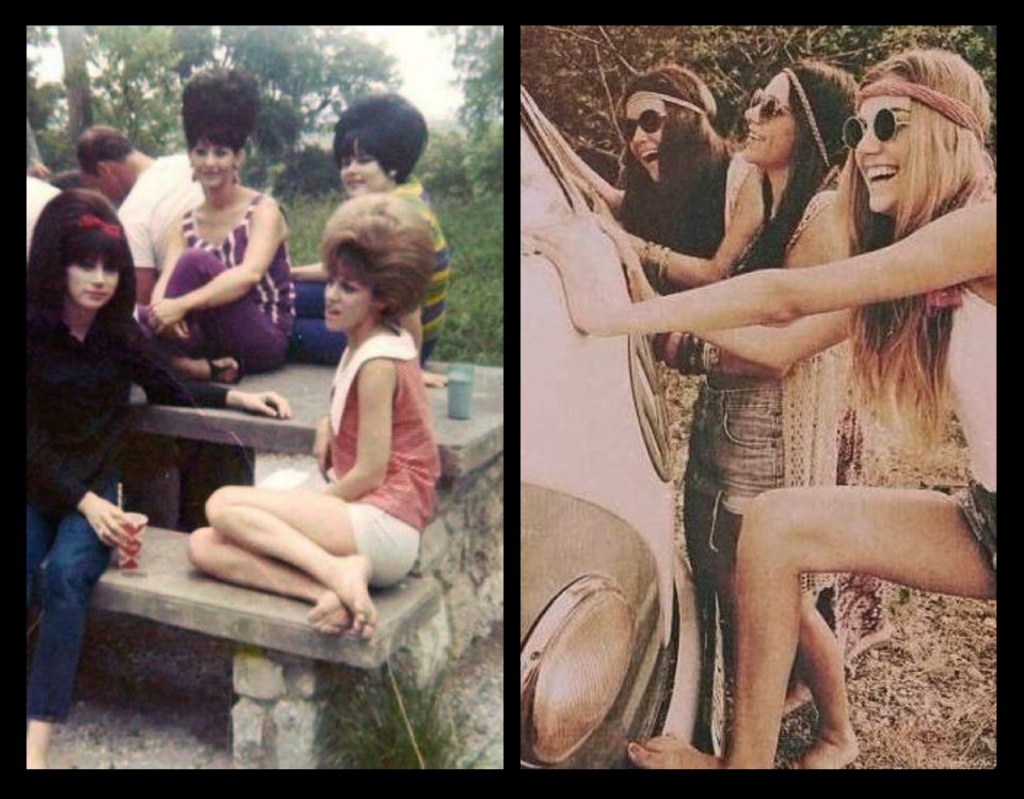
Seeing the above photos as a meme on Facebook made me think about how much people, society, and pop culture changed in the 1960s.

If a picture is worth 1,000 words, then are two pictures only worth 2,000 words? I don’t think so, I think it’s 1,000 words times 1,000 words, or 1,000,000 words. I could easily write that many from all the ideas my mind has generated since I began meditating on those photos.

Here’s the original meme from Facebook:
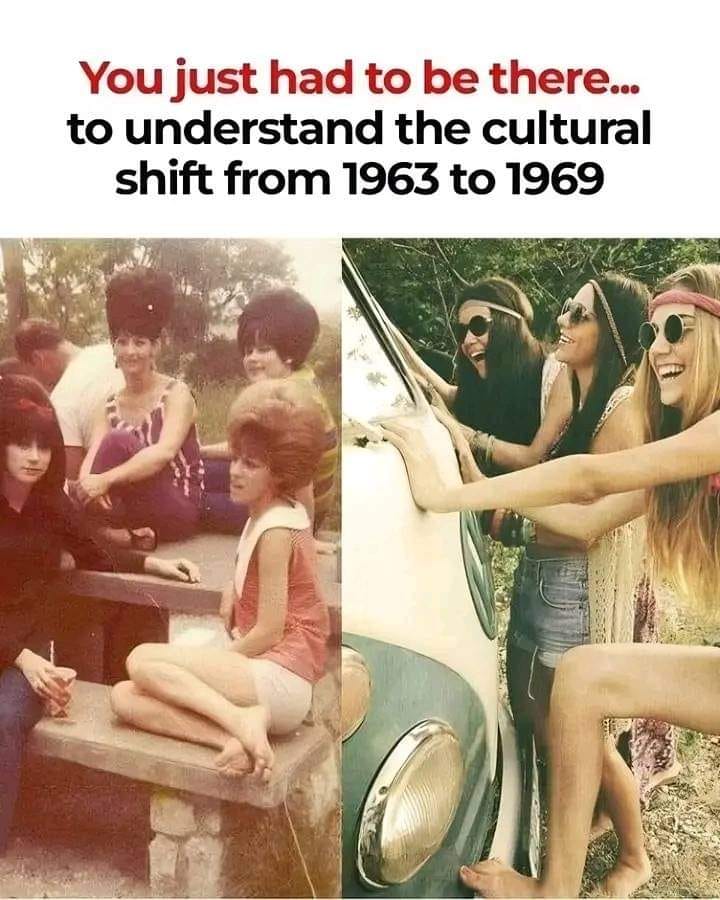
I was eight on 1/1/60 and eighteen on 12/31/69. I have always thought the longest years of my life were from 1963 to 1969 because so much happened to me and the world I lived in during that time. For folks who didn’t grow up in the sixties, it was much more than what you can learn from watching Grease or American Graffiti and contrasting it with Hair or Woodstock.

When I first saw the meme above I instantly thought about how rock and roll music of the 1950s ended up becoming the rock music of Woodstock. I’ve tried several times just to write an essay about that, but after typing over 5,000 words, I realize I’ve barely hinted at what I could say. That’s too long for a blog post.

I recommend that you find two photos that bracket your adolescent years or the decade you identify with the most and meditate on them. Start with remembering every place you lived and what you did each year. Remember your family and friends, your pets, your homes, your schools and workplaces, the clothes you wore, all the activities you pursued, everything you wanted to buy. Then write the shortest essay that makes it all coherent. You will then feel the mental anguish I am feeling right now.

Then branch out in your meditations. The easy and fun things to contemplate are the changes in pop culture — how music, movies, books, TV shows, games, and technology evolved over ten years. But then move on to the political and social changes. That’s when things get heavy. Can you connect your firsthand experiences with all those external events? Have you ever compared the life you lived to what you saw on the TV news every night?

Every one of us has the life experience to write a Proust-size novel and has lived through enough social change to write a series of history books about the formative decade of our lives. If you don’t think so, meditate more on the two photos you have selected.

I turned seventy-three on Monday, and getting old has made me more susceptible to memes about the past. My memories are fading away so I desperately want to cling to them. Emotions gnaw at me to make sense of everything I’ve experienced. The urge is to put it all down in words, but I don’t have what it takes to do the job and do it precisely.

There is an undefinable mental barrier that keeps me from organizing my thoughts into coherent histories. And I’m not talking about writing something worthy of publication for others to read, but just producing a narrative that makes sense of things for myself about myself and what I’ve learned. The older I get, the more I want to understand.

This essay started out about when rock and roll music became rock music. After several drafts and much contemplation, I narrowed it down to the summer of 1965 when I first heard Bob Dylan’s “Like a Rolling Stone” on the radio. As I kept trying to document my theory, I realized I could write a whole book on it.

Then as I was researching the subject, I found that Andrew Grant Jackson had already published the book I wish I had written, 1965: The Most Revolutionary Year in Music. His book is what I wanted to write in this essay when I first saw the meme above.

The Kindle edition is currently $2.99, and it’s a perfect example of what I’m talking about when I suggest we should chronicle our lives. Even if you don’t buy the book, read the sample at Amazon. I feel the format of organizing the narrative around a month-by-month description of what was happening is a great template to use for writing about memories.

JWH
What I See Outside My Window vs. What I See on My TV Screen

by James Wallace Harris, 7/5/24

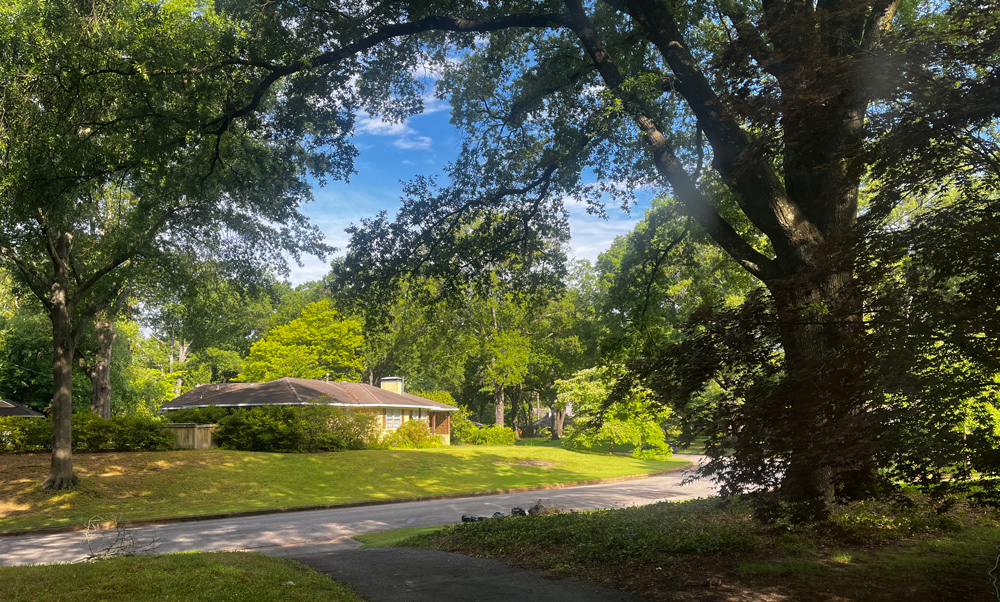
The picture above was taken from my dining room window. Not much is happening. It’s quiet and peaceful. In my den, looking through the sixty-five inch window of my television screen, I see so much turmoil and suffering. The fall of civilization is what’s happening.

One of my favorite novels is called The Door into Summer because the cat in the story hates New England winters and asks to see what’s out every door hoping to find one that leads to summer. I can open my front door and walk out into summer. It’s 77 degrees outside right now – not bad at all for July in a year that might become the hottest year on record. So, why do I spend my days watching television when all it does is to depress me?

The need to know what’s happening is a burden. The belief that I can control anything through knowing more is an illusion and deception. However, there are wars going on all around me and I don’t know if I can sit them out. My friend Anne lives in a nice neighborhood too, but last week there was a shooting at the house one over from hers. Yesterday was the 4th of July, and we heard plenty of fireworks. But we also heard plenty of guys shooting off their guns.

Crime and climate change are getting nearer all the time. What if I looked out my window and saw this:

Thousands of people are seeing this everyday around the world because of hurricanes, tornadoes, floods, and fires. In a decade it could be millions seeing such sites every day. Can we learn anything to avoid that future?

There is a cultural war happening all over the world and the battles are being fought in polling booths. Popularism wants to rewind the clock on progressive progress. To understand this, watch this talk by David Brooks. It’s one of the most uplifting things I’ve seen on my television screen in a very long time.

If you listen to Brooks, you’ll understand what the conservatives want to do with their Project 2025 plan and why. They believe it is their door into summer. If they succeed, I believe 1/20/2025 will be remembered like 4/12/1861 or 6/28/1914. It would be so much easier for my mental health to quit watching TV, but is that really an option? I can understand why Christians are fighting so hard for their way of life. I would have no problem surviving in their utopia if they got everything they wanted. But millions of people wouldn’t, and it will lead to civil war and self-destruction.

The world is going nuts while the environment is going down the drain. On one hand, I can’t stop watching this slow-motion apocalypse. One the other hand, I just want to look out my window or read a science fiction novel.

JWH

Will We Ever Be Able to Know Why There is Something and Not Nothing?

by James Wallace Harris, 6/29/24

Is there one question you’d love to know the answer to before you die? For me, it’s always been “Why is there something rather than nothing?” Religious people want to believe God created everything, but there’s always that one smart kid who asks: What created God? We get into the problem of infinite regression. Of course, there’s the famous story by a scientist where the punchline is: “Turtles all the way down.”

Science has been trying to answer this question forever. At the small end, we have elementary particles in the Standard Model, with scientists and mathematicians speculating they came about because of strings or other concepts. At the large scale, cosmologists think the universe might be part of a multiverse. But don’t we have the same problem? What creates strings and multiverses? It’s something tinier or larger all the way down or up.

I must assume I will never know the answer to the question that gives me the most existential angst. I used to think as a kid, when we die, we’re finally told the answer to all our questions. But if I find myself in another dimension after death, I’m just going to ask: “What created this place?”

Maybe the answer that leads to happiness is to ask questions that can be answered. To focus on a smaller domain of existence. If I reduce the domain to planet Earth, I’d ask: “What happens to humans after runaway climate change?” It’s possible to speculate with some possibilities of getting the answer close to what might happen. But is such speculation useful?

If I reduce the domain to the United States. I guess the question right now that most people are asking: “Who will be elected president in November?” Until the debate Thursday night, we assumed it would be one of two possibilities. But have things changed? Don’t things always change?

I think I need to reduce the domain again. On a very personal level I’d like to know: “What is time.” And I don’t mean where in the Earth’s rotation, or orbit about the sun. No, I want to know: “What makes reality grow from one moment to the next?” Nothing stays the same. So, what is the smallest degree of change perceptible? Is it the vibration of subatomic particles? Is it the fields and forces that make up those particles? What is one tick of reality’s clock?

This is why I’m currently reading books like The Order of Time by Carlo Ravelli and On the Origin of Time by Thomas Hertog. I struggle to understand what these books are telling me. Is it possible to understand physics without understanding mathematics and science at the graduate level? I can vaguely sense what I think they’re talking about, but I might be deluding myself.

I do think time might be the key to why there’s something and not nothing, but I’m not sure we can ever grasp the reality of spacetime. I’m certainly no Einstein or Hawking. I don’t even understand science at an eighth-grade general science teaching level. To me, comprehending time is closer to being a meditating Buddhist.

What question would you love to know the answer to?

JWH

I Gleaned Two Useful Bits of Wisdom from YouTube This Morning

by James Wallace Harris, 3/18/24

The first insight applies to internet addiction. I constantly check several apps on my iPhone all day, and regularly browse YouTube on my television. It’s gotten to be a terrible habit, even though it’s so satisfying.

The first video made an analogy to rats and internet use. If you provide a button to a caged rat that when pressed provides a food pellet, the rat will eat its fill and then stop pressing the button. But if you set the button to randomly provide a food pellet the rat will constantly push the button. The analogy is we constantly check the internet hoping to get a reward, but because we don’t always find something rewarding, we keep checking. I believe that describes my internet habit.

I’m going to take his advice and set a limited time to enjoy browsing. But for the other times I’ll only use the internet when I know I want something specific.

The second piece of advice is about To-Do lists. The guy on the video said if your To-List is too long, you’ll avoid using it. And that’s true for me. I use the same To-Do list app he uses, Todoist. So, I went and rescheduled most of my tasks for the future, and just left five on the main page. I might even reduce it to three. Or even one. I want to try extremely hard and get more things done, even if it’s only one thing a day.

It’s ironic that I found these two insights that are perfect for me by browsing. I think it’s important to do some internet browsing, but I was like a rat in a cage always pushing the button hoping that I’d get a reward. There’s just not that many truly significant rewards to be had on the internet every day.

I hope I can apply these two insights and stick to using them. I might even add them to my habit tracker. Since I started using it, I’ve been doing seven core habits for 151 days straight.

JWH

A Painful Challenge to My Ego

James Wallace Harris, 2/26/24

I’m hitting a new cognitive barrier that stops me cold. It’s making me doubt myself. I’ve been watching several YouTubers report on the latest news in artificial intelligence and I’ve been amazed by their ability to understand and summarize a great amount complex information. I want to understand the same information and summarize it too, but I can’t. Struggling to do so wounds my ego.

This experience is forcing me to contemplate my decaying cognitive abilities. I had a similar shock ten years ago when I retired. I was sixty-two and training a woman in her twenties to take over my job. She blew my mind by absorbing the information I gave her as fast as I could tell her. One reason I chose to retire early is because I couldn’t learn the new programming language, framework, and IDE that our IT department was making standard. That young woman was learning my servers and old programs in a language she didn’t know at a speed that shocked and awed me. My ego figured something was up, even then, when it was obvious this young woman could think several times faster than I could. I realized that’s what getting old meant.

I feel like a little aquarium fish that keeps bumping into an invisible barrier. My Zen realization is I’ve been put in a smaller tank. I need to map the territory and learn how to live with my new limitations. Of course, my ego still wants to maximize what I can do within those limits.

I remember as my mother got older, my sister and I had to decide when and where she could drive because she wouldn’t limit herself for her own safety. Eventually, my sister and I had to take her car away. I’m starting to realize that I can’t write about certain ideas because I can’t comprehend them. Will I always have the self-awareness to know what I can comprehend and what I can’t?

This makes me think of Joe Biden and Donald Trump. Both are older than I am. Does Biden realize what he’s forgotten? Does Trump even understand he can’t possibly know everything he thinks he knows? Neither guy wants to give up because of their egos.

So, what am I not seeing about myself? I’m reminded of Charlie Gordon in the story “Flowers for Algernon,” when Charlie was in his intellectual decline phase.

Are there tools we could use to measure our own decline? Well, that’s a topic for another essay, but I believe blogging might be one such tool.

JWH