Past-Present-Future As It Relates to Fiction-Nonfiction-Fantasy-SF

by James Wallace Harris, 12/12/25

I’ve been contemplating how robot minds could succeed at explaining reality if they didn’t suffer the errors and hallucinations that current AIs do. Current AI minds evolve from training on massive amounts of words and images created by humans stored as digital files. Computer programs can’t tell fiction from fact based on our language. It’s no wonder they hallucinate. And like humans, they feel they must always have an answer, even if it’s wrong.

What if robots were trained on what they see with their own senses without using human language? Would robots develop their own language that described reality with greater accuracy than humans do with our languages?

Animals interact successfully with reality without language. But we doubt they are sentient in the way we are. But just how good is our awareness of reality if we constantly distort it with hallucinations and delusions? What if robots could develop consciousness that is more accurately self-aware of reality?

Even though we feel like a being inside a body, peering out at reality with five senses, we know that’s not true. Our senses recreate a model of reality that we experience. We enhance that experience with language. However, language is the source of all our delusions and hallucinations.

The primary illusion we all experience is time. We think there is a past, present, and future. There is only now. We remember what was, and imagine what will be, but we do that with language. Unfortunately, language is limited, misleading, and confusing.

Take, for instance, events in the New Testament. Thousands, if not millions, of books have been written on specific events that happened over two thousand years ago. It’s endless speculation trying to describe what happened in a now that no longer exists. Even describing an event that occurred just one year ago is impossible to recreate in words. Yet, we never stop trying.

To compound our delusions is fiction. We love fiction. Most of us spend hours a day consuming fiction—novels, television shows, movies, video games, plays, comics, songs, poetry, manga, fake news, lies, etc. Often, fiction is about recreating past events. Because we can’t accurately describe the past, we constantly create new hallucinations about it.

Then there is fantasy and science fiction. More and more, we love to create stories based on imagination and speculation. Fantasy exists outside of time and space, while science fiction attempts to imagine what the future might be like based on extrapolation and speculation.

My guess is that any robot (or being) that perceives reality without delusions will not use language and have a very different concept of time. Is that even possible? We know animals succeed at this, but we doubt how conscious they are of reality.

Because robots will have senses that take in digital data, they could use playback to replace language. Instead of one robot communicating to another robot, “I saw a rabbit,” they could just transmit a recording of what they saw. Like humans, robots will have to model reality in their heads. Their umwelt will create a sensorium they interact with. Their perception of now, like ours, will be slightly delayed.

However, they could recreate the past by playing a recording that filled their sensorium with old data recordings. The conscious experience would be indistinguishable from using current data. And if they wanted, they could generate data that speculated on the future.

Evidently, all beings, biological or cybernetic, must experience reality as a recreation in their minds. In other words, no entity sees reality directly. We all interact with it in a recreation.

Looking at things this way makes me wonder about consuming fiction. We’re already two layers deep in artificial reality. The first is our sensorium/umwelt, which we feel is reality. And the second is language, which we think explains reality, but doesn’t. Fiction just adds another layer of delusion. Mimetic fiction tries to describe reality, but fantasy and science fiction add yet another layer of delusion.

Humans who practice Zen Buddhism try to tune out all the illusions. However, they talk about a higher state of consciousness called enlightenment. Is that just looking at reality without delusion, or is it a new way of perceiving reality?

Humans claim we are the crown of creation because our minds elevate us over the animals, but is intelligence or consciousness really superior?

We apparently exist in a reality that is constantly evolving. Will consciousness be something reality tries and then abandons? Will robots with artificial intelligence become the next stage in this evolutionary process?

If we’re a failure, why copy us? Shouldn’t we build robots that are superior to us? Right now, AI is created by modeling the processes of our brains. Maybe we should rethink that. But if we build robots that have a higher state of consciousness, couldn’t we also reengineer our brains and create Human Mind 2.0?

What would that involve? We’d have to overcome the limitations of language. We’d also have to find ways to eliminate delusions and hallucinations. Can we consciously choose to do those things?

JWH
Why Is Everyone Talking About Neoliberalism?

by James Wallace Harris, 8/24/24

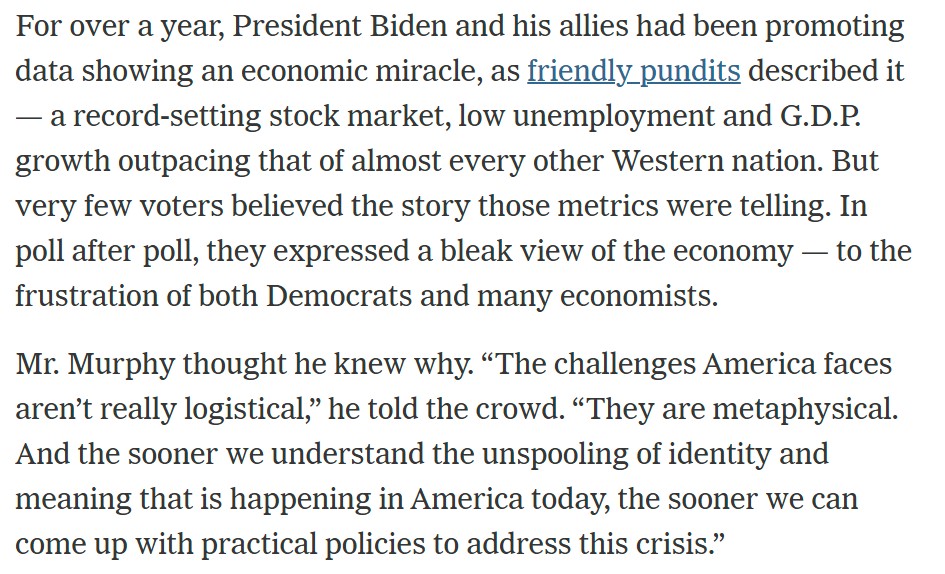
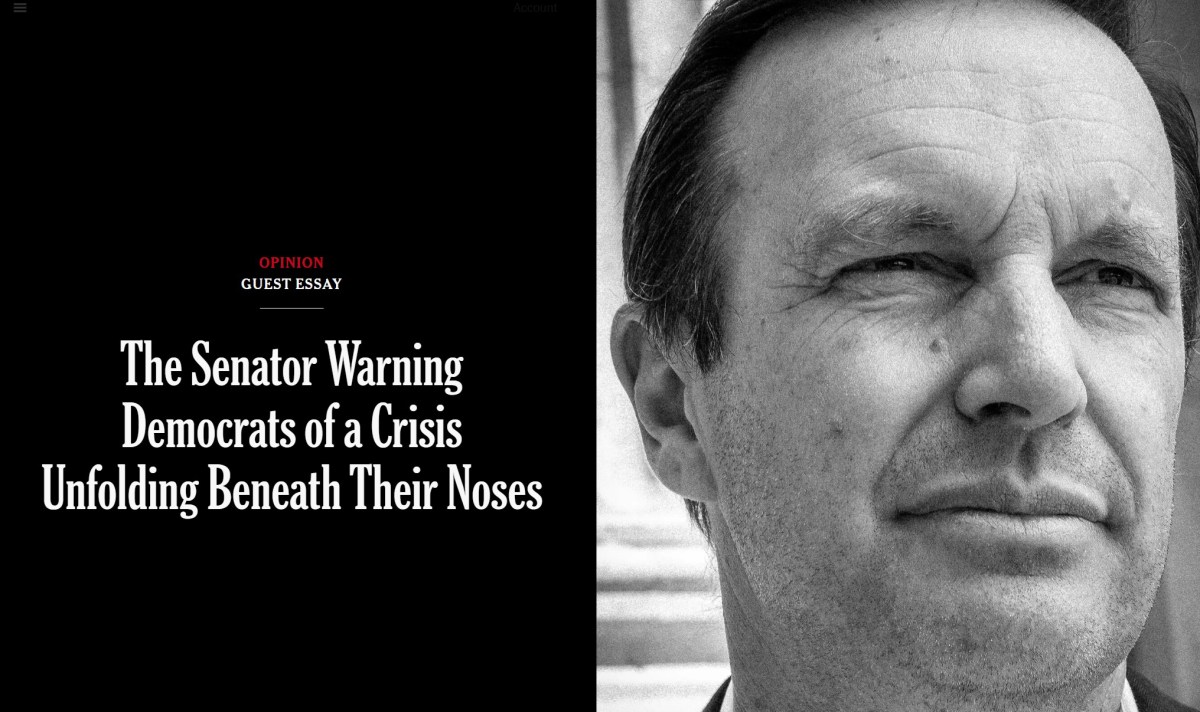
On Monday, August 19th, the New York Times ran a guest editorial by James Pogue about Senator Chris Murphy of Connecticut, entitled “The Senator Warning Democrats of a Crisis Unfolding Beneath Their Noses” which I found intriguing but hard to understand. It appears to suggest that Republicans are going to put limits on neoliberalism. That’s impossible for me to believe.

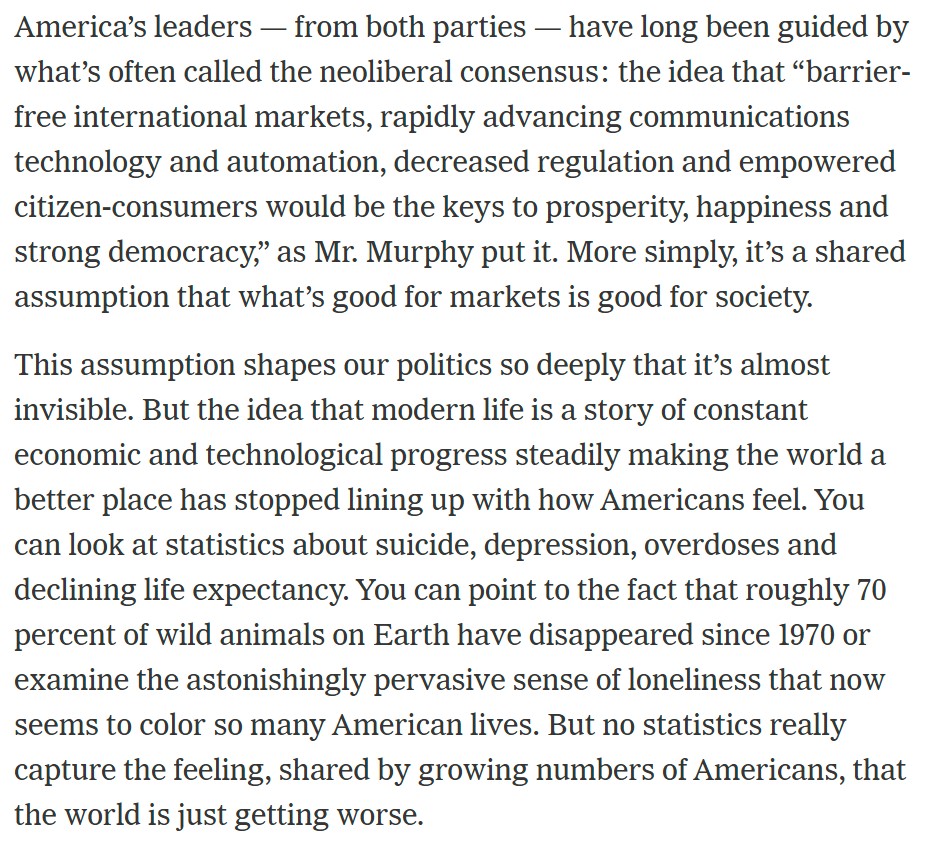
That’s a rather interesting statement, that the problems we face today aren’t logistical but metaphysical. Pogue then goes to say the subject of Murphy’s speech was “the fall of American neoliberalism.” I’ve read several articles over the last few years that mentioned the same thing. Neoliberalism is a virulent form of capitalism pushed by Ronald Reagan and Margaret Thatcher. It’s an economic philosophy embraced by Republicans, but Bill Clinton went along with it when he got his chance. So did Obama. It was Trump who appeared to put on the breaks Neoliberalism when he was elected, and Biden even followed Trump in some ways. So, some pundits are now suggesting the tide has turned.

But has it? Isn’t prosperity through economic success what Republicans and Democrats both want? Pogue goes on to summarize:

Okay, I understand this. Civilization is collapsing and ultimately capitalism is a Ponzi scheme that will fall apart as the one percent squeezed all the wealth out of the ninety-nine percent. But I assumed we need to fix neoliberal capitalism, not reject it. It’s the only system that creates jobs and freedom. We just needed to make it more equitable and friendly to the environment. I assumed that’s what the Democrats want, but evidently according to this essay it’s not the solution the Republicans want.

Pogue says Murphy defines it as a metaphysical problem that masks a spiritual crisis, one that Donald Trump has tapped into. Trump recognizes this unhappiness and appeals to it. Murphy says Democrats have trouble even admitting that it exists. But where does neoliberalism come in? Trump heads the Republican party, and isn’t that party the guardian angel of neoliberalism?

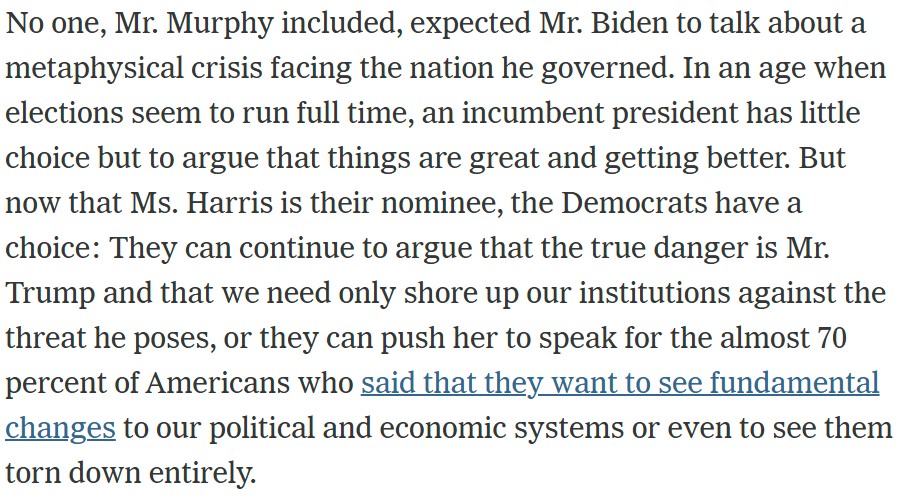
How can a political party overcome a spiritual crisis and still race full steam ahead with capitalism? Pogue summarizes Murphy’s recognition of the problem that the Democrats need to address:

This makes things even more puzzling. I can understand where Democrats might want to regulate capitalism, making it more socialistic and ecological, but how can Republicans alter their religion to help the dissatisfied?

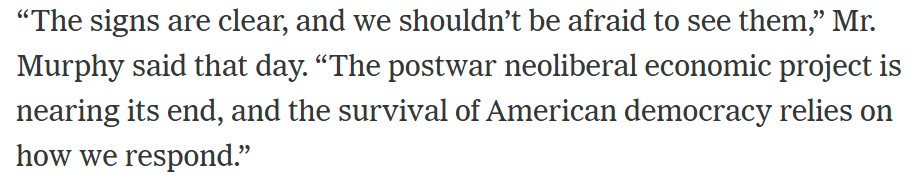
Murphy brings up Project 2025 but is that really a solution to the spiritual crisis he’s pointing at? Ever since FDR and the New Deal, Republicans have been wanting to undo it, and LBJ’s Great Society too. But wasn’t Neoliberalism a response to the Great Depression? But does Project 2025 offer a solution to Murphy’s problem? Isn’t it just consolidating power. It doesn’t claim to undo neoliberalism. Although, it hopes to rewind our sociological makeup back to the 1920s.

To me, the Republicans want to avoid taxes and regulations so they can make as much money as possible. They want private property protected and they want national security. Neoliberalism gives them all of that, so why would they want to undo it? I don’t think they do.

Lately, I’ve been reading books on the French Revolution and Napoleon. The French Revolution tried to create a democratic society based on Enlightenment ideals. The revolutionaries wanted to get rid of the aristocracy and the church. Napoleon believed democracy would just allow a class of wealthy to replace the aristocracy, and that either would need to keep the church because the church kept the poor from destroying either the aristocracy or the wealthy. Napoleon didn’t care for democracy and felt a hereditary aristocracy was a better system for maintaining order. He reinstated the church.

Aren’t the Republicans wanting to be the new aristocrats, and aren’t they embracing the faithful to protect them? Trump and the Republicans want to consolidate power. Is their promise of law and order going to solve the spiritual crisis that Murphy describes?

If the Republicans win in 2024, roll out their Project 2025 plan, and succeed at killing off the Democratic Party, they aren’t going to solve those spiritual problems Murphy points to. They will deregulate capitalism more, cut taxes for themselves, and go back to distilling American wealth from the ninety-nine percent to the one percent. They might make some Americans happier by legislating behavior, but I’m pretty sure they won’t put the breaks on neoliberalism.

Republicans will face a real revolution, like the one in 18th-century France. And we’ll discover the same problems as the French discovered. Between the fall of the Bastille and the coronation of Napoleon, they tried many kinds of governing theories based on the desires of the different factions of the population. None of them worked.

I believe the spiritual crisis Murphy points to has always been with us. There’s no form of government that makes most of the population satisfied. That the pendulum always swings between hope and the apocalypse but never reaches either. Murphy is saying that Trump and the Republicans are swinging the pendulum towards hope. That might even be true for some, but it doesn’t mean the pendulum will reach a point and make their followers happy.

I don’t think Trump is really offering an alternative to neoliberalism economics, but just appealing to isolationism, xenophobia, racism, and is anti-LGBTQ+.

Would it be cruel of me to point out that Christians have been waiting for the Rapture for over two thousand years. Republicans have been in the desert for forty years waiting to get into the promise land. They feel they are remarkably close. Religion and politicians have been promising to deliver people into the land of milk and honey for two hundred thousand years. We’ve never gotten there yet so why believe it now?

The essay goes on for a great length, but it finally gets down to talking about what the Democrats can do in response. I worry that the Democrats might promise pie-in-the-sky. I think we need to get away from believing political parties will save us.

Democrats and Republicans vilify each other, often to extreme. Each have legitimate complaints and desires.

The whole country needs to rethink what it wants, and not trust either party. I think Trump supporters should expect to be let down. I don’t think either party can solve the spiritual crisis that Murphy describes. We have a polarized political system that is stuck with always leaving half the voters unhappy.

I don’t know if we can fix our system, or even start over with a new one that works. But my gut tells me the present two-party system won’t ever succeed. I doubt a one-party system would either. I’d like to see more democracy, not less. We need to decide everything with referendums but change what a winning majority is from 50% to 66%. We need to move closer to a consensus rather than polarization. I think that might be possible with referendums, but not with political parties. Just study opinion polls. Political parties have succeeded in making minority rule work.

I want the Democrats to win in November, but I don’t expect them to solve the spiritual crisis Murphy describes. I just expect they will provide less turmoil over the next four years. Civilization will continue to head towards collapse. Theoretically, we might avoid that, but not with our present political system.

I also think whether the Democrats or Republicans win, they are just going to slightly modify neoliberal economics. The pandemic taught us that we shouldn’t depend on globalism for vital products, but corporations aren’t going to give up on global markets or moving jobs around the world to where labor is cheap. We’ll deploy some tariffs, but then we’ve always had. But the basic tenet of neoliberalism, that capitalism generates prosperity through unhindered commerce won’t end. Capitalism is destructive to the environment, and unkind to economic losers. By its very nature, capitalism generates inequality. The Americans who are suffering the spiritual crisis Murphy describes won’t be saved.

If we evolved a system based on referendums and larger winning majorities, the political parties would slowly fade away. Philosophers have always worried about democracy leading to mob rule. I’m not sure that would be true if we increased the size of the winning majority. It would force us to cooperate. It’s too easy to create minority rule with a fifty percent winning majority.

Our present situation is due to the wealthy getting what they want. Like Napoleon said, they are the new aristocrats, and they aren’t going to give up their power, privilege, and position. Any political or economic solution to help those suffering from the spiritual crisis that Murphy worries about will have to include the power of the wealthy in their equations.

Before neoliberalism was a period where the rich were taxed more heavily, and we had a larger middle class. I doubt Trump wants to use that solution. Neoliberalism wants to stop anything that gets in the way of the rich making money. I can’t believe anyone believes that any political movement will hinder that.

Murphy is right in that the Democrats don’t deal with the issue. But I don’t believe the Republicans are offering a solution either. I think they’re just lying to get elected. Trump’s isolationist policies will create some jobs, but other policies will do away with more jobs. And if he really deports millions of illegal immigrants it will make a huge dent in the economy. Even then, those policies aren’t altering neoliberialism.

I think Murphy and others have put their finger on the problem, but I don’t see anyone offering a solution that will work. Neoliberalism has made greed almost unstoppable. I say almost, because revolutions and apocalypses do happen.

To solve Murphy’s spiritual crisis, we need a lot more jobs and a lot less inequality. Unfortunately, this era also coincides with artificial intelligence, robots, and increased automation. The dream of capitalism has always been to do away with labor, and technology is getting closer and closer to doing that.

Sorry to be so pessimistic.

JWH

Hitting a Cognitive Barrier

by James W. Harris, 9/24/23

I crashed into a cognitive barrier trying to write my reactions to The Trouble with Harry and To Catch a Thief, two Alfred Hitchcock movies from 1955. After two drafts I realized I wasn’t getting where I wanted to go. I know I don’t want to write movie reviews — the perfect place to find them is Rotten Tomatoes. Nor did I want to describe a film — just go to Wikipedia or IMDB. I wanted to write an essay that captured what I got out of watching those films at age 71.

Time is running out, so I need to make the most of every experience. That involves understanding myself at a deeper cognitive level. One I’m finding harder to reach as I age. On the other hand, aging is giving me more wisdom. The cognitive barrier is being able to express what I’m learning by getting older. But aging is also wearing down my brain. What one hand giveth, another takes away.

Writing is thinking outside of the head. Thoughts are generated inside the head from emotional reactions. Thoughts are fleeting. Thoughts are like cream stirred into coffee, creating little patterns that quickly dissipate. Writing is about capturing that initial pattern and making sense of it by showing how it relates to the memories of millions of past patterns.

Very few people can describe exactly how they feel, and few of those people can explain why they feel the way they do. There are rare individuals that can compose their thoughts inside their heads and eloquently convey the results in speech. Most of us need to think outside our minds via writing and editing.

Even when we feel our written words are clear, readers seldom find clarity. Communicating with words is difficult at best and often impossible. What we think we’re expressing can often take a different path to each reader like those spaghetti strings we see in hurricane reports. I might believe I’m writing about Jacksonville, while some readers think I’m writing about Bermuda while others Miami and Charleston.

I enjoyed The Trouble with Harry better than all the other Hitchcock films we’ve watched this month, including Rebecca, Notorious, To Catch a Thief, and Strangers on a Train, films most critics admire a great deal more. However, I thought The Trouble with Harry had many flaws, but then Hitchcock is a flawed filmmaker.

How can I admire a movie that doesn’t measure well against the best movies I’ve seen over a lifetime? This gets into complexity and even multiplexity. I need to relate several reactions that contradict each other. The three films I admired and enjoyed the most this month have been The Trouble with Harry, Twelve O’Clock High, and Mr. Belvedere Rings the Bell. All three were feel-good movies to me, but they each made me feel good in a unique way. Is the word “feel-good” even useful? Many moviegoers might interpret the term “feel-good” so differently that these three movies would not fit their definition.

Should I even use the term? Shouldn’t I just describe exactly what I felt? Will that be clearer?

In my second draft I had a breakthrough. I realized to understand how I react to films I’d need to understand what I expected from them. But my expectations have changed widely over the years. And will my readers have the same expectations? It was then I realized that what I’m expecting from movies at 71 is different from my younger self. Even describing my own emotional experiences is a moving target. But explaining why that’s so hits another cognitive barrier.

I need to think about that.

Putting everything into words precisely is so difficult. Should I even try? I believe most people don’t because all they value is personal experience. Why tell anyone about our perceptions when they have their own?

Do you see why writing that essay became such a black hole?

JWH

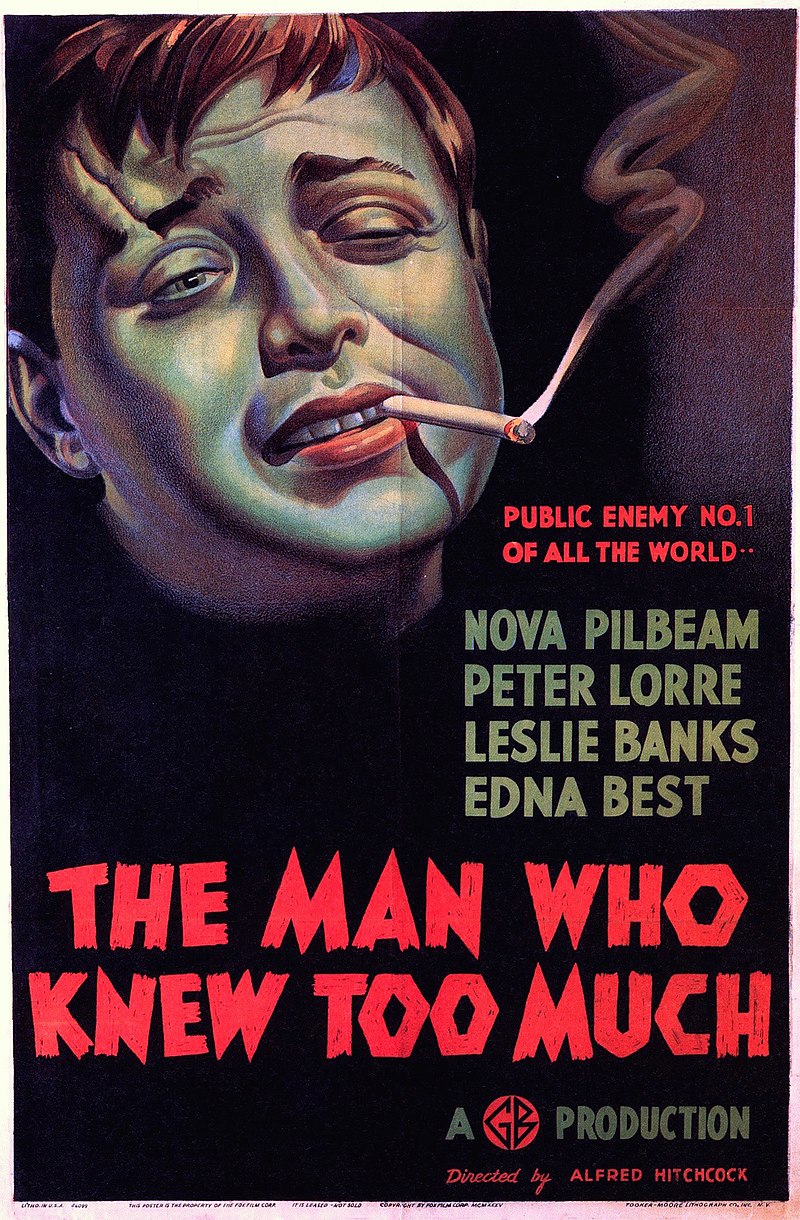
The Man Who Knew Too Much (1934)

by James Wallace Harris, 9/13/23

Do you ever think about why you watch movies? Do you ever think about why people make movies? The obvious answer is people want to be entertained and diverted and other people want to make money off those impulses. However, there are filmmakers with something to say, and audiences who want more than to be just entertained.

Alfred Hitchcock aims at pure entertainment. I don’t believe his films are philosophical, uplifting, meaningful, spiritual, or have anything specific to communicate. Hitchcock shows an evolution in the artistry over time, and his 1934 film The Man Who Knew Too Much is not as creative as his on 1956 remake. However, I don’t want to compare the two, I want to consider the 1934 film on its own.

The Man Who Knew Too Much is based on book title, a collection of detective stories by G. K. Chesterton. The film uses nothing of the stories.

The plot of the film is basic. Foreign agents plan to assassinate a prominent figure in London. A British couple vacationing in Switzerland with their adolescent daughter intercept a warning for the British consul. The agents kidnap the daughter and tell the couple if they relay the message to the police, they will kill their daughter. The couple return to London where British officials meet them. They have guessed the situation. They tell the couple they must tell them the message or else the assassination could cause a war like WWI. The couple refused, saying they only care about their daughter.

This hostage setup is common in thrillers. Hitchcock uses it clumsily. The criminals are willing to kill anyone at any time. Why didn’t they just kill the parents and leave the child? And why do the parents find the criminals almost instantly, faster than the police? And what’s with the silliness of the dentist scenes? Or the silliness of the cult of sun worshippers (nudists)?

Hitchcock switches between humor, violence, humor, violence, throughout the film. And for modern audiences, the stage and special effects are crude. They are on par with movies from 1934, but most modern film viewers won’t know that.

Hitchcock has said he was an amateur filmmaker when he made the 1934 version of The Man Who Knew Too Much, but a professional when he made the 1956 version. To me, the only reason to watch the 1934 version is if you want to have seen all of Hitchcock’s films.

My favorite film of 1934 is Treasure Island with Wallace Beery, Jackie Cooper, Lewis Stone, and Lionel Barrymore. Even still, most modern movie watchers will find it crudely made. Treasure Island is superior to The Man Who Knew Too Much in every way, plot, acting, costumes, sets, and special effects, but Treasure Island probably had five times the budget, and was made in Hollywood. The Man Who Knew Too Much is more comparable in quality to Charlie Chan in London from 1934.

The best thing about The Man Who Knew Too Much (1934) is Peter Lorre. He couldn’t speak English yet and had to memorize his lines phonetically. He’s not particularly evil or menacing in this film, but he does stand out as a fun bad guy.

However, as I watch these Hitchcock films, I’m disappointed that they never try to rise above just being thrilling or funny. They give no sense of place, history, or society. They offer no psychological insights. Later Hitchcock films offer style, but not this early one.

Comparing it to Rebecca made just six years later in 1940, but in Hollywood, Hitchcock shows a tremendous evolution in filmmaking. It offered so much more, but then Rebecca was based on an impressive book. Then six more years, in 1946 Hitchcock made Notorious, which I found problematic. It wasn’t based on a book and the plot seemed silly.

My current hunch is Hitchcock on his own or working closely with a screenwriter, focuses on pushing just a few kinds of emotional buttons. He likes to create suspense and tension and uses comedy to keep things within control. That’s what we see in The Man Who Knew Too Much (1934).

It’s okay if that’s what you like, but I wanted more.

JWH

Thinking Outside of Our Heads

by James Wallace Harris

I believe recent developments in artificial intelligence prove that many of the creative processes we thought came from conscious actions come from unconscious mechanisms in our minds. What we are learning is computer techniques used to generate prose or images are like unconscious processes in the human brain.

The older I get, the more I believe that most of my thinking comes from my subconscious. The more I pay attention to both dreams and my waking thoughts, the more I realize that I’m very rarely making conscious decisions.

I might think “I am going to walk across the street and visit Paul,” but I have no idea how to make my body walk anywhere. But then, I’ve always assumed muscle actions were automatic. It was mental actions I believed were conscious actions. I used to believe “I am writing this essay,” but I no longer believe that. This has led me to ask:

Just what activities do we perform with our conscious minds?

Before the advent of writing, we did all our thinking inside our heads. Homer had to memorize the Iliad to recite it. Prehistory was oral. How much of thought then was conscious or unconscious? Have you ever read The Origins of Consciousness in the Breakdown of the Bicameral Mind by Julian Jaynes? I know his theories have lots of problems, but they do imagine what I’m thinking about.

How often have you worried over a problem, say a math problem, or a programming problem, and gave up, but then later, usually after a nap or sleep, the solution came to you? That’s the classic view of unconscious thinking. But even when we’re thinking we’re solving a calculus problem is it really being done at a conscious level? Are you consciously recalling all your math lessons over a lifetime to solve the problem?

How often when working on a Wordle or Crossword does the word magically come to you? But sometimes, we are aware of the steps involved.

In recent years I’ve developed a theory that when we work with pen and paper, or word processor or spreadsheet, or any tool outside our body, we’re closer to thinking consciously. Sure, our unconscious minds are helping us, but making a list is more willful than just trying to remember what we need at the store.

Writing an essay is more willful than woolgathering in the La-Z-Boy. Authoring a book is far more willful still. Engineering a submarine by a vast team of people is an even more conscious effort. Sure, it involves a collective of unconscious activity too, but a vast amount documentation must be worked out consciously.

I’ve written before about this idea. See “Thinking Outside Your Head.” That’s where I reviewed different techniques and applications we use to think outside of our heads.

Many people want to deny the recent successes with AI because they want to believe machines can’t do what we do. That humans are special. If you scroll through the images at Midjourney Showcase, it’s almost impossible to deny that some of the images are stunningly beautiful. Some people will claim they are just stolen from human creativity. I don’t think that’s true.

I think AI developers have found ways to train computer programs to act like the human mind. That these programs have stumbled upon the same tricks that the brain evolved. Many great writers and artists often talk about their Muse. I think that’s just a recognition of their unconscious minds at work. What those creative people have learned is how to work consciously with the unconscious.

What some creative people are doing now is consciously working with two unconscious minds – their own and an AI. There is still a conscious component, the act of working with tools outside of our head. Where the action is, is that vague territory between the unconscious mind and the conscious one.

JWH