The Uneducated Unkindness of Youth Censoring the Past

by James Wallace Harris, Wednesday, September 25, 2019

Yesterday I read, “The Cult Books That Have Lost Their Cool” by Hephzibah Anderson at the BBC online. Anderson snidely dismisses several novels that were considered classics by my generation. Of course, when I was young I was just as quick to dismiss the works my parents loved. History has shown us that revolutionaries tend to eliminate people and art that don’t meet the standards of the new zeal. As an old person, and evidently part of an old guard, I’m seeing more of my history dismissed, causing artists and artists to disappear from pop-culture consciousness. It feels like agism censorship.

I can accept that the young have judged us harshly and found us morally wanting. What annoys me is they don’t have any sympathy for human frailty, and quite often I feel their social media kangaroo courts are conducted without examining the actual evidence. Take for example Anderson’s assessment of Jack Kerouac’s On the Road:

Based on a road trip from New York to Mexico with Beat muse Neal Cassady, Kerouac wrote what would become the Beatnik’s bible in just three weeks. It took six years to get published and more than half a century later, it exudes tiresome stoner machismo. Kerouac pokes fun at gay people, and isn’t much better where women and black people are concerned. A few years back, a spate of books and films inspired only a flicker of revived interest in his legacy. Boorish egotist or inspired prophet? The jury isn’t just out, it left the building long ago, dancing after the hippies who supplanted the Beats.

I can’t believe Anderson has even read the book. She says Kerouac pokes fun at gay people, but of the three main characters, Kerouac is straight, Ginsberg is gay, and Cassady is happy to have sex with almost anyone. And these men practically worship black jazz musicians. Kerouac hardly takes a machismo stance. He portrays himself with endless faults and emotional weaknesses. Kerouac was like Proust, he struggled to make sense of his life by fictionalizing it. The term beat deals with Kerouac’s existential angst over living in the 1940s and early 1950s. On the Road is about seeking freedom from an oppressive materialistic society. Anderson assumes it is some kind of bro road epic. If anything, Kerouac portrays the beats as Quixotic figures tilting at windmills. It’s a realistic portrait of the times, of men, women, gays, minorities, Mexicans, ethnic groups, and so on. It’s a sad, beat story about looking for kicks and being kicked down. It’s not pretty, but it is honest. Anderson has no sympathy for Kerouac’s suffering and struggle.

Nor is Anderson sympathetic to The Catcher in the Rye by J. D. Salinger:

Poor Holden Caulfield. Mired in a funk for more than half a century, the angst-ridden ‘everyteen’ is now regarded by the cool kids as being a bit – well, self-indulgent. His ennui is, if not exclusively a rich-white-boy problem, then certainly nothing compared with looming climate collapse and other woes weighing on the minds of his 21st-Century peers. Plus, in the era of helicopter parenting and geo-tagging, not to mention hyper-vigilant mental-health awareness, the idea that a depressed teen could simply go Awol in New York City for a couple of days is increasingly hard to indulge.

Just because Kerouac and Holden Caulfield don’t meet modern moral standards of 21st-century young people they are shunned and ridiculed. But here’s the thing, every generation is different. Should we erase the past because it’s different? Sure these people are morally and ethically wanting by today’s higher consciousness, but they are still human beings trying to make sense of life by what they knew at the time. The point of reading old books is to understand the past, to see it for what it was, not what we want it to be.

Dismissing Kerouac or Sallinger is cold and callous. Dismissing these writers is a kind of censoring the past. You can’t perfect the present by erasing the past. The ironic thing is Kerouac and Sallinger were revolutionaries like Anderson, wanting young readers to know that the times were changing. Of course, they did their own rejecting of the past too. That’s how it goes. But it’s better to see the bigger picture.

I wonder how Anderson will feel when she’s my age and someone her age now dismisses the cherished art and artists that shaped her generation?

I don’t really expect things to change. I always felt sorry for Kerouac. Kerouac and my father lived about the same years and died young from alcoholism. I wrote an essay years ago called “The Ghosts That Haunt Me” about Mark Twain, Jack Kerouac, Louisa May Alcott, and Philip K. Dick. These writers had painful lives, but they were outstanding in their soulful writing trying to make sense of those lives. It pisses me off that someone would blithely dismiss them for being uncool. I’m also sensitive about forgotten authors – see my page for Lady Dorothy Mills who has practically disappeared. It just seems hurtful to me that any writer would encourage readers to stop reading any author.

To be honest, I was like Anderson when I first read Kerouac when I was young. I thought it was a novel about thrills. But with every decade of life On the Road changes. I’ve been on the road for more years than Kerouac ever got to live. It takes a long time to really understand what beat means. Hephzibah, don’t be so quick to dismiss On the Road. Read it again when you’re older.

JWH
 

Book Shopping in the 21st Century

by James Wallace Harris, September 22, 2019

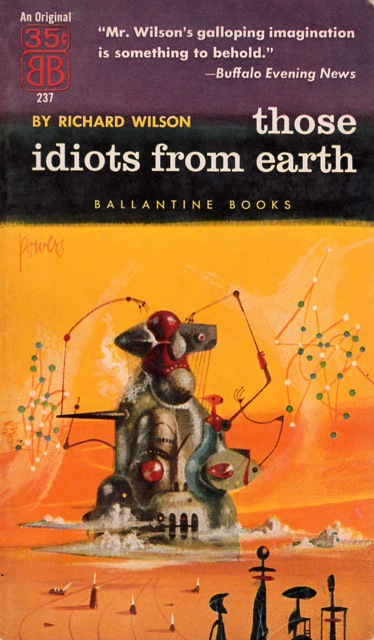
It’s early Sunday morning. My wife isn’t up. The stores are closed. And I’m book shopping. I just bought Those Idiots From Earth by Richard Wilson, an author I don’t even remember. I just loved the cover and title. Book shopping is so different from how it was back in the ancient times of the 20th century.

In the 21st century, I perused thousands of booksellers from around the globe in a fraction of a second. From the time I decided I wanted this book till the time I pressed the order button was about 25 seconds. Of course, I’ll have to wait several days for Mr. Wilson’s collection of SF stories to show up in my mailbox.

Maybe I should jump back before I even knew about Those Idiots From Earth. I’m in a Facebook group The Best Science Fiction and Fantasy Short Fiction of the Year created by Paul Fraser. It’s devoted to collections and anthologies of science fiction short stories. I hadn’t posted in a while, so I wanted to find a unique old science fiction anthology that had a cool cover. I was using the Internet Science Fiction Database and searching on anthologies edited by Groff Conklin. Several of his paperbacks had cover art by Richard Powers, a favorite artist of mine. I then clicked over to look at books with covers by Powers. That’s when I noticed Those Idiots From Earth. Checking Richard Wilson’s entry showed a few novels and a lot of short stories. He was a writer I don’t remember at all. If you follow those links you’ll see just how truly useful ISFDB.org is for book shoppers.

Once I saw that cover and title I was intrigued. I’ve owned hundreds of science fiction magazines, so I’m sure I’ve seen the name before, and maybe even read a story of Wilson’s. I just didn’t recall anything this morning. So I got on Google and found a review of the collection by Joe. He gave four stories 5-stars, and the rest either 4-stars or 4.5-stars. I’ve never read any reviews by Joe before, but he did make Wilson’s stories sound like something I wanted to read. I love finding new SF authors with a different slant.

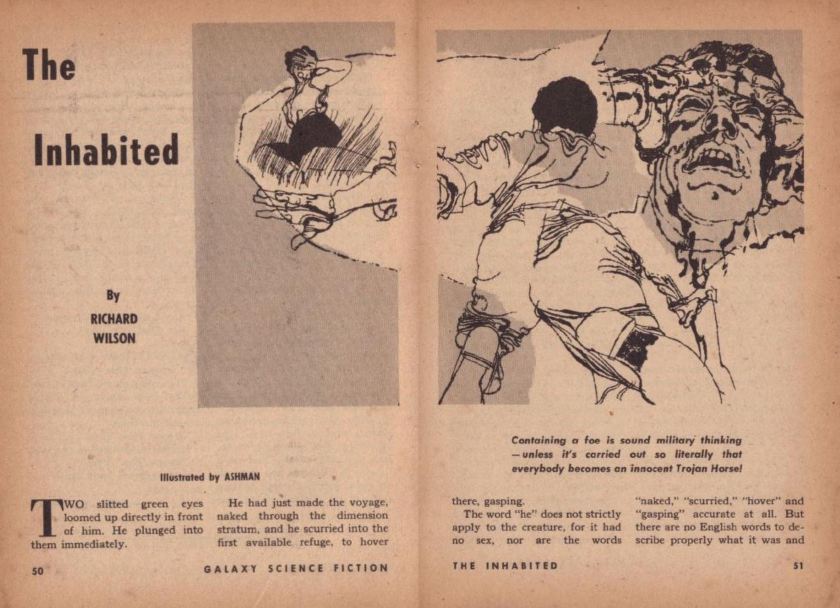
I wanted to test read the title story, but it was never published in a magazine. Luckily, the first 5-star story, “The Inhabited” was in the January 1953 issue of Galaxy Science Fiction. I checked my collection of Galaxy but didn’t have that copy. But I do have a complete run of the magazine on digital scans. You can read the story on the Internet Archive.

The Inhabited by Richard Wilson

“The Inhabited” is about an alien mind coming to Earth to scout out our planet. Are we worth invading? The alien mind occupies a cat, two men, a boy, and a pregnant woman before ending up in the mind of an insane man. The alien ends up confessing to a psychiatrist. It’s a neat little story. I decided I wanted Those Idiots From Earth and went to ABEbooks.com and ordered a copy. The original paperback was in fine condition and cost $4 (plus $4 shipping).

It took me a pleasurable ten minutes to find out about the book, but only about 25 seconds to find and buy it on ABEbooks. I’m hoping you’re getting the power of the internet for 21st-century book shoppers. ABEbooks claims it has thousands of booksellers in 50 countries selling millions of books. There were three copies available from all those locations. Now that’s efficient book browsing!

I remember the first bookstore I went to back in 1964. It was a little hole-in-the-wall shop in a strip mall in Perrine, Florida. The shop was dark and dusty. I was twelve. It was before I earned my own money. Back then a used paperback was a nickel or a dime – candy money. I had no idea what I was buying, but it was exciting. I knew I loved science fiction, and I’d buy books based on how cool their covers looked.

As I got older I would go all over town looking through old book shops. Whenever I visited another town, I’d look up their used bookstores. There were books I searched for years in several states and cities before finding them. The hunt for a book used to be quite thrilling. Then in my late teens, I learned how to use mailorder rare book dealers, which had its own kind of fun. I could almost always get my book, but sometimes it took years. There were some books I never found until the internet and ABEbooks.

In the 21st-century it’s much easier to track down a used book, but not quite as fun. Without the internet though, I would never have heard of Those Idiots From Earth. I often surprise my friends when they mention a book they’ve been searching for years and I find it in minutes.

I sometimes wish the internet had never been invented. I’m not sure if living in the hive mind of social media is healthy. Nor do I love keeping up with data overload. It does let me find the few people that share my exact interests. But then I have those highly specialized interests because of the internet. I remember when there were only three TV channels, Top 40 radio, and the science fiction section was two shelves of books at the new bookstore. At school, we all talked about the same movies, television shows, and songs. Nowadays every friend seems to have their own favorite show, so there’s less sharing, even though on social media what we do is called sharing.

The internet lets me get up on a Sunday morning and search through millions of books in thousands of booksellers from around the planet in a matter of seconds. That’s pretty damn far out. It’s not the same as riding my bike down to an old shop and spending an hour looking through stacks of unordered SF titles trying to find just the right books to get the most for my quarter.

The times keep changing. I can’t imagine how we can go any faster. Maybe I should wonder how to go slower?

JWH


Quantifying My Cognitive Decline

by James Wallace Harris, Thursday, September 5, 2019

I subscribe to a service called Grammarly which checks my spelling and grammar as I write. Grammarly sends me a weekly report on how I’m doing. Two years ago it would tell me I was more accurate than 65-70% of their users, referring to grammar and spelling. I doubt even when I was young it would have been much higher. In recent months that number has fallen to 35-40%. And I can feel it. I have to proof my posts countless times and I still find errors after I’ve published. I’m appalled by how bad my writing has become. If I published my first drafts readers would think they were following Charlie Gordon into his descent phase from the book Flowers for Algernon.

I consider this good quantitative data on my cognitive decline. Grammarly does give me some good news. I’m generally more productive than 98-99% of their users, and my vocabulary is larger than 98-99% of their users. The first is explained by being retired and writing for two blogs. The second reflects long term memory. I can tell it’s my short term memory that’s failing.

I still don’t see this as an early sign of dementia, but I might be deluding myself. I think it’s just an aspect of normal aging. We’re used to seeing our bodies getting old because of all the visible physical changes. We’re not used to mental changes because they are less observable to ourselves and the people around us. Unless we talk or act differently, other people don’t see the changes. And we don’t feel the changes unless we try to do something and fail.

I have been noticing the number of times people ask me why I’m not talking. I tell them I’m just listening to them. Or say I’m thinking. But I believe it’s because it takes more effort to put thoughts into words, and when I do talk I can’t remember words, or I verbally trip when saying sentences. My cognitive problems are the most obvious when writing. If I’m just playing with the cats, watching television, or listening to music I feel fine. I believe we ignore our mental aging by doing less and saying less. Of course, many people also ignore signs of physical aging — that’s why so many foolish oldsters fall off ladders.

The real question is: Can we exercise the mind like we exercise the body? It appears we can slow physical decline by being more active. Is that also true for mental activity? My first reaction when I realized I was making more spelling and grammar errors was to quit writing. But I quickly decided that was the wrong approach. I believe writing exercises the mind. Instead of quitting I should work harder. However, I might need crutches. I thought about pilots who use preflight checklists, or how surgeons now use checklists to avoid making surgical mistakes.

I already pay Grammarly to keep an eye on me, but it’s far from perfect. In fact, when I see errors after I published it means Grammarly and I both missed them. I usually proofread my posts four or five times before I hit the published button. Often the most glaring mistakes are last-minute rephrasing where I don’t proof the whole sentence, or whole paragraph again. But other mistakes come from reading too fast and assuming I’m seeing what I read.

I believe my essays give the illusion that my mind is working just fine. Y’all don’t see how many broke things I fix. I use the internet to cheat. It really is my auxiliary memory. And I have unlimited do-overs. Most importantly, I can take all the time I need to say what I want.

I’ve always been a good typist. It’s been the most useful skill I learned in high school. What I typed used to be what I thought. Thoughts came out of my fingers. That’s no longer true. Now my fingers give me sound-alike words, leave out words, type words twice, and even throw in extra words. Quite often I end up typing just the opposite of what I was thinking. While typing this paragraph I created 8-10 alternate words to what I was thinking. Just that could explain the halving of my accuracy score in Grammarly.

[When proofing the above paragraph I had a new insight. What if my typing is as accurate as ever, and I’m merely typing jumbled thoughts when I once transcribed clear ones?]

Writing isn’t the only way I’m seeing increased cognitive problems. The other day I wrote “Untying a Knotted Plot” about my difficulty of understanding a short story. I had to read it four times. Admittedly, it is a complicated story. The author even wrote a couple of comments to help me. That essay was extremely difficult to compose. I struggled with trying to comprehend the story and write about it clearly. Every time I typed the author’s name I looked at the magazine to verify the spelling. I still got it wrong three out of eight times. I proofed the hell out of that piece because errors seem to be popping like popcorn. I felt like I was playing a very desperate game of Whack-a-Mole.

There’s another reason to keep writing. I want to document my own decline. Like the researchers in Flowers for Algernon, they tell Charlie to keep a journal. I’m going to be my own researcher and subject. I think it’s useful to be aware of my diminishing abilities. Aging is natural, and I accept it. I’m willing to work to squeeze all I can from my dwindling resources. What’s vital is being aware of what’s happening. The real problem to fear is becoming unconscious to who we are. Like Dirty Harry said, “A man’s got to know his limitations.”

The reason why Flowers for Algernon was such a magnificent story is that we’re all Charlie Gordon. We all start out dumb, get smart, and then get dumb again. Charlie just did it very fast, and that felt tragic. We do it slowly and try to ignore it’s happening. That’s also tragic.

JWH


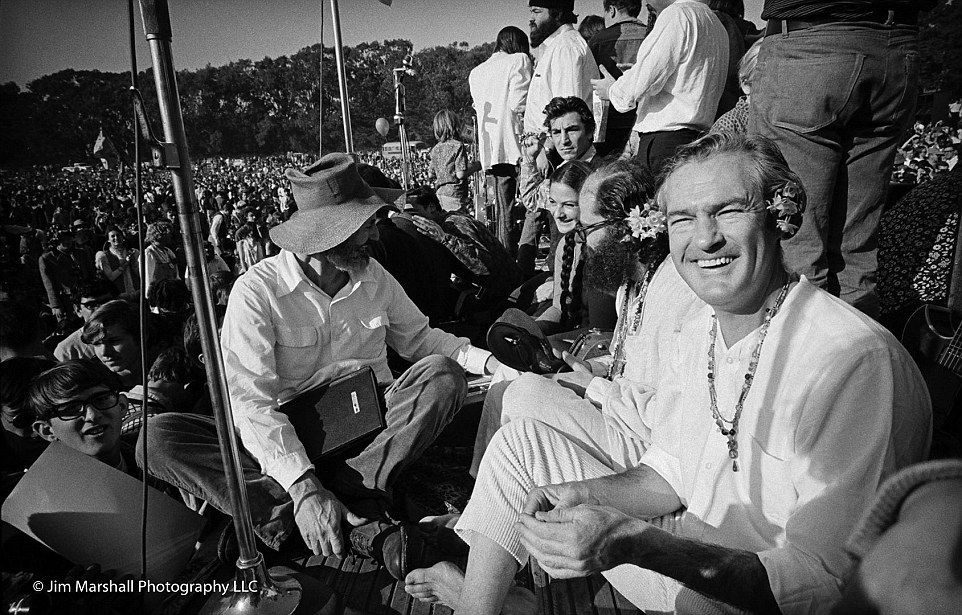
What’s the Legacy of the 1960s Counterculture Revolution?

by James Wallace Harris, Tuesday, August 20, 2019

Last night I watched “Summer of Love” on PBS’s American Experience. If you have a login for PBS you can follow the link and watch it. Or try your Roku PBS app. I’ve seen this documentary before, it originally appeared in 2007, but I guess PBS wanted to capitalize on the Woodstock 50th anniversary.

Watching “Summer of Love” was a bummer, a bad trip this time around. I remember back in the 1960s how badly I wanted to run away to San Francisco and become part of the counterculture. I thought a revolution was going on and I was missing out.

Over the years when I’d watch these remembrances of 1960s counterculture it would be with nostalgia. This time around I realized my nostalgia was all gone. At 15 it would have been fun for a while, but you have to watch between-the-scenes. There’s only so much prancing in the park you can do before it gets boring, and you can’t stay high forever. And I’ve lived in communal situations a number of times in the 1970s and it wasn’t all peace and love.

This past week I also watched documentaries on Woodstock and Altamont. Between Monterey Pop Festival on June 16, 1967, and Altamont Speedway Free Festival on December 6, 1969, the 1960s counterculture reached adolescence and then died a tragically early death. However, the dreams of what people wanted from the counterculture still persist. They have haunted us for fifty years.

We kept the long hair, beards, colorful clothes, free love, music, and dope, but we never found peace and harmony, we never freed ourselves from the 9-to-5 grind, we never escaped capitalism. We foolishly believed utopia was possible. We tried very hard to integrate and free ourselves of racism but we’ve never really succeeded. Both women and minorities have made great strides in society but we haven’t reached equality. In the 1960s the counterculture believed we could all transform ourselves. We thought we could clean up the environment, treat all life on Earth with love, and redesign capitalism to be kind and just.

It just didn’t work out. We can see the counterculture legacy in the 2020 candidates for the Democratic Party. We’ve convinced half the world to care about the environment but even the most idealistic of us can’t stop using plastics. Burger King might sell veggie burgers but we still have massive factory farms of animal torture. We know the use of fossil fuels will destroy us yet we still drive cars and electrify our homes with coal.

I think there have always been hippies with dreams of living kinder lives. Jesus and his disciples are one example of keeping a counterculture dream alive for two thousand years. Yesterday I listened to “Episode 38: The new anti-capitalist science fiction” of the podcast Our Opinions Are Correct by Annalee Newitz and Charlie Jane Anders. They just won the Hugo award for Best Fancast. Both are science fiction writers that are leaders in one of the many new countercultures. They assume, they dream a revolution will take place. It’s really the same revolution of 1967. They are full of hope. I still hope, but how much hope do I really have left?

For the 1960s legacy counterculture revolutionaries to succeed capitalism must be transformed. The extreme idealists have always wanted to do away with capitalism but I don’t think that’s possible. Capitalism is too basic to human nature, buying and selling are as natural as eating, even chimpanzees barter and trade. But can capitalism be tamed and civilized? Or will it always be Darwinian, the vicious survival of the fittest?

There is no doubt that society has drastically transformed since the Summer of Love in 1967. That’s proof we can change, but can we change everything about ourselves? If you study history change is constant. We never stay the same. We will never build a society or economic system and then rest with the satisfaction of achieving our goal. Human society is always boiling over with more wants.

The real question we must ask ourselves is: Can we stop being self-destructive? Conservatives want to cling to a dream of a stable past that never existed, while liberals dream of a stable future that’s a fantasy. There’s a type of insanity that grips us all — one where we believe if we all believed the same thing it will solve all our problems. In other words, we’re all revolutionaries. Christians think if everyone was Christian the world would be perfect. Conservatives think if everyone voted their party line we’d solve all our social problems. Counterculture thinkers believe we need to throw out the old for the new. The trouble is there are many counterculture revolutionaries out there now, some quite evil and nasty, and few revolutionaries share the same revolution. It’s chaos, but then isn’t it always chaos?

Read LikeWar: The Weaponization of Social Media by P. W. Singer and Emerson T. Brooking. It chronicles all the revolutions that are going on right now on the internet. The amount of information in this book is staggering. It has 107 pages of notes on sources. I expect the Summer of 2020 to be more heated and dramatic than the Summers of 1967 and 1968 (and if you don’t remember, 1968 was nasty). The hippies of San Francisco were kids at play and even the fiery student activists in Chicago of 1968 were babes in the woods compared to the radical revolutionaries online today.

The real legacy of the 1960s counterculture is more counterculture. It was easy to spot the hippies on Haight-Ashbury, or Yippies of Chicago, or the Black Panthers, or the SDS, or the Weather Underground. The new countercultures are as visible as electricity in the wires of your home. Read LikeWar. Don’t wait 50 years to watch the historical documentary.

What Dylan said back then is still valid, “‘Cause something is happening and you don’t know what it is, Do you, Mr. Jones?”

JWH


Keeping Up In The 21st Century

by James Wallace Harris, Thursday, August 8, 2019

I’m reading a rather disturbing book, LikeWar: The Weaponization of Social Media by P. W. Singer and Emerson T. Brooking. It’s disturbing for a number of reasons. First, it shows how completely out of touch I am. Second, it’s very relevant about today’s politics, problems, and conflicts, but makes me realize that I don’t have the tech skills I thought I had – and I’ve been working with computers since 1971. And it’s about a new stage in human communications that I might not be able to join or want to join. I might need to accept I’m too old and let a new stage of human consciousness pass me by.

It’s very difficult to explain why people need to read this book. But here’s a setup that might help. It’s my take on things but relates to what I learn from the book. It’s about the different stages of communications.

  1. Language. This gave us a tremendous boost compared to the other animals, and it’s probably why we’re sentient.
  2. Writing. Let us store knowledge and communicate at a distance.
  3. Printing. Let us mass-produce knowledge.
  4. Telegraph. Let us communicate over distances very fast. This was a tremendous boom for business, war, and journalism.
  5. Telephone. Faster two-way communication without codes.
  6. Radio. The beginning of mass communication. For example, LikeWar quotes Joseph Goebbels saying the Nazis couldn’t have gained power without radio.
  7. Television. More effective mass communication. Truly transformed society.
  8. Computers. They magnified our thinking power and speed.
  9. Networks. Created a world-wide digital nervous system.
  10. Social media. Mass communication with mass participation, or two-way mass communication. LikeWar is about how social media is transforming politics, crime, business, and war. One example LikeWar uses is ISIS, which used social media to overpower traditional national powers.

If you don’t have social media skills you’ll be left behind. Most people’s reactions will be, “Too bad, I don’t care about Facebook.” LikeWar provides significant evidence that all future political power will come from the people who can master social media. LikeWar showed how Trump gained his power with Twitter. Don’t dismiss that out of hand. Singer and Brooking make a powerful case for it being true.

I’m 67 and barely use social media. I blog, I keep up with family, friends, fellow hobbyists on Facebook, I use Twitter to keep up with news about science fiction. That’s essentially nothing. Here’s an example of what I’m talking about. When I was growing up I watched the CBS News every night to follow the Vietnam War. The news was about 24-48 hours old. Some people today keep up with wars in real-time, watching people conduct war using the internet to outmaneuver people conducting war at television and print journalism speeds. LikeWar showed how ISIS used social media users worldwide as recruits in their local battles.

In other words, in any field of endeavor, any conflict, if you’re using print, radio, or television to keep up you’re way behind. We really are developing a global hive mind, and it involves new skills. I can use the excuse that I’m too old to chase that bus. But younger people or older folks who want to compete can’t. And I think that’s stressful. I think a lot of stress in our society is because we’re stratifying by the speed in which we can compete.

I’ll predict there will be a new class of Luddites, those people who choose not to race at social media speeds. But it means giving up power. We’ve had wealth inequality forever, and education inequality for hundreds of years, but what LikeWar envisions is a new kind of inequality. I’m not sure what percentage of the population will be able to keep up.

LikeWar

JWH