Who Are the Abolitionists of Our Times?

What peculiar institutions do we embrace today that modern abolitionists see as evil?

Humans are an evolving social species and in every era some people see further than others.  They understand that common assumptions are wrong.  19th century abolitionists could see that slavery was a vile institution where most were blind to its cruelty.  They wanted to abolish a long held practice that other people embraced dearly.  This brought about the war of America against itself that was so violent that no other enemy has ever come close to hurting us so much.  And even though the war came to an end in 1865 some people are still fighting it today.  It’s very hard for people to change.

What I ask:  What evil do we embrace that is invisible to the society at large that a few people rightly want to abolish today?

The list could be quite long and it might take a century or two before the issues become obvious to everyone.  Evil is not invisible.  Evil doesn’t take a century of social evolution to see.  Evil is ignored.  Everyone in the 19th century should have seen that slavery was evil.  Southern states embraced slavery because it benefitted them economically.  They had to rationalize the practice.  The framers of the Constitution had to carefully dance around the issue in words.  Our forefathers accepted a level of cruelty in life that we can’t rationalize, but instead of feeling enlighten, we have to ask:  What cruelty do we rationalize so easily?  What vile practices do we embrace because we don’t want to see its evil because it profits us?

The first thing that comes to mind are animals.  Factory farms are nightmares of animal cruelty that slaughter billions of beings each year.  We’re also destroying animal habitats worldwide and causing extinctions only slightly slower than mass extinction events.  Given our trends, we’ll start surpassing some of those events soon.

The second thing that comes to mind is how we’re destroying the environment for future generations.  A century from now the the people of the world will hate us far worse than we ever hated slavers, colonialists, Nazis, Communists, terrorists, serial killers or child molesters.  Our excesses will make us the worst of the worst.

Most people today if confronted will go, “Huh, not me, I’m not doing anything wrong.”

And you can’t claim ignorance because we do have our own abolitionists.  They are out there.  They are telling us what’s wrong.  We’re just not listening.

JWH – 2/5/12

A Practical Plan for a Lunar Colony

Newt Gingrich last week got politically slammed for proposing a Moon colony while campaigning in the Florida primary.  In an obvious bid for votes from space coast residents Newt Gingrich claimed he would build a permanent colony on the Moon by the end of his second term.  Sounds great if you’re a science fiction fan and space enthusiast, but everyone else just hears more national debt.  The other Republican candidates quickly thrashed Gingrich for being impractical.

Even if the United States was flushed with dough and out of debt would Americans really want to return to the Moon?  China is making plans to land on the Moon but will they develop a colony there when we didn’t?  Back in 1969-1972 the U.S. landed six missions on the Moon, but the public grew bored after two.  The Chinese will discover the same thing – only a geologist can love the Moon up close.

Sending humans to the Moon, or Mars or anywhere else in space just doesn’t make sense right now, and hasn’t since 1972.  Sadly, robots have turned out to be far better astronauts, but we shouldn’t feel too choked up over being replaced by machines.  The human body isn’t suited for life in outer space, at least not yet, whereas robots can thrive in the harsh climates beyond our atmosphere.

What we need to do is colonize the Moon with robots.  Have machines roam over the lunar surface high and low and make a complete survey of natural resources.  Then send robots that mine those resources and build other robots.  Eventually we’d have enough robots on the Moon that could build underground cities suitable for humans to visit or colonize.  Whether humans can live on the Moon for extended stays, reproduce, and safely raise children is still unknown.  We may yet discover that humans can’t adapt to low gravity.

My point though is robots can build a colony on the Moon far cheaper than using manpower.  And it would be a far greater scientific achievement to develop a robotic colony because most of the money and resources used for a lunar colony for humans would go just to keep people alive. 

There are few reasons to go to the Moon:

  • Scientific study of the Moon
  • Base for very large telescopes
  • Mine helium-3 when fusion reactors come online
  • Prove that humans can live permanently in space

Three of the four reasons can be handled by robots, and robots could prepare the Moon for humans for the fourth.

Building a robot civilization on the Moon would be a new accomplishment and would outclass anything the Chinese could do by just repeating the Apollo missions.

Building a robotic colony would be far cheaper and it would lay the foundation for a cheaper human colony in the future.

Finally, developing the technology for a robotic civilization on the Moon would be more valuable than the accomplishment of putting men and women on the Moon again.

JWH – 1/31/12

Z-Coil Shoes and My Spinal Stenosis

The arthritis in my L5 vertebra makes walking and standing pain inducing activities.  To avoid pain I avoid walking anywhere but short distances.

I also keep pain under control by doing daily exercises my physical therapist taught me, but as things degenerate in my back my walking and standing stamina dwindles.  I’m always trying to find things to help and this week I bought some Z-Coil shoes.  I looked at them a year ago but was afraid to spend the money on something that might not work.  Well, I’ve been avoiding meetings that require walking across campus because even short quarter mile walks can make my feet go numb for a day or two.

Because I don’t want to give up such walks I spent $189 (on sale) for some Z-Coil shoes and I was surprised by how much they helped.  My feet tonight are no more numb and tired than than days I don’t have to walk across campus.

I can’t tell you if they will help you if you have back problems, but I can say they helped me.  I tried to find testimonials on the web and didn’t find many.  So here’s mine for what it’s worth.

Got to tell you though, they are weird looking, and they might even be dangerous if you aren’t careful.  Read the warnings.

z-coil

They come in many styles for men and women, even sandals.  Newer models even try to hide the big spring, which act like a shock-absorber.  The tension in my lower back started relaxing just hours after I started wearing these shoes.  I’ve even been able to cut back on my anti-inflammation medicine.  Oh, I’m not cured.  Daily activity still wears on my lower spine but I’ve reduced that strain significantly with these shoes.

I can’t promise they will help you with your back problems.  My guess is they won’t with muscle problems at all.  I have degenerative discs that bone wear is pressing on nerves, so I have numbness, tingling and tension more than pain right now.  I think these shock absorber shoes just reduce that wear somewhat – enough so I notice.

It’s something to consider.

JWH – 1/30/12

Update – 2/4/12

Before I tried Z-coil shoes I sometimes had weird sensations when I walked.  Sometimes I’d feel like I was stepping in a hole or slipping on ice for a tiny fraction of a section.  I assumed this happened when I twinged a nerve.  After I started wearing the Z-coil shoes I haven’t had those sensations.

Living in the Cloud: Chrome

I wish I had committed to Chrome years ago and studied its features.  Extensions make Chrome so much more powerful, offering a quantum leap in browsing features, especially when you use cloud sites like Evernote and Instapaper.  If only I had taken the time to play with Chrome years ago I would have found browser nirvana sooner.  Extensions are like apps for the iPhone.

What finally got me started was the Reader button in Safari.

You can click on any of these images to see a larger view.

Below is a web page in Chrome.

chrome

Here’s the same page in Safari after pressing the Reader button (the purple button at the top center).

safari-reader

However, I don’t like Safari, so I found Readability Redux extension in Chrome for online reading.  Readability Redux offers many layout, printing and email options. It’s icon is at the upper right, the R inside a blue square.  Readability Redux creates an ebook-like view for reading on the computer screen.  I prefer a medium font, a narrow scan line, and wide margins, but it’s all up to you.

readability-redux

Here’s my extension bar within Chrome.  The elephant head green icon is Evernote, a cloud based, free-form database.  I’ve created a notebook in Evernote called Books to Read.  By clicking on the Evernote extension the page I’m reading is saved on Evernote cloud server.

extension-bar

And here’s what it looks like in Evernote on my PC once that apps sync’s to Evernote’s cloud.  I can also read my Evernote clippings on my Mac, iPod touch or iPad, all of which have Evernote apps, or from the web.  Think of Evernote as a scrapbook for notes, pictures and PDFs with a search button.

evernote

The orange K icon is the Send to Kindle extension for sending a web article to my Kindle.  Sometimes I want to read the web from my La-Z-Boy – I’m just that lazy.

The white I icon sends a web page link to Instapaper for later reading and archiving page into subjects.  I’m all the time thinking, “Where did I read X?”  Instapaper helps me remember by tracking web pages I think are significant.  Anytime I see a  web page I don’t have time to read I press the I icon and visit Instapaper later.

The icon of an envelope, Email this Page, loads my email program, creates a new message containing a link of the web page I’m reading.  I’m big on sharing cool sites with my friends and this is a quick way to do it.  Of course I wonder how they feel about me pestering them with cool pages.

Chrome has a “sign into” Google feature that syncs my extensions, bookmarks and settings.  Anything I do at one Chrome location, on any of my five machines at work and home are all synchronized to the others.   If I add an extension while using one machine and go use another machine, I’ll see it there automatically.  If I save a bookmark on my work PC and go home that bookmark will be on my home machines.  Too cool daddy-o.

JWH – 1/30/12

Living in the Cloud: A File Structure for Life

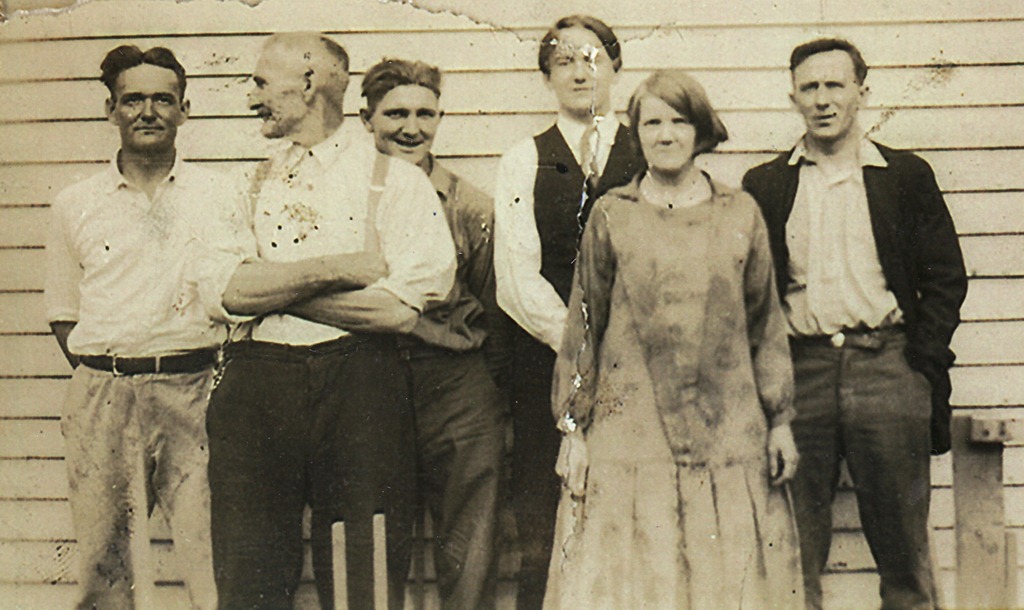
I’ve been messing with microcomputers since 1979, but it wasn’t until the mid-90s that I realized I was creating data I didn’t ever want to lose.  By the mid-00s with digital music, video and photography it’s obvious to everyone that we had invisible possessions we’d want to keep for life.  This presents a number of problems.  How long can I preserve photos like this of my great grandparents?

1920s - Dad's father on right - with parents and brothers - cropped

File Formats

My first efforts of writing fiction was on a Commodore 64 – and even if I had any of its floppies, I couldn’t read the discs, nor would I have a word processing program to read the files.  When I got a PC I bought Word Perfect, but that was many PCs ago, and I’ve since converted those files to Word.  If I live to be 100 (1951) will I still be able to read those files?  If by a miracle I do live a century I’m pretty sure I’ll be a sentimental old slob who cries over his ancient snapshots.  Will I be able to find the ones I want and still view them?  Is it .jpg forever?  I’ve been buying audiobooks from Audible.com since 2002, will I still have my audiobook library to play in 2051?  Or all the Kindle books I’m buying now?

Standard file formats are critical to long-term preservation of data.  How long will Amazon maintain the DRM copy protection on my Kindle books and Audible audiobooks?

Data Migration

I’ve lost count how many computers I’ve own after eleven.  Every time I get a new computer I need to move all my files over and that’s a pain.  I’m always making a new folder and throwing stuff in it, so the number of files I’m saving constantly grows, and every few years I try to clean things out and it’s a big job.  Usually when I get a new computer I just copy everything in My Documents to the new My Documents folder.  But what if I got a Mac?  Or what if in 2022 they come out with some far out new computer system?

File Organization

If you start with one folder, and organize your digital life into sub-folders, what is the best structure?  I sure wished that iTunes hadn’t put ripped audio books into My Music years ago, because that’s causing problems moving my music to the cloud.   Is there a way to plan for future snafus?

Is there an optimal structure that will stand the test of time.  By structure, I mean folder organization.

\Jim Harris

\Audio Books

\Data

\Ebooks

\Mind Maps

\Music

\Numbers

\PDF

\Photos

\Words

\Essays

\Fiction

\Videos

Let’s imagine a future where we have federally regulated data banks like we have money banks and we can trust them implicitly.  In this future, data bank replicates our data in layers of backups, that for anything short of Armageddon, will be completely secure.  Should we put all our data in one place?  In the above chart I could remove \Music because I have my music stored at Google, Amazon and Apple.  I could also remove \Photos because of Picasaweb.  I could also remove \Audio Books and \Ebooks because of Amazon.

Because we don’t have data banks and because my cloud storage is limited at Dropbox and SkyDrive, I will let those other companies maintain my media files.  But if we did have trustworthy data banks, I’d probably want all my content in one location, which means precise organization is important if I’m collecting files for life.

Data Inheritance

There is another thing to consider – what happens when we die?  When our parents die we inherit their papers, books, records, photos and so on.  Won’t we do the same things with digital files?  When I die I want my file structure copied over to my wife’s data bank, and if I wanted, I’d like to give copies to all interested relatives and friends too.  Having a well organize file structure would make it easier for people to go through my digital processions.

Cloud of the Future

Someday we will have data banks.  We might even have laws that require our data to be saved for historians.  Can you imagine scholars from 2782 AD trying to research our times?  I saw a wonderful show on Nova last night, “Mysteries of a Masterpiece” about art historians working to validate a work of art as Leonardo da Vinci.  The scientists had lots of physical artifacts to examine.  If our world goes digital, what will future researchers have to figure out how we lived?

Moving to the cloud is the first step towards this future where we have data banks and preserving digital data for all time.

JWH – 1/26/12