Homeschooling Myself in My Seventies: A Spiritual Journey for an Atheist

by James Wallace Harris, 10/21/25

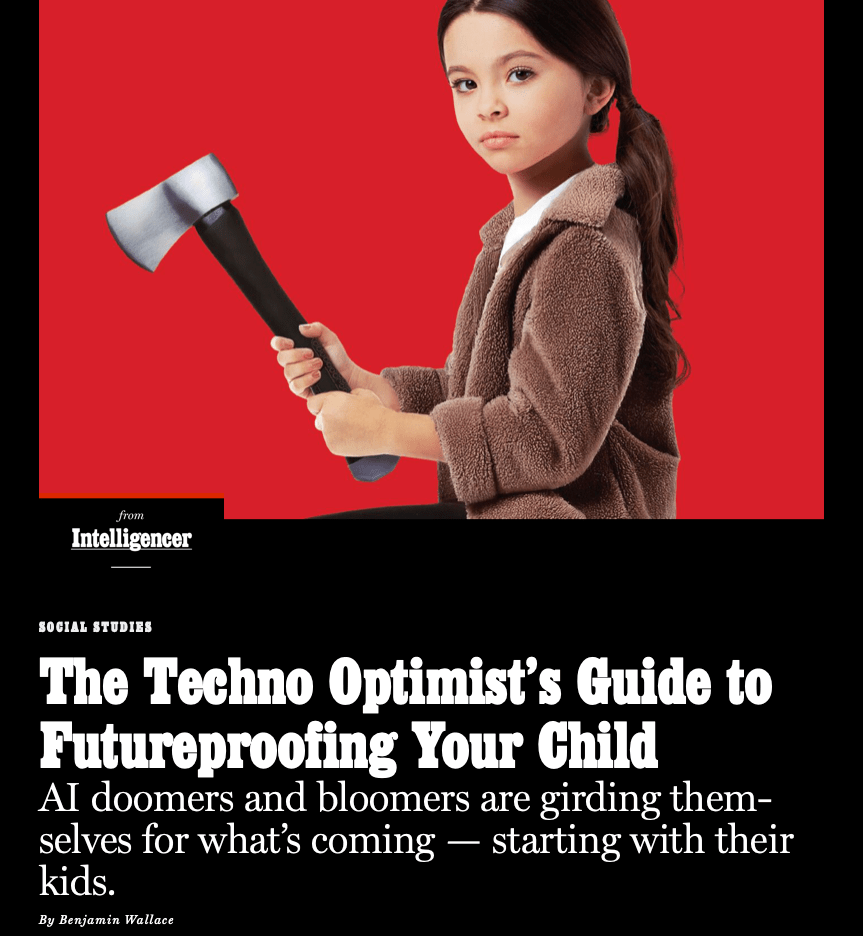
I recently read “The Techno Optimist’s Guide to Futureproofing Your Child” by Benjamin Wallace. The article was subtitled: “AI doomers and bloomers are girding themselves for what’s coming — starting with their kids.”

I don’t have a kid, but I do have me. The gist of the article is exploring new ways to teach kids. Many parents believe that a good college education is no longer the path to success in life. They fear AI will put everyone out of work, that climate change will disrupt society, and that the rapid progress is making everything unstable.

These parents ask: How can I prepare my kids for an uncertain future?

I ask: How can we all prepare for an uncertain future?

Generally, education is seen as preparation for a career. I’m retired. I don’t plan to work in the future. Sooner or later, I’m going to die. That’s another kind of uncertain future. This sense of affinity made this article relevant to me.

The article begins with a profile of Julia and Jeff Wise, who have three children. Wallace called Julia and Jeff “Effective Altruists.” I had to go look that up. To quote Wikipedia:

Affective altruism (EA) is a 21st-century philosophical and social movement that advocates impartially calculating benefits and prioritizing causes to provide the greatest good. It is motivated by “using evidence and reason to figure out how to benefit others as much as possible, and taking action on that basis”. People who pursue the goals of effective altruism, who are sometimes called effective altruists, follow a variety of approaches proposed by the movement, such as donating to selected charities and choosing careers with the aim of maximizing positive impact. The movement gained popularity outside academia, spurring the creation of research centers, advisory organizations, and charities, which collectively have donated several hundred million dollars.

Wallace quotes the Wise’s as saying, “We and some other parents we know have been thinking, Okay, it looks like there may be big changes in the next decade or two. What does that look like for how we prepare our children for the world?” They worry that their kids could die in disasters before they grow old, or find themselves in a post-scarcity utopia of abundance and not need a job.

Parents can’t decide; should their kids attend Harvard, train to be HVAC technicians, or become survivalists?

I could die any time now, since I’m approaching the statistical average age for death, or I could live another twenty or thirty years if I’m an outlier. That’s a big unknown. I could die with my mind intact or not know who I am. If society collapses, my retirement arrangements will fall apart.

What inspired me most about this article was the Alpha School, which sounded like a super-duper version of the Montessori school.

Founded in 2014 as a tiny K–8 private school in Austin, the Alpha School has opened 15 additional campuses, from Scottsdale to San Francisco, on the strength of a tantalizing pitch. Using its AI-driven digital platform, Alpha asserts students learn “2.6” times faster on average than in regular schools while doing only two hours of schoolwork per day. The school has named this platform, which knits together proprietary and third-party apps, “TimeBack.” With those newly liberated hours, students focus on learning the life skills that Alpha’s co-founder MacKenzie Price believes standardized education neglects — things like entrepreneurship and developing “a growth mind-set.” At the flagship campus, a second-grader, in order to ascend to third, must complete a checklist that includes running five kilometers in 35 minutes or less; delivering a two-minute TED-style talk with “zero filler words, 120–170 [wpm] pace, and 90% confidence,” as judged by an AI speech coach named Yoodli; and calling “a peer’s parent” to “independently plan and schedule a playdate.” At Alpha’s middle school, projects have included starting and running an Airbnb and sailing a boat from Florida to the Bahamas.

Basically, the Alpha School teaches kids to be independent learners. The teachers don’t teach; instead, they guide students to study independently.

The article covers theories about educating the young. We tend to think youth is the time of education. I feel like I’m learning more at the end of life than at the beginning. We also think of education in terms of goals. Shouldn’t education be a continual transformation? And we seldom think of learning in old age other than as a hobby.

How can I create my own pedagogy? And for what am I studying? I remember fifty years ago reading Be Here Now by Harvard LSD researcher Richard Alpert, writing as Ram Dass. He claimed that old age was the time to go on a spiritual journey to prepare for death. I’m a life-long atheist. I don’t believe in what most religions teach. But Ram Dass might be right; it might be time to go on a spiritual quest.

I don’t feel the need to study anything specific. First of all, my mind can’t retain information anymore. I love learning, but I have accepted that I forget almost as quickly as I discover. That doesn’t bother me. Like they say, it’s the journey that counts.

However, I don’t forget everything. I seem to lose the facts and details, but somehow, I retain a tiny bit of a new perspective.

My new method of educating myself is to subscribe to printed magazines. I’ve stopped trusting the internet and television. And I’m not too keen on podcasts either.

What I read helps me let go of lifelong beliefs. I’m learning that people live by delusions.

Our minds are corrupted by words. Strangely, the antidote for words is more words. To dissolve decades of thoughts that crust our minds like barnacles requires constant reading.

Our trouble, starting in childhood, is that we embrace beliefs that we never let go of. Most people are programmed by beliefs acquired early in life that they spend the rest of their lives defending.

Home schooling in my seventies is all about unlearning. But it’s not about forgetting. This isn’t intellectual Alzheimer’s. It’s about clarity.

When you watch the news and see reports about bad things happening, ask yourself: Is this because someone believed something wrong? If you are troubled by anything, consider letting go of something you believe true. See if that reduces your anxiety.

For example, much of what I believed in came from reading science fiction. Many billionaires are pursuing goals based on reading science fiction. But I’ve come to see that many desired science fiction futures are no more realistic than what religions have promised.

JWH
What Should I Major in at Old Age University?

by James Wallace Harris, 8/16/25

I’ve decided to earn an equivalent of a graduate degree before I turn 77. I need a project that will keep me occupied in retirement. I’ve always been one to know a tiny bit about hundreds of subjects rather than a lot about a few. I want to pick one subject and stick with it.

I could get a master’s degree from the University of Memphis, where I used to work, since I can take courses for free. I’m not sure they have a major that fulfills my interests. I will check it out. I’ll also check out available online universities. Mainly, I’m borrowing the structure of a graduate degree for my plan.

I decided a book-length thesis will be my measure of success. Since a master’s degree usually takes two or three years, I’m giving myself until I turn 77, which is November 25, 2028.

Over the next few months, I will decide what I want to study. There are many things to consider and think about. Most graduate programs have lots of prerequisites. Before I retired, I considered taking an M.S. in Computer Science. That program required 24 hours of math courses and 12 hours of computer courses to be accepted into the program. The degree itself was 36 hours.

It’s doubtful I could finish a computer science degree before turning 77. And in all honesty, I no longer have the cognitive ability to retake all that math.

My undergraduate degree is in English. I did 24 hours towards an M.A. in Creative Writing before I dropped out. I was also interested in American, British, and European literature. I’d have to start over from scratch because those 24 hours would have timed out. But I no longer want to study English or creative writing.

I’ve also thought of pursuing an Art History degree. I’ve been collecting art books and art history books for a couple of decades, and I have friends with degrees in Art History. One gave me a list of 200 artworks that I’d be required to discuss to pass the oral exam for the master’s degree. I started reading about those works.

I realized I would have to commit several years of dedicated study to pass the oral. I don’t want to do that. I don’t love art that much. I’m not sure what single subject would be worth that much dedication.

I’ll study college catalogs for inspiration, but it’s doubtful that I will want to complete an actual degree from a university. Instead, I will need to make up my own degree.

Let’s say a master’s degree involves twelve courses, and each course requires studying five books. Then my custom-designed degree will require distilling sixty books into a single thesis volume. That thesis should present an original idea.

The single subject I do know a lot about is science fiction. And I’ve thought it would be fun to write a book that parallels the development of science with the evolution of science fiction. I probably already own the books I’d need to research the subject. And it would be the easiest goal for me to achieve because it’s a subject I love and would have no trouble sticking with.

However, I’ve become obsessed with a couple of ideas that I want to study. I believe they are especially fascinating for the last years of my life.

The first is about how humans are delusional. I’d like to chronicle all the ways we fool ourselves. I want to study all the cognitive processes to discover if we can interact with reality without delusion. Current affairs is the perfect laboratory for such a study.

Second, I’m fascinated by how personality is formed. I’d like to answer this question: If I knew then what I know now, how would I have reshaped my personality?

There is a synergy between the two interests. How do delusions shape our personality?

Ever since I read Ed Yong’s An Immense World, I’ve been fascinated by the concept of Umwelt. Our senses limit and define how we perceive reality. Our personality and cognitive abilities determine how we choose to react to that perception of reality.

I haven’t decided yet on what I will pick, but I’m leaning towards delusion and personality development. If I choose that, I’d start this project by collecting books on the subjects and by reading popular periodicals. Eventually, I’d get to academic journals. I don’t think my made-up degree will be very rigorous, though. I’d consider a two-hundred-page book at a modest popular science reading level to merit my do-it-yourself degree.

JWH

Could You Give a One Hour Lecture On One of Your Favorite Subjects?

by James Wallace Harris, 2/19/25

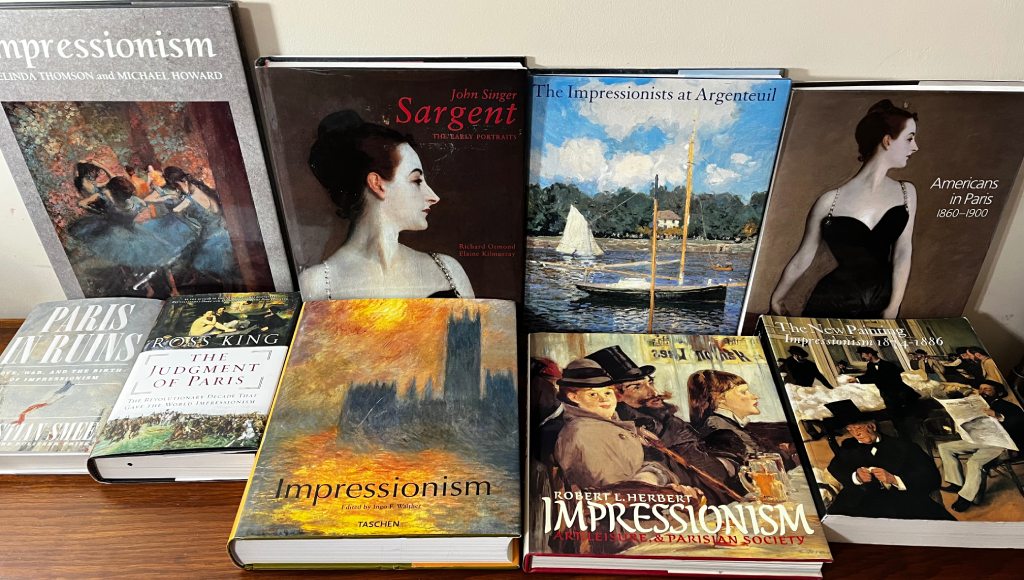
I’ve read several books on Impressionism. I’ve completed a 24-lecture series on The Great Courses on the topic. I’ve seen several exhibits of paintings by Impressionists. Yet, if someone asked me about Impressionism at a party, all I could say was “Oh, I love their paintings.” I vaguely remember their struggles to be accepted into the annual Salon in Paris in the 1860s and 1870s. I can’t tell Manet from Monat, or Gauguin from Van Gogh. If I saw pictures of water lilies I’d guess Monat, and if I saw ballet dancers I’d guess Degas. I have a stack of books on Impressionism that I want to read, but I doubt if I’ll retain much from reading them.

I’m a lifelong bookworm who loves reading nonfiction, but the information in those books seldom sticks. That’s always been disappointing to me.

I could give a pretty good lecture on the history of science fiction. I could give a decent talk on Robert A. Heinlein, the man and his work. I could get up and give a half-ass talk on Philip K. Dick. But that’s about all.

But there are so many other subjects that fascinate me. Ones I regularly read about. I worked with computers for decades and had a serious computer book/magazine addiction, but I couldn’t teach anyone anything reliable about programming anymore.

Most of us believe we know far more than we do, but isn’t that a delusion? News and information are usually how we divert ourselves. We don’t learn, we consume.

I’ve been thinking about how I could remember more. One method would be to research a subject, condense the facts, and then write and memorize a lecture. Certain people can talk at length at parties on their favorite subjects. My guess is they’ve memorized their routines like memorizing jokes. I’m not sure you could extensively grill them on the depths of their subject. I might be wrong though.

Other people are trivia buffs. They’ve memorized a lot of details. I’ve wondered if I could store enough facts about the Impressionists to have a good conversation with another fan of that art movement?

Have you ever thought about all the information they stuffed into you while attending K-12 and college? And then consider how much you’ve forgotten? A good education has always been based on exposure to a wide range of knowledge. And then we specialized in learning what’s needed to make a living.

I’ve been thinking about another kind of education. Call it the know-it-all approach to learning. Most know-it-alls are usually full of bullshit. Often they are mansplainers who annoy women. However, there is nothing wrong with loving to know a lot about little. We need an accreditation body for every subject and a way to test and rank people who want to be know-it-alls in their favorite subjects. Something like chess rankings.

I’ve wondered if I would retain more knowledge of Impressionism if I took regular tests and quizzes on the subject. Let’s imagine that scholars at universities teaching about Impressionism designed a database system that covered everything they’ve ever learned about the topic. They could create an international body that ranked knowledge of Impressionism by giving standardized tests.

I picture them putting the exams online allowing anyone to take them as often as they liked for practice. But to get an official ranking score, you’d have to take a paid supervised test. People who wanted to be ranked in this subject would attend lectures, join study groups, read books, subscribe to online study programs, etc. Learning would be any way you like to learn. That’s the problem with schools, it’s one size fits all.

I believe that the act of competing for a ranking would inspire people to remember their subject. Right now, I have no incentive to remember what I read. Of course, this is just a theory. I do know when I realized I’d forgotten all my math knowledge, studying at the Khan Academy encouraged me to keep going. Even though I had Calculus in college, I had to start over with second-grade math. I worked my way back to the 5th grade. That felt good. I’ve been meaning to keep going.

JWH