Even If You Only Speak English You Still Know Many Languages

by James Wallace Harris, Wednesday, December 19, 2018

My obsession with memory is teaching me fascinating lessons. I realized something new today. I was trying to remember what my mental outlook was like in 1959 when I was seven. I barely remember the presidential election of 1960 and seeing Kennedy and Nixon on TV. But I have no memory of ever even noticing President Eisenhower before 1960. And I got to thinking about my essay “Counting the Components of My Consciousness” and realized how important languages are in understanding the world around us.

I see now we know many languages even when we think we only speak one.

In 1959 I had no language for politics, so politics was invisible to me. I didn’t understand words like mayor, governor, president, senator, congressman, etc. I didn’t know about local, state, and federal governments. I didn’t know about the three branches of the federal government. I didn’t know about constitutions or legal systems. The world of politics was invisible to me because I didn’t know the language of politics. At seven, I also didn’t know the language of religion, science, mathematics, or even grocery shopping.

My awareness of politics began on November 22, 1963, when President Kennedy was shot in Dallas. That’s because my family watched the news for several days straight, and that hooked me on watching the nightly news with Walter Cronkite. However, I still didn’t know the language well. In the 9th grade (1965-1966) I took a required civics class that taught me the basics, but I’ve been learning the nuances of the language of politics ever since, and still don’t speak it fluently. It has its own vocabulary and grammar.

This morning I was researching where I went to school in Aiken, South Carolina in 1964. I found a copy of an Aiken newspaper online. I was 12 at the time. All the stories about local politics and businesses were unfamiliar to me. Even the ads were unfamiliar to me. I didn’t shop for groceries or clothes at age 12, so I didn’t have the language to remember that part of Aiken, South Carolina. I realize now I could have read that paper at age 12, but didn’t. I doubt I could have understood most of it. I didn’t have the languages. And that’s why I don’t remember 99.99% of what life was like in Aiken, South Carolina in 1964.

I’ve often returned to the year 1959 over my lifetime. 1959 was an important year in jazz, but I didn’t know that until I began learning the language of jazz. And my ability to speak jazz is at a very rudimentary level. I’m much more conversant in the language of science fiction so I can comprehend 1959 in science fictional terms much more deeply.

This revelation about knowing multiple languages within English is giving me many insights this morning. It explains why so many people refuse to accept that climate change is happening to us right now. They don’t understand the language of science, so it’s invisible to them. This realization also explains our polarized politics. Conservatives only know the language of conservative politics, so they are blind to liberal politics. And liberals are blind to conservative politics because they don’t know that language.

Linda, the other member of my two-person book club, suggested we read a conservative book for our next discussion. We’re both extreme liberals and she thought it might be enlightening if we did. And it is. We picked Conscience of a Conservative by Jeff Flake. I’ve only just begun but immediately realized Flake speaks a different political language than I do. His words have different meanings. His grammar is even different. His language references points to concepts and things in reality that I normally don’t see.

Liberals and conservatives are polarized because they aren’t speaking the same language even though they use the same words. In the essay, I mentioned above, I told about two experiences where I lost my ability to use words, and how reality looked when that happened. Without words, I didn’t know what things were. I could still see and hold them, but I could tell you what they were. Abstract concepts ceased to exist. Language is everything in understanding reality.

In 1959 I didn’t have the languages to understand most of what I saw and experienced. I’ve since learned a lot of new languages and can look back and see so many things that were invisible to me then. I’m obsessed with memory at this stage in my life, and I’m learning how important languages are to memories. I’m losing my memories, words, and languages. I struggle to keep them. One way of doing that is to look back over the years and study the languages that reveal what I saw.

We can’t trust our memories. One way to understand them is to struggle to remember what we saw. But another way is to study what we couldn’t see, and learn the language to reveal it.

I realize now I must study the languages I know more deeply to understand what I see now, and what my memories might have seen in the past. Here are the languages I partial know now but want to study deeper:

  • Science Fiction
  • Literature
  • Science and Nature
  • Politics
  • Ethics and Philosophy
  • Computers and Programming
  • Music
  • Television
  • Movies
  • Myths and Religions

JWH


Creating My Atheistic Prayer

by James Wallace Harris, Friday, December 14, 2018

For almost a year, I’ve had an item “Define my health goals in a daily prayer” left undone on my ToDoist list. I believe my original intent was to write a statement I’d recite every morning in meditation. I pictured it helping me stick to the habits that would make me healthier.

The trouble is atheists don’t believe in prayers, although, I try not to be a typical atheist. I want to keep an open mind about recycling concepts from religion that might have some scientific validity. Plus, I admire a handful of religious words like prayer, soul, grace, redemption, spiritual, that I want to refashion for atheists.

Praying does provide several problems for atheists. First, prayers generally appeal to a superior being for help. We don’t believe in such beings. Second, praying assumes there’s a telepathic phone system networking all beings in the universe. Well, we don’t believe in telepathy either. Finally, people who pray often want miracles, and atheists reject them too.

So, I’ve got to assume atheist prayers are thoughts directed at my unconscious mind or verbal affirmations I want my subconscious to overhear. That assumes my unconscious mind has the ability to hear my prayers, understand English, and could influence my behavior, but probably just in tiny ways.

Most people who pray attempt to change reality. They are rejecting what is. When my friends tell me about their health problems, they want me to help initiate a cure. Basically, I’m wishing them to get well. Does that really do any good? There’s no reason to believe thoughts from one person can affect another. What I’m wondering if our own wishes can change our behavior?

Physically being with another person when they’re sick and talking has been shown to help people, and even believing people are praying for you might help, but there’s no evidence that thoughts travel beyond our physical self.

The thing about atheists is we want to believe in things that exist and work. The whole point of skepticism is to get away from delusional thinking. That means I must find a real reason for praying if I’m going to embrace the concept.

I need a working hypothesis to test. There’s growing scientific evidence that meditation does affect us. To what degree is not known. What if praying is like meditation, in that it has a subtle effect on our health and psychology? What if it’s like the power of positive thinking? Of course, the power of prayer will be limited. No miracles. People with cancer pray like crazy, but does it affect cancer cells? What works with cancer is modern medicine.

There are prayers of acceptance, where we wish we can cope with what’s given to us. I’ve always considered the Serenity Prayer to be one of the wisest of all prayers:

God, grant me the serenity to accept the things I cannot change,
Courage to change the things I can,
And wisdom to know the difference.

If we removed the word “God” from this prayer, it would be suitable for atheists. But what could we substitute for the word “God” in this prayer? Aren’t we just talking to ourselves? But which part? Isn’t the conscious mind hoping for cooperation from the rest of our being for disciplined? Aren’t we really trying to reinforce a mental habit so we can change our lives?

I could say, “Jim, grant me the serenity …” because I am talking to myself. But, I think Jim is just a label for my conscious self. I’m really addressing my whole self. I’m seeking to integrate my conscious mind with my unconscious mind to discipline my biological urges. But what’s a good name for my whole self? For now, I shall open my prayer with, “To my whole self, grant me the serenity …”

When people pray the serenity prayer they must know they aren’t accepting the things they cannot change, and lack the courage to change the things they can, and don’t know the difference between the two. If they had those abilities, would they even be praying? So, what are they really praying for? The discipline to be different.

Most people can’t make decisions and stick with them. Look at New Year’s Resolutions. Aren’t we praying to our unconscious minds to stick with the decisions the conscious mind is making? Aren’t we begging our body to adapt to what we’ve learned at a conscious level?  Aren’t we praying to our reptilian and mammalian brains to follow the learning of the neocortex?

I need to edit and add a few lines to the serenity prayer. But I also need to think about other people too. To me, The Golden Rule is about the best guideline for that. I need to work in, “Do unto others what you would have them do to you.” But I want to update it some to include all life and the environment.

Here’s my working prayer for now. I suppose it will evolve over time, but I think it’s enough to finally close out my ToDoist item.

To my whole self,
grant me the ability to accept what I can’t change,
the discipline to change what I can,
the wisdom to know the difference,
the scientific knowledge to know what’s real,
the skepticism to know what’s not,
the empathy to respect all life,
and the generosity to help others.

JWH

Astounding by Alec Nevala-Lee On Sale for $2.99 for the Kindle

James Wallace Harris, Thursday, December 13, 2018

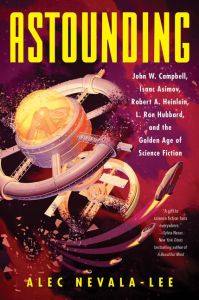
AstoundingI don’t know why or for how long, but the new book Astounding: John W. Campbell, Isaac Asimov, Robert A. Heinlein, L. Ron Hubbard, and the Golden Age of Science Fiction by Alec Nevala-Lee is on sale for $2.99 for the Kindle edition.

I’ve already read it and can recommend it to anyone who loves reading about the history of science fiction. I bet it wins a Hugo award next year.

See my earlier review, “The Rise and Fall of Astounding Science-Fiction.”

JWH

Mindfulness Inside Fiction

by James Wallace Harris, Tuesday, December 11, 2018

Probably most people picture mindfulness as the act of sitting on a beach crosslegged meditating on existence. The word mindfulness connotates an aesthetic living alone in the desert or on a high mountain monastery in Tibet. But it also applies to you washing the dishes, taking a crap, and even being fully aware while you’re reading a book or watching television.

BE HERE NOW is an important lesson of eastern philosophy. Our minds wander all over our distractions. Mindfulness is the ability to live fully in the moment being aware of what each sense is telling us and how we process it. One of the first things you should observe is there are more than five senses. Mindfulness is the ability to keep our model of reality in sync with reality. We are not little beings peering out our heads through sensory windows at reality. Our senses recreate a model of reality inside our head which our observer assumes and acts upon as if it was the objective reality. Subjective thoughts distort the flow of data from the external reality. Mindfulness is the skill of observing all of this happen.

Many of us spend a good portion of our day inside fiction. How can we be mindful when we’re lost in reading a novel, watching a television show, or out at the movies? We substitute our cognitive model of reality with a fictional model that someone else has created. We fool ourselves into believing we are someone else, being somewhere else, doing something else. Fiction by its very nature is anti-mindfulness.

Fiction is sometimes how we communicate our models of reality. Other times, fiction is intentional replacements for our model of reality meant to entertain or provide us temporary vacations from reality. When we’re inside fiction, we’re at least two dimensions away from the external reality. The only way to be truly mindful is to constantly recall our immediate place in reality, but that spoils the magical illusion of fiction.

Is it possible to be a bookworm and be mindful at the same time? Is it possible to be mindful while inside fiction? Especially when it requires forgetting who and where we are to fully experience a work of fiction.

While I’m at the movies watching Colette, I must juggle the sensation of seeing an illusion of 19th-century Paris while sitting in a dark room in Memphis, Tennessee. I must accept Keira Knightley pretending to fool me that she is Colette, a woman who spoke another language in another time and is long dead. This is when fiction is a tool for communicating what reality might have been like for another person. Being fully mindful of the experience requires observing my memories of history and knowledge of movie making as it reacts with experiencing the film in a darkened theater.

To be mindful in such a situation requires grasping the gestalt of a complex experience. That’s why people usually pick a quiet empty room to work at mindfulness. It’s much easier to observe our mental state of the moment when not much is going on. Being mindful inside fiction requires our observer watching a symphony of mental activity and understanding how it all works together.

Generally, we consume fiction to forget our observer. When I was listening to The Children of Time by Adrian Tchaikovsky I was imaging being thousands of years in the future and many light years away. This new model of reality was generated by whispering words into my ear. I never completely forgot the input from my senses because I listened to the audiobook while eating breakfast or walking around the neighborhood.

I believe part of being mindful while inside fiction is to observe our psychological need for that particular kind of fiction at that moment and how I’m reacting to it. I want and get something much different watching The Marvelous Mrs. Maisel than when I watch Get Shorty. What I experience while reading Friday by Robert A. Heinlein is much different from what I experience reading Swords and Deviltry by Fritz Leiber. The lack of mindfulness inside fiction lets us consume fiction in the same way we can eat a bag of potato chips without noticing that each chip was different.

If I don’t explore why my mind is entertained by stories of a 1959 housewife becoming a standup comic in New York City and a low-life thug wanting to become a movie producer in modern-day Nevada, then I’m not totally being here now.

The purpose of mindfulness is to be fully aware of who you are in the moment. So, it’s almost oxymoron to ask if we can practice mindfulness inside fiction because most people use fiction to escape who they are in the moment. But then, most people aren’t fully in the moment when they are getting dressed or even sitting in a lotus pose in front of a sunset. In the west, mindfulness is taught as a cure for the stress of living. We are told if we meditate five or ten minutes during the day it will help us handle the stress of the rest of the day. Of course, meditation is not mindfulness, but all too often they are confused as one.

One reason I’m bringing up the topic of mindfulness inside fiction is that I believe some types of fiction are polluting our minds. I have to wonder if all the violence in fiction isn’t programming our minds in subtle ways. Is there not a correlation between the mass consumption of violent fiction and the violence we’re seeing in everyday life? The other day I saw a short documentary on the history of the video game. In the 1950s video games were just blips on the screen. Today they almost look like movies. It startled me to see sequences from first-person shooters because I realized those video games were creating the same kind of scenes that mass shooters must see as they walk around blowing real people away.

I have to wonder if the rise of overblown emotional rhetoric we encounter in real life is not inspired by dramatic lines from characters in fiction. Everyday people can’t seem to express their feelings without putting them into harshest of words. Too many people can’t object to a philosophy without claiming they will kill the philosopher.

I  believe its time we extend moments of mindfulness beyond quiet empty rooms or restful respites in nature. We need to observe what fiction is doing to our minds, especially at the subconscious level. We need to be mindful why we seek fiction. We need to understand the purpose of fiction in our lives. We need to know why we turn our own lives off in favor of fictional lives. We need to know what our minds bring back from our fictional vacations.

When I first took computer courses back in 1971, I was taught an interesting acronym, GIGO. It stands for Garbage In, Garbage Out. It meant if you put lousy code and data into a computer you’d get crap for output. I believe it also applies to fiction.

JWH

Guest Star – Susan Oliver

by James Wallace Harris, Friday, December 7, 2018

Life is indeed full of little pleasures. Nowadays, I love watching old television shows, and it’s another small delight I can add to my daily total when I can recognize a character actor from the past. The other night I watched an episode of Route 66 with Susan Oliver guest starring. (“Welcome to Amity“- 1961:s1:e29). I had seen her a number of times lately on other old shows, including a two-parter on The Fugitive. (“Never Wave Goodbye” –  1963:s1:e4-5).

Susan Oliver made a career out of guest starring. Back in the early days of television audiences had no problem with guest actors appearing as different characters, and were usually allowed to appear in the same series once a year. Oliver was so well-liked by audiences that she appeared annually in many popular television shows, each time as a different character. Yes, Susan Oliver was strikingly attractive but more important, she always struck me as a tortured soul which uniquely revealed itself in every character she played. I never knew why until an odd incidence of serendipity.

I can’t tell you the first time I saw Susan Oliver, but I can tell you the last time. It was Wednesday night, December 5, 2018 when I saw her in that episode of Route 66. I remembered her name and face but I didn’t know anything about her history. Normally, I would have gone on to watch another show and forgot all about her for the moment. If by accident in the future I again caught one of her guest appearances I would have had another little spark of pleasure if I recognized her and remembered the Route 66 episode.

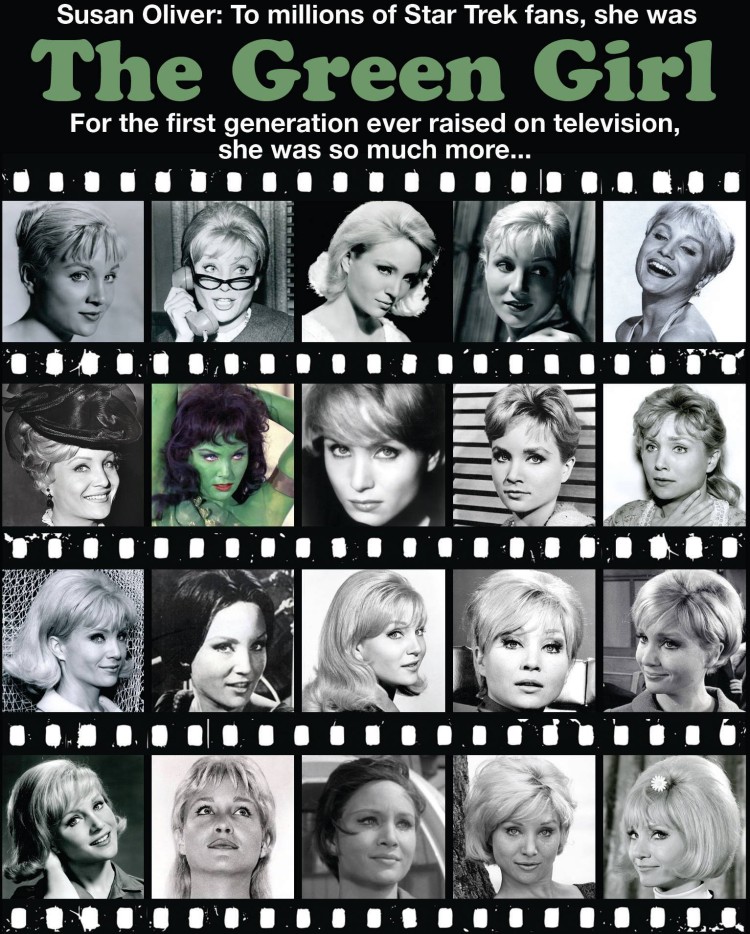
But something weird happened. It almost felt like The Twilight Zone music played. I clicked the Home button on my Amazon Fire and went to my watchlist. I don’t know why, but my eye immediately caught The Green Girl, a documentary I thought was about Star Trek. That appealed to me. I hit play. Then I discovered the documentary was really about Susan Oliver. That was spooky and fun.

I had completely forgotten that Susan Oliver had played Vina in the first Star Trek pilot that Gene Roddenberry had made in 1964. The film from that pilot was reused in 1966 to make a two-part episode called “The Menagerie” (s1:e11-12). I had seen “The Menagerie” when it first premiered on November 17, 1966. Vina might be Susan Oliver’s most famous role, and thus the title of the documentary. At one point, Vina appeared as a fantasy to Capt. Pike (this was before Capt. Kirk) as a dancing green alien woman. Susan Oliver’s green woman was also shown in the closing credits of the first season of Star Trek, making her famous to Star Trek fandom. I had completely forgotten that until seeing the documentary.

I was eight days from being sixteen when I first saw that episode of Star Trek with Susan Oliver. I thought she was beautiful then, but I didn’t memorize her name at that time. By then I had probably seen her in several television shows. Oliver was never famous, never had her own TV series, or became a movie star, but she appeared in almost countless television shows starting in the 1950s. She’s now haunting me because I’m watching all those old TV shows again.

The Green Girl is a wonderful 2014 tribute to Susan Oliver that tells her life story, interviews her friends and fellow actors, and shows clips from dozens of her performances. The documentary also chronicled her exploits as a competitive pilot. Oliver flew across the Atlantic solo and came in second in a cross-country race. As she aged she tried writing and directing but was thwarted because she was a woman. The Green Girl provides both a moving story about an ambitious young woman breaking into movies and television back when I was growing up and also reminds those of us who grew up back then of all the television shows we loved so much.

The Green Girl

When I was young I used to be frustrated with older folks when they didn’t know my favorite pop culture icons. I couldn’t understand how they could be so clueless to current famous people. Now that I’m old, I’m clueless about the identities of current pop culture favorites, and I realize I should have been more forgiving of my elders. I also wish now that I had memorized far more people back then. I feel bad in 2018 that I hadn’t become a dedicated fan of Susan Oliver in the 1950s, memorizing her name and following her career until she died.

This is kind of weird, maybe even spooky too, but for some unfathomable reason, I’m drawn to my pop culture past. I do love modern TV. For example, I’m crazy about The Marvelous Mrs. Meisel. But I can’t tell you who plays Mrs. Meisel. I’m not even going to make the effort to look it up – I’d only forget it. Why aren’t I memorizing all the details of current pop culture? I don’t even try. I don’t even feel guilty for not knowing. But it is important to me to keep up with the trivia of the 1950s and 1960s. Why?

When Susan Oliver shows up in an old TV show it brings me a little pleasure. Recalling the character actors names in shows I haven’t seen for decades gives me a twinge of happiness. And it’s not like the present doesn’t also bring pleasure. I really, really love The Marvelous Mrs. Maisel. It gives me great happiness. Much more than watching old favorite TV shows. Yet, I feel no need to memorize the names of its actors. Why?

It feels like I’m giving up on the present because I enjoy the past more. I’m not sure if that’s healthy, but then I don’t care either. I used to wonder why old guys wore orange plaid slacks with red paisley shirts. Now I know it’s because they are old and have an “I don’t give a shit” attitude about everything. (Although I’m quite thankful I don’t have the urge to wear plaid and paisley together. If I did, I would.) For some reason, it’s more important to remember trivia from the old days than it is to remember facts about the present.

If you feel that way, then I bet you’ll love watching The Green Girl.

JWH