Is It Time To Ditch News Feed Apps?

by James Wallace Harris, Saturday, July 25, 2020

The sad truth is I’m a Flipboard addict. And if I’m really jonesing for news, I’ll also check Apple News and Google News. I compulsively tap my iPhone several times a day for more new news, speed reading through dozens of digital essays and news stories every day. But Flipboard is starting to irritate me with all its ads, and more than that, my comprehension skills are deteriorating.

Although the internet is instant, smartphones are convenient, and news feed apps are comprehensive, I’m not sure they are the best conduits of news. Oh, they definitely get me more news from a greater variety of sources updated by the second, but I’m not sure its the best way to stay informed. And I’m not sure if it’s not becoming abusive to my neurons.

People often say less is more. News feed apps work on the principle of sending you news customized for your interests. Often content is barely more than blurbs with ads, and generally the same information is repeated or restated by countless news outlets, sources, and publishers. There is lots of substantial content, but lately, more than not, it’s behind a paywall.

I’m reading in a hyperactive mental state, gobbling down facts in a frantic effort stay informed. But am I? I’m starting to wonder if I read less if I’d be more informed?

Could carefully choosing my own news sources be the wiser path? Could a couple of newspapers and a handful of magazines, digital or print, offer a better news experience than a news feed service? I don’t know, but I’m thinking about trying the route. I just don’t know if I can break the news feed app habit.

I’m also tempted to go back to printed magazines and newspapers for some of that reading. The cost of printing tends to control what is printed. And I’m also wondering if reading less from a slower source might be advantageous. I really have no answers right now, but my hunch at the moment is pushing me to read less news on my iPhone. However, I’m not sure I can give up that much convenience.

It occurs to me now that I actually enjoyed TV more when there were only three networks. And music was more fun when I could only afford to buy one new album a week. Maybe there’s a downside to convenient abundance.

JWH

There’s No Modesty at the Urologist

James Wallace Harris, Wednesday, July 15, 2020

I awoke from the anesthesia with a tremendous urge to pee. I might have already been telling the nurse that before I was conscious because she was holding a plastic bottle up to my penis. I was trying to get up and she was urging me to lie back. I was in the middle of the action and not remembering why. Then I recalled I had been put under general anesthesia for a biopsy on my bladder. The last thing I remember was the oxygen mask.

I desperately wanted to pee, but the only thing going into the bottle was thick blood. My mind was clearing fast and I realized my hope of getting home quickly wasn’t going to happen. We had arrived at the clinic at six for a seven o’clock procedure. The clock now said eight. Susan and I had talked about how great it would be if we could have gotten home by nine.

That wasn’t going to happen. Something had gone wrong. All I could think was “I wish I wasn’t here” but I knew my wishing was wasted thinking. I wanted to pray, “God, get me out of this” but I’m atheist and I knew my prayers wouldn’t be answered even if I was a believer. I had to deal with things as they were.

I could not escape my situation and I knew how I handled it depended entirely on controlling my thoughts. Pain is so focusing. It was unreal waking up in this bizarre situation. I told myself this was just a bad trip I had to ride out and what I was experiencing was nothing compared to all the thousands of Covid patients were experiencing, much less people having cancer or heart attacks. Don’t whine, deal.

Still, I was doubling up in pain telling the nurse I had to go. She kept saying, use the urinal (which was only a plastic bottle). I told her it might help if I could sit on a toilet. I was in a recovery area with four or five bays behind curtains where patients were either being prepped for surgery or recovering. I thought for a second about modesty and then didn’t care. The nurse help wrap me up in my hospital gown and walked me to the bathroom. She put a plastic catcher over the rim of the commode before putting down the seat. She told me to pee into it because the doctor would want to see the results.

It was somewhat calming to be sitting in the bathroom by myself. I kept hoping pee would flush out all the blood, but it didn’t. All I could produce was blood as thick as Campbell’s soup just out of the can. And no matter how much blood I produced didn’t relieve the overwhelming urge to pee. I knew I needed a catheter and that’s something I’ve always dreaded. Again, it was all too obvious that what I wanted and what would happen was two different things.

I knocked on the door to get the nurse and told her it was no luck. She took me back to my bed and I begged for a catheter, but she already knew what I would want and need and had one ready. She asked if I wanted to be numbed first, I told her no, just do it, that I was dying to pee. So, she did. Six hours later, after flushing three bags of water through my system to clear out the blood I was able to go home with a catheter still in me. Unfortunately, this was Thursday and it was a three-day weekend because of the 4th of July. I’d had to live with the catheter until Monday.

Those four days were very educational. Pain is the perfect Zen Master. When a student’s mind wanders the Zen Master will whack their shoulders with a bamboo cane. The tube up my urethra would zap me with pain if I didn’t pay perfect attention. Luckily, the bladder spasms would only last five to ten seconds. I’d have to clutch something and kick the floor until they stopped.

My purpose here is not to bellyache about my pain, I know too many people who suffer far greater. No, I bring up this yucky incident to show how it affected my thought processes. The first title I had for this essay was “Thinking Clearly.” But I decided it was too boring to catch people’s attention. Then I thought of using “Pain is the Zen Master” but doubted it would attract much attention either. Then “There’s No Modesty at the Urologist” came to me and knew it was the kind of title that some people would click on. One of my most popular posts was “Losing My Modesty” about when three women holding me down to cut off a skin growth near my genitals.

I realized while in recovery that I needed to think clearly. Panic, fear, self-pity, anger, bargaining would not get me out of the situation. But neither would magical thinking of wishing or praying. And I realize that many of my thoughts were delusional or led to false assumptions. Making imaginary bargains, extrapolating from poor data, or speculating about the possibilities just generated endless possibilities that would never happen.

Let me give you one concrete example. Because I had a pain spasm every time my catheter was pulled or pushed I imagined that it was stuck to wounds within my urethra where healing and scabbing was taking place. I worried that pulling it out would be immensely painful, reopening the healing sites. I feared I’d need another catheter put right back in. I worried and thought about this for three days. Then Monday, the doctor pulled it right out with no pain, no fuss, and no bleeding. In other words, I worried for nothing.

In three days I theorized about endless possibilities — both positive and negative. Most of those thoughts was wasted thinking. As I wrote about earlier in “Expecting the Unexpected” I can’t predict the future. We can observe data to a small degree and act on it in small ways, but not in significant ways. For example, as my urine bag filled up I’d feel the need to pee. It would wake me up in the night just like when my bladder fills up. But I knew when I opened the tap on the urine bag the draining out of the urine would make a suction that caused a pain spasm. I deduced if I disconnected the bag’s hose to the catheter first that suction action wouldn’t affect me. That’s how far I could predict the future. Not much, huh?

Another example, I went back to the urologist on the 13th to hear the results of the biopsy. Of course, even though I’m not superstitious, I worried that might be a bad day to hear the report.

When the doctor told me I needed a biopsy weeks ago I realized that any speculation would be meaningless until I got the results. The answer would be like Schrodinger’s Cat — unknowable until I opened it. On the 13th the doctor told me the biopsy was clear. That was a huge relief. I can’t say I didn’t worry, but not much, most I spent a lot of time trying to imagine what I would do if the lab report had been positive.

We all think too much. We have so little control. We want to believe we have magical powers to control reality with our wishes, but we don’t. I know this, but I still wasted a lot of time on endless useless thinking. Another example, while waiting for my results I craved sweets, but I was afraid to eat them because I thought it would cause the biopsy to come back positive. When I saw the floor was dirty I thought if I don’t sweep it immediately my biopsy will come back positive. I know such thinking is crazy, yet knowing that doesn’t stop such thoughts.

We live in a highly deterministic reality even though we want to believe that mind over matter works. Religious people use the word faith but it’s use is not exclusive to theology. Throughout this whole process I kept trying to outthink my doctor even though I know nothing of urology. The reality is I have to put faith in modern medicine. I can’t think my way around it. I don’t have any alternatives. I’d love if prayer work and a personal God was taking care of me like my nurse, but there’s just no evidence for that. I’d love if I had great mental powers so my will could alter reality to my whims, but there is no evidence for that either.

Even the simple desire for modesty was beyond my control. My nurse saved me that day. She attended to all my needs while also helping others. She rushed from bay to bay but was always there when I needed help, which was often. She didn’t always close the curtain and I thought about saying something, but I realized it was too petty, too nothing. It was only my thoughts that made me worry about modesty. So I let it go. If people walking by wanted to look at me I didn’t care. Actually, I felt sorry for them having to see a old guy with a bloody tube coming out of his dick. That must have been revolting.

When it was all over I understood it was just a big painful inconvenience, the pain had been bearable. I could survive because I did. At the time I told myself I never wanted this to happen again. I still need my prostate trimmed, so I need to go through this all over again. And I will.

I don’t know if I can apply the lessons I’ve learned to the next time. I might still worry needlessly, still try to bargain, pray, read omens, and act on superstitions. The reality is we might never be able to control our thoughts even when we know they are wasted thoughts. Can we ever just accept reality?

This Covid crisis is a parallel example. Too many people want to reject reality and act on magical thinking. I keep hoping our whole society will become rational and think clearly, but isn’t that wishful thinking too? Especially, if I can’t think clearly myself.

JWH
Do Your Possessions Reflect Your Personality?

by James Wallace Harris, Wednesday, July 1, 2020

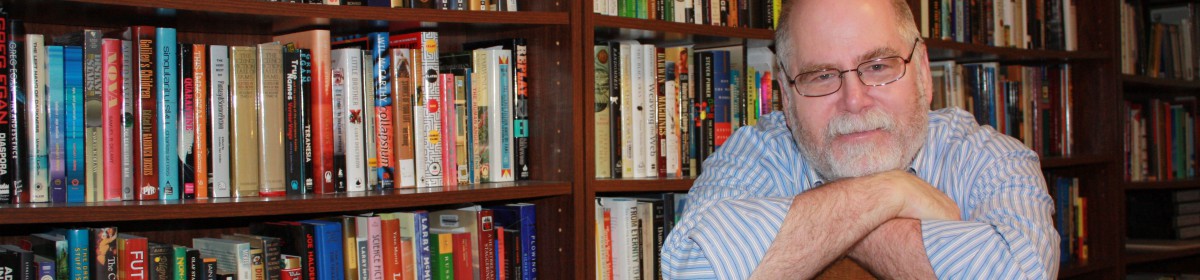
I love to peer at what’s behind people in Zoom and Facetime calls. This is true for the people I know, as well as famous people on TV. I wonder if what they own and how they decorate reflects much about their personality? I know I instantly like people who have shelves of books behind them, but then that’s what I have. Of course, now that Covid-19 has pushed so many people to appear from home I assume more and more people stage their background. I even see articles about how to look more professional on Zoom. And I know YouTubers carefully construct a set to present a creative image for their viewers.

Back in the 1960s, there was a slogan, you are what you eat. Odd, I’ve forgotten why we said that. In the 1970s I learned the term GIGO in computer school, an acronym for Garbage In Garbage Out. Now I wonder if we are what we own? Yet, how much can we guess about a person by looking over their shoulders in a Zoom video? Does this fall under psychological analysis, archeology/anthropology, art criticism, or tea leaf reading?

What do our possessions say about us? Are they like Rorschach images that reveal something about our personalities? The other day I was FaceTiming with my friend Janis who lives in Mexico. She’s only been in her current house a couple of months but she has it fixed up elegantly despite having to bring her possessions there one suitcase at a time. She was giving me a video tour and I looked for indications of her personality in the objects I could see. My first reaction was to think she had nothing personal on display, that it was all decoration because I was only seeing the artwork on the wall and crafts on the flat surfaces. Some were new, and some were from her old house I used to visit.

I then realized my initial thoughts were lame — I wasn’t looking deep enough. It occurred to me that Janis’ personality is reflected in the art objects she buys. She’s a lifelong traveler and all those things I first thought of as decorations were really her art collection from her travels. Each one meant something to her and had a story. For example, the picture at the top of the page. I asked her for its story and she replied:

I found this picture of a girl on a skateboard at an artists’ market in a Mexico City neighborhood sometime around 2003. I had worked for several months in 2001 as a flight attendant with Northwest Airlines but was furloughed after 9/11. As a laid-off employee I had flight benefits with Northwest for almost three years so I traveled to Mexico City several times during long holiday weekends. One weekend at the Bazar Sabado I found this framed painting and talked with the artist, from whom I had bought previously. In the airport the following day, I sat at the departure lounge with this 27” x 31” piece of art, made larger by a hotel bellman who had carefully wrapped it, wondering what would become of the girl in pink since the picture was way too big to bring aboard a plane, but since I was a furloughed flight attendant, the crew greeted me warmly and the pilots offered to store the piece in the cockpit.

Does everything we own have a wonderful story like this? Looking around my office here I see that I could probably tell a tale about everything in it. But to be honest, I’m not sure everything reflects my personality — at least not directly. For example, I have a picture of an old man praying. I am not religious, but my mother was, and this picture is something that used to belong to her. And that triggered another line of thinking. Whatever it meant to my mother is something different than what it reveals about me. But whatever anyone else sees into that picture can be completely different again.

Years before my mother died she started talking about how she wanted people to have certain belongings of hers. I’ve known many old people who have done this. I realize now that their possessions were an extension of their personality and they hoped to be remembered by them. Sadly, and I’m not sure I should admit it, but I didn’t keep most of the things my mom left. First of all, she left a whole house full of stuff. My sister and I took what meant something to each of us, but we gave most everything else away. Of my mother’s things I loved the photographs most. Becky, my sister seemed to be partial to mementos more. For many of the possessions my mother left, whatever they meant to her did not come through to me. She collected them before I was born, or after I left home. I didn’t have their story. I kept things like the quilts she made me because I knew their story. And my Mom wasn’t that sentimental sometimes, I once found Becky’s and my Baby Books in my Mom’s garbage can. I kidded her about that.

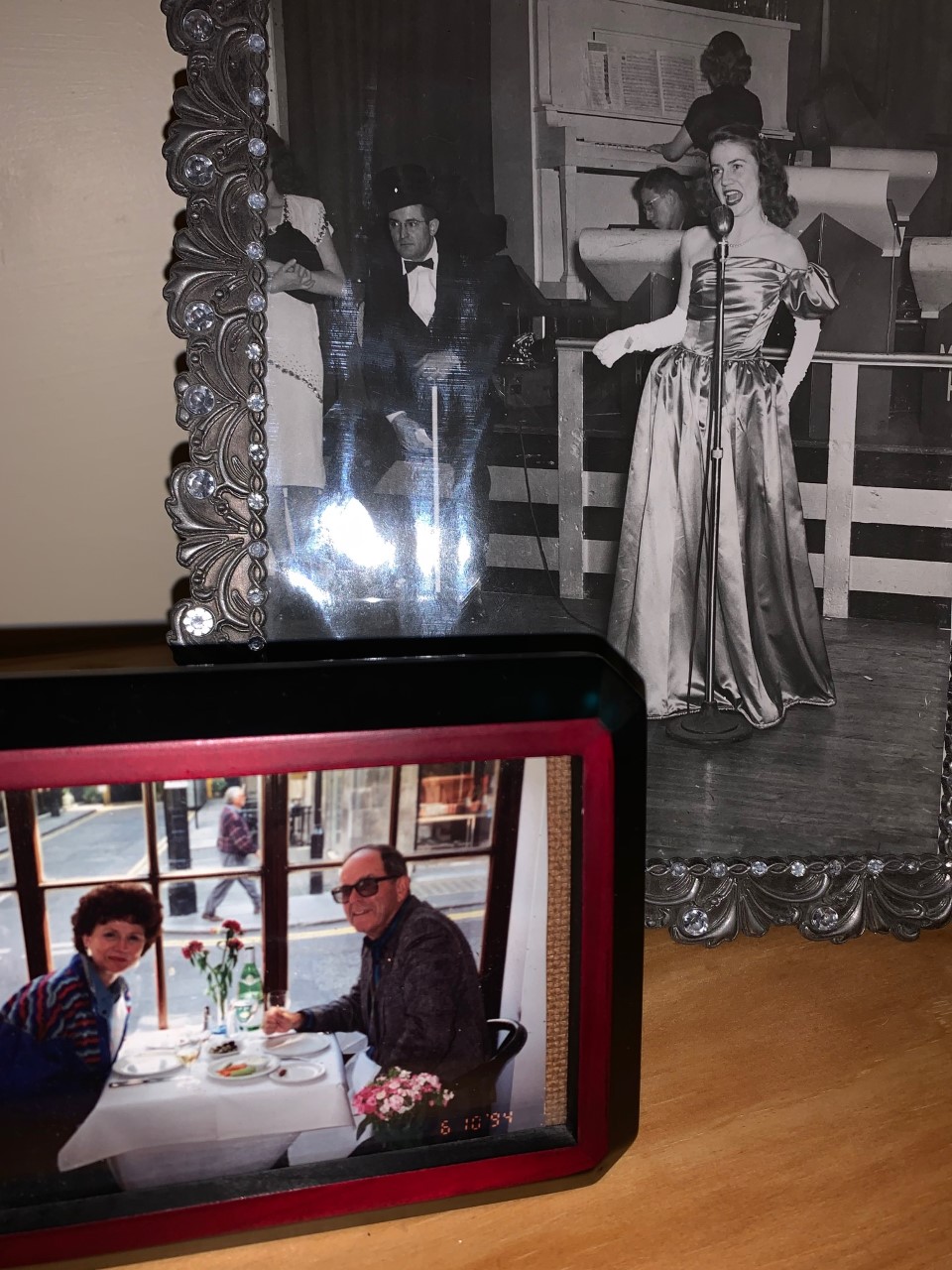
I’ve always worked at a different level. I don’t care much for things. But I do think photographs are very personal. I think the photographs we keep reveal a lot about us. Susan (my wife) and I have lots of family pictures on our walls, but we don’t collect artwork like Janis. I found seeing these two photos from Janis’ house far more revealing than her artwork.

Janis Mom and Dad

This is the story that goes with it:

These are my favorite photos of my parents. When my dad retired thirty years ago, he and my mother spent five weeks in London in a flat overlooking St. James Park where they could see the Royal Guards pass on the way to Buckingham Palace. This picture was taken in a Turkish restaurant where they ate often during their stay. This photo of my mother was taken when she was 18 years old and was singing with a band in Evansville, Indiana.

Janis has often told me many stories about her Mom and Dad, especially how her Mom used to be a singer and acted in the local theater until late in life. But maybe I’m being too basic in equating pictures of people as being more personal than the objects we own. It’s logical to think family is an extension of someone’s personality, it’s harder to think of the artwork they love as having a deeper personal meaning. Once I started thinking about Janis and how travel is the real love of her life, the artwork she picked up from around the world probably resonates deeply with her personality. But how much could I understand about Janis from just looking at her artwork? Don’t I also need the story?

I realize my casual efforts to decipher people by what they own were much too superficial, but it was educational. I then decided I need to reverse engineer the thought and ask: “Do things I own say anything about my personality?”

Of all my possessions, these are what I relate to the deepest way:

Books April 2020 cropped

Other than judging me a bookworm I’m not sure people can make much from seeing my books. Even though this collection has been curated from decades of experience and distilled down from thousands of other books, I’m not sure what anyone would learn about me by reading their titles or even reading their content. Like the art on Janis’ wall, they need a story. I used to believe the stories in the books reveal something about me, but I don’t think that’s true anymore. First, there are too many.

This gave me an idea for another project. List the exact short stories that would reveal the most about how I felt about this life. Here are three, “The Star Pit” by Samuel R. Delany, “A Rose for Ecclesiastes” by Roger Zelazny, and “Flowers for Algernon” by Daniel Keyes.

Before everything went digital I loved judging people by their books, albums, and movies they owned. I remember once going to William Faulkner’s house and looking at all his books, and I imagined a chunk of his personality was left in those bookcases. Like my Mom, this is how I used to want to be remembered after I died — even though I’m quite confident that a few weeks after my passing Susan would call up Salvation Army and have them haul it all away. And that’s the right thing to do.

By the way, this is how I remembered my mother on what would have been her 100th birthday. My father would have turned 100 in October and I plan to write my memories of him then. In both cases, I’m not sure I can ever know who my parents were. The possessions they left gave no real clues, and I now imagine they could be misleading in countless ways. It’s a shame they weren’t bloggers. That’s about the best way I could imagine for knowing who they were after they died. I wish all my friends were bloggers. They could at least post photos of what they own and give their stories.

I should give up guessing about people from their possessions (but I probably won’t). However, I am going to ask for more stories.

JWH


Expecting the Unexpected

by James Wallace Harris, Tuesday, June 23, 2020

“The future is everything I never imagined” is a saying I created for my personal philosophy long ago. That doesn’t stop me from trying to predict what will happen. For example, Friday I have to go to my urologist about my prostate. I keep imagining all kinds of scenarios. By Thursday night I’ll have imagined dozens. After I leave his office on Friday it will be obvious that every situation I fantasized beforehand was a waste of time.

Before I retired in 2013 I imagined all kinds of goals to accomplished with my free time. None of them have been achieved. I have pursued a lot of activities, but none that I imagined before retiring. Isn’t that weird?

Fantasizing about the future comes in two kinds. Daydreaming of things you want to happen, and nightmaring things that will. The Covid-19 pandemic is nothing I ever expected or imagined, and I’ve read dozens of books about plagues. But then why would anyone picture a pandemic where everyone has to stay inside, with millions losing their jobs, and the economy going into a tailspin? All those consequences are so obvious with hindsight.

I do have a microscopic ability to predict a tiny way into the future. Whenever I have to go anyplace new I look it up on Google Maps and plan my route. Sometimes I even use Streetview to see how things will look. This generally works out and I easily get to my destination. I like how I feel when my effort to plan a small event works. I’m also pretty good about imagining what I want to buy at the grocery store. I even picture contingencies where one store won’t have something and where to go next to find it. Like I said, my ability to predict or plan the future is teeny-weenie, but it does feel good. I can also imagine writing a blog and then writing it.

This implies the near future can be imagined to a limited degree. What’s really hard is expecting the unexpected — like Covid-19. But would we even want this power?

I’ve found it philosophically amusing that I didn’t expect all the psychological changes I’ve undergone since I retired. I assumed my non-working years would be rather static and stable. And yes, day-to-day life is rather routine with a great deal of sameness. I even delight in my rut and habits. But I have to laugh at myself for the mental changes I’ve undergone in the last seven years.

What was unexpected is how much I would change in how I felt about things. I figured after a lifetime of being me, that I’d continued being me with boring consistency. And for the most part that’s true. The unexpected changes have been subtle, and very hard to explain. But aren’t emotions and feelings always ineffable? Maybe one way to explain this is to say I thought I was an 8-color box of Crayolas, and then I discovered I really had 16-colors. I should expect the unexpected and wonder if I’ll eventually be 32-colors. But I just can’t imagine that.

It’s obvious now, that I wouldn’t do what I imagined doing seven years ago. That should have been expected, but it wasn’t. I should have expected the unexpected since that’s what experience has always taught me all along.

I have just over a year left in my sixties. I shouldn’t even try to imagine my seventies or eighties. Death is always unexpected, even though it’s certain. I’m always observing older folks trying to get hints about the future, but I realize now that I can’t extrapolate how they feel from how they look. Whatever being 75 or 85 feels like is nothing I can ever imagine. It will be as unexpected as Covid-19.

JWH


What If You Could Be Young Again for One Day?

by James Wallace Harris, Friday, June 12, 2020

What if you could be young again for one day? What would you do with that day? Bloom a 2019-2020 television series from Australia on Hulu explores that very question. Bloom has two seasons of six episodes each.

I don’t want to give spoilers, but the show is about a small town in Australia where a few people discover the magical properties of a strange plant. They become young again. The rules of this fountain of youth are not explicitly explained in the story, but whatever they were in season one changes again significantly for the second season.

Think about what you would do if you could take a magic potion and have your body transformed into your younger self. Picture a Dr. Jekyll and Mr. Hyde transformation, but instead of becoming a hairy monster, you become wrinkle-free and beautiful. In Bloom, most of the characters’ first impulse is to have sex. That reminds me of the science fiction novel, Old Man’s War by John Scalzi where the characters undergo another kind of rejuvenation process and immediately get horny. Is procreation our strongest urge? Wasn’t that also true in the old 1985 film Cocoon?

I was never that lucky at getting laid when I was young, thin, and had hair, so I have hard time believing these characters hook up so quickly. Other than that doubt, and finding the basic premise unbelievable, Bloom is quite compelling and even grittily realistic.

Ray Reed (Bryan Brown) has been married to Gwen Reed (Jacki Weaver/Phoebe Tonkin) for over fifty years, but for the last four years, Ray only knows Gwen’s body, because her mind has left them. We see the two Gwens in the photo above. Their story is the major thread, but there are several other old/young characters we follow too, including a criminal who befriends a young boy in an effort to be the father he regrets never being to his own son.

I binge-watched the six episodes of the first season over two nights because I found the story quite addictive. I’ve slowed down in the second season, where the setup has changed significantly. Season one ends with everything wrapped up, and season two begins by unwrapping everything. I assume because the original idea was used up and they needed to rethink their concept after getting the go-ahead for a second season.

But let’s get back to the philosophical question; What would you do with a second youth? The characters in the show are driven by physical impulses and regrets, but is that all that drives us? And if regained youth is only for a short period, I imagined food and sex are great short term pursuits, but how else could those few magical hours be spent. You certainly wouldn’t waste them on television. (So why do we watch so much television when we’re young?)

How could I make the most of that regained vitality if I had the chance?. I believe the writers struggled with that question too. That’s why the second season seems to be more about how to extend that time in paradise regained. Being young seems to be its own goal.

I can’t answer the title question, but it does make me ask another question: What does it mean to get old? Aging is more than getting wrinkled, hair loss, and having the Johnson quit saluting. There is an ineffable change of consciousness. Because we’re watching a TV show we focus only on the changes we can see, but suddenly being young again would be like snorting coke or dropping acid — it must ignite the brain. They used to have a silly phrase, “high on life” that I think applies here. There are moments in the show where that comes across, especially in the first episode where Sam runs down the main street shedding his clothes.

But there’s a Catch-22 problem. Evidently, it’s always young and foolish, or old and wise.

JWH