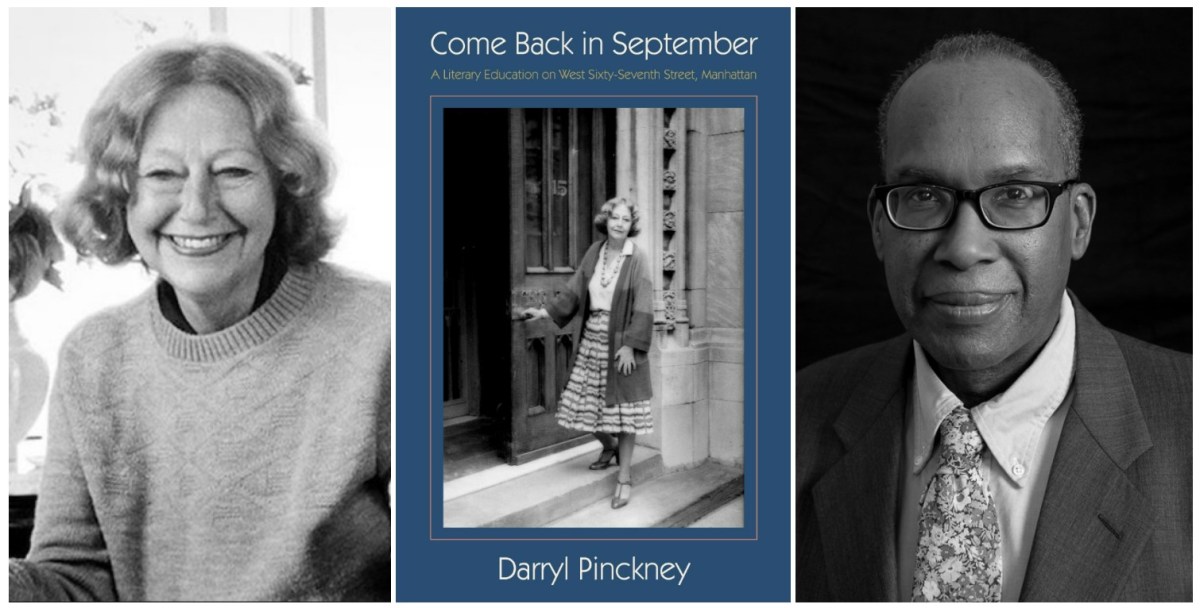
Come Back in September by Darryl Pinckney

by James Wallace Harris, 3/31/23

I nominated Come Back in September by Darryl Pinckney for my nonfiction book club because it was on some best-books-of-the-year lists at the end of 2022, and because it was about creative writing and literary people from the 1970s and 1980s. The book club members voted it in and Come Back in September was our March 2023 read.

However, I don’t think I can say, “Rush out and buy it.” It won’t be a bestseller, but I’d highly recommend it for a specific audience. If you have any of these qualities, you should read more of what I’ve got to say about the book below:

  • Your twenties and thirties took place in the 1970s and 1980s
  • You enjoy reading memoirs and autobiographies
  • You majored in English
  • You’ve taken or taught creative writing courses
  • You enjoy reading and writing poetry
  • You’re fascinated by the New York literary scene of the 1970 and 1980s
  • You love The New York Review of Books
  • You know about Robert B. Silvers and Barbara Epstein
  • You’re interested in Mary McCarthy, Norman Mailer, and Susan Sontag
  • You get a kick out of books with lots of name-dropping and gossip
  • You’re interested in punk rock from the 1970s and 1980s
  • You’re interested in black literature and writers
  • You’re interested in feminist writers of the 1970s and 1980s
  • You want to know about AIDs in New York in the 1980s
  • You can handle terse prose that is detailed and highly episodic

Come Back in September is mostly about Darryl Pinckney and Elizabeth Hardwick, two people who were completely unknown to me. Both have achieved a certain level of success in the literary world, especially in New York City, but are far from famous.

Even though Pinckney dedicated Come Back in September to the memory of Barbara Epstein, I feel the book is mainly about Elizabeth Hardwick – she is pictured on the cover. Epstein and her husband Robert B. Silvers, along with Hardwick were the founders of The New York Review of Books. Epstein and Silvers coedited the magazine from 1963 to 2006 when Epstein died, and Silvers was the sole editor until 2017 when he died.

Elizabeth Hardwick was Pinckney’s writing teacher and mentor. She also hired him as an assistant and helper. They became personal friends. Evidently, through that connection, Pinckney got a job working in the mailroom at The New York Review of Books and getting to know Epstein and Silvers. Much of this memoir is about his life at the magazine in the 1970s and 1980s. If you are a fan of The New York Review of Books, then I recommend Come Back in September. Pinckney went from mailroom clerk to typist to substitute assistant to reviewer, writer, and I believe even doing some editing.

Pinckney was born in 1953, making him two years younger than I am, but still very relatable in age. He accomplished goals I only fantasized about achieving. Elizabeth Hardwick (1916-2007) was born the same year as my mother and died the same year as my mother too. So, I pictured Pinckney throughout his memoir as interacting with a woman my mother’s age. I tried picturing my mother, a white woman born in rural Mississippi, befriending a gay black man. She wouldn’t have been prejudiced against him, and I’m positive she would have loved the attention that Pinckney gave Hardwick. She would have considered him a much better son than me.

Most of the memories in the book are divided between Pinckney’s life with friends and family, and his life with the literary crowd, and most of those seem to deal with Hardwick. So, why does he dedicate the book to Barbara Epstein? Maybe she helped his career more because of her position.

While reading Come Back in September I kept thinking about all the things I was doing the same years while Pinckney was writing about them.

Pinckney first met Elizabeth Hardwick in 1973 and he opens his memoir with:

I made Elizabeth Hardwick laugh when I applied late to get into her creative writing class at Barnard College in the autumn of 1973. Not only could I, a black guy from Columbia across the street, rattle off a couple of middle-period Sylvia Plath poems when she asked me what I was reading—Blacklakeblackboattwoblackcutpaperpeople—I told her that my roommate said we would kidnap her daughter, Harriet, if she didn’t let me into the class. His sister was her daughter’s best friend. I’d met her at a party of his Dalton School friends. I was in.
 
   Where do the black trees go that drink here? 
   Their shadows must cover Canada. 

I walked her to the subway at 116th Street and Broadway. Plath had come around once for her husband’s class when they lived in Boston. Professor Hardwick remembered her as almost docile, nothing like the poems that would make her famous.

Professor Hardwick was fresh and put together. Her soft appearance made the tough things she said even funnier. In her walk, she rocked gently, from side to side. She was on the job, in a short black leather coat and green print scarf, carrying a stiff leather satchel with short handles just wide enough for a certain number of student manuscripts. I hadn’t yet seen her bound up from a chair and break free, flinging over her silk shoulder a silver evening bag on its chain, saying to an astonished table of graduate students and free spirits who’d just agreed among themselves that poetry was everywhere,

   —I’m sure you’re very nice, but I can’t bear that kind of talk. 

And then dancing away from their party because she’d rather be at home looking forward to Saturday night delivery of the Sunday New York Times. 

At our first official teacher-student conference in dingy Barnard Hall, I made Professor Hardwick laugh again, because I recited the last paragraph of Lillian Hellman’s memoir An Unfinished Woman:

    Although I do have a passing sadness for the self-made foolishness that
    was, is, and will be … 

—That fraud, Professor Hardwick said. She tried to do everything but have me killed. 

Six years earlier there had been a Mike Nichols revival of Hellman’s play The Little Foxes at Lincoln Center, and she, Hardwick, had reviewed it for The New York Review of Books, calling it awkward, didactic, and full of cliché. She didn’t believe in the South as an idea, she said.

 —Her use of black people, she said. You would die. 

Agrarianism was a bore. Had I read Allen Tate? A poet I’d never heard of. 

—You don’t need him. Faulkner?

  The Bear. 

—You do need him. But don’t ever do that again.

—Excuse me?

—Read Lillian. People were cutting me on the street. She got people to write letters. She told them, I’m not used to being attacked by someone who has been a guest in my house. I made up my mind that I didn’t care if I never went to another dinner party at Lillian’s. Dashiell Hammett was always trying to get away from her, for Patricia Neal.

I was discovering so much: Rimbaud, Frank O’Hara, Baldwin’s essays, Gertrude Stein’s autobiography. Every day, from hour to hour, there was something new, a name to put on my list of names to reckon with. One afternoon I walked by an open door and a guy with long blond hair was at his upright, preparing to play. The music had poignance and a couple of other people also paused. My mother loved the piano, but I had never heard of Erik Satie. Friends and professors had a lot to tell me.

Pinckney, Darryl. Come Back in September (pp. 3-5). Farrar, Straus and Giroux. Kindle Edition. 

I quote so much of the opening pages to give you an idea of reading Pinckney’s prose. I had to pay close attention, and often reread lines to pick up on what he was saying. Pinckney’s prose reminds me of poetry, which involves short lines, that are tense, terse, vivid, detailed, and hard to read. On a superficial level, Pinckney’s prose reminds me of Hardwick’s novel Sleepless Nights, which I’ve just started. Both books are told in a long series of snippets of memories.

Our nonfiction book club rates books, 1 to 10, at the end of the month. I gave it a 10 even though I had problems with it. I think those problems were mine and not Pinckney’s. I admire Come Back in September quite a bit, but it’s just not something I always cared about, but I never stopped valuing its quality. My hunch is that Come Back in September is far more brilliant than I’m capable of perceiving.

This memoir is an amazing bit of memory excavation. I write about dredged-up memories all the time, so I know how hard it is, and I admire it when I see it done so much better than what I do.

I had problems with Pinckney’s writing style at first, but once I tuned into his way of expressing memories, I could see what he was doing. I don’t know if it was intentional, or if that’s how he thinks. His prose is very granular. He depends on the accumulation of memory flashes rather than one long consistent narrative.

I am reminded of Kurt Vonnegut’s technique. Vonnegut claimed to write his novels in 500-word chunks. Pinckney does something similar, but often his chunks are very short – just long enough to capture a significant moment of the past. Come Back in September covers the years 1973 to 1989 and is based on journals and letters, but I also expect deeply buried memories.

By our reading group’s rating scale, a 10 should be for books that we consider highly recommendable. I can’t say that’s true for this book. It’s highly recommendable if you are the right reader for this book, but I guess most readers won’t be. Still, I rated it a 10 for a group. I wasn’t the only one.

Now for the philosophical reading question. Should we always read books that are exactly like what we’ve trained ourselves to read? Even though my undergraduate degree is in English, and I’m a dropout from an MFA creative writing degree, Pinckney’s prose and subject matter were far outside of my normal stomping grounds. For the first half of the book, I had to push myself to read it. Eventually, I adapted and the second half became a page-turner.

I’m not sure if I will ever reread Come Back in September, but I think if I do, I will find a great deal more to get out of it. I’ve tried to find out more about Pinckney and Hardwick online. There’s a lot for Pinckney, he’s become somewhat successful over the years, but I believe Hardwick has become more obscure. I can’t find any videos of her at all, but within Come Back in September she expressed a distaste for that kind of attention.

A couple of years after the events in Come Back in September Pinckney published his first novel, High Cotton. It’s dedicated to his parents and sisters. Elizabeth Hardwick mentored and encouraged his writing during this time, so I was surprised she wasn’t mentioned in the dedication.

Another problem I had with the book, is all the big-name authors that Pinckney got to hang with back in the 1970s and 1980s are not ones I care about. How many people still read Mary McCarthy, Norman Mailer, Susan Sontag, Robert Lowell, etc.? Still, I imagine for people who do, this book will delicious inside gossip.

Pinckney leaves me mostly interested in Elizabeth Hardwick. I’ve started Sleepless Nights, but so far I don’t like it. It’s too poetic. She shunned plots. I can read books without plots, but I need engaging characters and marvelous settings to make up for them. So far I haven’t found them.

Hardwick’s novel and Pinckney’s memoir are both about collecting memories and depending on the totality of those collected flashes of memories telling a story. That worked for Pinckney but it took a while, that may also be true for Hardwick.

Jim
Just Saying No To Vinyl – Going Back To CDs

by James Wallace Harris, 3/28/23

The big news in the music world is vinyl is outselling compact discs in sales. That’s because it’s for total sales and not total units. That’s not hard to believe when LPs go for $20-50 for regular releases, and much more for special editions. Yet, CDs seem cheaper than they’ve ever been. I’m going back to buying CDs. Fooey on the $50 LP.

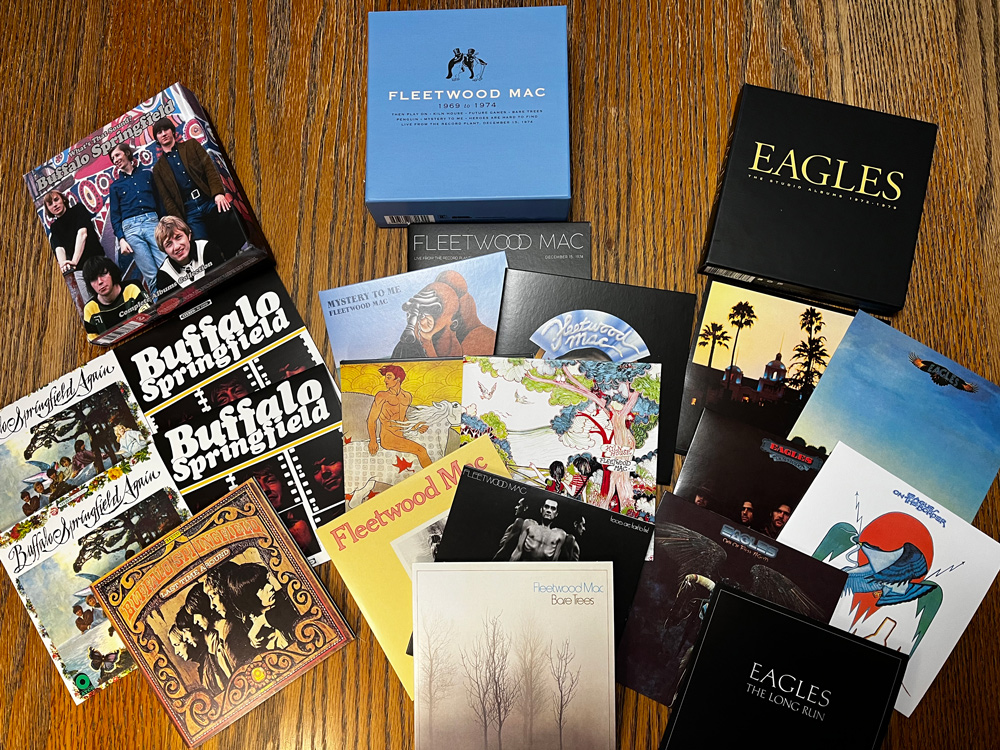
I just bought Fleetwood Mac- 1969 to 1974 on 8 CDs for $36.99. And Eagles, The Studio Albums 1972 – 1979 on 6 CDs for $27.88, and What’s That Sound? Complete Albums from Buffalo Springfield on 5 CDs for $26.39. The sound quality is impressive but the packaging is very cheap. Just cardboard sleeves for the CDs in a cheap cardboard box, no booklets or documentation.

I actually like these CDs in slim cardboard sleeves. I’m going to try and find a set of file drawers that will just fit them. Or maybe some miniature crates like how we use to store LPs. CDs in plastic cases take up a lot of room.

The Fleetwood Mac set seems to be all recent re-masters but I can’t be sure. Then Play On, one of the Fleetwood Mac albums has the same 18-cuts with bonus tracks as the remastered CD that Amazon sells as a single CD for $14.27. The Fleetwood Mac set has a sticker that says “Six studio albums re-mastered on CD for the first time. Plus a previously unreleased live performance from 1974, 20 bonus tracks, and 8 previously unreleased tracks.” That’s interesting because the box contains 7 studio albums and a live album CD. I ain’t complaining.

The Buffalo Springfield set has a sticker saying it was “Re-Mastered from the original analog tapes under the auspices of Neil Young.” Buffalo Springfield never sounded so good to me. Their original LPs and CDs always seemed thin sounding. The new set has Buffalo Springfield’s three original albums, with the first and second in both mono and stereo.

The Eagles set has six studio albums on CD, with no extra information, no extra cuts, and no claim to be re-mastered. But the CDs sound good.

For years I’ve been trying to get back into vinyl. I sometimes buy old LPs at the library bookstore for 50 cents each, and I bought a handful of new LPs when they were on sale. But I won’t buy them new anymore – they’re just too damn expensive, and still going up in price. And every time I hear a skip on an LP I want to give up vinyl completely – give away my records and turntable. No vinyl revival for me.

I like to play one or two whole albums each day. Sometimes in the afternoon when I’m tired, and sometimes after dinner when I’m tired and not ready for television. I’ve gotten so I enjoy hearing a whole album – and played loud. Susan is nice enough to indulge me for a couple of hours.

And I feel bad about always streaming music because I’ve read artists don’t get paid much through that system. I’m willing to buy new albums, especially if they are priced around $5-10. And I love these new bargain sets. Amazon has a bunch of them and I’m going to buy more. They are usually marketed under “Original Album Series” or “The Studio Albums” keywords.

I think the only Fleetwood Mac album I bought when it came out before they went big with Stevie Nicks and Lindsey Buckingham was Bare Trees. Over the years I’ve picked up a few albums with Peter Green and Bob Welch. I bought the 1975-1987 albums as they came out. It’s great to jump back and hear all the earlier albums. There is even a cheap box set of the earliest Fleetwood Mac albums that I’m going to buy.

These cheap box sets are a great way to really get into a group, and time travel to the past. There are quite a few artists and groups I didn’t listen to when they came out that I’m willing to try now because they now have an enduring reputation. I especially want to try a lot of jazz groups. I’ve already ordered a set of Weather Report albums on CD.

I have hundreds of CDs I’ve bought over the last forty years, but some weren’t mastered that well originally. I’m willing to buy CDs if they are priced low and especially if they’ve been re-mastered. I’d love to buy a cheap box set of Joe Walsh solo albums and James Gang albums. The old CDs I have sound thin and poorly mixed. I don’t see anything remastered for them currently.

So, it’s back to CDs for me. Just saying no to the vinyl revival. I know LPs are cool, and wonderful to look at and hold, but CDs sound better and are more convenient to use.

My plan is to explore a lot of music, especially albums that came out from 1960 to 1980. I’d like to buy all my favorite albums on CD and keep them in order by when they were originally released. I only want to buy albums I’ll listen to whole – from the first to the last track. I’m not interested in buying the greatest hits albums or compilations. I have Spotify for those songs.

Year Album Artist
12/05/1966 Buffalo Springfield Buffalo Springfield
10/30/1967 Buffalo Springfield Again Buffalo Springfield
06/30/1968 Last Time Around Buffalo Springfield
09/19/1969 Then Play On Fleetwood Mac
09/18/1970 Kiln House Fleetwood Mac
09/03/1971 Future Games Fleetwood Mac
03/00/1972 Bare Trees Fleetwood Mac
06/01/1972 Eagles Eagles
03/01/1973 Penguin Fleetwood Mac
04/17/1973 Desperado Eagles
10/15/1973 Mystery to Me Fleetwood Mac
03/22/1974 On the Border Eagles
09/13/1974 Heroes Are Hard To Find Fleetwood Mac
06/10/1974 One of These Nights Eagles
12/08/1976 Hotel California Eagles
09/24/1979 The Long Run Eagles

JWH

Why Do I Want Old Issues of Rolling Stone Magazine From the 1960s and 1970s?

by James Wallace Harris, 3/26/23

The other day I got the hankering to read old issues of Rolling Stone from the 1960s and 1970s and started trying to track them down. This morning I decided I needed to psychologically evaluate why I was doing this because I realized as I was still lying in bed that I don’t have enough time in life to read everything I want to read. So why waste reading time on these old magazines? That got me thinking about a Reading Bucket List and focusing on reading the most important books rather than just trying to read everything.

I might have ten more years, or it could be twenty or thirty, but the time to get things read is dwindling. For practical purposes, I’m going to assume I have ten years which will put me in the average lifespan range. Since I average reading one book a week, that’s 520 books. My best guestimate suggests I already own six times that many in my TBR pile. Or, put another way, I’ve already bought enough books to keep me reading for another sixty years. I need to stop chasing after more things to read like hundreds of old issues of magazines.

So why want to read a bunch of old magazines? Since I started contemplating the idea of a Reading Bucket List, I realized it’s not the number of books. This was my first useful revelation today. It’s the number of topics I want to study, including fictional explorations on those topics too.

Lately, I’ve been reading about the creation of the atomic bomb, the bombing of Hiroshima and Nagasaki in 1945, atomic bomb tests in the atmosphere, how the general public felt about nuclear war in the 1950s, and 1960s, and how all of that influenced science fiction novels and short stories. If I explored that subject completely I could use up my 520 books easily. Because I want to explore a number of topics before I die, I also need to limit how deep to get into them.

I see now that my Reading Bucket List won’t be a list of books, but a list of topics to study. So I need to change my bucket list name from Reading Bucket List to Topics to Study Bucket List. My fascination with topics usually doesn’t last long, just a few weeks or a couple of months. However, most of the topics I’m interested in are reoccurring. I’ve chased them my whole life and keep coming back to explore them some more.

(It might be valuable to make a list of these topics, but that’s for the future. Another project: see if I can create a timeline of how often these interests resurface.)

Let’s get back to the magazines. I believe writing the above paragraphs have already helped me see something important. I want to reread old issues of Rolling Stone with a specific goal. (One reason I write these blog posts is to think things through and see into myself.)

I want Rolling Stone magazines to find albums and groups I missed when I read Rolling Stone the first time they were coming out. This is part of a larger project of studying I’ve been piddling away at for decades. I started haunting record stores in 1965, but I never could afford to buy many albums each week. As I got older and had more money I’ve always tried to catch up by buying older records when I bought new ones, filling in the past. Now with Spotify, I can listen to almost any album from the past. But I need to know about the group or album to search for it and play it. I thought I’d read old record reviews and look for albums that are forgotten today but got good reviews back then.

My ultimate goal is to get a solid understanding of popular music from 1960 to 1980. Eventually, I want to add 1948-1959 and 1981-1999. And if I have time I’d like to learn about classical music. But I’ll define this topic as: What Were the Best Albums When I Grew Up? I figured Rolling Stone magazine from 11/9/67 to 12/31/80 could help me.

There are plenty of books on the best albums of all time, including from Rolling Stone, and I have many of them. But they tend to focus on the same famous albums and artists. I love when I find a song that’s been forgotten that really excites me. For example, recently I found “Harlem Shuffle” by Bob & Earl from back in 1963. I was listening to AM music at least eight hours a day back in 1963, but I don’t think I remember this song, at least not distinctly remember it. The title is familiar, and some of the lyrics, but then this song has been covered a number of times, including by The Rolling Stones.

Yesterday, I played “Harlem Shuffle” several times very loud on my big stereo with a 12″ subwoofer and it sounded fantastic. Boy did it press some great buttons in my soul. And that’s also part of my Topics to Study Bucket List. I grew up with certain buttons I liked pushed. I want to understand them. Studying music from 1960-1980 is working toward that. Studying science fiction that came out from 1939-1980 is another. But like I said before, making a list of all of them is for another day.

And wanting old issues of Rolling Stone is not a new desire. Back in 1973-74, I bought three huge boxes of old issues of Rolling Stone at a flea market. God, I wish I had them now, but I wouldn’t have wanted to drag them around for fifty years either. And earlier this century I bought Rolling Stone Cover to Cover, which featured every issue from 1967 to May 2007 on DVD. I still have it, but the discs have copy protection and the reader software stopped working after Windows 7. I’m thinking about setting up a machine, or virtual machine, and installing Windows XP on it to see if I can get it going again. But that will be a lot of work.

With some help from some folks on the internet, I’ve gotten the first 24 issues of RS on .pdf. I’m hoping to find more. If you have them and wish to share them, let me know. Or if you know of any other source. I’m also interested in learning about other magazines that reviewed music from 1960-1980. And I’ve already gotten some recommendations of less than famous bands to try. If you have a favorite forgotten album or group leave a comment. And now that I think about it, if you’re working on a similar project, tell me about your methods.

Ultimately, I want a list of all the albums I love most from 1960-1980. I might even buy them if I don’t own them already. I enjoy listening to one or two albums a day. Recent great discoveries were the first albums by Loretta Lynn and Etta James. I was surprised by how well they were produced, and how well everything sounds on my latest stereo system.

This week I discovered Amazon is selling CD sets that feature 3-8 original albums from certain groups for about the price of a single LP. Yesterday, I got in a set of Buffalo Springfield that was remastered under the supervision of Neil Young. 5 CDs for their three albums. (2 CDs are copies in mono.) I also ordered the first 6 studio albums of the Eagles, 7 albums from Fleetwood Mac’s middle period, and five albums of Weather Report. But these are famous albums. The real goal is to find forgotten albums I love as much as the classics of rock music.

JWH

Are You in Future Shock Yet?

by James Wallace Harris, 3/24/23

Back in 1970, a nonfiction bestseller, Future Shock by Alvin Toffler, was widely talked about but it’s little remembered today. With atomic bombs in the 1940s, ICBMs, and computers in the 1950s, manned space flight and landing on the Moon in the 1960s, LSD, hippies, the Age of Aquarius, civil rights, gay rights, feminism, as well as a yearly unfolding of new technologies, it was easy to understand why Toffler suggested the pace of change could lead society into a collective state of shock.

But if we could time travel back to 1970 we could quote Al Jolson to Alvin, “You ain’t seen nothing yet.” Couldn’t we? Toffler never came close to imagining the years we’ve been living since 1970. And his book was forgotten, but I think his ideas are still valid.

Future shock finally hit me yesterday when I watched the video “‘Sparks of AGI’ – Bombshell GPT-4 Paper: Fully Read w/ 15 Revelations.”

I’ve been playing around with ChatGPT for weeks, and I knew GPT 4 was coming, but I was surprised as hell when it hit so soon. Over the past few weeks, people have been writing and reporting about using ChatGPT and the general consensus was it was impressive but because it made so many mistakes we shouldn’t get too worried. GPT 4 makes far fewer mistakes. Far fewer. But it’s fixing them fast.

Watch the video! Read the report. I’ve been waiting years for general artificial intelligence, and this isn’t it. But it’s so damn close that it doesn’t matter. Starting back in the 1950s when computer scientists first started talking about AI, they kept trying to set the bar that would prove a computer could be called intelligent. An early example was playing chess. But when a computer was built to perform one of these measures and passed, computer scientists would say that test really wasn’t a true measure of intelligence and we should try X instead. Well, we’re running out of things to equate with human-level intelligence.

Most people have expected a human-level intelligent computer would be sentient. I think GPT 4 shows that’s not true. I’m not sure anymore if any feat of human intelligence needs to be tied to sentience. All the fantastic skills we admire about our species are turning out to be skills a computer can perform.

We thought we’d trump computers with our mental skills, but it might be our physical skills that are harder to give machines. Like I said, watch the video. Computers can now write books, compose music, do mathematics, paint pictures, create movies, analyze medical mysteries, understand legal issues, ponder ethics, etc. Right now AI computers configured as robots have difficulty playing basketball, knitting, changing a diaper, and things like that. But that could change just as fast as things have been changing with cognitive creativity.

I believe most people imagined a world of intelligent machines being robots that look like us — like those we see in the movies. Well, the future never unfolds like we imagine. GPT and its kind are invisible to us, but we can easily interact with them. I don’t think science or science fiction imagined how easily that interaction would be, or how quickly it would be rolled out. Because it’s here now.

I don’t think we ever imagined how distributed AI would become. Almost anything you can think of doing, you can aid your efforts right now by getting advice and help from a GPT-type AI. Sure, there are still problems, but watch the video. There are far fewer problems than last week, and who knows how many fewer there will be next week.

Future shock is all about adapting to change. If you can’t handle the change, you’re suffering from future shock. And that’s the thing about the 1970 Toffler book. Most of us kept adapting to change no matter how fast it came. But AI is going to bring about a big change. Much bigger than the internet or computers or even the industrial revolution.

You can easily tell the difference between the people who will handle this change and those who can’t. Those that do are already using AI. They embraced it immediately. We’ve been embracing pieces of AI for years. A spelling and grammar checker is a form of AI. But this new stuff is a quantum leap over everything that’s come before. Put it to use or get left behind.

Do you know about cargo cults? Whenever an advanced society met a primitive society it doesn’t go well for primitive societies. The old cultural divide was between the educated and the uneducated. Expect new divisions. And remember Clarke’s Third Law: “Any sufficiently advanced technology is indistinguishable from magic.” For many people, AI will be magic.

Right now AI can help scholars write books. Soon AI will be able to write better scholarly books than scholars. Will that mean academics giving up writing papers and books? I don’t think so. AIs, as of now, have no desires. Humans will guide them. In the near future, humans will ride jockey on AI horses.

A couple weeks ago Clarkesworld Magazine, a science fiction magazine, shut down submissions because they were being flooded with Chat-GPT-developed stories. The problem was the level of submissions was overwhelming them, but the initial shock I think for most people would be the stories would be crap. That the submitted science fiction wouldn’t be creative in a human sense. That those AI-written stories would be a cheat. But what if humans using GPT start producing science fiction stories that are better than stories only written by humans?

Are you starting to get why I’m asking you if you feel future shock yet? Be sure and watch the video.

Finally, isn’t AI just another example of human intelligence? Maybe when AIs create artificial AIs, we can call them intelligent.

JWH

What I Learned Cataloging My Books, Ebooks, and Audiobooks on Goodreads

by James Wallace Harris, 3/21/23

I learned several things this week while entering over fifteen hundred books into my Goodreads database. The books I added were mainly acquired since I retired in 2013. One insight that impressed me the most was I was specializing in a limited number of topics. On one hand, I was disappointed by my narrow range of interests, but on the other hand, I was annoyed at myself for being scattered in my intellectual pursuits. You can’t get good at something if you try to get good at too many things.

If I judged my reading as a leisure activity it wouldn’t matter what I read. However, if I judged my reading as an education, then I was majoring in too many subjects. But here’s the kicker to this revelation. Before I started cataloging my books I assumed I was reading for fun and randomly exploring any subject that caught my fancy. It was only as I entered all the titles into the database did I realize that I have been specializing in several areas. And my immediate impulse was to read deeper into those topics and to go out and buy more books on those subjects.

Why was I chasing so many subjects when I’ve always wanted to be a master of one? Why would I want to do that? Yet, focusing on one would mean ignoring many things I want to know more about. That thought has started me to do a lot of naval gazing this week.

My original goal was to put all my books into my Goodreads database so I’ll know what I own to keep from buying duplicates when I’m at the used bookstore. So far I’ve found a shopping bag of duplicates which I gave to my buddy Mike. I entered all my books into Goodreads many years ago but didn’t update the database when I bought books or gave them away, so my Goodreads database was badly out of date. I had been putting this task off for years because I couldn’t figure out which books to add or delete from the system to catch up again.

My solution was to create a “shelf” called “2023 inventory” and reenter all my books linking them to that shelf. Then delete all the books in the system that wasn’t in the 2023 inventory.

After entering 1,506 books, which were all the physical books in the house, I had 3,159 total books in the database. That implied I could have given away 1,653 books, but then I realized that some of those might be Kindle or Audible books I own. Now I must go down the list of 3,159 books, and if they aren’t in the 2023 inventory, see if they are in my Kindle or Audible libraries. If they aren’t, I can delete them.

Doing all this librarian work has been rewarding in several ways. The work is revealing how my reading has shifted away from physical books to ebooks and audiobooks. This process has also revealed other insights about myself. For certain titles, and subjects I tend to buy both the audiobook and the ebook edition because that’s how I like to study them. And for some titles, I have the ebook, audiobook, and physical book. If I really like the book and subject, or if it’s fiction, and I really enjoy the story, I like getting into the book through all three formats.

I can spot my favorite authors because with some writers I’ve collected their books in all three formats. That also reflects a consolidation of interests, focus, and specialization.

When I used to go to parties I noticed that people tend to talk about things they loved most. The most interesting people were the ones who could expound deeply on a subject. Like most people, I just chatted about what little I knew about a zillion subjects.

I eventually observed that some people like to specialize and that some people even feel they are experts on their favorite subjects. It’s even fun to see two fans of the same subject argue over who knows more. I see from my data entry the subjects I’ve unintentionally tried to master. What’s funny is I seldom meet people interested in the subjects I’m interested in. Which is why I seldom talked much at parties. (This blog is my way of nattering about what I like.)

Thinking about people who know a lot about a little has led me to ask why I’d want to specialize in certain topics anyway? It’s not like I’m at a university trying to pass courses and get a major. I never go to parties anymore. I think it’s like my urge to catalog my books, which is a kind of anal pursuit, I also want to organize what I know.

There is a certain satisfaction in getting the biggest picture on the tiniest of topics. There is also satisfaction in collecting everything of a certain type. For example, I like westerns, so I collected my favorite western movies on DVDs. Then I started buying books about movie westerns. But after that, I started buying books about the history of the American West. I’ve done the same thing for classic rock and jazz music. While cataloging my books I realize I was gathering novels written in England between the wars, and books about their authors. That interest is also reflected in the TV shows I’m watching. Susan and I have recently watched all of Downton Abbey, Upstairs, Downstairs, and we’re currently going through the seven seasons of the first television version of All Creatures Great and Small.

The upshot of all these cataloging revelations is I want to focus more on my best subjects. And abandon some lesser interests to put more time into my majors. After I finish this project I could write my tombstone epitaph – “Here lies Jim Harris, this is what he liked to read:” I mean, isn’t what we focus on one of the best descriptions of our personality?

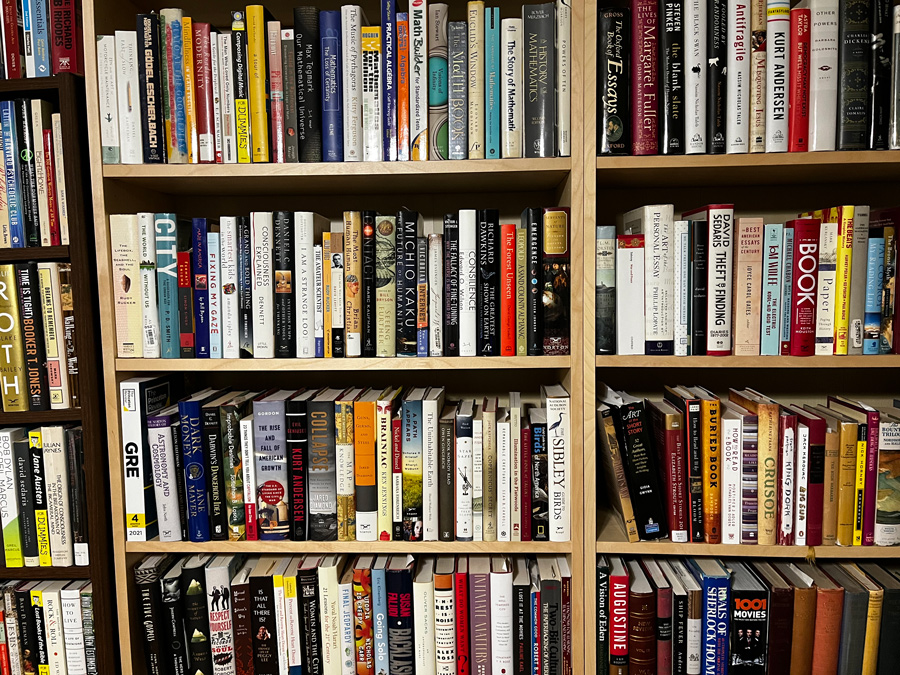
I only have nine bookcases. And they are all full. I don’t want to buy more bookcases. Nine’s my limit. I feel that’s also an analogy for my brain. It can only hold so much, so if I want to get better at one subject I have to forget about another.

If I want to buy more books I have to get rid of existing books to make room for the new ones on the shelves. This tends to distill my collection even further into specialized subjects. It also means I cull crappy books for better books.

But there is something else to consider. I’m getting older. I’m running out of time. My mental abilities are declining, which limits how much information I can process. And my physical abilities are declining, which also influences my book collecting. I can imagine a future where I can only handle six bookcases, or even three, and maybe down to just one.

I put every book I own onto a Rubbermaid rolling cart one shelf at a time to take them to my computer to enter their data. That physically wore me out. I’m thinking of getting rid of the heavy coffee table books in my collection just because in the near future I won’t be able to handle their weight. And there’s another reason I need to start shrinking my collection. If I should die I don’t want to burden my wife with having to get rid of a couple of tons of books. And if I ever need to move to a retirement apartment or assisted living I wouldn’t want to deal with all of them either.

This week of cataloging my books has reminded me of which subjects I’ve studied over the last forty years, which subjects are my favorite topics, and that I want to thin out my collection.

Currently, Goodreads says I have a total of 3,150 books but I haven’t finished entering all my Kindle and Audible books. Amazon says I have 1,608 Kindle books and 1,544 Audible titles, however, many are already in Goodreads. I’ve just got to figure out which ones aren’t. Luckily, Kindle and Audible books don’t weigh much, or take up much space.

I’ve always wanted to make a list of everything I own because I assume it would tell me a lot about myself. This Goodreads list is a good start toward that.

JWH