Looking Back at My First 10 Years of Retirement

by James Wallace Harris, 10/15/23

Friday was my 10th anniversary of retiring. I started work at Memphis State University in 1977 and retired from The University of Memphis in 2013. I hadn’t moved, they changed the name. Those 36 years represents half of my 72 years. The second largest chunk of time in my life was K-12 schooling. It’s interesting to see retirement has become the third largest segment of this pie chart.

These ten years of retirement were the same number of years as third grade through twelfth, but they certainly didn’t feel the same. For some reason, 1963-1969 were the longest seven years of my life, way longer than the last ten years of retirement. Isn’t that weird? Why have they sped by so fast?

When I look back, I can see a lot has happened. Three presidents. A pandemic. Several wars. Quite a bit of economic ups and downs. In the past ten years we’ve all seen society transformed by smartphones. The worst political polarization of my lifetime has happened in this last decade. There were lots of marriages and babies in our family, and several deaths. I entered my socialist years with social security and Medicare. I’ve had several surgeries and lots of MRIs, CT scans, a couple ER visits, and endless medical tests. Yet, I’m basically healthy.

I have lived in the same house since I retired. Those seven years I mentioned, I lived in nine different houses in three different states. Maybe that’s why those were the longest years of my life. These past ten years have been the most stable of my entire lifetime, and I’m not bored.

I thought when I retired I would do so much with all the free time I would have, but that hasn’t happened. The past ten years has been a slow decline into inactivity. I guess that’s what getting old means. And I accept that decline.

When I first retired, I didn’t watch TV until about eight o’clock at night. I tried to stay active all day. Susan worked out of town, and I spent a lot of time socializing.

Now my daily routine starts with an hour of YouTube videos after I do my physical therapy exercises. Then I putter around doing chores, eating lunch (breakfast since I’m intermittent fasting), writing blogs, listening to music. Then another hour of TV with Jeopardy and NBC Nightly News at 5:30 with Susan. After dinner I wash dishes and try to watch TV by myself while Susan watches her shows. I usually fail and switch to blogging, reading, or listening to music. I finish the evening at nine with two hours of TV watching with Susan, shows we both like.

In 2013 I probably watched 1-2 hours of TV a day, and not every day. Susan was working out of town, and I’d only watch TV when I had friends over in the evening. Now, I’m logging 4-5 hours a day. Television has become an addiction in retirement. I’ve been thinking about breaking it, but I’m not sure I can be more active anymore.

In 2013 I would go out several times a week with friends. I’d go to the movies once or twice a week, eat out several times, and I’d go to museums, parks, shopping, or just walks. Now I go out once a week to the used bookstore, and every other week to the grocery store. Susan and I take turns grocery shopping since we both hate doing it. The pandemic really changed my habits, but also my spinal stenosis limits my walking. However, staying home more does not bother me at all. In fact, I love it. My mother was that way when she got old too. A lot of people do that as they age. Like most of the old people I’ve known, I want to die at home, in this house.

What I’ve really gotten into these past ten years is reading. I read about fifty books a year, so I’d guess I’ve read about five hundred books since I’ve retired.

And several years ago, I joined with a guy from Britain and another from South Africa on Facebook to moderate a science fiction short story reading group. We discuss one story a day, and I’ve slowly developed several online friends from this activity. I’ve been focusing on reading short stories for the last five years and I’d guess I’ve read at least two thousand since then.

I also write essays for two different personal blogs. For a few years I wrote for three web sites, Book Riot, SF Signal, and Worlds Without End. I’d guess in my ten years of retirement I’ve written at least 1,500 essays.

I don’t keep records, but I’d guess I’ve watched a hundred TV series in my retirement. When Susan worked out of town, I’d watch them with my friend Janis. And since Susan retired, I watch them with her. I don’t really like watching TV by myself, so I tend to watch what other people like. My favorite series with Janis was Breaking Bad. My favorite series with Susan was Call the Midwife. Lately, my friend Annie has been coming over and we’re going through the films of Alfred Hitchcock. Ann and Tony come over to watch various shows, we’re currently finishing Ted Lasso. Our friends Mike and Betsy used to come over for TV or movies but since the pandemic that’s stopped. Watching TV series and movies with other people has been a major social activity for me during my retirement years.

Another recent activity is having people over for games and cards.

Our cats Nick and Nora died during the early years of my retirement, and now we have Ozzy and Lily. They are a big part of our retirement life since Susan and I have no children.

We bought this house; the one Susan grew up in when her parents died. That was 2007, I think. We had Susan’s brothers, wives, and their children over for Thanksgiving and Christmas for several years to continue the tradition of her parents. But by the time I retired, the nephews and nieces were grown up and had families of their own, and we stopped hosting the holidays. In terms of family life, the past ten years have been noticeably quiet. My mother, aunts, and uncles all died off before I retired. Since then, about half my first cousins have died. Our generation is fading away.

My retirement years have been mostly about maintaining friendships. I spend a lot of time on the phone keeping up with people. Some of my friends still come over to the house, but that’s slowing down too. Many of our friends no longer travel or drive at night. My sister still visits. And a few old friends that have moved away come to Memphis now and then. Getting old is weird that way.

Retirement goes hand in hand with aging. I didn’t foresee that before I retired. I thought I wouldn’t feel old for many years, and my first decade of retirement would be more active. When I first retired, I fantasized about moving to New York City for a year. Later, I thought about moving to The Villages in Florida. But NYC was impractical, and the pandemic and health problems killed off Florida. I no longer think about traveling, and the only way I imagine moving is if we need to move into a retirement community or assisted living.

My goals have become less ambitious. I’m reading self-help books about developing good habits. I want to do more reading and writing but be more organized and focused. I’m researching ways to take notes and remember what I read because I’m starting to forget more.

I think the next ten years of retirement will be more streamlined. I want to get rid of stuff and focus on accomplishing small quiet creative projects. I know I’m physically running down. I feel wiser than ever, but I’m losing mental horsepower. I need to become more efficient in my use of mental and physical energy.

These ten years of retirement have been nothing I planned. But then, long ago, even when I was still young, I had learned the future is everything we never imagined. My friend Linda and I are studying Stoicism. I think it’s the perfect time for that philosophy, both in our lives, and in this moment of civilization.

JWH
Discovering New Music From the 1980s – Prefab Sprout

by James Wallace Harris, 10/6/23

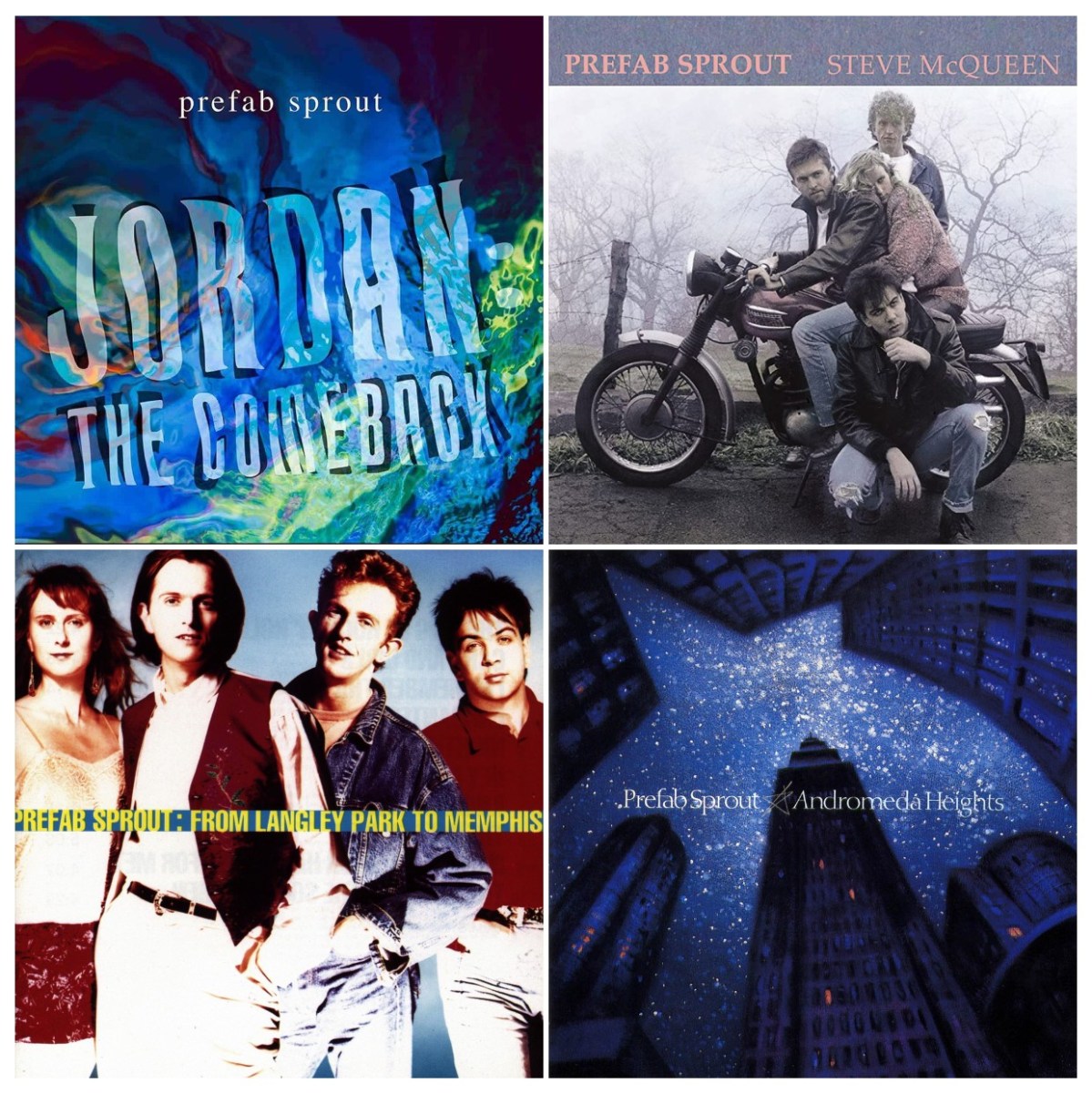
I get very few hits when I write about music, but I’m hoping to find a few old music addicts like me who didn’t discover Prefab Sprout back in the 1980s. Over the decades, I occasionally discover a band I’ll play obsessively for weeks. Well, I discovered Prefab Sprout on John Darko’s YouTube channel a few weeks ago and I’ve been playing them ever since. I started playing them on Spotify and Apple Music, but I loved them so much I’ve been ordering the CDs. I have a feeling I won’t get tired of this band for several more weeks.

It’s hard to put a love of music into words, so just listen below. At first, only a few songs grabbed me, especially the first two on Jordan the Comeback. But as I continued to play the albums more songs became great. This is why streaming music is so great. I can keep trawling the past until I find another band that pushes all my buttons.

JWH

Remembering the Sixties in Two Bad Movies

by James Wallace Harris, 10/4/23

I’m always shocked by how much American society has changed since the 1960s when watching movies and television shows from that decade. I graduated high school in 1969.

I’m curious how people born after the 1960s picture it in their mind’s eye. I grew up in the 1960s and remember two versions of that decade. I mostly recall the pop culture 1960s that everyone learns about in history and from the media, but if I think about it, I remember another 1960s, one far more mundane, and quieter. The difference you might say between The Beach Boys in 1963, and The Beatles in 1969.

Over the last two nights, Susan and I watched two movies from the 1960s that reminded me of the less famous version of that decade: Boy, Did I Get a Wrong Number (1966) and Doctor, You’ve Got to Be Kidding (1967). Neither film was particularly good, but I found them both to be fascinating time capsules of that other 1960s.

Someone growing up in the 21st century would probably find both films stupid and even offensive. They would probably wonder where the smartphones, tablets, computers, and social media were, and why no one used certain now universal four-letter words routinely as adjectives, adverbs, and nouns. I’m sure they would think the acting stilted and why people fit into roles, especially gender roles. Those thinking a little deeper would wonder why all the famous 1960s pop culture was missing. But I think the thing that would standout the most, was the attitude both movies presented regarding sex. You’d think people living in the 1960s were Victorians.

Both Boy, Did I Get a Wrong Number and Doctor, You’ve Got to Be Kidding were about sex, but neither showed actual nudity or anyone having sex. Doctor is about Sandra Dee getting pregnant and three boyfriends wanting to marry her. None of the three had had sex with her. And the only reason we know Sandra Dee had sex with her boss, George Hamilton, was because the movie showed fireworks.

Boy is about Bob Hope, a late middle-aged real estate agent getting accidently involved with sexy movie star Elke Sommer, but not really. Elke Sommer plays a French actress famous for making movies where she takes bubble baths. She really wants to do dramatic roles and free herself from tub casting. Ironically, we see her taking several foamed covered baths in this film. 1966 is before they started having nudity in films, but it tries hard to show as much of Elke Sommer as possible. Boy, Did I Get a Wrong Number advocates good old fashion puritanical values while promoting itself with the allusion of sex.

I thought both films were accurate with the clothes, houses, furniture, and cars. The look of the other sixties does come across in these films. Even the lame jokes and goofy dialog gave off the right vibes for the times.

Both films were aimed at the silent majority but tried to appeal to the emerging youth culture. It’s strange how we see counterculture slowly take over Hollywood by watching old movies and television shows from the late 1960s and 1970s. Very few movies in the middle 1960s showed what was happening in the rock world, or counterculture. If they had rock music, it was generic instrumental shit. Hollywood lagged for several years recognizing the social impact of rock.

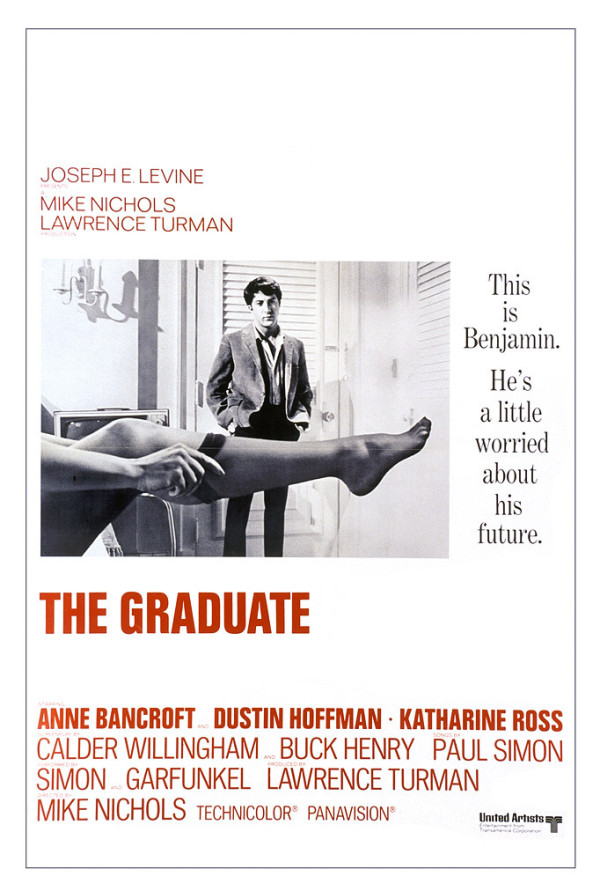
I remember seeing The Graduate in late 1967 and thinking how radical it was. The soundtrack used Simon and Garfunkel. That was tremendously exciting at the time because it felt like my generation was finally being recognized. However, seeing it recently was another shock. It wasn’t that radical at all, not how I remembered feeling it in December 1967. The Graduate was still much closer to that quiet version of the sixties than the infamous loud sixties. I see it now as a transitional film.

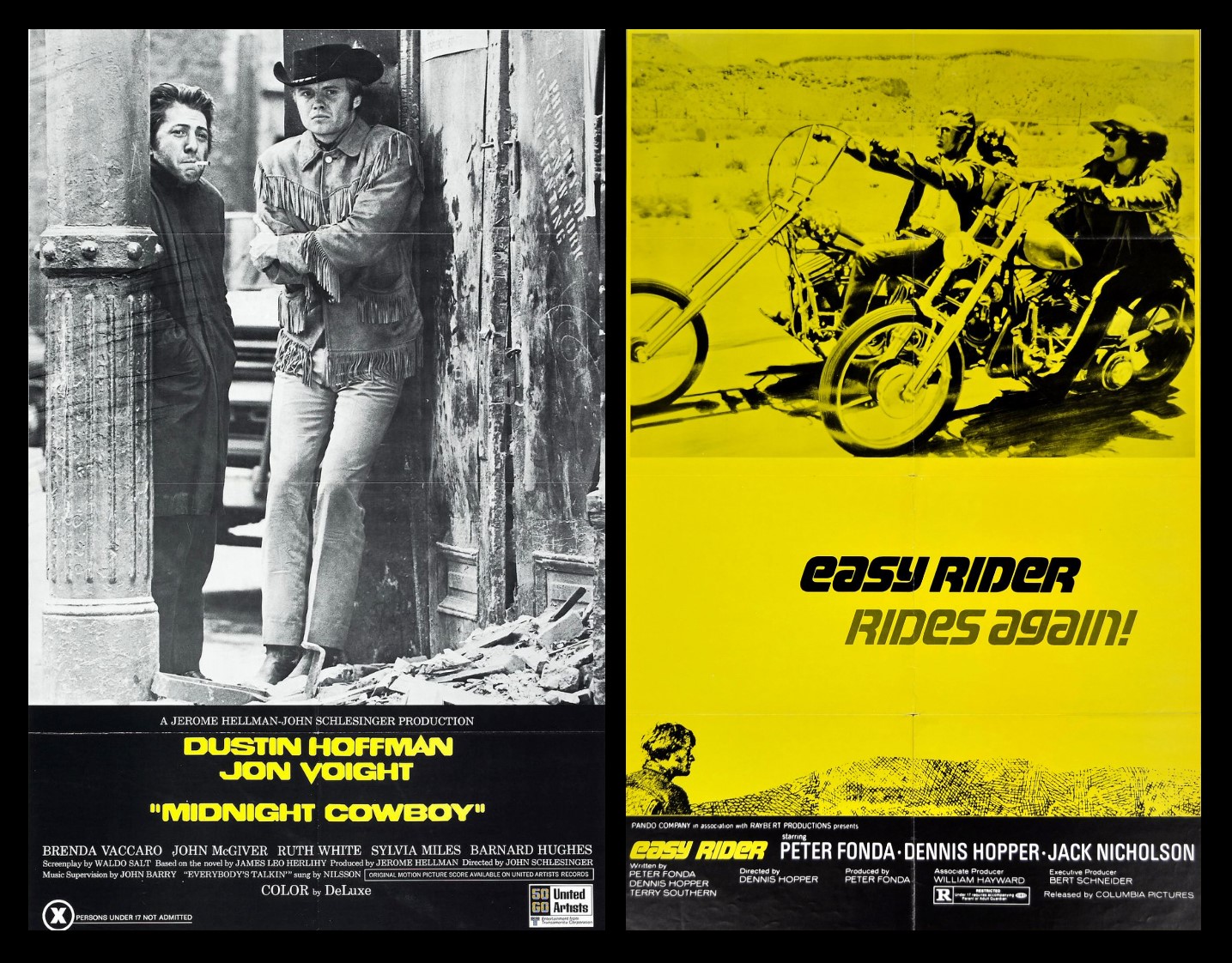
It wasn’t until 1969, with Midnight Cowboy and Easy Rider, that we began to see that notorious version of the 1960s. I remember how shocking both films were when I saw them at the theater. But by then, my personal sixties were closer to those films. But in 1966 and 1967, my life was still like the Bob Hope and Sandra Dee flicks.

Another way to look at it was Hollywood was censored for showing real life for many decades, and finally in the late 1960s changes in the laws allowed it to portray a more real America.

I’m not sure any film captures the times in which they were made. They all create a mythic view. But I need to think about that. Are there any films from the 1960s that come close to how I lived in that decade? Do you have a film, from any decade, that you feel represents something close to how you grew up? I was too young, but I do remember people like the characters in America Graffiti. Actually, I remember people like the Bob Hope and Sandra Dee characters too. Maybe it’s the characters and settings that feel more historical than plots.

JWH

On Rereading

by James Wallace Harris, 10/2/23

This week I started rereading Catch-22 by Joseph Heller, a novel first published in 1961. I was shocked by how much I disliked it. In my memory it was a terrific book. Back in 1970 I went to see Catch-22 the movie when it came out. I was so impressed I went to a bookstore, bought the book, went home, read it, and then went back to see the film again. For over fifty years I’ve thought of Catch-22 as a classic.

This week I listened to two hours of the novel before giving up. I can’t believe I ever loved that book. It’s sort of like how I feel when I catch Gilligan’s Island on TV, I can’t believe that in the eighth grade it was my favorite television show. Whenever I see a clip of Gilligan’s Island now, I assume I must have been brain damaged as a kid. I wondered the same thing when listening to Catch-22.

Maybe I’ve just lost my sense of humor. I loved Saturday Night Live when it came out back in 1975, but I’ve found it painful to watch for decades now. I’ve come to realize that I truly dislike lame satire. Heller appeared to take one absurdist point-of-view and stretched it out over a 21-hour audiobook. It felt like hearing a Who’s on First routine that never ended.

I came to the book expecting to find philosophical insight into WWII, and it just wasn’t there. Catch-22 is considered an anti-war classic, but I didn’t feel that in 2023. The film version of M.A.S.H. also came out in 1970. That was the height of the Vietnam War. Both stories felt like anti-war brilliance in 1970, but insane in 2023. Fifty-three years later, and after many other wars, such silliness no longer seems appropriate.

Obviously, I’ve changed over the decades, but I think there’s something else that’s changed. Postmodernism has crashed and burned. Postmodernism took us down a wrong path, and it’s time to retrace our steps.

I still reread my childhood favorite book, Have Space Suit-Will Travel which came out in 1958. It continues to work. It seems to be a genuine touchstone to my past. I find great insight into who I was as a kid and who I wanted to be when I grew up. To me, it was a science fiction version of Great Expectations — including the cynicism I give it in retrospect.

I also read an abridged version of Great Expectations in high school and have reread the full novel since. It seems to grow in maturity, especially as I read more about Charles Dickens. As a teenage boy I identified with Pip and his frustration with Estella. But as an old man, I figure Pip was a stand-in for the older 1858 Dickens, and Estella and Miss Havisham were stand-ins for Ellen Turan and her mother. The depth of Great Expectations grows with every rereading.

This morning I watched a video about rereading books by Anthony Vicino called “You Should Read These 12 Books Every Year.” Vicino is one of those people who want to get ahead in life quickly by reading self-help books. Because he wanted to succeed quickly, and many successful CEOs read fifty-two books a year, Vicino decided to read one hundred books in a year and get ahead twice as fast. What Vicino learned was to read fewer books. And rereading was the secret to success.

I’ve been thinking I need to do more rereading. This video made me wonder what twelve books I would reread every year. Would they be fiction or nonfiction? And would they be modern or postmodern? I’m starting to think we all took a wrong turn around 1960, at least in fiction. The trouble is since 1960 nonfiction has been overwhelming us with expanding knowledge that we need. Art and philosophy couldn’t handle that explosion of information and we got postmodernism.

I need to do a lot of rereading, and rethinking. What books will be ruined by my maturity and what books will reveal their own deeper maturity?

JWH

Have You Ever Wanted to Paint?

by James Wallace Harris, 9/27/23

I spend my days grazing on ideas. I listen to music, watch television or movies, read books, articles, or short stories, look at art books, browse the internet, read history, study popular science, and consume a lot of YouTube videos. All of it is about idea processing.

For breakfast, this morning I read “Painting of Hannah” by Lan Samantha Chang in the September 2023 issue of Harper’s Magazine. Follow the link if you want to read the story too.

“Painting of Hannah” is a short story about a young American, Jacob, studying art in France. Jacob stays at an atelier, apprentice to Thomas Gaugnot, a master painter who is trained in the naturalist technique, a student of Rennes, who was a student of Renoir, with a lineage all the back to Leonardo.

Gaugnot comes across like a Zen master, not saying much but tricking Jacob into seeing. Jacob must sacrifice both his ego and his desire for the beautiful artist’s model, Hannah, who he paints every day. Hannah, a young woman, lives with the older Gaugnot, and is Gaugnot’s muse. Gaugnot tells Jacob:

“They say my technique is obsolete,” Gaugnot said. “That is true. It is secret. It became a secret because no one cared. The attention of the world turned away from this kind of painting, what you call naturalism. You—­” His gaze pushed Jacob back; the chair creaked. “You are here to learn the techniques of this secret.” He smiled a small, triumphant smile. “You think it is romantic.”

We watch as Jacob learns to see. I’ve made a few lame attempts to learn to draw, but I’ve never stuck with it. I’ve even had some classes. I’ve learned with a few hours of work I can show some improvement, but I know becoming an artist takes years. That’s why I gave up, but that was lame of me.

I have several friends who are currently studying various kinds of painting. I admire them for not giving up. You don’t have to compete with John Singer Sargent to enjoy learning to draw and paint. You don’t have to move to France and study with a master for years. Ten thousand hours might make you a master, but thirty hours is enough to produce amazing results. Yet knowing that doesn’t allow me to apply myself at learning to draw. I hate that.

I wish I had that discipline because what I really want is to learn to see like an artist. That’s what the story hints at. That us ordinary folk are blind to most of the visual world. Gaugnot pushes Jacob into seeing what’s in front of the rest of us that we ignore.

The human eye can only see a tiny portion of the visual spectrum or hear a sliver of the audio spectrum. and there are other wavelengths of electromagnetic spectrum that are even beyond our senses. So, it’s a shame we don’t even make the most of what we can perceive.

Evidently, learning to paint means learning to see what we’ve never bothered to look at. I like that. I like that because that’s what I do all day long with my information grazing.

I feel reading and watching helps me discern finer shades of ideas, and learning to write is learning to paint with words. Writing these blogs is learning to see more into the spectrum of language.

But I wonder about Gaugnot and Jacob. They learn to put what they see on a canvas, but do we see what they saw when looking at their paintings? We might see beauty but without understanding the insight. And if I read something written by someone discerning something specific in the reality of ideas, can I discern it too by reading their writing? Or is it only telling me that I need to go look for myself?

There was something in this story, “Painting of Hannah” about Nietzsche that intrigued me. It was the concept of “Eternal return.” It hints at a Groundhog Day existence. That’s the thing about learning to discern all there is from the firehose of information we live with daily; it would take several lifetimes to learn how to perceive everything. Are we Bill Murray living the same life over and over? Are the Hindus right about reincarnation?

I don’t think I’m coming back, so I want to distinguish details as I can before I die, both visually and cognitively. I wonder if I shouldn’t study drawing again. Would the discipline I got from learning about light also apply to studying the perception of ideas?

All my life I’ve wished I had more self-discipline, but if a genie from a magic lamp offered me three wishes, what would be the downside if I asked for more discipline? There’s always a downside in those tales. Maybe I’ve already been granted that wish and I’m living the existence of eternal return.

Tonight, I might snack on “Painting of Hannah” again and reread the story before I go to bed. Reading short stories is like learning to paint, you must keep looking to see everything.

Tomorrow I will wake up and find something else to inspire me for the day. Jacob worked on the same painting daily for months. Is that the key? Maybe I should stay with one concept for months. Maybe the secret is not accumulating more information but studying the same information repeatedly.

JWH