Why Do My Cats Ignore Loud Music?

by James Wallace Harris, 5/20/24

My cats usually freak out over sounds. If the yard guys come and start mowing outside, they run and hide. If they hear a tiny noise, they will run around until they find it. But if I play my loud rock music, they don’t even wake up.

I worry my music will hurt their ears. At times, I’ve thrown them out of the room and shut the door to protect them, but then they beg to get in. They are very insistent, scratching furiously at the door until I open it. They want to sleep on me while I listen to rock music at 85 decibels.

I just read this report, and it says 120 decibels will damage their ears, and long exposures at 95 decibels will cause harm. I’ve read that I can safely listen to loud music at 85 decibels for eight hours, and at 88 decibels for four hours, and 91 decibels for 2 hours. Well, I listen one to two hours a day, and try to keep it under 85 decibels, although it sometimes peaks at 90. (I have an app on my phone that measures loudness.)

I guess we’re okay. But why do the cats just completely ignore my music? It doesn’t even faze them. Even when I first turn it on, or when a new song plays. They never jump or startle at the stereo.

How do your cats react to music?

Maybe my cats are like me. Music puts me into a meditative state, even kinetic rock music. So, we all rock-out to the tunes for an hour with our eyes closed.

If you’re curious what kind of music we listen to, here’s my standard playlist.

That’s Ozzy above and Lily below.

By the way, Ozzy and Lily don’t seem to have any musical preferences.

JWH

Science Blasts Past Science Fiction

by James Wallace Harris, May 14, 2024

Since the 1960s I’ve fantasized about writing a science fiction novel. Since the 1990s, I’ve fantasized about writing a science fiction novel about artificial intelligence. The likelihood of me ever writing this novel is nil, but I still imagine and refine it in my head. The trouble is, artificial intelligence has gotten real, making writing a novel about AI more difficult.

Yesterday OpenAI announced ChatGPT 4o. (That’s a little o – pronounced four oh.) If you haven’t seen any of the news stories or demoes, watch this video.

I first encountered the concept of artificial intelligent back in 1967 when I read The Moon is a Harsh Mistress by Robert A. Heinlein. That novel featured a sentient mainframe computer named Mike. He was my favorite character. Heinlein didn’t use the term AI. I wouldn’t encounter it for a few more years when I went to a two-year technical school to study computers. Along the way I read two other books that featured a sentient computer, When H.A.R.L.I.E. Was One (1972) by David Gerrold and Galatea 2.2 (1995) by Richard Powers. There were plenty of other novels and movies about intelligent computers, but these three were my favorites.

In other words, I’ve been waiting a long time for science to catch up with science fiction. It’s funny though, when reality finally caught up and surpassed fiction, it’s been kind of anticlimactic. Most AI science fiction today has more in common with 1960s science fiction than it does with 2020s computer science. I’m currently reading a 1983 story by Poul Anderson, “Vulcan’s Forge” that has a sentient computer, but not much different from Mike in Heinlein’s 1967 story, or the female AI in the 2013 film Her. It seems now that science fiction writers never pushed their imaginations enough.

ChatGPT 4o is way cooler than anything I’ve ever encountered in science fiction. For one thing, I’ve always assumed an AI computer would talk like a person, capable of holding only one conversation at a time. Real AIs now converse like real people, but with thousands, if not millions of people at once. Never imagined that. And ChatGPT 4o sounds like a real person. I’ve always assumed they would sound like a computer.

I also thought intelligent AIs would have to be sentient beings. Evidently, massive amounts of intelligence can still be unaware even while coming across like people. We’ve always assumed that the growth of intelligence paralleled the growth of consciousness. That might not be true. Of course, there are philosophers who claim that consciousness is an illusion. Maybe they were right. But where does that leave us?

Computer scientists are quick to point out that ChatGPT 4o isn’t real AGI (artificial general intelligence). Critics constantly point to the factual mistakes that even the best of current AIs make. The old Turing Test concept only required a human not to be able to tell the difference between a machine and human when communicating through a teletype. Humans make factual mistakes all the time. Both presidential candidates frequently misspeak, but we don’t accuse them of hallucinating. That’s the term computer scientists use when AIs make up shit. If we applied the same term to humans, humans hallucinate their asses off. I’m not sure the average person can tell the difference between a computer and a person anymore in a Turing test. And neither can we tell the difference between AI and AGI.

For many measurable areas of information, current AIs are far smarter than humans, and are getting smarter all the time. They may not be perfect at any single discipline, but they are far better than average at most subjects they are tested on. When computer scientists talk of AGI, I get the feeling they are expecting the machines to know absolutely all about everything. Haven’t they up the ante to AO (artificial omniscience)?

Here’s the thing. I always thought the world would go nuts when AI singularity happened. And it may have happened or may not. But that’s my point. I think it has happened and we’re just not smart enough to recognize it — yet.

People are embracing artificial intelligence in the same way they embraced smartphones and the internet. They just incorporate recent technology in whatever way they find useful or advantageous. They don’t philosophize about it. They might bitch they’re losing their jobs, but not because AI is a science fiction sense of wonder come true.

Why did talking computers evoke a sense of wonder in science fiction, but not in real life? How come I haven’t seen one person’s mind blown? Not even a, “Dang! I’m talking to a dang computer!” Instead, people are whining about AIs making math mistakes or getting dates wrong. Every human I know does that, so why not cut the machines some slack?

Why isn’t the current state of AI development a boom time for philosophers and science fiction writers? People treat ChatGPT 4o like an iPhone 15, just enother gadget. The only speculation seems to be when will we get ChatGPT 5 or the iPhone 16?

JWH

The Agony and Ecstasy of Working in the Yard

by James Wallace Harris, 4/25/24

My backyard is an example of entropy in action. Working in my yard is a never-ending battle between chaos and order. If I had my wish, I’d move to a retirement condominium so I wouldn’t have to worry about a yard, or any kind of house maintenance. However, with rising HOA fees, and private equity takeovers, that wish could turn bad, and we’d be homeless. I see our paid for house as our last bastion of security, so I want to hang onto this home as long as possible.

Regarding yardwork, I must choose between two options. Either I pay someone to do it, or I do it myself. I’m not keen on either option. I’ve known lots of folks who got into gardening as they got older, and they found enjoyment and exercise in the pursuit. Right now, I strongly dislike working in my yard. I wonder if I can change my spots. Since I find hiring people frustrating, I’m agonizing over choosing between two things I don’t want to do.

My front yard is mostly weeds and dirt. My friend Annie told me how she was seeding her lawn with mini clover and told me about all its advantages. So, I ordered a couple pounds of mini clover seeds from Amazon. It’s been fun seeing it come up, that is until the lawn guys mowed the lawn for the first time this year. I had texted them to raise the cutting height to three inches. They didn’t. My front lawn was sheared so close to the ground that nearly everything green is gone. That annoyed the crap out of me. Like they say, if you want something done….

The mini clover can be trained to grow just 3-4 inches high, so after a few mowings it will require no more mowing. If I really want that to happen, I need to buy a mower and mow the lawn myself. Unfortunately, I don’t have any place to keep a mower. So, I’d also need to buy a storage shed. And if I fire my yard guys, I’d also need to buy a blower, trimmer, and chainsaw. And if I got into landscaping, like I need to do, I’d also need to buy a wheelbarrow and other gardening tools. This is getting expensive and a commitment.

My friend Leigh Ann hired a yard planner. He produced a 24-page document advising her on how to beautifully landscape her yard. I’m thinking about hiring him too, but I want him to advise me to create a simple easy-to-maintain lawn. I don’t want a beautiful, landscaped yard, but a yard the neighbors won’t feel embarrassed to see in the neighborhood.

Our house used to be Susan’s parents’ house. We bought it after they died. They loved working in the yard, and it was nicely landscaped. We’ve neglected the yard for thirteen years, and the landscaping has gone wild. I want a new landscape design that’s easy to maintain.

I rationalize letting it go wild was good for the environment. Birds, insects, and little creatures love it. We even have a possum living out back. However, twice now the utility company has had to hire a crew to cut a path to the power pole during power outages. They don’t tell us to keep our yard clean, but they do give us dirty looks and act mighty unfriendly.

One reason I don’t work in the yard is I have spinal stenosis, and I can only do a limited amount of physical work before I’m in a lot of pain. But I do believe I could put in twenty minutes a day. Susan absolutely refuses to work in the yard.

I theorize I might eventually conquer the yard by working twenty minutes a day and it might even be good for me. Hell, it could even turn into a hobby I enjoy. That seems to happen with a lot of older folks I know. On the other hand, I might invest thousands of dollars and want to give up in a month.

I really would like to make the mini clover work in the front yard. I’ve kind of enjoyed working with it. I go out twice a day to see how it’s doing. It does take a lot of watering, but if I can get it established, the mini clover is supposed to fix nitrogen in the soil and be minimal in maintenance. That would give me a sense of accomplishment if I pulled it off.

Reversing the entropy in the backyard will be a full-scale battle. I’ll need some dangerous power tools to conquer the reemerging forest. I’ll feel bad about killing all those wild bushes and baby trees, especially if they’re sanctuary to wildlife. However, if I want a yard that’s a yard, I will have to do that.

I’m just not sure what to do. I’ve been trying to get away from all my screens and do something real, and yard work is very real. I just don’t know if I can handle it, either physically or mentally. My friend Janis’ father still works in the yard, and he just turned ninety-nine. I wonder if his longevity and vitality come from yard work.

JWH

Are You Bothered by Fiction Based on History Changing the Facts of History?

by James Wallace Harris, 4/22/24

I divide historical fiction into two types: fiction set in the past, and real history that’s been fictionalized. Susan and I just finished Manhunt, a seven-part limited TV series running on Apple TV+. Manhunt is about the hunt for John Wilkes Booth after he shot Abe Lincoln.

We both loved the show and I felt like I was learning a lot about history that I didn’t know. It made me want to know more.

Then I read “Manhunt Episode 7 Fact-Check: 9 Biggest True Story Changes & Inaccuracies” on Screen Rant. That site has posted over thirty articles about the series and real history, including articles on each episode and how they differed from the facts. Here’s some of the points they bring up:

  • Edwin Stanton did not do all the things portrayed in the show. He was not the detective hot on the trail that we saw in the show. Nor did his son help him. This was very disappointing to learn because the show makes a historical hero out of Stanton. I finished the show thinking Stanton was next to Lincoln in historical importance. Now I don’t know if that’s at all true. This bothered me a lot. Stanton did not track Booth south. Nor was Stanton’s asthma a major health issue during the time. And there is no evidence that Stanton ever suspected Johnson had any connection to the conspiracy.
  • Many of the details of the assassination differ from history, but historians don’t agree on what happened either. For example, it’s undecided if Booth broke his leg jumping onto the stage or during his getaway. Those kinds of nitpicky details don’t bother me in fiction; however, I wish shows would put a disclaimer at the end.
  • John Wilkes Booth didn’t escape Washington due to a fan on sentry duty. This happens in the show when Booth tries to cross a bridge after curfew and a sentry lets him pass because he’s famous. These kind of fictional changes to history I don’t care about, I can easily see them as dramatic speculation.
  • John Surratt never met up with David Herold or Samuel Mudd. This is deceiving. The show makes a case that Booth was part of a large conspiracy controlled by the highest levels of the Confederacy. Since the show itself is making a case, like a court case, this kind of false evidence is stacking the deck. I consider this as bad as intentional misinformation used on the internet for political gains.
  • The show thoroughly convicts Dr. Samuel Mudd as an active conspirator. I remember as a kid seeing a show that defended Mudd, claiming he was just a doctor following his professional oath. History is undecided about Mudd’s real role, but the show wasn’t.
  • The hidden room in The Surratt Boardinghouse didn’t exist. This bit of misinformation made me feel that Stanton was inventing the role of detective and pursuing evidence in a modern way.
  • The details of Oswell Swann were quite different. He didn’t know who Booth was, and when he found out later, told the Union soldiers.
  • Lincoln’s funeral train was not Eddie Stanton’s idea. I wondered about that when it happened in the show.
  • Mary Todd Lincoln never boarded her husband’s funeral train.
  • The show completely backs the idea that there was a big conspiracy behind Booth, but there’s no historical evidence to support it.
  • Lincoln never spoke to Stanton and Frederick Douglass together.
  • Evidently all the stuff about George Sanders, and his role in a conspiracy was made up by the show.
  • There is no evidence that Edwin Stanton ever traveled to Montreal.
  • Ciphers and codes were so popular during that time period that finding one with Booth was no proof he belonged to a conspiracy.
  • There’s no proof that Stanton ordered an assassination of Jefferson Davis.
  • Mary Simms left Samuel Mudd a year before Booth came through. She never met Booth. She never had a land grant. Nor did she have a significant role in the trial. Nor was the part with Louis Weichmann true either. And Mary Simms did not attend Howard University. Manhunt the TV shows makes her into a major character of history, and my second favorite character of the show.
  • Much of George Sanders’ role was made up, especially to promote the conspiracy theory.
  • Agent Lafayette Baker never led a raid on Wall Street, although Confederate sympathizers and supporters dominated Wall Street.
  • Edwin Booth was not at Lincoln’s wake.
  • Sanford Conover’s role was exaggerated and deceptive.
  • Stanton never met Sanders in his office.
  • John Wilkes Booth didn’t meet with Confederate soldiers.
  • The real Andrew Johnson was much worse than he was portrayed.
  • There is no evidence that Stanton questioned Jefferson Davis in his cell.
  • Conover’s “pet letter” never existed. This rang false in the show too, but it’s presented as a major piece of evidence that Jefferson was involved in the plot to kill Lincoln. This makes the show come across like Oliver Stone’s JFK.
  • The eighteen missing pages of Booth’s diary is a historical mystery. How they are portrayed in the show is fictional. The show led me to believe that Stanton saw something in the eighteen pages that proved there was no conspiracy, and he didn’t want that to come out. That’s damning both Stanton and the show. But that then, that might be the artistic way the show revealed its picture of history could be wrong.

All this information makes me wonder if I should have even watched Manhunt. It was very entertaining, and Susan and I looked forward to every episode. However, the show left me with the impression that Edwin Stanton was Lincoln’s closest confidant, who influenced Lincoln in a major way, and was the architect of Reconstruction. Now I’m left wondering if any of that was true.

I thought about reading Manhunt: The 12-Day Chase for Lincoln’s Killer by James L. Swanson, but now I wonder if it speculates in the same way that the television show does? I’m going to have to do some research before I buy it.

Ultimately, I feel the TV series gave me a false view of history, one that I would have assumed was true if I hadn’t read up on the show. On the other hand, Susan and I really enjoyed the show, and it’s extremely hard to find shows that we both like. We tend to like shows based on history. That’s an intersection of our interests, so I’d hate to give up on such shows.

Yet, it still bothers me. If television shows and movies that are based on history and real people aren’t essentially true to history, then they serve the same purpose as conspiracy theories, spreading misinformation. That troubles me.

I talked with my friend Mike about this, and he says it doesn’t bother him. He says he never expects fiction to be accurate or to teach him about history. I can’t help but feel historical fiction does leave me with the impression that I learned a bit of history. I can’t easily imagine that people who don’t read and study history feel that the history they get from fiction was the way it happened.

JWH

Why I Deleted Facebook and Twenty Other Apps from My iPhone

by James Wallace Harris, 4/21/24

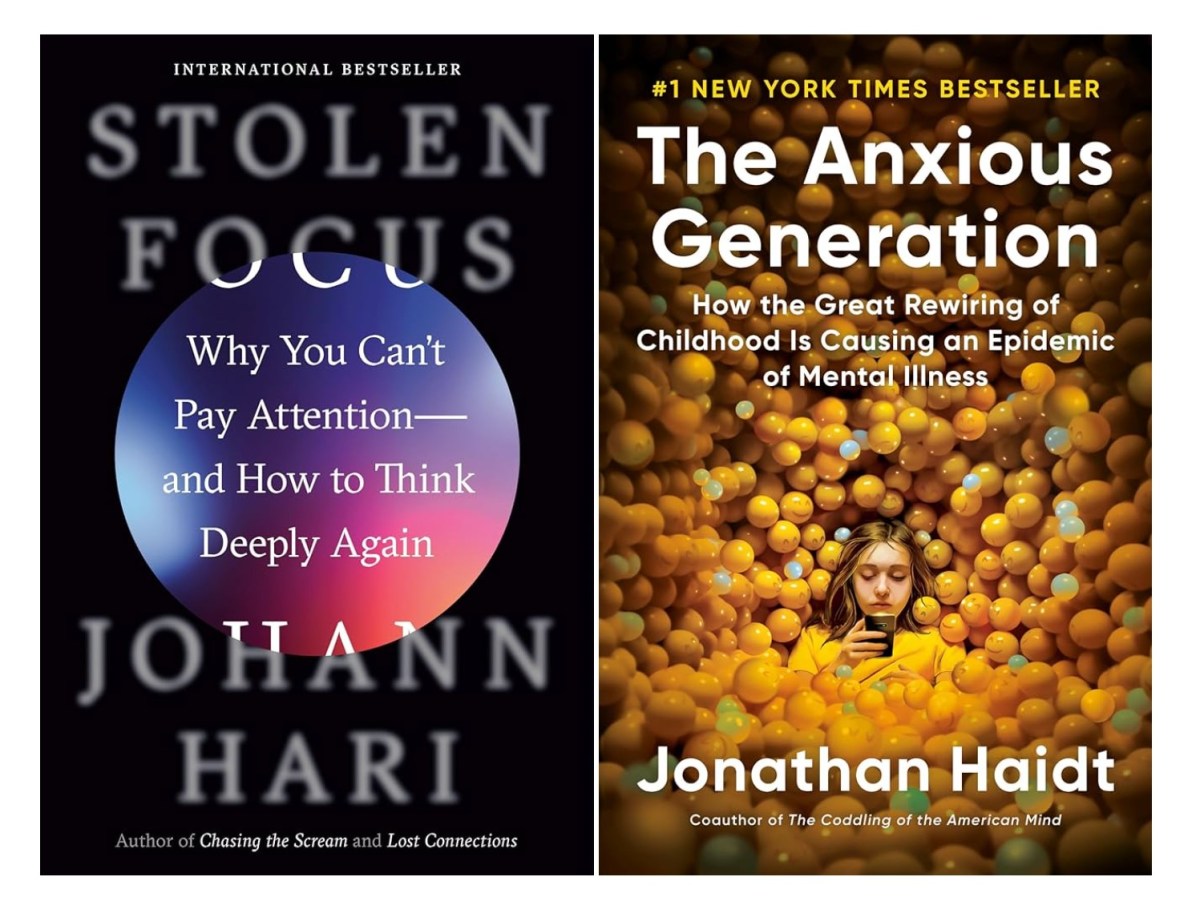
Lately, I’ve been encountering numerous warnings on the dangers of the internet and smartphones. Jonathan Haidt is promoting his new book The Anxious Generation. Even though it’s about how there’s increase mental illness in young girls using smartphones, I think it might tangentially apply to an old guy like me too.

Haidt was inspired to write his book because of reports about the sharp rise in mental illness in young people since 2010. That was just after the invention of the iPhone and the beginnings of social media apps. Recent studies show a correlation between the use of social media on smartphones and the increase reports of mental illness in young girls. I’m not part of Haidt’s anxious generation, but I do wonder if the internet, social media, and smartphones are affecting us old folks too.

Johann Hari’s book, Stolen Focus, is about losing our ability to pay attention, which does affect me. I know I have a focusing problem. I can’t apply myself like I used to. For years, I’ve been thinking it was because I was getting old. Now I wonder if it’s not the internet and smartphones. Give me an iPhone and a La-Z-Boy and I’m a happy geezer but not a productive one.

So, I’ve decided to test myself. I deleted Facebook and about twenty other apps from my iPhone. All the ones that keep me playing on my phone rather than doing something else. I didn’t quit Facebook, or other social media accounts, just deleted the apps off my phone. I figure if I need to use them, I’ll have to get my fat ass out of my La-Z-Boy and go sit upright at my desktop computer.

This little experiment has had an immediate impact — withdrawal symptoms. Without Facebook, YouTube, and all the other apps I kept playing with all day long, I sit in my La-Z-Boy thinking, “What can I do?” I rationalized that reading the news is good, but then I realized that I had way too many news apps. With some trepidation, I deleted The Washington Post, Ground News, Feedly, Reddit, Instapaper, and other apps, except for The New York Times and Apple News+.

I had already deleted Flipboard because it was one huge clickbait trap, but couldn’t that also be true of other news apps? They all demand our attention. When does keeping current turn into a news addiction? What is the minimum daily requirement of news to stay healthy and informed? What amount constitutes news obesity?

I keep picking up my iPhone wanting to do something with it, but there’s less and less to do. I kept The New York Times games app. I play Mini Crossword, Wordle, Connections, and Sudoku every morning. For now, I’m rationalizing that playing those games is exercise for my brain. They only take about 20-30 minutes total. And I can’t think of any non-computer alternatives.

I still use my iPhone for texting, phoning, music streaming, audiobooks, checking the weather, looking up facts, reading Kindle books, etc. The iPhone has become the greatest Swiss Army knife of useful tools ever invented. I don’t think I could ever give it up. Whenever the power goes out, Susan and I go through withdrawal anxiety. Sure, we miss electricity, heating, and cooling, but what we miss the most is streaming TV and the internet. We’ve experienced several three-day outages, and it bugs us more than I think it should.

One of the insights Jonathan Haidt provides is his story about asking groups of parents two questions?

  1. At what age were you allowed to go off alone unsupervised as a child?
  2. At what age did you let your children go off unsupervised?

The parents would generally say 5-7 for themselves, for 10-12 for their children. Kids today are overprotected, and smartphones let them retreat from the world even further. Which makes me ask: Am I retreating from the world when I use my smartphone or computer? Has the iPhone become like a helicopter parent that keeps me tied to its apron strings?

That’s a hard question to answer. Isn’t retiring a kind of retreat from the world? Doesn’t getting old make us pull back too? My sister offered a funny observation about life years ago, “We start off life in a bed in a room by ourselves with someone taking care of us, and we end up in bed in a room by ourselves with someone taking care of us.” Isn’t screen addiction only hurrying us towards that end? And will we die with our smartphones clutched tightly in our gnarled old fingers?

Is reading a hardback book any less real than reading the same book on my iPhone screen, or listening to it with earbuds and an iPhone? With the earbuds I can walk, work in the yard, or wash dishes while reading. Is reading The Atlantic from a printed magazine a superior experience than reading it on my iPhone with Apple News+?

Is looking at funny videos less of a life experience than playing with my cat or walking in the botanic gardens?

Haidt ends up advising parents to only allow children under sixteen to own a flip phone. He would prefer kids wait even longer to get a smartphone till they complete normal adolescent development, but he doesn’t think that will happen. I don’t think kids will ever go back to flip phones. The other day I noticed that one of the apps I had was recommended for age 4+ the App Store.

Are retired folks missing any kind of elder years of psychological development because we use smartphones? As a bookworm with a lifelong addiction to television and recorded music, how can I even know what a normal life would be like? I’m obviously not a hunter and gatherer human, or an agrarian human, or even a human adapted to industrialization. Is white collar work the new natural? Didn’t we live in nature too long ago for it to be natural anymore?

Aren’t we quickly adapting to a new hivemind way of living? Are the warnings pundits give about smartphones just identifying the side effects of evolving into a new human social structure? Is cyberization the new phase of humanity?

There were people who protested industrialization, but we didn’t reject it. Should we have? Now that there are people rejecting the hivemind, should we reject it too? Or jump in faster?

For days now I’ve been restless without my apps. I have been more active. I seeded my front lawn with mini clover and have been watering and watching it come in. I contracted to have our old bathtub replaced with a shower so it will be safer for Susan. I’ve been working with a bookseller to sell my old science fiction magazines. And I’ve been trying to walk more. However, I’ve yet to do the things I hoped to do when I decided to give up my apps.

It’s hard to tell the cause of doing less later in life. Is it aging? Is it endless distractions? Is it losing the discipline of work after retiring? Before giving up all my apps, I would recline in my La-Z-Boy and play on my iPhone regretting I wasn’t doing anything constructive. Now I sit in my La-Z-Boy doing nothing and wonder why I’m not doing anything constructive. I guess it’s taken a long time to get this lazy, so it might take just as long to overcome that laziness.

JWH