Democracy Awakening by Heather Cox Richardson – Review Part Two

by James Wallace Harris, 12/17/23

The idea of Donald Trump becoming president again has me worried. I’ve enjoyed the quiet years of the Biden administration, and I fear four years of a Trump president because it won’t be peaceful. I know I shouldn’t worry at my age because any kind of stress is hard on my health. I know I can’t control the future or even what’s happening now, but I’ve discovered that reading about the past alleviates some of my worries. America has always been at war with itself and the political strife we see now has always been the norm. Political peace never existed. Even when I think Biden’s administration has been quiet, that’s only relative to the Trump years. The volume of acrimonious political rhetoric has stayed quite high, just nowhere near as high as 2016-2020.

After I finished reading Democracy Awakening by Heather Cox Richardson, I began rereading it hoping to make sense of an overwhelming amount of information. Ultimately, I felt Democracy Awakening Richardson identified two forces seeking to define the political structure of America. Those two forces have always existed since the beginning of our nation, each fighting for dominance, with power swinging back and forth between two poles of human perception. My hopes of that conflict going away is a fantasy that I need to give up. That conflict might be as natural as kill or be killed is to animal evolution.

The political poles could be called conservative and liberal, or we could use political party names like Republican and Democrat, but one thing that Richardson shows is labels for politics have constantly changed over the history of our country. I constantly think if I could only understand why people believe what they do I could just accept them and let them be, even if I think they’re out of their minds.

I’ve started wondering if political views are connected to personality and upbringing. Richardson’s book gives an overview of the history of democracy in America that feels like a war between the two philosophies that divide us. First, are the Darwinians who believe power belongs to the fittest, and second are idealists who want complete democracy and universal suffrage. But I don’t feel these beliefs come from free will or logic. It’s something much deeper, as if we’re two different species.

Ever since growing up in the 1960s I can’t understand why we’re so polarized politically. What I believe offends half the country, while they passionately believe in what I think are delusions. In recent years I’ve concluded that each group perceives reality differently. It’s not a matter of evidence, or external truths, we just don’t perceive the world in the same way. We can’t convince each other of anything because we’re psychologically different. I’ve even wondered if there’s a physiological difference.

I read a science fiction story yesterday that might be the perfect metaphor for what I’m trying to say. It’s called “The First Men” by Howard Fast and you can read it online. Fast based his story on theoretical concepts about feral children, which is a controversial subject itself. Children raised without language seldom acquire it later in life. Children raised by animals never act human because what it means to be human is something acquired in childhood. In the story, Fast suggests that mutant superhuman children are born occasionally, but because they are raised human, they can never become superhuman. In the story, scientists track down orphans with very high IQs with a technique that can detect intelligence in babies. Those babies are raised in a controlled environment and grow up to be superhuman. I’ll let you read the ending.

What if back during the Renaissance a new kind of child began to show up and saw the world in a different way? At first, they were rare, and most of their special thinking was snuffed out by being raised by traditional believers. But slowly, some of them got a new upbringing, and raised a few more of their kind. So today, about forty percent of the population have this new kind of thinking. We might call this thinking liberalism. While the old thinkers call their perspective conservatism. The conservatives have a theocratic, autocratic, aristocratic, or oligarchic view of reality. While the new people think everyone should have equal say in politics and be given equal opportunity to achieve their full potential. This new way of thinking is anti-Darwinian, but then so is the Christianity of The Sermon on the Mount. And these two ways of perceiving reality are not based on logic, facts, or rhetoric, but a biologically programmed perception etched in early childhood upbringing.

We have a problem with words and labels. Richardson uses democracy vs. authoritarianism. The trouble is, both these terms have many definitions, used in different ways. Even saying Republican and Democrat, or conservative or liberal is very troubling. Republicans today are different from Ronald Reagan Republicans, or Nixon Republicans, or Eisenhower Republicans, or Teddy Roosevelt Republicans or Lincoln Republicans. Lincoln Republicans are more like current Democrats. The words conservative and liberal have gone through several different definitions and meanings.

Despite the problem with labeling these two forces in politics, I believe it’s important that we recognize what each force wants to achieve. There have always been people wanting to limit the running of the country to an elite group, while other people have wanted to move towards a democracy with universal suffrage.

You can see this back-and-forth battle by reading Wikipedia’s timeline of voting rights in the United States. Whatever 2024 brings, it will just be a continuation of this long process.

I believe political stress is caused by believing we need to decide issues once and for all by our personal perspectives. I think we’re stuck in a Groundhog Day loop that we can’t escape because everyone wants what they want and won’t be happy until they get what they want. It’s like being stuck in an endless programming loop without an exit condition. Because we’re polarized politically, half the country is always unhappy when the other half gets what their biological programming wants at the poll.

The failure has always been that each group thinks it can convince the other to change, and that’s just not going to happen.

The only escape I can see for this endless loop is to change a condition. One idea I’ve had, is require more than a simple majority to win elections or pass laws. I think we should raise it to 55% to start with, and eventually increase that over time, to 60% and 66%. We should force politicians to appeal to a wider audience, and we should pass laws with referendums. Of course, this won’t happen because the current power structure would never allow it.

I’ve decided to read more history books about the United States to see how changes were brought about. It’s soothing to my mind to understand how things got to be the way they are. It’s less stressful than wanting things to be different.

JWH
Democracy Awakening by Heather Cox Richardson – Review Part One

by James Wallace Harris

Americans have general thought of America as a democracy, although it’s never been a true democracy. When the United States of America was first created a limited number of white males could vote. As time progressed more white males were allowed to vote. As liberals and radicals influenced politics, they advocated for wider suffrage state by state. See this timeline for details, but the Fifteenth Amendment in 1870 gave black men the vote, and in 1920 the Nineteenth amendment was passed that gave women the vote in all states. Whites have always suppressed black voters, and even some men still resent women voting. And political parties have always tried to control who could vote and how, and even suppressing voting.

A true democracy would allow every citizen over a certain age to vote, or universal suffrage. Before the 21st century most Americans didn’t see that as a problem, but as ethnic demographics have changed it has turned some Americans against democracy.

America is supposed to have a representative democracy, but it inspired the formation of political parties supported by various special interest groups fighting for power. In America Awakening Heather Cox Richardson describes how we’ve reached the current state where liberals advocate more democracy and conservatives push for less, apparently wanting authoritarian rule instead. Authoritarians general promote some ideal in the past as the authority of how things should be govern. Most modern American authoritarians look to either the Founding Fathers and the Constitution or to God and The Bible, or a combination of both. Modern American authoritarian leaders tend to be white and paternalistic, and their followers tend to want a strong man, or strong father figure, although more women are wanting to be Republican leaders too.

Richardson says it’s important to understand that many terms like conservative, liberal, radical, Republican, and Democrat have changed over the centuries. In the 19th century Republicans were for African Americans voting, and for gun laws, and in the early 20th century, for regulations on corporations. In the 19th century and through the first half of the 20th century, Democrats tried to keep African Americans from having the vote. The Republican and Democratic parties went through a polarity change in the 1960s. Richardson says its important understand how words have changed meaning because authoritarians often abuse them and justify their abuse by claiming history supports their new definitions. In other words, history gets distorted and abused.

I’m reviewing Democracy Awakening because I think it’s an important book everyone should read for the 2024 U.S. presidential election, but also to push my ability to remember. I love reading nonfiction books, but their information often feels like it goes in one ear and out the other. I can only retain what I learn in the vaguest way. Since I’m also reading about memory and aging, I’ve decided to read Democracy Awakening differently. I’m going to distill what Richardson is saying into my own words but in some concise form that I hope I can remember. I’ll do that in a series of blog posts, outlines, tables, etc.

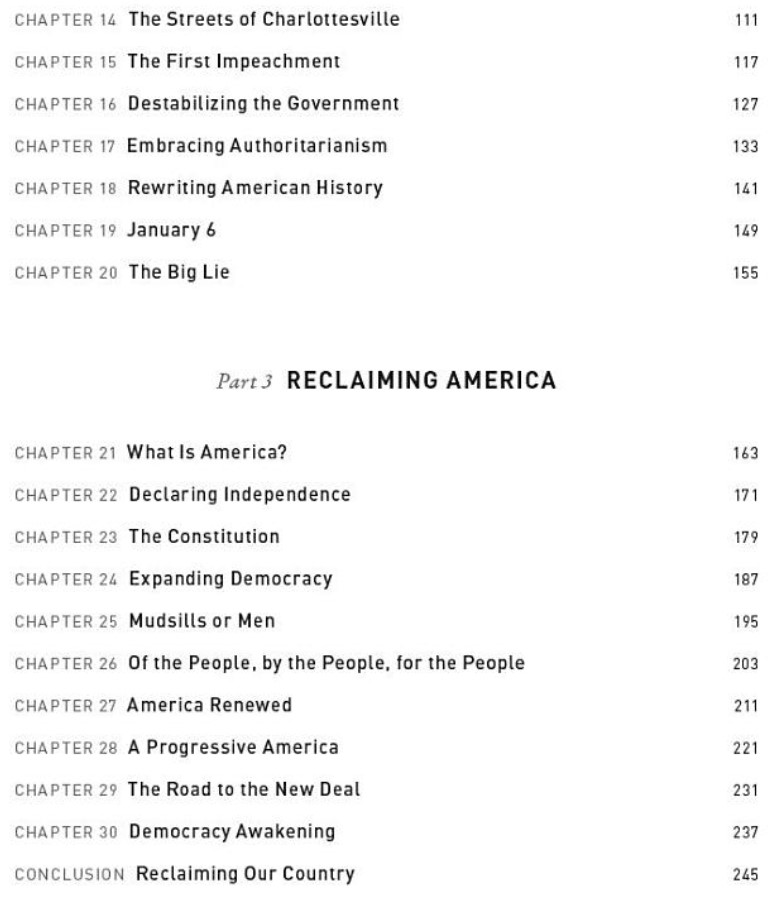
My friend Linda and I are reading Democracy Awakening together and for our first discussion we are covering Part 1, Chapters 1-10, which I hope to cover today. Here is the Table of Contents.

Because I’ve also read other books on this subject already, including watching related documentaries and YouTube videos, I’m going to reference them in this series to show how there’s a synergy in my reading.

Heather Cox Richardson is a history professor who has specialized on the history of the Republican Party through a series of books. I have not read these books, but I have read some about each and it gives me confidence that Richardson is an expert on this subject. On the internet there are zillions of people claiming to be knowledgable on specific subjects but when you check into their creditials, you find little to back their claim of authority.

Richardson makes her points by citing historical events. I wish I could remember all the cited dates and important changes in history because they show an evolution of how we got to today. The first ten chapters progress mostly in a linear fashion, so I hope to eventually create a timeline.

Richardson also quotes significant papers, speeches, books, and other sources to reveal how concepts emerged that cause people to seek political change. Just the history of African Americans seeking Civil Rights reveals many connections to how conservatives and liberals changed their parties and political goals. I’d like to make a list of the most significant quotes to remember. And I’d like to read the books Richardson references, including books by conservative writers. But this will take a lot of time.

And there’s another problem, both conservatives and liberals use the Founding Fathers as historical authority even though members of both political parties distort history for their cause. Republicans like to cite the past, both the Founding Fathers, and The Bible, as how to create or interpret laws. This is rediculous. 2023 isn’t 1776, or 800 BCE. Yet, reading Richardson’s book Democracy Awakening shows the democracy we have today is constantly changing, and how those changes comes from actions in the past.

It is well documented that Republicans feel the United States took a wrong turn in the 1930s when FDR’s administration created the New Deal. They’ve been trying to undo it ever since. And their methods and philosophy of why and how have evolved over the decades. Part of that evolution is moving away from democracy, which is what Richardson’s book is about.

Richardson believes we didn’t fall into fascism in the 1930s because the United States has a long history of various groups fighting for suffrage. That the history of United States is one of a ruling class struggling to keep power from various groups of people wanting to vote. This includes poor whites, African Americans, women, and immigrants. The current Republicans know they cannot win with universal suffrage and fair elections and so they have to do an end run around democracy.

Republicans formed coalitions with special interest groups that the leaders of the party have no interest in supporting. What has changed is the special interest groups have taken over the power from the old Republican elites. Neither the Republicans nor Democrats have a clear majority with voters, and depend on Independents who swing their votes.

The main problem revealed in the first part of Democracy Awakening is the country is dividing itself into two camps. Those who want an authoritarian government based on their version of the Founding Fathers and their version of Christianity, and those people who want universal suffrage and a true democracy.

The authoritarians cannot get what they want by existing voting laws and population demographics. That’s why they are undermining the election process. Since majority rule is 50%, these two groups are polarized. Neither Republicans or Democrats have a majority. They depend on swing votes from Independents.

What I’m hoping to see in the next two parts is whether or not Richardson thinks democracy can survive. I was recently terrified by a New York Times essay, “Trump Has a Master Plan for Destroying the ‘Deep State’” by Donald P. Moynihan. In it Moynihan says Trump has three goals which I’ll take out of context and quote here:

The first is to put Trump loyalists into appointment positions. Mr. Trump believed that “the resistance” to his presidency included his own appointees. Unlike in 2016, he now has a deep bench of loyalists. The Heritage Foundation and dozens of other Trump-aligned organizations are screening candidates to create 20,000 potential MAGA appointees. They will be placed in every agency across government, including the agencies responsible for protecting the environment, regulating workplace safety, collecting taxes, determining immigration policy, maintaining safety net programs, representing American interests overseas and ensuring the impartial rule of law.

...

The second part of the Trump plan is to terrify career civil servants into submission. To do so, he would reimpose an executive order that he signed but never implemented at the end of his first administration. The Schedule F order would allow him to convert many of these officials into political appointees.

Schedule F would be the most profound change to the civil service system since its creation in 1883. Presidents can currently fill about 4,000 political appointment positions at the federal level. This already makes the United States an outlier among similar democracies, in terms of the degree of politicization of the government. The authors of Schedule F have suggested it would be used to turn another 50,000 officials — with deep experience of how to run every major federal program we rely on — into appointees. Other Republican presidential candidates have also pledged to use Schedule F aggressively. Ron DeSantis, for example, promised that as president he would “start slitting throats on Day 1.”

...

The third part of Mr. Trump’s authoritarian blueprint is to create a legal framework that would allow him to use government resources to protect himself, attack his political enemies and force through his policy goals without congressional approval. Internal government lawyers can block illegal or unconstitutional actions. Reporters for The New York Times have uncovered a plan to place Trump loyalists in those key positions.

This is not about conservatism. Mr. Trump grew disillusioned with conservative Federalist Society lawyers, despite drawing on them to stock his judicial nominations. It is about finding lawyers willing to create a legal rationale for his authoritarian impulses. Examples from Mr. Trump’s time in office include Mark Paoletta, the former general counsel of the Office of Management and Budget, who approved Mr. Trump’s illegal withholding of aid to Ukraine. Or Jeffrey Clark, who almost became Mr. Trump’s acting attorney general when his superiors refused to advance Mr. Trump’s false claims of election fraud.

This is why I believe everyone should be reading Democracy Awakening. I believe Richardson’s book is defining what the 2024 election will truly mean at the deepest level.

JWH

Could Different Actors Make a Mediocre Film Great?

by James Wallace Harris, 11/28/23

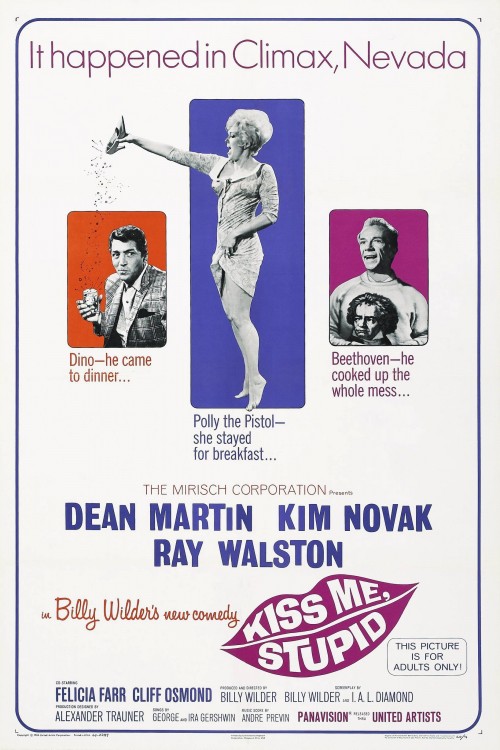
Billy Wilder has made many great movies, including seven films on the National Film Registry. So last night, when Susan and I started watching Kiss Me, Stupid (1964) we expected another hit. The show wasn’t a total dud, but it was one of the weirdest major motion pictures I’ve ever seen. It’s a sex comedy, and Wilder has a great reputation from two previous classic sex comedies, The Seven Year Itch (1955) and Some Like it Hot (1959). And if you think about it, Some Like It Hot is a very weird picture, but it worked despite its weirdness, and it gets more famous every year. Why hasn’t Kiss Me, Stupid? (Although, it might work with younger people for reasons I can’t fathom.)

There are many parallels between the careers of Billy Wilder and Alfred Hitchcock. One is young people are getting into the films of both directors today. And two, both directors fizzled out in the 1960s after a long career. There are other parallels, but for now I feel disappointed for Kiss Me, Stupid in a similar way I felt let down by Hitchcock’s Marnie, another 1964 film. Both films had many elements I liked, but they weren’t easy to watch. Both were too long.

To me, Wilder was obviously trying to have another sex comedy hit like Some Like It Hot because he originally hoped it would star Jack Lemmon and Marilyn Monroe. Both starred in that movie. Instead, he got Ray Walston and Kim Novak.

The story is about a piano teacher named Orville Spooner (Ray Walton) and gas station attendant Barney Millsap (Cliff Osmond) who dream of selling hit songs. They’ve composed 62 so far. So when Dino (Dean Martin) shows up at Barney’s gas station Barney quickly concocts a wild idea to get Dino to hear their songs. Barney sabotages Dino’s car and tells him he’ll have to stay over night. Dino asks where some action could be had, meaning where he could get laid. He tells both Barney and Orville that he gets terrible headaches if he doesn’t get sex once a day. Barney tells him to go to a dive called The Belly Button.

Dino then asks where’s a good place to stay and Barney says there isn’t any, but he should stay with Orville and his wife. When Barney gets the chance he tells Orville his plan. He wants Orville to get his wife out of the house, and they’d get a prostitute from The Belly Button to play Orville’s wife and seduce Dino. He’ll be so grateful for all their efforts he will sing one of their songs on his TV show.

Orville’s wife, Zelda, is played by Felicia Farr, who was Jack Lemmon’s wife at the time. The prostitute, Polly the Pistol is played by Kim Novak. And here’s one of the major problems of Kiss Me, Stupid. Even though Ray Walston does a good job playing Orville, the loser piano teacher, who is easily sent into rages of jealousy over his pretty wife, there’s no chemistry between him and Farr, or him and Novak. And Walston plays the role just how I imagined Jack Lemmon would have played it, he just doesn’t have the physical presence of Lemmon. Lemmon really would have been the perfect choice for the role or Orville.

Farr plays Zelda okay, but she doesn’t really charm us. I wondered if Zelda had been played by Shirley MacLaine, who had tremendous screen charm back then, could Kiss Me, Stupid have been another Billy Wilder classic. It makes you think about just how important the actor is in a hit, especially two actors in a romantic comedy. Lemmon and MacLaine had proven themselves in two other Wilder pictures, The Apartment (1960) and Irma la Douce (1963), although the second picture is no where near as good as the first. That shows that story counts for a lot too.

And since Kiss Me, Stupid becomes a three-way love story, the role of Polly the Pistol is also important. If Marilyn Monroe had lived, I don’t think she would have been right for the part. I thought Novak did a great job, and I think if she had the right onscreen chemistry with Jack Lemmon, it would have been perfect. Poor Ray Walston just wasn’t a romantic comedy lead. And even though he’s the main character, he only got third billing.

Dean Martin was fine playing himself, and his public persona that he uses in his acts fits the part, however, I always thought Martin was nicer than than the boozie character he created. And Martin never comes across as a horndog that the role needs. I wonder if Frank Sinatra or Bobby Darin wouldn’t have been better at acting the sex maniac. The part needed a big name singer who could act sleazy.

And last, I thought Barney should have been played by Jonathan Winters.

How much does on screen chemistry play in creating a hit movie? Watching Kiss Me, Stupid, it proves that it’s a great deal.

Kiss Me, Stupid was both stupid and boring in many places, but also oddly touching sometimes, and even funny in other places. We have to listen to a bunch of bad songs that are parodies of famous songs. They were funny sometimes, and painful at other times. The songs were written by Ira Gershwin pattern on George Gershwin’s melodies. They almost sound good, even the words, but it’s obvious they’re suppose to be bad too, even though they almost sound good.

Kiss Me, Stupid is available to watch for free on YouTube.

JWH

Are Computers Making It Too Easy for Us?

by James Wallace Harris, 11/24/23

Last night I watched two videos on YouTube that reviewed the Seestar S50 “smart telescope.” It’s an amazing $499 go-to telescope that does astrophotography automatically. It works in conjunction with your smartphone. You take the telescope outside and set it up level, then use your smartphone to tell it what astronomical object to photograph, and it does everything else. You can go back inside and monitor the Seestar S50 by smartphone.

But does it make astrophotography too easy? The reviewer mentions that question and says no. But I know if I bought the Seestar S50 I would play with it a couple of time and then leave it in a closet. (Unless I felt challenged to find ways to push the device to its limits.)

A couple of decades ago I wanted to get into digital astrophotography. I even bought a $60 how-to book. At the time, it was both too expensive and too difficult for me. The learning curve was extremely high. I had a 120mm cheap refractor that was fun to look through, but a bitch to carry around and set up. And it didn’t have the mount to handle photography. And except for the Moon, Venus, Mars, Jupiter, and Saturn, I needed to drive an hour out of town to the astronomy club’s viewing site to see deep sky stuff. I eventually gave my telescope to a lady who wanted to get into astronomy. I lost interest in what I could see with just by eyes. The next step was photography, and it was too big to take at the time.

After I retired and have gotten older, I’ve thought about getting another telescope, but a smaller one. After having hernia surgery, I don’t want to risk picking up heavy stuff. The Seestar S50 would be light enough, and cheap enough. And it takes better photographs than what I fantasized about doing twenty years ago.

Astronomy is a deceptive hobby. You see the great astrophotography in Sky & Telescope and think that’s what you’ll see when you look through a telescope. It’s not. Even with expensive scopes, deep sky objects are just patches of fuzzy gray blobs of lights in the eyepiece. Cameras, both film and digital gather greater amounts of light by making time exposures, sometimes hours long. What the Seestar S50 does is take a series of ten second exposures that build up the image over time. The longer you spend photographing an object the better it looks. Watch both videos to see what I mean.

What you see on your smartphone using the Seestar S50 is way more than what you see looking through an eyepiece. And real astronomers seldom look through eyepieces. However, is looking at your iPhone really what you want?

In this second film, we see how traditional digital astrophotography is done. It involves a lot of equipment and software. It’s a skill that takes time to master but look at the results. (Watch the entire video here but the results in the video below are stunning.)

The 80mm APO looks so good I can’t help but think the guy is fooling us with a photo from the Hubble telescope.

What is the goal here? To have a photograph of something in the sky you claim to have taken? The Seestar S50 will do that. But what did you do? Paid $499. Isn’t the real goal to learn how to take an astrophotograph by learning how it’s done? Doesn’t it also involve the desire to know how to find objects in the night sky? Isn’t what we really want is knowing how to do something, and do it well?

Computers are starting to do everything for us. And by adding AI, it will soon be possible to do a lot of complex tasks by just asking a computer. People now create beautiful digital art by assembling keywords into a prompt.

I know it’s impossible to turn back progress. I wouldn’t want to give up computers, but I’m not sure I want computers to do everything for me. Of course, everyone is different. Some people will be happy to have a computer do the entire job, while other people will take pleasure in doing something entirely by themselves. I don’t mind using a computer with word processing to write an essay, but I wouldn’t want the computer to write the essay for me.

I’m already seeing people give up their smartphones for dumb phones. I know people who have taken up drawing, painting, or water coloring by hand rather than use a computer art program.

I wonder if society will eventually reject computers. AI might push us over the limit. We could draw the limit at AI. Or we could draw the limit at an earlier stage of computer development. What if we gave up the internet too? Or set the clock back to 1983 before the Macintosh made graphical interfaces what everyone wanted. What if we limited computer technology to IBM AT personal computers, IBM 370 mainframes, and VAX 11 minicomputers? Humans had to work harder and know more to use that level of technology. But wasn’t using those old machines a lot more fun?

I don’t think we would turn off technological progress. I expect a Seestar S80 that does everything that guy could do with his $5000 computer for $399 in a few years and be even easier to use. And in ten years people will have robots with eyes like telescopes, and if you want a photography of M31, you’d just say to your robot, “Robbie, go take a picture of M31 for me.”

JWH

Do You Plan to Bequeath Any of Your Computer Files in Your Will?

by James Wallace Harris, 11/20/23

I currently have 71,882 files in Dropbox. Will anyone want any of those digital documents after I die?

Let’s say I go on a Döstädning rampage (Swedish death cleaning) of my digital possessions, would there be anything left that I’d want anyone to have?

Most people consider their photographs to be among their most cherished digital possessions. I have 5,368 of those — some of those photos go back to four generations in our families. Susan and I have no children. We made copies of those photos for our relatives one Christmas, although I’m not sure if any of those relatives wanted them. I imagine them groaning at their pile of digital junk growing larger.

Would a genealogical database want old photographs? I know people interested in their ancestry spend a lot of time looking for old documents online. I wonder if I have any photos, letters, or documents that would be of interest to people in the future researching their past?

I have 28,811 digital scans of old science fiction and pulp magazines that took me years to collect. Most of them are easily found online, so I doubt they will be wanted. But what if the Internet Archive servers were shut down for lack of funding? Will there be kids in the future wishing they had a complete run of Astounding Science Fiction? Or will that desire die with the generation that grew up reading the stories that were first published in that magazine?

There are certain documents relating to money that my wife will want, but she will prefer printed copies. When my mother died, and Susan’s folks died, I scanned a bunch of family documents. I haven’t looked at them in years, and Susan has never asked about them. Still, would they be of value to anyone? What will future historians want to know about ordinary people?

I wonder how long my blogs will exist after I die. I’ve known bloggers who have died, and I can still read their blog posts, but some of writers were published at online companies that went under. I know I used a couple of those sites, and I can’t even remember the names of the companies.

I have over a thousand Kindle books, and over a thousand Audible audiobooks in Amazon’s cloud. Is there any way for me to leave those libraries to other people?

And if no one in the future will want my digital files, do I need to hang onto them now? Why do I keep them? Why do I give Dropbox $119 a year? When I retired, I made copies of all the computer programs I wrote. I put them on several drives just to be sure. I put those drives in the closet. Several years later I went to check on them and every one of those hard drives was dead. I have a friend whose computer hard drive died recently. She had always backed everything up with Apple’s Time Machine. However, when she restored her files, many were corrupted. It’s hard to preserve digital files for a long time. Backup programs and online backup services aren’t 100% reliable.

When humanity stored our past on paper, some of it got saved. Not much, but some. I get the feeling that since we switched to storing stuff digitally, even less will survive. I have a handful of paper photographs that my great grandparents, grandparents, and parents took. So does Susan. I wonder who we should give them to?

Every day I spend a few minutes going around the house looking for things to throw away or give away. I need to start doing that with my computer files. I spent a lifetime gathering stuff, both physical stuff, and digital stuff. It’s funny now that I’m trying to reverse that progression of acquisitions.

I wonder when I was young if I had somehow known for sure that my older self would be getting rid of all the stuff I was buying back then, would I have bought so much stuff in the first place? How much stuff have I bought or saved because of FOMO (fear of missing out)? And how much did I really miss out?

JWH