Marie Kondoizing a 240GB SSD

by James Wallace Harris, Thursday, February 2, 2018

This is one of my essays where I think out loud trying to solve a problem. Sometimes this helps other people with the same problem, and sometimes I get comments with insights I didn’t imagine. It’s surprising how beneficial thinking by writing can be.

A few years ago I decided I wanted a minimal computer system, so I swapped out my big tower rig for an Intel NUC with a 240gb M.2 SSD (solid-state drive). This little computer is smaller than a Mac Mini, drives a 27″ 4k monitor, takes up very little desk space, and is very quiet. I’ve been happy as a cosplayer at ComicCon until yesterday when I noticed the red warning that my disk was almost full. I don’t even have a full 240GB because after formatting the drive is only 232GB. That’s my whole digital world.

Intel NUC


I could add an external drive, but that would ruin the elegance of having a small computer. I don’t have 232GB of user-generated data but I do use Dropbox for my main file system which I replicate with Second Copy to OneDrive. Both my Dropbox and OneDrive offer 1TB of space in the cloud, but my files are stored locally and backed up to the cloud. This means I have quicker access and automatic backups to two different cloud locations. I store around 50GB of data files on Dropbox, which when copied to OneDrive, makes up a total of 100GB on my SSD. With the OS, data I don’t back up, and programs on my C: drive brings the total to around 210GB.

Lately, I’ve been collecting scans of old pulp magazines from the web. Yesterday I got in 25GB of pulp-scans in CBZ format from a collection I bought on eBay. I wanted to add them to Dropbox, which means with replication to OneDrive, would add 50GBs to my system.

Astounding Stories020


My digital life just got bigger than my digital universe. So last night I spent the evening Marie Kondoizing my SSD. I uninstalled programs, cleaned out files, ran cleanup programs, and got my SSD down to 23GB free. I had hoped to build a folder on Dropbox called Pulps and eventually collect entire runs of all my favorite magazines.

I figured my ultimate pulp collection might run 200-300GB, which means after replicating to OneDrive I’d need 600GB. I could fork out $350 and upgrade my SSD to 1TB.

I then put on my Marie Kondo thinking cap and wondered:

  1. Do I need complete runs of all these old magazines?
  2. Do I need to back up all my digital content in quadruplicate?
  3. Could I upload the magazines to Dropbox and OneDrive without using my local SSD?
  4. If the magazines are readily available on the web, do I need to own and manage copies of my own?
  5. Since I have Dropbox on my Linux machine, and it replicates my Dropbox cloud to its local drive, do I really need OneDrive as a secondary backup?
  6. Will my digital universe legitimately grow enough over time to make it worthwhile to expand my digital universe to 1TB?
  7. Should I rely more on free cloud services like Flickr and Google?
  8. Should I upgrade my M.2 SSD to 1TB? (About $350)
  9. Should I go ahead an upgrade my whole computer? Maybe even make things simpler by getting an All-in-One computer with a 1TB drive. (Either Dell or iMac will approach $3,000)

To answer #1, it’s very cool to have the entire history of science fiction pulp fiction on Dropbox, where I can call up any issue I want on my iPad to read. But to be honest, it’s not that much trouble to find the issue online and just copy it to Dropbox as needed. Hell, it might even be possible to use my iPad to find the issue and read it directly without even saving it to Dropbox.

Number #2 is intriguing. If I simplified my backups I could reduce the amount of space needed on my SSD. I could even stop running the background copy program, freeing up other resources. This might be a way to have my cake and eat it too.

Number #3 offers some very interesting possibilities. I’d need to study how Dropbox and OneDrive work in greater detail. Can I store stuff on OneDrive that isn’t replicated to my SSD? I could unmap my OneDrive and only upload stuff to it via the web. But it would be nice to have part of it mapped locally so I could automatically back up essential files from Dropbox in real time.

Number #4 is the heart of the matter. A true Marie Kondo insight. I’m spending a lot of time and effort to collect something I might only use for 1% of its content or less. On the other hand, if collecting brings me true happiness, it’s not an issue. If The Pulp Magazine Archive became the perfect repository for old pulp magazines I wouldn’t need to collect. Why recreate a library when someone else is already doing all the work?

Number #5 is interesting but also complicates things. If I only relied on Dropbox for my backing up I’d have a copy of my files on my SSD, in the cloud, and another local copy on my Linux SSD. That’s pretty safe. But if my house burned down there would only be one copy, on Dropbox. Having all my files on Dropbox and OneDrive means if my house burns down and one of those companies has a catastrophic failure, I’d still have access to my files. Also, Dropbox on Linux doesn’t keep up that well with changes to Dropbox on Windows. Finally, I have a bad habit of reinstalling Linux whenever I want to play with a new distribution.

Number #6 brings up questions about my future and longevity.  If I excluded data I didn’t create like pulp scans, music, videos, audiobooks, etc., my digital universe would shrink dramatically. I could exist on the free space I earned from Dropbox and not even pay their $99/year fee.

Years ago I ripped my 1,700 CD collection. I kept multiple copies of 130GB of around 30,000 songs. I was always worried about losing it. Then Rhapsody, Rdio, Spotify came around and I got less and less worried. Awhile back I uploaded it all to Amazon and let all my local copies disappear one by one as drives died. I hardly ever go to Amazon to play that music. If there was a Spotify for old pulp magazines I wouldn’t even think about collecting them. I got rid of hundreds of CDs, but I’ve kept about 500. I sometimes wonder why I even keep them, or why I still buy CDs on rare occasions. I tell myself it’s because of the better fidelity, but I’m not sure if I can tell the difference anymore.

The odds are my digital universe will shrink over time, rather than expand.

#7 is something I should also consider. Why keep all my photographs on my SSD? And replicate them to my two paid cloud services when there are several free cloud services for photographs? Again, I couldn’t rely on just one company. If I’m going to trust cloud storage I need to always use two companies — especially if I’m going to abandon all local storage.

If I managed things correctly I don’t need to go to #8 or #9. Hell, I saw the other day where users can rent high-end graphics cards in the cloud for playing extreme video games so they don’t even need a powerful gaming computer locally. If that’s true, the future of computers will be moderate machines that just view data processed and stored in the cloud. It means we’d need less powerful CPUs, basic GPUs, less RAM, and less SSD space.

Still, should we rely on the cloud completely? If the internet goes down I can still work with all my files on Dropbox because they are replicated locally. Of course, I freak out when the internet goes down just like I do when the power goes out. I don’t want to live without either.

Have we moved to a wired world we can’t live without? Is there any need to own any work of art that could be digitized? Do we even need any local storage? I believe I have this urge to collect copies of old pulp magazines because back in the 1970s I actually collected the real issues and hated I could never afford all I wanted. I sold my collection because pulp magazines are all disintegrating. Pulp scans on the web are preserving these old magazines for the future. But do we really need more than one copy if everyone can access it on the web?

I think I’ve answered my questions. No to a bigger SSD drive. No to a new computer. I don’t need to collect pulps but I can without hardware upgrades, but I should assume my collection efforts will be invalidated by the web in the future. If I was a photographer or videographer, I’d need massive amounts of local storage, but writing fiction and nonfiction takes little hard drive space. I’ll keep this computer until it dies. My next computer will be an All-in-One because that’s even more minimalistic. I’m not sure I can break my pulp collecting habit, but it’s rather minor compared to collecting stuff in the real world.

JWH


What Writers Influenced Heinlein, Twain, Kerouac, PKD, and Alcott?

by James Wallace Harris, Monday, January 29, 2018

I need some help. I’m trying to find out what writers influenced Robert A. Heinlein, Mark Twain, Jack Kerouac, Philip K. Dick, and Louisa May Alcott. Bookworms love to talk about their favorite authors, but do we ever research our favorite writers’ writers? I especially want to know what they read before their first successful books.

5-authors

I believe much of my thinking was shaped by what I read. The five writers above are the authors I’ve read about the most. I’ve read many books about each of them. I don’t necessarily mean these are my favorite authors, but their lives have become compelling reading for me. I even wrote about these writers before in “The Ghosts That Haunt Me.” My poor memory has not retained exact details from their biographies. I do have some vague memories of what they read, but instead of spending a lot of time rereading those biographies I thought I’d post a query here. I assume some of y’all might know a lot about these writers.

The writer I remember best talking about the books that influenced him was Heinlein. He often mentioned H. G. Wells and James Branch Cabell. But then, Heinlein wrote a book Job: A Comedy of Justice (1984) which riffs off of Cabell’s Jurgen: A Comedy of Justice (1919). I also have to assume Heinlein loved Edgar Rice Burroughs and L. Frank Baum because of The Number of the Beast and his other “World as Myth” multiverse novels. Finally, I also have to assume Heinlein loved Jerome K. Jerome, because he includes references to Three Men in a Boat in my favorite Heinlein story, Have Space Suit-Will Travel. But this is a lot of assumptions. Does anyone know different about Heinlein? I have to wonder if Heinlein was influenced by Upton Sinclair or Ayn Rand.

Philip K. Dick is even harder. PKD was a voracious reader. My friend Mike found “List of Influences on Philip K. Dick” for me, but I’m not sure I trust it. The list cites quotes from Dick, but it seems like he’s putting on airs. I can believe A. E. van Vogt, because van Vogt was a major science fiction writer when Dick was growing up. And I might buy “The novels that influenced my writing when I was in my late teens and early twenties, were the French realistic novels…Flaubert, Stendahl, Balzac, et al…” because he mentions them more than once. And I can readily believe “I liked the short stories of James T. Farrell very much. They had a tremendous influence on me in the short story form” because of PKD’s short stories. He also said, “I was very very very influenced by Nathaniel West for a while…” which I can believe because I’ve read West. But why doesn’t he mention more science fiction writers since he wrote so much science fiction?  If you know more about what PKD read let me know.

I just can’t remember anything about Twain’s reading. Since he was born in 1835, his formative reading years would have been the late 1840s and 1850s. I know he skewered a lot of writers like James Fenimore Cooper. I don’t think Twain and Alcott liked each others’ work. We might assume Twain admired satirical writers like Swift, but I haven’t found anything to verify that. Alcott grew up knowing Emerson, Thoreau, and Hawthorne, but did they influence her? She loved the pulp fiction of her day.

I’ve read many biographies on Kerouac and I think I remember him liking Proust, Thomas Wolfe, and Louis-Ferdinand Céline. Again, I’m not sure. I can’t imagine Kerouac not being influenced by Ernest Hemingway and Joyce. Wasn’t the Beat Generation in reaction to the Lost Generation?

Searching Google for these answers is annoying. I have to constantly rephrase my query. When I finally asked: “What books did Jack Kerouac love to read?” I got Kerouac’s Top 40. But most of the other results were about the books Kerouac wrote. The same search didn’t work for the other writers.

I’m hoping this will reach fans of these writers and you might know what I want to know. Please leave a comment if you do. Thanks.

JWH

Free Will and Exercise

by James Wallace Harris, Sunday, January 28, 2018

I’ve always been doubtful about the concept of free will. As I’ve gotten older I’ve become a complete skeptic. If we had free will would anyone be fat? If we had free will would anyone be self-destructive? Maybe I lack free will and other people have it because some people always do the right thing. Or maybe, those people who succeed have other internal motivating factors pushing them. For example, it could be all those men and women who faithfully work out at the gym are compelled by relentless mating impulses and not free will.

I have found that pain is an effective but imperfect motivator. I have chronic back pain. I also have clogged arteries.  Both will nag me incessantly if I don’t eat and exercise properly. Chest pain and shortness of breath is a wonderful motivator, but I inconsistently obey its commands. Immobilizing back pain will also get my attention but I don’t always listen. In both cases, I do just enough to get those two nags off my case. Why don’t I do more?

The Thinker

If I truly had free will I’d exercise regularly and diet until I got down to a healthy weight. Intellectually I know making those choices could rid me of my pain burdens and even give me freedoms I haven’t had in years. So, why don’t I do what needs to be done? Obviously, a lack of free will.

Other folks might say its a lack of willpower, but I disagree. I say free will is where willpower should come from. Let me use an example.

I have spinal stenosis which causes numbness in my leg that can lead to back pain. I also have some bad discs in my lower spine that can cause dull back pain. And if I let both get out of hand I get tight muscles in my lower back that causes very sharp back pains. I can’t handle anti-inflammatory drugs or NSAIDs. If I eat a healthy diet I can keep my inflammation in check and reduce the numbness in my leg down. If I exercise and maintain a symmetrical posture for sitting and sleeping I can keep my discs happy. If I do both I don’t experience muscle pain. It’s like walking a tightrope.

My doctors have always told me my spinal stenosis would get worse but I’ve been able to keep it in check by faithfully following my diet, doing physical therapy exercises, and working out on my Bowflex machine. I’ve been doing this for years, and have kept the numbness and pain to a minimum. It never goes away completely, but I keep it at a level I consider okay.

Everyone once in a while I’ll rebel and skip a day or two of exercising. I just want to have a vacation from my routine. But it always costs me. If I vacation too long I pay severely where I’m laid up using heating pads and taking drugs that upset my stomach. Interrupting my routine starts a downward spiral and I have to fight hard to regain control.

Recently I took a vacation, lost control, and couldn’t get it back. I thought I’d finally reach the point where things would get worse like my doctors told me. That was depressing. I had to take drugs that totally tore up my stomach. At which point I had to stop taking the drugs. I figured I had to do something different. I remember I had started doing Miranda Esmonde-White exercises last year and they helped.

Here’s the thing. When I feel good I do less to help myself. If I had free will I would always know never to stop doing what’s good for me. I don’t decide to do right because of my willpower or free will, I do it because of pain. At least I respond to pain. I know people who don’t. They do nothing to help themselves and just suffer.

My current free will crisis is the knowledge that doing the Miranda Esmonde-White exercises is the best thing I’ve done for my back in years. In fact, for a few days, I felt no pain whatsoever. That was remarkable. Of course, the first thing I did when this happened was to start eating bad food and skipping my exercising. And the pain came back.

The Miranda Esmonde-White classical stretch exercises showed me that I had a lot of tight muscles I wasn’t stretching in my normal physical therapy exercises, and when I loosened them up my back felt wonderful. I could sit with my legs crossed. I could slouch while sitting. I could sit in chairs that usually hurt my back.

I’ve been doing episode 1003 (Season 10, third episode) “Spine Stretch for Posture” daily since January 1st – 28 days in a row. There are 29 other episodes in the Season 10 DVD set I bought. Intellectually, I know if I systematically did more Miranda Esmonde-White episodes I might get much better. Yet I can’t make myself try them. I’ve been faithfully doing episode 1003 every day because it keeps the pain at bay but I can’t push myself to do more. Why?

Free will is an iffy concept. But I think of it this way. I don’t believe in souls, but let’s use the concept of a soul as an illustration. Think of the body as an automobile and the soul as the driver. I would say free will is the ability of the soul to decide where to drive the car. I don’t believe in souls or free will because our conscious and unconscious minds are completely integrated into our bodies. They can’t be separated. My conscious mind is only a fraction of the whole. Evidently, my body and unconscious mind also want to drive.

If we had free will we’d have complete say over our body and unconscious mind. At least that’s my theory. Sometimes I think my conscious mind can trick the other two.

My body and unconscious mind don’t like eating healthy or exercising. They constantly try to con me to quit being good and doing what they want. But I’ve learned that I can fool them by repetition and conditioning. I’ve been able to muster up enough free will and willpower to make myself do episode 1003 every day this month. Sometimes its a struggle. I’ve discovered it helps to do it first thing in the morning. I just tell myself I can’t do anything fun until I do my Miranda exercises.

At first, it was really hard. My muscles were tight, I lacked the stamina. And the exercises seems confusing to my uncoordinated ways. I can’t dance because I can never remember the steps. So following Miranda always feels clumsy. Even after doing this routine 28 times I still struggle to remember the order of the exercises. This is another revelation about my lousy memory. At first, I thought it might be another sign of aging, but then I remembered I’ve never been able to remember song lyrics or melodies, even to songs I’ve heard a thousand times.

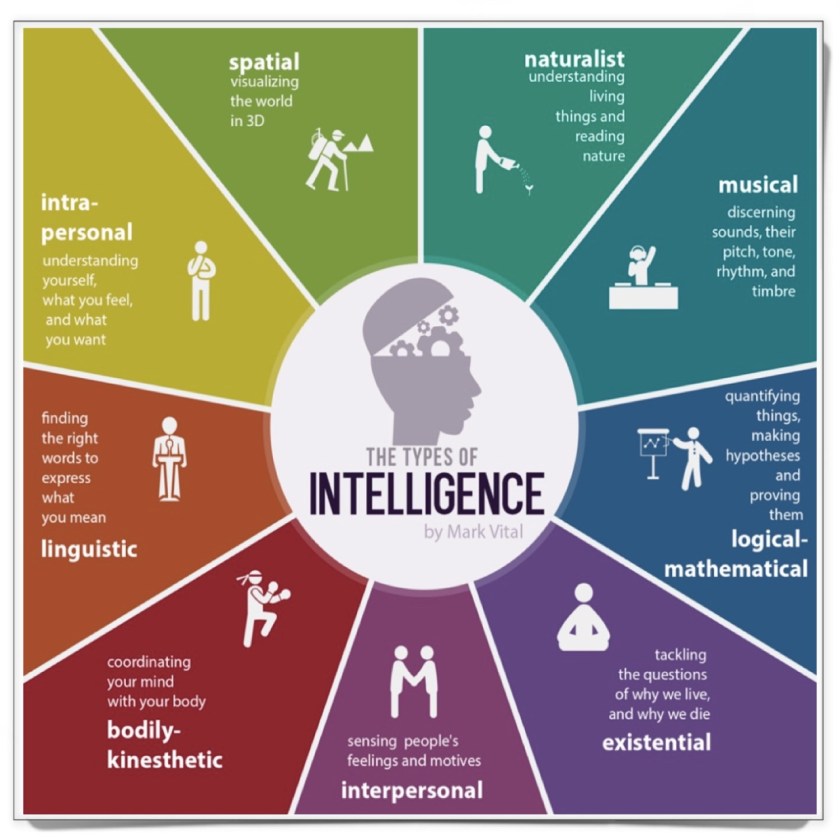
I’m reminded of Howard Gardner’s Theory of Multiple Intelligences. He started out with eight, but eventually added a ninth, but others have suggested even more mental abilities. Free will or lack of free will might be due to a combination of ability levels.

Types of multiple intelligences

My solution has been to relax and just go along with the DVD. Over 28 days I’ve gotten much better at following Miranda’s moves, and even learning routines I hated. And the routines I hated were always the ones I had the most trouble following. But persistence has paid off. I realize Miranda was right, stretching all my muscles helps do the routines and erases my chronic pains.

Now, you’d think learning this powerful lesson would allow my free will to decide to do the right thing every day. It doesn’t. It’s a constant struggle. I resent giving up those 23 minutes. My unconscious mind and body like total freedom to be lazy and wanton. They hate that my conscious mind is always wanting to do something that requires discipline. For my whole life, I’ve hated to put anything on my calendar. Even if it’s something fun and exciting like a great concert.

My conscious mind is trying to fight this though, to trick my unconscious mind and body. I keep thinking if I could only remember the Miranda Esmonde-White routines I could do them throughout the day during odd moments. They say sitting is this new smoking, so doing something every hour would be great for my overall health. And, I wouldn’t feel like I have to follow a set routine. The trouble is I can’t remember the routines. Oh, I can remember them in a haphazard way, but I really need to be organized and stretch every set of muscles through the day.

Part of the problem is I follow the routines visually and I have a very poor visual memory. I wish each routine had a name. I’ve thought about watching all 30 episodes and trying to create a total list of routines and give each a name to memorize. And then work to condition my unconscious mind and body to do a few routines each hour during the day. That might fool them I’m not having to dedicate myself to regular exercising period.

I’d love to give up having to exercise every morning before I can start my day. I hate losing an hour to a scheduled routine. I tell myself if I would stop once an hour and do a few minutes of stretching I’d end up exercising more and I might be able to give up the morning routine and even the Bowflex machine. Miranda claims her stretches is all the exercising an older person needs, and that might be true. I feel like I stand taller, have better posture, and have more strength in my arms.

Which brings us back to free will. If I had a choice this is what I want. (Well, what I really want is to eat anything I want, never exercise at all, and still be healthy.) If I had free will I should be able to say, “This is something that works and I’ve decided to do it.”

Getting old is a pain in the ass. Wearing out is a pain in the ass. I recognize I must work harder and harder to maintain my dwindling vitality and wellbeing is just how it’s going to be. I just wish I had the free will to do what I need to do without having to fight sloth and gluttony.

JWH


This Song is My Heroin

by James Wallace Harris, Friday, January 26, 2018

I’ll tell myself, “Just one more time,” when I hit the << button to re-play “Maggot Brain” by Lili Haydn. It’s already the sixth time. I know full well it might be another six times before I’ll actually start feeling like stopping. That’s close to the one hour mark. Sometimes the song paralyzes me for a couple hours. I haven’t been able to enjoy another song for weeks now.

Here are two versions you can listen to but they won’t sound the same as I hear them. I play this song while reclined in my La-Z-Boy in the middle of four tall floor standing Infinity speakers playing it at a volume that makes the vibrating air feel solid to the touch.

This is a live performance where you can watch Lili’s facial expressions. I wish I could feel what she feels. Is it the same as what I feel? If I could play this song maybe I could know, but that will never happen. I can’t even remember the melody.

I usually play her CD Place Between Places to hear her version of “Maggot Brain” in its highest fidelity. Sadly, this CD is out-of-print. I wish I had an SACD version to hear even more sampled bits. Here’s how the album version sounds from Spotify in case you’re a subscriber.

I don’t even know what her other songs and albums sound like. I can’t stop playing Haydn’s version of “Maggot Brain.”

I wish I could express in words what this song does to my mind. One of the best things about drugs was listening to music while high. I gave up drugs decades ago. But listening to Lily Haydn play “Maggot Brain” over and over again has a drug like intensity. Her high is emotional, philosophical, sad, wistful, aching, transcendental, longing, regretful, spiritual, thankful, and so many more existential settings.

What’s funny is I play this song for my friends and they don’t like it. Some even hate it. My wife tolerates me getting high on it for a few repetitions but eventually, it starts makes her want to run away. Only my friend Mike loves this song too. However, I don’t think he plays it over and over again like I do.

Ever since I got into music I’ve saught the songs that make me want to repeat them endlessly. It was a burden in the old days when I had to jump up every few minutes to reposition the tone arm on the record. CDs with remotes were a godsend for my habit. When I find a song I love I repeat it like one of those rats with a button that directly stimulated its own brain. I think some rats pushed their button till they died. I keep re-playing songs until the high wears off. I assume it depletes some kind of chemical in my brain.

The reason I can’t allow myself to do real drugs anymore is that I can’t make myself stop. I guess listening to music is my methadone or nicotine patch.

Peoples emotional levels very greatly. I’ve always been a rather reserved person emotional. I don’t get very excited or depressed. When I see people going nuts over a football game I wonder what the hell are they feeling. I never jump up and down and shout for anything. My guess is some pieces of music make me feel an intense joy that comes to other people in so many different ways.

And what’s weird is I’m not even sure I hear music in the same way other people do. I can’t remember melody or lyrics to a song no matter how many times I hear it. When “Maggot Brain” isn’t playing I have no memory of it other than a kind of withdrawal feeling.

When I was young I used to think everyone experienced the world the same. Over the years I’ve slowly realized that’s completely untrue. I now assume any taxonomy of mental states would be as varied as all the forms of mammals.

All I can say is I’m immensely grateful for this song and how it makes me feel.

Lili Haydn violinist

JWH

1939 – “I, Robot” by Eando Binder

by James Wallace Harris, Wednesday, January 24, 2018

When I reread “I, Robot” by Eando Binder today, a science fiction story from 1939, I wondered just how much Earl and Otto knew about robots, where did they get their knowledge, how much of their speculation was original with them, and how much did they borrow from earlier writers. I also wondered how wide-spread the concept of robots was in 1939, a term only coined in 1920. The concept of what would eventually be called a digital computer was first described by Alan Turing in a 1936 paper. I doubt the Binders had read it. Artificial intelligence wouldn’t become a concept until the 1950s. What kind of imaginative feat had these two brothers achieved writing a short story for a lowly pulp magazine?

Here is a nice graph from Google that shows how often the word robot was used over time. I wish I could track down all the science fiction stories that used it from 1923 when the English translation first appeared until “I, Robot” in 1939.

robot - eytomology

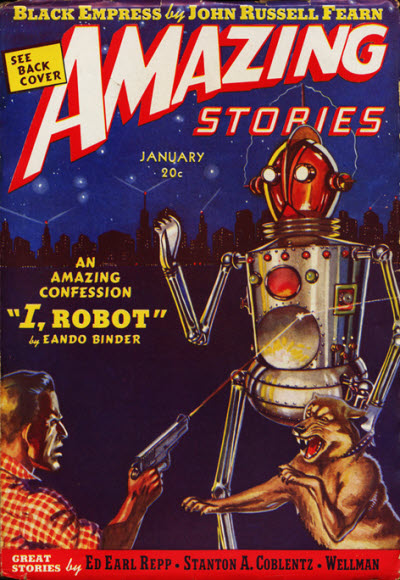
Eleven years before Isaac Asimov’s famous collection of robot stories, I, Robot, a short story appeared in the January 1939 issue of Amazing Stories called “I, Robot” by Eando Binder. Asimov admits his later robot stories were inspired by this one, and he had protested his editors naming his collection with the same name.

“I, Robot” is the first person narrative of a robot named Adam Link, and Amazing Stories would eventually run ten of his tales between 1939-1942. In 1965 Paperback Library came out with a fix-up novel based on many of these stories called Adam Link – Robot. Currently, this novel version is available from Wildside Press on Amazon as an ebook. However, if you’d like to read these stories as Amazing Stories presented them, they are available online as digital .pdf scans:

Amazing Stories 1939-01

The first two stories were combined and altered for a 1964 episode of The Outer Limits, and later that episode was remade for a 1995 episode of a revival series of The Outer Limits. Both shows featured Leonard Nemoy. In the 21st-century we’re becoming robot crazy, so it’s very hard to imagine a time when people didn’t know about the concept of robots. This 1939 story is a far cry from Ex Machina (2014) and Humans (2015- ) yet it dealt with the same themes those shows do. Until humanity has real self-aware robots to coexist with we really won’t know how we will react.

I’ve read “I, Robot” by Earl and Otto Binder (Eando) a couple times over the last century, and today, when I started Isaac Asimov Presents The Golden Years of Science Fiction (combining Isaac Asimov Presents the Great SF Stories 1 (1939) and Isaac Asimov Presents the Great SF Stories 2 (1940)) I wasn’t in the mood to read it again. Boy, am I glad I did. As my recent posts attest, I’ve been in the mood to read old science fiction short stories and I had bought all six of the Golden Years of SF series which contain the first 12 of the 25 of The Great SF Stories series (1939-1963).

[These six anthologies collect the twelve years of science fiction before I was born. I bought the combined double-deckers reprints because I can’t afford to collect the original 25 paperbacks edited by Isaac Asimov and Martin H Greenberg because they generally run $10-60 on ABEbooks and eBay. (Ouch!)]

Now that I’m rereading science fiction with a deconstructive mindset I realized immediately that “I, Robot” was a goldmine of a historical SF story. The Binders imagined a mechanical man with an electronic mind that could learn and was mentally much like a human. This was 1939 before the world knew about computing machines (the word computer back then meant a human job classification). Adam Link has television like eyes that see in shades of blue (like early TVs, well before color TV), and microphones for ears. The Binders imagine an artificial brain that has a perfect memory. Not only that, the Binders imagine a kind of machine learning phase for Adam Link. The bulk of the story worries about how humans will act when meeting a conscious, self-aware artificial being. “I, Robot” is modeled on Frankenstein, which is quite satisfying because Adam Link is a fictional descendant of Mary Shelley’s monster.

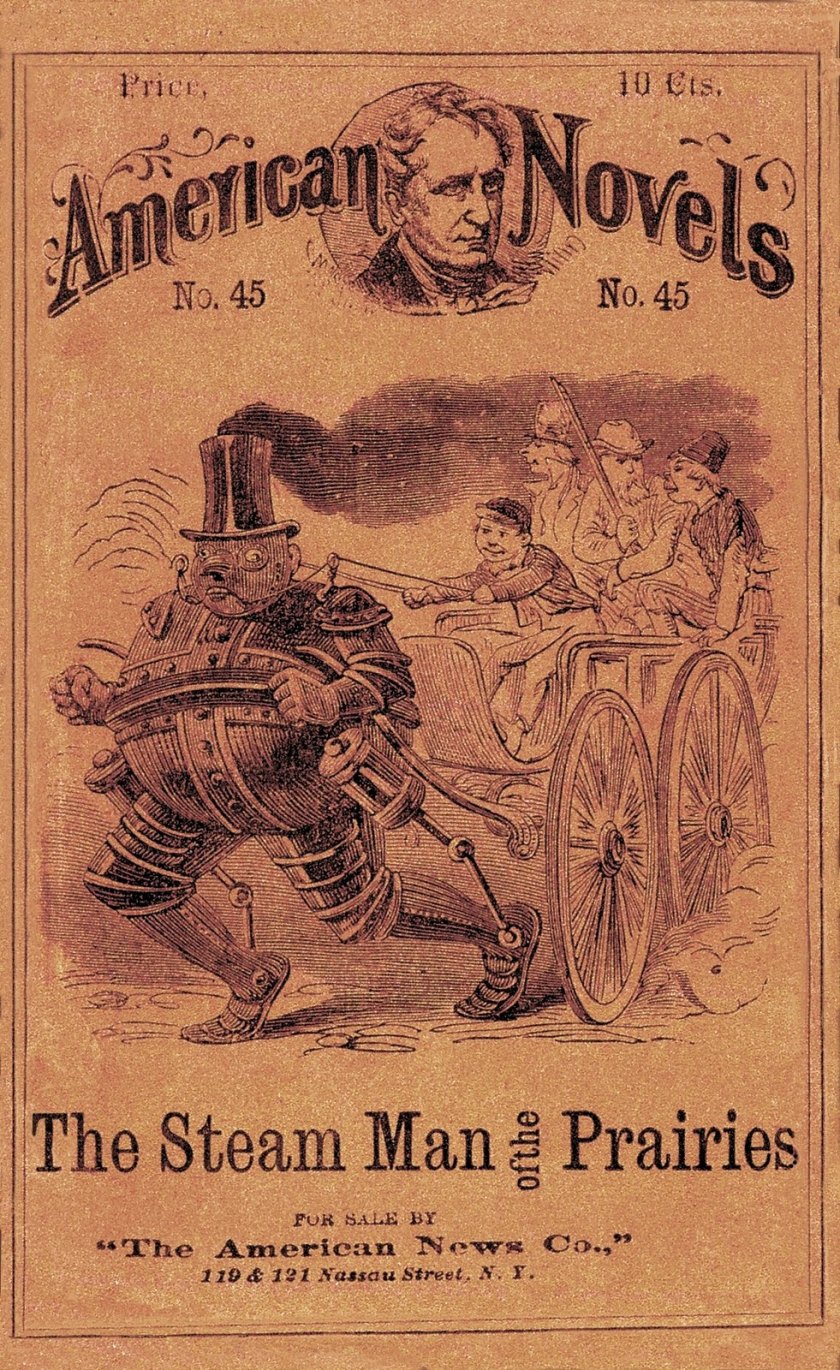
The term “robot” was first coined in the 1920 Czech play R.U.R. (Rossum’s Universal Robots), but the artificial creatures in that story were made from synthetic organic matter, more like replicants in Blade Runner. The history of robots is ancient, but they have mostly been magical automata and mechanical. In the 19th-century we had The Steam Man of the Prairies, which some say was the first science fiction dime novel in 1868.

The_steam_man_of_the_prairies_(1868)_big

The steam man was just an all-purpose versatile machine. I never read it, but my earliest memories as a kid include a robot, the Tin Woodman of Oz, that first appeared in the book The Wizard of Oz in 1900. I first encountered this robot-like-man in the 1939 film in the 1950s. The Tin Man was originally a human named Nick Chopper who kept losing body parts to an enchanted ax and having them replaced by a tinsmith.

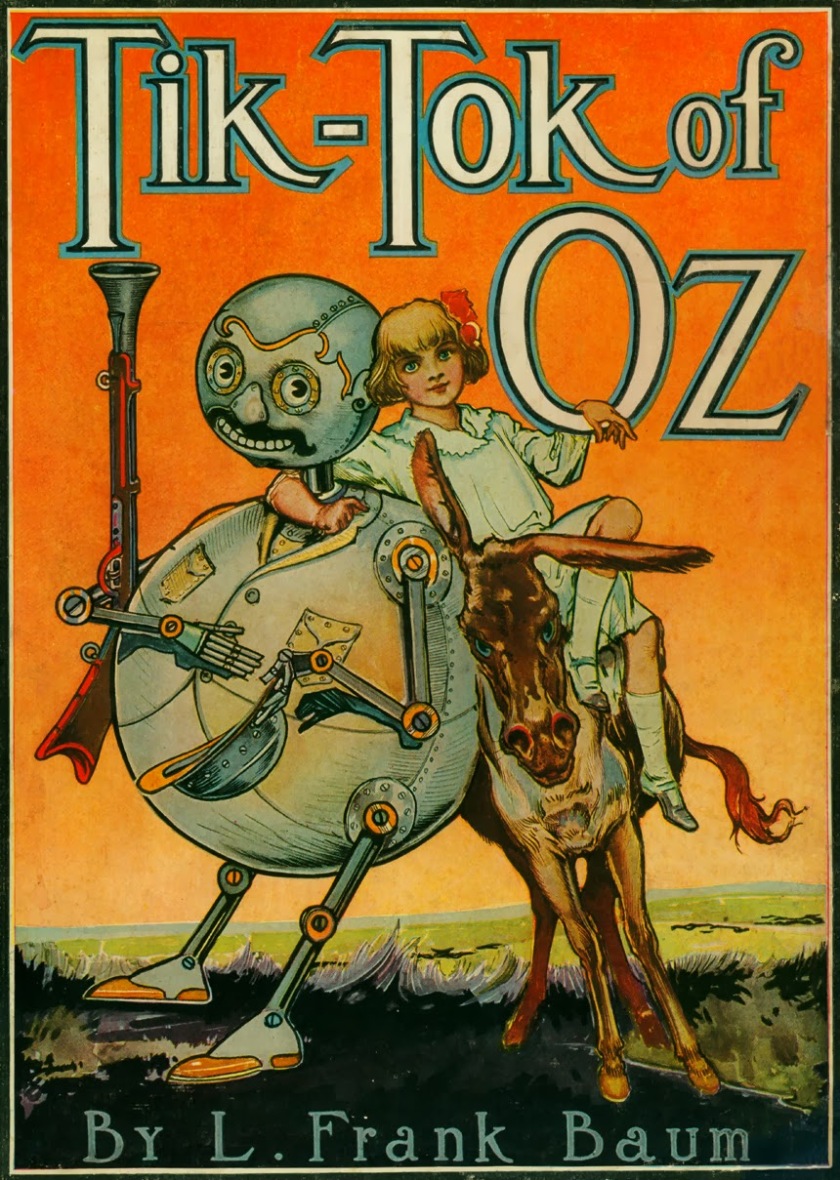
TikTokofOz_BookCover_lores

The next proto-robot I remember encountering was Tik-Tok, after discovering that The Wizard of Oz movie was based on a series of books. The Tik-Tok of Oz by L. Frank Baum was eighth in the series coming out in 1914, but I didn’t discover it until 1962 while in elementary school. Tik-Tok was a wind-up machine that could talk, but little was made of describing how he actually worked. Like talking animals in fantasy stories, talking machines were for fun and not genuine speculation about creating artificial intelligence.

Metropolis

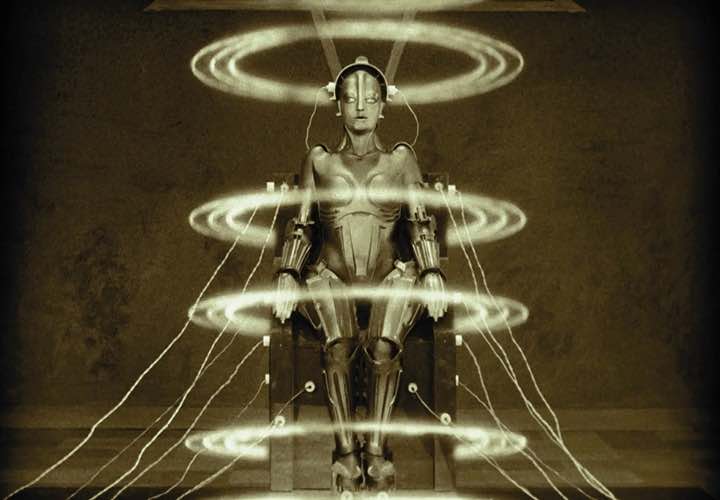
The next robot I know about that existed before “I, Robot” was from the 1927 German film Metropolis.  Like R.U.R., Metropolis is a social commentary on the working classes. I’m not sure Thea von Harbou was concerned philosophically with artificial intelligence, and I’m not sure where I can find out. Evidently, the concept of a robot was easily embraced by our society, even ones that could act human, but when did folks begin to think seriously how to create an artificial mind? (I’ve since found out the word robot isn’t used in the film, but the 1927 placards did list some actors as robots.

That’s what’s so fun about “I, Robot.” The Binders were putting everything into place. They theorized a metallic brain of “iridium-sponge” cells, not as fancy sounding as Asimov’s positronic brain but they did assume it would need to store information. The Binders made no hint of computer programming. I guess they assumed a being with senses would program itself through learning. The artificial thinking was still relegated to the magic happens kind of hand waving.

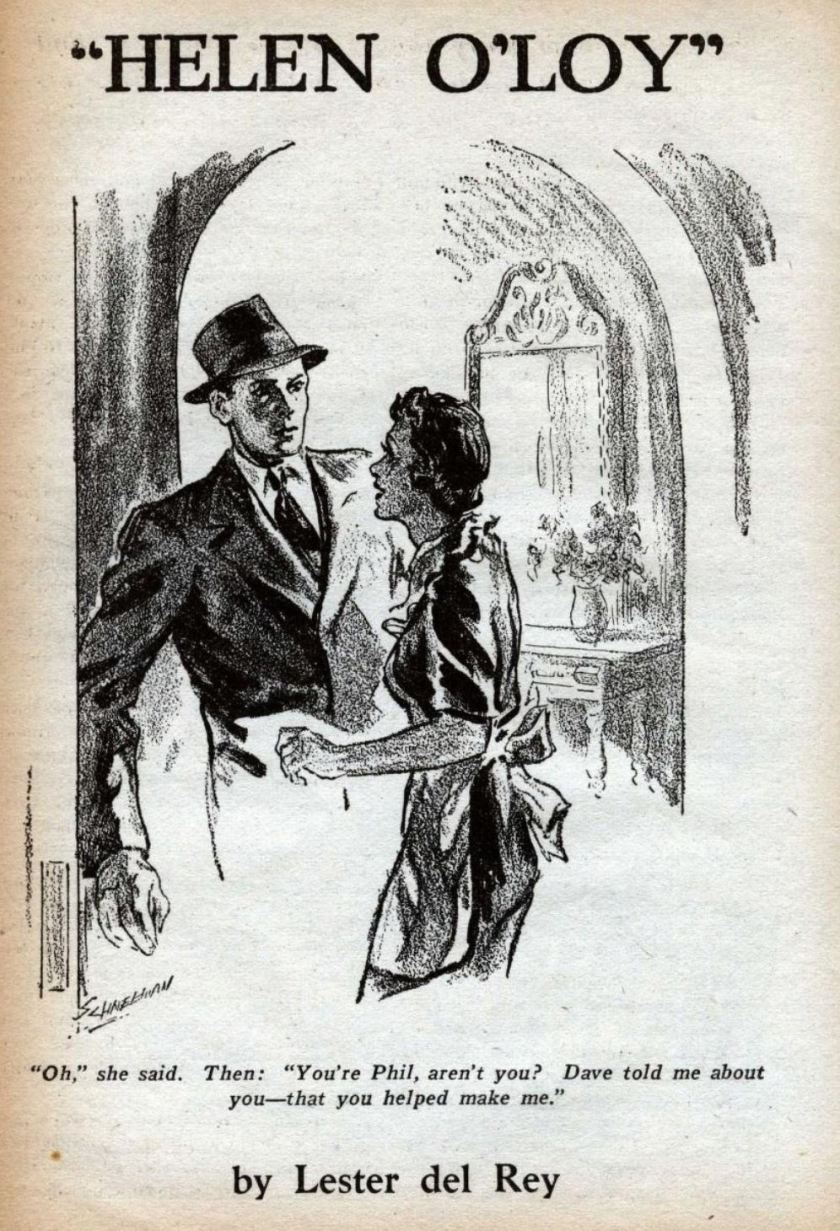
Helen O Loy by Lester del Rey

In 1938, “Helen O’Loy” by Lester del Rey came out in Astounding Science Fiction. I’m pretty sure the Binders could have read that one. I recently listened to that story, and it is another proto-AI tale. Two men who own a robot repair shop put together a robot woman they both fall in love with. Again, where did they get the word robot? How quickly did a Czech word from 1920 spread to America? Did Lester del Rey know of the story, “A Wife Manufactured to Order” from 1895? How do ideas spread? And is inventing an artificial wife something that just comes to guys. What story lays claim to inventing the sexbot?

Wikipedia has a wonderful list of fictional robots. It gives me several stories I need to track down to read. I’ve already read some of the Professor Jameson stories by Neil R. Jones from the early 1930s. His aliens had their minds transferred to mechanical bodies — not AI robots. I need to read The Metal Giants (1926) by Edmond Hamilton and Automata (1929) by S. Fowler Wright, both science fiction writers.

I’m going to assume the Binders were inspired by science fiction. Could there have been nonfiction books theorizing about robots before 1939? When does science fiction precede science and when does it follow? I’ve always assumed rockets for space travel and mechanical robots for artificial minds preceded science, but I could be wrong.

I did find An Anthropology of Robots and AI: Annihilation Anxiety and Machines by Kathleen Richardson that has a chapter on robots in fiction. It looks promising but is too expensive. Even the Kindle edition is $35.99.

Someone needs to write a book about robots like James Gleick did for time travel in his book Time Travel: A History. “I, Robot” is an amazing story in the evolution of ideas about robots. The Binders suggested an iridium-sponge for a brain. I suppose we can think of our current computers with a silicon sponge. They didn’t have enough information to guess about computers. Earlier stories only imagined robots having clockwork brains. The Binders speculations about a robot having to learn are also insightful.

Human-constructed creatures have been around a long time in our thoughts, and we’re getting very close to creating them. I think it’s fascinating to see how the idea evolved.

Recommended Reading


Updates

I’ve found some earlier citations in science fiction from The Encylopedia of Science Fiction.

JWH