Social Media Science Fiction

by James Wallace Harris, Friday, March 9, 2018

AFF_MarApr2018_400x570I’ve been reading the new March/April 2018 issue of Analog Science Fiction and Fact. I’ve found two stories we could call social media science fiction. I’ve read many other examples of this emerging sub-genre but can’t recall them at the moment. But I smell a trend.

Since I’ve been reading stories from Astounding Science Fiction, Analog’s previous title, from 50-80 years ago I can’t help but imagine what readers 50-80 years from now will think about these two stories.

The first story, “The Streaming Man” by Suzanne Palmer is about a fellow named Rohn who is an inventor of implantable medical monitors. For fun, Rohn programs these monitors to also play different musical instruments based on data from his body, so his body generates music and he puts that feed online. His unique compositions gather a large following of online listeners who become addicted to the music of his body. Rohn likes to interact with his followers via something like Twitter. His followers try to guess what Rohn is doing based on the music he makes. The story itself has other characters and complications but for us readers, this story tells us how creative the internet is and will be.

The second story, “Razzibot” by Rich Larson is about a fourteen-year-old girl, Marisol, receiving a Razzibot for her birthday. This device is a small AI driven drone that flies around Marisol filming her life for a live feed to the internet. Between Marisol’s need for followers, and the AI’s ability to always seek shots that flattery Marisol’s looks and appeal to the viewers’ voyeurism, the number of her followers grow and grow. Through the story, Marisol knows when she’s playing up to the camera, but also knows when she’s revealing too much of her personal life. The tale is about ego and technology.

These two stories are very engaging. Besides good writing, I assume their relevant topics would make them appealing reads to most people. Both of these stories feel very possible. In fact, the science might already exist to allow them to happen. The stories are so close to now I have to wonder if we should even call them science fiction. They could be considered contemporary social commentary. If a reader in 2068 reads them what will they think? I can easily imagine future readers believing these stories were realistic fiction about 2018.

That’s the thing. When I read technology and science news I often feel that I’m already living in a science fictional future. I also find it really hard to imagine the next fifty years experiencing as much change as I have in the last fifty years. It’s one thing for Dick Tracy comics to imagine a wrist phone back in 1946 that’s a lot like an Apple smartwatch, but it’s a whole other thing for us to imagine what people will be using in 2090. All the easy to imagine inventions have been fictionally invented.

That makes it hard for science fiction writers. Coming up with the idea of making music from monitoring bodily functions is clever. Thinking up an always-on selfie robot is good too, but less original. They already have drone selfie cams on the market. Building in the AI to make users internet interesting is not such a stretch. SF writers probably have a hard time keeping up with real science and technology.

Dick Tracy’s two-way wrist radios go back 72 years. It wasn’t called a phone. His creator didn’t imagine cell phones. Portable two-radios were already getting smaller back then, so it wasn’t a big leap to imagine one on the wrist. We’d be far more impressed if Chester Gould had imagined a cellular phone system or a computer network.

Science fiction often imagines too much, thinking up magical inventions, like teleporters, brain downloading, holodecks, or spaceships that can make interstellar flights in a few hours. We know computer chips are getting smaller, but should we expect smartphones to get smaller too? They were, but then they got larger. There’s a practical limit to what’s useful to hold. I figure most people want to over-imagine things and suggest people in 2090 will have smartphones built into their heads, and thus providing techno-telepathy.

I find Blu-tooth headsets annoying to wear and use, and I don’t see many people sporting them like years ago. And if you’ve ever talked to Alexa or Siri you know that there are limitations in doing things verbally. I suppose we could wear necklaces that are phones which operate by voice commands and have auxiliary tablet screens for reading. But I find hearing people talk on their cellphones annoying, so picturing a world where everyone looks like they are talking to themselves and not holding anything will be even more aggravating. The other day I saw a man walking down the street shouting angrily. I told myself, “I hope he’s on a phone.”

There are countless implications to everyone having a smartphone, especially one tied to our physiology. What happens to privacy? What happens to crime when everyone’s location can be tracked in great detail? There are endless stories there, but what happens to the old-fashioned mystery novel? We’d always know who-did-it. Have you ever noticed how many classic movies would have had their plots invalidated if the characters had cell phones?

Both “The Streaming Man” and “Razzibot” assume technology will make certain individuals more interesting than others. But if everyone has the same technology will that be true? Marisol is interesting because her friends don’t have a Razzibot. Rohn is interesting because he’s the only person making music with his body.

I’m wondering if technology will eventually even out and a return to privacy will become compelling. Today I read “For Two Months, I Got My News From Print Newspapers. Here’s What I Learned” by Farhad Manjoo in The New York Times. Manjoo got better news by getting his news from slower news sources. I would think some science fiction writers might work on imagining a backlash to more technology.

I know I’m getting irritated by so many people calling me every day. Maybe we’ve become too accessible. Which is the driving force of the plot lines of these two short stories.

JWH

The Hardback Legacy of Astounding Science Fiction

by James Wallace Harris, Thursday, March 1, 2018

For the past few weeks, I’ve been reading and researching stories from the pulp magazine Astounding Science Fiction (1930-1960). I’m slowly learning its history, impact, and legacy. I never bought a new issue of Astounding at the newsstand. I did start buying Analog Science Fiction & Fact in the mid-sixties. That was Astounding’s new name starting in 1960. However, by then I was already reading stories from Astounding reprinted in old books I found in libraries and used bookstores.

From reading blogs and writing people on the internet I’m learning there are different generations of fans. The first generation, the G.I. generation, started reading Astounding in the 1930s and 1940s. This generation has mostly died off. The second generation, the Silent generation, bought Astounding in the 1940s and 1950s and bought the hardback reprints new in bookstores in the 1950s. If they are still alive they are well into their 70s, 80s, and 90s. The third generation, the Baby Boomers, never bought new copies of Astounding or the first edition hardbacks that reprinted Astounding but discovered its stories in anthologies and novels on dusty library shelves.

I’m meeting those Baby Boomers now online at Facebook, Yahoo! Groups, Goodreads, and other websites, who fondly remember discover the legacy of Astounding Science Fiction. As youngsters we grew up reading science fiction books for young adults by Robert A. Heinlein, Andre Norton, and those published in the Winston Science Fiction series and then stumbled onto the classic anthologies by Healy & McComas, Groff Conklin, Martin Greenberg, John W. Campbell, and then finding the novels from Gnome Press, Fantasy Press, Doubleday, Simon & Shuster, and Prime Press that reprinted the legendary serials from Astounding.

This all happened in the 1960s. I sometimes call it Baby Boomer science fiction, but that describes the readers and not what was read. The stories we loved originally appeared in Astounding Science Fiction in the 1930s, 1940s, and 1950s. The best its content was reprinted in hardback in the 1950s. By the time we found those volumes in the 1960s they were well read and worn. Some still had the classic dust jackets that make them expensive collector items today, but others were already rebound in hideous orange, tan, brown, and aqua colors that libraries used back then.

For the nostalgic thrill of it, I’ve decided to recall those first edition hardbacks. If I was rich and reckless with owning things, I’d collect them. However, I’m quite happy when I can find beautiful hi-resolution scans of the dust jackets just to trigger those remaining synapses that remember seeing them in my favorite libraries of childhood.

Links are to Wikipedia or whatever has the most useful and descriptive content about the book. Most of the dust jacket scans were nicked from the Internet Science Fiction Database, and I did almost all of my research at that invaluable site. I’m trying to find the highest resolution scans possible. If you know of better copies let me know. Of the anthologies and fix-up novels, I’ve worked to only remember volumes that mostly used content from Astounding Science Fiction.

I put in parenthesis the dates the tale originally ran in Astounding and the publisher. I’ve probably left out many famous titles, just let me know.

1946

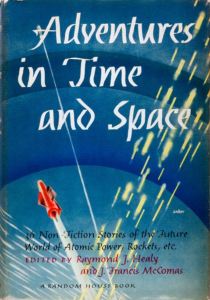
Adventures in Time and Space ed. Healy and McComas 1946 Random House

Adventures in Time and Space edited by Raymond J. Healy and J. Francis McComas

Slan by A. E. van Vog 1946 Arkham House

Slan by A. E. van Vogt – (Sep-Dec40) Arkham House

1947

The Legion of Space by Jack Williamson 1947 Fantasy Press

The Legon of Space by Jack Williamson – (Apr-Jul34) Fantasy Press

The Mightiest Machine by John W. Campbell 1947 Hadley

The Mightiest Machine by John W. Campbell (Dec34-Apr35) Hadley Publishing Co.

Venus Equilateral by George O. Smith 1947 Prime Press


Venus Equilateral by George O. Smith – (collection) Prime Press

The Weapon Makers by A. E. van Vogt 1947 Hadley Publishers

The Weapon Makers by A. E. van Vogt – (Feb-Apr43) Hadley Publishing

1948

... And Some Were Human by Lester del Rey 1948 Prime Press

… And Some Were Human by Lester del Rey – (collection) Prime Press

beyond-this-horizon

Beyond This Horizon by Robert A. Heinlein – (Apr-May42) Fantasy Press

Divide and Rule by L. Sprague de Camp 1948 Fantasy Press

Divide and Rule L. Sprage de Camp – (1939, 1941) Fantasy Press

Final Blackout by L. Ron Hubbard 1948 Hadley Publishing

Final Blackout by L. Ron Hubbard – (Apr-Jun40) Hadley Publishing

A Treasury of Science Fiction ed. Groff Conklin 1948 Crown

A Treasury of Science Fiction ed. Groff Conklin – (collection) Crown

Who Goes There by John W. Campbell 1948 Shasta. Campbell 1948 Shasta

Who Goes There? by John W. Campbell – (collection) Shasta

Without Sorcery by Theodore Sturgeon 1948 Prime Press

Without Sorcery by Theodore Sturgeon – (collection) Prime Press

The World of Null A by A. E. van Vogt 1948 Simon and Schuster

The World of Ā by A. E. van Vogt – (Aug-Oct45) Simon & Schuster

1949

The Humanoids by Jack Williamson 1948 Simon and Schuster

The Humanoids by Jack Williams – (Mar-May48) Simon & Schuster

Pattern of Conquest by George O. Smith

Pattern for Conquest by George O. Smith – (Mar-May46) Gnome Press

Sixth Column by Robert A. Heinlein 1949 Gnome Press

Sixth Column by Robert A. Heinlein – (Jan-Mar41) Gnome Press

The Skylark of Valeron by Edward E. Smith 1949 Fantasy Press

The Skylark of Valeron by Edward E. Smith – (Aug34-Feb35) Fantasy Press

1950

The Cometeers by Jack Williams 1950 Fantasy Press

The Cometeers by Jack Williamson – (May-July36, Apr-Jun39) Fantasy Press

Cosmic Engineers by Clifford D. Simak 1950 Gnome

Cosmic Engineers by Clifford Simak – (Feb-Apr39) Gnome Press

Fury by Henry Kuttner 1950 Grosset and Dunlap

Fury by Henry Kuttner and C. L. Moore – (May-Jul47) Grosset & Dunlap

Gather, Darkness! by Fritz Leiber 1950 Pellegrini and Cudahy

Gather, Darkness! by Fritz Leiber – (May-Jul43)

I Robot by Isaac Asimov 1950 Gnome Press

I, Robot by Isaac Asimov – (collection) Gnome Press

Needle by Hall Clement 1950 Doubleday

Needle by Hall Clement – (May-Jun50) Doubleday

Masters of Time by A. E. van Vogt 1950 Fantasy Press

Masters of Time by A. E. van Vogt – (fix-up) Fantasy Press

Men Against the Stars ed. Martin Greenberg 1950 Gnome Press

Men Against the Stars ed. Martin Greenberg – (anthology) Gnome Press

Nomad by George O. Smith 1950 Prime Press

Nomad by George O. Smith – (Dec44-Feb45) Prime Press

Seetee Shock by Jack Williamson 1950 Simon and Schuster

Seetee Shock by Jack Williamson – (Feb49-Apr49) Simon & Schuster

The Voyage of the Space Beagle by Jack Williamson 1950 Simon & Schuster

The Voyage of the Space Beagle by A. E. van Vogt – (fix-up) Simon & Schuster

Waldo and Magic Inc by Robert A. Heinlein 1950 Doubleday

Waldo and Magic, Inc. by Robert A. Heinlein (collection) Doubleday

1951

Dreadful Sanctuary by Eric Frank Russell Fantasy Press

Dreadful Sanctuary by Eric Frank Russell – (Jun-Aug48) Fantasy Press

Foundation by Isaac Asimov 1951 Fantasy Press

Foundation by Isaac Asimov – (fix-up) Gnome Press

Gray Lensman by Edward E. Smith 1951 Fantasy Press

Gray Lensman by Edward E. Smith – (Nov39-Jan40) Fantasy Press

Journey to Infinity ed. Martin Greenberg 1951 Gnome Press

Journey to Infinity ed. Martin Greenberg – (collection) Gnome Press

Renaissance by Raymond F. Jones 1951 Gnome Press

Renaissance by Raymond F. Jones – (Jul-Sep44) Gnome Press

SeeTee Ship by Jack Williamson 1951 Gnome Press

SeeTee Ship by Jack Williamson – (Jan-Feb43) Gnome Press

Tomorrow and Tomorrow and The Fairy Chessmen by L. Sprague de Camp 1951 Gnome Lewis Padgett

Tomorrow and Tomorrow and The Fairy Chessmen by Henry Kuttner and C. L. Moore (1946, 1947)

1952

The Astounding Science Fiction Anthology ed. John W. Campbell 1952 Simon & Schuster

The Astounding Science Fiction Anthology ed. John W. Campbell – (collection) Simon & Schuster

City by Clifford Simak 1952 Gnome Press

City by Clifford Simak – (fix-up) Gnome Press

Cloak of Aesir by John W. Campbell 1952 Shasta

Cloak of Aesir by John W. Campbell, Jr. – (collection) Shasta

The Current of Space by Isaac Asimov 1952 Doubleday

The Currents of Space by Isaac Asimov – (Oct-Dec52) Doubleday

Foundation and Empire by Isaac Asimov 1952 Gnome Press

Foundation and Empire by Isaac Asimov – (fix-up) Gnome Press

Judgment Night by C. L. Moore 1952 Gnome Press

Judgement Night by C. L. Moore – (collection) Gnome Press

The Legion of Time by Jack Williams 1952 Fantasy Press

The Legion of Time by Jack Williamson – (May-Jul38) Fantasy Press

The Red Peri by Stanley G. Weinbaum 1952 Fantasy Press

The Red Peri by Stanley G. Weinbaum – (collection) Fantasy Press

Robots Have No Tails by Lewis Padgett 1952 Gnome Press


Robots Have No Tails by Henry Kuttner – (fix-up) Gnome Press

1953

Assignment in Eternity by Robert A. Heinlein 1953 Fantasy Press

Assignment in Eternity by Robert A. Heinlein – (collection) Fantasy Press

Children of the Atom by Wilmar Shiras 1953 Gnome Press

Children of the Atom by Wilmar H. Shiras – (fix-up) Gnome Press

Iceworld by Hal Clement 1953 Gnome Press

Iceworld by Hal Clement – (Oct-Dec51) Gnome Press

Mutant by Lewis Padgett 1953 Gnome Press

Mutant by Henry Kuttner and C. L. Moore – (fix-up) Gnome Press

Revolt in 2100 by Robert A. Heinlein 1953 Shasta

Revolt in 2100 by Robert A. Heinlein – (Feb-Mar40) Shasta

Second Foundation by Isaac Asimov 1953 Gnome Press

Second Foundation by Isaac Asimov – (fix-up) Gnome Press

Second Stage Lensmen by Edward E. Smith 1953 Fantasy Press

Second Stage Lensman by Edward E. Smith – (Nov41-Feb42) Fantasy Press

1954

Children of the Lens by Edward E. Smith 1954 Fantasy Press

Children of the Lens by Edward E. Smith – (Nov47-Feb48) Fantasy Press

Three Thousand Years by Thomas Calvert McClary 1954 Fantasy Press

Three Thousand Years by Thomas Calvert McClary – (Apr38-Jun38) Fantasy Press

1956

Double Star by Robert A. Heinlein 1956 Doubleday

Double Star by Robert A. Heinlein – (Feb-Apr56) Doubleday

The Dragon in the Sea by Frank Herbert 1956 Doubleday

The Dragon in the Sea by Frank Herbert – (Under Pressure Nov55-Jan66) Doubleday

1957

The Naked Sun by Isaac Asimov 1957 Doubleday

The Naked Sun by Isaac Asimov – (Oct-Dec56) Doubleday

They'd Rather be Right by Clifton and Riley 1957 Gnome Press

They’d Rather Be Right by Mark Clifton and Frank Riley – (Aug-Nov54) Gnome Press

1958

Methuselah's Children by Robert A. Heinlein 1958 Gnome Press

Methuselah’s Children by Robert A. Heinlein – (Jul-Sep41) Gnome Press

1960

Agent of Vega by James H. Schmitz 1960 Gnome Press

Agent of Vega by James H. Schmitz – (fix-up) Gnome Press

1963

Orphans of the Sky by Robert A. Heinlein 1963 Putnum

Orphans of the Sky by Robert A. Heinlein – (fix-up from 1941) Putnam

1966

The Winged Man by A. E. van Vogt and E. Mayne Hull 1966 Doubleday

The Winged Man by A. E. van Vogt and E. Mayne Hull – (May-Jun44) Doubleday

JWH

Writing Goals at Age 66

by James Wallace Harris, Wednesday, February 21, 2018

Writing is focusing thoughts. Herding your thoughts into an essay reveals the chaos of thinking. When I was young I wanted to be a science fiction writer but that was not meant to be. Now that I’m retired writing is the hobby that keeps me sane. It’s vitally important to have at least one hobby when retired because the purposelessness of waiting to die can get existentially challenging.

fountain pen

Having goals in the last third of life can be tricky. The primary goal when aging is staying healthy. Working at maintaining health can be both time-consuming and energy draining. Any other ambitions depend on mental and physical vitality. Some days my batteries are so low all I can do is daydream and listen to music. But when I do have extra energy I want to make the most of it, and that means writing.

When I first retired in 2013 I had a long list of hobbies I wanted to pursue. I’ve since learned I can only get better at one skill. I can piddle around with many interests, but if I want to see actual progress requires focusing on what I know best. Because I’ve stuck with it, that’s writing. However, at 66 my writing ambitions are tiny compared to what huge dreams I had in my twenties. Anyone young reading this essay should heed this advice: Do it now.

I’ve written over 1,500 essays in the last ten years, and most of that was piano practice. I’ve improved but my progress has been slow. Theoretically, there are magnitudes of possible improvements left to achieve, but it all depends on my health. Realistically, I know I’m not going to start pounding out bestselling novels. I have to match my goals to my vitality.

For years, I’ve been content with blogging and writing for a few other websites. I’ve recently started a new series, “Reading the Pulps” at Worlds Without End that’s got me excited. On the other hand, my efforts for Book Riot have declined as I’ve realized my perspectives might not be suited for a site where the readers are so young and mostly female. For the last few months, I’ve struggled to find something to say that would appeal to that audience. That struggle has led me once again to think about my writing goals.

Writing for this blog is easy, maybe too easy, and not challenging enough. Writing for another site requires thinking about the audience. This blog allows me to write anything I want. I write to please myself. I’m happy if others want to read it, and I try hard to make it read-worthy, but its primary purpose is to let me think out loud while practicing my writing skills. My goal has always been to write at least two essays a week for this site.

When I write for another site I realize I have to write content that helps that site achieve its goals. Other websites build audiences to make money. Their readers want reading satisfaction or they won’t return. My job as a content provider is to be so useful that readers will remember and keep coming back.

Book Riot makes money by showing ads or getting readers to buy books from an Amazon affiliate link. It takes a lot of page hits to make money from ad views. It’s faster to make money from link sales. Thus, my essays need to be either very positive about books or about something that inspires many page views. I know how well I’m doing because I’m paid a portion of what the page makes. I’m not making that much, so Book Riot isn’t making that much off of me. One writing goal I’m considering is to write something more appealing to their audience. This has become hard, but I haven’t given up completely. I love the challenge. I contracted to write two essays a month for Book Riot but I’m not sure I can keep that up for a third year. It would help if I could find an ongoing gimmick or angle.

Worlds Without End is slightly different. Right now it’s mostly a database system for readers of science fiction, fantasy, and horror to find new books to read. WWEnd’s appeal is seeing how many books you’ve read on over fifty notable lists. It’s quite fun to use but users tend to come use the database for a while and not come back. The creators of WWEnd want to attract a community of fans that routinely participate in a growing list of new features. They want content contributors like me to help attract science fiction fans to that community. Like Book Riot, WWEnd’s audience is hardcore bookworms, but the age and gender demographics are wider. They do narrow reader interest to the science fiction, fantasy, and horror genres, and science fiction is my main interest.

Most people who write about books write about new books. I’m more interested in old books. That limits the appeal of my essays. Currently, I’m having a lot of fun writing about stories that came out of the pulp magazines in the 1930s and 1940s. I have no idea how many readers are interested in that topic. (It’s pretty damn narrow, don’t you think?) However, one of my sub-goals is to get better at writing about the details of history, even if its a very tiny slice of history. That involves a lot more research. Lucky for me, that research coincides with what I love reading at the moment. I’m actually quite anxious to write two essays a week for this project.

If you’ve mentally kept a tally, you know I’m committing myself to 4.5 essays a week. I can actually do that if my health holds up. On bad weeks I’ll be behind 4.5 essays. However, I have two more goals. I want to try writing fiction again. Just short stories, but even that is probably way too ambitious. I have thousands of hours of momentum behind essay writing, but except for thirty unpublished short stories and two novel attempts from about twenty years ago, I have little experience writing fiction.

Writing fiction might always be a pipedream for me. However, I’m mostly reading short stories these days and that’s making me want to try writing one too. I think this goal goes beyond the limits of health. I’m finding it extremely difficult to start a new discipline as I get older. I feel like a fish in an aquarium. I’m reminded of my all-time favorite short work of science fiction, “The Star Pit” by Samuel R. Delany. It’s a story about limitations. Delany was a young black man becoming a writer in the 1960s, so he knew all about overcoming limitations. You can read it here.

My last goal, and probably the least obtainable of all is to write a book about science fiction. There are countless books about science fiction and few people read them. I believe I have a unique slant on the subject. Mentally, I can’t imagine working on a project as large as a book, but I can imagine writing fifty blog essays. Each essay could be a chapter in a book. If I added one more essay to my weekly goal I could finish a book size project in one year.

There is a reality to making plans in the last third of life. We’re on a downward slope, and it’s hard to plan for erratic ever-shrinking vitality. In the first third of life, it feels like we have unlimited potential. Even in our middle work years we still feel we could do more if we could only find the free time. But now that I have all my time free I’ve discovered it’s not all useful time. Sixteen hours a day does not equal sixteen hours I can apply myself.

There’s one last factor. I think it’s age-related. The desire to make an effort. That desire fades more and more as I get older. Often now I tell myself I should be doing something and I mentally reply that I don’t want to. It’s so pleasant to just sit and daydream, or hang with friends, or read a book, or watch television, or listen to music.

The sirens of small pleasures are more alluring than ever.

JWH


Poor Man’s Time Machine

by James Wallace Harris, Monday, February 12, 2018

Some days you just want to live in another era. Statistically, we live in the best of times. If you’ve read The Better Angels of Our Nature: Why Violence Has Declined by Steven Pinker, you should feel safer about war, crime, and violence. Pinker’s new book, Enlightenment Now: The Case for Reason, Science, Humanism, and Progress promises to make us feel better about everything. Bill Gates is calling it his all-time favorite book. Yet, 2017 was a very depressing year for me because of Donald Trump. 2018 should be even more depressing because there’s no sign that Trump will be impeached or quit.

time-machine-steampunk-clock

Whenever I watch the NBC Nightly News it makes me wish I had a time machine. Sadly, I can’t afford one. When I read Global Citizen I feel like I should be doing something to help the world because that site shows how people can make a big difference. But to be honest, I’m old, set in my ways, and don’t want to get out in the world anymore. When I look at Congress I see a rabid pack of old white guys snarling and snapping at each other to shape America with their narrowminded beliefs. It’s time for women, youth, and diversity to take the reins.

I don’t think the world needs input from another old white dude, so I’m retreating from the rat race by reading books. What’s hilarious, those books are mostly by old dead white guys. Maybe it’s like the old Tarzan movies, and we’re like a dying elephant knowing where to go to our secret graveyard.

I’ve been time traveling back to the late 16th-century by listening to The Complete Essays of Montaigne translated by Donald M. Frame. When Montaigne was still in his thirties he retired by retreating to a tower in his castle, bringing a desk, chair, and a thousand books. There Montaigne contemplated reality by comparing his personal experiences to what he read. Along the way, he invented the personal essay, which is why I consider Montaigne the Patron Saint of Bloggers.

Montaigne remains essential reading for jaded bookworms because he explains the usefulness of all those dead white writers of history, the ones remembered in The Western Canon by Harold Bloom. Listening to Montaigne makes me understand why 19th-century intellectuals were so big on classical studies. By the way, if you have a detailed scholarly bent, love annotations, and notes on textual variations, you might prefer the M. A. Screech translation. Listening to the Frame translation makes me feel like Montaigne is talking at me. It’s very smooth.

And I highly recommend you listen to Montaigne on audio because he’s a rambler, and rambles on for over a thousand pages. But, if you prefer to hold a book in your hands, I recommend the Everyman’s Library edition of The Complete Works, also translated by Frame. It’s easier to hold and has a nifty ribbon bookmark. However, you’re still holding a 1,336-page book. Because there’s no ebook edition with a Frame translation, I’d recommending getting older Cotton/Hazlitt translation from the public domain for your carry around everywhere on your phone edition. Amazon has many 99 cent Kindle editions, but I picked this edition because the text reformats nicely on my phone.

(By the way, I got turned onto Montaigne from reading How to Live: Or A Life of Montaigne in One Question and Twenty Attempts at an Answer by Sarah Bakewell.)

When I’m not back in the 16th-century I spend a lot of time in the 1920s, 1930s, 1940s, 1950s, and 1960s, either by watching old television shows and movies, or reading old books, or listening to old music. Recently I’ve been listening to a playlist of music from the 1920s and 1930s created from ten volumes in a series called The Big Broadcast.

I’m still having big fun reading through The Great SF Stories #1-25 (1939-1963) edited by Isaac Asimov and Martin H. Greenberg. These stories were from the great science fiction pulp magazines. It almost feels like I’m living in 1940 when I read the stories and play music from that year, especially when I get so deep into a tale that I forget it’s 2018, and a maniac runs the country.

I’ve fantasized about redecorating my living room so it only contains furniture and objects that could have existed before WWII. We bought the house my wife grew up in after her parents died, and left the living room unchanged with the old furniture, lamps, and pictures on the wall. I imagine smoking a pipe wearing a smoking jacket while sitting in one of the blue chairs reading a July 1939 issue of Astounding Stories.

Susan did add an antique floor standing radio she bought at an estate sale. We gutted the old equipment from it that didn’t work, but left the knobs and the frequency scale. I could build a computer to hide inside it that played pre-war radio shows and music. I could put mint copies of old books, slick and pulp magazines on the coffee table. Then play Billie Holiday and Louis Armstrong while reading and imagine I’m back in the past.

I’d have to concentrate hard not to remember Donald Trump. Actually living in the 1930s would be horrible compared to today. I’m just nostalgic for its pop culture, well some of it. For example, I’d have to make sure I played “All of Me” instead of “Strange Fruit” when listening to Billie Holiday.

Sadly, there is no utopia to escape to. Steven Pinker is right, now is the best of time for humanity. The future is unknown. I hope trends continue and things continue to get better. But as long as Donald Trump is in the news I just can’t imagine it.

JWH

The Great SF Stories #1-25 (1939-1963)

by James Wallace Harris, Wednesday, February 7, 2018

I’m not the only one having BIG fun reading The Great SF Stories #1-25 (1939-1963), so I’ve created an online discussion group for us. So far seven of us have joined. If you’re interested go here. You’ll have to join Groups.io first, but it’s free and easy to do so.

I’m constantly using Internet Science Fiction Database (ISFDB) to look up these stories to see where they have been anthologized and first appeared in magazines. So I thought I’d copy their table of content links to one page. If you click on a story title it will take you to ISFDB’s page showing it’s publication history. If you click on an author it will take you to the author’s bibliography. ISFDB is a wonderful site!

I’ve annotated this list with some links to other annual best-SF-of-the-year anthologies. The easiest way to compare two Table of Contents is to right-click on the other anthology link and select “Open in New Window.”

This will be our reading list.

1

2

The Retro Hugo Awards 1941 (for 1940 stories)

The voting statistics and nominations for the 1941 Retro Hugo

3

4

5

6

Retro Hugo Awards 1946 (for 1945 stories)

7

8

9

10

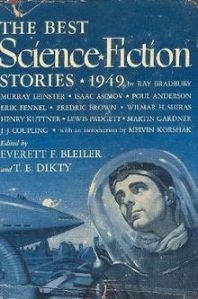
Compare to: The Best Science Fiction Stories 1949 edited by Everett F. Bleiler and T. E. Dikty

11

Compare to: The Best Science Fiction Stories 1950 edited by Everett F. Bleiler and T. E. Dikty

12

Compare to: The Best Science Fiction Stories 1951 edited by Everett F. Bleiler and T. E. Dikty

1951 Retro Hugo Award (for 1950 stories)

13

Compare to: The Best Science Fiction Stories 1952 edited by Everett F. Bleiler and T. E. Dikty

14

Compare to: The Best Science Fiction Stories 1953 edited by Everett F. Bleiler and T. E. Dikty

15

Compare to: The Best Science Fiction Stories 1954 edited by Everett F. Bleiler and T. E. Dikty

1954 Retro Hugo Awards (for 1953 stories)

16

Compare to: The Best Science Fiction Stories and Novels edited by T. E. Dikty

17

Compare to: The Best Science Fiction Stories and Novels 1956 edited by T. E. Dikty and S-F: The Year’s Greatest Science-Fiction and Fantasy edited by Judith Merril

1956 Hugo Awards (for 1955 stories)

18

Compare to: SF: The Year’s Greatest Science-Fiction and Fantasy Second Annual Volume edited by Judith Merril

19

Compare to: The Best Science Fiction Stories and Novels Ninth Series edited by T. E. Dikty and SF:58: The Year’s Greatest Science Fiction and Fantasy edited by Judith Merril

20

Compare to: SF:59: The Year’s Greatest Science Fiction and Fantasy edited by Judith Merril

1959 Hugo Awards (for 1958 stories)

21

Compare to: Fifth Annual of The Year’s Best SF edited by Judith Merril

1960 Hugo Awards (for 1959 stories)

22

Compare to: The Sixth Annual of The Year’s Best SF edited by Judith Merril

1961 Hugo Awards (for 1960 stories)

23

Compare to: The 7th Annual of The Year’s Best SF edited by Judith Merril

1962 Hugo Awards (for 1961 stories)

24

Compare to: The 8th Annual of the Year’s Best SF edited by Judith Merril

1963 Hugo Awards (for 1962 stories)

25

Compare to: The 9th Annual Year’s Best SF edited by Judith Merril

1964 Hugo Awards (for 1963 stories)

26

Compare to: 10th Annual Edition: The Year’s Best SF edited by Judith Merril

1965 Hugo Awards (for 1964 stories)

Statistics on Popular Stories in Anthologies

JWH