Sometimes We Really Do Want More Government Regulations

by James Wallace Harris, 4/27/21

Please watch this fifteen minute video from NBC News. It is the most insightful news story I’ve encountered this year because it encapsulates many of the essential issues about the future.

This video illustrates why lack of regulations and resource management leads to ordinary citizens and the environment losing to big business. Corporations and people with money wanting to make more money are searching the globe for places where they can get any kind of competitive edge with their investments. Basically, big business and rich individuals will gentrify every last acre on the planet, pricing ordinary people off their land.

Southeast Arizona has very little surface water and rainfall. For decades homeowners, family owned farms and ranches, and towns have been sipping off the top of their aquifer. As long as rains replenish that aquifer, life in the desert is sustainable. However, global corporations have discovered this Arizona land is essentially unregulated and the water is there for the the price of sinking deeper wells. This makes it profitable for corporations from around the world to exploit this area. Raising hamburgers and cattle feed in the desert seems insane until you realize the real value of water.

Water is the new gold rush, and some locales are trading their water for jobs and investments. However, once that water is gone, that locale, that environment will die. Keep an eye on this trend. You’ll see it everywhere once you start looking.

As the corporations put millions into exploiting this land, drilling ever deeper into the aquifer, they have gained control of the land because ordinary people can’t afford to extend their wells deeper, and are thus force to sell out and move. Local control over land is going to disappear.

A kind of corruption is taking place. Politicians back the corporations because they follow the money. Notice how toady the politician is in this video. People who don’t own land and just want jobs align themselves with the corporations. And even though the corporations claim they are there for the long haul, the reality is they are there as long as they can make a profit. Once they suck the aquifer dry or it becomes too costly to pump that water out of the ground, they will leave.

This is happening all over the world. The long term results is the total land area that is sustainable for life on Earth is shrinking. The dynamics of what’s happening here also reveals various kinds of inequality in action. Ordinary people can’t compete. Neither can nature. Basically, outsiders with money have all the power. If the local government had regulations about land and water use they could preserve their old way of life. They could build a sustainable society. Corporations have played the democratic system to get what they want. Read Dark Money by Jane Meyer or Evil Geniuses by Kurt Anderson for fuller explanations.

Right now we have an exploitation society. The rules are simple. Anything you can do that others can’t stop you from doing, you can do. Individuals can’t compete against corporations. And since corporations are rigging the laws, there’s little people can do – unless people take back their democracy. But it might be too late. There is little demand for sustainability. Corporations want to make money, and individuals want jobs. Unless people can create jobs that coexist with sustainable economies, things won’t change.

When you watch this video think about the two opposing groups. On one hand, you have the global demand for meat and dairy, which includes all of us, and a few individuals who have been living in southeast Arizona for decades. Corporations just fulfill the global demand. But what if the global demand becomes greater for sustainability and the environment? We all have to want it, or it won’t happen.

JWH

Will We Reach Herd Intelligence Before We Crash Our Civilization?

by James Wallace Harris, 4/19/21

  • Collapsed: How Societies Choose to Fail or Succeed by Jared Diamond
  • Falter: Has the Human Game Begun to Play Itself Out? by Bill McKibben
  • Seaspiracy – a documentary on Netflix

All indicators point to the collapse of civilization sometimes this century. Despite all the press about this perfect storm of self destruction, few people are willing to worry, and even fewer willing to do anything. Must the conclusion be that failure is our only option?

Most of humanity is either preoccupied with personal problems, or if they contemplate the future at all, assume our species will muddle through as it always has in the past. All the evidence suggests otherwise, that the biosphere cannot absorb the impacts of Homo sapiens without a significant destabilization of its system, which in turn will alter the course of civilization.

Civilizations have always come and gone, and so have species. Nothing lasts forever, not even the Earth or the Sun. It’s rather disheartening to consider what we could have become. We almost had the intelligence to create a global civilization that could have lasted thousands, if not millions of years. Theoretically, we still have a chance, but few people who think about such things give that chance much hope. It would have required everyone pulling together towards a common cause, and we’re just not that kind of species.

However, don’t worry, don’t get depressed or do anything irrational. No need to become a prepper assuming an Armageddon is just around every corner. The collapse of civilization will probably be so slow you might not even notice it. Humans are very adaptable to hard times and excellent at rationalizing things aren’t what they seem. Just take every day one day at a time and enjoy the passing parade of history.

As an individual who reads many books and watch many documentaries like the ones above, I keep thinking we should be doing something. But I realize there’s a problem with that assumption. First, we all need to be doing the same thing, and second, we should all stop what we’ve been doing our whole lives. Now is that going to happen? Is humanity a ship that can be steered or a bullet on a trajectory? It really comes down to the Serenity Prayer,

God grant me the serenity to accept the things I cannot change,
Courage to change the things I can,
and Wisdom to know the difference.

It’s the last line that’s so hard to achieve. What can we change, and what can’t we change? Theoretically we could change everything in society if we could just change ourselves. Is it Pollyannaish to think we could, and fatalistic to think we can’t? I wonder if people have always believed in God just to redirect that burden of responsibility?

If you read the above books maybe you will also ask who is smart enough to understand and solve these problems? If we built giant AI minds that could think their way through these immense challenges, would we take their advice? Aren’t we too egotistical to listen? Or even if a God spoke directly to the world would we obey? I’m not sure that’s in our nature either.

Maybe the only path an individual can take and stay sane is learning to accept and endure. But that doesn’t seem to be the way either because too many people today are angry. Anger means still trying to control. If you watch the news pay attention to anger. Too many hate what’s happening to them. And it’s on both sides of the political spectrum. All the people who fight for freedom and all the people who want rules and regulations are motivated by anger. That’s what I dread about the collapse of civilization, living with all these angry people. And the only solution to that is find a place away from them, but that’s not really possible either, is it?

This is a strange book review. But I find it’s getting harder and harder to review books like these by talking about the issues they cover. I’m down to evaluating their emotional impact. The penultimate question is: Can we do anything? The answer is yes. The ultimate question is: Will we? I used to hope that was a yes too, but my faith is fading.

JWH

Imagine Living Only in the Real World and Rejecting All Screens

by James Wallace Harris, 3/18/21

I grew up in the 1950s with the television screen. In the 1980s I became addicted to the computer screen. In the 2010s I started looking at the smartphone screen all the time. After having someone impersonate me with a fake Instagram account on Facebook last night I got disgusted with the internet I wondered if I shouldn’t abandon the online world. Then I thought, what would it be like to live just in the real world, without any screens, not even the TV screen? Much of what I find disturbing about the world comes through screens.

That’s a scary thought, giving up screens. I spend hours every day staring at them. My favorite past time right now is discussing science fiction short stories with folks on Facebook. If I didn’t use screens I could still read books but I couldn’t connect with the other people who love to read the same kind of things I do. Of course, what if we considered book pages to be like screens and abandoned them too?

Before screens there were books, newspapers, and magazines. I can imagine giving up screens, even giving up watching television, but I can’t imagine giving up the printed page. Isn’t that weird?

I’m trying to imagine life without screens or pages. It kind of blows my mind. My world would get very small. I’d probably keep up the house and yard way better than I do now. I’d probably get into gardening, cooking, and making things. I’d want to spend more time with people face-to-face. I assume life would slow way down. I guess I’d crave hearing about the world beyond my little place in it by talking to people and listening to their stories about events beyond my sight.

Without pages from books, magazines, and newspapers I’d be a lot more ignorant. Pages and screens inform us, connect us to the wider world. I can see now thinking about this, that screens really are an extension of pages. Screens add movement to the static type, illustrations and photos in printed matter.

When I watch YouTube videos created by amateurs I realize they are sending a highly constructed recorded speech with visuals which is more evolved than the printed essay, and an essay is more evolved than a lecture, and a lecture is more evolved than conversation.

The real world is nature. Plants and animals, earth and sky. Pages and screens are our way of communicating about nature. But hasn’t the abstraction of our communication moved us away from nature?

As much as I find nature beautiful and fascinating, I’m far more wrapped up in pages and screens, which if you think about it, is our way of reacting to nature. So what if we gave up abstraction and just dwelled in the natural world? (It might feel like living in a Ursula K. Le Guin novel. Even her futuristic human societies dwelling on far away worlds seem like medieval times on Earth.)

To be honest, it’s too late for me. I’m far too addicted to abstraction. I much prefer the fantasy of fiction on the page or screen to living actively in the real world. I much prefer the abstraction of nonfiction, news programs, and documentaries to studying reality first hand.

Should I feel guilty about that?

JWH

To The Bearers of False Witness Against Our Democracy

by James Wallace Harris, 2/23/21

When I was in school back in the 1950s and 1960s we were taught that America was the best example of democracy, and it was our most valuable export. The history I was taught, also claimed we inspired a slow worldwide conversion to democracy since the founding of America. Those lessons were something we took very seriously, and for most Americans it was politically sacred. We looked down on those corrupt government and leaders in other countries that undermined democracy as barbarians. And most of all, we believed America was impervious to any such corruption.

Well, we were wrong. Conservatives have taken up the weapon of denialism, first wielding it against science, then journalism, and now democracy. Denialism is a weapon of mass destruction. Donald Trump spent months carpet bombing America with denialism against democracy, claiming our system of voting is corrupt and full of fraud. It was Trump’s backup plan in case he lost the election, and his followers embraced that plan wholeheartedly. Even now the Republican party is doing everything it can to undermine democracy so they can win back power in 2022.

There was no significant voter fraud in 2020, even the conservative judges Donald Trump appointed affirmed that. Anyone who knows anything about our voting systems knows it’s well monitored. But even more important armies of Americans volunteer to support our voting system each election, and to claim it is corrupt and fraudulent is to insult their dedication. That’s goes beyond anything I can imagine to undermine our national unity.

Donald Trump shat all over American democracy and his followers have embraced his acts as the way to get what they want. The only systemic fraud in American democracy are the efforts by Republicans to disenfranchise people of color and immigrants, and to undermine our voting systems. This is down to Earth evil. If you follow the news, it is quite obvious that the Republicans have decided their #1 tool for winning elections in the future is by controlling them.

I just read this quote in 21 Lessons for the 21st Century by Yuval Noah Harari:

Joseph Goebbels, the Nazi propaganda maestro and perhaps the most accomplished media-wizard of the modern age, allegedly explained his method succinctly: “A lie told once remains a lie, but a lie told a thousand times becomes the truth.”

Donald Trump told his lie about election fraud so many times that it has become true to millions of people. Those lies are bearing false witness against democracy. By Republicans playing this one trump card over and over is causing their party members to believe it too. Harari went on to say:

In Mein Kampf Hitler wrote, “The most brilliant propagandist technique will yield no success unless one fundamental principle is borne in mind constantly — it must confine itself to a few points and repeat them over and over.” Can any present-day fake-news peddler improve on that?

I definitely do not mean to imply any connection between Trump and the Nazis. It’s just that the Nazis wrote the manual on public manipulation. Anybody who manipulates other people use a fraction of the techniques the Nazis perfected. We all need to study those techniques to become aware of how we’re being manipulated, either by politicians, corporations, or even by our coworkers, family, and friends.

Harari in an earlier chapter worked to understand why people believe what they do. He said as a species we’re not rational, but depend on myths and group thinking to understand reality. Most Americans don’t understand our democracy and voting systems so it’s easier to sway their opinion with disinformation. Trump treats his followers not as individuals but as a group mind. This comes from from the same book:

Not only rationality, but individuality too is a myth. Humans rarely think for themselves. Rather, we think in groups. Just as it takes a tribe to raise a child, it also takes a tribe to invent a tool, solve a conflict, or cure a disease. No individual knows everything it takes to build a cathedral, an atom bomb, or an aircraft. What gave Homo sapiens an edge over all other animals and turned us into the masters of the planet was not our individual rationality but our unparalleled ability to think together in large groups.

The Republican Party has learned the power of group thinking. That’s why they are so passionate about party loyalty. Unity consistently achieves success and they know it. The trouble is people who do think for themselves can break up groups, and the group is all important to Republicans. What’s amusing is individual Republicans who do think for themselves are always jockeying for control of the party, but it seems that it was Trump who rolled out the attack on democracy and the others had to fall in line. It’s another reason why so many Republicans want to retain Trump as a leader, his successes worked, so why rock the boat.

Harari went on to say:

Yet like many other human traits that made sense in past ages but cause trouble in the modern age, the knowledge illusion has its downside. The world is becoming ever more complex, and people fail to realize just how ignorant they are of what’s going on. Consequently, some people who know next to nothing about meteorology or biology nevertheless propose policies regarding climate change and genetically modified crops, while others hold extremely strong views about what should be done in Iraq or Ukraine without being able to locate these countries on a map. People rarely appreciate their ignorance, because they lock themselves inside an echo chamber of like-minded friends and self-confirming news feeds, where their beliefs are constantly reinforced and seldom challenged.

Conservatives, like any group seeking power, have used techniques and insights into how people form opinions to shape party member’s opinions. It’s how they get their coalition to do their bidding. Harari also noted that once people form opinions they seldom change them. Once the denialism of democracy bomb was dropped there was no going back. The rank and file had to follow. This is destroying our democracy with lies and even false witnessing in courts of law and the courts of public opinion.

Even some Republicans realized this is going too far. It’s like dismantling a passenger jet in flight. We all depend on our democracy for security and happiness, even the people who no longer believe in it. I plead with all rational Republicans to stop denying democracy. Stop undermining our way of life.

I have never believed in hell because I could never imagine any compassionate God would condemn any human soul to it for eternity. Christianity teaches forgiveness, and I can forgive the people who can’t think for themselves and spread lies about democracy. They don’t know any better. But I don’t have enough forgiveness to forgive those who are capable of thinking, who know what they are doing, and who bear false witness against democracy. They can go to hell – forever.

JWH

How to Save The World by Reading Science Fiction

by James Wallace Harris, 1/26/21

Many people have the inner confidence that the world will always muddle through. That we’ll solve our problems naturally through the unfolding of uncontrolled events. Other people believe as the population of humans grow, we’ll eventually reach a breaking point and things will fall apart. If you read Jared Diamond’s Collapse, you know the history of the world is a history of failed civilizations. Whatever goes up must come down, and if you’re the kind of person that uses numbers and graphs to anticipate the future, it doesn’t look good.

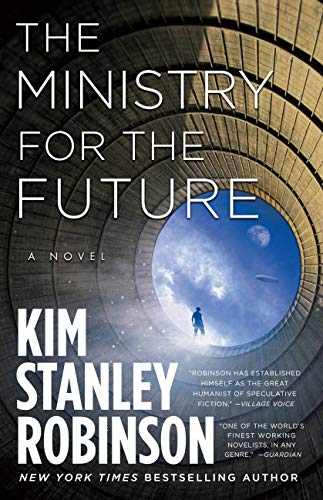
Kim Stanley Robinson has written a science fiction “novel” where he imagines humanity intentionally solving our big problems. The book is called The Ministry for the Future. It’s hard to recommend this book because people who expect a novel to work in a certain way could have difficulty reading it. I’ve already written about how The Ministry for the Future isn’t structured like a typical novel so you might want to read that essay before buying it.

The Ministry for the Future imagines how humanity could save itself. It’s just one possible scenario, but it does offer more hope than I’ve seen elsewhere. Now, it’s not entirely Pollyannaish, because it also assumes a massive economic depression and worldwide acts of terrorism will force us to change at times too, warning us there are no easy solutions, and to expect a bumpy ride.

The chief task to saving our planet is reducing CO2 in the atmosphere. Robinson suggests this can mainly be done by inventing a new worldwide currency he calls the carbon coin. Like the gold standard, this currency will be based on carbon kept out of the atmosphere. Once worldwide financial institutions back the carbon coin, and people and corporations realize future wealth depends on it, there will be an incentive to keep CO2 out of the atmosphere. At one point, Robinson says we’ll pay Saudi Arabia to keep its oil in the ground and that will create more worldwide wealth. That’s hard to believe, especially if you watch this film. (Really, watch this film.)

Robinson also imagines many giant geoengineering projects, including pumping water out from under glaciers to slow their pace into the oceans. He also assumes we’ll pursue different kinds of carbon sequestering combined with switching to renewable energy sources. These are all technical solutions that we’re considering today, but Robinson also has several chapters about why many of our current big ideas will fail.

The whole goal is to get CO2 back down to 350 ppm. Near the end of the novel, which spans many decades, CO2 peaks at 475 ppm. Robinson promotes the success of the real 350.org movement in the book. Last month we were averaging 413.95 ppm of CO2, so we’re currently about half-way to Robinson’s future in real life. To get back to 350 ppm we’ll have to stop using all fossil fuels and retrieve a lot of CO2 already in the atmosphere and put it away somewhere safe. Generally, that’s into trees, or sequestered. So, Robinson imagines the world reforesting on a vast level. But can you really imagine that we’ll stop taking oil, gas, and coal out of the ground? That’s trillions of dollars in wealth that people have invested trillions of dollars to own.

Concurrent with the CO2 problem is the extinction problem. Robinson also embraces Half-Earth Project to give half the Earth back to wildlife based on E. O. Wilson’s book Half-Earth: Our Planet’s Fight for Life. Within Robinson’s novel, huge tracts land are purchased to create wildlife corridors to connect the larger national parks around the world. This is a beautiful vision that I hope comes true. But to achieve it would require buying up small towns and destroying roads on a vast scale. That adds another giant expenditure for saving the world. Robinson claims this will add jobs and eventually grow the economy, but will people see saving animals as an investment?

Robinson foresees two horrible sources of good for the earth that are evils for people. A giant worldwide depression will slow the release of CO2, and he imagines vast networks of ecoterrorists that will stop air and sea travel by any machines that run on fossil fuel. Robinson pictures us returning to clipper ships and dirigibles, as well as new kinds of electric planes and ships that use renewable resources.

In this book Robinson doesn’t dwell on rising seas and other natural disasters like he has in her earlier novels, but he does focus on the refugee problems. He imagines we’ll eventually develop a global citizenship status that will allow us to fairly resettle the millions of refugees. Will we be that wise and kind?

All of this is just a tip of the iceberg among Robinson’s speculations. Overall, The Ministry for the Future is a very hopeful story, but you must read between the lines to account for all the horrors. However, his first chapter is an extremely dramatic scene of one terrifying ecocatastrophe, and I can’t recommend reading it highly enough. It’s available online to read.

After finishing The Ministry for the Future, I keep asking myself: Will we really save ourselves? Robinson believes we’ll more than muddle through, and even find triumph in our achievements. Robinson is almost gung-ho for the future. Americans can’t even pull together in a crisis like the Covid-19 pandemic, so why expect us to pull together at far greater challenges? Will we muddle through despite ourselves? I don’t think so. Humans have always muddled through in the past because there were always been an abundance of options and resources. Solving climate change is where the Ponzi scheme of Capitalism finally comes due. Saving ourselves will require moving to a new paradigm for the politicaleconomy. I’m not sure that will happen. In fact, I seriously doubt it. Why? Because it will require humans to work together at a level of cooperation that we’ve never shown in the past.

Kim Stanley Robinson is an optimist. I’m a pessimist looking for hope. I believe it’s important to read science fiction novels like The Ministry for the Future because we need to all ask ourselves if such dreams are possible. Are we capable of making these kinds of changes in our lives? My hope says its theoretically possible. My pessimism says no.

If you haven’t really thought about how we’ll save ourselves in the future, then you might want to read The Ministry for the Future. It’s not a fun page turner, but I believe it covers most of what you’ll need to consider.

JWH