I’m Too Dumb to Use Artificial Intelligence

by James Wallace Harris, 1/19/24

I haven’t done any programming since I retired. Before I retired, I assumed I’d do programming for fun, but I never found a reason to write a program over the last ten years. Then, this week, I saw a YouTube video about PrivateGPT that would allow me to train an AI to read my own documents (.pdf, docx, txt, epub). At the time I was researching Philip K. Dick, and I was overwhelmed by the amount of content I was finding about the writer. So, this light bulb went off in my head. Why not use AI to help me read and research Philip K. Dick. I really wanted to feed the six volumes of collected letters of PKD to the AI so I could query it.

PrivateGPT is free. All I had to do was install it. I’ve spent days trying to install the dang program. The common wisdom is Python is the easiest programming language to learn right now. That might be true. But installing a Python program with all its libraries and dependencies is a nightmare. What I quickly learned is distributing and installing a Python program is an endless dumpster fire. I have Anaconda, Python 3.11, Visual Studio Code, Git, Docker, Pip, installed on three computers, Windows, Mac, and Linux, and I’ve yet to get anything to work consistently. I haven’t even gotten to part where I’d need the Poetry tool. I can run Python code under plain Python and Anaconda and set up virtual environments on each. But I can’t get VS Code to recognize those virtual environments no matter what I do.

Now I don’t need VS Code at all, but it’s so nice and universal that I felt I must get it going. VS Code is so cool looking, and it feels like it could control a jumbo jet. I’ve spent hours trying to get it working with the custom environments Conda created. There’s just some conceptual configuration I’m missing. I’ve tried it on Windows, Mac, and Linux just in case it’s a messed-up configuration on a particular machine. But they all fail in the same way.

I decided I needed to give up on using VS Code with Conda commands. If I continue, I’ll just use the Anaconda prompt terminal on Windows, or the terminal on Mac or Linux.

However, after days of banging my head against a wall so I could use AI might have taught me something. Whenever I think of creating a program, I think of something that will help me organize my thoughts and research what I read. I might end up spending a year just to get PrivateGPT trained on reading and understanding articles and dissertations on Philip K. Dick. Maybe it would be easier if I just read and processed the documents myself. I thought an AI would save me time, but it requires learning a whole new specialization. And if I did that, I might just end up becoming a programmer again, rather than an essayist.

This got me thinking about a minimalistic programming paradigm. This was partly inspired by seeing the video “The Unreasonable Effectiveness of Plain Text.”

Basically, this video advocates doing everything in plain text, and using the Markdown format. That’s the default format of Obsidian, a note taking program.

It might save me lot of time if I just read the six volumes of PKD’s letters and take notes over trying to teach a computer how to read those volumes and understand my queries. I’m not even sure I could train PrivateGPT to become a literary researcher.

Visual Studio Code is loved because it does so much for the programmer. It’s full of artificial intelligence. And more AI is being added every day. Plus, it’s supposed to work with other brilliant programming tools. But using those tools and getting them to cooperate with each other is befuddling my brain.

This frustrating week has shown me I’m not smart enough to use smart tools. This reminds me of a classic science fiction short story by Poul Anderson, “The Man Who Came Early.” It’s about a 20th century man who thrown back in time to the Vikings, around the year 1000 AD. He thinks he will be useful to the people of that time because he can invent all kinds of marvels. What he learns is he doesn’t even know how to make the tools, in which to make the tools, that made the tools he was used to in the 20th century.

I can use a basic text editor and compiler, but my aging brain just can’t handle more advance modern programming tools, especially if they’re full of AI.

I need to solve my data processing needs with basic tools. But I also realized something else. My real goal was to process information about Philip K. Dick and write a summarizing essay. Even if I took a year and wrote an AI essay writing program, it would only teach me a whole lot about programming, and not about Philip K. Dick or writing essays.

What I really want is for me to be more intelligent, not my computer.

JWH
Do You Plan to Bequeath Any of Your Computer Files in Your Will?

by James Wallace Harris, 11/20/23

I currently have 71,882 files in Dropbox. Will anyone want any of those digital documents after I die?

Let’s say I go on a Döstädning rampage (Swedish death cleaning) of my digital possessions, would there be anything left that I’d want anyone to have?

Most people consider their photographs to be among their most cherished digital possessions. I have 5,368 of those — some of those photos go back to four generations in our families. Susan and I have no children. We made copies of those photos for our relatives one Christmas, although I’m not sure if any of those relatives wanted them. I imagine them groaning at their pile of digital junk growing larger.

Would a genealogical database want old photographs? I know people interested in their ancestry spend a lot of time looking for old documents online. I wonder if I have any photos, letters, or documents that would be of interest to people in the future researching their past?

I have 28,811 digital scans of old science fiction and pulp magazines that took me years to collect. Most of them are easily found online, so I doubt they will be wanted. But what if the Internet Archive servers were shut down for lack of funding? Will there be kids in the future wishing they had a complete run of Astounding Science Fiction? Or will that desire die with the generation that grew up reading the stories that were first published in that magazine?

There are certain documents relating to money that my wife will want, but she will prefer printed copies. When my mother died, and Susan’s folks died, I scanned a bunch of family documents. I haven’t looked at them in years, and Susan has never asked about them. Still, would they be of value to anyone? What will future historians want to know about ordinary people?

I wonder how long my blogs will exist after I die. I’ve known bloggers who have died, and I can still read their blog posts, but some of writers were published at online companies that went under. I know I used a couple of those sites, and I can’t even remember the names of the companies.

I have over a thousand Kindle books, and over a thousand Audible audiobooks in Amazon’s cloud. Is there any way for me to leave those libraries to other people?

And if no one in the future will want my digital files, do I need to hang onto them now? Why do I keep them? Why do I give Dropbox $119 a year? When I retired, I made copies of all the computer programs I wrote. I put them on several drives just to be sure. I put those drives in the closet. Several years later I went to check on them and every one of those hard drives was dead. I have a friend whose computer hard drive died recently. She had always backed everything up with Apple’s Time Machine. However, when she restored her files, many were corrupted. It’s hard to preserve digital files for a long time. Backup programs and online backup services aren’t 100% reliable.

When humanity stored our past on paper, some of it got saved. Not much, but some. I get the feeling that since we switched to storing stuff digitally, even less will survive. I have a handful of paper photographs that my great grandparents, grandparents, and parents took. So does Susan. I wonder who we should give them to?

Every day I spend a few minutes going around the house looking for things to throw away or give away. I need to start doing that with my computer files. I spent a lifetime gathering stuff, both physical stuff, and digital stuff. It’s funny now that I’m trying to reverse that progression of acquisitions.

I wonder when I was young if I had somehow known for sure that my older self would be getting rid of all the stuff I was buying back then, would I have bought so much stuff in the first place? How much stuff have I bought or saved because of FOMO (fear of missing out)? And how much did I really miss out?

JWH

Visualizing My Discontent

by James Wallace Harris, 2/28/23

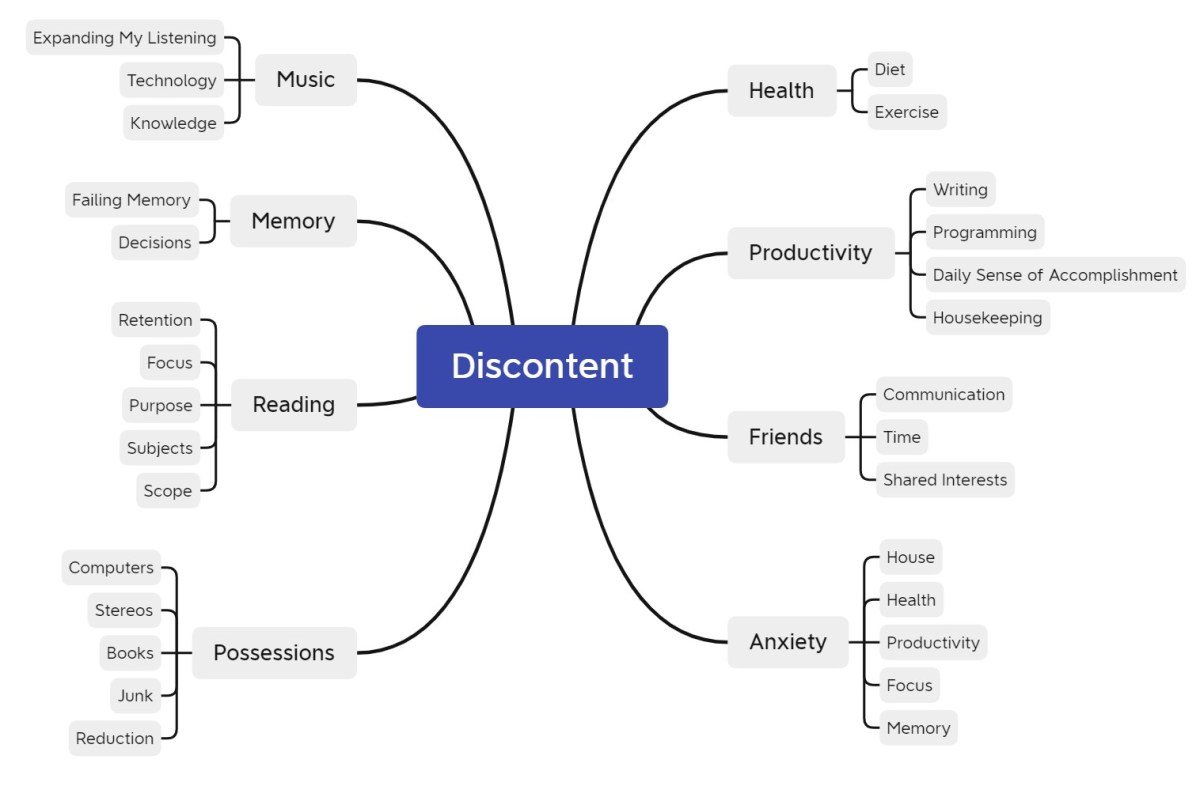
Yesterday I watched a YouTube video about writing morning pages. The idea is to get up and hand-write three pages of stream-of-conscious thoughts. So, I tried it this morning and I realized I have a number of things that make me discontent. And one of the things that make me dissatisfied with my life is not being able to see the big picture of what’s going on with myself. This brings me to this blog. I went to Xmind and created a quick mind map of my discontents hoping to see an overview of what was gnawing at me. You can see the results above.

The seed of discontent that inspired all of this comes from the way I feel each night before I go to bed — about how I spent my day. If I did something that felt productive, I feel satisfied with my day. If I didn’t I feel restless. I like when I have an ongoing project that inspires me to get up and get back to working on it. I haven’t had one of those in a while. My next level of satisfaction comes when I write a blog that I’ve put some good work into creating.

Of course, everything depends on health. Over the past few years, I’ve had to deal with a number of health issues. The walls of my life, my aquarium you might say, are the limitations of my health. When I was younger, that aquarium felt like the ocean itself, but as I grew older it shrank. As an adult, I began to realize my limitations, but the possibilities still felt huge, like I was living in the Atlanta aquarium. In my fifties, it felt more like a fancy 50-gallon deluxe home aquarium. In my sixties an ordinary 20-gallon job. Now when I feel bad it feels like I’m living in one of those bowls people keep goldfish in. When I’m feeling better, I’m back in a basic 10-gallon tank. My health goal is to do as much as I can within the boundaries set by my body. That means a lot of my daily anxiety deals with staying healthy. If I can maintain a certain level of health I feel like it minimizes my discontent. And the more I do, the less discontent I feel.

However, staying healthy juggles so many goddamn variables that it’s stressful to think about what to do to stay healthy. For instance, I watched a video, “7 Foods That Ruin Your Liver” this morning — two of which are among the top ingredients of the protein supplements I eat. Since I have a fatty liver, and sometimes have pains in my liver area, this is another worry. I also have a cyst on my liver. And I have gallstones. Eating carefully has become a very big deal for me.

Luckily, my health problems don’t cause me much discontent, or even anxiety. I’m used to dealing with them. My discontent comes from worrying over what to eat and how to exercise. I want to eat what I like and dislike making myself exercise. What would eliminate that anxiety would be finding a diet that I just stick with all the time, and finding a way to integrate just enough exercise to the minimum needed. Both really come down to discipline, but discipline is a major area of discontent for me.

I’ve been lucky lately, and have been feeling better. Last year wasn’t so good because of health problems and a hernia operation. Because I’m feeling better I feel like I should be doing more. Because I’m not doing more I’m feeling restless and discontent. That’s what came out in my morning pages.

Reducing that discontent and getting back on track will require finding a project to work on. I want something that will take me several days or weeks. Something that will make me feel like getting out of bed in the morning. The one I’ve picked to start on, but I don’t know if I’ll stick with, involves creating a new way to learn, memorize, and visualize a subject. My memory is deteriorating, but it’s never been very good for studying a subject deeply. I read nonfiction books and news articles all the time. But that information goes in and out of my brain almost instantly.

I recently read and reviewed a book about the German romantics. Supposedly, they found a lot of insights that have trickled down to us today. I want to create some kind of visual representation of their ideas and how they connected to other influential people over the last two hundred years. I figure this will kill several birds with one stone. It will touch on four branches of the mind map above: memory, reading, productivity, and anxiety. It might even touch on possessions because I will enjoy using more of my computer equipment, and it might touch on friends because it will give me something to talk about with them.

What I want to do is develop a way to visualize what I read to help me remember the information and convey what I’ve learned to other people.

All of this was inspired by scribbling out three handwritten pages this morning when I got up. Watch the video above, you might find it useful too.

By the way, the level of discontent I feel right now isn’t very high. I have a very contented personality. I find it very easy to just hang out and putter around in life. My greatest discontent has always been not being more ambitious. All I’m doing now is pushing myself to do just a little more.

JWH

What I’m Learning From Thinning Out My Books

by James Wallace Harris, 9/22/22

I want a new stereo system for my bedroom. A higher fidelity one than what I described in “To Go, or Not to Go — To the Bookstore?” That was written back in July, well before I had my hernia surgery on August 29th. I used researching stereo equipment to avoid thinking about surgery before my operation and to ignore my physical discomforts afterward. I have a long history of using unpleasant experiences as justifications for buying myself new toys.

Two things have stopped me from ordering my new stereo equipment. First, my release instructions warned me not to pick up anything over five pounds while I recovered. Second, I have no room to set up new equipment. Making room will involve getting rid of stuff and rearranging furniture, all weighing over five pounds. So while lying around with pillows on my lap to protect my swollen private parts from cats, I’ve been mentally analyzing the best way to free up the most wall space while requiring the least weight lifting.

After much grinding of my mental gears, I’ve concluded the easiest solution is to get rid of two bookcases worth of books. My bedroom has four bookcases of books. For twenty years before I quit working I stashed away books for my retirement years. Well, I squirreled away too many. Way too many. And in the decade since I’ve had all my time free, I’ve learned that most of the approximately 500 books I’ve read over the last ten years were bought after I retired.

I’ve been trying to thin out my collection for decades. But whenever I try to pull volumes to give to the Friends of the Library I start reading and think, “Oh man, I’ll read this someday. This one is too good to give up.” I just can’t follow Marie Kondo’s advice because every book I hold sparks joy.

It’s either give up books or forget about that new stereo. Ouch! I’ve spent four hours this morning going through half a bookcase. With much agonizing, I’ve found 23 books to discard. That’s about one shelf of books. I need to clear off eleven more shelves.

This is so painful. But what doesn’t kill us, makes us stronger – right? What I’m learning is each book is a little world of knowledge that I wanted to incorporate into my soul. And to decide not to read a book means deciding that’s an area of knowledge I’ll remain ignorant of.

By the way, did I tell you that all these books are nonfiction? I’m not ready to thin out my science fiction collection. That’s revealing too.

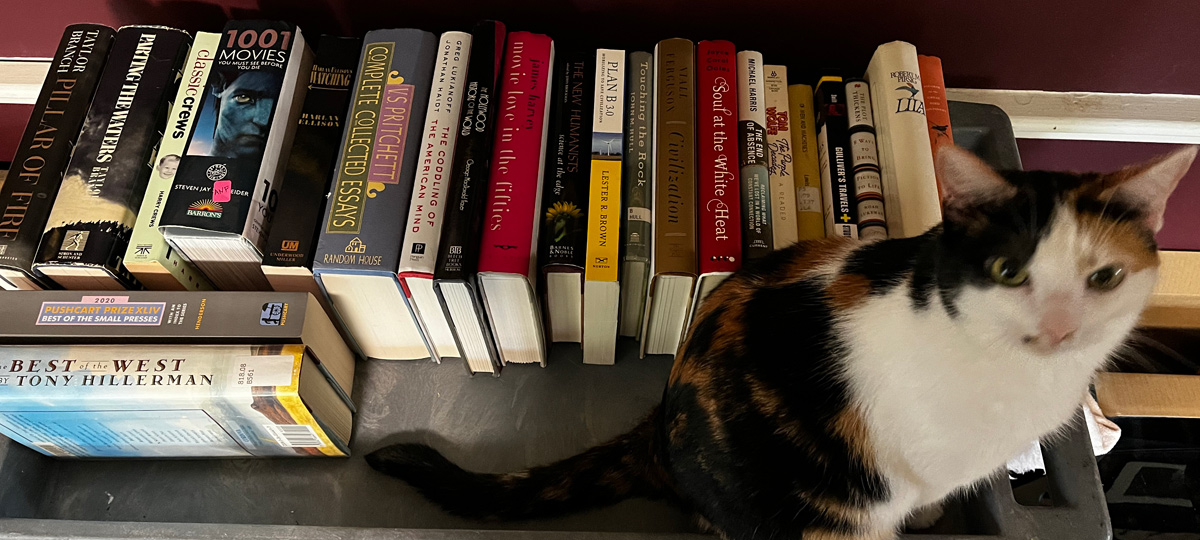
Some of the books I’m discarding I’ve decided would be better on audio anyway. I’m opening each book up and reading from it randomly. I realize that some books, particularly certain kinds of history books, I’d rather listen to than reading. I can get rid of those (unless I’d want to keep them for reference). Examples are Civilization: The West and the Rest by Niall Ferguson and Parting the Waters: America in the King Years 1954-63 by Taylor Branch.

However, I’ve discovered another type of book I can part with, but the reason why disturbs and depresses me. I’m finding some books I thought I could read when I was younger are probably too difficult for my older mind or would require a level of concentration that I no longer possess. A good example is Soul at the White Heat: Inspiration, Obsession, and the Writing Life by Joyce Carol Oates. Her intellectual analyses are ones I’m no longer capable of handling, and maybe never was.

The final type represents an acceptance of resignation. I’m just not going to live long enough to get around to some books. These are the books I feel would be the last in line. I’d love to read Complete Collected Essays by V. S. Pritchett or Harlan Ellison’s Watching because I admire their commentary on pop culture’s past. But I have to decide what’s really worth learning in my fading years of life.

Another funny kind of realization is I’m torn between preserving my precious reading time for what’s relevant to the existential needs of my remaining years and books that offer the purest delightful fun. Two examples of what I’m keeping are Energy: A Human History by Richard Rhodes and Zappa: A Biography by Barry Miles.

I know without a doubt I could give away all the books in all four bookcases and not really miss them. My eyes now prefer reading ebooks and I have over a thousand of them waiting to be read. I also have over a thousand audiobooks hidden away in the cloud. And I have six bookcases of physical books in my computer room. Yet, I just hate to part with physical books. I’ve thought about putting bookcases in other rooms of the house, but that would be unfair to Susan. She’s already bitching about how many books she’ll have to get rid of if I die before her.

With every book I hold to decide its fate, I mentally go through a gauntlet of emotions and thoughts. I should make a daily meditation of routinely going through my library. With each book, just reading a few paragraphs here and there inspires several ideas for blog essays.

JWH

I Can’t Take It With Me?

by James Wallace Harris, 7/3/21

That old saying warns us we can’t take it with us, but where does our stuff go when we say goodbye to this plane of existence? If I go first, Susan will just haul all my crap down to Goodwill. If she goes first, I’ll do the same for her. But if Susan goes first, who will process all my cherished possessions?

Before my mom died, she gave some of her stuff as little personal gifts to people she knew at church, or in the neighborhood, or relations. And the stuff she didn’t give away, she assumed either I or my sister would take after she died and cherish for the rest of our lives. We didn’t tell her we had other plans. After my mom died I went through her house looking for sentimental things like photographs, letters, and a few books. My sister wanted more of the knicknacks. My mom’s closets and extra bedrooms were jammed with things she’d had been saving since the 1945 when she married my dad. I told the ladies we had hired to sit with my mother when I was at work that they could have anything they wanted in the house except the stove and refrigerator. The house was clean enough to sell when I came back.

If I was kind and considerate, I’d get rid of my junk now. I’ve been getting rid of stuff for years, but there’s enough left to fill the pickup several times over. When I was young I thought I wanted a smaller house for when I was older, but now that I’m older, I don’t want that at all. This house has become the perfect size for our junk. Susan and I have divided our home into our individual territories. I junk up the den, two bedrooms, and one hall closet. Susan fills up the living, dining room, one bedroom, and the other hall closet. We both encourage the other to get rid of their stuff, but we don’t.

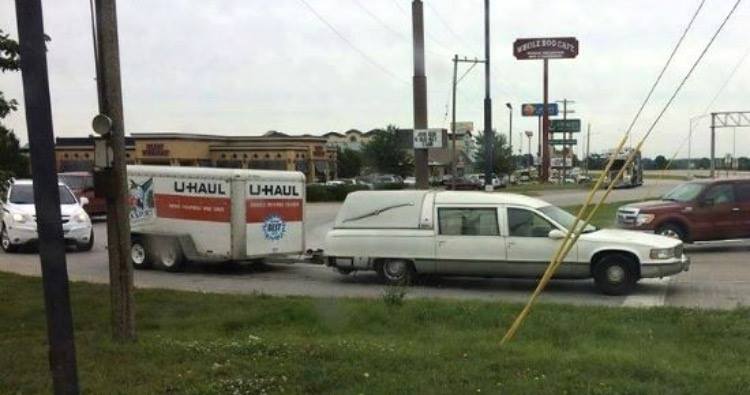
I’m not religious, but what if there was a heaven, and what if we could take it with us? What if St. Peter allowed everyone to bring one U-Haul trailer full of Earthly possessions to heaven, what would you take? Imagine everyone getting a luxury two-bedroom condo in paradise, how would you decorate it? (I wonder if they have the internet up there?)

My friend Connell has been moving out of his house where he’s lived since the 1980s and into a two-bedroom condo. He’s been selling his stuff on Craigslist. I wonder if I should set up an eBay account and sell off my stuff too? But it would be so much easier and put it off until I die and let Susan deal with it. Now I know why I always planned to go first.

JWH