A Painful Challenge to My Ego

James Wallace Harris, 2/26/24

I’m hitting a new cognitive barrier that stops me cold. It’s making me doubt myself. I’ve been watching several YouTubers report on the latest news in artificial intelligence and I’ve been amazed by their ability to understand and summarize a great amount complex information. I want to understand the same information and summarize it too, but I can’t. Struggling to do so wounds my ego.

This experience is forcing me to contemplate my decaying cognitive abilities. I had a similar shock ten years ago when I retired. I was sixty-two and training a woman in her twenties to take over my job. She blew my mind by absorbing the information I gave her as fast as I could tell her. One reason I chose to retire early is because I couldn’t learn the new programming language, framework, and IDE that our IT department was making standard. That young woman was learning my servers and old programs in a language she didn’t know at a speed that shocked and awed me. My ego figured something was up, even then, when it was obvious this young woman could think several times faster than I could. I realized that’s what getting old meant.

I feel like a little aquarium fish that keeps bumping into an invisible barrier. My Zen realization is I’ve been put in a smaller tank. I need to map the territory and learn how to live with my new limitations. Of course, my ego still wants to maximize what I can do within those limits.

I remember as my mother got older, my sister and I had to decide when and where she could drive because she wouldn’t limit herself for her own safety. Eventually, my sister and I had to take her car away. I’m starting to realize that I can’t write about certain ideas because I can’t comprehend them. Will I always have the self-awareness to know what I can comprehend and what I can’t?

This makes me think of Joe Biden and Donald Trump. Both are older than I am. Does Biden realize what he’s forgotten? Does Trump even understand he can’t possibly know everything he thinks he knows? Neither guy wants to give up because of their egos.

So, what am I not seeing about myself? I’m reminded of Charlie Gordon in the story “Flowers for Algernon,” when Charlie was in his intellectual decline phase.

Are there tools we could use to measure our own decline? Well, that’s a topic for another essay, but I believe blogging might be one such tool.

JWH

ChatGPT Isn’t an Artificial Intelligence (AI) But an Artificial Unconsciousness (AU)

by James Wallace Harris, 2/12/24

This essay is for anyone who wants to understand themselves and how creativity works. What I’m about to say will make more sense if you’ve played with ChatGPT or have some understanding of recent AI programs in the news. Those programs appear to be amazingly creative by answering ordinary questions, passing tests that lawyers, mathematicians, and doctors take, generating poems and pictures, and even creating music and videos. They often appear to have human intelligence even though they are criticized for making stupid mistakes — but then so do humans.

We generally think of our unconscious minds as mental processes occurring automatically below the surface of our conscious minds, out of our control. We believe our unconscious minds are neural functions that influence thought, feelings, desires, skills, perceptions, and reactions. Personally, I assume feelings, emotions, and desires come from an even deeper place and are based on hormones and are unrelated to unconscious intelligence.

It occurred to me that ChatGPT and other large language models are analogs for the unconscious mind, and this made me observe my own thoughts more closely. I don’t believe in free will. I don’t even believe I’m writing this essay. The keyword here is “I” and how we use it. If we use “I” to refer to our whole mind and body, then I’m writing the essay. But if we think of the “I” as the observer of reality that comes into being when I’m awake, then probably not. You might object to this strongly because our sense of I-ness feels obviously in full control of the whole shebang.

But what if our unconscious minds are like AI programs, what would that mean? Those AI programs train on billions of pieces of data, taking a long time to learn. But then, don’t children do something similar? The AI programs work by prompting it with a question. If you play a game of Wordle, aren’t you prompting your unconscious mind? Could you write a step-by-step flow chart of how you solve a Wordle game consciously? Don’t your hunches just pop into your mind?

If our unconscious minds are like ChatGPT, then we can improve them by feeding in more data and giving it better prompts. Isn’t that what we do when studying and taking tests? Computer scientists are working hard to improve their AI models. They give their models more data and refine their prompts. If they want their model to write computer programs, they train their models in more computer languages and programs. If we want to become an architect, we train our minds with data related to architecture. (I must wonder about my unconscious mind; it’s been trained on decades of reading science fiction.)

This will also explain why you can’t easily change another person’s mind. Training takes a long time. The unconscious mind doesn’t respond to immediate logic. If you’ve trained your mental model all your life on The Bible or investing money, it won’t be influenced immediately by new facts regarding science or economics.

We live by the illusion that we’re teaching the “I” function of our mind, the observer, the watcher, but what we’re really doing is training our unconscious mind like computer scientists train their AI models. We might even fool ourselves that free will exists because we believe the “I” is choosing the data and prompts. But is that true? What if the unconscious mind tells the “I” what to study? What to create? If the observer exists separate from intelligence, then we don’t have free will. But how could ChatGPT have free will? Humans created it, deciding on the training data, and the prompts. Are our unconscious minds creating artificial unconscious minds? Maybe nothing has free will, and everything is interrelated.

If you’ve ever practiced meditation, you’ll know that you can watch your thoughts. Proof that the observer is separate from thinking. Twice in my life I’ve lost the ability to use words and language, once in 1970 because of a large dose of LSD, and about a decade ago with a TIA. In both events I observed the world around me without words coming to mind. I just looked at things and acted on conditioned reflexes. That let me experience a state of consciousness with low intelligence, one like animals know. I now wonder if I was cut off from my unconscious mind. And if that’s true, it implies language and thoughts come from the unconscious minds, and not from what we call conscious awareness. That the observer and intelligence are separate functions of the mind.

We can get ChatGPT to write an essay for us, and it has no awareness of its actions. We use our senses to create a virtual reality in our head, an umwelt, which gives us a sensation that we’re observing reality and interacting with it, but we’re really interacting with a model of reality. I call this function that observes our model of reality the watcher. But what if our thoughts are separate from this viewer, this watcher?

If we think of large language models as analogs for the unconscious mind, then everything we do in daily life is training for our mental model. Then does the conscious mind stand in for the prompt creator? I’m on the fence about this. Sometimes the unconscious mind generates its own prompts, sometimes prompts are pushed onto us from everyday life, but maybe, just maybe, we occasionally prompt our unconscious mind consciously. Would that be free will?

When I write an essay, I have a brain function that works like ChatGPT. It generates text but as it comes into my conscious mind it feels like I, the viewer, created it. That’s an illusion. The watcher takes credit.

Over the past year or two I’ve noticed that my dreams are acquiring the elements of fiction writing. I think that’s because I’ve been working harder at understanding fiction. Like ChatGPT, we’re always training our mental model.

Last night I dreamed a murder mystery involving killing someone with nitrogen. For years I’ve heard about people committing suicide with nitrogen, and then a few weeks ago Alabama executed a man using nitrogen. My wife and I have been watching two episodes of Perry Mason each evening before bed. I think the ChatGPT feature in my brain took all that in and generated that dream.

I have a condition called aphantasia, that means I don’t consciously create mental pictures. However, I do create imagery in dreams, and sometimes when I’m drowsy, imagery, and even dream fragments float into my conscious mind. It’s like my unconscious mind is leaking into the conscious mind. I know these images and thoughts aren’t part of conscious thinking. But the watcher can observe them.

If you’ve ever played with the AI program Midjourney that creates artistic images, you know that it often creates weirdness, like three-armed people, or hands with seven fingers. Dreams often have such mistakes.

When AIs produce fictional results, the computer scientists say the AI is hallucinating. If you pay close attention to people, you’ll know we all live by many delusions. I believe programs like ChatGPT mimic humans in more ways than we expected.

I don’t think science is anywhere close to explaining how the brain produces the observer, that sense of I-ness, but science is getting much closer to understanding how intelligence works. Computer scientists say they aren’t there yet, and plan for AGI, or artificial general intelligence. They keep moving the goal. What they really want are computers much smarter than humans that don’t make mistakes, which don’t hallucinate. I don’t know if computer scientists care if computers have awareness like our internal watchers, that sense of I-ness. Sentient computers are something different.

I think what they’ve discovered is intelligence isn’t conscious. If you talk to famous artists, writers, and musicians, they will often talk about their muses. They’ve known for centuries their creativity isn’t conscious.

All this makes me think about changing how I train my model. What if I stopped reading science fiction and only read nonfiction? What if I cut out all forms of fiction including television and movies? Would it change my personality? Would I choose different prompts seeking different forms of output? If I do, wouldn’t that be my unconscious mind prompting me to do so?

This makes me ask: If I watched only Fox News would I become a Trump supporter? How long would it take? Back in the Sixties there was a catch phrase, “You are what you eat.” Then I learned a computer acronym, GIGO — “Garbage In, Garbage Out.” Could we say free will exists if we control the data, we use train our unconscious minds?

JWH

Reading Vonnegut’s Slaughterhouse-Five at Ages 18, 55, and 72

by James Wallace Harris, 2/8/24

When I first read Slaughterhouse-Five by Kurt Vonnegut back in 1970 I thought of it as an antiwar novel. The Vietnam War overshadowed everything back then, and I was old enough to be drafted. 1970 was the year M.A.S.H. and Catch-22 came out in the movie theaters. I went to see Catch-22 and was so blown away that I bought the book, read it in a day, and then went to see the movie version again. I didn’t read the book version of M.A.S.H. for another year but saw the film in 1970 too. Ever since I’ve thought of Slaughterhouse-Five, Catch-22, and M.A.S.H. as the trilogy of anti-war novels of my generation. The books were all about hating war.

When I read Slaughterhouse-Five again, in 2006 when I was 55, I listened it on audio. That time it was a completely different novel. That time it was hilarious. It was over-the-top silly, slapstick, and viciously satirical. At that time I focused on the Tralfamadorians and Kilgore Trout, and Vonnegut’s commentary on science fiction. In 2006 I noticed the antiwar parts, but they didn’t seem to be the primary point of the novel. They were still horrifying, but I found it hard to take Slaughterhouse-Five as a serious novel about WWII. That happened to me last year when I tried to reread Catch-22.

Now in 2024, when I’m 72, I listened to the book again. This time the story was bittersweet, heavy on the bitter, gentle on the sweet, and deeply philosophical. This time Slaughterhouse-Five was a condemnation of humanity. It was dark, very dark, but strangely not depressing. Both Billy Pilgrim, the protagonist, and Vonnegut were accepting that humans do horrible things and there is nothing we could do about it. This time it was obvious that Vonnegut believes we have no free will, and the best we can do in life is enjoy those moments when life is pleasant. This time around Slaughterhouse-Five was incredibly stoic.

When I read Slaughterhouse-Five the first time I thought the main goal of the novel was to horrify readers that we bombed Dresden in 1945 and make them outraged. I thought Vonnegut was testifying to an Allied war crime. This time around I realized Vonnegut wasn’t doing that at all. He was completely accepting that we had to bomb Dresden.

I think both times before, I thought Billy Pilgrim was a stand-in for Vonnegut. However, this time it was quite explicit that Billy Pilgrim and Vonnegut were distinctly two different characters in the book. At the end of the audiobook, there was a ten-minute conversation between Vonnegut and another unnamed WWII vet. In that conversation Vonnegut even tells us the name of the man he based Billy Pilgrim on.

The vet Vonnegut was talking to kept trying to praise Vonnegut, and Vonnegut kept deflecting the compliments. But one thing the other guy said stood out. He said that all of Vonnegut’s books were in print because they have multigenerational appeal. Since I have read the book when I was young, middle aged, and old, I can attest to that.

When I read Slaughterhouse-Five back in 1970, I thought the book was a protest. It was Vonnegut telling his readers that we need to change. And back then I thought humans could change. When I read it in 2006, I still had hope that humanity could evolve into something better. But in 2024, I didn’t find Vonnegut protesting at all. Vonnegut advised acceptance. Why didn’t I see that at 18?

Slaughterhouse-Five is neither an antiwar novel, nor even a misanthropic novel. In 2024 it seems obvious that Vonnegut was saying we have no choice but to accept the life we’re given, both as an individual and as a species.

Vonnegut was around 42 when Slaughterhouse-Five was published in 1969. How is it he now seems like a wise old man when I read it at 72 in 2024? Every time I read Slaughterhouse-Five I thought of Kurt Vonnegut as a modern-day Mark Twain. I was very into Twain when I was young, but I pictured him as a bitter old man from his later fiction and autobiography.

I wonder now if Vonnegut eventually turned bitter like Twain. Even though for the 2024 reading many scenes felt bitter, now that I write this, I’m not even sure that’s what Vonnegut intended. Could he have intended a total beatific point of view? I need to rewatch the 2021 documentary about Vonnegut called Unstuck in Time. And I need to read And So It Goes: Kurt Vonnegut: A Life by Charles J. Shields.

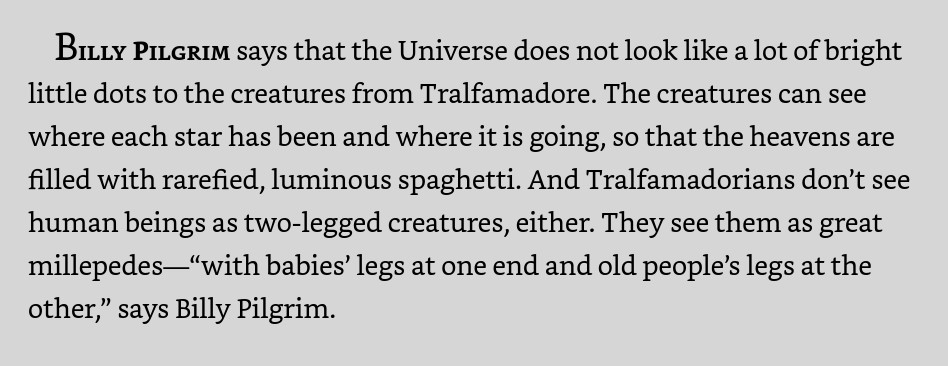
This time around I’ve been thinking more about the Tralfamadorians, the alien race who kidnaps Billy Pilgrim in a flying saucer and takes him to their home world where they exhibit him in a zoo. The Tralfamadorians don’t see time like we do. Existence is all of one piece.

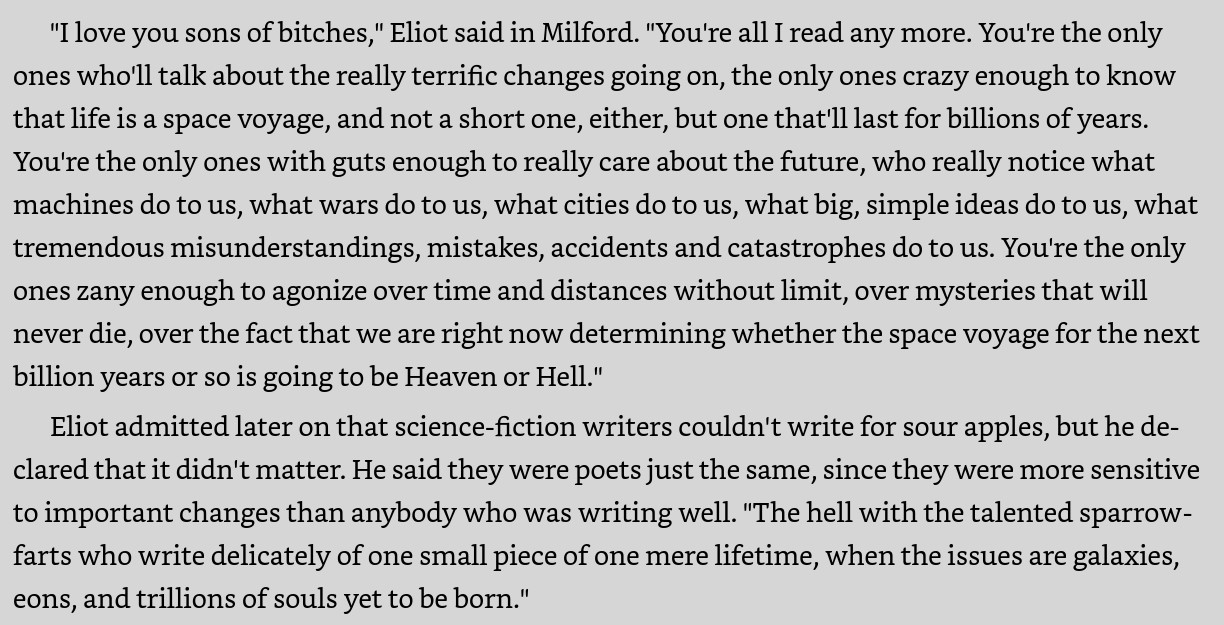
These aliens are like Zen Masters. Vonnegut uses them as enlightened teachers. But then, he gives a rather pitiful assessment of science fiction with his portrayal of Kilgore Trout. However, in a later novel, God Bless You, Mr. Rosewater, where Kilgore Trout is again featured, its hero, Elliot Rosewater attends a science fiction convention and gives this speech.

Science fiction didn’t come across so positively in Slaughterhouse-Five. Kilgore Trout wrote dozens of books that never sell. He’s a surly old man who makes his living by managing paperboys. Billy Pilgrim finds Kilgore Trout’s books only by accident. One time he finds four of them in a porn bookstore used as window dressing.

Wikipedia has an illuminating entry on Kilgore Trout. It says Vonnegut based Kilgore on Theodore Sturgeon. I’ve always wanted to know more about Theodore Sturgeon. Sturgeon’s fiction suggests he’s both eccentric and beat.

There are certain writers that haunt me. I think Vonnegut is becoming one of the ghosts that I need to get to know a whole lot better. And I might need to give Catch-22 and M.A.S.H. another read too.

JWH

I’m Too Dumb to Use Artificial Intelligence

by James Wallace Harris, 1/19/24

I haven’t done any programming since I retired. Before I retired, I assumed I’d do programming for fun, but I never found a reason to write a program over the last ten years. Then, this week, I saw a YouTube video about PrivateGPT that would allow me to train an AI to read my own documents (.pdf, docx, txt, epub). At the time I was researching Philip K. Dick, and I was overwhelmed by the amount of content I was finding about the writer. So, this light bulb went off in my head. Why not use AI to help me read and research Philip K. Dick. I really wanted to feed the six volumes of collected letters of PKD to the AI so I could query it.

PrivateGPT is free. All I had to do was install it. I’ve spent days trying to install the dang program. The common wisdom is Python is the easiest programming language to learn right now. That might be true. But installing a Python program with all its libraries and dependencies is a nightmare. What I quickly learned is distributing and installing a Python program is an endless dumpster fire. I have Anaconda, Python 3.11, Visual Studio Code, Git, Docker, Pip, installed on three computers, Windows, Mac, and Linux, and I’ve yet to get anything to work consistently. I haven’t even gotten to part where I’d need the Poetry tool. I can run Python code under plain Python and Anaconda and set up virtual environments on each. But I can’t get VS Code to recognize those virtual environments no matter what I do.

Now I don’t need VS Code at all, but it’s so nice and universal that I felt I must get it going. VS Code is so cool looking, and it feels like it could control a jumbo jet. I’ve spent hours trying to get it working with the custom environments Conda created. There’s just some conceptual configuration I’m missing. I’ve tried it on Windows, Mac, and Linux just in case it’s a messed-up configuration on a particular machine. But they all fail in the same way.

I decided I needed to give up on using VS Code with Conda commands. If I continue, I’ll just use the Anaconda prompt terminal on Windows, or the terminal on Mac or Linux.

However, after days of banging my head against a wall so I could use AI might have taught me something. Whenever I think of creating a program, I think of something that will help me organize my thoughts and research what I read. I might end up spending a year just to get PrivateGPT trained on reading and understanding articles and dissertations on Philip K. Dick. Maybe it would be easier if I just read and processed the documents myself. I thought an AI would save me time, but it requires learning a whole new specialization. And if I did that, I might just end up becoming a programmer again, rather than an essayist.

This got me thinking about a minimalistic programming paradigm. This was partly inspired by seeing the video “The Unreasonable Effectiveness of Plain Text.”

Basically, this video advocates doing everything in plain text, and using the Markdown format. That’s the default format of Obsidian, a note taking program.

It might save me lot of time if I just read the six volumes of PKD’s letters and take notes over trying to teach a computer how to read those volumes and understand my queries. I’m not even sure I could train PrivateGPT to become a literary researcher.

Visual Studio Code is loved because it does so much for the programmer. It’s full of artificial intelligence. And more AI is being added every day. Plus, it’s supposed to work with other brilliant programming tools. But using those tools and getting them to cooperate with each other is befuddling my brain.

This frustrating week has shown me I’m not smart enough to use smart tools. This reminds me of a classic science fiction short story by Poul Anderson, “The Man Who Came Early.” It’s about a 20th century man who thrown back in time to the Vikings, around the year 1000 AD. He thinks he will be useful to the people of that time because he can invent all kinds of marvels. What he learns is he doesn’t even know how to make the tools, in which to make the tools, that made the tools he was used to in the 20th century.

I can use a basic text editor and compiler, but my aging brain just can’t handle more advance modern programming tools, especially if they’re full of AI.

I need to solve my data processing needs with basic tools. But I also realized something else. My real goal was to process information about Philip K. Dick and write a summarizing essay. Even if I took a year and wrote an AI essay writing program, it would only teach me a whole lot about programming, and not about Philip K. Dick or writing essays.

What I really want is for me to be more intelligent, not my computer.

JWH

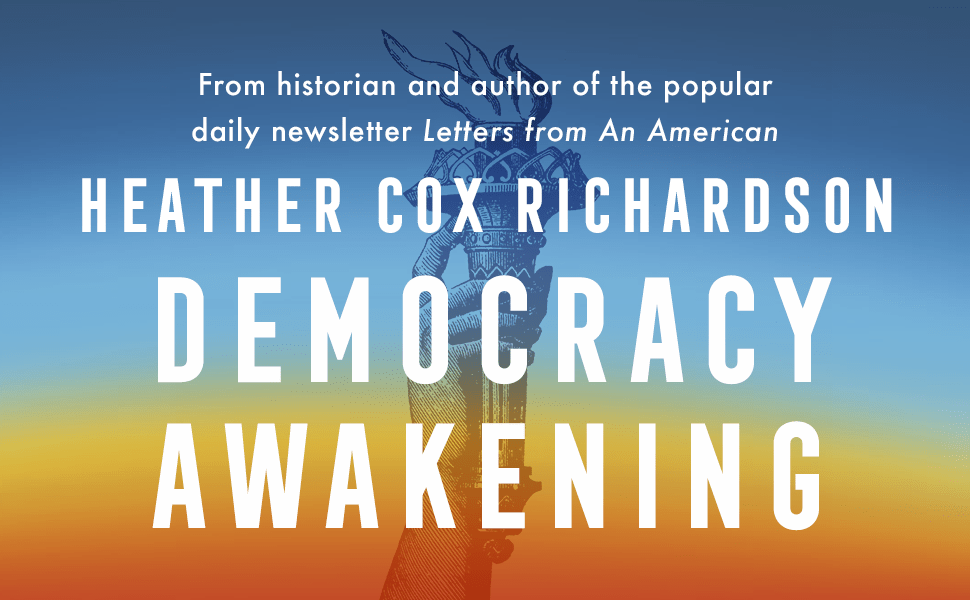
Democracy Awakening by Heather Cox Richardson – Review Part One

by James Wallace Harris

Americans have general thought of America as a democracy, although it’s never been a true democracy. When the United States of America was first created a limited number of white males could vote. As time progressed more white males were allowed to vote. As liberals and radicals influenced politics, they advocated for wider suffrage state by state. See this timeline for details, but the Fifteenth Amendment in 1870 gave black men the vote, and in 1920 the Nineteenth amendment was passed that gave women the vote in all states. Whites have always suppressed black voters, and even some men still resent women voting. And political parties have always tried to control who could vote and how, and even suppressing voting.

A true democracy would allow every citizen over a certain age to vote, or universal suffrage. Before the 21st century most Americans didn’t see that as a problem, but as ethnic demographics have changed it has turned some Americans against democracy.

America is supposed to have a representative democracy, but it inspired the formation of political parties supported by various special interest groups fighting for power. In America Awakening Heather Cox Richardson describes how we’ve reached the current state where liberals advocate more democracy and conservatives push for less, apparently wanting authoritarian rule instead. Authoritarians general promote some ideal in the past as the authority of how things should be govern. Most modern American authoritarians look to either the Founding Fathers and the Constitution or to God and The Bible, or a combination of both. Modern American authoritarian leaders tend to be white and paternalistic, and their followers tend to want a strong man, or strong father figure, although more women are wanting to be Republican leaders too.

Richardson says it’s important to understand that many terms like conservative, liberal, radical, Republican, and Democrat have changed over the centuries. In the 19th century Republicans were for African Americans voting, and for gun laws, and in the early 20th century, for regulations on corporations. In the 19th century and through the first half of the 20th century, Democrats tried to keep African Americans from having the vote. The Republican and Democratic parties went through a polarity change in the 1960s. Richardson says its important understand how words have changed meaning because authoritarians often abuse them and justify their abuse by claiming history supports their new definitions. In other words, history gets distorted and abused.

I’m reviewing Democracy Awakening because I think it’s an important book everyone should read for the 2024 U.S. presidential election, but also to push my ability to remember. I love reading nonfiction books, but their information often feels like it goes in one ear and out the other. I can only retain what I learn in the vaguest way. Since I’m also reading about memory and aging, I’ve decided to read Democracy Awakening differently. I’m going to distill what Richardson is saying into my own words but in some concise form that I hope I can remember. I’ll do that in a series of blog posts, outlines, tables, etc.

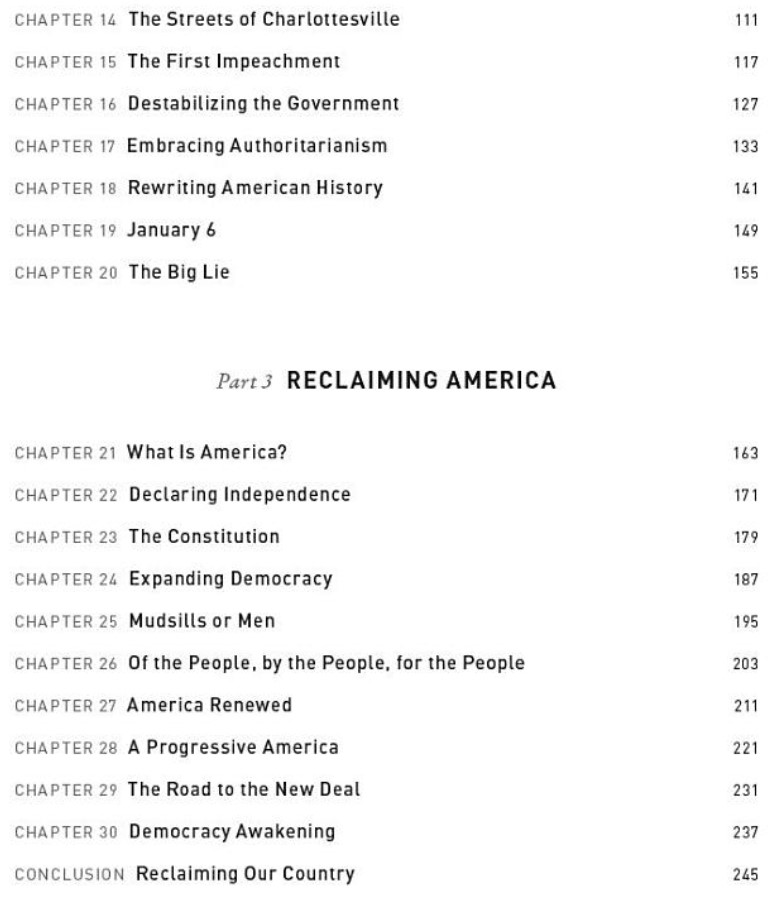
My friend Linda and I are reading Democracy Awakening together and for our first discussion we are covering Part 1, Chapters 1-10, which I hope to cover today. Here is the Table of Contents.

Because I’ve also read other books on this subject already, including watching related documentaries and YouTube videos, I’m going to reference them in this series to show how there’s a synergy in my reading.

Heather Cox Richardson is a history professor who has specialized on the history of the Republican Party through a series of books. I have not read these books, but I have read some about each and it gives me confidence that Richardson is an expert on this subject. On the internet there are zillions of people claiming to be knowledgable on specific subjects but when you check into their creditials, you find little to back their claim of authority.

Richardson makes her points by citing historical events. I wish I could remember all the cited dates and important changes in history because they show an evolution of how we got to today. The first ten chapters progress mostly in a linear fashion, so I hope to eventually create a timeline.

Richardson also quotes significant papers, speeches, books, and other sources to reveal how concepts emerged that cause people to seek political change. Just the history of African Americans seeking Civil Rights reveals many connections to how conservatives and liberals changed their parties and political goals. I’d like to make a list of the most significant quotes to remember. And I’d like to read the books Richardson references, including books by conservative writers. But this will take a lot of time.

And there’s another problem, both conservatives and liberals use the Founding Fathers as historical authority even though members of both political parties distort history for their cause. Republicans like to cite the past, both the Founding Fathers, and The Bible, as how to create or interpret laws. This is rediculous. 2023 isn’t 1776, or 800 BCE. Yet, reading Richardson’s book Democracy Awakening shows the democracy we have today is constantly changing, and how those changes comes from actions in the past.

It is well documented that Republicans feel the United States took a wrong turn in the 1930s when FDR’s administration created the New Deal. They’ve been trying to undo it ever since. And their methods and philosophy of why and how have evolved over the decades. Part of that evolution is moving away from democracy, which is what Richardson’s book is about.

Richardson believes we didn’t fall into fascism in the 1930s because the United States has a long history of various groups fighting for suffrage. That the history of United States is one of a ruling class struggling to keep power from various groups of people wanting to vote. This includes poor whites, African Americans, women, and immigrants. The current Republicans know they cannot win with universal suffrage and fair elections and so they have to do an end run around democracy.

Republicans formed coalitions with special interest groups that the leaders of the party have no interest in supporting. What has changed is the special interest groups have taken over the power from the old Republican elites. Neither the Republicans nor Democrats have a clear majority with voters, and depend on Independents who swing their votes.

The main problem revealed in the first part of Democracy Awakening is the country is dividing itself into two camps. Those who want an authoritarian government based on their version of the Founding Fathers and their version of Christianity, and those people who want universal suffrage and a true democracy.

The authoritarians cannot get what they want by existing voting laws and population demographics. That’s why they are undermining the election process. Since majority rule is 50%, these two groups are polarized. Neither Republicans or Democrats have a majority. They depend on swing votes from Independents.

What I’m hoping to see in the next two parts is whether or not Richardson thinks democracy can survive. I was recently terrified by a New York Times essay, “Trump Has a Master Plan for Destroying the ‘Deep State’” by Donald P. Moynihan. In it Moynihan says Trump has three goals which I’ll take out of context and quote here:

The first is to put Trump loyalists into appointment positions. Mr. Trump believed that “the resistance” to his presidency included his own appointees. Unlike in 2016, he now has a deep bench of loyalists. The Heritage Foundation and dozens of other Trump-aligned organizations are screening candidates to create 20,000 potential MAGA appointees. They will be placed in every agency across government, including the agencies responsible for protecting the environment, regulating workplace safety, collecting taxes, determining immigration policy, maintaining safety net programs, representing American interests overseas and ensuring the impartial rule of law.

...

The second part of the Trump plan is to terrify career civil servants into submission. To do so, he would reimpose an executive order that he signed but never implemented at the end of his first administration. The Schedule F order would allow him to convert many of these officials into political appointees.

Schedule F would be the most profound change to the civil service system since its creation in 1883. Presidents can currently fill about 4,000 political appointment positions at the federal level. This already makes the United States an outlier among similar democracies, in terms of the degree of politicization of the government. The authors of Schedule F have suggested it would be used to turn another 50,000 officials — with deep experience of how to run every major federal program we rely on — into appointees. Other Republican presidential candidates have also pledged to use Schedule F aggressively. Ron DeSantis, for example, promised that as president he would “start slitting throats on Day 1.”

...

The third part of Mr. Trump’s authoritarian blueprint is to create a legal framework that would allow him to use government resources to protect himself, attack his political enemies and force through his policy goals without congressional approval. Internal government lawyers can block illegal or unconstitutional actions. Reporters for The New York Times have uncovered a plan to place Trump loyalists in those key positions.

This is not about conservatism. Mr. Trump grew disillusioned with conservative Federalist Society lawyers, despite drawing on them to stock his judicial nominations. It is about finding lawyers willing to create a legal rationale for his authoritarian impulses. Examples from Mr. Trump’s time in office include Mark Paoletta, the former general counsel of the Office of Management and Budget, who approved Mr. Trump’s illegal withholding of aid to Ukraine. Or Jeffrey Clark, who almost became Mr. Trump’s acting attorney general when his superiors refused to advance Mr. Trump’s false claims of election fraud.

This is why I believe everyone should be reading Democracy Awakening. I believe Richardson’s book is defining what the 2024 election will truly mean at the deepest level.

JWH