Was My Brilliant Friend by Elena Ferrante #1 With Me?

by James Wallace Harris, 9/2/24

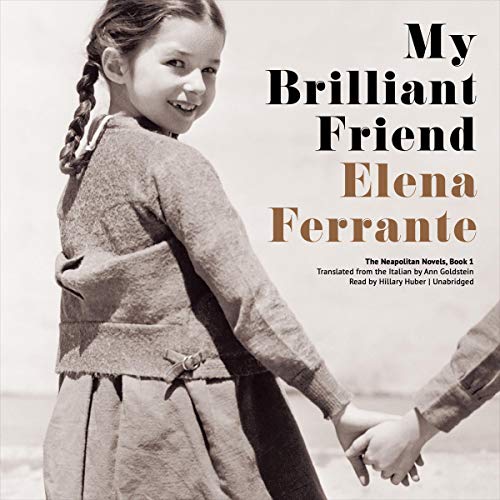
I just listened to My Brilliant Friend by Elena Ferrante because it was voted the best book of the 21st century so far by The New York Times. Well, it was #1 on the list voted for by 503 writers, critics, and editors. It was #8 on the list voted for by the NYT’s readers. And it was #11 on a list created by The Guardian. It wasn’t my #1 twenty-first century read, but it might be in my Top Ten. I should create a Top 100 list for the books I’ve read so far this century. Right now, #1 would be The Warmth of Other Suns by Isobel Wilkerson.

Ranking books is ridiculously hard. Even describing my exact feelings about a book is extremely hard. But I can say, My Brilliant Friend is the kind of novel I rate as being the best kind of novel, and those are the ones that feel autobiographical.

We don’t even know who Elena Ferrante is, so there’s no telling if the novel is autobiographical. There is even speculation the author could be a man, but I doubt it. This book reads like the absolute best of women writers. However, it also reads like it describes the author’s own childhood and adolescence. And it feels like it’s about two very real people. Of course, the story could be entirely made up.

When I was young, and an English major in college we used to argue over whether a novel is best understood as a standalone work, or from a larger context of when, where, why, and who wrote it.

Back then, when I was young, I argued that a novel had to be judged as a standalone work.

Now that I am old, I disagree completely with my younger self. Just judging a book by itself is like looking at the tip of an iceberg that floats above the ocean. You also need to consider the rest of the mountain of ice below the waterline to get the complete picture.

Because Ferrante hides her identity, I can’t do that. Without reading several biographies and collections of letters, plus interviews and other works about her writing, I can only react to My Brilliant Friend as a standalone work.

My Brilliant Friend is very readable, compelling, engaging, moving, and sometimes inspiring. It’s told in two sections: Childhood and Adolescence. The narrator tells us that the story is about Raffaella Cerullo, who her friends call Lina, but she calls Lila. The narrator’s name is Elena Greco but is called Lenuccia or Lenù by others in the story. The story is set in Naples in the 1950s and early 1960s. In the first section the girls are eight or nine, and in the second section, they are fourteen to sixteen.

The first section is about how the two girls compete in grade school. Lina is the smartest, and Elena works hard to keep up with her. In the second section, Elena soars ahead academically. She gets to go to middle and high school. Lina does not and stays home to work in her father’s shoe repair shop. Yet, Lina reads on her own and is often far ahead of Elena intellectually and in maturity.

In My Brilliant Friend, the girls read Little Women. It’s so important to them, they reread the book until it falls apart. I have only read Little Women once, but I’ve seen several film adaptations, and I’ve read three biographies and watched one documentary on Louisa May Alcott. Little Women didn’t become impressive to me until I read those biographies.

I don’t think readers can deeply appreciate Little Women until they read a couple of biographies of Louisa May Alcott. I think that will also be true of My Brilliant Friend. Little Women was my mother’s favorite book from childhood. It was a favorite of her mother and sisters, and aunts. I’ve known many women for whom Little Women was something important that crossed generations. But then for hundreds of millions of readers and film goers, the story is good enough by itself. But I’d say, it’s just a wonderful sentimental tale until you get to know Louisa May Alcott.

I think the same could be true about My Brilliant Friend. I don’t know if My Brilliant Friend will be popular like Little Women has been in the 19th, 20th, and 21st centuries. I won’t live long enough to know. It might be.

I wonder why Elena Ferrante hides their identity. I wouldn’t want to be famous either. All that attention would be annoying. But if her novels are just made-up stories, ones with incredibly detailed character development, I think they will only be popular reads. However, to become classics, we need to know a lot more about Elena Ferrante.

At least I do.

JWH

If Ignorance is Bliss, is Knowing Suffering?

by James Wallace Harris, 6/27/24

This essay is about how keeping up with current events is hard on our mental health. Is there a point in becoming informed that turns self-destructive? Happiness seems to be a balance between knowing and not knowing, between learning and ignoring.

I’ve always been amazed by the amount of fiction we consume in our lives — the books, movies, television shows, plays, video games, role playing, comics, fantasizing, bullshitting, and so on. Is fiction our way of regulating our awareness of reality?

I’m trying to decide in this essay just how much news I should consume. I believe I have three basic choices:

  1. Ignorance really is bliss.
  2. Learn enough to maximize my own survival.
  3. Learn everything I can to answer why and maybe know what can be changed.

I also consider the first three lines of the Serenity Prayer practical advice:

God grant me the Serenity to accept the things I cannot change,
Courage to change the things I can, and
Wisdom to know the difference.

Mental health depends on knowing what can be changed and what cannot. I believe the old saying, “ignorance is bliss” is merely advising people not to try to change things. Eastern religion and philosophy are all about acceptance, and that might be one path to happiness, or at least contentment. Western religion and philosophy have always been about control, which often leads to frustration and unhappiness. However, Western religion and politics have always been delusional because they don’t know enough to wisely make changes. Too many people think they know, but don’t. And too many people pursuing ignorance follow the people who don’t know. In other words, even if you learn everything you probably won’t be able to do anything.

For most of my life I hoped humanity would evolve into a global humanistic society that was ecologically sustainable, maximizing freedom, and minimizing inequality. That’s obviously not going to happen. Instead, we’re returning to nationalism, xenophobia, and fascism. The growing consensus advocates: get all you can, protect what you have, and let the losers lose. Even Christians have become Darwinians.

The main message in the movies and television shows we consume is the good life is eating, screwing, buying, and travel. But hasn’t that made us the most invasive and destructive species on the planet?

I believe the fiction we consume, and the fantasies we chase, is our way of self-medicating a deep depression caused by seeing too much of reality. If I read or watch too many news programs, documentaries, or nonfiction books about what’s happening around the world I get bummed out and need to retreat. Is that the best thing to do? Or the only thing to do?

How much of learning about reality is educational, soul strengthening, and enlightening? Billions of people are suffering. How important is it to know that the majority of people on this planet spend a good deal of their lives in misery?

If you only watch NBC Nightly News, Fox News, MSNBC, or CNN, you’ll only end up worrying about problems in the United States. And that’s enough to depress most people. But if you take in news from around the world, it can deeply threaten your mental health.

I watch a lot of news from all over, and I’m convinced that our civilization is in decline. The number of failed nations grows every year. The number of weather catastrophes increases every year. Wars and famines are increasing. Life expectancies are declining. Economies are breaking down, and people are dying, becoming homeless or refugees, and suffering in ever-growing numbers. We’re lucky in the United States that we don’t suffer as much, but that’s why millions want to come here.

Decades ago, I stopped watching local news so I wouldn’t be depressed about crime. Even though I live in a high crime city, I seldom hear about it, and thus seldom worry. I could do the same thing with national and international news. That would be good for my mental wellbeing, but shouldn’t I do something?

Liberals believe society should alleviate suffering through laws. Conservatives want to solve the same problems by convincing everyone to pull themselves up by their bootstraps. The reality is liberals want to solve society’s problems by spending the conservative’s money, and the conservatives just want to ignore the problems and keep their money. And it seems the only problem politicians really want to solve is how to get reelected and feed their egos.

Civilization is coming undone. That’s all too obvious if you watch a lot of news and study local, state, federal, international, and world events. However, knowing, and even understanding the problems we face doesn’t empower us to solve them. We either solve them together, or not at all, and if you’re an ardent news watcher, you’ll know we’re living in an age where we don’t work together.

Here’s where I’d love to list and catalog all our problems and assess their chances of being solved. But that would take a book length bit of writing. I’m sure you see enough of the news to know about all the problems we face — or do you? Would knowing more help or hurt you?

I could construct a detailed taxonomy of all the problems we face. I could stop reading novels and watching television and study the heck out of current events. But other than finding enlightenment about why civilization is collapsing, are there any mental, spiritual, or psychological benefits to learning how and why we’re self-destructing?

The real question is: Can we do anything to stop our self-destruction if we all agreed to work together and knew the right solutions? Even if we banned all airplane travel, reduced car travel to a minimum, rebuilt the energy grid that maximized renewable energy, and we all became vegetarians, we’ve already put enough CO2 in the atmosphere to radically change the climate. We may have already destabilized the climate so it can’t be reversed.

And we don’t have to wait until the seas rise above New York and London before climate change will do us in. We’re about to see the collapse of the home insurance industry which will completely destabilize the economy around home ownership. Just that might bring about economic chaos.

I could go on. Aren’t we like cattle in a stockyard? Would knowing about the captive bolt pistol offer any personal benefit in our lives? Or is there a kind enlightenment to be achieved by figuring out how the system works?

JWH

ChatGPT Isn’t an Artificial Intelligence (AI) But an Artificial Unconsciousness (AU)

by James Wallace Harris, 2/12/24

This essay is for anyone who wants to understand themselves and how creativity works. What I’m about to say will make more sense if you’ve played with ChatGPT or have some understanding of recent AI programs in the news. Those programs appear to be amazingly creative by answering ordinary questions, passing tests that lawyers, mathematicians, and doctors take, generating poems and pictures, and even creating music and videos. They often appear to have human intelligence even though they are criticized for making stupid mistakes — but then so do humans.

We generally think of our unconscious minds as mental processes occurring automatically below the surface of our conscious minds, out of our control. We believe our unconscious minds are neural functions that influence thought, feelings, desires, skills, perceptions, and reactions. Personally, I assume feelings, emotions, and desires come from an even deeper place and are based on hormones and are unrelated to unconscious intelligence.

It occurred to me that ChatGPT and other large language models are analogs for the unconscious mind, and this made me observe my own thoughts more closely. I don’t believe in free will. I don’t even believe I’m writing this essay. The keyword here is “I” and how we use it. If we use “I” to refer to our whole mind and body, then I’m writing the essay. But if we think of the “I” as the observer of reality that comes into being when I’m awake, then probably not. You might object to this strongly because our sense of I-ness feels obviously in full control of the whole shebang.

But what if our unconscious minds are like AI programs, what would that mean? Those AI programs train on billions of pieces of data, taking a long time to learn. But then, don’t children do something similar? The AI programs work by prompting it with a question. If you play a game of Wordle, aren’t you prompting your unconscious mind? Could you write a step-by-step flow chart of how you solve a Wordle game consciously? Don’t your hunches just pop into your mind?

If our unconscious minds are like ChatGPT, then we can improve them by feeding in more data and giving it better prompts. Isn’t that what we do when studying and taking tests? Computer scientists are working hard to improve their AI models. They give their models more data and refine their prompts. If they want their model to write computer programs, they train their models in more computer languages and programs. If we want to become an architect, we train our minds with data related to architecture. (I must wonder about my unconscious mind; it’s been trained on decades of reading science fiction.)

This will also explain why you can’t easily change another person’s mind. Training takes a long time. The unconscious mind doesn’t respond to immediate logic. If you’ve trained your mental model all your life on The Bible or investing money, it won’t be influenced immediately by new facts regarding science or economics.

We live by the illusion that we’re teaching the “I” function of our mind, the observer, the watcher, but what we’re really doing is training our unconscious mind like computer scientists train their AI models. We might even fool ourselves that free will exists because we believe the “I” is choosing the data and prompts. But is that true? What if the unconscious mind tells the “I” what to study? What to create? If the observer exists separate from intelligence, then we don’t have free will. But how could ChatGPT have free will? Humans created it, deciding on the training data, and the prompts. Are our unconscious minds creating artificial unconscious minds? Maybe nothing has free will, and everything is interrelated.

If you’ve ever practiced meditation, you’ll know that you can watch your thoughts. Proof that the observer is separate from thinking. Twice in my life I’ve lost the ability to use words and language, once in 1970 because of a large dose of LSD, and about a decade ago with a TIA. In both events I observed the world around me without words coming to mind. I just looked at things and acted on conditioned reflexes. That let me experience a state of consciousness with low intelligence, one like animals know. I now wonder if I was cut off from my unconscious mind. And if that’s true, it implies language and thoughts come from the unconscious minds, and not from what we call conscious awareness. That the observer and intelligence are separate functions of the mind.

We can get ChatGPT to write an essay for us, and it has no awareness of its actions. We use our senses to create a virtual reality in our head, an umwelt, which gives us a sensation that we’re observing reality and interacting with it, but we’re really interacting with a model of reality. I call this function that observes our model of reality the watcher. But what if our thoughts are separate from this viewer, this watcher?

If we think of large language models as analogs for the unconscious mind, then everything we do in daily life is training for our mental model. Then does the conscious mind stand in for the prompt creator? I’m on the fence about this. Sometimes the unconscious mind generates its own prompts, sometimes prompts are pushed onto us from everyday life, but maybe, just maybe, we occasionally prompt our unconscious mind consciously. Would that be free will?

When I write an essay, I have a brain function that works like ChatGPT. It generates text but as it comes into my conscious mind it feels like I, the viewer, created it. That’s an illusion. The watcher takes credit.

Over the past year or two I’ve noticed that my dreams are acquiring the elements of fiction writing. I think that’s because I’ve been working harder at understanding fiction. Like ChatGPT, we’re always training our mental model.

Last night I dreamed a murder mystery involving killing someone with nitrogen. For years I’ve heard about people committing suicide with nitrogen, and then a few weeks ago Alabama executed a man using nitrogen. My wife and I have been watching two episodes of Perry Mason each evening before bed. I think the ChatGPT feature in my brain took all that in and generated that dream.

I have a condition called aphantasia, that means I don’t consciously create mental pictures. However, I do create imagery in dreams, and sometimes when I’m drowsy, imagery, and even dream fragments float into my conscious mind. It’s like my unconscious mind is leaking into the conscious mind. I know these images and thoughts aren’t part of conscious thinking. But the watcher can observe them.

If you’ve ever played with the AI program Midjourney that creates artistic images, you know that it often creates weirdness, like three-armed people, or hands with seven fingers. Dreams often have such mistakes.

When AIs produce fictional results, the computer scientists say the AI is hallucinating. If you pay close attention to people, you’ll know we all live by many delusions. I believe programs like ChatGPT mimic humans in more ways than we expected.

I don’t think science is anywhere close to explaining how the brain produces the observer, that sense of I-ness, but science is getting much closer to understanding how intelligence works. Computer scientists say they aren’t there yet, and plan for AGI, or artificial general intelligence. They keep moving the goal. What they really want are computers much smarter than humans that don’t make mistakes, which don’t hallucinate. I don’t know if computer scientists care if computers have awareness like our internal watchers, that sense of I-ness. Sentient computers are something different.

I think what they’ve discovered is intelligence isn’t conscious. If you talk to famous artists, writers, and musicians, they will often talk about their muses. They’ve known for centuries their creativity isn’t conscious.

All this makes me think about changing how I train my model. What if I stopped reading science fiction and only read nonfiction? What if I cut out all forms of fiction including television and movies? Would it change my personality? Would I choose different prompts seeking different forms of output? If I do, wouldn’t that be my unconscious mind prompting me to do so?

This makes me ask: If I watched only Fox News would I become a Trump supporter? How long would it take? Back in the Sixties there was a catch phrase, “You are what you eat.” Then I learned a computer acronym, GIGO — “Garbage In, Garbage Out.” Could we say free will exists if we control the data, we use train our unconscious minds?

JWH

On Rereading

by James Wallace Harris, 10/2/23

This week I started rereading Catch-22 by Joseph Heller, a novel first published in 1961. I was shocked by how much I disliked it. In my memory it was a terrific book. Back in 1970 I went to see Catch-22 the movie when it came out. I was so impressed I went to a bookstore, bought the book, went home, read it, and then went back to see the film again. For over fifty years I’ve thought of Catch-22 as a classic.

This week I listened to two hours of the novel before giving up. I can’t believe I ever loved that book. It’s sort of like how I feel when I catch Gilligan’s Island on TV, I can’t believe that in the eighth grade it was my favorite television show. Whenever I see a clip of Gilligan’s Island now, I assume I must have been brain damaged as a kid. I wondered the same thing when listening to Catch-22.

Maybe I’ve just lost my sense of humor. I loved Saturday Night Live when it came out back in 1975, but I’ve found it painful to watch for decades now. I’ve come to realize that I truly dislike lame satire. Heller appeared to take one absurdist point-of-view and stretched it out over a 21-hour audiobook. It felt like hearing a Who’s on First routine that never ended.

I came to the book expecting to find philosophical insight into WWII, and it just wasn’t there. Catch-22 is considered an anti-war classic, but I didn’t feel that in 2023. The film version of M.A.S.H. also came out in 1970. That was the height of the Vietnam War. Both stories felt like anti-war brilliance in 1970, but insane in 2023. Fifty-three years later, and after many other wars, such silliness no longer seems appropriate.

Obviously, I’ve changed over the decades, but I think there’s something else that’s changed. Postmodernism has crashed and burned. Postmodernism took us down a wrong path, and it’s time to retrace our steps.

I still reread my childhood favorite book, Have Space Suit-Will Travel which came out in 1958. It continues to work. It seems to be a genuine touchstone to my past. I find great insight into who I was as a kid and who I wanted to be when I grew up. To me, it was a science fiction version of Great Expectations — including the cynicism I give it in retrospect.

I also read an abridged version of Great Expectations in high school and have reread the full novel since. It seems to grow in maturity, especially as I read more about Charles Dickens. As a teenage boy I identified with Pip and his frustration with Estella. But as an old man, I figure Pip was a stand-in for the older 1858 Dickens, and Estella and Miss Havisham were stand-ins for Ellen Turan and her mother. The depth of Great Expectations grows with every rereading.

This morning I watched a video about rereading books by Anthony Vicino called “You Should Read These 12 Books Every Year.” Vicino is one of those people who want to get ahead in life quickly by reading self-help books. Because he wanted to succeed quickly, and many successful CEOs read fifty-two books a year, Vicino decided to read one hundred books in a year and get ahead twice as fast. What Vicino learned was to read fewer books. And rereading was the secret to success.

I’ve been thinking I need to do more rereading. This video made me wonder what twelve books I would reread every year. Would they be fiction or nonfiction? And would they be modern or postmodern? I’m starting to think we all took a wrong turn around 1960, at least in fiction. The trouble is since 1960 nonfiction has been overwhelming us with expanding knowledge that we need. Art and philosophy couldn’t handle that explosion of information and we got postmodernism.

I need to do a lot of rereading, and rethinking. What books will be ruined by my maturity and what books will reveal their own deeper maturity?

JWH

Books Do Furnish a Room by Anthony Powell

by James Wallace Harris, 9/16/23

Books Do Furnish a Room is book ten in Anthony Powell’s series A Dance to the Music of Time covering the years 1945-1947 in the fictional life of Nick Jenkins. After the war, England is rebuilding, food is rationed, liquor is scarce, and Nick is trying to make a living by reviewing books. I’ve read in Powell’s biography, Anthony Powell: Dancing to the Music of Time by Hilary Spurling that Powell was reviewing as many as twenty books a month to make ends meet. Sometimes I wish that A Dance to the Music of Time was a series of memoirs rather than novels because I’d love to know the basis for all the satire in Nick’s life.

For instance, two of the main characters in Books Do Furnish a Room are Pamela Widmerpool and X. Trapnel. Powell supposedly based them on Barbara Skelton and Julian Maclaren-Ross. They aren’t nice characters either. Pamela is a notorious emasculator of men, yet men can’t resist her. Trapnel is a talented posser who sponges off everyone he meets. Pamela is married to Kenneth Widmerpool, a character who is in all twelve novels of the series.

Nick met Widmerpool at school, where he was despised by the other boys for being fat, poor, and a loser. Yet throughout the novels, Widmerpool keeps climbing higher on the social ladder until he’s a member of Parliament. It is quite strange that he ends up with Pamela, an extremely beautiful woman.

Books Do Furnish a Room is about Fission magazine that Nick, Kenneth, and X. Trapnel all write for. It was backed by Erridge, Earl of Warminster, Nick’s brother-in-law, who dies at the beginning of the story. One of the founders of Fission is J. G. Quiggin who has been in earlier novels and is a Marxist. In fact, many of the characters in these books are left leaning. Powell suggests England was full of fellow travelers, communists, and Marxists, even Kenneth Widmerpool.

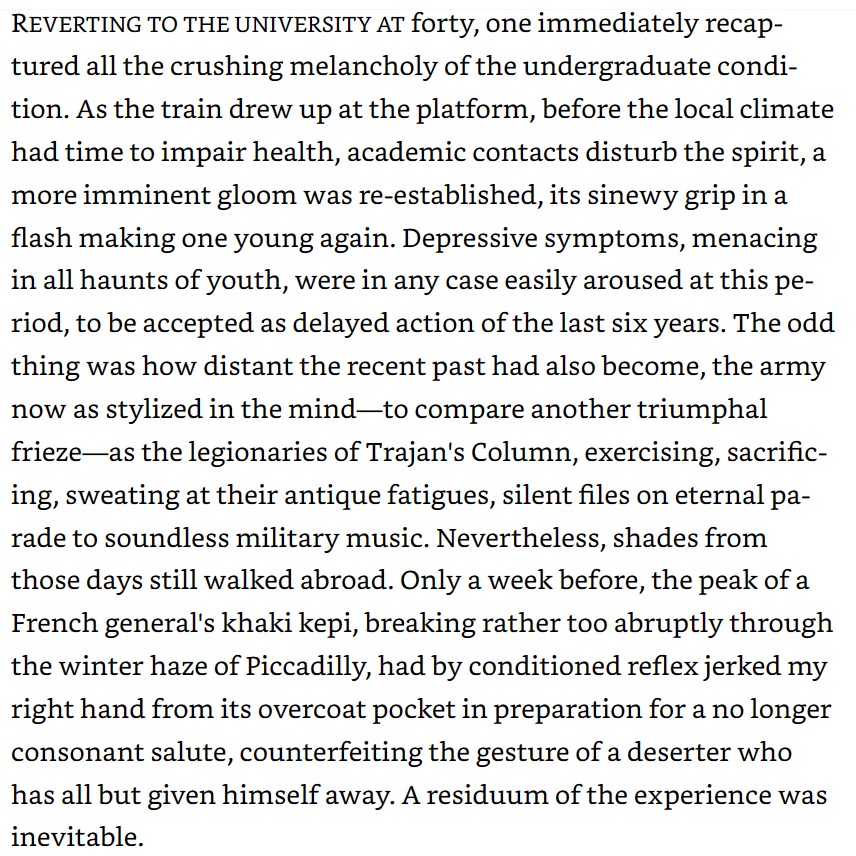
The hardest thing to describe about this story is the humor. It’s very dry. I remember hearing Powell’s prose being described as a cross between Evelyn Waugh and P. G. Wodehouse. In one of the opening scenes Pamela flees a funeral service during a bout of nausea, almost knocking down the pallbearers of Erridge. Later she vomits into a five-foot tall Chinese vase that may or may not be rare, and there’s a funny seen of several men trying to wash it out. But Powell’s slapstick scenes are rare. Most of his prose is like the opening paragraph:

Books do Furnish a Room begins the final trilogy of books in A Dance to the Music of Time, and it deals with the academic and literary world. The story begins with Nick meeting Sillery, his old school master again. Nick is also researching a book he’s writing on The Anatomy of Melancholy, a 1621 book by Robert Burton. This was a real book, and maybe if I knew it better, it might relate to this story. Throughout Books do Furnish a Room, Nick mentions many books, most of which are fictional. It’s a challenge to discern references to real works and works that belong only in Nick Jenkins’ reality. The most important made-up novel is Camel Ride to the Tomb by X. Trapnel. In the eleventh novel, Nick meets Trapnel’s biographer, so its importance stretches over two books.

There was a 1997 4-part miniseries based on A Dance to the Music of Time. You can get them on YouTube. It’s quite a rush job to cram twelve novels into four TV episodes that are less than two hours each. However, they do cover the highlights of the entire series. I’ve seen it twice and I’m watching parts of it for a third time. You can get a feel for Books Do Furnish a Room by watching the first third of this episode. (By the way, the actress that plays Pamela looks nothing like how I imagined her from the novel. But the scene I mentioned above is in this sequence.)

JWH