My Problem with the Terms “Evil” and “Free Will”

by James Wallace Harris, 11/8/23

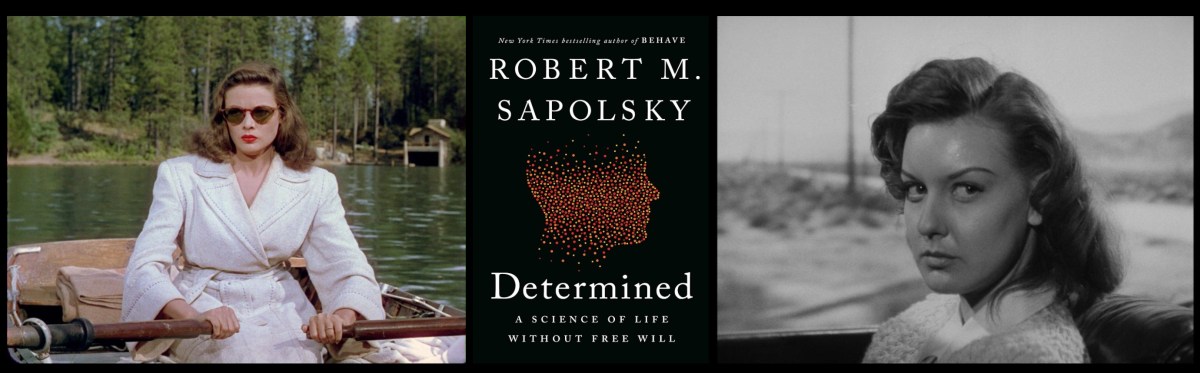
Yesterday my friend Mike and I were talking about evil women characters in old movies. We both immediately thought of the character Ellen Berent Harland (Gene Tierney) in the 1945 film, Leave Her to Heaven. I told Mike that I had just read a review of Detour, also from 1945, that featured one mean woman, Vera, played by Ann Savage. The reviewer said she was the evilest woman in all of film noir.

This got me Googling the phase “evil women in the movies” and finding several lists: 25 Of The Best Female Villains You’ll Love To Hate, The Greatest Female Villians, 10 Awesomely Sinister Women in Movie History, Most Memorable Female Villians. Not to surprising, most of the films listed were recent. What was surprising, was most modern female villians are from fantasy, horror, or animated films. Mike and I were thinking about ordinary realistic women in films.

Mike texted me:

I make a distinction between evil and insane. For example, Kathy Bates in Misery, Jessica Walter in Play Misty for Me, and Glenn Close in Fatal Attraction play characters that I consider insane, not evil. The Barbara Stanwyck character in Double Indemnity is not insane, just evil. The same goes for Gene Tierney in Leave Her to Heaven.

I texted back:

Evil is a slippery word for me. In the original religious term God was the source of all good and the Devil was the source of all evil. Being evil meant you were doing the work of the devil. It connotes that the person is a puppet of the devil. Or worshipping of the devil by doing the kind of things he wanted done. Being evil meant being devilish.

By the way, in the old days being insane meant being possessed by the devil. So judging someone evil or insane was close to the same thing.

In the modern sense of how we use those words it all relates to free will. An insane person has lost control of their free will. An evil person chooses to do evil.

But we have a problem. Recent research suggests no one has any free will. 

Now, our fun conversation has turned serious, but I think valid. If we don’t have free will, how do we judge people we think are doing wrong? I just bought the book Determined: A Science of Life Without Free Will by Robert M. Sapolsky but haven’t read it yet. However, I have been reading reviews and watching interviews with Sapolsky. What he’s saying is based on brain research that I’ve been reading about for years. We don’t have free will. The trouble is our moral and ethical structures depend on people either being sane and deciding on their own actions, or insane and out of control. What if we have no control over our actions at all?

The nightly news is full of people I’d call evil. What if we took a different approach to the problem. What if we say killing innocent children is evil no matter if you have free will or not. Does it matter if the evil person is consider sane or insane? Or has free will or not? What we’re horrified by is bad things happening to good people.

Modern films have made evil rather cartoonish by portraying the bad guy as over the top in their evilness. The films Mike and I were talking about, Leave Her to Heaven and Detour, are mundane portrayals of evil. I think the gigantic evils we see in the news, and the unrealistic portrayals of evil in modern movies, have made us forget the everyday type of evils. We no longer expect everyone to be honest and civil, and bad behavior is often claimed to be free expression and a personal right.

I don’t like what I see on the news, or in modern movies and television shows. And the behaviors I’m seeing on the freeways and while shopping is disturbing too. Maybe we don’t have free will, but we could at least act like we do. Maybe pretending to be good is all we can hope for.

I’m reminded of a science experiment I read about back in the 1960s where they put many rats in small confined cages to simulate overpopulation. The rats became violent, tearing at each other. I think that’s what’s happening to us today. Overpopulation is causing us to go mad. But that also supports the argument that there’s no free will.

Even though neuroscience is revealing there’s no free will, I wonder if free will isn’t something we could develop? Can we overcome genetics and conditioning? Is there some way we can consciously reprogram our unconscius minds. The reason why scientists say we have no free will is because they can measure brain activity happening before we’re consciousnessly aware of our choices and actions. Is there no way to condition our unconscious minds to act in the ways we consider ethical?

It’s obvious that any adult who follows the same beliefs they were taught as a child is not acting on free will. Most people believe what they are taught early in life. But if they radically change what they believe, is that a case of free will? If someone raised a Baptist grows up and spends many years trying out different religions, and ends up choosing to become a Zen Buddhist, is that free will?

When you watch movies think about whether or not the antagonist is acting on their own, or from genetics and conditioning. Do the same when you are watching the news. Does Putin have free will? The current war in the middle East is just like all the wars of history. Maybe we don’t change because we can’t.

Still, the idea of being able to change ourselves intrigues me. Science might prove we don’t have free will, but does that mean we should stop trying to change ourselves?

I’ve been paying attention to my dreams lately, so I’m getting to know my unconscious mind. I’m also working on developing good habits and breaking bad habits. And I think there are ways to reprogram how our unconscious minds function. If we could, wouldn’t that be an act of free will?

JWH

Ethical vs. Virtuous

by James Wallace Harris, 10/23/23

I try to be an ethical person but I’m not a particularly virtuous person. Some might define both terms, “ethical person” and “virtuous person,” as a good person. I’m reading The Lives of the Stoics by Ryan Holiday and Stephen Hanselman and it’s making me wonder if being ethical, or even a moral person is not the same thing as being a good, or virtuous person.

I believe morality is defined by theology, and ethics are defined by the consensus of humans. It’s how we divide right from wrong. Before I thought about it today, I assumed being moral or ethical meant you were a good person, and being unethical or amoral meant you were a bad person. But now that I’m reading the Stoics I’m wonder if they offer a different definition for being good or bad, mainly because they bring in the term virtue.

Stoicism is all about how you live life. Actions speak louder than philosophy. Being a virtuous person, a good person means acting in the positive. Doing good for yourself, your family and friends, for you community, nation, species, and planet. Being ethical or moral only means not breaking the rules, not being bad. That doesn’t make you good.

And I can imagine amoral and unethical people doing constructive things. And I can imagine ethical and moral people being destructive. I can see why the Stoics, and philosophers in general, argue so much.

Most of us fear and despise amoral, unethical, destructive people because they hurt us or people we know. But I’m not sure we are good people if we’re just ethical and moral. In my reading of the Stoics I’m getting the feeling that by virture we have to do something good to be good. But doing what is where philosophical problems arise.

We make exceptional people in our society who can do amazing things into stars and heroes. But should we equate success with virtue? Expecially success measured by money and fame? For the early Stoics like Zeno, working hard all day at a job was virtuous. To handle whatever life threw at you without complaining was virtuous. To take hardships and disease in your stride was virtuous. Of course, today we’d say that’s only being stoic.

Maybe I want to define virtue by what some people call saintly. Does someone have to bring diplomatic peace to the Mideast to be virtuous, or does just volunteering at food bank count? I haven’t read enough of ancient philosophy to know yet.

I do know the more philosophical I become the more I distrust words and concepts. I do enjoy reading about the Stoics, but ultimately, I’m not sure philosophy will be any more valid than religion was to me.

I used to say I was a Puritanical Atheist. Now I want to label myself an Existential Buddhist.

JWH

Is Ethical Capitalism Even Possible?

by James Wallace Harris, 10/20/23

This month, several of my friends have separately expressed doubt about the future. I don’t hold much hope either. Our current world civilization seems to be falling apart. Capitalism is consuming the planet, but capitalism is the only economic system that creates enough jobs to end poverty. The only alternative to free market capitalism I can imagine is if we adapt capitalism to an ethical system. So, I’ve been keeping my eye open for signs of emerging ethical capitalism.

Here’s one: “The Workers Behind AI Rarely See Its Rewards. This Indian Startup Wants to Fix That” from Time Magazine (8/14/23). The article describes how AI startups need vast amounts of sample data from other languages for their large language models. In India, many data companies are exploiting poor people for their unique language data and keeping the profit, but one company, Karya, is giving the poor people they employ a larger share of the profits. This helps lift them out of poverty.

Capitalism has two dangerous side effects. It destroys the environment and creates inequality. For capitalism to become ethical it will need to be environmentally friendly, or at least neutral, and it will need to be more equitable. If we want to have hope for the future, we need to see more signs of that happening.

Right now, profits drive capitalism. Profits are used to expand a corporation’s ability to grow profits, and to make management and investors rich. Labor and environmental controls are seen as expenses that reduce profits. For a corporation to be ethical it will have to have a neutral or positive impact on the environment, and it will need to share more of its profits with labor.

Since the pandemic hourly wages have been going up, and so has inflation. If capitalism becomes more ethical, costs for environmentalism and labor will go up, thus ethical capitalism will be inflationary. Some people have gotten extraordinarily rich by making things cheap, but it’s also shifted labor and environmental costs away from corporations onto the government and the public. The price at the store does not reflect the actual cost of making what you buy. You pay the difference in taxes.

For ethical capitalism to come about things will need to be sold for what they cost to make. That will involve getting rid of governmental and corporate corruption. It will involve political change. And it will be inflationary until the new system stabilizes.

My guess is ethical capitalism will never come about. If I were writing a science fiction novel that envisioned life in the 2060s it would be very bleak. Life in America will be like what we see in failed states today. Back in the 1960s we often heard of the domino theory regarding communism. Failed states are falling like dominoes now. Environmental catastrophes, political unrest, dwindling natural resources, and viral inequality will homogenize our current world civilization. Either we work together to make it something good, or we’ll all just tear everything apart.

Civilization is something we should all shape by conscious design and not a byproduct of capitalistic greed.

We have all the knowledge we need to fix our problems, but we lack the self-control to apply it. I have some friends who think I’m a dope for even holding out a smidgen of hope. Maybe my belief that we could theoretically solve our problems is Pollyannish.

I have two theories that support that sliver of hope. One theory says humans have always been the same psychological for two hundred thousand years. In other words, our habits and passions don’t change. The other theory says we create cultures, languages, technologies, systems that can organize us into diverse kinds of social systems that control our behavior.

We could choose better systems to manage ourselves. However, we always vote by greed and self-interest. We need to vote for preserving all.

In other words, we don’t change on the inside, but we do change how we live on the outside. My sliver of hope is we’ll make laws and invent technology that will create a society based on ethical capitalism and we’ll adapt our personalities to it.

I know that’s a long shot, but it’s the only one I have.

I’m working to develop a new habit of reading one substantial article a day and breaking my bad habit of consuming dozens of useless tidbits of data that catch my eye as clickbait. In other words, one healthy meal of wisdom versus snacking all day on junk ideas. Wisdom doesn’t come packaged like cookies or chips.

JWH

Fiction v. History

by James Wallace Harris, 9/25/22

Ken Burns’s new documentary, The U.S. and the Holocaust, punched me in the soul. No documentary has ever moved me as much, and I’ve seen a lot of them. And it’s not because it’s about the Holocaust. I’ve even read about most of the painful facts it presents before. No, the gestalt of this film, which is well over six hours, is to set off an epiphany about our relationship with history.

At the highest level, the documentary asks: What did Americans know about the treatment of the Jews under the Nazis from 1932 to 1945 and when and how did they learn it? But to answer that question Ken Burns and company have to describe what Americans were like during those years. The U.S. and the Holocaust give a different history of America for those years from any I’ve ever encountered from people, in school, reading, at the movies, or on television.

Maybe the best way I can describe it is to say: Everything that has horrified me about living through the years 2016 to 2022 existed in the 1920s, 1930s, and 1940s. The documentary cements a theory that I’ve been developing in recent decades – that people don’t change and even the percentages of the population that hold specific opinions don’t really change either.

The documentary set off this existential conundrum: Why didn’t I already know what the documentary revealed? Or did I just filter it out? Republicans are in an uproar over Critical Race Theory and other curricula that they’re afraid will upset their children. I imagine they will be just as upset at The U.S. and the Holocaust. I knew about the wide popularity of the KKK and eugenics in the 1920s. I knew Americans were mostly isolationists and anti-immigration in the late 1930s. But the documentary gives us a different take on history than what I was taught.

I have to wonder since FDR was president from 1932-1935, have we always gotten the Democratic party’s view of that history? I wonder if Ken Burns has rounded out the historical period by adding the Republican party’s take on those years? I do know the documentary feels very synergistic with today’s politics.

I love old movies from the 1930s and 1940s, and none of the hundreds of movies I’ve seen from that era convey what I learned from The U.S. and the Holocaust. My grandparents, parents, aunts, and uncles, all lived through those years, and none of them ever described the mood of the country revealed in the documentary. I’m a bookworm that has read countless works of both fiction and nonfiction about America in those decades, giving me some of the details from in the documentary, but not in the same gestalt. Two books that come to mind are One Summer: America, 1927 by Bill Bryson and In the Garden of Beasts by Erik Larson.

After I watched the Ken Burns documentary I read The Plot Against America by Philip Roth. It’s a kind of science fiction novel, an alternative history where Charles Lindbergh wins the 1938 presidential election and for many of the reasons described in the documentary. Roth was born in 1933, and he makes himself the point-of-view character in his novel. Young Phil is only 8 when it begins and 10 when it ends, but his viewpoint is mature. It’s about the anti-Semitism of those years.

I thought The Plot Against America was a well-told story about Jewish life in Newark, New Jersey 1938-1942. I thought Roth’s alternate history speculation was well done, deriving from the kind of knowledge I got watching The U.S. and the Holocaust. But the story is mainly a personal one, and its gestalt is different from the documentary.

Last night Susan and I watched Radio Days for the umpteenth time. It’s Woody Allen’s nostalgic look back at those same years. It completely ignores all the political history of The U.S. and the Holocaust. Radio Days is like both movies from that period and later films that worked to recall that era. They all filter out the nastiness of racism and xenophobia that existed in America back then. Although some of it came through in the film The Way We Were, and the book version of Breakfast at Tiffany’s.

And just before I watched the three episodes of The U.S. and the Holocaust I read Revolt in 2100 which contains a 1940 short novel by Robert A. Heinlein called “If This Goes On….” Heinlein imagined America would go through decades of The Crazy Years, before undergoing a second American revolution that created an American theocracy. I was disappointed that Heinlein didn’t do more world-building for his novel, but after seeing the Ken Burns documentary I understand his inspiration for writing it. It’s obvious that many Americans back then wanted a Protestant theocracy. Consisting of only white people from England, Germany, and some Scandanavian countries.

I think it’s important to distinguish fascism as a political philosophy from the Nazis, who were also fascists. What many Americans wanted then and now is basic fascism, and the Philip Roth novel shows how America could have turned fascist.

The other day I saw a quote on Facebook that went something like this: If you get warm and fuzzy feelings reading history then you’re not studying history. I’m on the third volume of world history by Susan Wise Bauer, and it’s brutal. Most people want to romanticize history, which is what we get from novels and movies. The Republicans don’t want CRT taught because they want their kids to feel all warm and fuzzy studying American History. The new Ken Burns documentary will not leave you feeling warm and fuzzy.

My current theory is humans can’t handle reality. That we develop all kinds of psychological delusions to filter reality out. We prefer our fantasies. And popular history along with pop culture gives us nice takes on the past that allows us to cope. It’s also why most people’s theory of how reality works is no more complex than a comic book. It’s why we’ve always clung to religion. It’s why I have a life-long love of science fiction.

We just can’t handle complexity. There are plenty of real history books that document the reality of the times they cover, but they aren’t widely read. Maybe the Republicans are right, and history is too brutal for children. But maybe we keep repeating history because we’re all too wimpy to handle history.

I’m getting so I can’t stomach the historical lies of Hollywood, but I don’t know if I can handle all that much real history either. I used to think that maybe four percent of the population was mentally ill. In recent years, I’ve upped that to forty percent. But lately, I’m thinking there’s an entry for all of us in the DSM-5.

JWH

When Will Women Have a Constitutional Right to an Abortion?

by James Wallace Harris, 6/25/22

Predicting the future is impossible, but we can speculate. The Supreme Court just changed its mind about how it interprets the Constitution regarding a woman’s right to an abortion, so can we expect it will change its mind again? Congress could pass a law giving women a right to an abortion but the Supreme Court could knock it down. The most lasting solution would be ratifying an amendment to the Constitution. That probably won’t happen anytime soon. But when might it be possible?

Anti-abortionists fought to reverse Roe v. Wade for half a century, will it take that long for the political pendulum to swing back? Polls show that a majority of Americans want abortion to be a legal right for women, so how did anti-abortion voters win? The common answer is they joined forces with the conservatives. The conservatives have also worked for decades to get what they want, and are succeeding because they have formed a tight coalition among several special interest groups.

I would assume feminists would have to join several other special interest groups and work with the Democrats to get what they want. Is that possible? What alignment of special interests would beat the alignment of specialist interests the Republicans have formed?

We must admire the conservatives for their dedication, focus, and work to get what they want. Are liberals willing to make an equal effort? Will liberals make a more significant effort to join school boards, get elected in city and state governments, work to influence law school curriculums, and do everything else the conservatives have done since the 1970s?

I have read many books about how conservatives have achieved their political goals over the last fifty years. Many of their tactics have not been honest or ethical. Will liberals go to such extremes? We are currently watching the conservatives subvert democracy to game the system. They have been sowing doubt on all the tools liberals would use to get what they want, especially science, education, medicine, journalism, and common sense.

Liberals have always relied on intellectual proof to fight for what they want, and conservatives have completely undermined intellectualism. Liberals can’t rely on logic to get what they want. They will need to build a coalition of passionate wants. Conservatives have won what they wanted with well-managed minority interests. Can liberals find enough minority interest groups to create a larger coalition than the conservative groups? They have the feminists, LGBTQ+, some minorities, environmentalists, and anti-gun, but who else? They used to have labor, but that’s not so anymore.

It would be great if the liberals could claim the scientists, but scientists are often people first and scientists second. The Republicans have done well with certain religious groups, are there other believers that would passionately support the liberals?

Are there interests that liberals could take back from the conservatives? The core driving force of conservatives has been anti-taxes. Greed is the most powerful political interest of all. If the Democrats could find ways to solve social problems by spending less money it would be a huge factor. If Democrats could find ways to improve the financial health of families and individuals without increasing taxes it would also help. Voters want security, stability, and law and order. Republicans have always been able to capitalize on that more than Democrats. If liberals want to swing the pendulum back their way, they need to change that.

I doubt I’ll live long enough to see the political pendulum swing back to the liberal side. The conservatives are still gaining momentum. I’ve seen a lot of change in my life, and if I live another ten or twenty years I expect to see a lot more. I never imagined that Roe v. Wade would be overturned. But then, the future has always been everything I never imagined.

JWH