Thinking Outside of Our Heads

by James Wallace Harris

I believe recent developments in artificial intelligence prove that many of the creative processes we thought came from conscious actions come from unconscious mechanisms in our minds. What we are learning is computer techniques used to generate prose or images are like unconscious processes in the human brain.

The older I get, the more I believe that most of my thinking comes from my subconscious. The more I pay attention to both dreams and my waking thoughts, the more I realize that I’m very rarely making conscious decisions.

I might think “I am going to walk across the street and visit Paul,” but I have no idea how to make my body walk anywhere. But then, I’ve always assumed muscle actions were automatic. It was mental actions I believed were conscious actions. I used to believe “I am writing this essay,” but I no longer believe that. This has led me to ask:

Just what activities do we perform with our conscious minds?

Before the advent of writing, we did all our thinking inside our heads. Homer had to memorize the Iliad to recite it. Prehistory was oral. How much of thought then was conscious or unconscious? Have you ever read The Origins of Consciousness in the Breakdown of the Bicameral Mind by Julian Jaynes? I know his theories have lots of problems, but they do imagine what I’m thinking about.

How often have you worried over a problem, say a math problem, or a programming problem, and gave up, but then later, usually after a nap or sleep, the solution came to you? That’s the classic view of unconscious thinking. But even when we’re thinking we’re solving a calculus problem is it really being done at a conscious level? Are you consciously recalling all your math lessons over a lifetime to solve the problem?

How often when working on a Wordle or Crossword does the word magically come to you? But sometimes, we are aware of the steps involved.

In recent years I’ve developed a theory that when we work with pen and paper, or word processor or spreadsheet, or any tool outside our body, we’re closer to thinking consciously. Sure, our unconscious minds are helping us, but making a list is more willful than just trying to remember what we need at the store.

Writing an essay is more willful than woolgathering in the La-Z-Boy. Authoring a book is far more willful still. Engineering a submarine by a vast team of people is an even more conscious effort. Sure, it involves a collective of unconscious activity too, but a vast amount documentation must be worked out consciously.

I’ve written before about this idea. See “Thinking Outside Your Head.” That’s where I reviewed different techniques and applications we use to think outside of our heads.

Many people want to deny the recent successes with AI because they want to believe machines can’t do what we do. That humans are special. If you scroll through the images at Midjourney Showcase, it’s almost impossible to deny that some of the images are stunningly beautiful. Some people will claim they are just stolen from human creativity. I don’t think that’s true.

I think AI developers have found ways to train computer programs to act like the human mind. That these programs have stumbled upon the same tricks that the brain evolved. Many great writers and artists often talk about their Muse. I think that’s just a recognition of their unconscious minds at work. What those creative people have learned is how to work consciously with the unconscious.

What some creative people are doing now is consciously working with two unconscious minds – their own and an AI. There is still a conscious component, the act of working with tools outside of our head. Where the action is, is that vague territory between the unconscious mind and the conscious one.

JWH

What Gives Me A Sense of Accomplishment at Age 71

by James Wallace Harris

When we were little kids grownups would ask: “What do you want to be when you grow up?” That plants a seed in us that we should have a goal for the future, to plan to do something and accomplish things. When we were little, we’d tell the grownups we wanted to be astronauts or rock stars, because those were the exciting glamourous occupations we knew about.

As we got older, we learned that becoming an astronaut requires getting advanced science degrees, and becoming a rock star means learning how to play the guitar and sing which takes ten thousand hours of practice, neither of which we really want to do.

As we got older we learned that just finishing doing anything had its own rewards. The trouble was learning what we like to do. I had to work at many shit jobs before I was 25 to learn what I actually liked doing, which was working in a nice office, messing with computers, and having coworkers who would become friends. Helping someone else accomplish their goals by programming a computer was what I eventually discovered I like doing. I found working at a university that helped other people to become what they wanted to be fulfilling to me.

Before we retire we think about all kinds of big things we want to do after we quit work. I thought about moving to New York City or living in England, or moving to a retirement community with a lot of social activities. But those things were like dreaming of becoming an astronaut when I was a kid. The reality of retirement was quite different. Susan and I decided to stay in the home we had. And my health problems made me not want to travel.

However, the urge to do something is still there. And even as I get older and can do less physically, I still have this desire that I should have a goal for the future, and to accomplish something. What’s rather fascinating is where and how I get my sense of accomplishment every day.

Nowadays, the future isn’t so far off. It’s either, “What am I going to do tomorrow,” or “What will I do today.”

My goals have become smaller and smaller too. A big one recently was cleaning out the attic. Our friends Anne and Tony came over and helped us get everything down, and now Susan and I are going through all the boxes and suitcases stacked up in the dining room to get rid of that stuff. When that task is done it will give me a reasonably big sense of accomplishment.

But I don’t need big things to accomplish to find satisfaction. Even going to the grocery store provides a satisfying sense of getting something done. It involves Susan and I planning our meals for the week, making a list, going shopping, and putting things away. All of that might take just a couple hours, but it wears me out and leaves me feeling I did do something worthwhile. Me and my old friends joke about how doing one thing like going to the grocery store makes us feel like we’ve gotten something done for the day. And the common joke is, “How did we ever have time for a job?”

If I look at my ToDoist app on my phone, I see a list of things to do that will make me feel good when I get to remove them from my To Do list. And most of those little goals are rather mundane: clean out the file drawers, find a new dermatologist, hire an electrician to install the new Blink security camera and light, cull out DVDs I’ll never watch again, get my eyes checked, and so on.

This is a long way from becoming an astronaut. We never hear people ask: “What do you want to do when you get old?” Theoretically, my retirement years could be longer than my work years. At one time I had big ambitions about what I would do with them, but like a kid growing up and discovering the reality of the work years, the reality of the retirement years is very different too.

A lot of what you can accomplish in retirement depends on money and health, and health really becomes the defining factor. I no longer have a bucket list of things I want to do because at some point the scope of life changes. My sister Becky once told me, “You start out life by living mostly in one room with someone changing your diaper and end up living mostly in one room with someone changing your diaper.” At the time that was funny, scary, and depressing. But as you get older, it becomes, “I can see that.”

I could still have a decade or two, or even three. That’s a lot of time. Unfortunately, it’s time when I’ll have dwindling energy and health. But I don’t think I’ll lose a sense of wanting to accomplish things.

I’m reminded of a short story by R. A. Lafferty called “Nine Hundred Grandmothers.” In it, a space explorer visits another planet and learns the beings there are immortal. However, they get smaller and smaller as they age. He is taken to a cave where the ancestors live on shelves in the wall. The further back he goes the tinier they get. That’s what life is like getting older. The scope of every day slowly gets smaller and smaller. You live with it.

Right now I measure accomplishments by how many books I read or essays I write. I like waking up in the morning and thinking of a goal and then achieving it during the course of the day. At 5:55am this morning I imagine writing this essay. It’s now 7:53am and I’ve almost got a first draft. I hope to finish it soon and eat breakfast. It’s great to start the day having completed a goal early.

Before I got up I also pictured cleaning up the house so our friend Leigh Ann could come over and Susan, Leigh Ann and I can spend the afternoon playing Rummikub. It’s not much of a goal, but it is satisfying.

And I look forward to tonight when Suan and I will watch another episode of Call the Midwife and A Place to Call Home. This might be silly, but I find watching complete series from pilot to finale gives me a sense of accomplishment. So each night I feel like we’ve done something by watching another episode from those two series.

Sometimes I even give myself big goals, ones that are daunting to me now. Ones that I have to push myself to finish. Like cleaning out and organizing my email and computer files on my hard drive. You might laugh, but I have thousands of emails and tens of thousands of computer files waiting to be examined.

Finally, there’s a weird symmetry to getting old. Susan and I have collected a lot of stuff in 45 years of marriage, and now we’re getting rid of all that stuff a little bit at a time. I have thousands of books that I still haven’t read. Ones I bought thinking that one day I’ll get to read. Well, that one day is here and I’ve got to get busy reading them. Finishing each one gives me a sense of accomplishment.

JWH (another thing done – 8:35am)

I Wish All My Family and Friends Blogged, I Wish Everyone Blogged

by James Wallace Harris, 7/16/23

What if everyone who ever lived kept an indestructible diary. Imagine reading what all our ancestors thought throughout their lifetimes. I don’t believe in an afterlife, but this could be the form of one. I’ve often wondered what my parents thought as they were growing up and got older. I’ve also wondered about my grandparents and what they thought about their lives. If they had written down their thoughts and were saved in some way, I could read them now. I wish I had a magic lamp and three wishes. This is how I’d use one of them.

I’ve always been somewhat interested in genealogy. However, just seeing names with dates of birth and death isn’t good enough. Whenever I see a genealogy chart I ask: Who were they, what did they think, what did they do?

The past is gone, so we can’t worry about that now. Although I have read accounts of people wanting to program an AI based on everything they could find out about someone they loved who died. The theory is if we programmed everything we know about a person, say Mark Twain or Ernest Hemingway into an AI, it might act like those men. That sounds creepy. On the other hand, one of my favorite science fiction stories, “Appearance of Life” by Brian W. Aldiss involved the protagonist finding memory cubes by two people who had been married and died years apart and putting them on a shelf so they talked to each other. It was both moving, tragic, and pathetic all at once.

Reading books by famous writers and biographies about them does convey a sense of who they were and how they reacted to their times. And biographies about famous people who left no writings of their own lack something. Look at the four Gospels — if only Jesus had written something himself.

Blogging offers the potential to do what I’m talking about. What if the Library of Congress archived all blogs. Would people in the 22nd century find our blogs interesting? What about the 43rd century?

If you pay attention to serious fiction and films, much of the trouble conveyed about the characters and interactions with other characters is due to a lack of communication. A good example is Celeste Ng’s first novel, Everything I Never Told You. Think about every person you ever loved, hated, or worked with, and what it would mean if you read their inner thoughts? Or at least the thoughts they wanted to share?

Also, it’s important to know that our thoughts are not coherent. Writing is the way we learn this. You’ll never know yourself only by thinking. Writing is a way to sculpt thoughts into something recognizable. Writing is the way to learn about yourself, and reading is the way to learn about other people.

Remember being back in school and all the emotional turmoil and conflicts caused by relationships, perceived relationships, and lack of relationships? Would we have been better people, kinder people, more self-aware people, if we had all blogged back then and read each others’ thoughts? Weren’t a lot of our problems as kids because we hid inside of ourselves and only speculated about our classmates? Would there be more or less school shootings if all the kids knew each other better?

Not only would growing up blogging help with self-expression, and communication, but it would have made us better learners and scholars. I’ve already written about “Blogging in the Classroom.”

I also wrote, “77 Things I Learned From Writing 1000 Blog Essays” which was mostly about how blogging is a great self-improvement tool. One of the main reasons I blog is it helps keep my mind together.

But I mostly wish everyone I knew blogged so I could learn more about them. Lately, I’ve been noticing how little we really communicate with one another. We have our public persona, and we hide the rest. I’ve noticed how many people as they grow older withdraw into themselves. We tend to just chat. Is that because we have given up on relationships? Or because we have more worries about ourselves and don’t want to worry about other people?

For some reason, we consume fiction hours a day. And it’s not the kind of fiction where we learn about people. It’s the kind that helps us forget and hide. Wouldn’t our lives be better if we learned more about real people and not imaginary people?

On the other hand, we are bombarded with personal problems and information overload every day. Maybe we watch television because we had enough of reality and real people? Even extroverts who crave constant social activity often stay at a shallow level of communication. Could the fact that we don’t all blog, or communicate deeply imply that’s what we prefer?

JWH

What I Learned Cataloging My Books, Ebooks, and Audiobooks on Goodreads

by James Wallace Harris, 3/21/23

I learned several things this week while entering over fifteen hundred books into my Goodreads database. The books I added were mainly acquired since I retired in 2013. One insight that impressed me the most was I was specializing in a limited number of topics. On one hand, I was disappointed by my narrow range of interests, but on the other hand, I was annoyed at myself for being scattered in my intellectual pursuits. You can’t get good at something if you try to get good at too many things.

If I judged my reading as a leisure activity it wouldn’t matter what I read. However, if I judged my reading as an education, then I was majoring in too many subjects. But here’s the kicker to this revelation. Before I started cataloging my books I assumed I was reading for fun and randomly exploring any subject that caught my fancy. It was only as I entered all the titles into the database did I realize that I have been specializing in several areas. And my immediate impulse was to read deeper into those topics and to go out and buy more books on those subjects.

Why was I chasing so many subjects when I’ve always wanted to be a master of one? Why would I want to do that? Yet, focusing on one would mean ignoring many things I want to know more about. That thought has started me to do a lot of naval gazing this week.

My original goal was to put all my books into my Goodreads database so I’ll know what I own to keep from buying duplicates when I’m at the used bookstore. So far I’ve found a shopping bag of duplicates which I gave to my buddy Mike. I entered all my books into Goodreads many years ago but didn’t update the database when I bought books or gave them away, so my Goodreads database was badly out of date. I had been putting this task off for years because I couldn’t figure out which books to add or delete from the system to catch up again.

My solution was to create a “shelf” called “2023 inventory” and reenter all my books linking them to that shelf. Then delete all the books in the system that wasn’t in the 2023 inventory.

After entering 1,506 books, which were all the physical books in the house, I had 3,159 total books in the database. That implied I could have given away 1,653 books, but then I realized that some of those might be Kindle or Audible books I own. Now I must go down the list of 3,159 books, and if they aren’t in the 2023 inventory, see if they are in my Kindle or Audible libraries. If they aren’t, I can delete them.

Doing all this librarian work has been rewarding in several ways. The work is revealing how my reading has shifted away from physical books to ebooks and audiobooks. This process has also revealed other insights about myself. For certain titles, and subjects I tend to buy both the audiobook and the ebook edition because that’s how I like to study them. And for some titles, I have the ebook, audiobook, and physical book. If I really like the book and subject, or if it’s fiction, and I really enjoy the story, I like getting into the book through all three formats.

I can spot my favorite authors because with some writers I’ve collected their books in all three formats. That also reflects a consolidation of interests, focus, and specialization.

When I used to go to parties I noticed that people tend to talk about things they loved most. The most interesting people were the ones who could expound deeply on a subject. Like most people, I just chatted about what little I knew about a zillion subjects.

I eventually observed that some people like to specialize and that some people even feel they are experts on their favorite subjects. It’s even fun to see two fans of the same subject argue over who knows more. I see from my data entry the subjects I’ve unintentionally tried to master. What’s funny is I seldom meet people interested in the subjects I’m interested in. Which is why I seldom talked much at parties. (This blog is my way of nattering about what I like.)

Thinking about people who know a lot about a little has led me to ask why I’d want to specialize in certain topics anyway? It’s not like I’m at a university trying to pass courses and get a major. I never go to parties anymore. I think it’s like my urge to catalog my books, which is a kind of anal pursuit, I also want to organize what I know.

There is a certain satisfaction in getting the biggest picture on the tiniest of topics. There is also satisfaction in collecting everything of a certain type. For example, I like westerns, so I collected my favorite western movies on DVDs. Then I started buying books about movie westerns. But after that, I started buying books about the history of the American West. I’ve done the same thing for classic rock and jazz music. While cataloging my books I realize I was gathering novels written in England between the wars, and books about their authors. That interest is also reflected in the TV shows I’m watching. Susan and I have recently watched all of Downton Abbey, Upstairs, Downstairs, and we’re currently going through the seven seasons of the first television version of All Creatures Great and Small.

The upshot of all these cataloging revelations is I want to focus more on my best subjects. And abandon some lesser interests to put more time into my majors. After I finish this project I could write my tombstone epitaph – “Here lies Jim Harris, this is what he liked to read:” I mean, isn’t what we focus on one of the best descriptions of our personality?

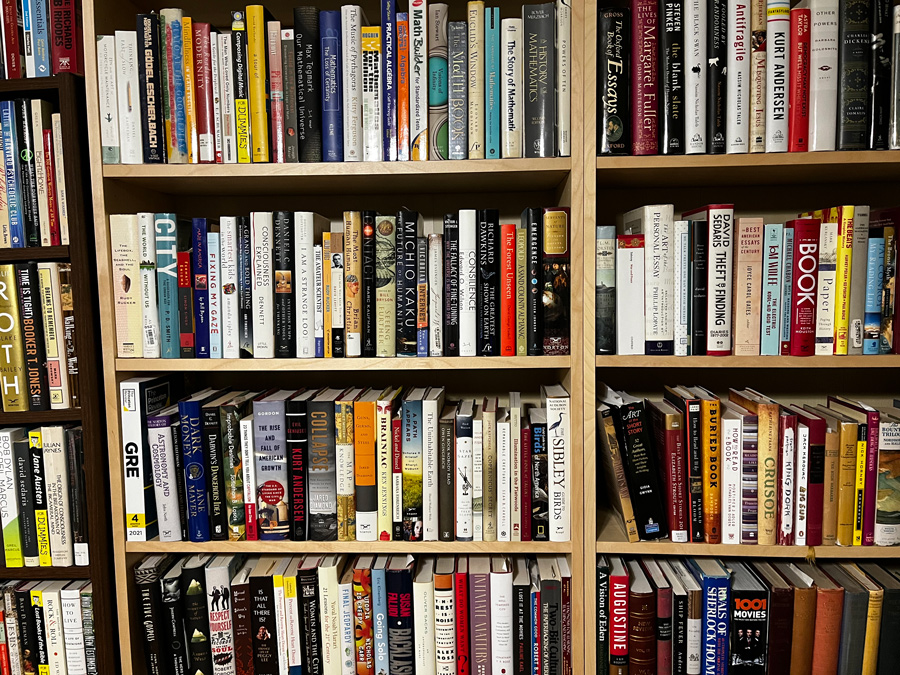
I only have nine bookcases. And they are all full. I don’t want to buy more bookcases. Nine’s my limit. I feel that’s also an analogy for my brain. It can only hold so much, so if I want to get better at one subject I have to forget about another.

If I want to buy more books I have to get rid of existing books to make room for the new ones on the shelves. This tends to distill my collection even further into specialized subjects. It also means I cull crappy books for better books.

But there is something else to consider. I’m getting older. I’m running out of time. My mental abilities are declining, which limits how much information I can process. And my physical abilities are declining, which also influences my book collecting. I can imagine a future where I can only handle six bookcases, or even three, and maybe down to just one.

I put every book I own onto a Rubbermaid rolling cart one shelf at a time to take them to my computer to enter their data. That physically wore me out. I’m thinking of getting rid of the heavy coffee table books in my collection just because in the near future I won’t be able to handle their weight. And there’s another reason I need to start shrinking my collection. If I should die I don’t want to burden my wife with having to get rid of a couple of tons of books. And if I ever need to move to a retirement apartment or assisted living I wouldn’t want to deal with all of them either.

This week of cataloging my books has reminded me of which subjects I’ve studied over the last forty years, which subjects are my favorite topics, and that I want to thin out my collection.

Currently, Goodreads says I have a total of 3,150 books but I haven’t finished entering all my Kindle and Audible books. Amazon says I have 1,608 Kindle books and 1,544 Audible titles, however, many are already in Goodreads. I’ve just got to figure out which ones aren’t. Luckily, Kindle and Audible books don’t weigh much, or take up much space.

I’ve always wanted to make a list of everything I own because I assume it would tell me a lot about myself. This Goodreads list is a good start toward that.

JWH
Unfocused Reading

by James Wallace Harris, 3/12/23

I love reading best when I’m reading a book that I hate to stop reading and always want to get back to when I’m not reading it. Back in December, I was obsessed with reading Elizabeth Strout’s books. I read seven of her nine novels, practically one right after another. That was delightful. I was in reading heaven.

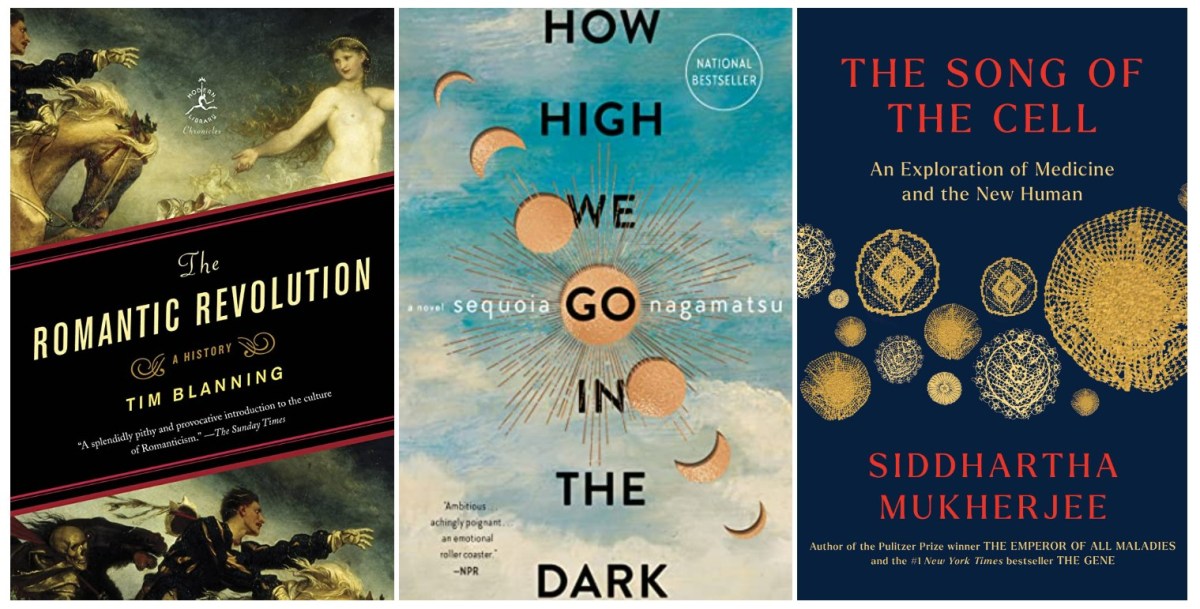
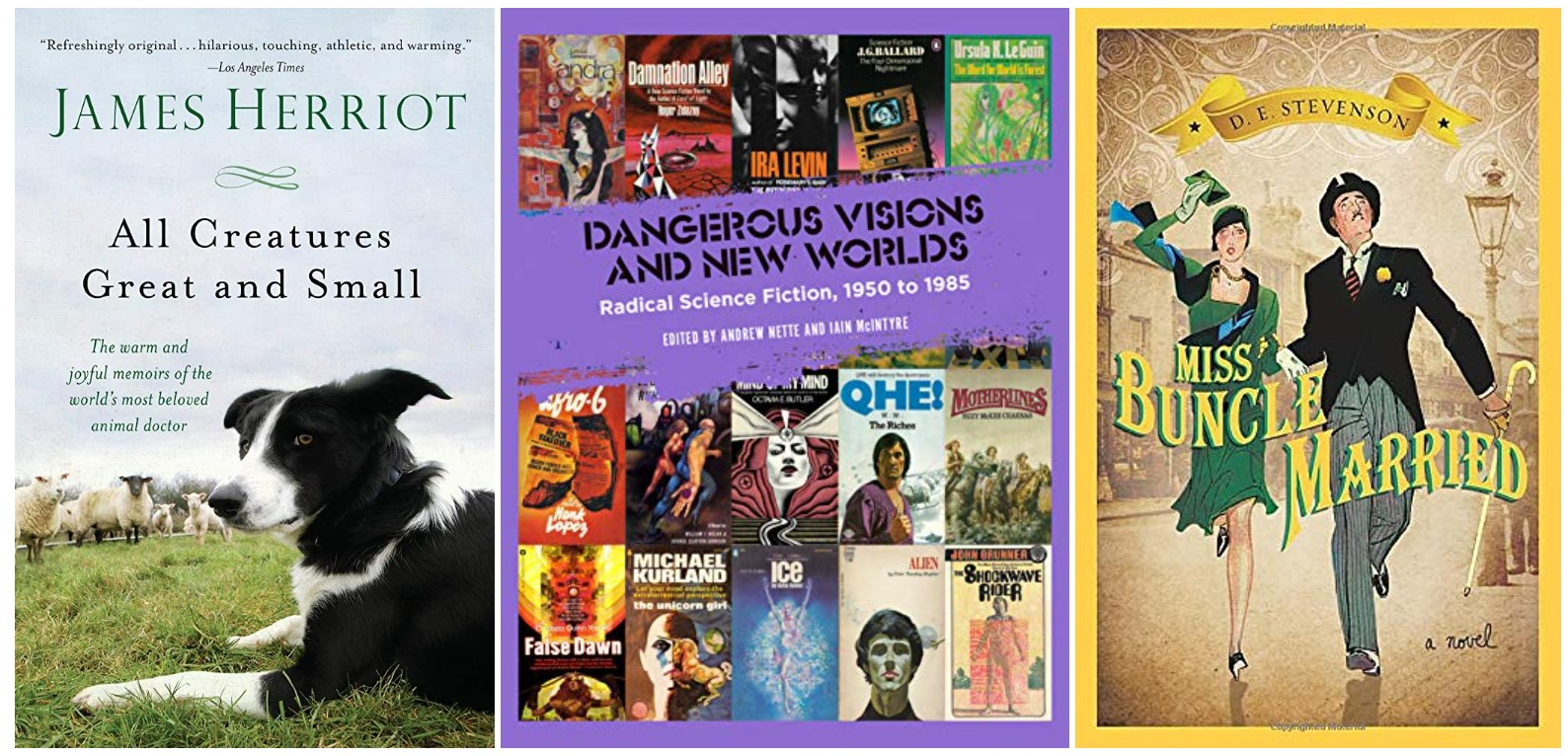
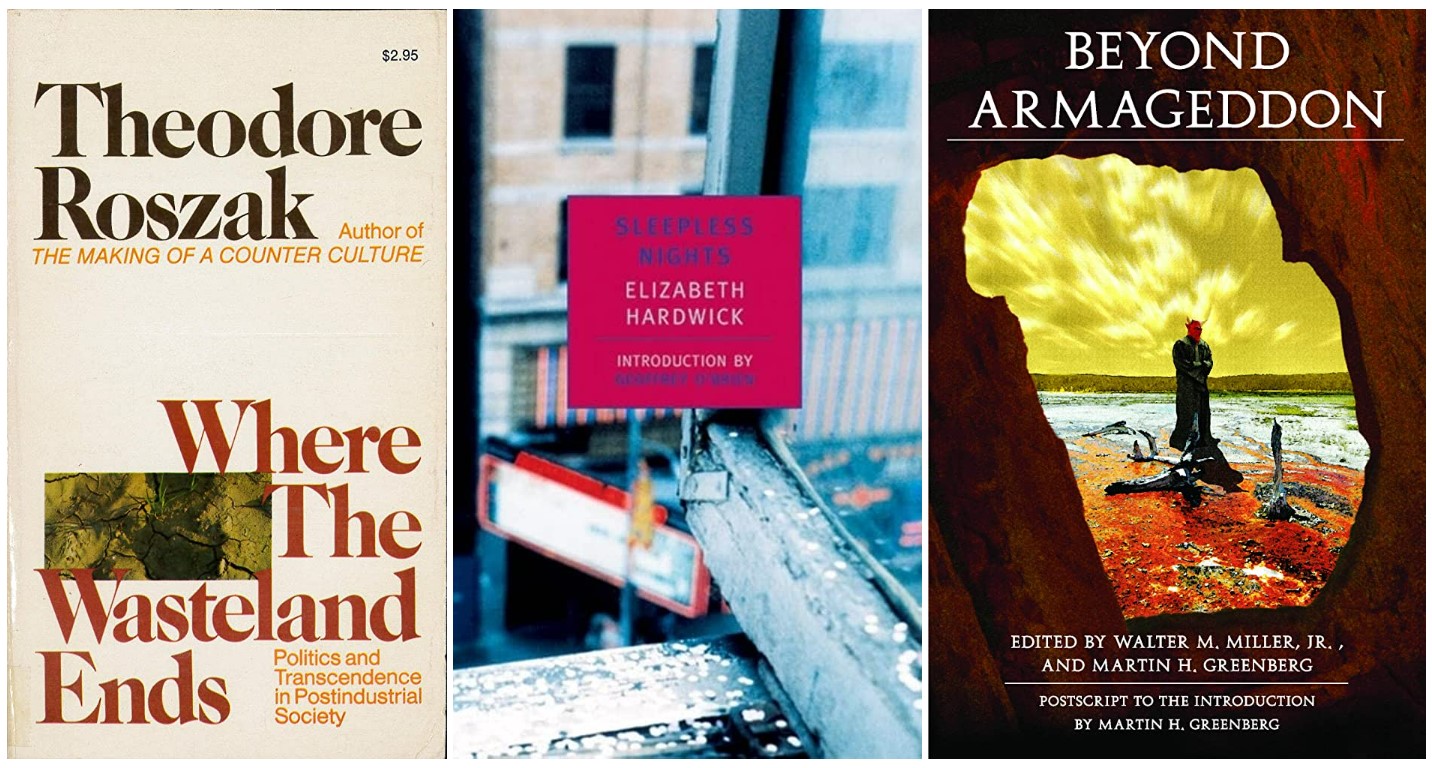
Right now my reading is terribly unfocused. I can’t stick with any book for long. Pictured on this page are all the books I’m currently reading — at least they are the ones that are currently up on my Kindle, Audible, Scribd, and Libby apps, and the books I see lying around. There’s probably more lying next to chairs, or under magazines.

Some of the books I’m reading are because I’m in an online book club for nonfiction books (Come Back in September, Song of the Cell). Or books related to what we read (Jena 1800, Sleepless Nights, The Romantic Revolution).

Others are because I’m in a Facebook group that reads anthologies (The Best of Nancy Kress, Beyond Armageddon, 21st Century Science Fiction). Others are because I’m interested in a particular subject, or they were recommended by a friend (The Good Lord Bird). (It’s great.)

I’m reading All Creatures Great and Small by James Harriot because Susan and I are watching the TV show of the same title. We finished the new series and are into the third season of the old series.

I’m reading Where The Wasteland Ends because I got interested in Romanticism in my online book club. I’m reading Miss Buncle Married because I loved Miss Buncle’s Book. I’m reading Neanderthals and The Great SF Stories 20 because I just love reading science fiction short stories.

I’m reading The Murder of the U.S.A. because I’m writing about the history of science fiction stories that deal with surviving a nuclear war, and it’s an early example of the subject. I’m reading Television’s Greatest Year: 1954 because I found it in a used bookstore and it looked interesting and is interesting. I’m reading Dangerous Visions and New Worlds because I like reading and writing about the history of science fiction. I’m reading How Hight We Go In The Dark because I try to keep up with current science fiction and it was considered one of the best SF novels last year.

I hope this illustrates how scattered my reading and thinking are at the moment. I’d much rather be focused on one subject and one book. When I was growing up and for many years of my working life, I mostly read one book at a time. I miss that simplicity, that focus.

When I joined Audible in 2002 I was on the 2 audiobooks a month plan, and I’d finish one audiobook and carefully study for days how I would use my second credit. Each book was special.

Then Audible started having sales, and now I have hundreds of audiobooks in my TBL to pile. And with all the Kindle books on sale, and all the wonderful buys I find at the Friends of the Library bookstore, I have a couple thousand books on my TBR pile. Life was simpler when I could only afford to buy one book at a time. I just can’t resist a book I think I want to read if it’s priced very low. And I subscribe to Scribd, Kindle Unlimited, and Apple News+ which provide access to hundreds of magazines and countless books and audiobooks. I have too much of a good thing. Less might be a whole lot more.

The book covers shown on this page are only the books I’m trying to read this week. It doesn’t include the books I’m buying or the books I recently gave up trying to read or finished.

I think between all the zillions of albums I can listen to on Spotify, all the zillions of movies and TV shows I can stream, and all the zillions of books, audiobooks, and magazines I could read my mind is running in seven directions at once trying to consume everything. It’s wearing me out.

I hanker for a simpler reading, listening, and watching life. One that is more focused. I think it’s time to cancel some subscriptions and give up buying bargains. I don’t know if I can ever get back to reading just one book at a time, but it should get it down too much less than 21 at a time.

[There is a certain synergy between this essay and the one I just wrote for my science fiction blog, “10 Reasons How I’m Reevaluating My Interest in Science Fiction.”)

JWH