
Getting My Stick-to-it-ness to Be More Sticky — Has the Internet Ruined My Ability to Focus?

James Wallace Harris, 12/29/23

Over the past few years, I’ve lost the ability to watch movies and television by myself. I read 55 books last year but only 33 this year. I rarely finish reading news and magazine articles anymore. I’ve given up on my hobbies and learning projects. And I’m blogging way less.

I can’t decide if this is aging related, or have I’ve ruined my ability to focus because my growing YouTube and Facebook video watching addiction. Does constantly watching short videos ruin attention span and the ability to focus?

I think this started years ago when I got addicted to Flipboard, RSS, and other forms of news feeds on the internet. I got hooked on constantly grazing on entertaining bits of information. Then for the past year or two, I’ve switched to short videos. They’re way more addictive than even clicking on clickbait.

I used to not watch TV until evening, but now I turn it on after my morning physical therapy exercises to watch YouTube videos for about an hour. I watch more after lunch and supper, and before bed. Lately, I’ve also been watching videos on Facebook, they have particularly good cat videos, bear attack videos, and people doing amazing feats videos.

I know I shouldn’t watch these videos and do something constructive instead, but I can’t help myself. It’s so pleasant and relaxing to just kick back in my La-Z-Boy and watch. I have over a hundred YouTube channels I follow. It feels like I’m involved with countless people and learning about endless subjects.

And that’s one of the problems with this addiction. I used to finish most of the videos I watched. Now I seldom finish them. If they cover something I already know I switch to another one, or scan ahead looking for real news. I’ve watched so many stereo product reviews that I could become a Hi-Fi salesman. Ditto for computer reviews, telescope reviews, and many other tech toys. I watch so much political news on YouTube during the day that I know everything that’s on the NBC Nightly News in the evening. And this is only touching on a few of the dozens of subjects and people I follow. Who knew I’d want to keep up with a transgender guitar pedal engineer? Or an expat couple living in Ecudor. Or an opinionated old English guy who makes hour long videos about his science fiction collection.

YouTube and Facebook videos give the illusion that I’m seeing what’s going on around the world. I watch videos from countless countries. From people living 40 degrees below zero in Siberia, to following a woman nature photographer in Sweden, to a Chinese girl who can build almost anything out in the woods by herself with just a few hand tools.

And that might be one of the reasons why YouTube videos are so addictive. As I’ve gotten older, and developed more physical limitations, I seldom leave the house. Watching the videos on my 4k 65″ television feels like I’m traveling around the world. It’s more visceral than reading a book or programming on my computer.

But I need to think hard about this addiction. Writing about it now reveals why it’s more appealing than watching old movies and TV shows. It also reveals why I can watch old movies and TV shows if I’m watching with someone else. If I have company, I’m doing something with them. But by myself, clicking around the world is more stimulating, offering far more information, and in a way, far more connection to other people. Fiction, in books, movies, and television shows, gives the illusion of connecting with people, but watching someone talk directly to you on a YouTube channel gives an even greater illusion of relating to someone else.

I get lots of human contact with my wife and friends, and regular socializing, and so I’m happy. However, my virtual acquaintances on YouTube offer a greater variety of intellectual stimulation. And thinking about it, I see where that competes with reading too.

Still, I have my problem of diminishing focus. Doing something constructive requires spending hours alone, concentrating on details, and applying a kind of disciplined focus. Watching YouTube videos seems to be destroying that ability.

However, what I want — or think I want, is to work on projects that take focus and discipline. I have too many projects I dream about accomplishing, and the indecision of picking one might also be why I watch YouTube videos instead. To accomplish anything worthwhile requires focusing on that project for hours a day for many days, weeks, or months.

That means sitting at a desk working by myself. That was easy when I worked at a job. I could focus for four hours, go to lunch, and then come back and focus for another four hours. Retiring has also ruined that ability. Aging might be a part of it, but I’ve also got addicted to relaxing and always having fun.

If I want to strengthen my flabby focusing ability, I need to give up having so much fun. My focusing stamina is limited to about one or two hours, for writing short blog posts like this one. For anything else I crash and burn.

I constantly dream of working on projects that would take much longer to finish. For example, I just read The Simulacra by Philip K. Dick, one of five novels he wrote in 1963. Last year I read Dr. Bloodmoney, or How We Got Along After the Bomb, another he wrote in 1963. These are very strange books, and they all deal with mental illness and marital problems. Because I’ve read several biographies on Philip K. Dick, and know what his life was like in 1963, I would like to read all five and write about how they are similar and reflect his own mental and marital problems he was having at that time. Such a project would take about two weeks of concentrated work, reading of the reading of the novels and researching the biographical material, and reading about the novels.

I don’t know if I can do that even though I think it would be a big fun project. It’s a barrier involving focus that I’m not sure I can break through. But I have a theory. I wonder if I exercised my focus, extending my ability to stick to one task for longer and longer, could I finish such a project?

I’ve even wondered if I should start by giving up YouTube videos and practice by watching movies by myself. Right now, I watch movies by myself, by watching them five minutes at a time. I know that sounds weird, but I’ll keep returning to the movie until I finish it. Maybe three times a day, or once a day. The way my focus works is I’ll start with five-minute segments. If I get into the movie, and I really like it, those five-minute viewings stretch to ten minutes. Usually, if I can get through most of the movie, I’ll stick with the last thirty minutes in one stretch. Even this piecemeal watching technique only succeeds with maybe one in twenty movies I try.

This isn’t a New Years resolution, but I’m going to try and stick with movies until I can watch them in one sitting by myself. I wonder if that will beef up my stick-to-it-ness muscles? It’s something to try.

UPDATE: 12/31/23

After I wrote this I read “It Sure Looks Like Phones Are Making Students Dumber” at The Atlantic. Unfortunately, it’s behind a paywall. It said things like, “First, PISA finds that students who spend less than one hour of “leisure” time on digital devices a day at school scored about 50 points higher in math than students whose eyes are glued to their screenmore than give hours a day.” It also said, “For comparison, a 50-point decline in math scores is about four times larger than America’s pandemic-era learning loss in that subject.” The article went on to detail the many ways phones might be the cause of anxiety, distraction, and learning loss.

JWH
Deciding What Will Be My 7th Habit

by James Wallace Harris, 10/26/23

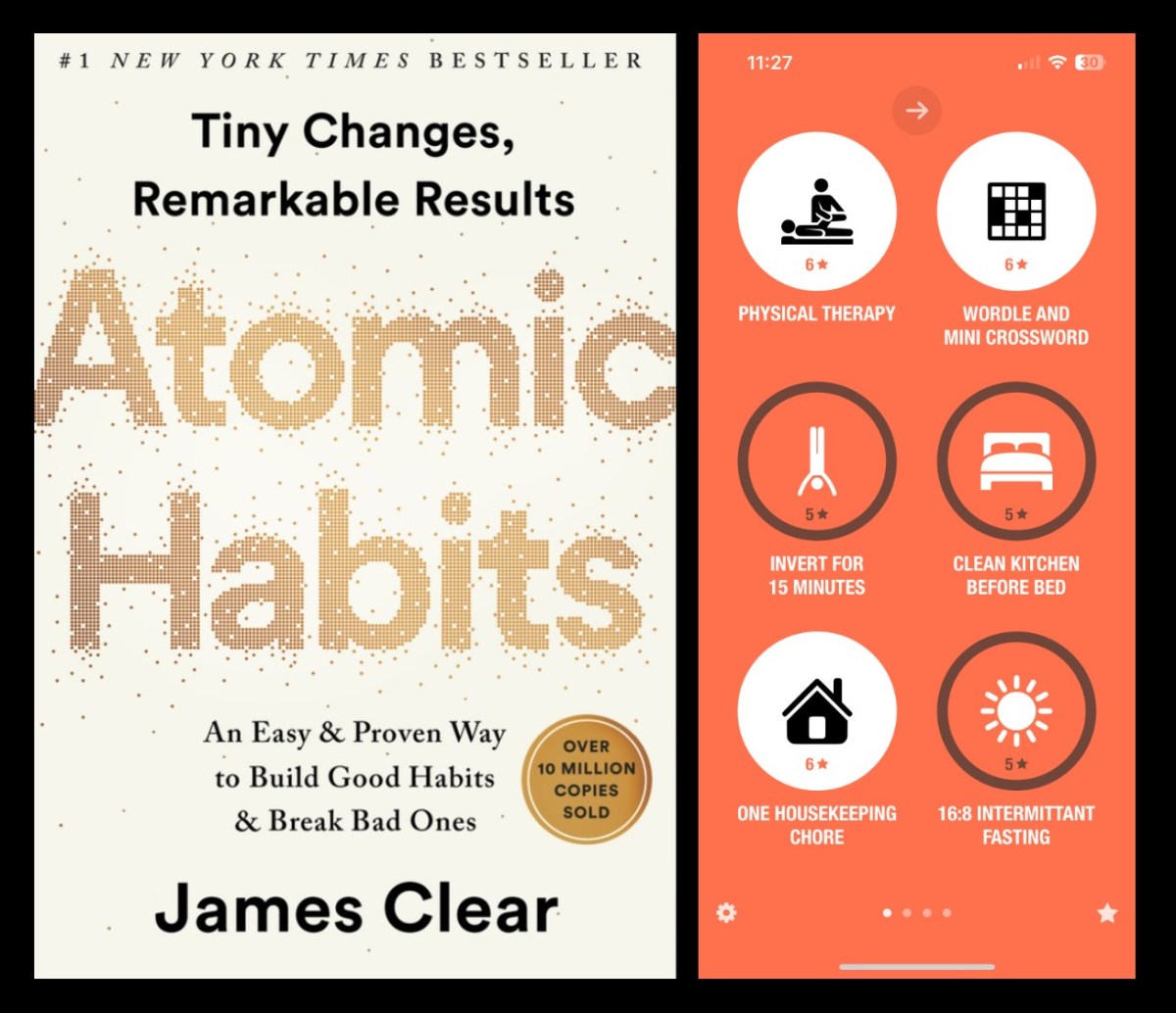
About ten days ago I bought Atomic Habits by James Clear and started reading it. It’s quite convincing about how to start good habits and phase out bad ones. I then decided I should track my habits and created a spreadsheet, but then a couple of days later a video about habit tracking apps showed up on my YouTube feed. I decided on one called Streaks for iOS; it was $4.99.

Streaks can track twenty-four daily habits. I decided to track six habits I’m already half-ass doing now:

  1. Physical therapy exercises
  2. Wordle/Mini crossword puzzles
  3. Invert for 15 minutes (with inversion table)
  4. One housekeeping chore
  5. 16:8 Intermittent fasting
  6. Clean kitchen before bed

After six days of practicing with these six habits I see how Streaks works. James Clear in Atomic Habits advises to focus on systems rather than goals. Instead of wanting to write a novel, make writing fiction daily a habit. And instead of aiming big, aim small instead. Clear says making tiny changes can lead to big results.

My starting six habits which I’ve been working on for years are mostly about mental and physical health. I haven’t always stuck with them, but I have learned, without a doubt, that if I do them every day, I feel better. Streaks has helped me stick with them better because keeping a streak going is challenging — like a little game. And I hate the idea of breaking the streak.

It’s time now to pick something I want to do but I haven’t gotten a half-ass habit going already. I don’t want to be too ambitious. Failing at New Year’s resolutions has always been demoralizing. I need another win to bolster my momentum. Yet, it needs to exercise my new habit muscle.

My life-long fantasy to write fiction is an obvious choice, but I think it might be the wrong time. I’ve always failed at fiction writing before, so I don’t want to fail at it again, and possibly ruin my efforts at forming atomic habits. I need a new habit that is both small but bigger.

However, selecting a new habit that will lead to achieving a cherished goal is an enticing thought. Isn’t that why I’m pursuing this habit system? Here are some things I wish I were doing in retirement:

  1. learn Python and make programming a hobby
  2. study math as a hobby
  3. learn to draw illustrations like I see in 19th century science journals
  4. learn Obsidian and use it with Readwise to create a second brain for remembering what I read and want to write
  5. read one lengthy article a day and write about it
  6. write short stories

These are all things I wish I worked on a little bit each day. I could add all six to Streaks with the self-imposed rule of doing each for a minimum of fifteen minutes a day. That would only be ninety minutes of activity, less than watching one movie. But Atomic Habits claims building one habit will strengthen other habits. So maybe, it’s better that I add one at a time.

Items 4 and 5 go well together, and would aid things when I go for item 6, but how would I structure it into a daily habit? Reading a long-form article can take an hour or two, and taking notes for Obsidian could be another hour or two. Writing about what I learn could take another three or four hours.

Streaks does track weekly habits, but I’m not ready to try one of those yet. Studying math on Khan Academy, practice drawing with You Can Draw in 30 Days by Mark Kistler, or writing 500 words on a short story is habits much better suited for finishing up in 15-30 minutes.

I don’t know if this is cheating, but it occurs to me that I should try doing each of these activities daily without adding them to Streaks and then see which one I stick to the most. Then add it to the habit tracker. (Don’t place a bet unless I think it’s a sure thing.)

This is psychological revealing. Could this be what I do all the time? I don’t try to create habits because I don’t want to fail at them. All six of the habits I’ve created already on Streaks are ones I need to do or I’ll feel bad. Feeling bad is a great incentive — I’m highly motivated to avoid pain and suffering. And those six habits were ones I was mostly doing anyway.

I’m a laid back lazy guy that dislikes obligations. Creating a habit is taking on an obligation. I guess successful people who get a lot done either don’t mind obligating themselves, or thrive on it.

Fantasizing about being a different person is one thing, but actually becoming a different person is WORK. (You should voice that like Maynard G. Krebs did in The Many Loves of Dobie Gillis television series.)

JWH

Is Ethical Capitalism Even Possible?

by James Wallace Harris, 10/20/23

This month, several of my friends have separately expressed doubt about the future. I don’t hold much hope either. Our current world civilization seems to be falling apart. Capitalism is consuming the planet, but capitalism is the only economic system that creates enough jobs to end poverty. The only alternative to free market capitalism I can imagine is if we adapt capitalism to an ethical system. So, I’ve been keeping my eye open for signs of emerging ethical capitalism.

Here’s one: “The Workers Behind AI Rarely See Its Rewards. This Indian Startup Wants to Fix That” from Time Magazine (8/14/23). The article describes how AI startups need vast amounts of sample data from other languages for their large language models. In India, many data companies are exploiting poor people for their unique language data and keeping the profit, but one company, Karya, is giving the poor people they employ a larger share of the profits. This helps lift them out of poverty.

Capitalism has two dangerous side effects. It destroys the environment and creates inequality. For capitalism to become ethical it will need to be environmentally friendly, or at least neutral, and it will need to be more equitable. If we want to have hope for the future, we need to see more signs of that happening.

Right now, profits drive capitalism. Profits are used to expand a corporation’s ability to grow profits, and to make management and investors rich. Labor and environmental controls are seen as expenses that reduce profits. For a corporation to be ethical it will have to have a neutral or positive impact on the environment, and it will need to share more of its profits with labor.

Since the pandemic hourly wages have been going up, and so has inflation. If capitalism becomes more ethical, costs for environmentalism and labor will go up, thus ethical capitalism will be inflationary. Some people have gotten extraordinarily rich by making things cheap, but it’s also shifted labor and environmental costs away from corporations onto the government and the public. The price at the store does not reflect the actual cost of making what you buy. You pay the difference in taxes.

For ethical capitalism to come about things will need to be sold for what they cost to make. That will involve getting rid of governmental and corporate corruption. It will involve political change. And it will be inflationary until the new system stabilizes.

My guess is ethical capitalism will never come about. If I were writing a science fiction novel that envisioned life in the 2060s it would be very bleak. Life in America will be like what we see in failed states today. Back in the 1960s we often heard of the domino theory regarding communism. Failed states are falling like dominoes now. Environmental catastrophes, political unrest, dwindling natural resources, and viral inequality will homogenize our current world civilization. Either we work together to make it something good, or we’ll all just tear everything apart.

Civilization is something we should all shape by conscious design and not a byproduct of capitalistic greed.

We have all the knowledge we need to fix our problems, but we lack the self-control to apply it. I have some friends who think I’m a dope for even holding out a smidgen of hope. Maybe my belief that we could theoretically solve our problems is Pollyannish.

I have two theories that support that sliver of hope. One theory says humans have always been the same psychological for two hundred thousand years. In other words, our habits and passions don’t change. The other theory says we create cultures, languages, technologies, systems that can organize us into diverse kinds of social systems that control our behavior.

We could choose better systems to manage ourselves. However, we always vote by greed and self-interest. We need to vote for preserving all.

In other words, we don’t change on the inside, but we do change how we live on the outside. My sliver of hope is we’ll make laws and invent technology that will create a society based on ethical capitalism and we’ll adapt our personalities to it.

I know that’s a long shot, but it’s the only one I have.

I’m working to develop a new habit of reading one substantial article a day and breaking my bad habit of consuming dozens of useless tidbits of data that catch my eye as clickbait. In other words, one healthy meal of wisdom versus snacking all day on junk ideas. Wisdom doesn’t come packaged like cookies or chips.

JWH

Have You Ever Wanted to Paint?

by James Wallace Harris, 9/27/23

I spend my days grazing on ideas. I listen to music, watch television or movies, read books, articles, or short stories, look at art books, browse the internet, read history, study popular science, and consume a lot of YouTube videos. All of it is about idea processing.

For breakfast, this morning I read “Painting of Hannah” by Lan Samantha Chang in the September 2023 issue of Harper’s Magazine. Follow the link if you want to read the story too.

“Painting of Hannah” is a short story about a young American, Jacob, studying art in France. Jacob stays at an atelier, apprentice to Thomas Gaugnot, a master painter who is trained in the naturalist technique, a student of Rennes, who was a student of Renoir, with a lineage all the back to Leonardo.

Gaugnot comes across like a Zen master, not saying much but tricking Jacob into seeing. Jacob must sacrifice both his ego and his desire for the beautiful artist’s model, Hannah, who he paints every day. Hannah, a young woman, lives with the older Gaugnot, and is Gaugnot’s muse. Gaugnot tells Jacob:

“They say my technique is obsolete,” Gaugnot said. “That is true. It is secret. It became a secret because no one cared. The attention of the world turned away from this kind of painting, what you call naturalism. You—­” His gaze pushed Jacob back; the chair creaked. “You are here to learn the techniques of this secret.” He smiled a small, triumphant smile. “You think it is romantic.”

We watch as Jacob learns to see. I’ve made a few lame attempts to learn to draw, but I’ve never stuck with it. I’ve even had some classes. I’ve learned with a few hours of work I can show some improvement, but I know becoming an artist takes years. That’s why I gave up, but that was lame of me.

I have several friends who are currently studying various kinds of painting. I admire them for not giving up. You don’t have to compete with John Singer Sargent to enjoy learning to draw and paint. You don’t have to move to France and study with a master for years. Ten thousand hours might make you a master, but thirty hours is enough to produce amazing results. Yet knowing that doesn’t allow me to apply myself at learning to draw. I hate that.

I wish I had that discipline because what I really want is to learn to see like an artist. That’s what the story hints at. That us ordinary folk are blind to most of the visual world. Gaugnot pushes Jacob into seeing what’s in front of the rest of us that we ignore.

The human eye can only see a tiny portion of the visual spectrum or hear a sliver of the audio spectrum. and there are other wavelengths of electromagnetic spectrum that are even beyond our senses. So, it’s a shame we don’t even make the most of what we can perceive.

Evidently, learning to paint means learning to see what we’ve never bothered to look at. I like that. I like that because that’s what I do all day long with my information grazing.

I feel reading and watching helps me discern finer shades of ideas, and learning to write is learning to paint with words. Writing these blogs is learning to see more into the spectrum of language.

But I wonder about Gaugnot and Jacob. They learn to put what they see on a canvas, but do we see what they saw when looking at their paintings? We might see beauty but without understanding the insight. And if I read something written by someone discerning something specific in the reality of ideas, can I discern it too by reading their writing? Or is it only telling me that I need to go look for myself?

There was something in this story, “Painting of Hannah” about Nietzsche that intrigued me. It was the concept of “Eternal return.” It hints at a Groundhog Day existence. That’s the thing about learning to discern all there is from the firehose of information we live with daily; it would take several lifetimes to learn how to perceive everything. Are we Bill Murray living the same life over and over? Are the Hindus right about reincarnation?

I don’t think I’m coming back, so I want to distinguish details as I can before I die, both visually and cognitively. I wonder if I shouldn’t study drawing again. Would the discipline I got from learning about light also apply to studying the perception of ideas?

All my life I’ve wished I had more self-discipline, but if a genie from a magic lamp offered me three wishes, what would be the downside if I asked for more discipline? There’s always a downside in those tales. Maybe I’ve already been granted that wish and I’m living the existence of eternal return.

Tonight, I might snack on “Painting of Hannah” again and reread the story before I go to bed. Reading short stories is like learning to paint, you must keep looking to see everything.

Tomorrow I will wake up and find something else to inspire me for the day. Jacob worked on the same painting daily for months. Is that the key? Maybe I should stay with one concept for months. Maybe the secret is not accumulating more information but studying the same information repeatedly.

JWH

Hitting a Cognitive Barrier

by James W. Harris, 9/24/23

I crashed into a cognitive barrier trying to write my reactions to The Trouble with Harry and To Catch a Thief, two Alfred Hitchcock movies from 1955. After two drafts I realized I wasn’t getting where I wanted to go. I know I don’t want to write movie reviews — the perfect place to find them is Rotten Tomatoes. Nor did I want to describe a film — just go to Wikipedia or IMDB. I wanted to write an essay that captured what I got out of watching those films at age 71.

Time is running out, so I need to make the most of every experience. That involves understanding myself at a deeper cognitive level. One I’m finding harder to reach as I age. On the other hand, aging is giving me more wisdom. The cognitive barrier is being able to express what I’m learning by getting older. But aging is also wearing down my brain. What one hand giveth, another takes away.

Writing is thinking outside of the head. Thoughts are generated inside the head from emotional reactions. Thoughts are fleeting. Thoughts are like cream stirred into coffee, creating little patterns that quickly dissipate. Writing is about capturing that initial pattern and making sense of it by showing how it relates to the memories of millions of past patterns.

Very few people can describe exactly how they feel, and few of those people can explain why they feel the way they do. There are rare individuals that can compose their thoughts inside their heads and eloquently convey the results in speech. Most of us need to think outside our minds via writing and editing.

Even when we feel our written words are clear, readers seldom find clarity. Communicating with words is difficult at best and often impossible. What we think we’re expressing can often take a different path to each reader like those spaghetti strings we see in hurricane reports. I might believe I’m writing about Jacksonville, while some readers think I’m writing about Bermuda while others Miami and Charleston.

I enjoyed The Trouble with Harry better than all the other Hitchcock films we’ve watched this month, including Rebecca, Notorious, To Catch a Thief, and Strangers on a Train, films most critics admire a great deal more. However, I thought The Trouble with Harry had many flaws, but then Hitchcock is a flawed filmmaker.

How can I admire a movie that doesn’t measure well against the best movies I’ve seen over a lifetime? This gets into complexity and even multiplexity. I need to relate several reactions that contradict each other. The three films I admired and enjoyed the most this month have been The Trouble with Harry, Twelve O’Clock High, and Mr. Belvedere Rings the Bell. All three were feel-good movies to me, but they each made me feel good in a unique way. Is the word “feel-good” even useful? Many moviegoers might interpret the term “feel-good” so differently that these three movies would not fit their definition.

Should I even use the term? Shouldn’t I just describe exactly what I felt? Will that be clearer?

In my second draft I had a breakthrough. I realized to understand how I react to films I’d need to understand what I expected from them. But my expectations have changed widely over the years. And will my readers have the same expectations? It was then I realized that what I’m expecting from movies at 71 is different from my younger self. Even describing my own emotional experiences is a moving target. But explaining why that’s so hits another cognitive barrier.

I need to think about that.

Putting everything into words precisely is so difficult. Should I even try? I believe most people don’t because all they value is personal experience. Why tell anyone about our perceptions when they have their own?

Do you see why writing that essay became such a black hole?

JWH