When The Future Has Become the Past

by James Wallace Harris, Tuesday, December 24, 2019

Back in 1965, I read The Door Into Summer by Robert A. Heinlein. The story is about a guy named Dan Davis who invents a robot vacuum cleaner. The setting of the story begins in the year 1970 but the story itself was first published in F&SF in October 1956. So Heinlein was assuming a lot would happen in 14 years. Well, two things. One, household robots would appear in 1970, and cold sleep would be perfected so people could pay to be put into suspended animation. In 1965 when I read the book I thought both of these were still futuristic but hoped a lot would happen in five years. I wanted that future.

Not to spoil the story, but Dan decides to take cold sleep and wakes up in the year 2000 when his patents and investments should have grown into a magnificent pile of wealth. This lets Heinlein extrapolate and speculate even further into the future. Unfortunately, things didn’t work out as planned by Dan. In his future, Dan invents Drafting Dan hoping to make another fortune.

What’s funny is I read The Door Into Summer in 1965 when everything in the book was set in the future and I’ve lived long enough so that the book is now set in the past. That’s very science fictionally existential. Essentially Heinlein imagines the Roomba and Autocad back in 1956. And the 1959 Signet book cover artist imagines we’ll be wearing spandex and capes. And even though some people do wear such garb today, it’s not an accurate guess about average Americans in the future. Wouldn’t it have been hilarious if that artist had imagined everyone wearing hoodies, shorts, t-shirts, and flipflops?

I remember back in the 1960s having so much hope for the future. It’s mind-blowing to me that next week I’ll be living in the year 2020.

There’s one thing I’ve learned from experience – the future is everything I never imagined. It’s almost as if I imagine something being possible that the act of thinking it cancels out the possibility.

There is no predicting the future. Science fiction writers never claim to have crystal balls, but sometimes they accidentally get things a tiny bit right. People are always thrilled at that. But imagine if Robert A. Heinlein had written a novel that perfectly captured the Donald Trump years and published it back in 1965. How would readers have reacted? Could they have believed it? Most people would have just brushed it off as crazy science fiction.

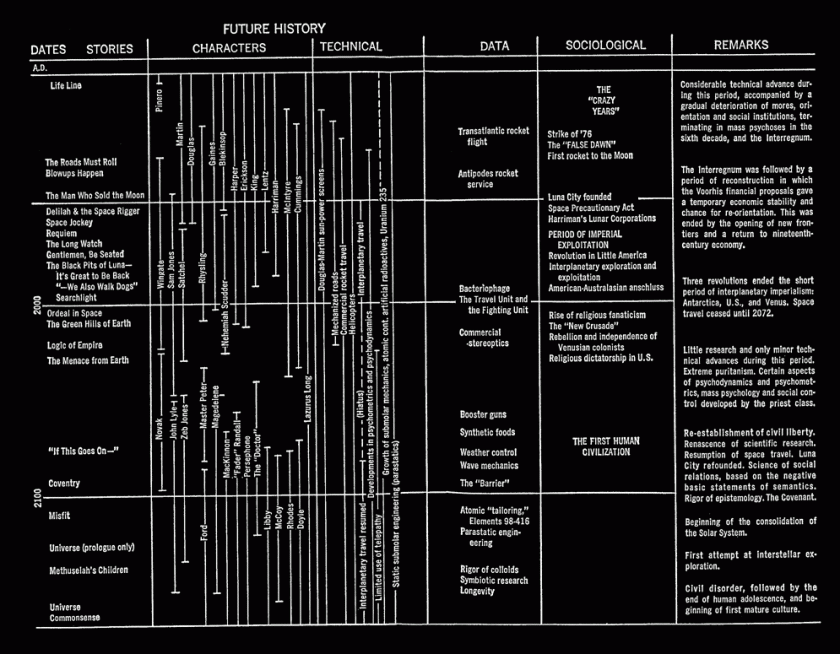
RAH-Future-History-chart

However, back in the early 1940s, Heinlein imagined the United States going through what he called the “Crazy Years” and later on experiencing religious fanaticism that leads to a theocracy. Quite often in the 1950s science fiction writers imagined the United States falling apart because of religious revivals convincing people to reject science. Doesn’t produce a tiny bit woo-woo soundtrack in your head?

Science fiction is never right about the future, but sometimes it feels a little eerie. Just enough to hear The Twilight Zone music. In 2019 I’ve been reading a lot of science fiction from the 1940s and 1950s. Those stories had a lot of hopes and fears about the future, a future that is now my past. That’s very weird. But it’s also strange how often they get just a little bit right. Just enough to put a little zing into the story.

By the way, The Door Into Summer is an entertaining novel I recommend and features a wonderful cat character, Pete, short for Petronius the Arbiter. Heinlein loved cats, so do I. Here’s how he said he got the idea for writing the story:

When we were living in Colorado there was snowfall. Our cat — I'm a cat man — wanted to get out of the house so I opened a door for him but he wouldn't leave. Just kept on crying. He'd seen snow before and I couldn't understand it. I kept opening other doors for him and he still wouldn't leave. Then Ginny said, 'Oh, he's looking for a door into summer.' I threw up my hands, told her not to say another word, and wrote the novel The Door Into Summer in 13 days.

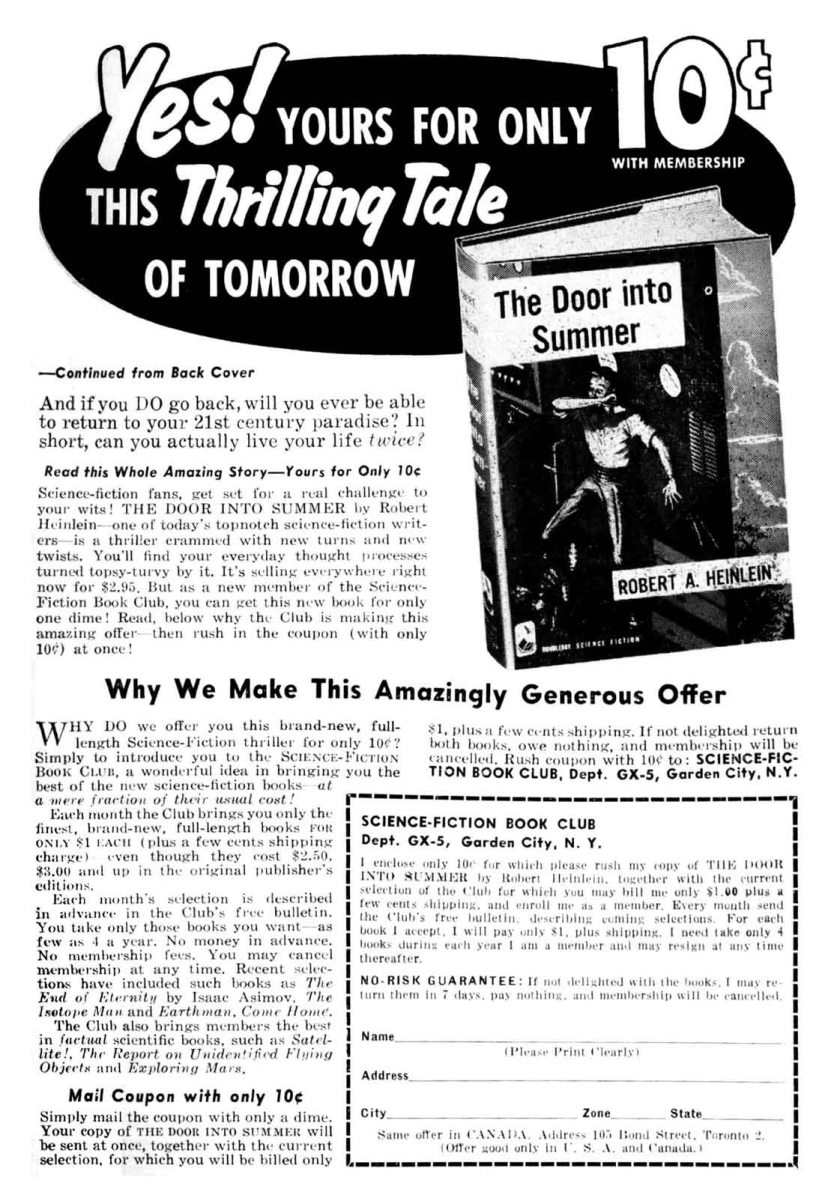
And here is a 1958 ad for the book that is fun to read today when we can look back to when they were looking forward.

Door Into Summer ad page 1

Door Into Summer ad page 2

Yeah, I know it’s bizarre that I’m recommending you read a book set in the past that was supposed to be our future. However, it still features the sturdy standbys of storytelling, love, betrayal, greed, revenge, and of course, a cat.

Merry Christmas — JWH

Deception, Self-Deception, Confabulation, Bullshit, Narrative Fallacy, Dunning-Kruger Effect, and Fiction

by James Wallace Harris, Saturday, November 23, 2019

I’ve been studying Plato. Plato is good for the soul but hard on the ego. Humans often lack the ability to distinguish fact from fiction. Our superpower is self-deception. As children, we are told stories that we desperately cling to for the rest of our lives. We adapt to reality by making up explanations that usually end up being fictional. And when our stories clash with reality, the odds are we embrace the story. We aren’t rational. We are rationalizing creatures. We seek what we want by lying to ourselves and the people around us.

Anyone who follows the news knows this.

If a noise wakes us up in the middle of the night we don’t rush outside to investigate it. We start making up explanations trying to imagine what the noise could be. We tell ourselves its a burglar. Or if we’ve seen a raccoon lately, we’ll say to ourselves that Rocky is in the garbage can. Or its the wind, or a fallen tree limb. We can’t help ourselves. Instead of saying we don’t know we imagine that we do. Generally, we imagine wrong.

Nassim Nicholas Taleb called this tendency the narrative fallacy in his book The Black Swan. Neuroscientists call it confabulation. As children, we ask how the world was created and our parents tell us answers to the best of their abilities. How we are raised determines a lot of what we believe. If you were brought up a Southern Baptist more than likely their ideas about God are what you’ll believe for the rest of your life. However, if you were kidnapped at birth and given to a Muslim family in Saudi Arabia you’d grow up believing their local variation of the origin story.

Psychologists and philosophers talk about deception and self-deception. We like to think this problem belongs to other people. Our intuition tells us we’re right. We feel right. But are we?

We want to believe what we learn growing up is the truth. Few people are intellectual rebels that reject their upbringing. Not only will you maintain your beliefs, but you will also rationalize and lie to defend those beliefs.

A good percentage of humans learn to lie to get what they want. Conscious lying sometimes involves knowing the truth but working to suppress it. Liars are different from bullshitters. To a degree, liars are conscious of their lying. Bullshitters, as defined by Harry G. Frankfurt in his philosophical essay “On Bullshit” often don’t know they are lying, or even know what is true. Their grasp of reality is usually tenuous. They have told so many lies they don’t know what’s true anymore, but they have learned they can say anything to get what they want. Their concept of reality is so fluid that it changes from moment to moment.

The trouble is we bullshit ourselves all the time. We are especially dangerous to ourselves and others when we think we know more than we do. This is called the Dunning-Kruger Effect. People who suffer from this cognitive ailment are clueless about their own lack of knowledge. They firmly believe they are smart and wise.

We have so many built-in brain functions for fooling ourselves that I have to wonder if it’s even possible to know the truth if it came up and tapped us on the shoulder.

Most people dismiss philosophy as abstract useless wordplay. I just finished reading Plato in the Googleplex by Rebecca Goldstein and I’ve developed a new respect for Plato and philosophy. Goldstein came up with a very clever gimmick for presenting Plato’s philosophy. She imagines him alive today going on a book tour in America. She has his ancient words respond to our modern conundrums by fictionalizing Plato in different settings arguing with people of varying beliefs. I really recommend listening to this book on audio because these discussions are quite dramatic and effective. When Plato goes on a conservative talk radio show it’s hilarious. But I think my favorite encounter was between Plato and a neuroscientist who was going to scan his brain. The section where he’s on a panel with two opposing authors dealing with education was also quite brilliant.

However, the gist of Plato at the Googleplex is to question what we know and think we know. I’ve been lucky to be the kind of person that’s usually gone against the current, but I realized in later years my skepticism has not always protected me from bullshit. I’m acquiring new levels of doubt as I age realizing my own persistent gullibility.

For example, as a life-long science fiction fan, I’ve had high hopes for the future. I realize now that many of my cherished science-fictional beliefs are no better than what the faithful believe about God, Heaven, angels, and life-after-death.

And there is one cherished concept I have to reevaluate. I’ve always believed that humans would one day overcome their problems with confabulation. 2,400 years ago Plato concluded that only a small percentage of humans would ever be able to tell shit from Shinola.  He felt only a few could ever understand what philosophy teaches. I’ve always wanted to assume that we’re evolving, our knowledge is growing, and our abilities to educate are improving, so eventually, that percentage would be much greater.

That belief might be self-deception. But it might not.

We have to honestly ask ourselves can philosophy be integrated into the PreK-12 educational system so the majority of the population understands their problem with confabulation? This is to assume we can be totally different from who we are now as a species. Are we hardwired so we can’t change, or are we adaptable to change if we can find the right educational path?

This experiment would require raising a generation without fiction. That includes both God and Harry Potter. No Easter Bunny, Tooth Fairy, or Santa Claus. We’d have to stop lying to our children, or letting them play with lies and fiction. They’d have to grow up on nonfiction and documentaries instead of fiction, television, and movies.

Children’s entertainment would be limited to sports, games without a fictional narrative component, arts, crafts, and other hobbies. When kids ask why we can only give them answers that we know. For example, if they ask why everything is here we can only answer we don’t know. If they ask who made the world, we can only answer what we know from observable cosmology and geology.

It’s too late for me. I can’t give up fiction. I love it too much. I too addicted. I should be building my own robots and programming them instead of reading science fiction about robots. I wish I was, but it’s so much easier just to dwell in fictional worlds where intelligent robots exist, or we’re colonizing the solar system, or we’re creating utopias.

Fiction offers an infinity of virtual realities we prefer over actual reality. I believe our chronic confabulation is caused by wanting reality to be different from what it is. Buddhists call that desire. Eastern religions teach we should accept reality, whereas western philosophes promote shaping reality to our needs and wants. Western thought is active, it’s all about conquering reality. When we fail we lie to ourselves. Probably we suffer from such great confabulation because we seldom get what we want. It’s easier to have romantic fantasies or watch porn than date than to actually seek out our perfect match.

I think the path lies between the East and West. We shouldn’t be completely passive in our acceptance, but we shouldn’t want absolute control either. It would be interesting to know how people think a thousand years from now. Will they have a more honest relationship with reality? There could be a good science fiction story in that, but then it would be fiction. Maybe there’s another kind of acceptance too. Maybe we have to accept that we are amazing confabulating creatures. It will be a shame when such an imaginative species goes extinct.

And I’m not excusing myself from self-delusion either. My liberal friends and I believe Republicans are only out to reduce taxes and regulations at any cost. That they are either deluded about Trump, consciously lying to get what they want, or they are confabulated by his bullshit. Anyway, they ware willing to back Trump at any cost because Trump gets them what they want.

Like I said, I’m willing to consider this a liberal narrative fallacy. I believe its possible Republicans could be seeing a truth we liberals don’t. However, their stance on climate change suggests they are blind to science. I believe scientific consensus is as close as we ever get to the truth, and I could be wrong about that too. I also know that even though I accept what science says about climate change I don’t act on their conclusions. Oh, I do a token amount, what’s convenient for my consciousness. But if climate change is real, then none of us are doing what it takes to avoid it.

Looking in the mirror and seeing who we really are is hard. That’s what Plato was all about.

JWH



I Believe I’ve Found a Solution to All My Reading Problems

by James Wallace Harris, Sunday, November 3, 2019

Problems:
  • I miss reading like I did when I was young
  • I try to read too many books concurrently
  • I start too many books I don’t finish
  • I buy too many books I never even get around to trying to read
  • I start too many reading projects (reading multiple books on one subject)
  • I’m attracted to too many subjects
  • I want to read every book that sounds great
Solutions:
  • Only read one book at a time
  • Only listen to one book at a time
  • Keep a list of books I want to read next
  • Keep a list of audiobooks I want to listen to next
  • I can only buy a new book/audiobook when I’m finished with my current book/audiobook and I must read it immediately.
  • I must look through my TBR lists before buying a new book.

When I was a young bookworm I only bought a new book when I finished my old book. I didn’t have much money, so deciding what to buy and read next was a huge pleasure that I’d spend a lot of time contemplating. When I first joined Audible.com, I only had two credits each month, and I was very careful about how I used them. I’d listened to everything I bought. Deciding on the next audiobook was always a delicious time of deciding.

Being able to afford all the books and audiobooks I want has been bad for me. I spend more time buying books and thinking about buying books than I do reading and listening. When I was younger, I used to read an hour or two every day, and many hours on the weekend. I barely read three hours a week now, but I do get in 5-7 hours a week of listening to books. I miss those days when I got so into books I’d finish them in a day or two.

I thought when I retired I would get more books read, but it’s been just the opposite. I have too many other distractions in my life. I won’t go into all of them, I’m sure everyone knows about all the new entertainment diversions that have popped up in the last couple of decades.

What worries me is another problem, a lack of focus. I wonder if getting older is reducing my ability to stay focused, or is it just all the distractions? Part of the problem is I have dozens of books pulled off my bookshelves in different stages of being read. I jump from one book to the next as my mental whims come and go. I have too many writing projects I want to research, and that means I don’t get anything finished. I can focus just enough to complete a blog length essay. I’d like to write something longer, but that would require focusing on one topic for days or weeks and my mind can’t seem to do that.

I’ve been wondering if my lack of writing focus is related to my lack of reading focus. Sometime after midnight last night, a solution jumped into my mind. I theorized if I only read one book at a time maybe that would help. Because reading and listening work only in their own unique settings I decided I could keep one book and one audiobook going.

From this theory, I’ve developed a plan that I believe might solve all my reading problems. I can’t start or buy new books/audiobooks while I’m working on a book/audiobook. I have to keep TBR lists for books and audiobooks with at least a hundred titles on each and I have to read through those lists before buying a new book/audiobook. I  have over a thousand unread books I could put on each list but the idea is to put just enough books I’m craving to read on each list to remind me why I shouldn’t buy another book.

To further keep me from buying new books/audiobooks, is making the rule I can only buy books after finishing books, and I must read any new purchase immediately. Any new book becomes the next read. In other words, to buy a book/audiobook I have to look at my TBR list and decide I want to read a new book more than any of the books on the list.

Right now I try to read all the books that are laying around and it doesn’t work. I need an analogous saying for “My eyes are bigger than my stomach” regarding reading. When you have countless books you’re dying to read it’s rather insane to go buy more. And boy am I crazy.

I don’t know if I will have the discipline to accomplish this plan but I’m going to try very hard. I’ve already started unsubscribing to the mailing lists advertising books on sale. I’ve got to break my restless habit of visiting used bookstores twice a week. I’ve also got to break my habit of jumping on ABEbooks and ordering any book that I think I should read.

I believe I will actually save money if I only buy books just before I read them even if I have to pay the full new price. Now, I’ve come to that conclusion before. And it slowed down my book buy a great deal, but I still bought way more than I can read. My problem is I want to read too much and I believe buying a book means I’ll eventually read it. That’s obviously not true.

The trick of this plan is to only buy a book when I’ve just finished another, whether book or audiobook. And only purchase that book if I want to read it before any of the other great books I already own and supposedly dying to read. If I can stick to that one act of discipline I believe it will have a cascading effect on solving all my reading problems.

Update 11/4/19:

I’ve decided I need a quitting factor. If I commit to reading a book I don’t want to be stuck finishing it if the book is no good. But I also want to give a book a fair shake. I figure I need to read a certain number of pages to get to know the book, but I’m not sure what that number will be. See the comments below for one suggested formula.

I also need to decide what to do with books I quit. Do I still keep them? For printed books, I’ve always donated those to the library book sales. But what about ebooks and audiobooks that clutter up my digital libraries? I’m thinking I should delete them. I believe Amazon has a provision for that, but that seems kind of drastic.

Finally, I decided on a couple loop-holes about buying books. If I buy a new book it has to be read immediately. But I can buy books I’ve already read. Quite often when I listen to a book I want a printed copy for reference. I keep an eye out for cheap used copies. Or there are books I’ve read in the past that I wished I owned a copy for reference. And sometimes I want to buy reference books that aren’t meant to be read from cover-to-cover. Finally, there are some books that I collect for various reasons — because I want a special edition, or I want to replace an old copy, or I just want an edition for its dust jacket or cover. This leaves me a little room to have fun book shopping without stockpiling books to read. However, my discipline will be sorely tested if I see a mint used edition of a book I’ve always wanted to read for $3.

I’ve already finished the first book I committed to reading and wrote a review last night. That felt good. I’m already reading on the second book I committed to, and I’m very excited about being able to stick with it. I skipped TV watching last night to read on it, and got up this morning and read some more. This early success suggests my idea of committing to reading only one book at a time works.

I guess its finally time to get down to the nitty-gritty of reading all those books I bought to read in my retirement years.

JWH


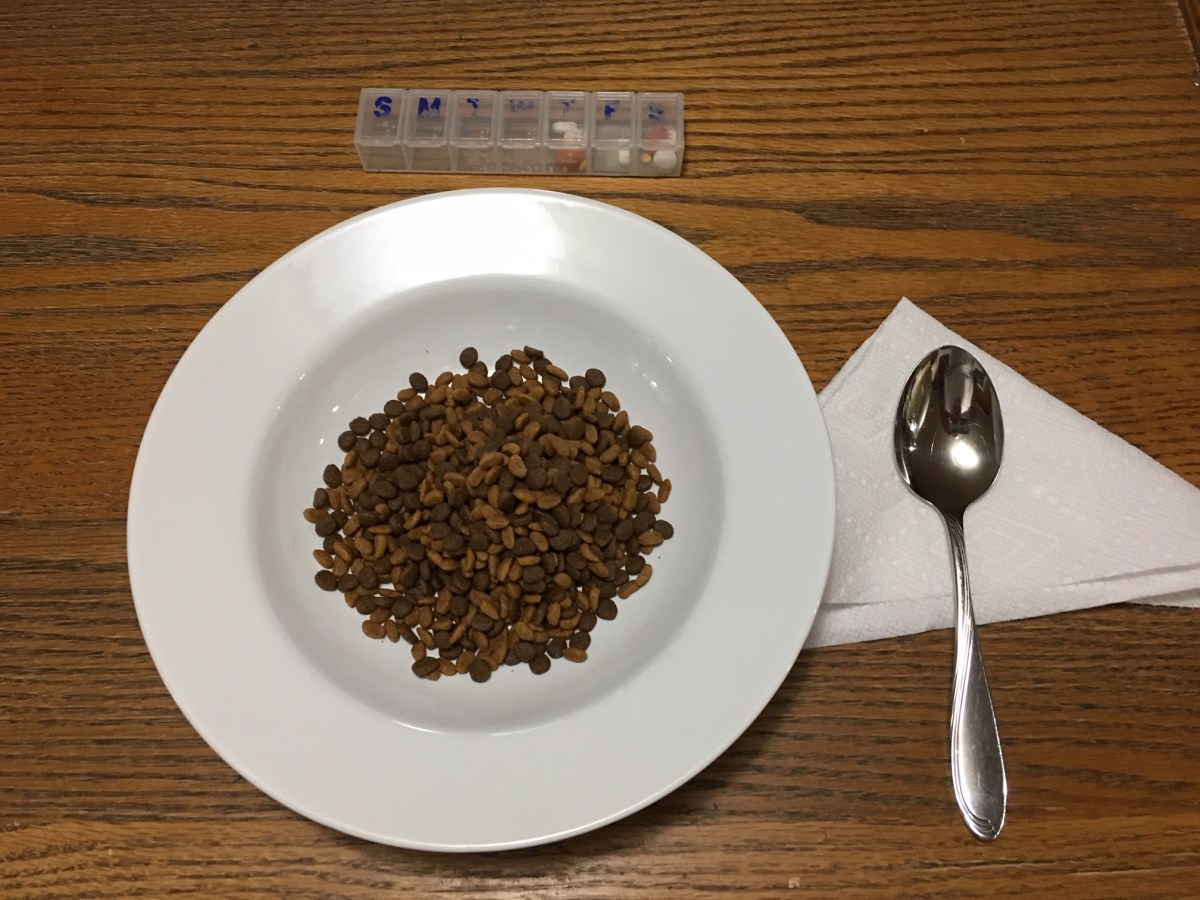
Wanted: Purina People Chow (Formulated for the Aging Geezer)

by James Wallace Harris, Wednesday, September 26, 2019

Abstract: Seeking a 100% nutritionally balanced meal plan for my aging body that involves the fewest possible standard meals that can be easily prepared. These meals should never cause gas, acid reflux, constipation, stomach pains, bloating, lethargy,  diarrhea, or any other bodily discomfort.

Trigger Warning: Do not read if you are unsettled by descriptions of bodily functions or euphemistic words that describe them. Do not read if you are depressed about getting older. Do not read if you want to keep all your geriatric surprises until they happen to you personally.

My friend Linda recently asked me why they didn’t warn us about all the weird things that would happen to our body as we got old. Not long after that I was at my doctor and asked her that question. She replied with a twinkle in her eyes, “You don’t want us to spoil the surprise, do you?” I thought, maybe she doesn’t want to depress her patients. I gave her an example to see what she would say. I told her my dick was shrinking. I lamented that my dick had never been big, and now it was beginning to whither. I might have also said WTF? She gave a little knowing laugh. Maybe that was a common complaint from men that she found funny, but I worried that maybe other changes for my little wonder worm were in my future and she didn’t want to tell me.

The other day I saw an article on Flipboard about vagina atrophy. Maybe such secrets of aging are out there and I just haven’t been paying attention. If penises and vaginas can atrophy, what about other organs? Am I peeing so much because my bladder is atrophying? Is constipation a new problem in my life because my intestines are shrinking away? Is all my stomach problems due to my stomach wimping out? WTF? I bet this is TMI, isn’t it?

When I was a kid I could eat anything and it never bothered me. Growing up I don’t really remember shitting much. I can’t ever remember taking a dump at school. And I think I only went to the boys’ room once a day to piss, and maybe some days not pissing at all. Hell, if I was in school today I’d be waving my hand to go to the restroom every hour – at least. And that lunchroom food would give me a stomach ache, heartburn, and gas that would last the rest of the day. In fact, I can’t remember spending much time in the bathroom when I was young, other than those adolescent years of jerking off while pretending to need to take a long leisurely crap, but now I practically live next to the toilet. And it’s no longer because of one-handed reading.

I’ve decided what I need is to study nutrition and create a small repertoire of meals that don’t offend my fussy body. In the last decade, I’ve slowly learned through painful lessons I refuse to accept, that my stomach, intestines, and bladder just don’t like my favorite foods anymore. For example, eating peanut butter now makes me feel like I have a bleeding ulcer. Drinking iced tea or soda pop makes me piss every fifteen minutes. Oatmeal creates enough gas that I could pressurize a natural gas tanker. Fatty foods give me painful acid reflux that feels like I’m having a heart attack. And the list of humiliations goes on and on.

I understand that my bladder is being crushed by an enlarging prostate and I have to pee more often, but if I get constipated or pressurized enough for farting I have to pee 2-3 times an hour. That’s very annoying. I hate to leave the house anymore because I have to piss so goddamn much. My wife is annoyed I won’t go on trips, but the logistics of finding that many bathrooms on the road put travel plans out of the question.

And I don’t mean to be whining. I know people with cancer, dementia, chronic pain, strokes, debilitating diseases, and other depressing conditions, so I consider myself very lucky to only have the puny physical problems I do have. But I figure if I’m going to live another 10, 20, or god forbid 30 years, I need to adapt to a long-term strategy of surviving with the minimum of discomfort. And since much of my discomforts come from eating, I need to buckle down and find out just exactly what my body wants. I feel hostage to my digestive system and I’m ready to pay the ransom.

If Purina offered People Chow that provided everything I needed for optimal nutrition, bright eyes, and a shiny chromedome, I’d eat it three meals a day. I’d forego all eating pleasure just to make turds that slid smoothly out, to be free of gas and bloating, to need to pee as infrequently as possible and especially to have a nice peaceful stomach.

I know I sound like all those old folks who talk endlessly about their bowel movements. But I figured something out last night. If young people had our bowels they’d be talking about their shits and pisses all the time too. Take care of your body because if you don’t it will get its revenge. (No, I’m glad I drank a trainload of  Cokes and chocolate shakes and ate those thirty-three tons of M&Ms.)

What I want to find are meals that satisfy my body’s need for nutrition and causes no physical complaints. I figure I need to eat two healthy meals a day with one snack in between. The problem I face is finding a selection of meals and snacks that are nutritionally balanced. I don’t even need culinary variety.

I know such meals exist because I sometimes go days without my body complaining. Then I’ll eat something and my pleasant digestive detente will be shattered for a week. Being vegetarian complicates things because foods with enough protein are limited. For fifty years I did fine with dairy products, beans, and peanut butter, but now those cause constipation, gas, and stomach pain.

I wish that my healthy diet could be based on ice cream, pie, cake, cookies, chocolate, Coke, and ice tea. Actually, my digestive system loves pie and ice cream, but they make me gain weight. Come to think about it, everything that makes me lose weight annoys my insides. Is just getting fatter the answer?

It’s such an insanely hard puzzle to figure out the right combination of foods that are ideal. If anyone knows of cookbooks for geezers or meal plans for sissy stomachs, post them below.

JWH


The Uneducated Unkindness of Youth Censoring the Past

by James Wallace Harris, Wednesday, September 25, 2019

Yesterday I read, “The Cult Books That Have Lost Their Cool” by Hephzibah Anderson at the BBC online. Anderson snidely dismisses several novels that were considered classics by my generation. Of course, when I was young I was just as quick to dismiss the works my parents loved. History has shown us that revolutionaries tend to eliminate people and art that don’t meet the standards of the new zeal. As an old person, and evidently part of an old guard, I’m seeing more of my history dismissed, causing artists and artists to disappear from pop-culture consciousness. It feels like agism censorship.

I can accept that the young have judged us harshly and found us morally wanting. What annoys me is they don’t have any sympathy for human frailty, and quite often I feel their social media kangaroo courts are conducted without examining the actual evidence. Take for example Anderson’s assessment of Jack Kerouac’s On the Road:

Based on a road trip from New York to Mexico with Beat muse Neal Cassady, Kerouac wrote what would become the Beatnik’s bible in just three weeks. It took six years to get published and more than half a century later, it exudes tiresome stoner machismo. Kerouac pokes fun at gay people, and isn’t much better where women and black people are concerned. A few years back, a spate of books and films inspired only a flicker of revived interest in his legacy. Boorish egotist or inspired prophet? The jury isn’t just out, it left the building long ago, dancing after the hippies who supplanted the Beats.

I can’t believe Anderson has even read the book. She says Kerouac pokes fun at gay people, but of the three main characters, Kerouac is straight, Ginsberg is gay, and Cassady is happy to have sex with almost anyone. And these men practically worship black jazz musicians. Kerouac hardly takes a machismo stance. He portrays himself with endless faults and emotional weaknesses. Kerouac was like Proust, he struggled to make sense of his life by fictionalizing it. The term beat deals with Kerouac’s existential angst over living in the 1940s and early 1950s. On the Road is about seeking freedom from an oppressive materialistic society. Anderson assumes it is some kind of bro road epic. If anything, Kerouac portrays the beats as Quixotic figures tilting at windmills. It’s a realistic portrait of the times, of men, women, gays, minorities, Mexicans, ethnic groups, and so on. It’s a sad, beat story about looking for kicks and being kicked down. It’s not pretty, but it is honest. Anderson has no sympathy for Kerouac’s suffering and struggle.

Nor is Anderson sympathetic to The Catcher in the Rye by J. D. Salinger:

Poor Holden Caulfield. Mired in a funk for more than half a century, the angst-ridden ‘everyteen’ is now regarded by the cool kids as being a bit – well, self-indulgent. His ennui is, if not exclusively a rich-white-boy problem, then certainly nothing compared with looming climate collapse and other woes weighing on the minds of his 21st-Century peers. Plus, in the era of helicopter parenting and geo-tagging, not to mention hyper-vigilant mental-health awareness, the idea that a depressed teen could simply go Awol in New York City for a couple of days is increasingly hard to indulge.

Just because Kerouac and Holden Caulfield don’t meet modern moral standards of 21st-century young people they are shunned and ridiculed. But here’s the thing, every generation is different. Should we erase the past because it’s different? Sure these people are morally and ethically wanting by today’s higher consciousness, but they are still human beings trying to make sense of life by what they knew at the time. The point of reading old books is to understand the past, to see it for what it was, not what we want it to be.

Dismissing Kerouac or Sallinger is cold and callous. Dismissing these writers is a kind of censoring the past. You can’t perfect the present by erasing the past. The ironic thing is Kerouac and Sallinger were revolutionaries like Anderson, wanting young readers to know that the times were changing. Of course, they did their own rejecting of the past too. That’s how it goes. But it’s better to see the bigger picture.

I wonder how Anderson will feel when she’s my age and someone her age now dismisses the cherished art and artists that shaped her generation?

I don’t really expect things to change. I always felt sorry for Kerouac. Kerouac and my father lived about the same years and died young from alcoholism. I wrote an essay years ago called “The Ghosts That Haunt Me” about Mark Twain, Jack Kerouac, Louisa May Alcott, and Philip K. Dick. These writers had painful lives, but they were outstanding in their soulful writing trying to make sense of those lives. It pisses me off that someone would blithely dismiss them for being uncool. I’m also sensitive about forgotten authors – see my page for Lady Dorothy Mills who has practically disappeared. It just seems hurtful to me that any writer would encourage readers to stop reading any author.

To be honest, I was like Anderson when I first read Kerouac when I was young. I thought it was a novel about thrills. But with every decade of life On the Road changes. I’ve been on the road for more years than Kerouac ever got to live. It takes a long time to really understand what beat means. Hephzibah, don’t be so quick to dismiss On the Road. Read it again when you’re older.

JWH