The Church of Reality

by James Wallace Harris, Friday, October 27, 2017

PKD“Reality is that which, when you stop believing in it, doesn’t go away.”

― Philip K. Dick, I Hope I Shall Arrive Soon


We need to declutter the world of bullshit memes. It’s time to apply Marie Kondo’s techniques for getting rid of unnecessary things to unnecessary beliefs. We all live in a fantasyland of lies, myths, untruths, and endless other forms of bogus thoughts. There is too much truthiness in the world and not enough truth.

Yesterday I started writing an essay about all the bullshit beliefs that pollute our minds. As I began tallying those crazy concepts I realized I’d need to write a whole book to cover the topic. This morning I discovered that book has already been written, Fantasyland: How American Went Haywire: A 500-Year History by Kurt Anderson. Here is a portion of chapter 1, “Now Entering Fantasyland,” but I highly recommend following the link to Amazon and reading the whole chapter.

HOW WIDESPREAD IS this promiscuous devotion to the untrue? How many Americans now inhabit alternate realities? Any given survey of people’s beliefs is only a sketch of what people in general really think, but from reams of research, drilling down and cross-checking and distilling data from the last twenty years, a rough, useful census of American belief, credulity, and delusion does emerge.
By my reckoning, the more or less solidly reality-based are a minority, maybe a third of us but almost certainly fewer than half. Only a third of us, for instance, believe with some certainty that CO2 emissions from cars and factories are the main cause of Earth’s warming. Only a third are sure the tale of creation in Genesis isn’t a literal, factual account. Only a third strongly disbelieve in telepathy and ghosts.
Two-thirds of Americans believe that “angels and demons are active in the world.” At least half are absolutely certain Heaven exists, ruled over by a personal God—not some vague force or universal spirit but a guy. More than a third of us believe not only that global warming is no big deal but that it’s a hoax perpetrated by a conspiracy of scientists, government, and journalists.
A third believe that our earliest ancestors were humans just like humans today; that the government has, in league with the pharmaceutical industry, hidden evidence of “natural” cancer cures; that extraterrestrials have recently visited (or now reside on) Earth.
A quarter believe vaccines cause autism and that Donald Trump won the popular vote in the 2016 general election. A quarter believe that our previous president was (or is?) the Antichrist. A quarter believe in witches. Remarkably, no more than one in five Americans believe the Bible consists mainly of legends and fables—around the same number who believe that “the media or the government adds secret mind-controlling technology to television broadcast signals” and that U.S. officials were complicit in the 9/11 attacks.

What we need is a movement to zap unreality whenever we encounter it. We need a Church of Reality where the ten commandments work to clear the collective consciousness of delusion. Of course, that’s Zen Buddhism, which has never caught on big. Too bad we can’t all walk around with bamboo sticks and give each other a politic whack if we hear something attacking reality.

If John Kelly had a keisaku, swatting Donald Trump every time he said something foolish, I wonder if the President could be conditioned into seeing reality more clearly? Would it help any or all of us if we got a little sting when we said something unreal? Maybe Apple and Google could develop apps for our phones that listen to us like Alexa and honks rudely when hearing silly remarks. Think of it as an AI friend like Mr. Spock or Data from Star Trek who would be cool and logical.

Anderson, in Fantasyland, goes into the history of how we’ve become such a looney nation. It used to be crackpots were loners seldom seen, but the internet has turned them into preachers gathering huge flocks of crazy followers. To compound the problem our country is creating an anti-authority establishment. Politicians and businessmen have learned that two-thirds of the population will believe anything they tell them so they greedily take whatever they want by lying. Currently, they are pulling off the biggest con in history with their tax-cuts using tired old lies that have been disproven for decades, yet they continue to succeed.

There is one external reality in which we all reside, unfortunately, the human mind creates its own subjective reality that each mind prefers to believe. Science is the only cognitive tool that tells us statistically which aspects of the external reality are probably real. Any Church of Reality we create needs to teach people how to tell shit from Shinola. I don’t know if that’s possible, but it’s lessons need to come from an external source. I can picture us each having a robot that follows us around and routinely says in the voice of Jeeves, “I’m sorry sir, what you just said is incorrect” or maybe in the voice of Marvin the Robot, “Damn human, you certainly are full of crapola today!”

JWH


Is There Any Hope for the Future?

by James Wallace Harris, Tuesday, October 24, 2017

A friend of mine recently posted to her Facebook that her world was rocked when she attended a lecture by Rev. Dr. William Barber who is leading a moral movement to repair the breaches in our society. I assume Laurie found hope in the idea we can save ourselves by creating a new moral order. Even though I’m an atheist, I’m all for this. The trouble is our society is too fractured. Is it even possible to put it back together again? I’ve recently wondered if there is any kind of movement that everyone could embrace and find agreement? I figured it would have to be as powerful as Christianity was in its first four centuries — and yet work with non-Christians and non-believers.

How can we find common ground? Everyone talks about America being politically polarized into conservatives and liberals, but I believe there are far more divisions than that cracking up our society. If every group identity is going to demand society conform to their narrow vision we are doomed. How can we find common ground when so many different viewpoints want to dominate making the rules? Instead of seeking cooperative compromises they all fight to impose their view while demeaning everyone else’s.

In small, homogenous societies, social coherence is found with shared morality. We live in a vast, heterogeneous society with countless ethical/moral visions which makes having shared values almost impossible. In the past, we all tried to agree on some social conventions such as etiquette, acceptable public behaviors, and abiding the laws. Such efforts are almost universally ignored now.

Our greatest obstacle to finding social consensus is defining reality. “I will destroy the wisdom of the wise” is how the apostle Paul began the divide between religion and science by attacking what he called the “empty logic of the philosophers.” Several hundred years later, St. Augustine continued with “There is another form of temptation, even more fraught with danger. This is the disease of curiosity . . . It is this which drives us to try and discover the secrets of nature, those secrets which are beyond our understanding, which can avail us nothing and which man should not wish to learn.”

The-Closing-of-the-Western-Mind-by-Charles-Freeman

I got these quotes from The Closing of the Western Mind: The Rise of Faith and the Fall of Reason by Charles Freeman. They explain perfectly how and why modern believers deny science. The faithful intuitively understand faith is threatened by science. It’s why Christianity embraced Plato and not Aristotle when they discovered the Greeks. It’s why conservatives have a never-ending guerrilla war with education working to undermine K-12 and higher education. They deny the results of science by denying science.

Is it even possible to find a common morality sharable by the sacred and the secular? We can’t even agree murder is evil. How can Christians embrace stand-your-ground laws, gun carrying permits, and AR-15s in light of the Sermon on the Mount? It’s strange that godless liberals support diversity, a concept that St. Paul brought to Christianity when many modern Christians reject it today. Not only is our secular society fractured into countless pieces, but so is Christianity. If believers in a single divine authority can’t agree how can secular society?

The old saying claims money is the root of all evil. I think it’s truer than ever. Money promotes self-interest, and self-interest promotes justifying the acquisition of money by any means. Our plutocratic society has escalated lying to the supreme tool of the greedy. Wealthy people and corporations have learned that lying pays big dividends. A great book that makes that point is The Merchants of Doubt by Naomi Oreskes & Erik M. Conway.

There is a war on science, knowledge, expertise, and intellectualism. The greedy have aligned themselves with the faithful to attack science, and they are winning the war. We can never achieve a universal morality if half the population believes the end justifies the means, thus rationalizing lying. The age of fake news and endless assaults on journalism will never stop before society collapses. I sometimes wonder if the goals of the radical right are to destroy society so they can start over fresh.

There is no hope for any moral movements if we all can’t agree to stop lying. We all need to accept that science is the only tool we have for verifying reality. Science was invented to work across cultures and weed out subjective bias. It is an extremely effective tool for explaining the objective reality we all live in. We must accept that any subjective religion, philosophy, or opinion can’t be a basis for defining what is true. Religion has two choices. It can embrace science or reject it. Religion will strengthen itself if it accepts science, even if science denies it’s metaphysical assumptions. The real value of religion is creating shared values and stable communities — heaven on Earth rather than silly promises in exchange of silly declarations of beliefs.

The greedy are currently using religion to attack science to protect their wealth. The greedy have aligned with the faithful who are also attacking science to defend ancient memes created by primitive folks thousands of years ago. There is a logical synergy to their union but if it succeeds it will destroy our current civilization. Thus, greed is corrupting modern Christianity. I find it hard to accept the faithful who claim the moral high ground when Mammon is their ally.

I don’t know how they can assert America is a Christian nation when our society isn’t even close to resembling the sayings printed in red in their bibles. I believe Jesus tried to teach social action that has more in common with the Democratic party than the Republican. To me, the only valid analysis of Christian philosophy comes from what Jesus said. Everything else said in his name or about him is corrupt. Read The Five Gospels by the Jesus Seminar to understand what I mean, or the books of Bart D. Ehrman.

I believe our only hope is to get the faithful and faithless to agree on common secular morality. This is what the Founding Fathers intended when they created freedom of religion. Because religious beliefs are infinite in variety they need to stay out of politics and remain personal. We need laws and common morals that protect everyone equally. We need to ignore the politics of special interest groups that want special treatment for the few.

We need to agree that science is the only arbiter of explaining reality, promote universal quality education, develop a set of ethics that all agree on which protects both people, animals, the plant world, the environment, that develops a sustainable society. What we need is worldwide Constitution and Bill of Rights for everyone in the 21st century. We need to protect the poor and helpless, but allow the ambitious to succeed without collectively destroying the planet.

The Death of Expertise by Tom Nichols

I’ve read two articles this week that suggests this won’t happen. Both are about the war on science and knowledge. The first is Bill Moyers dialog with Joan Scott at Salon, “In the Trump age, an embolden attack on intellectuals.” And this older article at The Federalist by Tom Nichols, “The Death of Expertise” which later became the book, The Death of Expertise.

Hope involves believing people can change. Since we haven’t for two hundred thousand years, why expect the human race to get its shit together at the last moment to avoid an apocalypse of our own making? We could save ourselves if we weren’t so greedy. Unfortunately, we live in a civilization where greed is the foundation.

JWH


Blade Runner 2049 – The Evil of Heartless Sequels

by James Wallace Harris, Wednesday, October 11, 2017

Normally I don’t write “reviews” of works I dislike. Why waste time on bad art, huh? I prefer to promote creative work I admire. However, in trying to understand why I disliked Blade Runner 2049 I asked myself, “What did I love about the original?” It came to me instantly – the voiceover. In that moment I realized Harrison’s Ford narration in the original film was the heart of the story. That insight also explained why Ridley Scott detested the voiceover. The narration must come from a human, and Scott wanted Deckard to be a replicant.

Blade Runner 2049-2

Before seeing Blade Runner 2049 I watched Blade Runner (final cut) with a friend. I explained the history of all the versions to her and offered to show her whichever one she wanted. She picked the final cut. Normally, I always rewatch the theatrical version, which is how I first saw the film back in 1982. Whenever I see one of the director’s cuts the viewing is always a letdown. They have the same sterile quality Blade Runner 2049 has.

Blade Runner 2049 is directed by Denis Villeneuve, with the story by Hampton Fancher and Michael Green. However, it feels like a Ridley Scott baby. Scott has always argued that Rick Deckard was a replicant and Blade Runner 2049 vindicates that idea to the point that I think of this film as an expression of his ideas.

Back in 2008, I wrote “Is It Time To Remake Blade Runner?” which was really a plea to film Do Androids Dream of Electric Sheep? as the story was written by Philip K. Dick. I believe the book deserves a truer conversion to film than Blade Runner. I can’t document this, but I believe Ridley Scott bragged that he hadn’t even read the novel when making the movie. Don’t get me wrong, I loved the original theatrical version of Blade Runner, but I don’t consider it very PKD.

When the screenwriters changed androids to replicants something else got changed. In the book, androids are soulless creatures who look like humans but completely lack empathy. They are self-aware but are also psychopathic sociopaths. I believe PKD intended them to be symbolic of inhuman humans. Blade Runner is about artificial creatures that were meant to be soulless slaves that have accidentally evolved empathy. We’re supposed to feel for them. And I did with the Harrison Ford voiceover.

Without the voiceover, both films are just action flicks of heartless machines killing heartless machines. Why has Riddley Scott never understood the Romeo and Juliet beauty of having a love story between lovers from two opposing houses? In Blade Runner 2049 we are taken on a meaningless thrill ride where it’s impossible to tell human from replicant – and I really didn’t give a shit either. There are a few touching scenes in Blade Runner 2049, but they are so artificial as to cause existential angst. At times we feel for K, our replicant protagonist, but the scenes are so obviously manipulating us that it’s hard to genuinely care.

In Blade Runner 2049 it becomes obvious the real problem is our lack of understanding of replicants. They are called skin jobs. That implies they are machines covered in skin. But that’s not true. In both movies, they bleed. In Blade Runner 2049 they seem to be artificially produced biological creatures that can’t reproduce on their own, and the goal of the mad scientist Niander Wallace (Jared Leto) is to create a Nexus model that is self-replicating. But what’s the fucking point of that? Humans are self-replicating, and we have plenty of them.

Wallace wants a new process to produce less costly slaves. The government obviously backs him as long as replicants don’t act like real humans. However, we also learn replicants have secretly organized into a slave rebellion. But why secret? What good is a secret mass-movement? Isn’t it obvious that replicants aren’t soulless machines?  Do any moviegoers feel the replicants aren’t equal to people? That makes the whole point of the film a straw man argument. Truly pointless. It’s funny, but Jared Leto’s character is the most inhuman character in the film and he’s supposed to be human. Or will Ridley Scott pull another juvenile joke and claim everyone in this film was a replicant.

Our world is full of robotic slaves now. They don’t have consciousness. They don’t look human. They lack any kind of consciousness. A major theme of science fiction has always been about when robots become conscious. Generally, these science fictional robots are shown as looking human. I guess SF writers assume we can’t empathize with them if they don’t look like us. By the way, the film Her did a fantastic job of overcoming this problem.

We’ve always wanted to build robots that look like us, and that’s a problem. We want them to do our work, but we worry about robots becoming self-aware as us. If they do, we can’t keep them as slaves, and we fear they may become better than us. The TV show Humans is exploring this same topic. The trouble is Blade Runner 2049 adds absolutely nothing to this topic. The film only confuses the issues in its razzle-dazzle. It lacks both a heart and a brain. Almost every character is violent and action-oriented.

Blade Runner 2049

PKD’s original novel, Do Androids Dream of Electric Sheep? isn’t about action. His androids are conscious, self-aware beings that lack empathy. Rachel is alluring and beautiful, but a cold-blooded killer. Dick’s theme wasn’t robot suffrage. PKD believed the androids in his story deserved to be destroyed because without empathy they are evil, and in doing so infers that humans without empathy are evil too. PKD’s story wasn’t about killing androids but identifying inhuman humans.

Do Androids Dream of Electric Sheep? is vastly more complicated than Blade Runner. If I could film it I would give it the look of 1959 films, because I believe PKD formative decades were the 1940s and 1950s. Its future setting would be very retro-future. It would have the Penfield mood organs and Mercerism. And the story would focus on philosophy and psychology rather than fights and shooting. The film must keep Iran, Deckard’s wife. And it needs the fake police station, having Deckard doubt himself, and eventually proving he’s human. And it needs the artificial religion of Mercerism.

Blade Runner leaves so many fascinating concepts out from the original novel. First off, Rick Deckard isn’t a tough-guy like Harrison Ford, but a married man trying to save his marriage. Their livelihood depended on the bounty from killing androids. The novel opens with their marital squabbling, and the use of mood organs. Mood organs are personal devices for controlling psychological states. People in this future use them to subtly control how they interact with other people, cope at home and work, and explore hundreds of emotional states. PKD uses this imaginary device to dissect human nature. The book is stuffed with observations about what it means to be human. Blade Runner uses none of that. PKD was obsessed with psychiatry, psychology and philosophy and his stories constantly explore those subjects. The Blade Runner movies only faintly hint at the issues PKD brought up in endless ways.

Blade Runner 2049 does not define humans or replicants. We can’t tell them apart. In fact, the evil scientist who creates the replicants acts like a heartless AI, and K, the Ryan Gossling character, who we know is a replicant, when left alone is humanly hung up on an AI girlfriend (who may be a future descendant of Alexa).

Blade Runner 2049 fails horribly if you need a human story. For moviegoers who love eye candy, violence, and a rollercoaster plot, you’ll probably be happy enough.

What’s evil is trying to make millions by making a movie that lacks heart, based on a novel that struggles to define our hearts. Seems kind of heartless, don’t you think?

Blade Runner 2049 is chock full of touchstone analogs from the original Blade Runner. That felt manipulative like Ridley Scott wanted to push our emotional buttons as if we were replicants. Did he expect us to emotionally resonate with air hoses being pulled out, yucky eyeballs, pianos, giant billboards animated with Japanese women, microscopic photo scanning machines, bicyclists riding in parallel formation, machines that measure artificial minds, old abandoned apartment buildings, drinking whiskey from squarish glasses, women dressed like 1970s hookers, giant pyramid-shaped buildings, flying cars, sentimental photographs, umbrellas and rain, and so on.

Everything in Blade Runner 2049 seems set-up for additional sequels, but like his Alien franchise, they will probably continue to abuse the original. I’ve gotten so I hate sequels to books and films. There are few exceptions, but for the most part, sequels feel like they are conning me for my money.

JWH


Why Do I Love Old Black and White TV Shows and Movies?

by James Wallace Harris, Tuesday, October 10, 2017

Normally I watch the latest hit TV shows, usually on Netflix, HBO, or Amazon Prime. Generally, I watch these shows with friends. I’ve gotten so I don’t like watching TV alone. However, when I do, it’s because I’m too tired to do anything else and it’s too early to go to bed. When I’m alone I’m drawn to old black and white television shows, movie westerns from the 1950s and old Hollywood movies from the 1930s. Why do I prefer black and white shows? Why do I save shows in color for when I’m with friends?

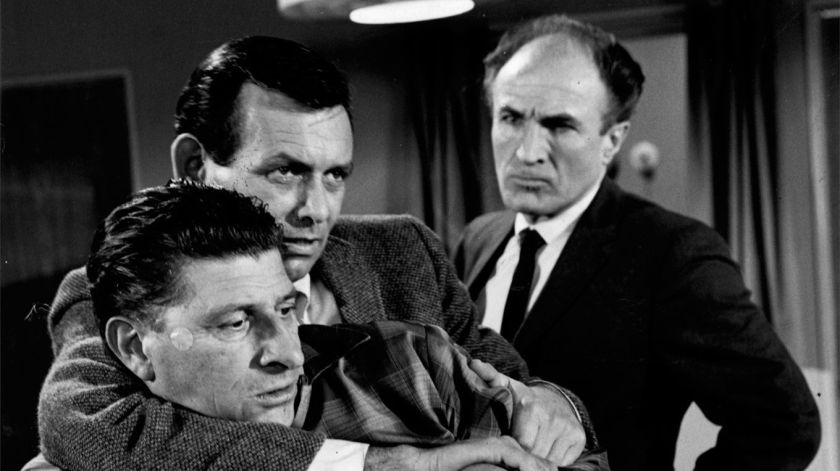
MeTV got me hooked on two old TV series this month, The Fugitive and The Outer Limits. Both shows premiered in 1963. As a kid, I discovered The Outer Limits when the first episode aired. It ran on Monday nights at 7 on ABC. My father loved The Fugitive which came out on Tuesdays on ABC at 10 pm. I watched it some back then but didn’t really care for it. I generally hated the TV my folks loved. I don’t know if that was rebellion or I was just too young for the content.

I have a hard time remembering my dad being home, but he loved TV, and he liked it best when us kids weren’t around. There was nothing on Tuesdays at 10 my sister Becky and I wanted to see, so we left him alone to watch The Fugitive in peace. A half-century later, I’m staying up late watching The Fugitive alone like he did. I wonder if that gives me any kind of psychic connection to how my father felt?

Fugitive

Becky and I were horrible TV hogs. We’d have huge shouting matches with our dad on Sunday nights during the 1966/67 season when we pleaded to watch The Smothers Brothers Comedy Hour and he fought to see Bonanza, his favorite western. I loved westerns too, but not Bonanza or The Virginian, my mother’s favorite cowboy show. Gunsmoke was my TV shoot-em-up. I don’t think Becky ever liked westerns, but I should ask her the next time she calls.

This year I’ve also bought the first seasons of Gunsmoke, Have Gun Will Travel, Route 66, and Cheyenne. I bought the complete series of The Twilight Zone on Blu-ray and The Fugitive on DVD. I’m thinking about buying Perry Mason and Maverick.

Route 66

I used to hate Perry Mason, which was my mother’s all-time favorite TV show. She also loved to read the Perry Mason mysteries. But for some reason this year, I started watching them on MeTV. I liked that it was in black and white and sometimes featured street scenes of the early 1960s. That’s why I bought Route 66 because it was filmed on location, viewing 1963 America in contrasty black and white.


At the start of the 1963 TV season, we were living on Homestead Air Force Base. I started the seventh grade at Redlands Junior High in South Florida, when I was eleven. After a few weeks, we moved back to Hollywood, Florida, and I attended my second 7th-grade school, but I forgot its name. I thought it was Broward Junior High, but I can’t verify that on the internet. I was in class at that school when they announced over the PA that JFK had been shot. Three days later I turned twelve. After that, we moved to South Carolina, where I went to my third 7th-grade school, John F. Kennedy Junior High.

The Outer Limits

Memories of 1963 represent living in two states and three schools, and for some reason the 1963/64 television season also vividly sticks in my mind. I started regularly listening to rock music at the end of 1962 when I got an AM clock radio for Christmas. I became much more aware of the world around this time. It was during that time period I became a bookworm, rock & roll fan, addicted to the boob tube, and started going to the movie theater on my own.

High Barbaree

I remember watching TV since I was four or five, probably with the 1956/57 television season. My family didn’t get a color television set until 1965, so my first decade of TV was in glorious black and white. All my life I’ve loved old black and white movies from the 1930s and 1940s. I wonder if that’s because I spent my formative years viewing a B&W TV screen? My earliest memory of my father is waking up in the middle of the night when I was four, and walking out to the living room to find my dad watching an old movie on television. He let me stay up and watch it with him. This is my first memory of television and the first movie I ever remember seeing. I didn’t discover until years later it was High Barbaree (1947) with June Allyson and Van Johnson.

Why now? Why has my mind started craving old black and white TV shows again, ones from long ago? Is it just nostalgia? Is it a way of communing with my dead parents. And isn’t it odd that I’m not watching the shows I loved as a kid but prefer seeing the ones my parents watched when I wasn’t around?  I still can’t stand Bonanza or The Virginia. Both of those shows insult my sense of what a western should be.

The other night my friends and I watched The Solid Gold Cadilac and I found it immensely pleasurable it was in wide-screen black and white. I can only remember a couple wide-screen black and white films at the moment, The Apartment and The Big Trail, both of which I have on Blu-ray. It’s a shame B&W wide-screen didn’t catch on back in 1930.

Am I drawn to the black and white, or to the period content? I don’t know. I’m not sure I would like The Fugitive as much if it had been in color for its first three seasons. For some reason, I’ve never liked the remakes of The Twilight Zone or The Outer Limits which were made in color. And the only horror movies I enjoy are the classics from the 1930s which were in black and white.

I wonder if nostalgia comes in black and white and modernity in technicolor? The 1950s were definitely a black and white decade to me, even though I have some personal photographs to prove it was indeed in color. I wonder if kids who have always lived with color TV ever think of the past in black and white? Were my formative years corrupted by black and white TV sets? Will children today remember the world in LCD/OLED imagery? How would my consciousness of the past be today if I had never seen a TV, movie or computer screen, or photograph of any kind? Would I even conceive of black and white?

The world does turn black and white in low light, or when you’ve had way too much to drink. But now that we preserve the past digitally in color, will that eventually eliminate an appreciation of viewing reality in grayscale?

JWH


How to Save Thousands of $$$

by James Wallace Harris, Wednesday, October 4, 2017

An American Sickness by Elisabeth RosenthalThere are some books everybody should read. Often those books are on topics few people want to think about and the book I want everyone to read is about health care — a subject that will bore the will-to-live out of most readers. An American Sickness: How Healthcare Became Big Business and How You Can Take It Back by Elisabeth Rosenthal is a book I read for my Two-Person Book Club, and we both found it riveting.

As long as you can stay out of a hospital, emergency room, or a doctor’s office that’s aligned with a hospital, you’re probably okay to skip reading this book. But don’t think having good health insurance will protect you from bankruptcy. Rosenthal’s book is about all the ways the American Medical Industrial Complex is finding to bill you beyond what your insurance will pay. If you have any kind of savings at all, they are at risk of being wiped out by playing Russian roulette with our current healthcare system.

What Rosenthal thoroughly proves is our plutocratic government will always take political donations from the greedy, which explains the escalating medical costs in America. Republicans are hell-bent to kill Obamacare because they want to cut taxes for themselves and their donors don’t want any laws that impede them from profiting on the misery of sick folks.

This is the second time I’ve written about this book. I’ve told all my friends about it, and none of them are interested. An American Sickness scares the bejeezus out of me. The only way we can avoid being ripped off is by collectively working together. Expecting Congress to solve this problem is insane unless there’s an overwhelming demand from voters.

Everyone wants to have a health insurance policy that covers all their medical bills and never worry what hospitals and doctors bill their insurance. That’s not going happen. One day you will receive a bill that your insurance won’t pay, whether it’s $600, $6,000, $60,000 or $600,000, and you’ll not be able to wish it away. Rosenthal had many stories of people going to an emergency room and ending up owing the price of a Mercedes or even a median-priced house because parts of their bill weren’t cover by their insurance.

I was just on the phone with a friend who got a $29,000 ER bill after he fell off his bike while on vacation and needed 13 stitches. He’s now wrangling with his Medicare Advantage plan over how much he has to pay for this out-of-network event. He also says he’s in the Medicare donut hole and paying $500 a month for insulin and $600 a month for his digestive enzymes. [Rosenthal relates a story of a mom taking her toddler to a pediatrician who referred her to a plastic surgeon that put in 3 stitches and was billed $50,000. So my friend got a bargain for 13.]

Rosenthal offers hope, but it depends on political change. And for political change to occur more people need to read this book. That means you.

Recommended Reading

JWH