Sometimes We Really Do Want More Government Regulations

by James Wallace Harris, 4/27/21

Please watch this fifteen minute video from NBC News. It is the most insightful news story I’ve encountered this year because it encapsulates many of the essential issues about the future.

This video illustrates why lack of regulations and resource management leads to ordinary citizens and the environment losing to big business. Corporations and people with money wanting to make more money are searching the globe for places where they can get any kind of competitive edge with their investments. Basically, big business and rich individuals will gentrify every last acre on the planet, pricing ordinary people off their land.

Southeast Arizona has very little surface water and rainfall. For decades homeowners, family owned farms and ranches, and towns have been sipping off the top of their aquifer. As long as rains replenish that aquifer, life in the desert is sustainable. However, global corporations have discovered this Arizona land is essentially unregulated and the water is there for the the price of sinking deeper wells. This makes it profitable for corporations from around the world to exploit this area. Raising hamburgers and cattle feed in the desert seems insane until you realize the real value of water.

Water is the new gold rush, and some locales are trading their water for jobs and investments. However, once that water is gone, that locale, that environment will die. Keep an eye on this trend. You’ll see it everywhere once you start looking.

As the corporations put millions into exploiting this land, drilling ever deeper into the aquifer, they have gained control of the land because ordinary people can’t afford to extend their wells deeper, and are thus force to sell out and move. Local control over land is going to disappear.

A kind of corruption is taking place. Politicians back the corporations because they follow the money. Notice how toady the politician is in this video. People who don’t own land and just want jobs align themselves with the corporations. And even though the corporations claim they are there for the long haul, the reality is they are there as long as they can make a profit. Once they suck the aquifer dry or it becomes too costly to pump that water out of the ground, they will leave.

This is happening all over the world. The long term results is the total land area that is sustainable for life on Earth is shrinking. The dynamics of what’s happening here also reveals various kinds of inequality in action. Ordinary people can’t compete. Neither can nature. Basically, outsiders with money have all the power. If the local government had regulations about land and water use they could preserve their old way of life. They could build a sustainable society. Corporations have played the democratic system to get what they want. Read Dark Money by Jane Meyer or Evil Geniuses by Kurt Anderson for fuller explanations.

Right now we have an exploitation society. The rules are simple. Anything you can do that others can’t stop you from doing, you can do. Individuals can’t compete against corporations. And since corporations are rigging the laws, there’s little people can do – unless people take back their democracy. But it might be too late. There is little demand for sustainability. Corporations want to make money, and individuals want jobs. Unless people can create jobs that coexist with sustainable economies, things won’t change.

When you watch this video think about the two opposing groups. On one hand, you have the global demand for meat and dairy, which includes all of us, and a few individuals who have been living in southeast Arizona for decades. Corporations just fulfill the global demand. But what if the global demand becomes greater for sustainability and the environment? We all have to want it, or it won’t happen.

JWH

Will We Reach Herd Intelligence Before We Crash Our Civilization?

by James Wallace Harris, 4/19/21

  • Collapsed: How Societies Choose to Fail or Succeed by Jared Diamond
  • Falter: Has the Human Game Begun to Play Itself Out? by Bill McKibben
  • Seaspiracy – a documentary on Netflix

All indicators point to the collapse of civilization sometimes this century. Despite all the press about this perfect storm of self destruction, few people are willing to worry, and even fewer willing to do anything. Must the conclusion be that failure is our only option?

Most of humanity is either preoccupied with personal problems, or if they contemplate the future at all, assume our species will muddle through as it always has in the past. All the evidence suggests otherwise, that the biosphere cannot absorb the impacts of Homo sapiens without a significant destabilization of its system, which in turn will alter the course of civilization.

Civilizations have always come and gone, and so have species. Nothing lasts forever, not even the Earth or the Sun. It’s rather disheartening to consider what we could have become. We almost had the intelligence to create a global civilization that could have lasted thousands, if not millions of years. Theoretically, we still have a chance, but few people who think about such things give that chance much hope. It would have required everyone pulling together towards a common cause, and we’re just not that kind of species.

However, don’t worry, don’t get depressed or do anything irrational. No need to become a prepper assuming an Armageddon is just around every corner. The collapse of civilization will probably be so slow you might not even notice it. Humans are very adaptable to hard times and excellent at rationalizing things aren’t what they seem. Just take every day one day at a time and enjoy the passing parade of history.

As an individual who reads many books and watch many documentaries like the ones above, I keep thinking we should be doing something. But I realize there’s a problem with that assumption. First, we all need to be doing the same thing, and second, we should all stop what we’ve been doing our whole lives. Now is that going to happen? Is humanity a ship that can be steered or a bullet on a trajectory? It really comes down to the Serenity Prayer,

God grant me the serenity to accept the things I cannot change,
Courage to change the things I can,
and Wisdom to know the difference.

It’s the last line that’s so hard to achieve. What can we change, and what can’t we change? Theoretically we could change everything in society if we could just change ourselves. Is it Pollyannaish to think we could, and fatalistic to think we can’t? I wonder if people have always believed in God just to redirect that burden of responsibility?

If you read the above books maybe you will also ask who is smart enough to understand and solve these problems? If we built giant AI minds that could think their way through these immense challenges, would we take their advice? Aren’t we too egotistical to listen? Or even if a God spoke directly to the world would we obey? I’m not sure that’s in our nature either.

Maybe the only path an individual can take and stay sane is learning to accept and endure. But that doesn’t seem to be the way either because too many people today are angry. Anger means still trying to control. If you watch the news pay attention to anger. Too many hate what’s happening to them. And it’s on both sides of the political spectrum. All the people who fight for freedom and all the people who want rules and regulations are motivated by anger. That’s what I dread about the collapse of civilization, living with all these angry people. And the only solution to that is find a place away from them, but that’s not really possible either, is it?

This is a strange book review. But I find it’s getting harder and harder to review books like these by talking about the issues they cover. I’m down to evaluating their emotional impact. The penultimate question is: Can we do anything? The answer is yes. The ultimate question is: Will we? I used to hope that was a yes too, but my faith is fading.

JWH

Lightning Killed More Than My Hardware

by James Wallace Harris, 4/17/21

Lightning zapped my Sony TV, NUC computer, Yamaha music streamer, and AT&T internet box. It was six days before we were back on the internet, but I still haven’t replaced the other equipment. I’ve been thinking about what I had and what I want.

The lightning strike has indirectly killed my interest in Linux. I’ve been playing with Linux ever since the early 1990s when I downloaded floppy disc images off Usenet. Each time I installed it I realized I couldn’t use it for my daily computing, but over the years Linux got better and better. I thought Linux terribly neat and always wondered if there would come a day I could use it for my regular computing tasks. When lightning struck I switched to using my Linux machine. I found programs to do nearly everything I did under Windows and figured that day had finally come. Then I needed to print. HP even offers support for different Linux distributions, but the HP software I downloaded wouldn’t install. It almost did, but it was missing a handful of dependencies, just some Python files, and I just didn’t want to go looking for them. So I finally gave up on Linux. I needed to print a letter to my doctor and couldn’t. I realized that if I made a big effort I could. I might even get my flatbed scanner to work too, but it would take a lot of fiddling, and I realized I’ve just gotten too old for fiddling with computers that don’t work.

I got out my copy of Windows 10. It installed within minutes. It automatically recognized the HP printer and downloaded the drivers. My letter printed. I’ve decided my backup computer will be a Windows machine from now on too. I’m just getting too old to keep up with two operating systems. And I was thinking about getting a Mac Mini too, one of the new M1 machines. I’ve dreamed of owning a Mac for decades. Well, lightning has killed that desire too. The side effect of losing my Windows machine has made me realize I want to simplify my computer usage, and Windows only is the way to go.

I haven’t replace my TV yet because I wasn’t sure what kind of TV I wanted next. I spent years selecting the Sony. I had known I wanted a 65″ TV, but there was so many other technical considerations. Since my TV died I’ve been watching my wife’s 55″ TCL Series 5 TV and realized it’s almost as good for 1/3 to 1/4th the price. I just didn’t miss all those superior technical features Rtings.com claimed the Sony had, and the simplicity of the TCL’s built in Roku interface turns out to be the real deciding factor. I still want a 65″ TV, but I’m going to buy a 55″. The larger TV weighs more than I can handle. Over the past few years I’ve been learning that weight matters too in factoring in convenience.

Evidently, lightning also killed my desire for high tech toys. When I replace my computer, I’m going to get an Intel i5 chip instead of the i7 that got zapped. Using my old machine with an i5 has shown me it’s fast enough. Even before the crash I was thinking about a new computer. I was hankering for a tower unit with a fast graphic card. But after the lightning strike I’ve decided to stay with the small NUC form factor.

I haven’t decided what to do about my Yamaha music streamer. The lightning killed the ethernet and wireless circuits, so I can’t stream music, but the amp still works, so I can play CDs and LPs. Maybe that’s good enough. However, in my evolution towards a simplified lifestyle I’ve been considering giving up CDs and LPs. Maybe I can find a small streamer to play through the amp. All it needs is Spotify connect. I bet an Echo Dot would do. I’ve already given up on streaming high definition music. It was just too much trouble for something I wasn’t sure I could hear.

It’s odd to think about how a lightning killed my desire for newer technology, but it has. I was already downsizing because of aging, so I no longer believed bigger was better, but I still had faith that the latest technology was better, and now I don’t. A burst of lightning has shown me that I reached good enough tech years ago. I don’t need cutting edge computing equipment, or audiophile stereo equipment, or even a television that Rtings.com rates the best.

When lightning killed my toys I was annoyed, but only mildly so because of the inconvenience. It was just after several towns in Alabama were hit by tornadoes and many people lost their entire homes. I considered myself lucky to lose so little. But in a way, I was doubly lucky because what I lost has taught me what I don’t need, and that will save me a lot of time and money in the future.

JWH

Lessons Learn from Lightning Killing My Computer, TV, and Internet Box

by James Wallace Harris, 4/1/21

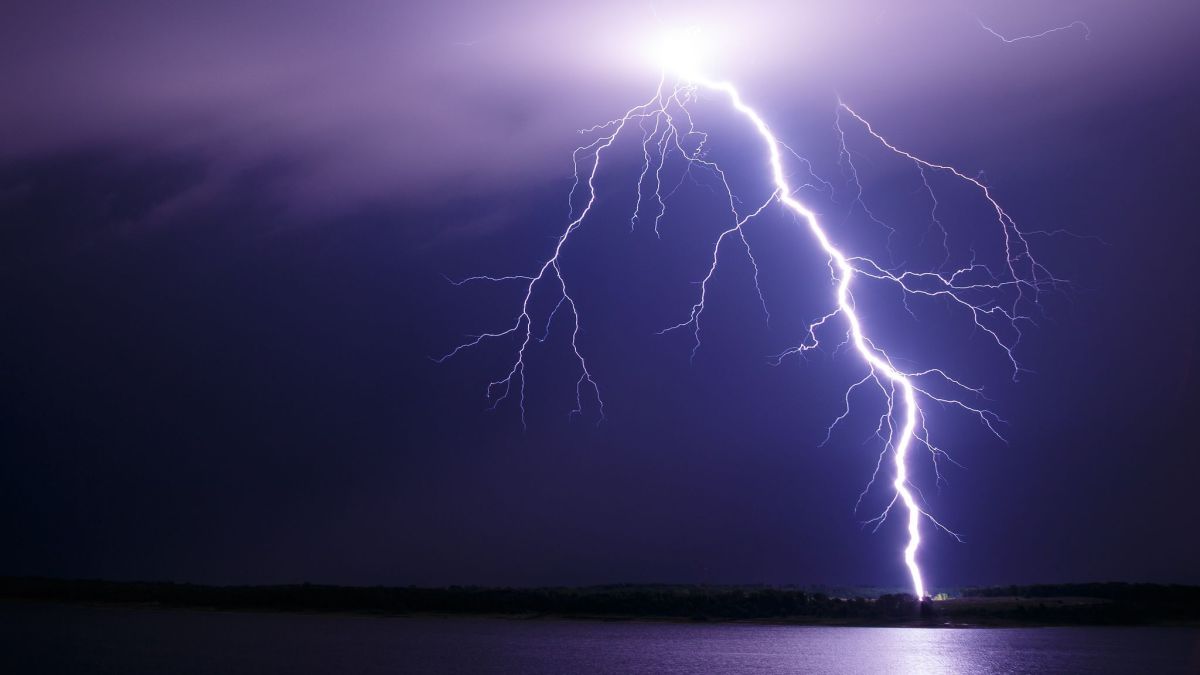
Around 4:30 am last Friday lightning struck near my house. I was up peeing when a tremendous flash and boom occurred just outside the bathroom window, stunning my eyes and ears. I didn’t think much about it and went back to bed. When I got up I turned on my computer to check my email it wouldn’t come on. It was as dead as a dried up cockroach. Oddly, my nice APC UPS was still functioning. And my monitor worked. Huh, wondered what all that meant? I was heartsick my computer died but not too worried, I believe I had everything on Dropbox.

I went around the house checking things and discovered my 18-month old 65” Sony TV was dead as the computer. That was a shocker, but then I thought about all the folks in Alabama who had their houses blown to bits by tornadoes. R.I.P. my Sony, but I can buy another.

Finally, I realized I was getting no WiFi in the house, and discovered the internet router was a goner too. Now I was worried, feeling the growing anxiety I feel when I’m not connected. Dang, I hate that feeling.

The TV was on a brand new surge protector that seemed to be in fine working order too. My current theory is lightning zapped everything through the Ethernet cabling. So much for trusting UPS boxes and surge protectors. I did some research and lightning can be destructive in mysterious ways. It doesn’t have to make a direct strike, or come through the house wiring. My neighbor to the north lost his cable TV box and my neighbor to the south had to reset all the breakers in his house.

So my first lesson is to unplug electronic devices from both power, Ethernet, and outside antennas when I get a severe storm warning. But that was only the beginning of my education from this event. We’ve been without the internet and WiFi for almost six days now. That’s taught Susan and I just how addicted we’ve become to the global net. It’s also shown us just how many of our daily activities depend on WiFi and networking.

Without the internet some of the things I missed were:

  • Streaming TV
  • Streaming music
  • Streaming audiobooks
  • Streaming Kindle books
  • Talking to Alexa
  • House phone
  • WordPress blogging
  • Groups.io clubs
  • Social Media
  • Zooming
  • Browsing the web
  • YouTube

Our smartphones were working, but we only get one bar of AT&T service in the house. That meant we weren’t totally cut off. We had our little handheld lifeboats. Our weak broadband was good enough for email, light Facebook use, reading simple web pages, or watching short video clips. Just enough to keep us connected with people and information, but no massive multimedia consumption.

You’d think it would be no big deal to go without the internet because most of our lives we didn’t have it. But I realized now I’ve been using the internet daily for more than a quarter century and wasn’t aware of just how integrated it’s become to my daily routines. And I’m not even one of those guys who’s automated their house with intelligent control and security features. Think about the direction society is heading by connecting everything.

At first I only missed little things, but they added up. For example, I needed to fill out registration forms for an upcoming surgery, but filling in the forms were impractical on the phone. I had to go to a neighbor’s house and borrow their computer to complete that task.

We gave up cable years ago, so all our TV comes to us via streaming. Susan made do by watching over-the-air TV, and I got by with Gunsmoke season 2 DVDs. Using that old tech has an old timey feel. That should have been retro trendy, but it wasn’t cool, reminding us it obvious why everyone prefers streaming.

I stream all my music, newspapers, and magazines too, and about half my books. While we were off the net I read physical books. It seemed very quiet. I’ve always been a bookworm, and I have enough printed books to keep me in reading for the rest of my life, so why did I feel anxious about not having my digital books and magazines? Was it just new habits are comfortable and old lost habits are odd?

Staying home for over a year because of the pandemic has made me very depended on the internet for socializing. Since retiring in 2013 many of my hobbies have become internet related. During the last power outage some people in my groups even wondered if something had happened to me. (It’s not uncommon on listserv book clubs for someone to die and leave folks wondering about those people who never post again.)

Internet friends aren’t the same as real life friends, but I’ve come to value them in my daily digital life in a big way. Are we slowly becoming adapted to hive socializing? I do feel sorry for people who aren’t internet savvy. More and more, daily business is conducted over the internet, from getting vaccine appointments to replying to jury summons. When my doctors come into the exam room they bring their laptops and they expect me to join their portals. I haven’t written a letter or sent a postcard in years. I keep up with family and friends on Facebook. Most of my shopping is online. I have several friends that I talk with on the phone and we each use the speakerphone so we can look up stuff we can’t remember on Google and Wikipedia while we chat. Increasingly, I have running texting sessions with friends I used to visit because we no longer want to use up all that real time getting together in person. The interest is my auxiliary memory, my second brain.

You’d think one thing I learned this week is to value analog living, but I was too anxious to get back to the digital world. Once the router came in this afternoon I jumped back on the net. Susan immediately cranked up the streaming TV, and I started researching how to avoid an internet outage again.

My first idea is to switch to using WiFi all around the house. I have Ethernet cables running everywhere because I want Ethernet speeds and hate putting in WiFi passwords. I started researching buying a WiFi mesh system but realized I’d have to tinker a fair amount with my AT&T router’s setting. So I ordered one WiFi range extender that AT&T pushes. If it works, I’ll get another. It will be much cheaper than buying a mesh system. If the AT&T extender works I can give up several cables stretches, a switch, many patch cables to devices, and two Ethernet over 110 wiring hubs. I’m also going to research what it takes to get a broadband WiFi hotspot. At minimum I could get a tablet with broadband and a keyboard.

On the other hand I feel guilty. I feel I should be visiting friends (this goddamn Covid), watching television as God and Philo Farnsworth intended via over-the-air broadcasts, and reading books in the Gutenberg form factor. Have you tried local television lately? Susan found four stations that ran old television shows we watched growing up until cable TV and the internet intervened. It was like time traveling all day long.

This week we were reminded of the old reality. Given a few weeks I believe I could have overcome the withdrawal symptoms of internet addiction. Thomas Wolfe said we can’t go home again, and maybe that’s true, and maybe it’s not. Did he try hard enough?

I could use the internet less, but I couldn’t do without computers. I’d never want to return to the typewriter after knowing the wonders of the word processor. I could give up Facebook but not email. I could even learn to shop in stores again, but will we? We’re all rushing into the future and do we ever consider slowing down that stampede, or even turning around?

JWH