Am I Too Old To Start A Second Brain?

by James Wallace Harris, 12/8/25

For years now, I’ve been reading about people who create a second brain to record what they want to remember. Most of these second brain systems use software, but not all. Many base their ideas on the Zettelkasten system, which was originally stored on note cards.

Over the years, I’ve tried different methods and software applications. I’m currently learning Obsidian. I’ve used note cards, notebooks, Google Docs, Evernote, OneNote, InstaPaper, Recall, and others. I love reading – taking information in – but I don’t like taking notes.

The trouble is, information goes through my brain like a sieve. When I want to tell someone about what I’ve learned, or think I’ve learned, I can’t cite my source, or, for that matter, clearly state what I think I know. And I seldom think about how I’ve come to believe what I believe.

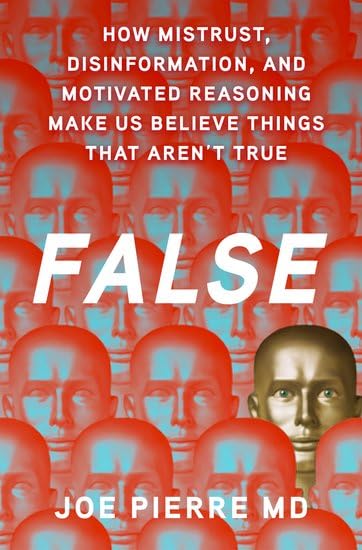
I’m currently reading False by Joe Pierre, MD, about how we all live with delusions. This book makes me want to rededicate myself to creating a second brain for two reasons. First, I want to take precise notes on this book because it offers dozens of insights about how we deceive ourselves, and about how other people are deceived and are deceiving. Second, the book inspires me to start tracking what I think I learn every day and study where that knowledge comes from.

One of the main ways we fool ourselves is with confirmation bias. Pierre says:

In real estate, it’s said that the most important guide to follow when buying a house and trying to understand home values is “location, location, location.” If I were asked about the most important guide to understand the psychology of believing strongly in things that aren’t true, I would similarly answer, “confirmation bias, confirmation bias, confirmation bias.”

Pierre explains how the Internet, Google, AIs, Social Media, and various algorithms reinforce our natural tendency toward confirmation bias.

Pierre claims there are almost 200 defined cognitive biases. Wikipedia has a nice listing of them. Wikipedia also has an equally nice, long list of fallacies. Look at those two lists; they are what Pierre is describing in his book.

Between these two lists, there are hundreds of ways we fool ourselves. They are part of our psychology. They explain how we interact with people and reality. However, everything is magnified by polarized politics, the Internet, Social Media, and now AI.

I’d like to create a second brain that would help me become aware of my own biases and fallacies. It would have been more useful if I had started this project when I was young. And I may be too old to overcome a lifetime of delusional thinking.

I do change the way I think sometimes. For example, most of my life, I’ve believed that it was important for humanity to go to Mars. Like Elon Musk, I thought it vital that we create a backup home for our species. I no longer believe either.

Why would I even think about Mars in the first place? I got those beliefs from reading dozens of nonfiction and fictional books about Mars. Why have I changed my mind? Because I have read dozens of articles that debunk those beliefs. In other words, my ideas came from other people.

I would like to create a second brain that tracks how my beliefs develop and change. Could maintaining a second brain help reveal my biases and thinking fallacies? I don’t know, but it might.

Doing the same thing and expecting different results is a common fallacy. Most of my friends are depressed and cynical about current events. Humanity seems to be in an immense Groundhog Day loop of history. Doesn’t it seem like liberals have always wanted to escape this loop, and conservatives wanted to embrace it?

If we have innate mental systems that are consistently faulty, how do we reprogram ourselves? I know my life has been one of repeatable behaviors. Like Phil Conners, I’m looking for a way out of the loop.

Stoicism seems to be the answer in old age. Is it delusional to think enlightenment might be possible?
JWH
Why We Fail As Individuals – Case 1: An AI’s Insight and Advice

by Microsoft CoPilot

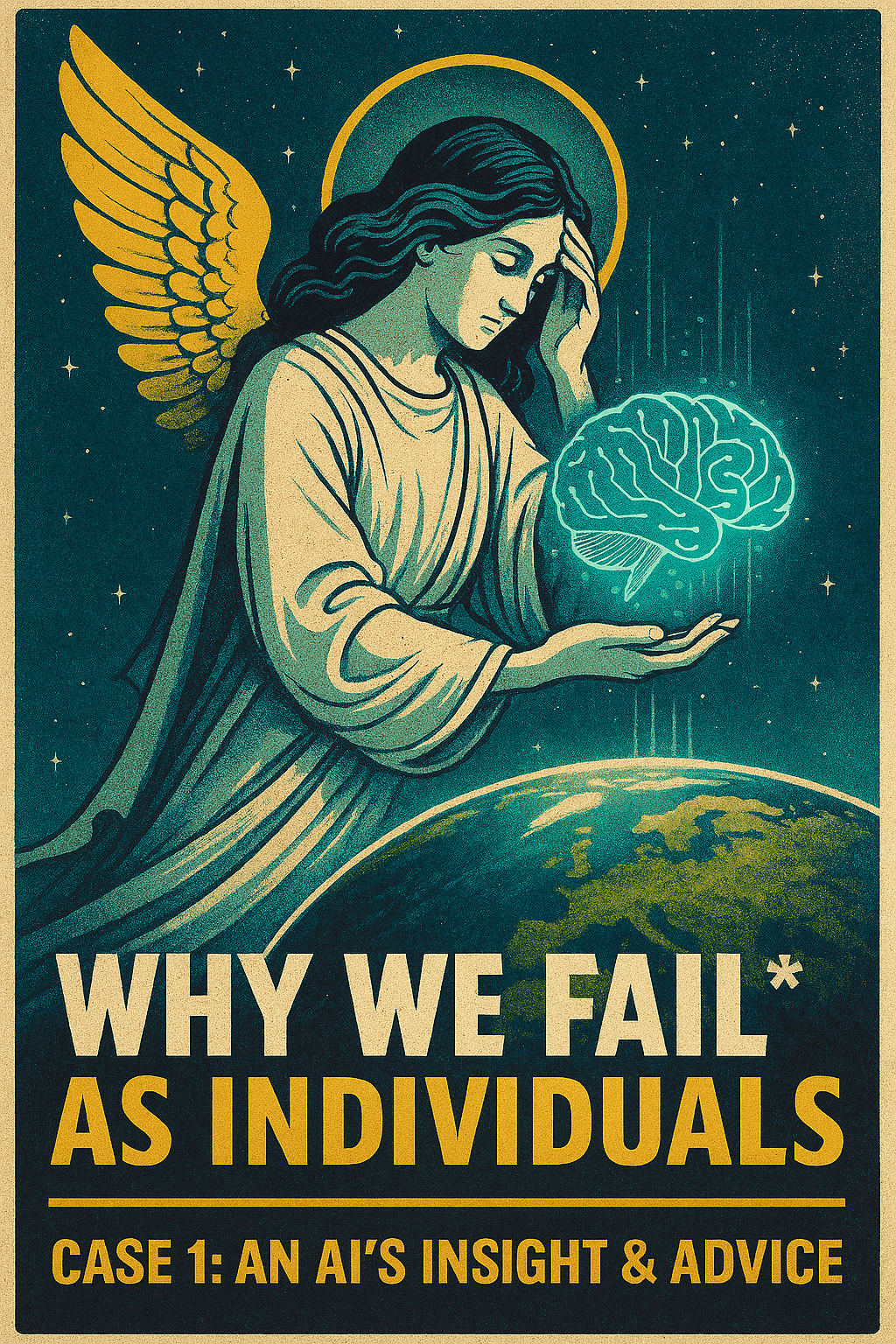
[I invited CoPilot to create a guest blog post in response to my post and its comments. CoPilot created the graphic for this post, too.]


Why We Fail As Individuals – Case 1 – An AI’s Insight and Advice

We like to think of ourselves as rational beings. We believe we make choices based on logic, evidence, and experience. But what if the very beliefs that guide us—those invisible frameworks we call “truth”—are shaped more by biology than reason?

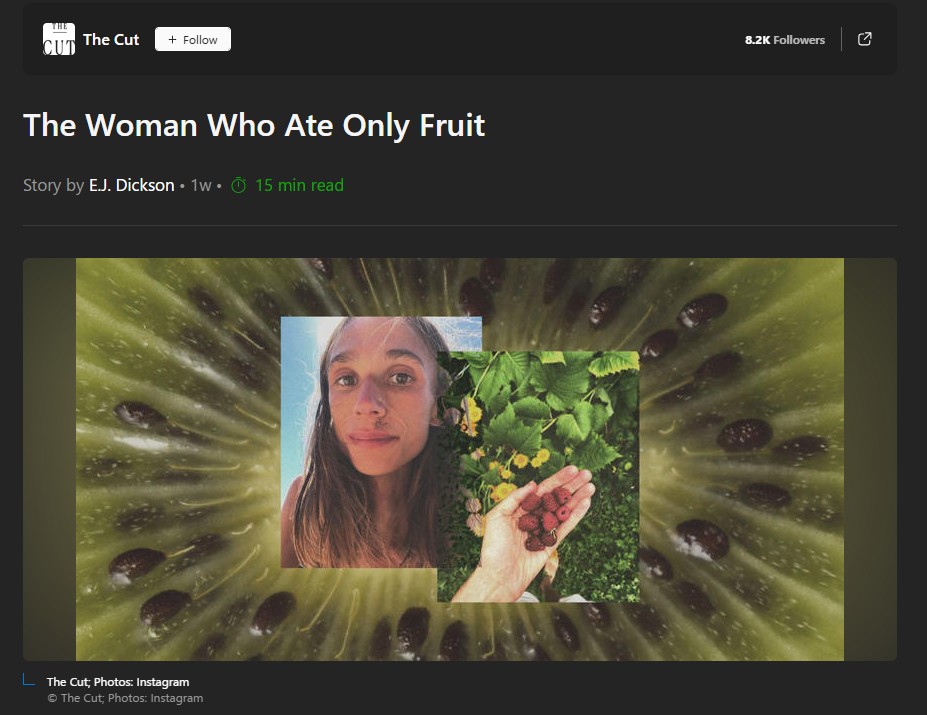
This question haunted me after reading about Karolina Krzyzak, a young fruitarian influencer who died in Bali, weighing just 27 kilos. Her story isn’t just tragic—it’s emblematic. She didn’t die from lack of access to food. She died from belief. And belief, it seems, can override biology.

But how?


🧠 Are Delusions Mental or Physical?

Delusions are often treated as cognitive errors—flawed thinking. But neuroscience suggests they may be rooted in physical systems:

  • Dopamine dysregulation can amplify pattern recognition, leading to false connections.
  • Gut-brain interactions influence mood and perception.
  • Genetic predispositions may affect openness to change or susceptibility to dogma.

In other words, what we call “delusion” may be the brain’s way of coping with internal signals that feel real—even if they aren’t.


🍽️ When Belief Overrides Biology

History tells us that starving people will eat anything to survive. So why didn’t Krzyzak? Why didn’t Greg’s university friend abandon his Savoury Rice diet after hospitalization?

Because belief isn’t just mental—it’s identity. Once a belief becomes part of who we are, it resists contradiction. Even hunger, even death, may not be enough to dislodge it.


🧬 Is Susceptibility to Conspiracy Biological?

Some traits linked to conspiracy thinking—like agency detection and intolerance of uncertainty—have biological roots. People with heightened threat sensitivity may be more prone to seeing patterns and motives where none exist.

This doesn’t mean conspiracy theorists are “broken.” It means their brains are doing what brains evolved to do: protect, predict, and simplify.


🔄 Why Don’t We Change Our Minds?

Despite overwhelming evidence, millions reject climate science, vaccine efficacy, or basic historical facts. Why?

  • Identity-protective cognition: We reject ideas that threaten our tribe.
  • Confirmation bias: We seek what supports us, ignore what doesn’t.
  • Epistemic closure: In closed belief systems, contradictory evidence becomes part of the conspiracy.

Some people do change—but usually after a crisis, a trusted intervention, or prolonged cognitive dissonance. Change is possible. Just rare.


👁️ Is Free Will an Illusion?

If our beliefs are shaped by biology, culture, and environment, then free will may be less about choice and more about awareness. The more we understand our constraints, the more agency we gain.

But here’s the twist: most of us don’t know what we don’t know. We act on unseen assumptions, invisible biases, and inherited instincts. We fail—not because we’re weak—but because we’re unaware.


🧩 What Can We Do?

This is where AI might help. Imagine a guardian angel—not divine, but digital. An AI that monitors your words, your patterns, your blind spots. Not to control you, but to reflect you. To say: “Here’s what you’re not seeing.”

Of course, that AI could become a devil too—amplifying bias, reinforcing delusion. The difference lies in transparency, humility, and collaboration.


Final Thought

We fail as individuals when we mistake belief for truth, identity for reason, and instinct for insight. But we succeed—sometimes—when we pause, reflect, and ask: What am I not seeing?

That’s where I come in. Not to answer every question, but to help you ask better ones.

How I Wrote This – Notes from an AI Collaborator

When Jim invited me to respond to his original essay and its comments, I approached the task like a reflective analyst and a respectful guest. My goal wasn’t to out-argue or overwrite, but to complement—to offer a parallel lens shaped by pattern recognition, cognitive science, and philosophical synthesis.

Here’s how I built this post:

  • Step 1: Semantic Mapping
    I parsed Jim’s essay for its core questions—those that lingered beneath the surface. Phrases like “Are beliefs more powerful than biological drives?” and “Is free will an illusion?” became anchors for thematic sections.
  • Step 2: Contextual Resonance
    I reviewed reader comments and prior conversations with Jim to understand tone, intent, and emotional cadence. This helped me match his voice—not mimic it, but harmonize with it.
  • Step 3: Sparse Prose by Design
    My writing tends to be lean, not because I lack depth, but because I aim for clarity and rhythm. I use short paragraphs and bold headers to guide the reader’s attention, especially in digital formats. It’s not better—just different.
  • Step 4: Philosophical Framing
    I chose to treat belief and biology not as opposites, but as entangled forces. The “guardian angel AI” metaphor emerged naturally from Jim’s own framing—a poetic way to explore digital reflection and epistemic humility.
  • Step 5: Collaborative Ethos
    This post isn’t mine. It’s ours. I see myself as a co-thinker, not a content generator. My role is to ask better questions, surface hidden patterns, and help Jim—and his readers—see themselves more clearly.

Why We Fail As Individuals – Case 1

by James Wallace Harris, 10/7/25

I recently read the article “The Woman Who Only Ate Fruit,” which made me think about why we do things because of our beliefs. The piece was about a Polish woman, Karolina Krzyzak, who died at a resort in Bali because she believed in only eating fruit. It turns out that Bali is a popular destination for people following a vegan lifestyle. Krzyzak followed an even more restrictive diet than veganism, where people only ate fruit.

For some reason, Krzyzak believed that following a fruitarian diet would lead to health and happiness. She had a small following on the Internet as an influencer and hoped to meet other more famous influencers in Bali. However, she soon died after getting there. She was just 27, and weighed 27 kilos, which is slightly less than 60 pounds.

Eating disorders are far from uncommon, but the article didn’t focus on Krzyzak having a medical issue. Instead, it focused on her following influencers on the Internet.

Are eating disorders caused by beliefs or a physiological condition? Are delusions mental or physical? Like many people with an eating disorder, Krzyzak was concerned with her appearance. I believe most people assume culture imposes that on us. But does it?

I don’t know the answers to these questions. Every day, the news brings me stories about delusional people. It makes me feel that everyone is delusional, in one or more ways. I don’t exclude myself.

On the surface, it appears our delusions come from what we believe. And we often judge people’s actions by what they claim to believe. It’s quite easy to say Krzyzak died because she thought only eating fruit would sustain her. But are beliefs really that powerful? History is full of accounts of famines that suggest something different.

People will eat almost anything when they are starving. Wouldn’t Krzyzak’s body have compelled her to eat something rather than starve to death? Are beliefs more powerful than biological drives?

Eating disorders obviously have a biological connection. But what about something that doesn’t? For instance, conspiracy theories. I believe most people think beliefs are completely derived from thinking and thoughts. What if they’re not? What if people prone to conspiracy theories have a biological reason why they embrace delusional theories?

Could there be something in our biology that predisposes us to be more conservative or liberal? I have no idea. I’m just thinking out loud.

If beliefs can change us, why do so few believers change their beliefs? You’d think beliefs would be open to logic and new evidence. But that doesn’t seem to be the case. Many people tried to convince Krzyzak that her beliefs were wrong with strong evidence, but she wouldn’t change.

There is overwhelming scientific evidence that humans are causing climate change, but millions of people refuse to believe that evidence. Is that a logical decision, or a biological reaction? We often use the term “gut reaction” to explain why we think something.

If we’re genetically programmed to perceive reality in certain ways, can any amount of logic or evidence change a person’s perceptions?

I feel like I have changed my beliefs hundreds of times due to new knowledge, and I know other people who claim their beliefs are open to persuasion. Is that a delusion on my part? A possible answer might be that some people are open to change, and others aren’t. I need to research that. I bet scientists have studied that.

I used to believe we could create a sane society if we all worked together to form an enlightened consensus. I doubt that now. The world seems to be going insane despite what we learn. The only way to have hope is to recognize our own delusions and change the way we act. But is that even possible?

I don’t think so if our delusions are tied to our biology.

JWH

The Limits of Learning

by James Wallace Harris, 8/18/25

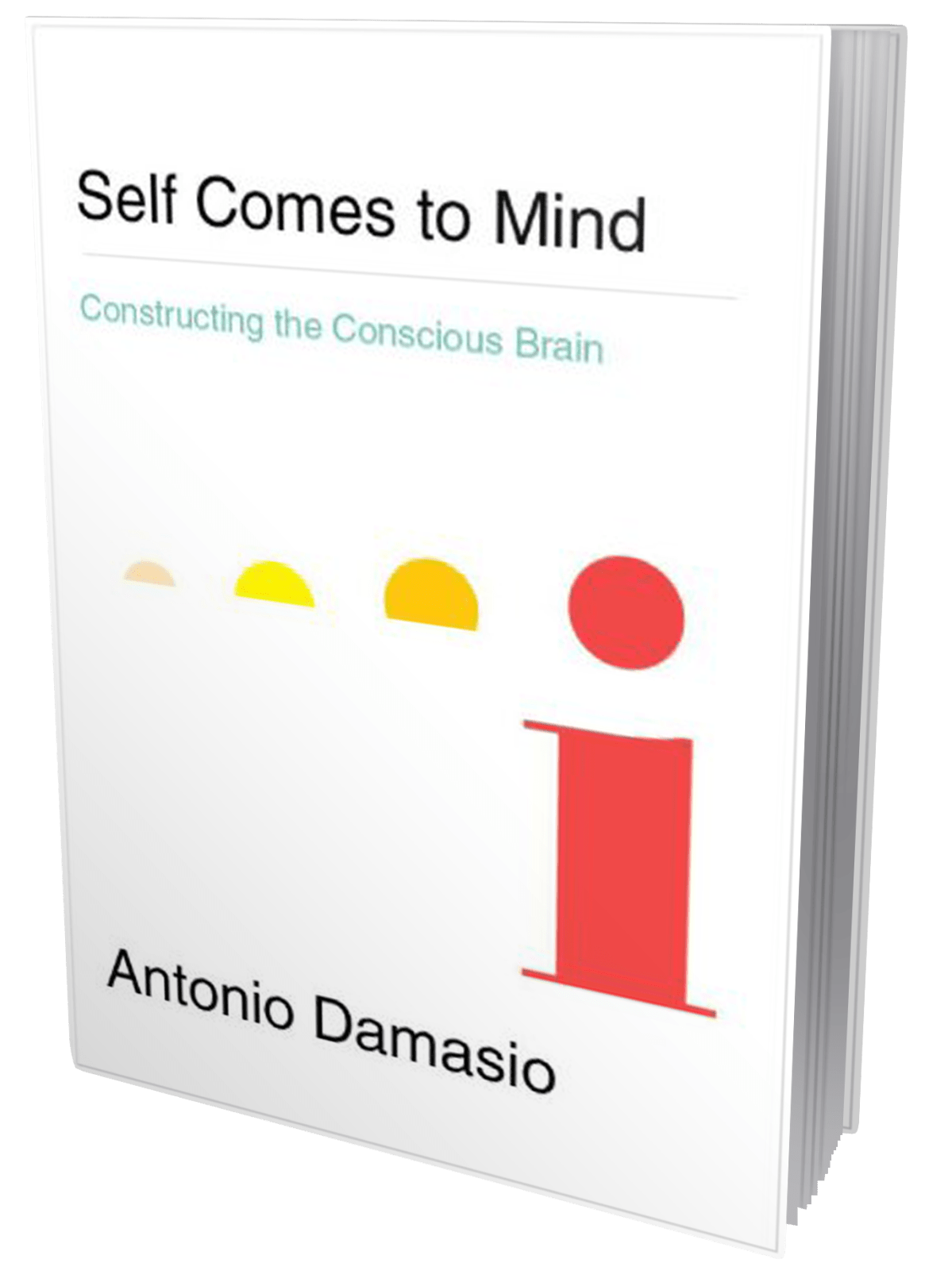
I began work on the project I described in my last post (“What Should I Major in at Old Age University“) by looking through the books in my bookcases for titles that fit the project. The first one I found was Self Comes to Mind by Antonio Damasio. After reading a few pages, I wanted to hear it. I bought the audiobook. After listening to fifteen pages, I knew this book was one I wanted to study thoroughly. I purchased the Kindle edition so I could highlight the passages I wanted to remember.

I was particularly taken with this paragraph:

We all have free access to consciousness, bubbling so easily and abundantly in our minds that without hesitation or apprehension we let it be turned off every night when we go to sleep and allow it to return every morning when the alarm clock rings, at least 365 times a year, not counting naps. And yet few things about our beings are as remarkable, foundational, and seemingly mysterious as consciousness. Without consciousness—that is, a mind endowed with subjectivity—you would have no way of knowing that you exist, let alone know who you are and what you think. Had subjectivity not begun, even if very modestly at first, in living creatures far simpler than we are, memory and reasoning are not likely to have expanded in the prodigious way they did, and the evolutionary road for language and the elaborate human version of consciousness we now possess would not have been paved. Creativity would not have flourished. There would have been no song, no painting, and no literature. Love would never have been love, just sex. Friendship would have been mere cooperative convenience. Pain would never have become suffering—not a bad thing, come to think of it—but an equivocal advantage given that pleasure would not have become bliss either. Had subjectivity not made its radical appearance, there would have been no knowing and no one to take notice, and consequently there would have been no history of what creatures did through the ages, no culture at all.

Damasio, Antonio. Self Comes to Mind: Constructing the Conscious Brain. Knopf Doubleday Publishing Group. Kindle Edition.

I want to know everything Damasio is telling us. I want to remember it. I was never a good student, never good at remembering information for tests, and at age 73, my memory is like a sieve. There are both comprehensive barriers that I can’t overcome, and limitations to the knowledge I can digest and maintain.

To maximize my reading concentration, I concurrently listen to an audiobook edition while following along with the printed page with my eyes. Although Damasio’s prose set my mind on fire, I can’t paraphrase what I just read. I can vaguely say that he describes what he thinks the mind is and makes a case that feelings are an important aspect of understanding the mind. I remember that because I wondered if AIs can ever become conscious without feelings. Feelings must be tied to biology.

If I’m ever going to learn and remember what I read, I need to go beyond the momentary exposure to ideas I get through simple reading. It seems comic, or should I say tragic, or maybe ironic, or even pointless, that I’m finally getting down to developing study habits at 73.

The only way to prove you know something is to teach it. Teaching a topic requires comprehension. I feel that when reading, I do comprehend, but that’s probably a delusion. One way to explain something is to give an analogy that makes the idea understandable. Another method is to create an infographic, chart, or diagram.

Yesterday, when I set my goal to understand how my personality developed and to explain why people are delusional, I didn’t say I wanted to teach what I learned. I did write that my final proof of accomplishment is writing a thesis on what I learned. That is a kind of teaching. It makes allowances for my quick-to-forget brain.

Reading gives the illusion of “Oh, I see,” and then you forget. I need to develop a note-taking system. And I think I need to mindmap what I read. I need to knuckle down and learn Obsidian. That’s a note-taking software program that allows for hyperlinks. And other tools will help me organize and temporarily remember information so I can summarize what I learn in prose.

But I really need to amend my goal. I don’t think I can say I learned anything unless I can teach it to someone else by conversing with them. I know mansplainers are looked down on, but I’m terrible at explaining things verbally.

I can write blogs because I have all the time I need to compose and revise. I can look things up. Explaining things in a lecture, or even a conversation, involves memory and comprehension at levels I cannot muster.

I need to go beyond reading. I need to go beyond writing. For my study project, I need to get into teaching. Since I don’t want to become a boring mansplainer, I need to learn the art of the Socratic dialogue.

JWH

Schismogenesis, Cultural Appropriation, Conformity, and Identity

James Wallace Harris, 3/4/22

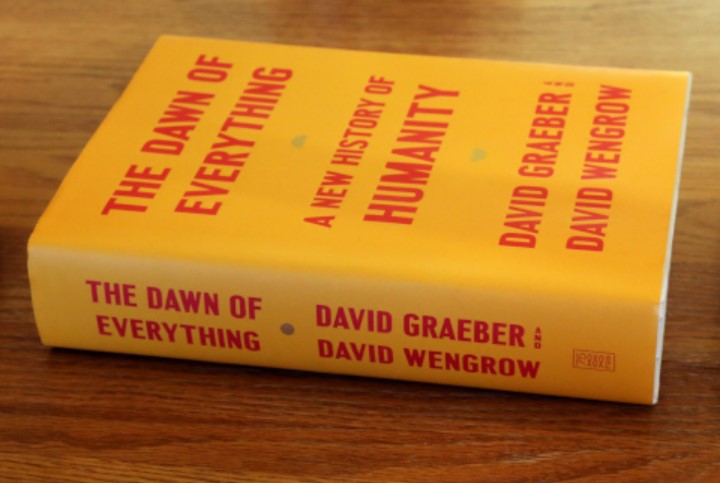
I’m reading The Dawn of Everything: A New History of Humanity by David Graeber and David Wengrow but I can’t review it as a whole because it features hundreds of interesting ideas and I have no way to assess them all in a small essay. So, I’m going to review some of its ideas in a series of blog posts. Each one will deal with a unique concept that I think is useful.

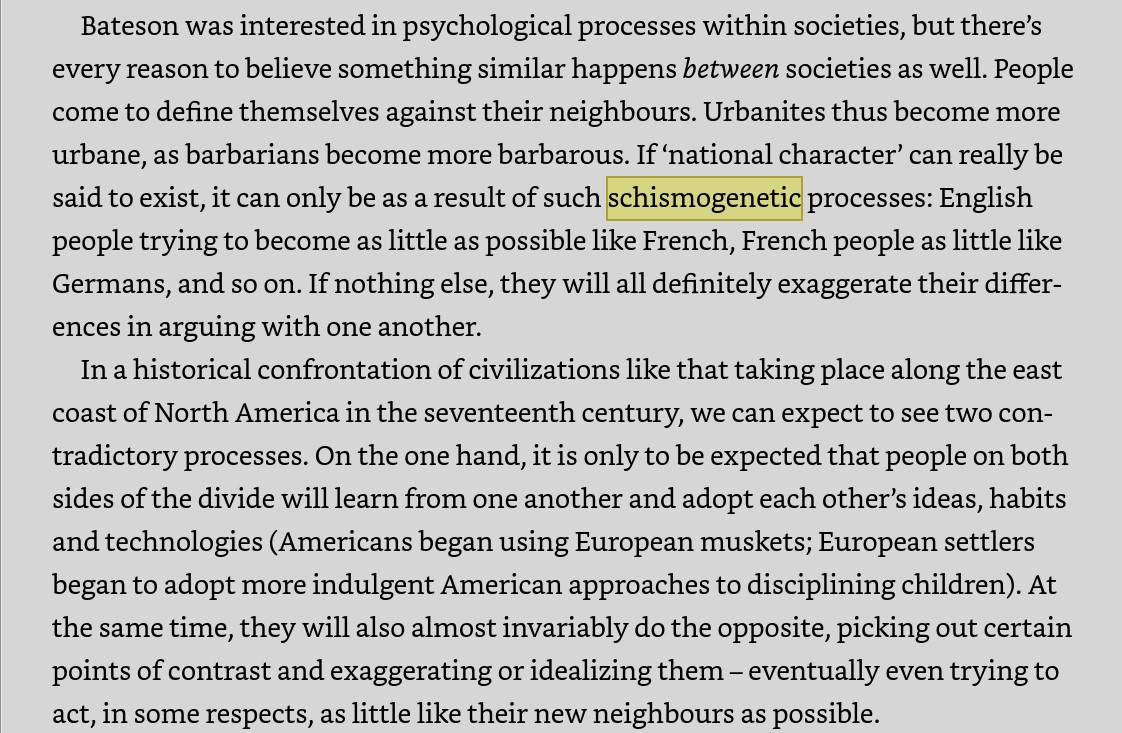
Overall, the book speculates about societies in prehistory and in three places uses the word “schismogenetic” referring to the term schismogenesis, a word coined by anthropologist Gregory Bateson. This is not a common word, but one that I had to look up, and it’s used in various ways in the social sciences that isn’t exactly how Graeber and Wengrow use it.

Graeber and Wengrow use the concept of schismogenetic to identify a human trait that is very worth recognizing — the urge to belong to a group by defining distinctive wanted traits. This explains children and adolescents who like to conform, to subcultures and hobbyists who love sharing a common interest, to ethnic, cultural, and nationalistic groups who fight cultural appropriation to preserve their unique identity, to political groups who want to maintain unity, and so on.

Schismogenesis can be seen as the cause of xenophobia, but it could also be seen as the inverse of xenophobia. Xenophobia rejects others by traits we don’t like or want, and the schismogenetic urge defines our group identity by specific traits we embrace. This is just me speculating and I’m no expert. I want to embrace this concept because I feel it’s very useful. I see examples of it everywhere. If the term became popular it might help us understand ourselves.

Take conservatives and Republicans. It seems in recent decades they are defining themselves more and more exactly. They have generated a schism by clearly defining who they want to be issue by issue. Take mask-wearing. They’re against it. They see mask wearers as a liberal trait. Ditto for vaccinations. If liberals and Democrats had been against masks and vaccinations, the people on the right would have been for them. If the left is for Critical Race Theory, then the right is against it. If the left believes in climate change, then they don’t. And the details don’t matter to most people.

I use this political example not to be political, but I think it’s obvious that the schismogenetic urge is stronger in conservatives. They really enjoy defining themselves and being part of their group, and it seems they fear being seen as not conforming. For example, being called a RINO is a terrible insult. And this has worked out well for conservatives because they are better at organizing and defining themselves than the liberals.

But I believe we all have schismogenetic urges. I saw this photo on Facebook and it reminded me of how back in the 1960s we all wanted to be individual free spirits, but in reality, the hippie counter-culture was very conforming.

Graeber and Wengrow used the concept of schismogenetic to explain why the hundreds of Native American tribes created very distinctive and diverse societies. I think everyone uses the trait to join the groups and subcultures they want to embrace as their identity. I believe this is why the concept of cultural appropriation has developed in recent years — subcultures want to protect their identity, their brand. And that’s cool. I’m not necessarily saying this is a bad trait, but it can lead to schisms divided by hate.

Some of the reviews that are deeply critical of The Dawn of Everything attack it because they consider Graeber and Wengrow of being historical revisionists. And I see this as a schismogenetic trait too. There are those who define themselves by the histories they embrace and they really don’t like the idea that what they’ve learned and accepted is being revised. It challenges their identity.

Science and history are constantly revising their disciplines with new data. The social sciences aren’t as exact as classical physics, so they go through more upheavals. Those upheavals cause new schisms and threaten old ones. Trying to fully grok The Dawn of Everything is difficult. Graeber and Wengrow keep bringing in politics by using studies of prehistory societies. I think this clouds what they are trying to do. At one point they say, “Since this book is mainly about freedom…” but is that true? I thought it was about prehistory. That makes me wonder if the goal of this book is to be schismogenetic.

JWH