Book Shopping in the 21st Century

by James Wallace Harris, September 22, 2019

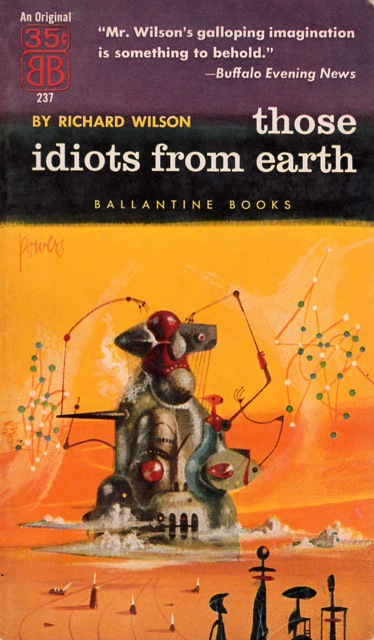
It’s early Sunday morning. My wife isn’t up. The stores are closed. And I’m book shopping. I just bought Those Idiots From Earth by Richard Wilson, an author I don’t even remember. I just loved the cover and title. Book shopping is so different from how it was back in the ancient times of the 20th century.

In the 21st century, I perused thousands of booksellers from around the globe in a fraction of a second. From the time I decided I wanted this book till the time I pressed the order button was about 25 seconds. Of course, I’ll have to wait several days for Mr. Wilson’s collection of SF stories to show up in my mailbox.

Maybe I should jump back before I even knew about Those Idiots From Earth. I’m in a Facebook group The Best Science Fiction and Fantasy Short Fiction of the Year created by Paul Fraser. It’s devoted to collections and anthologies of science fiction short stories. I hadn’t posted in a while, so I wanted to find a unique old science fiction anthology that had a cool cover. I was using the Internet Science Fiction Database and searching on anthologies edited by Groff Conklin. Several of his paperbacks had cover art by Richard Powers, a favorite artist of mine. I then clicked over to look at books with covers by Powers. That’s when I noticed Those Idiots From Earth. Checking Richard Wilson’s entry showed a few novels and a lot of short stories. He was a writer I don’t remember at all. If you follow those links you’ll see just how truly useful ISFDB.org is for book shoppers.

Once I saw that cover and title I was intrigued. I’ve owned hundreds of science fiction magazines, so I’m sure I’ve seen the name before, and maybe even read a story of Wilson’s. I just didn’t recall anything this morning. So I got on Google and found a review of the collection by Joe. He gave four stories 5-stars, and the rest either 4-stars or 4.5-stars. I’ve never read any reviews by Joe before, but he did make Wilson’s stories sound like something I wanted to read. I love finding new SF authors with a different slant.

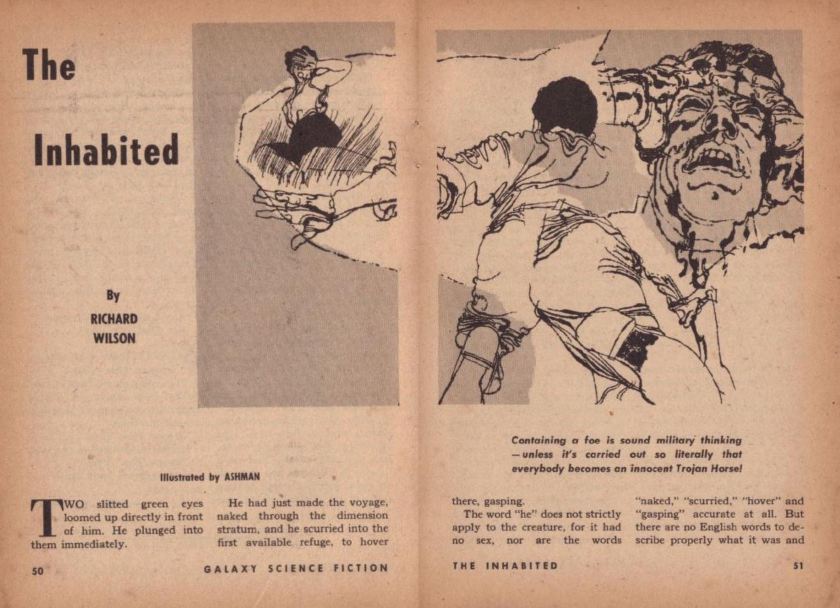
I wanted to test read the title story, but it was never published in a magazine. Luckily, the first 5-star story, “The Inhabited” was in the January 1953 issue of Galaxy Science Fiction. I checked my collection of Galaxy but didn’t have that copy. But I do have a complete run of the magazine on digital scans. You can read the story on the Internet Archive.
The Inhabited by Richard Wilson

“The Inhabited” is about an alien mind coming to Earth to scout out our planet. Are we worth invading? The alien mind occupies a cat, two men, a boy, and a pregnant woman before ending up in the mind of an insane man. The alien ends up confessing to a psychiatrist. It’s a neat little story. I decided I wanted Those Idiots From Earth and went to ABEbooks.com and ordered a copy. The original paperback was in fine condition and cost $4 (plus $4 shipping).

It took me a pleasurable ten minutes to find out about the book, but only about 25 seconds to find and buy it on ABEbooks. I’m hoping you’re getting the power of the internet for 21st-century book shoppers. ABEbooks claims it has thousands of booksellers in 50 countries selling millions of books. There were three copies available from all those locations. Now that’s efficient book browsing!

I remember the first bookstore I went to back in 1964. It was a little hole-in-the-wall shop in a strip mall in Perrine, Florida. The shop was dark and dusty. I was twelve. It was before I earned my own money. Back then a used paperback was a nickel or a dime – candy money. I had no idea what I was buying, but it was exciting. I knew I loved science fiction, and I’d buy books based on how cool their covers looked.

As I got older I would go all over town looking through old book shops. Whenever I visited another town, I’d look up their used bookstores. There were books I searched for years in several states and cities before finding them. The hunt for a book used to be quite thrilling. Then in my late teens, I learned how to use mailorder rare book dealers, which had its own kind of fun. I could almost always get my book, but sometimes it took years. There were some books I never found until the internet and ABEbooks.

In the 21st-century it’s much easier to track down a used book, but not quite as fun. Without the internet though, I would never have heard of Those Idiots From Earth. I often surprise my friends when they mention a book they’ve been searching for years and I find it in minutes.

I sometimes wish the internet had never been invented. I’m not sure if living in the hive mind of social media is healthy. Nor do I love keeping up with data overload. It does let me find the few people that share my exact interests. But then I have those highly specialized interests because of the internet. I remember when there were only three TV channels, Top 40 radio, and the science fiction section was two shelves of books at the new bookstore. At school, we all talked about the same movies, television shows, and songs. Nowadays every friend seems to have their own favorite show, so there’s less sharing, even though on social media what we do is called sharing.

The internet lets me get up on a Sunday morning and search through millions of books in thousands of booksellers from around the planet in a matter of seconds. That’s pretty damn far out. It’s not the same as riding my bike down to an old shop and spending an hour looking through stacks of unordered SF titles trying to find just the right books to get the most for my quarter.

The times keep changing. I can’t imagine how we can go any faster. Maybe I should wonder how to go slower?

JWH


Unraveling a Loose Thread of History Found in a 1956 Issue of Galaxy Science Fiction

by James Wallace Harris, Monday, September 16, 2019

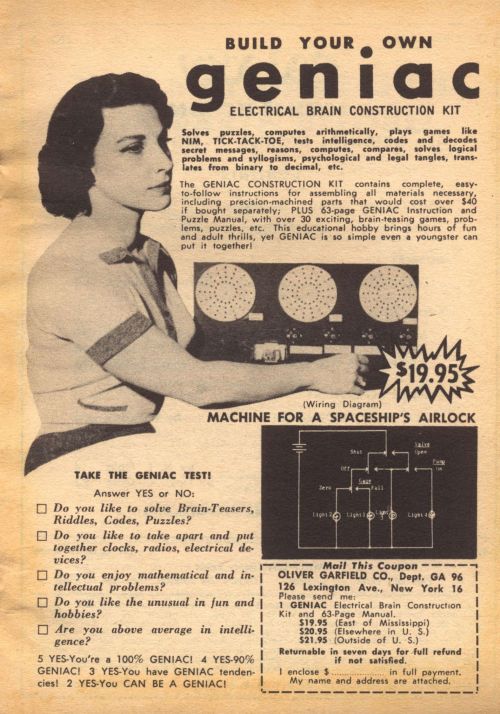
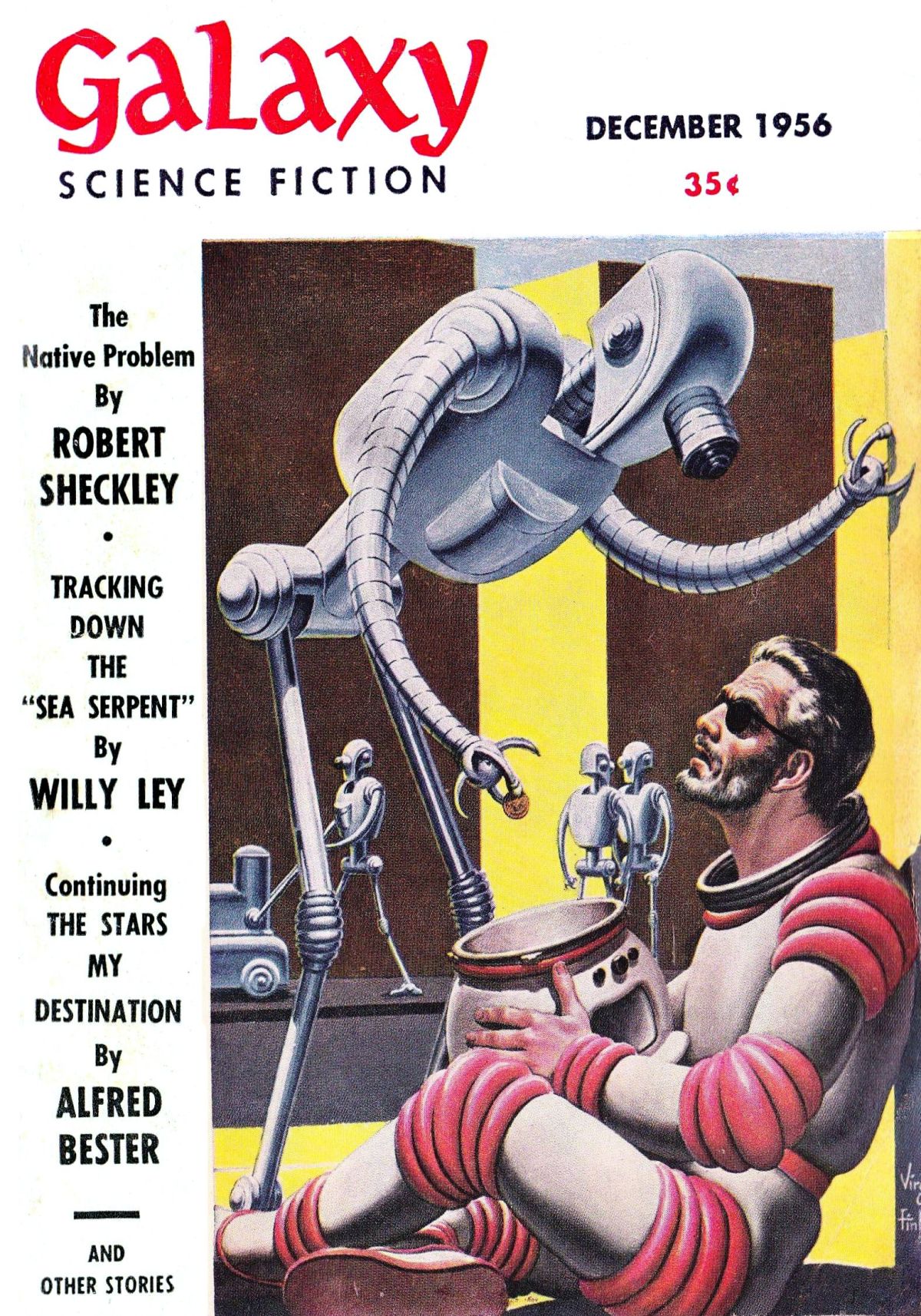
This morning I was flipping through some old issues of Galaxy Science Fiction I had bought on eBay and ran across this ad in the October 1956 issue:

Geniac - Galaxy 1956-10

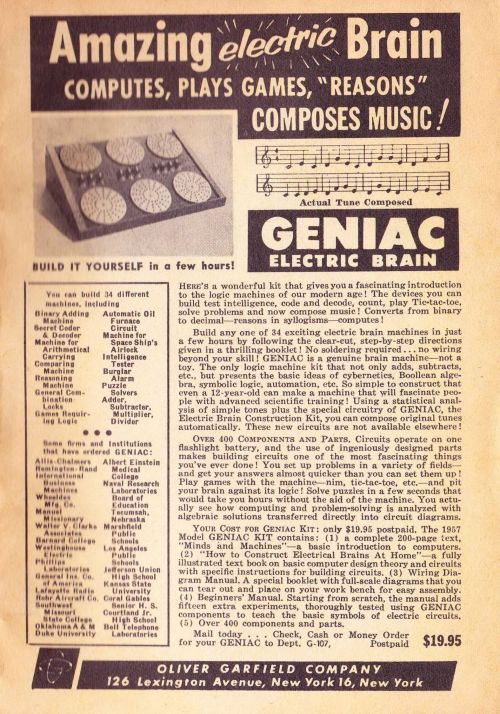
At first, I flipped right by it. Then in the next issue I picked up, the December 1956 issue, I found this ad:

Geniac - Galaxy 1956-12

This one promised a whole lot more. Could this be for real? Computes, plays games, composes music? I don’t ever remember reading about home computers existing this early. I thought computer kits were something from the 1970s. This December ad promised a new improved 1957 model, and for only $19.95. In 1956, $19.95 was some serious money for a kid. It would probably be hundreds of dollars in today’s money. And was this a genuine computer, or was it some kind of trick, like those X-Ray glasses advertised in the back of comic books?

First stop: Wikipedia.

Geniac was an educational toy billed as a "computer" designed and marketed by Edmund Berkeley, with Oliver Garfield from 1955 to 1958, but with Garfield continuing without Berkeley through the 1960s. The name stood for "Genius Almost-automatic Computer" but suggests a portmanteau of genius and ENIAC (the first fully electronic general-purpose computer).

Operation
Basically a rotary switch construction set, the Geniac contained six perforated masonite disks, into the back of which brass jumpers could be inserted. The jumpers made electrical connections between slotted brass bolt heads sitting out from the similarly perforated masonite back panel. To the bolts were attached wires behind the panel. The circuit comprised a battery, such wires from it to, and between, switch positions, wires from the switches to indicator flashlight bulbs set along the panel's middle, and return wires to the battery to complete the circuit.

With this basic setup, Geniac could use combinational logic only, its outputs depending entirely on inputs manually set. It had no active elements at all – no relays, tubes, or transistors – to allow a machine state to automatically influence subsequent states. Thus, Geniac didn't have memory and couldn't solve problems using sequential logic. All sequencing was performed manually by the operator, sometimes following fairly complicated printed directions (turn this wheel in this direction if this light lights, etc.)

The main instruction book, as well as a supplementary book of wiring diagrams, gave jumper positions and wiring diagrams for building a number of "machines," which could realize fairly complicated Boolean equations. A copy of Claude Shannon's groundbreaking thesis in the subject, A Symbolic Analysis of Relay and Switching Circuits, was also included.

Okay, so it was real! But in 1956? In the mid-fifties, commercial computers were just beginning to be rolled out to businesses. In 1957 American audiences got to see a humorous look at computers in the film Desk Set with Spencer Tracy and Katherine Hepburn. Rumors of computers produced a fear that the librarians would lose their jobs, but ultimately humans prevailed. I expect most Americans in 1957 had never seen a computer and only knew about them from funny cartoons in magazines and newspapers. Geniac came out before Sputnik which ignited a fear that American youths weren’t being educated in science. Was there a desire by kids that early in the 1950s to know about computers?

Here is a History of Computer timeline that shows the Geniac for 1955. And here’s an article about the history of computers that played NIM games, which includes the Geniac.

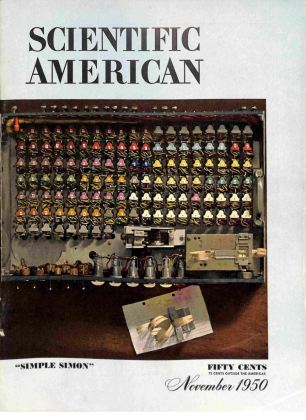
Scientific American 1950-11The main designer of Geniac appears to be Edmund Berkeley. He wrote an early book about computers in 1949, Giant Brains, or Machines That Think. Berkeley was also written about in Edmund Berkeley and the Social Responsibility of Computer Professionals by Bernedette Long. If you follow that link she writes about his influence with Geniac. I’m awful tempted to buy the Kindle edition. He also designed what some people call the first personal computer, Simon. Simon appeared as 13 how-to articles that began running in Radio-Electronics magazine in October 1950. (All 13 parts can be read online here.) It would have cost around $600 to build and had very limited features with only 2-bits of memory. Berkeley wrote the article “Simple Simon” for the November 1950 issues of Scientific American.

Electronics was a big tech hobby back then and had been since the early days of the radio in the 1910s. Looking at the Geniac ad carefully though showed it wasn’t an electronics kit, but merely electrical. It might contain 400 parts, but they were wires, light bulbs, batteries, nuts, and little contacts. It seems designed to set up simple logic programs. How much could a kid do with one? YouTube to the rescue:

And this film, which features a later model from the 1960s called a Brainiac:

This brings up even more questions. Did kids really play with them? Where they inspired to study computers and become computer programmers and engineers? Were there any famous computer pioneers that started with a Geniac or Brainiac? Could Steve Wozniak or Bill Gates have played with one? Of course, those two might have been too young for this era.

The kit seemed aimed at kids, but it would have required a great deal of work and patience to produce any results. Actually putting one together and doing any of the example projects would have been very educational.

David Vanderschel describes his Geniac computer from 1956. He says an IBM 1620 was the first real computer he encountered in 1962. That was the first computer I programmed on in 1971 at computer school using FORTRAN.

Hackaday had a post last month about the Geniac claiming that Mike Gardi credits his professional success in software development to educational logic games like the Geniac. Gardi created a replica of a Geniac and has links to the original documentation. This 1955 manual had instructions for a couple dozen projects. Gardi said:

Technically GENIAC was a collection of configurable N-pole by N-throw rotary switches, which could be set up to cascaded and thus perform logical functions. As a result GENIAC could use combinational logic only, its outputs depending entirely on inputs manually set. However, projects outlined in the manual, which started with basic logic circuits, ultimately progressed to such things as a NIM machine and TIC-TAC-TOE machine.

I did find a Geniac on eBay that has a $99.99 buy it now price. There’s a Brainiac for sale for $349! That’s more than I’d want to spend. The Brainiac is in great shape though. It’s probably the one from the film above.

The more I Googled, the more intrigued I became about the impact of the Geniac computer. Is this how historians get sucked into writing books? I checked a couple books on the history of personal computers I own, but neither mention Geniac or Edmund Berkeley. If you search Google for the first personal computer you usually get the MITS Altair 8800. Maybe that’s not true. Maybe I could write a whole history book about home computers before 1975.

Additional Reading:

Update:

I went to my public library and looked through the books about the history of computing. I found no mentions of Geniac or Edmund Berkeley. I then checked The Reader’s Guide to Periodical Literature for the years 1950-1960. I found no references to Geniac and only a handful of articles by Berkeley. His articles did sound interesting:

  • “Robots for Fun” Life, 173-74+, March 19, 1956
  • “Relations Between Symbolic Logic and Large-Scale Calculating Machines” Science, 395-399, October 6, 1950
  • “Simple Simon” Scientific American, 40-43, November 1950
  • “Tomorrow’s Thinking Machines” Science Digest, 52-57, January 1950
  • “2150 A.D. Preview of the Robotic Age” New York Times, 19, November 19, 1950
  • “Robot Psychoanalyst” Newsweek, 58, December 12, 1949
  • “Algebra and States and Events” Science Monthly, 332-342, April 1954
  • “We Are Safer Than We Think” New York Times, 11, July 29, 1951

An amusing thing happened at the library. I kept asking the librarians where the Reader’s Guide to Periodical Literature was located. They didn’t know. Finally, they asked a very old librarian and she found it for me. She then came back with the younger librarians, they wanted to see it too. I had told them when I was young every kid was taught to begin their library research with that classic index.

JWH


Why We Can’t Trust Digital to Remember

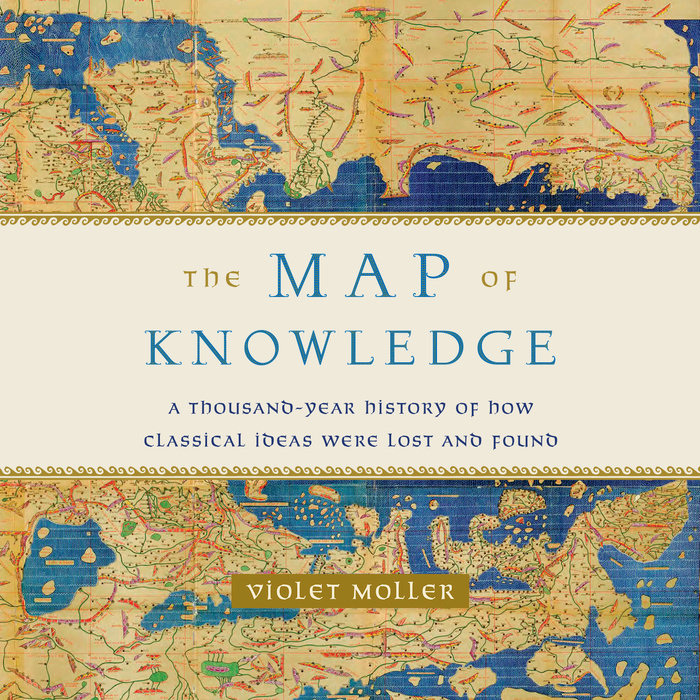
In The Map of Knowledge Violet Moller describes how the works of Euclid, Galen, and Ptolemy were collected, translated, transcribed, and preserved over over the centuries. Most of the works from the ancient world have been lost. We have the Arab civilization to thank for preserving much of what we have from ancient Greece after the fall of Rome, and before the emergence of the modern western civilizations.

When humans first develop writing we wrote on stone, wood, clay, wax, and metal, but eventually invented the more convenient papyrus and paper for scrolls and books. We’re still finding ancient works of papyrus like the Dead Sea Scrolls, and we’re still translating steles from antiquity that archaeologists unearth. In other words, our data can potentially last for thousands of years.

On the other hand, it’s surprising how quickly it can disappear. Since the dawn of the internet age how many digital content providers have gone bust leaving their customers without access to the works they bought? Remember Microsoft’s Zune player? Microsoft phased it out which is okay, but they also turned off the servers handling the digital rights, meaning owners of that content were locked out of their digital libraries. Over the years I’ve bought books, movies, television shows, songs, albums, etc. from various online sellers that have disappeared. Much of it was without DRM, but I didn’t back it up. Since then most of that content has been lost between all my computer upgrades.

Today I only buy digital content from Amazon because that company is so big I hope it will never go out of business. But it if did, I’d lose thousands of ebooks, audiobooks, movies, television shows, songs, and albums. So far it appears that Amazon (and their company Audible) have saved everything I bought, even when the work went out of print. But sometimes I think I owned something I can’t find in my Amazon library. So far I think it’s me because in the early years I bought so much from other companies that I now misremember what I bought from Amazon. But I never can be sure.

Many years ago I decided to go paperless and scanned my files to .pdf documents. My mother had saved all my report cards and I scanned those too, throwing away the originals away. I can no longer find those files. I thought they were on DropBox. When you have hundreds of thousands of digital files it’s hard to know when a few thousand disappear. I’ve been putting everything on Dropbox for years, and they’ve always seemed very reliable. Again, I can’t tell if I could have accidentally deleted those files, or something in their system ate them.

I recently discovered my Yahoo email has all disappeared. I used Yahoo to save backups of important emails, but I seldom went to the site to look at these old emails. I just discovered Yahoo deletes your content if you haven’t access your account for one year. Dang. Also, I used to have access to all my oldest emails at Outlook. But now Outlook only shows recent years. If you get to the bottom of a folder you can request Outlook to show more, but I’m not sure if they save everything anymore.

What’s needed is a program that catalogs all my files and tells me when some go missing. I don’t do backups because I assume I have my files locally and on Dropbox and that’s good enough. I used to save backups to external hard drives, but keeping up with such backups is a pain. I recently threw out six hard drives. They had been sitting in my closet for years, but when I checked them they no longer worked.

I also worry about all my financial records. All the companies I do business with begged to stop sending me paper copies so they could go digital. Now I wonder about the wisdom of that. I realize if I died I’m not sure if my wife would know where all my 401K savings are located. But if I only saved on paper and my house burned down, where would we be too?

I’ve read a few articles in the news lately saying if you read the fine print we don’t own our digital content. We can’t resale it or lend it, but what about accessing our purchased content forever? What if a publisher goes out of business? What if a publisher selling through Amazon goes out of business, is Amazon responsible for maintaining that digital content forever for its customers?

And what happens to my 1,400+ essays if WordPress shuts down? One of my blogs, Lady Dorothy Mills, is about a woman writer from the 1920s whose work is almost completely forgotten. I started a website about her decades ago, and I used to get 1-2 emails a year asking about her. It’s been years since I’ve had a query. Only a handful of her books come up for sale every year. Even printed books have no guarantee of surviving. If I really wanted to save my essays I should print them out. I don’t though. I hate saving paperwork.

We are becoming completely reliant on saving data digitally. After our civilization collapses, and they all do, how will future scholars like Violet Moller write about us? A book from this century could last a thousand years. But even if a hard drive could last a thousand years, would people in 3019 have a PC to run it?

Or will future civilizations carefully preserve our digital data someway? For years I tried to save the files I created on my Commodore 64 or Atari ST to my early PC programs like WordPress. Even as late as 2013 when I was still working I’d get requests to convert 1980s Apple II discs so the files could be read on Macs. It was seldom possible.

We talk about plastics surviving for thousands of years. I wonder if it’s possible to produce a new kind of paper that’s nearly indestructible, including fire and water proof? That way, anything we really wanted to save we’d print on the new DuroPrint format. Or can we design solid-state drives that can hold their bit positions forever?

I’m at an odd point in my life. I have a lifetime of books I’ve collected that run in the thousands. They included printed books, ebooks, and digital audiobooks. I’ve actually saved too many books. I figure I might live another 10-20 years and I want to thin out my collection to just what I need as I fade away. I also want to start deleting digital files and paper files of things I no longer need. What a huge task. I’ll probably delete 99 out of a 100 items, but for that one, I’ll want it to survive no matter what, and be discoverable by someone after I die.

I feel like I’m moving towards an Omega Point where I will die with just the exact books and documents I need. It’s the opposite of building a library or filing system. I’m not sure I need to leave any of my books or papers to anyone. I’ll give away my books before I die, and my wife will need only a few papers. But I do worry about a few rare objects I own, like the Lady Dorothy Mills books, or rare science fiction fanzines. I’ve been scanning the fanzines for the Internet Archive. I should probably scan the Mills books too.

The Map of Knowledge by Violet Moller

JWH


Why Isn’t Everything Beautiful?

by James Wallace Harris, Sunday, September 8, 2019

I’m reading The Map of Knowledge: A Thousand Year History of How Classical Ideas Were Lost and Found by Violet Moller where she describes how books were important in seven beautiful cities in the ancient world. Over and over again Moller describes how a conquerer builds a city, embraces books and libraries, and founds a new civilization. They raise magnificent buildings and evolve a culture. Then someone else comes around and sacks the city.

It occurred to me that if humanity had preserved everything great we built the world would be beautiful all over. Moller describes the founding of Baghdad and it sounded magnificent. But all I can think about is how ugly that city is when I see it on the news. How many civilizations have built countless gorgeous edifices that have disappeared in time? Which is worse, war or entropy? People and decay eventually ruin everything beautiful?

The Biggest Little Farm

Last week we watched The Biggest Little Farm on Amazon about a couple who transformed an ugly drought-brown farm into something amazingly green and beautiful. Humans have the ability to go walk out into a desert and create what you see below.

beautiful house in desert

But soon or later we do this:

Syrian city

It takes so much effort to transform chaos into order you’d think we do everything possible to protect what we create. Moller writes about all the books and libraries that have been destroyed before the invention of the printing press. I know it’s hard to build something that lasts because everything eventually wears out, decays, falls apart, or is bombed, burned, or torn to pieces. But I think we could make things last far longer if we tried. What if the hanging gardens of Babylon still existed? Or all the larger works of the Mayans and Aztecs?

Just think how beautiful the world would be if we had spent all the money we spent on wars into preserving the best of our cultures. Sure there are lots of incredibly beautiful places that exist now, but what percentage of everything are they, and how long will they last? Imagine every city an entire work of art.

Quite often on television, I see documentaries about grand buildings that existed within my parents and grandparents lifetimes. Historical societies struggle to preserve as many as they can, but all too often we bulldoze aged building to make way for new ones. Sure it is natural for us to get tired of some buildings, but do we always have to? The other day I saw a story about an entertainment complex for teenagers in the 1940s where it had a roller skating rink, an immense pool, and a pavilion for music and dancing. Photos showed something very elegant, and to my modern eye very nostalgically attractive. I wished it still existed so I could go hear big band music live. Photos taken just before it was destroyed show it dilapidated and sad looking. Why did we let it fade away? I guess not everyone wants to hang onto the past.

When I drive through most commercial districts today everything looks utilitarian and tawdry. Depending on the wealth of the locale, the designs run from crappy decaying to hip conformity to city council standards. I can drive for miles on certain big city thoroughfares and see a repeating array of chain stores and restaurants. It feels like the cycling background in the old Hanna-Barbera cartoons. Wasn’t it more beautiful in the old days where every business building was unique?

I can remember over sixty years of changes. I can’t count the number of buildings I once knew that no longer exist. You’d think we’d construct every structure to last and to be the most beautiful it could be by the current architectural fashion. There’s a magazine I love to look at, Atomic Ranch, that reveres the mid-century ranch house. That’s an era I thought was beautiful. Sure, it’s not Athens or Alexandria, but the look is very appealing to me. I wonder if a mid-century modern neighborhood could be preserved for a thousand years.

It’s odd how ideas come to us. I was reading a book and I wondered why it isn’t beautiful everywhere we looked. Our species certainly has built enough beautiful objects to cover the earth. Why haven’t we preserved them?

Mid-century modern ranch

Of course, I’m one answer. We’ve let our house rundown. Suan and I have never been into yard work, decorating or housework. We care more about our hobbies and television. It takes a lot of money and effort to maintain something beautiful. Some of my neighbors work hard to make their yards and interiors look beautiful, on the outside and inside. What’s funny is some of them only make the effort on the outside, or just the inside. I’ve always envied my friends who make their personal environment beautiful. Take this as a thank you.

You’d think with seven billion people everything on this planet would look clean and tidy, if not aesthetically elegant. Maybe it’s too easy to find beauty on our flat-screen televisions.

What’s also fascinating to contemplate is how beauty pops up in nature through random nonintelligent design. Of course, the concept of beauty is something that might only exist in our species. Does any other animal stop to admire the rose? Maybe beauty only resides in human civilizations because of anti-entropic efforts. We’re all at war with entropy, and only some of us use our limited energies to create beauty.

Rose

I’ve read that color doesn’t exist in reality, but it’s something our brains adds. I’d hate to think this is true. I wonder what the other animals and insects see.

JWH

Quantifying My Cognitive Decline

by James Wallace Harris, Thursday, September 5, 2019

I subscribe to a service called Grammarly which checks my spelling and grammar as I write. Grammarly sends me a weekly report on how I’m doing. Two years ago it would tell me I was more accurate than 65-70% of their users, referring to grammar and spelling. I doubt even when I was young it would have been much higher. In recent months that number has fallen to 35-40%. And I can feel it. I have to proof my posts countless times and I still find errors after I’ve published. I’m appalled by how bad my writing has become. If I published my first drafts readers would think they were following Charlie Gordon into his descent phase from the book Flowers for Algernon.

I consider this good quantitative data on my cognitive decline. Grammarly does give me some good news. I’m generally more productive than 98-99% of their users, and my vocabulary is larger than 98-99% of their users. The first is explained by being retired and writing for two blogs. The second reflects long term memory. I can tell it’s my short term memory that’s failing.

I still don’t see this as an early sign of dementia, but I might be deluding myself. I think it’s just an aspect of normal aging. We’re used to seeing our bodies getting old because of all the visible physical changes. We’re not used to mental changes because they are less observable to ourselves and the people around us. Unless we talk or act differently, other people don’t see the changes. And we don’t feel the changes unless we try to do something and fail.

I have been noticing the number of times people ask me why I’m not talking. I tell them I’m just listening to them. Or say I’m thinking. But I believe it’s because it takes more effort to put thoughts into words, and when I do talk I can’t remember words, or I verbally trip when saying sentences. My cognitive problems are the most obvious when writing. If I’m just playing with the cats, watching television, or listening to music I feel fine. I believe we ignore our mental aging by doing less and saying less. Of course, many people also ignore signs of physical aging — that’s why so many foolish oldsters fall off ladders.

The real question is: Can we exercise the mind like we exercise the body? It appears we can slow physical decline by being more active. Is that also true for mental activity? My first reaction when I realized I was making more spelling and grammar errors was to quit writing. But I quickly decided that was the wrong approach. I believe writing exercises the mind. Instead of quitting I should work harder. However, I might need crutches. I thought about pilots who use preflight checklists, or how surgeons now use checklists to avoid making surgical mistakes.

I already pay Grammarly to keep an eye on me, but it’s far from perfect. In fact, when I see errors after I published it means Grammarly and I both missed them. I usually proofread my posts four or five times before I hit the published button. Often the most glaring mistakes are last-minute rephrasing where I don’t proof the whole sentence, or whole paragraph again. But other mistakes come from reading too fast and assuming I’m seeing what I read.

I believe my essays give the illusion that my mind is working just fine. Y’all don’t see how many broke things I fix. I use the internet to cheat. It really is my auxiliary memory. And I have unlimited do-overs. Most importantly, I can take all the time I need to say what I want.

I’ve always been a good typist. It’s been the most useful skill I learned in high school. What I typed used to be what I thought. Thoughts came out of my fingers. That’s no longer true. Now my fingers give me sound-alike words, leave out words, type words twice, and even throw in extra words. Quite often I end up typing just the opposite of what I was thinking. While typing this paragraph I created 8-10 alternate words to what I was thinking. Just that could explain the halving of my accuracy score in Grammarly.

[When proofing the above paragraph I had a new insight. What if my typing is as accurate as ever, and I’m merely typing jumbled thoughts when I once transcribed clear ones?]

Writing isn’t the only way I’m seeing increased cognitive problems. The other day I wrote “Untying a Knotted Plot” about my difficulty of understanding a short story. I had to read it four times. Admittedly, it is a complicated story. The author even wrote a couple of comments to help me. That essay was extremely difficult to compose. I struggled with trying to comprehend the story and write about it clearly. Every time I typed the author’s name I looked at the magazine to verify the spelling. I still got it wrong three out of eight times. I proofed the hell out of that piece because errors seem to be popping like popcorn. I felt like I was playing a very desperate game of Whack-a-Mole.

There’s another reason to keep writing. I want to document my own decline. Like the researchers in Flowers for Algernon, they tell Charlie to keep a journal. I’m going to be my own researcher and subject. I think it’s useful to be aware of my diminishing abilities. Aging is natural, and I accept it. I’m willing to work to squeeze all I can from my dwindling resources. What’s vital is being aware of what’s happening. The real problem to fear is becoming unconscious to who we are. Like Dirty Harry said, “A man’s got to know his limitations.”

The reason why Flowers for Algernon was such a magnificent story is that we’re all Charlie Gordon. We all start out dumb, get smart, and then get dumb again. Charlie just did it very fast, and that felt tragic. We do it slowly and try to ignore it’s happening. That’s also tragic.

JWH