
BASS 2020: “A Faithful but Melancholy Account of Several Barbarities Lately Committed” by Jason Brown

by James Wallace Harris, Wednesday, November 11, 2020

In literary fiction, plot is often a contrivance that careens the story toward genre fiction. That’s why I often hear friends say “I don’t like those slice of life stories” when sneering at literary fiction. They want a plot that carries them along in the story. “Godmother Tea” the first story in The Best American Short Stories 2020 (BASS 2020) didn’t have a plot. The second story, “The Apartment” did, one that fits the short story template of having a beginning, middle, and end, with an arc of rising action that includes characters growing and learning. It even had an old fashioned ending that would have amused Poe or O’Henry.

The third story in BASS 2020, “A Faithful but Melancholy Account of Several Barbarities Lately Committed” by Jason Brown promised a plot but it fizzled out. Although I might be completed and fleshed out in the ten linked stories in the collection by the same name, but I haven’t read it.

By coincidence, both this story and “The Apartment” are about a man wanting to acquire a home from an old dying person. Our first person narrator, John Howland, is just as neurotic as Joy was in “Godmother Tea” so the story is really about him and not the quest of ending up with property. Jason Brown has created an imaginary family dynasty that began with the first John Howland arriving on the Mayflower, but is now petering out while fighting over the last four acres they still own in Maine, on Howland Island that the family once owned completely.

The current John Howland is having the same growing up pains as Joy in “Godmother Tea,” but his anxieties are diluted by a story of a grandfather scheduling himself to die on Saturday with a pre-dug hole waiting for him. As a reader I’m torn between following two interesting fictional forks in the road. The first is the kookie Howland family feuding, and the second is the hapless John Howland quest to get married and have children.

I have to say the most interesting aspect of “A Faithful but Melancholy Account of Several Barbarities Lately Committed” is John’s problem of wanting to marry Melissa, an independent woman who isn’t interested marriage. From my perspective outside the story looking into John Howland’s inner perspective, I can’t see why any woman would want to marry him. His dream is to marry and have children so he can occupy the ancestral manse that has no electricity or indoor plumbing.

This story is entertaining because Jason Brown has concocted a fun story and has the creative skills to do so, but that’s all it is. I’m afraid I crave something heavier. To give you an example of what I mean read “Useless Things” by Maureen McHugh.

In this story, the unnamed narrator is a woman living alone out in the country in New Mexico near the border. Times are tough, few people have jobs, drought is the norm. The temporal setting is the near future when climate change has taken its economic toll, but the story could be very close to now. Like the two other stories about wanting property, the narrator of this story is struggling to make ends meet so she can pay her property taxes, keep her home, and avoid becoming homeless person living out of her car. To scratch out a survivable income she makes realistic dolls that look like babies that have died for a very sad clientele. But a hobo immigrant steals her tools, so she’s forced to sculpt realistic dildoes for online buyers instead because they require fewer tools and resources.

There is a grim realism in “Useless Things” that hits you in the gut. The story scares us about the future. We feel the desperation, fear, and pain. The people in the story don’t feel like they were made up fit a story, even though they were.

I’m not saying fiction needs to be grim to be worthy. Joy’s struggle for identity in “Godmother Tea” is funny and light even though it’s about a serious existential crisis. But I am saying I want stories that make an emotional impact. They have to be about something I can connect with reality. I want stories that point to something other than themselves. Does that make sense?

Now this is just me. My take on BASS 2020 is probably extremely atypical. I’m old and tired of just being entertained, but I do know and understand the value of entertainment. Just watch Sullivan’s Travel (1941) to understand why I say that. I seek fiction where writers are driven to comment on reality, usually inspired by their angst, or some other powerfully felt emotion. I want stories that make me cry or laugh, or dazzle me with awe and insight. Creative and clever are amusing, earning some Brownie points, but they don’t satisfy my hunger for hardcore emotionality.

Menu: The Best American Short Stories 2020 Project

JWH

BASS 2020: “The Apartment” by T. C. Boyle

by James Wallace Harris, Tuesday, November 10, 2020

Writing teachers used to tell budding writers to write what they know. But if you’ve run out of things to say about yourself or the people around you, you’re left to make stuff up. My natterings about “Godmother Tea,” the first story in The Best American Short Stories 2020 (BASS 2020), expressed a theory that literary writing tends feel biographical or autobiographical. That’s especially true of stories by young writers. Older writers who have long said everything they wanted to say about themselves, tend to make up fascinating fictional tales, but still with rich characterization. Even with contrived plots, the true hallmark of genre stories, the literary characters feel like real people.

T. C. Boyle is currently 71, and his story, “The Apartment” feels like something Edgar Allan Poe could have written if he had taken a very long Rip Van Winkle nap. The story is about a wager between a fortyish man and an eightyish woman with a setting that begins in France in the 1960s. The main characters are merely called Monsieur R and Madame C. Boyle paints what feels like realistic portraits of both in rich detail, but “The Apartment” is really about the plot.

I don’t have a lot to say about this story. It was well-written, entertaining, and I will soon forget it. “The Apartment” is finely crafted by a master wordsmith. It should even make a lovely little movie. I might continue to remember Joy in “Godmother Tea” because the story was about realistic conflicts in her head. “The Apartment” is about an artificial conflict invented for telling this story, and even though it’s entertaining, it’s not memorable.

Most writers who succeed over a lifetime churn out countless such stories, but it’s quite difficult to write memorable stories. Over the decades, I’ve picked up The Best American Short Stories now and then. I’m always dazzled by the level of writing. But my mind seldom hangs on to any of the stories, even when I feel they are excellent. MFA programs have been churning out armies of high trained literary writers for decades, writers that can write with New Yorker level skill. But after you read a few hundred such stories, it’s hard to remember any of them.

I am old. I’ve consumed tens of thousands of good stories in my lifetime if you count up all the short stories, novels, movies, plays, and television shows. This year I’m digging through BASS 2020 looking for something. I’m not sure what, but just being a well written story it’s not. The first story “Godmother Tea” offered a faint scent of what I’m after. I’ve got 18 stories to go, so maybe I can still find what I’m after.

Menu: The Best American Short Stories 2020 Project

Update:

Jake Weber at Workshop Heretic has a much more extensive review of “The Apartment” where he reports the story is based on real life events and characters. Now I’m less impressed with Boyle’s plotting and creativity. And the grotesque Poe ending takes on a whole different meaning.

Karen Carlson at A Just Recompense was also reminded of Poe when reading this story.

JWH

BASS 2020: “Godmother Tea” by Selena Anderson

by James Wallace Harris, Tuesday, November 10, 2020

I’ve read “Godmother Tea” by Selena Anderson several times now trying decipher her message in a bottle, which is how I picture short stories. To me, we’re all isolated on our own deserted islands of consciousness. No matter how physically close we get, we’re all still very far apart mentally in comprehending one another. Fiction, that is the best of fiction, is a coded message from one conscious mind given to another.

I don’t mean to imply that literary writers have a philosophy to push, but I believe the best of them strive to describe something quite specific they’ve observe about reality with the best words and phrases they can find. However, no decoding of those words can ever lead to perfect telepathic communion.

There are a number of factors to consider when decoding a short story. The first thing to ask: “Whose story is it?” This can be simple to answer, or complex, or even multiplexed. In “Godmother Tea” Joy is a young black woman dealing with her unhappiness and loneliness. She has being abandoned by her lifelong best friend, the man she wanted to marry, and she is tormented by personal critiques from her mother, relatives, ancestors, friends, strangers, possessions, and even an imaginary godmother. Is Joy having an identity crisis? Is she worried that she is too white or not black enough? Is Joy a chronically dissatisfied human, or just having trouble growing up?

There is another level to consider when asking whose story is it. Is Joy merely a made-up character, or does she embodied any personal insights and characteristics of the author, Selena Anderson? All my favorite literary fiction has elements of the autobiographical. Roman à clef writing has gone out of fashion, but that doesn’t mean Anderson hasn’t used her own life as grist for the mill of her fiction.

One small clue I have that this story might be based on memory, is at the party, “some fool was playing Spice Girls on the violin.” The Spice Girls were popular in the mid-1990s. But that’s the kind of observation you save for a story, although that means Anderson has been working on this tale for a very long time. I did find this quote by Anderson:

My dissertation is a collection of stories about people who want to win and who make a bad situation worse by trying to do something about it. The stories are set in Texas—but in my imagined Texas of the recent past. There are ghosts, tiny men, a slave ship, dolls, dudes who talk in third person, forest fires, and plenty of girls brooding in their apartments.

Joy is definitely a girl brooding in her apartment making a bad situation worse by trying to do something about it. However, I also found an interview with Anderson talking about the writing of “Godmother Tea” and it doesn’t offer much hope that it’s about her (although in a couple places she mentions that some observations were based on the real world.)

The reason I love literary fiction, and even how I personally define it, is by it’s biographical/autobiographical feel. Literary writing is dominated by characterization that goes way beyond what genre characterization attempts. In short stories especially, literary writing feels like you are getting inside someone’s head. That’s why I say literary fiction feels biographical in third person or autobiographical in first person. It doesn’t have to be real biography/autobiography, just feel like it.

“Godmother Tea” by Selena Anderson has the prestige of having the pole position for the BASS 2020 anthology. That means the editors really admired this story, and the one they expected to hook book buyers. It begins:

Just like my mama. She rolled up with a gift: a life-sized mirror edged by baroque curling leaves, with slender gold feet that somehow supported both its shimmering weight and mine. My mother has a knack for messy presents. Day passes to the gym, Merry Maids coupons, flat irons with built-in conditioner. This, however, was especially rude. A mirror would only reflect me, plus all my sulky auras, plus the cultivated environment that had drawn me this way.
 

Right away we know the narrator doesn’t want to see herself or how she lives. We don’t know immediately that the narrator is a woman, but it’s what I’m guessing. Moms don’t usually by their sons mirrors, and sons don’t usually worry about being judged or consider themselves sulky.

I did not know the author was black until after I read the story and began researching this blog. I didn’t know the character was black until later in the story, although I had my guesses. We don’t even learn her name right away, and then we discover this unhappy young woman is named Joy.

The main virtue of reading literary short stories is seeing inside people unlike ourselves. As an old white guy I expect most of these BASS 2020 stories will be about people much different from myself. Although Joy is African American her story isn’t about race. If anything, I feel it’s more about gender because Joy’s thoughts, observations, worries, and feelings aren’t anything like mine, or the guys I know, but are quite common with my women friends. But Joy’s problems are also about being young, something that’s becoming ever more alien to me.

A challenge to writers is to find a way to relate to the universal but present the specific. As readers we want novelty but we also need to resonate with the protagonist. Anderson lets us know the many ways in which Joy doesn’t like herself, and even why her friends are turning against her.

Joy is quite perceptive, quite smart. Is her suffering due to being too intellectual? Is her hyper-awareness of her situation the real cause of her anguish?

Joy’s mom obviously gives her gifts to help her improve her self esteem. Poor Joy has worn out her best friend who is leaving her, and rejected a boyfriend who was trying to help her. Joy knows all of this, and some of it comes out in an imaginary Godmother Joy creates to lecture herself. I wonder if Anderson wrote this story as a form of her own self realization.

Of course, we can’t know the answer to that. But I consider it a quality of good literary writing to wonder about such motives. On the other hand, would-be writers are taught to put their main character through the wringer, and maybe Anderson thought it would be fun to create Joy so we could watch her suffer.

Strangely, Anderson gives some of the best lines not to Joy, but to characters around her. Her best friend Nicole is moving on but still tries to help Joy by taking her to a party.

“You on the computer too much,” said Nicole. Someone passed her a plate of intricately painted chocolates that she rationed with me only. We were supposed to take one and pass them down. 

“Only because I’m heartbroken,” I said, “and failing. I’m not sure if we can take it anymore.” I was speaking vaguely about everything, so when Nicole said she knew what I meant, firecrackers went off in my face and hands. 

“I was just thinking about that the other day,” said Nicole. “I was wondering if I had the heart to do this work again. Like, could my heart break one more time? Then I came across the website of a woman who fostered medically fragile babies. Apparently when a newborn is terminal, the parents can give up their rights if they know they won’t be able to handle the medical bills. These newborns have nobody, so this woman would bring them home. Every now and then one would get better and be adopted, but most of them died in her living room. After about the tenth dead baby, her little son asked when they were getting another one. The mom told him it was too hard on her, she just couldn’t take it. And her son replied, ‘So we aren’t going to help any more babies because you can’t take it?’ ” 

“I hadn’t thought of it that way,” I said. I looked Nicole up and down. “That story reminded you of me?” 

“It reminded me of a lot of things,” she said. She turned a cocoa-dusted truffle between her fingers as though contemplating my future. “When you think of quitting on yourself,” she said, “just remember the mom and the babies.” But I was stuck on the little son who couldn’t get enough of baby-death, who had also put their sad life in perspective. Without him the mother never would have noticed. 

Nicole leaves both Joy physically and emotionally at the party and Joy overhears:

“It may be over between us,” the blond person said, “but I just have to say, right now, you are nullifying my entire life.” 

I turned away. I didn’t like to hear somebody’s life get nullified. People have the right to withhold their attention. I’ve done it. And when André did it to me, I’d believed I was special. My heartache was delicious. It turned me into an outcast. I would cling to him until he said something devastating, like Take it easy.

Joy then leaves the party to confront André, the man she rejected but still wants, first on the phone, and then at his house. Joy hears Porsche, the new girlfriend, say in the background: “All shut eyes ain’t sleep” and “You don’t apologize to a roach once you spray it” which Joy comments to us “It takes skill to get to that level, years if you study really hard.”

In the end, Joy achieves some insights that let us feel she’s going to be better, but I’m not sure I buy them. Jake Weber takes a deep look at Joy’s identity problem at his blog Workshop Heretic. He thought the story was more about black identity than I did, and there are hints in the story to suggest that. But I thought the story was more about being judged, with Joy being her own harshest critic. Joy sees herself as a failed artist, whose apartment reflects other people’s tastes, who can’t dress in style or put on makeup properly, who seeks identity by cooking world cuisine that others consider slop, whose best friend has grown bored of her even when she’s making exciting observations, and her lover has moved on with a women that has more insight about people and relationships.

“Godmother Tea” is stuffed with witty lines, but my favorite was “It was April and I liked to be alone.” Joy is a person who lives in her head trying to figure out who she should be by all the external judgments made about her. I believe Selena Anderson’s story captures this wonderfully. Because she has painted Joy’s inner world so vividly that I wonder if she used herself as a model.

Other Bloggers Reviewing BASS 2020 This Year:

Other Stories by Selena Anderson:

Menu: The Best American Short Stories 2020 Project

JWH

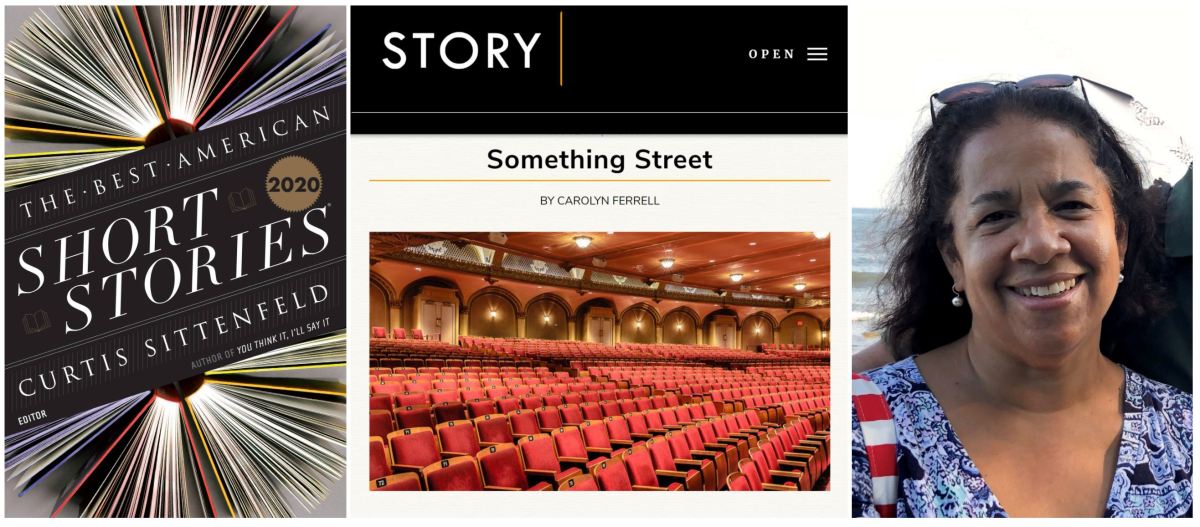
The Best American Short Stories 2020

by James Wallace Harris, Friday, November 6, 2020

Once again I’m turning my reading of The Best American Short Stories (BASS) into a blogging project. See my review for the 2019 volume. The series editor is Heidi Pitlor, who has held that post since 2007, and this year’s 2020 guest editor is Curtis Sittenfeld. Each year, the series editor reads hundreds of stories and passes on what they consider to be the top 120 stories to the guest editor, who in turn picks their favorite twenty stories to publish as The Best American Short Stories for the year. It’s a kind of literary playoff where the winners of the Final 20 are chosen by us readers.

I’ve always wanted to write fiction, especially short stories, but I’ve never felt I was any good at it. Reading these stories teaches me about the best of literary prose. For each of the past three years I’ve read hundreds of short stories and I’m slowly learning what goes into good storytelling. I doubt I’ll ever write a story worthy of being published but I keep trying. To succeed at 69 or 70 would be very satisfying as an extremely late blooming boomer.

My intended project is to read The Best American Short Stories 2020 and study how each story works. This means twenty blog posts, something that should take me months to complete. I’m aware of two other bloggers also analyzing each BASS story (Karen Carlson, Jacob Weber). If other readers of this blog are also reviewing this BASS edition, please let me know in the comments.

To understand each story at an artistic level will require multiple readings. I’ve already learned it takes two or three readings to do justice to a good story, and it will take even more readings to reveal everything the author intended. Most readers rush through their fiction. That’s how I’ve read most of my life. It’s only since I started listening to audiobooks in 2002 that I’ve learned that slower is better. I’ve read the first story in this volume, “Godmother Tea” by Selena Anderson three times now, and I’m only beginning to comprehend why it’s the lead story.

My plan is to read each story via the printed book first. This will give me the general idea of the story, the flyover view. Then, I’ll listen to the audio version of the anthology. That will give me the voice and drama of the story. Professional narrators are highly skilled at interpreting that. And, finally, I’ll read the story again on the Kindle where I can highlight, take notes, and copy quotations. This is where I’ll deconstruct the writing and look for examples of what I want to learn.

I highly recommend buying BASS 2020, but if you don’t want to make such a commitment, some of the stories are available to read online. Try reading one of them. Then read it again. Did a lot more of the story pop out that you didn’t notice when you read it the first time? Try reading it yet again. Were you surprised by even more being revealed? These stories have amazing depth to them.

  1. Godmother Tea” by Selena Anderson (my review)
  2. “The Apartment” by T. C. Boyle (my review)
  3. “A Faithful but Melancholy Account of Several Barbarities Lately Committed” by Jason Brown (my review)
  4. “Sibling Rivalry” by Michael Byers (my review)
  5. The Nanny” by Emma Cline (my review)
  6. “Halloween” by Marian Crotty (my review)
  7. Something Street” by Carolyn Ferrell (my review)
  8. This is Pleasure” by Mary Gaitskill (my review)
  9. In the Event” by Meng Jin
  10. The Children” by Andrea Lee
  11. Rubberdust” by Sarah Thankam Mathews
  12. It’s Not You” by Elizabeth McCracken
  13. “Liberté” by Scott Nadelson
  14. Howl Palace” by Leigh Newman
  15. “The Nine-Tailed Fox Explains” by Jane Pek
  16. “The Hands of Dirty Children” by Alejandro Puyana
  17. “Octopus VII” by Anna Reeser
  18. Enlightenment” by William Pei Shih
  19. Kennedy” by Kevin Wilson
  20. “The Special World” by Tiphanie Yanique

Normally, I read science fiction, but literary fiction usually reflects the cutting edge on the art of writing. Literary fiction also focuses on getting inside the heads of characters, and since we’re in the middle of a diversity boom, that means we’re seeing a wider range of perspectives, writing styles, and experimentation.

Few people read short stories today. It’s a dying art form that has a thriving subculture, albeit small. Before television Shanghaied popular entertainment in the 1950s, newsstands were filled with hundreds of magazine titles devoted to endless variety of short stories subjects, and most general interest and special focus magazines carried a handful of stories.

I consider short stories to be messages in a bottle from one soul to another. They are intricate little communiques where the writer sculps a small vision they want to share with the world. Great stories are multifaceted with layers and textures that required effort, concentration, and contemplation to reveal.

For some reason at my fading end of life I’ve found reading short stories to be far more interesting than any other art form. That’s partly due to the limits of what my aging mind can handle. Short and precise is good. But I also cherish what each writer expresses. They say a picture is worth a thousand words, so each story is a handful of mental portraits and landscapes painted in words.

There is far more to short stories than finding out what happens in the plot. And once they are carefully decoded you have to ask why did the writer write this, and also ask yourself, what does it mean to me.

It’s all deliciously multiplex.

Other Bloggers Reviewing BASS 2020 This Year:

JWH

Mind Over Aging

by James Wallace Harris, Saturday, October 31, 2020

We all lie to ourselves that we’re not getting old. Unfortunately, we sometimes encounter situations that remind us of our self deceptions. Yesterday I went to IKEA to buy some Billy bookcases. After marching endlessly through their giant showroom maze I came to the warehouse section. I went over to a young woman with a vest assembling an order and asked her if it was quicker to pull my own order or let the IDEA staff do it.

“About the same,” she replied looking like she was anxious to get back to her task.

“Where can I find a cart?” I said figuring I could be faster.

She immediately changed her mind, “Oh, let me do it for you.”

“I don’t want to take you away from someone else’s order.”

“That’s okay,” she insisted, turning more friendly.

“Well, then let me help you.” I said. I wasn’t used to letting girls lift heavy things for me. I knew the boxes would weigh 72 pounds each.

“That’s okay,” and she called to another young women and they immediately started looking for my items. I thought this was great customer service. But I felt bad watching two young females do all the manual labor. (I know, I shouldn’t be sexist.)

After I paid for my stuff I rolled my cart out to my truck. Another young woman, a customer this time, driving out of the parking lot stopped and asked, “Do you need help getting that in your truck?”

I thought that was rather nice of her. I’m about a year from turning 70 and I remembered a George Carlin routine. He said when he turned 70 he never had to lift anything big again. He could try but people would rush over to do it for him. I realized the young girl thought I was old. I guess I am. George Carlin had observed some kind of social dynamic that’s not just a comedy routine.

“I think I can manage,” I said, “but that’s awful nice of your to stop and offer.”

The boxes were heavier than I wanted to lift. After hurting my back carry 53 pound speakers a few weeks ago I knew I shouldn’t lift 72 pound boxes. But I hadn’t planned to pick them all the way up. I lifted one end of the first box onto the tailgate, and then lifted the other end sliding it on the truck bed. I had visualized doing that before I left home.

I then happened to look up and saw the young woman had pulled over and was watching me from her car. I quickly put the other boxes in the truck and waved to her that I was okay.

For most of my life women expected me to pick heavy stuff up for them and kill their bugs. I guess I’m old now when they rush over to do the heavy lifting. I wonder if they still want me to kill their bugs?

When I got home I knew I couldn’t carry the boxes into the house. So I opened each box one at a time and Susan and I carried the pieces inside individually. I had visualized that before I went shopping too. Where there’s a will, there’s a way. Mind over aging. It took me two days to put the bookcases together and load them up with books. I wore myself out several times. But I got the job done. Mind over aging.

But I kept chuckling to myself that those young women saw me as a helpless old guy. I realized the store clerk probably thought I was too old to too, which was why she quickly offered to help. Someday I will be too old. Or maybe I’m getting there. I feel it’s important to have the right attitude about aging.

I’ve been studying aging for many years from Ronni Bennett and her website about aging Time Goes By.

Yesterday Ronnie died. She was just ten years older than me, and I always felt she was exploring the path of getting older just ahead of me. I felt it was important to pay attention to her because she was having the real experiences I would someday go though too. I’ve learned many things from Ronni’s wonderful posts, but I think the most important was: Don’t pretend we’re not getting older. My friends tell me I’m too accepting of aging. They want to believe if you don’t think about it, aging and death won’t happen.

All us fans of her blog knew Ronni was dying. She was in Hospice care these last several months. She blogged right up to the end. Here’s her last regular post called “Old Lady Fancy Pants” about getting her first pair of adult diapers. Ronni’s last two paragraphs:

It was my first chance to try this out on Monday with my first evening incontinence pill at bedtime. I yanked a pair out of the tightly wrapped package, shook the panties open and to my utmost surprise, found they they are trimmed in – wait for it – frilly lace. Yes, you read that right: frilly lace.

Is there anything else to do but giggle? So I pulled them on, pranced around in front the full-length mirror and had a big hearty guffaw at myself – old lady fancy pants.

That is truly mind over aging. Of sure, I’m scared of getting old and feeble. I’m terrified of dementia. But reading Ronni’s communiques taught me I’ll have to take whatever comes. Laughing at wearing adult diapers is certainly better than crying. I hope I can laugh when the time comes.

I thought Ronni was the Zen Master of mind over aging. Anyone over sixty should maintain a keen awareness of growing old. Oh sure, don’t give in easily. Being aware isn’t giving up. I’m reminded of something I heard Stevie Nicks say on CBS Sunday Morning last week. She said being forced to stay home from touring was aging her. I thought that was a keen insight. No one wants to age, but I think it’s important to notice when and how it’s happening. Those two girls taught me that I’m starting to look old.

Thinking about aging is a kind of conscious practice, a developing awareness, that allows us to surf the waves of declining powers rather than letting them drown us. We will all die. Getting old will be unpleasant. We will have to deal with an endless procession of experiences we don’t want to experience. The real goal is to figure out how to keep doing all the things we want to do – and chuckle along the way.

By the way, fans of Ronni will keep her website going, and maintain what she wrote. Visit Time Goes By.

JWH