Reconstructing 1973

by James Wallace Harris, 1/5/22

[The photo above was probably taken in 1972-1973. It should do to show what I looked like in 1973. Jim Connell is on the left. I’m on the right. Connell was 6’4″ so I look tall and skinny. I’m much lower to the ground and wider today.]

How many memories can our brains hold? Is there a limit, like a hard drive? I know from experience there are limitations on accessing memories, so I assume there are storage limits. However, countless random forgotten experiences burble to the surface of my mind daily. And at night I have an apparently limitless supply of visual settings and characters to film my dreams.

I’ve always been obsessed with wanting perfect recall. Aren’t the things we obsessed over what we want and can’t have? 2023 is the 50th anniversary of 1973. I shall use that year for testing my memory in this essay.

This is not another nostalgic look back in time. In fact, I feel the golden glow of nostalgia is finally starting to wear off. 1973 is one of the least remembered years in my mind. At this moment I can’t recall anything specific I did in 1973. I know I was doing stuff, and some of my vaguer memories might have taken place that year, but for now, I just don’t remember what I was doing. I’m not even sure where I was living at the time.

Think of this essay as a cold case. I’m going to go through old drawers and paperwork looking for clues and use the internet to find out what was happening in the world at large to see if that triggers any memories of 1973.

Unfortunately, around 1975-77 I went into a Buddhist phase and gave away or threw away a lot of my possessions. I intentionally tossed most of my personal mementos because I didn’t want to be attached to them or be hung up on the past. I regret that now because I destroyed all my letters, photos, slides, 8mm films, and copies of my APAzines. When my mother died in 2007 I inherited all her photos and mementos. She kept a lot of my report cards. And over the years people have given me photos and old letters. Plus I have my college transcripts — if I can find them. Physical clues are theoretically slim, but I shall look for them.

I shall use full names in case some of my lost friends are Googling their own names. Who knows, maybe it might cause a reconnection.

Sadly, many of my close friends from the 1970s have died. My old roommate Greg Bridges has moved away and I’ve lost contact with him. 1973 was well before I met my wife in 1977. I’m still in contact with my old high school buddy Connell, and my sister Becky is still alive. Becky married in 1971 and moved to Dallas, so she won’t remember much of my 1973. Most of my relatives have also died, at least the ones I saw the most in 1973.

I did not remember a visit to Dallas in 1973 with Carol Suter and Jim Connell until after writing the first draft of this essay. The act of writing has caused memories to float to the surface. Sometimes it took hours, sometimes days to recall. I shall note these delayed experiences in italics.

I’ve written an essay like this before, in 2019, for the 50th anniversary of when I graduated high school. This time I want to go deeper into reconstructing the past. One of the best books I’ve read about being a historian is Jesus Before the Gospels by Bart D. Ehrman.

Ehrman covers all the sources of evidence a historian uses to reconstruct the past and discusses the effectiveness of each. Ehrman shows how memory is unreliable. He also shows how unreliable eyewitnesses are too. Even if I had lots of memories of 1973 I couldn’t trust them. Not everything I write here will be truly reliable. One of the most damning pieces of evidence Ehrman reviewed in his book was about a professor who had his students write down where they were and what they saw and felt the day after 9/11. Then a decade later he tracked down many of those students and asked them to write down what they remembered about 9/11. Several wrote something entirely different. But here’s the kicker. Some of those students who were shown their original essay written the day afterward claimed they didn’t believe what they had written. They believed their memory!

The first piece of evidence I found is a transcript from Memphis State University (now the University of Memphis).

I was a terrible college student. I dropped out many times. I hardly ever did homework, and it’s amazing I got grades as good as these. During 1971-1972 I attended State Technical Institute Memphis. There I majored in a two-year computer science degree. I loved computers, but the focus was on COBOL and getting a job in a bank. I decided I didn’t want that and transferred to Memphis State in 1973. This only came back to me as I studied the transcript.

Many of these courses are general requirements but the ones that weren’t, remind me of when I was searching for a major. I remember now I was considering history, sociology, English, and anthropology. Although, at some point, maybe even when I quit State Tech, I was considering getting a library degree. I needed a B.S. degree before moving to Knoxville to get an M.L.S. degree (Master of Library Science). I just can’t remember.

I remember liking Byzantine history but not the course. It required too much real work. I don’t know why I made an F in “U.S. Southern History Since 1865” since I made an A in “U. S. History Since 1865.” I have absolutely no memory of taking that course. I took “Southern Literature” in the Spring of 1974 and got an A. I also took two Library Science courses that spring, which backs up my memory theory that I was thinking about becoming a librarian.

One course I distinctly remember is “ENGL 3501 English Grammar” because it was about grammar theory and was really hard. And I have trouble with ordinary grammar. What improved my grade was writing a paper on computer translation of languages. I was really into that subject and I impressed the professor.

I lived at 140 Eastview Drive in Memphis during that year because that’s where I remember writing the paper on computer translation. I was sharing a duplex apartment with Greg Bridges who was my science fiction buddy. We went to conventions and produced a fanzine on Gestetner mimeograph which the two of us co-owned with Dennis McHaney. Another buddy John Williamson lived next door in the duplex across the driveway. We got our friend Claude Saxon to move onto this street too, just a couple doors down. We pictured ourselves creating a hippie-like commune by getting all our friends to move to Eastview. It was a rundown neighborhood in 1973, and it’s worse now in 2022. Here’s what it looks like today from Google Maps.

One of the reasons why my grades were falling off was having so much fun at the time. I was into fandom and a member of two APAs – Spectator Amateur Press (SAPS) and Southern Fandom Press Alliance (SFPA). I was also going to lots of rock concerts and smoking a lot of weed with many friends. Two that I remembered a day later were Tom and Sara. I ended up dating Sara’s sister Alice in 1975.

It was while Greg and I lived in this Eastview duplex that he worked on the Programs committee at Memphis State and he got Fred Pohl, John Brunner, and James Gunn to come and do a two-day seminar. The three writers took Greg and me to lunch and we got to listen to them talk about the old days for a couple hours before Pohl and Gunn had to go to the airport. Then we spent the afternoon taking John Brunner around Memphis. He wanted to see the Lorraine Hotel because he was the president of the Martin Luther King society in London. This was before it was renovated. Then Brunner took Greg and me out to dinner at a Mexican restaurant on Union Avenue before we took him to the airport.

I was able to document this from a fanzine article Greg Bridges wrote for Memphen 279 in 2002. The internet has become my real auxiliary memory. Pohl, Brunner, and Gunn were in Memphis on November 22 and 23 1972. That’s before 1973, and earlier than I thought. I assumed 1973 or 1974. But, can I trust Greg’s memory. I hope he had some kind of physical evidence.

I’ve always told people I never lived anyplace longer than 18 months during the 1970s. His date puts me in Eastview in 1972 and I’m pretty sure I moved out in the summer of 1975. I remember 1975 because that’s the year Born to Run by Bruce Springsteen came out. If Greg’s dates are correct I lived on Eastview for almost three years, maybe longer. That completely contradicts what I believed for years.

To me, the 10th, 11th, and 12th grades seemed like the longest years in my memory. I went to three different high schools in two states while living in four different houses. There’s got to be more to 1973. I was twenty-one for eleven months of 1973, that should have been a special time. I suppose going to college filled up the time in a way that made it seem quick and not memorable.

I found a timeline I made years ago. It gives me a few clues. Jim Connell came to visit me and he, Carol Suter, and I drove in Carol’s yellow Gremlin to Dallis to see my sister Becky and her husband Skip Suter, Carol’s brother. That was when I first met Becky’s future second husband Larry Gamer. I was very impressed with him since he was a computer programmer.

Another thing I remember is making a trip to Cape Kennedy with Carol. Her mother asked Carol and me to drive her nephew and niece back home to Titusville. They had been staying with Carol’s mother. Their father, Carol’s uncle, worked at NASA and he took Carol and me to his job site at a communication facility on base. While we were there they taped conversations with Skylab 3, which operated from July 7, 1973, to September 25, 1973. This was when we were out of school and could have made the trip. After we dropped off the kids, Carol and I drove to Gainesville to see my old friend Jim Connell. I remember sleeping on the floor in a communal house. But I’m not sure of this memory. It might have been another trip with Carol. But Gainesville would have been close to Titusville. I do remember we went by Six Flaggs in Atlanta. That’s when I saw Helen Reddy in concert.

I made that timeline decades ago to help me remember all the places I lived. It confirmed the trip to Gainesville. It said the Helen Reddy concert was on 8/31/73. It also said Carol and I went to see Edgar Winter and Dr. John the next day, 9/1/73.

So far I’ve been able to prove I took 12 college courses and visited Dallas, Atlanta, Gainesville, and Cape Kennedy in 1973. That’s something but not much.

I have found one letter from 7/29/73 that I wrote Connell which he returned in 1980. I wrote Connell hundreds of pages of letters, which he kept in a box, but his mother threw out sometime in the 1970s. I’d give anything to have that box now. Here’s the letter:

There’s something woo-woo in that letter. In the third-to-the-last paragraph on page one, I asked Connell to imagine a future where he has a daughter born deaf. Connell’s stepdaughter went deaf several years ago after having to take some major antibiotics.

This letter is also weird because it sounds like me now. But then I was trying to imagine the future and now I’m trying to reconstruct the past.

I had Connell read the letter to see what he remembered. He didn’t remember the letter but he thought we thought many more thoughts per second back then than we do now because the letter impressed him with my stream of ideas.

I don’t remember taking any photographs from 1973. I don’t think I owned a camera. That really limits my recall.

A day later I remembered that not only did I own a camera, but so did Greg Bridges and John Williamson. That we had built a darkroom, in the living-room closet at the house on Eastview and considered ourselves amateur photographers. I still don’t think we took pictures of ourselves. We were all into nature photography and macro photography. I did take several rolls of film using Carol as my model. Plus we made super8mm movies. Williamson was into various creative hobbies and even made silkscreen images. He made a silkscreen cover for my SAPS apazine After the Goldrush. I through all that out in my later Buddhist phase.

I’m now out of physical evidence to prove my existence in 1973. Wikipedia’s timeline of major events of 1973 triggers little for me. Neither the 1972-73 nor 1973-74 TV schedule triggers any memories. I’m not sure we watched TV at the Eastview house or even owned a TV.

In my letter above I review a movie. I can’t remember where I watched it. I sometimes rode my bike over to my mother’s house to watch TV there. Today I had a vague memory of a black and white TV in an old wooden cabinet sitting in a tiny living room that had one ugly couch. This memory was in black and white. All my memories of that Eastview living room are in black and white. I think it must have been dark and dingy.

In this post about 50 albums from 1973, I remember many of them, but most of them I bought later. The only ones I think I bought in 1973 were Brothers and Sisters by the Allman Brothers Band, ‘Pronounced ‘Leh-‘nerd ‘Skin-‘nerd’ by Lynyrd Skynyrd, Over-Nite Sensation by Frank Zappa and the Mothers of Invention, Goodbye Yellow Brick Road by Elton John, and Piano Man by Billy Joel.

I was able to verify going to a few concerts by recalling them and verifying the dates on the internet. Carol Suter and I went to see Elton John on October 11, 1973, at the Mid-South Coliseum for the Goodbye Yellow Brick Road tour. We also saw him one other time, but I can’t remember if it was in 1972 or 1974. Carol hurt my feelings because she said she would go with me to see Billy Joel during the Piano Man when he was at Lafeyette’s for several days but then went with someone else. I now wished I had seen Billy Joel before he was famous.

I also saw Frank Zappa twice during the 1970s. He was in Memphis in March of 1973, but I can’t verify I was at that concert, but I think it was around the time of Over-Night Sensation. I and my friends went to a lot of concerts during these years. It seemed like every week some big act would perform, often two or three at a time. And the tickets were less than ten dollars back then.

If I would go to the library and look at the microfilm of the Commerical Appeal for 1973 I could verify all those concerts probably. I might even dredge up some other 1973 events I remembered or attended.

Here are the most remembered science fiction books from 1973. I don’t remember reading any of them during that year. Greg and I were both science fiction collectors. I’m pretty sure I subscribed to F&SF that year because I had collected over 200 back issues. But I probably also subscribed to Galaxy, Analog, Amazing, and Fantastic. I also remember building several large bookcases for my collection. They were the same size as a sheet of 1/4″ plywood. I used 1 x 8-inch planks for the shelves and plywood for the backing. They were huge. Greg used giant metal shelves in his room. We even had bookcases in the hall and living room.

Greg and I also published fanzines, traded fanzines, and subscribed to fanzines. Our favorite was Richard Geis’s Science Fiction Review. A few years ago I bought most of them again on eBay and scanned them for the Internet Archive. Probably if I reread the 1973 issues it would trigger many memories.

A memory that came to me on the second day of writing this essay was about my Raleigh 3-speed bicycle. I didn’t have a car that year. When I needed a car I’d ride my bike over to my mom’s house and borrow her car. I rode that bike all over Memphis. Once, and I don’t remember when I visited Connell in Miami and he told me to bring my bike on the airline. I did. And we rode it all over Coconut Grove, where I used to live. I loved that bike. I have no idea what happened to it. That saddens me.

Well, this research is running too long for a blog post, but I think you get the idea. We can remember a lot. Especially if we have triggers. I often have vivid memories of the past pop into my head unbidden. It makes me wonder if everything is recorded and if the bottleneck is the mechanism of recall.

I’m sure if I kept at this experiment I could write a whole book about memory and what I could eventually remember from 1973. I doubt many would want to read it. I’m not even sure anyone will want to read all that I’ve written here. Most people don’t seem very interested in remembering the past. I even know people who say they intentionally try to forget the past and throw away anything that makes them recall it. That horrifies me. I hate that I went through that Buddhist phase.

How much can you remember from 1973?

JWH

Why I Need To Side With Amazon/Audible

by James Wallace Harris, 1/1/23

Daniel Greene just posted The Audible Situation on his YouTube Channel. Greene is not attacking Amazon/Audible, but he is reporting on a controversy that began when author Brandon Sanderson posted “State of the Sanderson 2022” about why Sanderson wanted to publish his audiobooks first with Speechify rather than Audible. Amazon/Audible is moving towards becoming a monopoly for indie publishers and Sanderson wants to counter that and give other publishers a chance. Greene sides with that idea, and I sympathize completely. However, I need to explain why I and probably many other readers will stick with Amazon/Audible.

I’ve been buying audiobooks for maybe thirty years and buying them from Audible for twenty. I’ve been buying ebooks since the Rocket eBook came out, which was a little over twenty years ago. I have over a thousand Kindle books in my Amazon library and seventy-four pages of audiobooks (20 per page) in my Audible library. That’s a huge library of digital books I want to protect, and Amazon/Audible does a fantastic job of helping me. If my house burned down I’d lose all my physical books along with my iPad, iPhone, and Kindle. But I could buy a new iPhone, log in and have instant access to all my Amazon/Audible books.

Over the decades I have bought ebooks and audiobooks from companies not owned by Amazon/Audible. Nearly all of them have been lost as I moved from computer to computer, or forgotten the places and accounts I bought them from. I’ve bought books from Kickstarter, Apple, Barnes & Nobel, Recorded Books, Downpour, Humble Bundle, Phoenix Picks, O’Reilly Books, and many other publishers. I also bought audiobooks on cassettes and CDs, For example, we bought all the Harry Potter books on CD as they came out, but recently when my wife wanted to hear them again, she rebought them on Audible because it was convenient and because they will always be in her library.

Some of the ebooks I bought I sent to a Kindle device, but they don’t stay there as I’ve moved to new devices. And they don’t always look right in my Amazon library.

Years ago I realized that the only secure way of “owning” a digital book was to buy them from Amazon/Audible. I know they could change their policies or go out of business, but since Amazon is so big I’m betting they will be there until I die.

Amazon/Audible has become my trusted library to store digital books. They keep them fairly well organized and easy to find. They bought Goodreads and that helps me remember and review my books. That ecosystem makes for a very good digital library system. Even when Audible stops selling an audiobook I still have my copies. Of course, with thousands of books, some may have been deleted and I haven’t noticed.

There are times when I remember owning a book and going to Amazon/Audible and not finding it. When I search my mind I realize it’s missing because I bought it elsewhere. Sometimes I can still find them on my computer or remember the publisher and my account, but as time goes by, that’s becoming rarer.

If we thought of books like buying a movie ticket and watching a film, then buying books from any publisher wouldn’t matter. It would be a one-time experience. But if you buy books to build a library that doesn’t work.

I often see wonderful deals on Humble Bundle. I would buy them if they instantly became part of my Amazon library. And that’s true for deals from other publishers. But I’ve stopped getting those deals because I can’t easily keep up with their books for the long haul.

I do agree that it’s wrong that Amazon/Audible has gotten such a stranglehold on the industry. And I don’t see why Amazon/Audible must demand exclusive deals from authors. Amazon/Audible should stop that practice just to show goodwill to the book world.

I can think of some farfetched solutions to this problem. If there were an international registry of digital ownership that was separate from the publishers and sellers that would track what digital works a person owns, then that would break the monopoly. Booksellers would offer readers the best deal, and readers could pick from whichever seller they liked. But their purchase would be added to the registry. And they could then always download a copy of that book even if the bookseller or publisher went out of business. Such a system would even allow readers to leave their library to someone when they died.

Of course, Amazon/Audible has already created such a registry, and that’s why they are so successful.

JWH

Downgrading to DVD – When Streaming TV Fails Us

by James Wallace Harris, 12/31/22

I’ve lived long enough to experience a number of technological revolutions in television. I was born in 1951, and some of my earliest memories are of watching TV in 1955. TV screens were much smaller then, and the image was in black and white. Well, the whites weren’t white, and the blacks weren’t black, and the image quality was halfway between a black-and-white half-tone photo in the newspaper and a Tri-X black-and-white photograph. What we saw on the screen was small, and fuzzy, giving the impression we had bad eyesight.

Although we couldn’t afford it, my father got us a color TV in 1965. Wow. That was the first big tech breakthrough in television that I remember. And not all shows were broadcast in color. I remember how the TV Guide noted which shows were in [COLOR]. As it became more common, they shortened it to [C].

Growing up with black-and-white TV is the main reason why I love old black-and-white movies. And for two reasons. First, I learned to love watching stories visually told in black and white, and second, early TV ran old movies from the 1930s and 1940s that were mostly black and white.

The next big tech innovation was cable TV. No more messing with the antenna anymore. Cable TV took us far beyond ABC, CBS, and NBC. But the biggest tech change was in the later part of the 1970s when we got a VCR. That opened up time shifting and freed us from the TV schedule. But more importantly, it allowed us to buy or rent movies and TV shows. We had more freedom than ever for choosing what we wanted to watch and when.

We didn’t know how bad the image quality of VHS was until we could buy DVDs. A couple decades later we got large flatscreen TVs that could do 720p and 1080i and realized we needed Blu-ray discs. Then came streaming TV services that freed us from the disc. I’ve gone months or even years without using a DVD. Susan has a big collection of Christmas movies she watches each December, but this year I noticed she streamed most of those movies.

We could almost give away our DVD/BD library. But not quite. Every once in a while I’ll want to watch something that no streaming service offers, and no site rents. Sometimes these forgotten shows are available on YouTube, but usually not. That’s when I have to return to the disc.

I wanted to show Susan Northern Exposure to see if she wanted it to be our next series to watch together every night. It’s nowhere to stream or rent online. Luckily, I have seasons 1-4 on DVD. But they are on flippy discs which I hate, and seasons 3 and 4 didn’t use the original music. The music was an enchanting feature of the series, but the producers didn’t foresee they’d have to pay expensive royalties if they resold their show on disc. [See explanation.]

If Northern Exposure was on a streaming service I didn’t already subscribe to, I would subscribe to that service just to watch it. Or I’d buy a digital copy on Amazon. After that, I’d want to buy it on Blu-ray. Unfortunately, the only complete series for sale on Region 1 discs still doesn’t have the original music. There are Blu-ray and DVD sets from Great Britain but they are expensive and Region 2 discs.

Fans of the show on Amazon are spending $170 for the Blu-ray sets and another $170 for a Region-free Blu-ray player. I’m not going to spend $340. So, I got out my old DVDs but discovered that my Sony Blu-ray player was dead. I haven’t used it in a very long while. Streaming really has changed us. Luckily, I have a cheap $29 Region-free DVD player I had to buy it to watch Love in a Cold Climate because I could only find that old series used on Region 2 discs. Downgrading to DVD is how we watched the pilot of Northern Exposure last night.

The image quality was a step down – 480i. And the DVD player was poorly designed with a terrible remote. And that release on flippy discs forced us to watch previews for several TV shows from back in the 1990s each time we start the player.

Quite a downgrade in TV watching. Still, the 4:3 image on my 65″ screen was far better than what we saw in the summer of 1990 on a 25″ screen. I could say it was a retro-nostalgic experience, but I’m too addicted to the current state of television technology to be satisfied. I’m awful tempted to spend the $103 and get the British Region 2 DVD set. That’s a lot more money than the American Region 1 $39 DVD set of the complete series, but it has the original music that I’ve ached to hear again. I really want the Blu-ray version, but it’s just too damn expensive.

For now, we’ll try the old DVDs to see if we get hooked again on a show we both loved thirty years ago.

JWH

Susan and I Need a New TV Show – Give Us Your Recommendations

by James Wallace Harris, 12/30/22

About six weeks ago Susan and I developed a new nightly routine. At ten o’clock she would feed the cats, and then we’d sit down to watch an episode of Downton Abbey with a piece of cake. This has turned out to be an extremely delightful routine and we want to keep it up. However, we’re about to run out of Downton Abbey and need a new show.

When we first got married we always watched TV together, but in recent years, our tastes have diverged greatly and we have a hard time finding shows we like watching together. I’m no longer interested in half-hour comedies which Susan loves. And Susan hates shows like Breaking Bad and Stranger Things. However, we both liked The Sopranos. And that might be a possibility, although Susan might not like it anymore.

It’s strange how our tastes have changed over the last four and a half decades. She used to sit and watch Star Trek with me, and I’d watch The Gilmore Girls with her, but those days of watching something we didn’t like just to be sociable are over. We need something we’ll both love.

So, if there is a series you liked as much as Downton Abbey please let us know. We both liked Downton Abbey in the past, so it was an easy pick. If you’re a couple, recommendations you both like might be more valid.

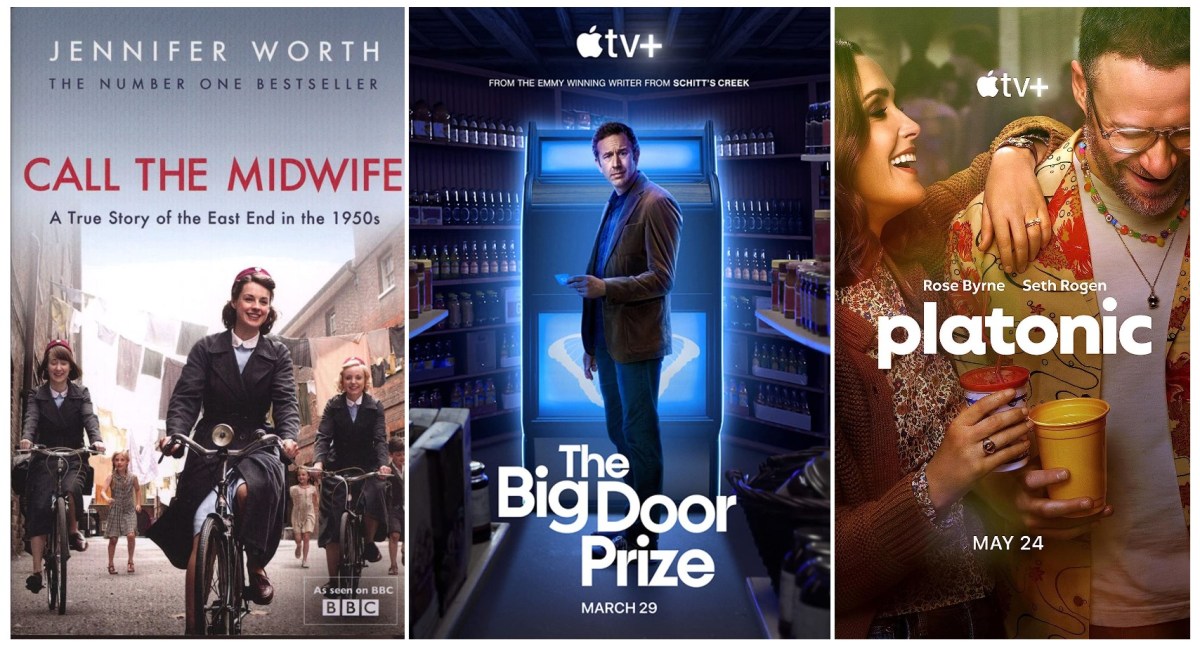
We are currently considering The Marvelous Mrs. Maisel, which we’ve both watched and liked, and Call of the Midwife which Susan has seen some. We want an hour show that has continuity. Downton Abbey was really a soap opera, and that might be a key to why we looked forward to ten o’clock every night (and well, the cake.)

It helps if the show is streaming somewhere, but I’m not against buying a DVD set.

I just remembered a show we both loved – Northern Exposure. So that’s three possibilities. But if we’re to keep this routine up we’ll need a whole lot of shows.

JWH

2022: Year in Reading

by James Wallace Harris, 12/30/22

It’s always amusing to look back over the books I read during the year to see how many I’ve forgotten. For some reason, I remembered them all this year. Oh, I couldn’t have made a list from memory, but when I look at Goodreads database every book came back to me. That’s unusual. It could be I’m getting better at picking memorable books to read. I tried to review many of them, so that might be a factor too. I read eight anthologies for a Facebook group devoted to reading a science fiction short story daily. And six books were read for a nonfiction book club. Also, I got interested in four authors this year: Philip K. Dick, Robert A. Heinlein, Elizabeth Strout, and Anthony Powell. Finally, this was my year for reading history, especially about the ancient world.

2022 was the year of reading Elizabeth Strout. I read seven of her nine novels. I binged on them, reading those novels in about seven weeks. But when I look at my list, I see I read Bewilderment by Richard Powers at the beginning of the year. If I think on it for a while, my memories suggest I might have liked it better than Lucy by the Sea, my favorite Strout book, and the novel I currently think of as the best I read in 2022. Memory is tricky and comparing books is so hard.

On the other hand, An Immense World by Ed Yong feels like my favorite nonfiction book right now, but when I dig through old thoughts, I have to wonder if I didn’t like Where the Wizards Stay Up Late by Katie Hafner and Matthew Lyon better? It wasn’t The Soul of a New Machine or Hackers, but it did press my love of computer history button long and hard.

Whether I’m reading a novel or a nonfiction book, the best ones often feel like the most amazing book I’ve ever read — while I’m reading them. So, instead of picking the best books of the year, I’m going to bold any book below that I highly recommend. I really enjoyed all the history books I read, but I doubt many people would, so I’m hesitant to recommend them.

Here are the books I read in 2022. Links are to my reviews.

  1. The Soul of an Octopus: A Surprising Exploration Into the Wonder of Consciousness by Sy Montgomery
  2. Bewilderment by Richard Powers
  3. The Great SF Stories 25 (1963) edited by Isaac Asimov and Martin H. Greenberg
  4. The Horse, the Wheel, and Language: How Bronze-Age Riders from the Eurasian Steppes Shaped the Modern World by David W. Anthony
  5. We Can Build You by Philip K. Dick
  6. Dr. Bloodmoney or How We Got Along After the Bomb by Philip K. Dick
  7. The Other Side of Philip K. Dick by Maer Wilson
  8. Philip K. Dick: Remembering Firebrght by Tessa B. Dick
  9. Humankind: A Hopeful History by Rutger Breman
  10. The Big Book of Science Fiction edited by Ann and Jeff VanderMeer
  11. Star Science Fiction Stories No. 1 edited by Frederik Pohl
  12. Hugo & Nebula Award Winning Stories from Asimov’s Science Fiction edited by Sheila Williams
  13. The Dawn of Everything: A New History of Humanity by David Graeber
  14. Breakfast with Seneca: A Stoic Guide to the Art of Living by David Fideler
  15. Over My Shoulder: Reflections on a Science Fiction Era by Lloyd Arther Eshbach
  16. The Writing of the Gods: The Race to Decode the Rosetta Stone by Edward Dolnick
  17. Forgotten Peoples of the Ancient World by Philip Matyszak
  18. Where Wizards Stay Up Late: The Origins of the Internet by Katie Hafner and Matthew Lyon
  19. No Man on Earth by Walter F. Moudy
  20. The Best Science Fiction of the Year: Volume Six edited by Neil Clarke
  21. Sea of Tranquility by Emily St. John Mandel
  22. The History of the Ancient World: From the Earliest Accounts to the Fall of Rome by Susan Wise Bauer
  23. The Arbor House Treasury of Modern Science Fiction edited by Robert Silverberg
  24. In the Funhouse: 17 SF Stories about SF edited by Mike Resnick
  25. Galaxies by Barry Malzberg
  26. Time’s Last Gift by Philip Jose Farmer
  27. Project Hail Mary by Andy Weir
  28. The History of the Medieval World: From the Conversion of Constantine to the First Crusade by Susan Wise Bauer
  29. Inventor of the Future: The Visionary Life of Buckminster Fuller by Alec Nevala-Lee
  30. John Brunner by Jed Smith
  31. Red Planet by Robert A. Heinlein
  32. Nothing to See Here by Kevin Wilson
  33. Methuselah’s Children by Robert A. Heinlein
  34. Sixth Column by Robert A. Heinlein
  35. The Plot Against America by Philip Roth
  36. For Us, the Living: A Comedy of Customs by Robert A. Heinlein
  37. Revolt in 2100 by Robert A. Heinlein
  38. The Kraken Wakes by John Wyndham
  39. A Question of Upbringing by Anthony Powell
  40. A Buyer’s Market by Anthony Powell
  41. The Acceptance World by Anthony Powell
  42. Olive Kitteridge by Elizabeth Strout
  43. Olive, Again by Elizabeth Strout
  44. My Name is Lucy Barton by Elizabeth Strout
  45. Anything is Possible by Elizabeth Strout
  46. The History of the Renaissance World: From the Rediscovery of Aristotle to the Conquest of Constantinople by Susan Wise Bauer
  47. At Lady Molly’s by Anthony Powell
  48. The Mountain in the Sea by Ray Nayler
  49. Index: A History of the by Dennis Duncan
  50. Abide With Me by Elizabeth Strout
  51. Oh, William! by Elizabeth Strout
  52. The Good New Stuff: Adventure SF in the Grand Tradition edited by Gardner Dozois
  53. The World Turned Upside Down edited by David Drake, Eric Flint, and Jim Baen
  54. Lucy by the Sea by Elizabeth Strout
  55. An Immense World by Ed Yong

For many years I’ve ended my yearly summary of reading with my reading ambitions for the following year. I’m not going to do that this year. My reading tastes seem to be in flux. I like trying to read one book a week, or 52 books a year, but I’m not sure is that’s a useful goal anymore. What I love is finding great books to read. I think I’ll worry less about genre or subject, or how many, and focus on making every read count. It felt really wonderful to discover Elizabeth Strout this year. And to be honest, I am finding reading science fiction, by favorite genre, becoming less rewarding. I might just be burned out on the genre for a while.

I’m also excited about the Anthony Powell books from his A Dance to the Music of Time series of twelve novels. I’m on the fifth book and so far they show more promise than they deliver. I’m hoping if I read all twelve, and think about their total impact, my impression might change.

I’ve been studying the Best-Books-of-2022 lists and there are many I want to read. So, I’ll just call them my reading goal for the year.

JWH