
Hubble Telescope at 10x or 100x or 1000x

The other night I caught a new documentary, “Hubble’s Amazing Universe” on the National Geographic Channel that in high definition wonder showed how the Hubble Space Telescope revolutionized astronomy since 1993.  Sadly, I can’t find a link to an online version.  I hope they repeat this HD documentary often because seeing the spectacular Hubble images on a 52″ inch screen was beyond beautiful.  Using technology that I can’t name, they made the images look three dimensional, and the stories that went with them explained why Hubble was well worth it’s price tag of billions.

Now, I’ve got to wonder, what will a telescope that is 10 times more powerful than the Hubble will see and discover?  What about one 100 times more powerful, or even a 1,000 times more powerful?  We really won’t know what such futuristic telescopes will discover, because like the Hubble’s discoveries, they will be unexpected.  In my mind, the most exciting thing these future space telescopes could discover are Earth-like planets orbiting around nearby stars that show indications of life or technology.

image

Pillars of Creation

Ever since our cave dwelling days, humans have been asking how we got here in this unbelievable reality.  Well, the Hubble telescope has shown us how big here really is, both in dimension and composition.  Hubble has revealed stellar nurseries and black hole graves.  It has helped scientists make discoveries about dark matter and energy, and revealed the largest structures in the universe discovered to date.

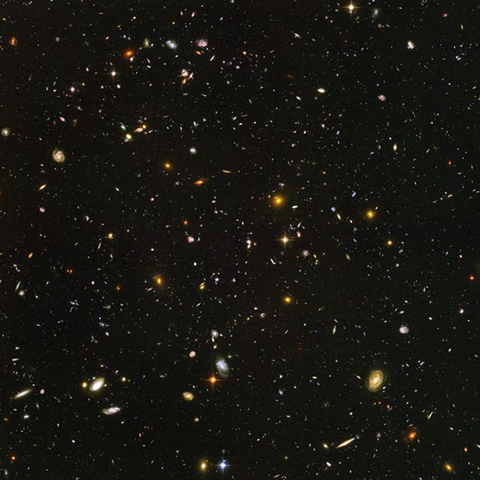
Most people never ponder the size of reality.  They never grasp that we live in space-time.  Hell, few people even look at up at the lights in the sky at night.  If Genesis had to encompass the scope of Hubble’s vision, imagine how different God and the Bible would have been.  Is there any analogy that I can give that can convey the scope of how far Hubble can see?  If you were the smallest sub-atomic particle in an carbon atom that’s part of a molecule in a one cell of your heart, would any scientific instrument you build show you how big your body would be?  Imagine being one grain of sand and trying to count all the others on a beach?  In the photo above, our solar system is so small it wouldn’t be seen in those dust pillars that are light years high.  But look at the picture below.  The above scene is smaller than you in relation to the solar system compared to the objects in the photo below.
image

This is the famous Hubble ultra deep field photo, where scientists tried to photograph an empty patch of sky.  Each speck of light is a galaxy containing billions of stars.  Now imagine a more powerful space telescope picking a black patch in this photo and zooming in on it.  What would it see?

We know the universe is big.  Back to that analogy of being a sub-atomic particle in your heart, now imagine trying to figure out that you are part of a body of organs, each with its purpose, could you ever imagine what the brain does from just looking at its parts from your tiny vantage point?  It’s no wonder that so many want to embrace the Biblical view of creation, because the scientific view is too much work to grasp by us little fellas.  Individually we are tiny, but scientists stand on each other’s shoulders to get the bigger view.  Now imagine future space telescopes spying on nearby stellar systems and seeing other Earth-like worlds, worlds where we analyze the chemicals in their atmospheres.  What if we discovered what we call man-made chemicals?

Now imagine, if we could get our giant artificial brains to communicate with the distant giant AIs of their world.  How far can two species see standing on each other’s shoulders?

Think of it another way.  If we consider every human as a cell in the body of a single being called humanity, a space telescope could be its eyes, and all our computers and knowledge, its brain.  The mirror lens of the Hubble telescope was slightly wider than a very tall man.  Now imagine building a pair of eyes in space where the pupils were the size of a football stadium?  How far could our new body see?  Then hook them up to immense armies of computers and swarms of natural philosophers and you might begin to imagine what I’m asking.  And, I’m only wondering, “what might we see?”  We won’t know until we build these new eyes.

The primary question we’ve always asked is, “Where do we come from?”  The next important question is, “Are we alone?”  We hoped that SETI would answer that question, but it might be astronomy and space telescopes that will actually answer it.  The manned Apollo missions to the Moon answered a lot of scientific questions, but the Hubble Space Telescope has answered an immense amount more in comparison.  Some people are now asking, what if we went back to the Moon and built truly giant telescopes on its far side, how far could we see?

The James Webb Space Telescope is schedule to fly to L2 orbit in several years, and it’s eye is 6.5 meters in diameter, compared to Hubble’s 2.4.  The JWST is designed to see in the infrared, and not the visible spectrum like Hubble, but then the visible spectrum is such a tiny fragment of the total spectrum to be explored.

What if Congress had said no to the financial bailout, and given the $700 billion to astronomers, how much more would we have gotten for our money?  Just try and speculate what life on Earth would be like if we found out we weren’t alone in the Universe, and had nearby neighbors.  The Hubble Space Telescope gave us a quantum leap in knowledge about the universe, so think about a Hubble telescope at 10x, or 100x or 1000x.

JWH 11-18-08

Science As Fantastic As Science Fiction

Science fiction magazine editors often complain they don’t get enough science fiction stories submitted to them.  What they need to do is convince the popular science writers showcased in the latest edition of Best American Science and Nature Writing 2008 to also write fictionalized versions of their latest essays.  Or maybe, all those would-be science fiction writers stuffing their slush piles should study this volume, integrate the ideas into their work, and then they’d impress those editors.  I kid you not, there are some far-out, fantastic, sense-of-wonder concepts in these essays.  Just do a bit of sampling here, and you’ll see what I mean.

Start with the Freeman Dyson prediction about green technology.  He’s not talking about windmill generators, but plants with silicon leaves, engineering biology and taking over the role of evolution to remake the Earth.  If you want to know about alien minds, trying reading the essays by Colapinto and Cook.  They don’t look to the stars and little green men who think different, but to South America.  Then Jon Mooallem looks at the history of people seeking anti-gravity and gravity radio.  Each essay, no matter how down to earth, could be used to inspire SF stories.

Here’s the table of contents with links to the articles on the web:

Just the fact that I can link to full-text versions of all but three of these articles on the web is science fictional.  It represents a major paradigm shift in copyright, economics and the dissemination of knowledge.  And I’m not linking to these articles to give you free reads, you should buy the volume and study it.  I’m linking to web pages as a way to review this book, because just sampling these links will give you a taste of what I’m talking about far better than I could with descriptive words.  Most people do not like to read off computer screens, but having these essays online is an excellent way to recommend them to your friends.

This collection is a snapshot of our times but far different from what you see on the news at night.  These articles are overwhelmingly about the future, either predicting fantastic new developments, or warning us of dire happenings if things continue as they are now.  All the concepts that science fiction writers use to write visionary science fiction.  I’ve been getting this volume each year for awhile now, but I’ve yet to meet anyone else that recommends it.  That’s a real shame.  Science was never so accessible, so why isn’t it more popular?

Could this be why the SF mag editors aren’t seeing that many science fiction stories cross their desks?  Because we now live in a world that seems science fictional compared to what we grew up in just a few decades ago.  I was watching a new cop show called Life on Mars, about a detective thrown into the distant past of 1973, and I was struck by the scene where he’s wishing for a cell phone.  Or another time when he mutters about wanting a computer.  I’d love to time travel back to see The Monterey Pop Festival in 1967, or the Beatles in Germany, but I don’t know if I could live without my sixth sense, the Internet.

The world and election I remember seeing through a 19″ black and white TV in 1960 is so very different from how I see reality in 2008 while watching a 52″ high definition set.  I think we take science for granted now, and back then science was that gee-whiz Mr. Science stuff that nobody paid any attention to other than the proto-geeks.  Many of the science stories in this year’s collection come from The New Yorker, The Atlantic and other mundane periodicals.  Today I can switch on my TV and see an hour documentary on the history of the black hole, and the controversy over the information paradox that Stephen Hawking had proposed that angered scientists for years.  When I was growing up, my choices were Gilligan’s Island, Bewitched and I Dream of Jeannie.

In the early days of three channel television, there wasn’t room for physics and astronomy shows.  Today I can find several science documentaries on every night, and not boring ones like we used to see on 16mm film in science class, but fantastic shows with killer computer graphic clips beautifully illustrating cutting edge science, like string theory and the effects of dark matter of galaxy formation.

Sheila Williams, the editor at Asimov’s SF Magazine, complains she receives too many stories beginning with exploding space ships.  That was a popular way to begin a story back in the 1930s.  Explosions are dramatic and quickly lead to action, but what people want today are new far-out ideas to create sense-of-wonder SF, and evidently too many potential science fiction writers are living on ancient clichés.  They need to be reading the science essays and watching the science documentaries on TV, because the mundane world has passed old science fiction by, leaving it quaint and suitable for nostalgia retrospectives.

The Donlan and Dyson articles inspired me to envision fantastic changes in our everyday landscapes.  Donlan writes about scientists wanting to repopulate the American plains with substitute “megafauna” like that found 13,000 years ago during the Pleistocene overkill, which would make traveling out west like a safari crossing a well populated African wildlife preserve.  Imagine tooling west on Interstate 70 and seeing elephants, tigers, lions, camels dwelling in the high grass beyond the highway fences?  If you add in Dyson’s biological experiments, and think about T. Boone Pickens’ giant windmill farms, our country is going to look very different.  When I was growing up, the future was exciting because of rocket travel.  Traveling to Mars may end up boring compared to just staying home.

I think about the recent hurricanes, Katrina and Ike, and wonder what our coastlines would be like if we could build houses that were indifferent to big waves and wind.  In my neighborhood I’m seeing hawks, raccoons and red foxes set up habitats.  I know there’s a chance that possums, coyotes and armadillos exist unseen.  It wouldn’t take much to let our lawns become urban prairies and adapt our lifestyle to allow for more wildlife, renewable energy, shifting ecologies so where we live would no longer be manicured sameness.

If we listen to Freeman Dyson, we could have all kinds of scientifically created plants and animals joining us, like shrubs that produce electricity.  How do you make such a neighborhood biosphere into a science fiction story?

On the TV at night, the news is all bad, dwelling on lost jobs, crashing stock markets, terrorism, melting glaciers, oil panics that make me worry that the future will be dim and full of drudgery.  Reading The Best American Science and Nature Writing 2008, makes me think the future will be more like living in Oz.  I wonder what the mood of the country would be like if ABC, CBS and NBC nightly news programs shifted their focus from Wall Street to science laboratories around the world, would we all feel better about the future?

The public fear you see in the news is all about economics, and that’s because economists are uncertain about the future.  Reporters should spend more time interviewing scientists, who are more confident about what’s ahead.  Reading Hot, Flat and Crowded by Thomas L. Friedman made me feel a whole lot better about the next forty years because he interviewed hundreds of people with solutions, not problems.  The articles in Best American Science and Nature Writing 2008 aren’t gosh-wow futurism like the 1939 World’s Fair, but working class science, as real and ordinary as cloning and gene splicing.

JWH 10-11-8

A World Without Fiction

Last night I read the riveting essay, “The Interpreter” by John Colapinto from the new 2008 edition of The Best American Science and Nature Writing.  I highly recommend buying the collection, but the link to the article takes you to the New Yorker where you can read it for free.  This fine essay a about tiny tribe in the Amazon jungle, the Pirahã, who have a language and culture that confounds linguists and missionaries, and some scientists even suggests that their mind and grammar predate the structure of modern language.  This tribe lives so totally in the moment that their language is completely literal, showing no long term memory of the past, where even missionaries can’t use Bible stories on them because fiction is invisible to their minds.

Inspired by Sapir’s cultural approach to language, he hypothesized that the tribe embodies a living-in-the-present ethos so powerful that it has affected every aspect of the people’s lives. Committed to an existence in which only observable experience is real, the Pirahã do not think, or speak, in abstractions—and thus do not use color terms, quantifiers, numbers, or myths. Everett pointed to the word xibipío as a clue to how the Pirahã perceive reality solely according to what exists within the boundaries of their direct experience—which Everett defined as anything that they can see and hear, or that someone living has seen and heard. “When someone walks around a bend in the river, the Pirahã say that the person has not simply gone away but xibipío—‘gone out of experience,’ ” Everett said. “They use the same phrase when a candle flame flickers. The light ‘goes in and out of experience.’ ”

I’ve always been fascinated by thinking about what the world would be like without fiction.  I define fiction as anything make believe that occupies our times, such as novels, television shows, movies, plays, comic books, poems, songs, idle fantasies, and so on.  I have a life-long addiction to fiction, and I’ve often wondered what my life would be like without fiction.  And for the purpose of writing here, I’m going to imagine what our world would be like without fiction.  As I was reading “The Interpreter” last night I realized, the story of this tribe illustrated what a world without fiction would be like.

I can’t begin to understand or explain all the linguistic theory in this essay, but from what I can tell, most people on Earth use a language that reflects a universal grammar, and they can use and understand abstraction, including stories.  This tribe does not.  The Pirahã children will make models of airplanes that have landed, but when the plane goes away they quit playing with the models.  The essay profiles Daniel L. Everett who has lived with the tribe off and on for years.  Everett is very careful to point out that these people are not dumb or show any signs of mental retardation.  They are very skilled hunters and gathers, they just don’t “get” make believe.

Everett started out as a missionary, but…

“After twenty years of living like a Pirahã, I’d had it with roughing it,” he said. He threw himself into missionary work, translating the Book of Luke into Pirahã and reading it to tribe members. His zeal soon dissipated, however. Convinced that the Pirahã assigned no spiritual meaning to the Bible, Everett finally admitted that he did not, either. He declared himself an atheist, and spent his time tending house and studying linguistics.

Had living with the tribe converted him to their state of consciousness?  Does this tribe represent humans at a state of development before being able to comprehend religion?  And is religion related to fiction somehow?  He showed some of his jungle friends the new remake of King Kong,

If Fitch’s experiments were inconclusive on the subject of whether Chomsky’s universal grammar applied to the Pirahã, Jackson’s movie left no question about the universality of Hollywood film grammar. As Kong battled raptors and Watts dodged giant insects, the Pirahã offered a running commentary, which Everett translated: “Now he’s going to fall!” “He’s tired!” “She’s running!” “Look. A centipede!” Nor were the Pirahã in any doubt about what was being communicated in the long, lingering looks that passed between gorilla and girl. “She is his spouse,” one Pirahã said. Yet in their reaction to the movie Everett also saw proof of his theory about the tribe. “They’re not generalizing about the character of giant apes,” he pointed out. “They’re reacting to the immediate action on the screen with direct assertions about what they see.”

I’ve often wondered if I went cold turkey on fiction, how my mind and consciousness would change.  Fiction plays with time.  Fiction alters time.  Fiction is a way to step out of our lives, and even out of our thoughts, and transport ourselves into a make-believe abstraction.  When I was watching The Big Bang Theory last night, I stopped thinking about work, the pain in my back and hip, the financial collapse, Obama and McCain, global warming, and all the other abstractions I try to grasp when my mind isn’t occupied with a task at hand.

Except for the direct experience of pain, and creating web pages at work, all those other things are about imaginary abstractions that I don’t see in my day-to-day life.  Who knows, maybe the purpose fiction is not to kill time, but to focus our minds.  The funny nerds of the sitcom are not real, but my high-definition TV made them real enough.

If I wasn’t a fiction addict, I’d have a lot more time.  And that might reflect something about me, maybe I have too much time.  Might we all have too much time and need to fill it with fiction?  If we lived in the jungle and had to hunt and gather all our food, and slept when it got dark, maybe we’d have just the right amount of time.

Even if I stopped pursuing fiction, my mind wouldn’t stop creating it.  Every time I do anything, from writing this essay to going grocery shopping, I imagine what it will be like before I do it.  I create a fictionalize version to map out my real actions.  I don’t think the Pirahã do that.  I’m not even sure they think about food before they see and eat it.  Because of drugs or illness I have had a few moments in my life when language didn’t work.  The very act of dredging up a name for an object made it feel like I had brought the object into being.  During these moments there were no words without objects.  I would not like to live in such a limited reality.

I just finished Clifford Simak’s Hugo award winning novel, Way Station, that came out in 1963.  The novel is merely a succession of words strung together, but it decodes into images in my mind, and it’s chock full of fantastic ideas that my mind loved to entertain.  I think the world is a much richer place because of this novel.  I feel it has added much to my life, even though it’s all make-believe.  But I have to wonder would the real world be far more vivid if my mind wasn’t distracted by fiction?

Do the Pirahã see the world more intently than we do?  I love fiction, but I suppose a heroin addict loves his dope too.  I should try and go a month without fiction and see what happens, but sadly, I know I can’t give up fiction for even a day.  Do linguists take into account the role of fiction in our language and consciousness?

JWH – 10-7-8

Happy 400th Birthday to the Telescope

Hans Lippershey announced his telescope on October 2, 1608.  Quite a few sites around the web are celebrating that fact with fascinating histories, while other sites look to the future describing colossus telescopes to see first light in the next decade.  Astronomy is truly going through a renaissance right now, and it’s a very exciting time to study it.

A cool virtual way to play with a telescope is to download the free World Wide Telescope from Microsoft.  It allows you to learn the sky and see collections of astronomical photographs at the same time.

Finally, as a way to show your appreciation to astronomy and help bring back the sense of wonder of the night sky, take a look at the International Dark-Sky Association.  One reason why you may never have wanted to use a telescope is because most people never see the stars anymore.  Treat yourself someday.  Take a vacation where you can find natural dark skies.  Look up.  You will be amazed.

JWH – 9-5-8

Religion and Science

Again, my friend Carl from Stainless Steal Droppings has inspired me to write another essay about religion.  He and I are both disturbed by aggressive communication tactics taken by people on both sides of our philosophically polarized society.  Carl and I agree that both liberals and conservatives go to extremes in attacking each other.  Carl is a Christian and I am an atheist, and we’re working on ways to coexist philosophically.  We’re not trying to convert each other to our own positions, but we are trying to find ways to have opposing ideas and still have friendly discussions.  This is a real challenge.

Often in the editorial press and on the blogosphere you see writers trying to convince readers of their beliefs.  For many aggressive writers trying to get notice their position is often:  I’m right, you’re wrong, let me explain how you’re a dumb ass.  One step up in politeness is:  We’re right, they’re wrong, let’s have a good laugh. What I like to see is:  I’m coming from this vantage point, you’re coming from that vantage point, how can we solve a problem together.  Which probably explains why I’m not a popular writer because of my Pollyannaish thinking.

In my last essay on the subject, Faith, Carl posted a very good reply, but I particularly like what he said here:

I think you certainly got part of what I was referring to as ‘faith’ down. The other part is probably most accurately reflected in my feelings about evolution. I certainly believe in the type of evolution that involves adaptation. I believe species can adapt to surroundings, eventually developing new ways to cope with their environment, etc. In fact this kind of thinking most definitely falls in line with biblical ideas about how God’s creation works. I do not, however, believe that any one species evolved into another regardless of how long this ol’ earth may have been around. My own personal view of the ‘theory’ of evolution is that it is that, a ‘theory’, based on observations and calculations of scientists but mostly based on a type of ‘faith’. I don’t recall reading any ‘proof’ that my ancestors came from monkeys and it is certainly not an experiment that can be duplicated in a lab, tested, etc. so my ideas that there is ‘faith’ involved in science in large part comes from the way that a large part of the scientific community and humanity at large accepts the idea of evolution as science ‘fact’ rather than theory. That, in my mind, is no different than the faith I place in the existence of a real and loving and personable God. I know, your hackles are rising, but can you see what I am driving at?

Now this brings us to a very exact problem.  I don’t want to make this an issue of which side is right.  I’m not going to try and convince Carl how I think evolution is a good explanation biological reality.  What I want to do is explore ways in which Carl can have his beliefs and I can have mine and we can develop a social structure that allows us to coexist and communicate.

Science describes a universe 13.7 billion years old.  The Bible, by certain people’s measure, describes a universe that is just several thousand years old.  This is a problem mainly for our public education system.  It’s a problem being fought by school boards and state legislatures.  One solution brought about by creationists, is the theory of intelligent design, an idea that scientists considers an insult to science.  To describe the battle so far, some Christians feel that society went too far by excluding religion from schools.  The original solution to the problem Carl and I are working on was to separate church and state, and that’s still the best solution in my mind.  Evidently, there are conservatives that don’t like that idea, and they want to find ways to change the educational system.

But I don’t want to get into politics.  What I want to explore is how we treat each other personally.  Concurrent to my discussion with Carl, I’ve been discussing Christianity with a lady friend at work.  I told her that even though I’m an atheist I like studying the Bible, and I’m willing to consider some religious teachings as philosophical explorations on down-to-Earth problems.  She said Christianity is about accepting Christ, salvation and rebirth.  I told her I couldn’t go that far.

In fact, while I was talking with her, I had a revelation of my own.  I’ve always tried to imagine a metaphysical aspect to reality where religious people could be right.  I’ve always tried to imagine some kind of wormhole to the spiritual dimensions.  Theoretically, I wanted to give religious beliefs a possible loophole in space and time that could only be found in death where we might exist in some other dimensional realm.  However, while talking with my friend, I realized that I no longer can imagine such a loophole existing.

Where does that leave me?  I feel quite confident that all 6.7 billion of us living on planet Earth all share the same reality.  Whether or not that reality is ruled by some unknown quantum physics that allows for thought to bend the fabric of reality so Christians can be right as well as Richard Dawkins, or Buddhists meditating in a temple in Tibet, is beyond what I can know.  I do know that a couple billion of our 6.7 billion are Christians, and I think Muslims make up another billion or so.  Whatever political and social system we have has to include everyone.

Does that mean that the religious of the Earth are like a more populous Amish, and we should just let them freeze knowledge at some pre-19th century level of discovery?  Is it okay to just let a portion of the population deny Darwin?  Maybe the answer lies in my discovery of how to handle climate deniers that I made last week.

Up until very recently I worried that climate deniers would keep humanity from doing something about global warming, and then I reached a critical mass of observations in the news.  So many nations, states, companies, industries, scientists, educators and citizens are now working on the problem of global warming with the assumption that the theory is valid that it doesn’t matter if millions of people who are doing nothing, deny the concept.  Sometime in the last year, I think a secret vote was taken, and it was decided this was a problem we had to deal with, and people went to work.  A critical mass of scientists accepted the theory, and now the problem of global warming caused by man-made actions is now accepted as fact.

There are millions of people that don’t believe in the income tax, but that hasn’t stopped Uncle Sam from collecting our dough.  The same is true about evolution.  The scientific and academic world accepted evolution as fact a long time ago.  I do not understand linear algebra, but this mathematical discipline can exist quite well without my awareness.  The time to argue Darwin’s ideas was in the late 19th century.  Botanists, zoologist, biologists, and all the people who use the science of evolution in their work took up the idea long ago and made it part of their routine because it worked.

It doesn’t matter that I believe Darwin, because my kind of belief is only a kind of faith. I’m just a fan at the Science Bowl rooting for the Science team.  It doesn’t matter that Carl chooses not to accept the theory of evolution.  As long as he doesn’t try to publish any papers on biology, his lack of belief will go unnoticed.  Is me trying to convince Carl that evolution is right any different that me trying to convince him that the Beatles were a better band than The Rolling Stones?

I think too much of the polarized emotional heat in the press and the blogosphere are people fighting over opinions.  Why should it matter to Christians that some people don’t believe?  Why should it matter to atheists that some people do?

Carl and I love to discover great books.  That’s what we do.  That’s why we’re friends.  I think we need to focus on what we do, and less on what we believe.  In the old days, it was considered impolite to talk about politics and religion publicly.  I think I’m going to take up that custom.  It doesn’t matter if I “believe” in global warming, it only matters if I do something about it.  I need to get away from writing essays about pure ideas and abstract beliefs.  I need to get back to writing about science fiction books.  Those are real.

JWH – 10-4-8