
by James Wallace Harris, 10/26/23
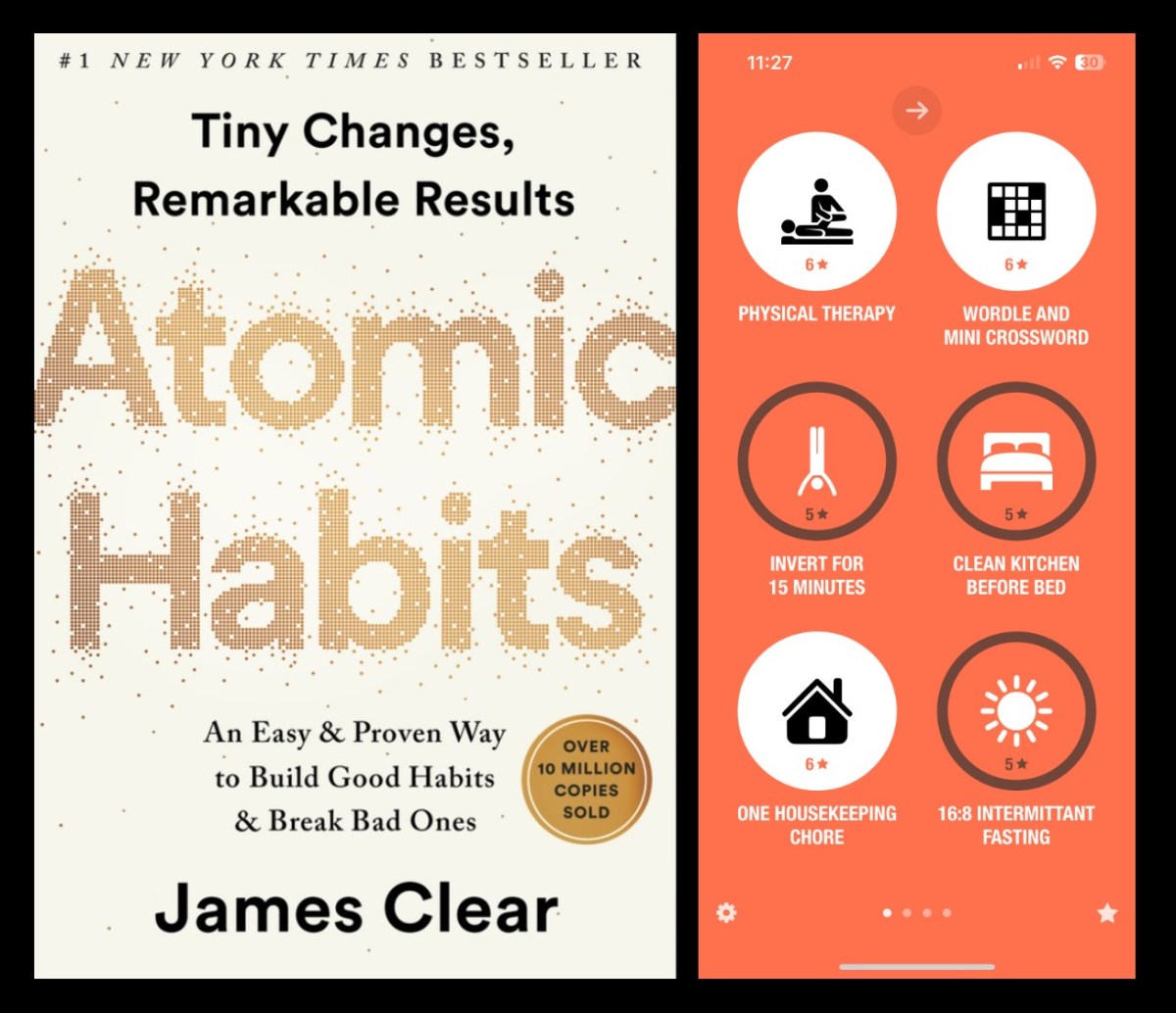
About ten days ago I bought Atomic Habits by James Clear and started reading it. It’s quite convincing about how to start good habits and phase out bad ones. I then decided I should track my habits and created a spreadsheet, but then a couple of days later a video about habit tracking apps showed up on my YouTube feed. I decided on one called Streaks for iOS; it was $4.99.
Streaks can track twenty-four daily habits. I decided to track six habits I’m already half-ass doing now:
- Physical therapy exercises
- Wordle/Mini crossword puzzles
- Invert for 15 minutes (with inversion table)
- One housekeeping chore
- 16:8 Intermittent fasting
- Clean kitchen before bed
After six days of practicing with these six habits I see how Streaks works. James Clear in Atomic Habits advises to focus on systems rather than goals. Instead of wanting to write a novel, make writing fiction daily a habit. And instead of aiming big, aim small instead. Clear says making tiny changes can lead to big results.
My starting six habits which I’ve been working on for years are mostly about mental and physical health. I haven’t always stuck with them, but I have learned, without a doubt, that if I do them every day, I feel better. Streaks has helped me stick with them better because keeping a streak going is challenging — like a little game. And I hate the idea of breaking the streak.
It’s time now to pick something I want to do but I haven’t gotten a half-ass habit going already. I don’t want to be too ambitious. Failing at New Year’s resolutions has always been demoralizing. I need another win to bolster my momentum. Yet, it needs to exercise my new habit muscle.
My life-long fantasy to write fiction is an obvious choice, but I think it might be the wrong time. I’ve always failed at fiction writing before, so I don’t want to fail at it again, and possibly ruin my efforts at forming atomic habits. I need a new habit that is both small but bigger.
However, selecting a new habit that will lead to achieving a cherished goal is an enticing thought. Isn’t that why I’m pursuing this habit system? Here are some things I wish I were doing in retirement:
- learn Python and make programming a hobby
- study math as a hobby
- learn to draw illustrations like I see in 19th century science journals
- learn Obsidian and use it with Readwise to create a second brain for remembering what I read and want to write
- read one lengthy article a day and write about it
- write short stories
These are all things I wish I worked on a little bit each day. I could add all six to Streaks with the self-imposed rule of doing each for a minimum of fifteen minutes a day. That would only be ninety minutes of activity, less than watching one movie. But Atomic Habits claims building one habit will strengthen other habits. So maybe, it’s better that I add one at a time.
Items 4 and 5 go well together, and would aid things when I go for item 6, but how would I structure it into a daily habit? Reading a long-form article can take an hour or two, and taking notes for Obsidian could be another hour or two. Writing about what I learn could take another three or four hours.
Streaks does track weekly habits, but I’m not ready to try one of those yet. Studying math on Khan Academy, practice drawing with You Can Draw in 30 Days by Mark Kistler, or writing 500 words on a short story is habits much better suited for finishing up in 15-30 minutes.
I don’t know if this is cheating, but it occurs to me that I should try doing each of these activities daily without adding them to Streaks and then see which one I stick to the most. Then add it to the habit tracker. (Don’t place a bet unless I think it’s a sure thing.)
This is psychological revealing. Could this be what I do all the time? I don’t try to create habits because I don’t want to fail at them. All six of the habits I’ve created already on Streaks are ones I need to do or I’ll feel bad. Feeling bad is a great incentive — I’m highly motivated to avoid pain and suffering. And those six habits were ones I was mostly doing anyway.
I’m a laid back lazy guy that dislikes obligations. Creating a habit is taking on an obligation. I guess successful people who get a lot done either don’t mind obligating themselves, or thrive on it.
Fantasizing about being a different person is one thing, but actually becoming a different person is WORK. (You should voice that like Maynard G. Krebs did in The Many Loves of Dobie Gillis television series.)
JWH




 Auxiliary Memory