The Barbarians at the Liberal Gates

Republicans have dug in their heels and swear they’ll die before they allow any new taxes.  What does this mean?  I think they have two main motives:  greed and the destruction of liberal ideals.  This is no big news, but what does it mean really?  Republicans have fixated on lowering taxes for decades and I think this is mainly due to ordinary old greed, but they have come up with so many justifications to achieve this goal, that they have developed an anti-liberal philosophy to promote tax cuts.

They think big government is taking their money, and so they’ve developed a philosophy against big government.  But what does having a big government mean?  Or more precisely, what does having a small government mean?

Civilization has always meant bigger and bigger government.  All throughout history whenever a civilization would develop barbarians would come along and attack it because it was an easy source of booty.  Protecting civilization began the ever spiraling costs to support big government and big military.  There are two kinds of people in this world, those who want to build civilizations and those who want to tear it down.  Civilizations take a lot of money to create and run, and history shows there are essentially two sources of wealth to run a civilization, taxes or conquering other civilizations, which is essentially a non-citizen tax if you will.  Europe flowered during the Renaissance by taxing the natives of the Americas, Africa, Middle East and Asia, as well as the heavy burden of taxes they imposed on their own citizens.

Like it or not, great civilizations cost a lot of money.  During the course of the last five hundred years we also saw the growth of liberal ideas.  It’s no longer socially acceptable to attack a primitive society and steal their wealth to build your own society.  Either through colonists, armies or corporations.  And the history of corporations are really the history of private business plundering the resources of other nations through price speculation.

However, things have changed.  The nations of the Earth are no longer in flux and national stabilization has set in, and corporations are no longer tied to specific countries, but work worldwide.  This means vast booms of generating wealth through exploiting other people is tapering off.  Nations are having to compete as equals, and the wealth of governments depend more and more on internal taxes based on economic productivity of their citizens.

In other words, if the United States wants to be the leading civilization of the world, the cost of that civilization is on the backs of its taxpayers.   Our military might will wane as the world stabilizes.  So will our influence.  So what will make us the great nation we believe we are?  As all nations become more capitalistic, we’ll no longer be the richest.  For the longest time, we were great because we championed freedom and democracy, and liberal ideals – but they are spreading worldwide too.

So what kind of nation will we be if the Republicans get their way and cut social programs and other spending, and reduce the size of the federal government?  I can’t help but believe we’ll be more like India or Egypt than Germany, Japan, England, South Korea or France.  We’ll have a democracy with lots of poor people.  We’ll have lots of beggars, criminals and lower class people, a small middle class, and a few very wealthy people that stand out in stark contrast.

We won’t have the arts, science, and infrastructure of a #1 nation, and instead start developing the look of a decaying empire.

The greed of the wealthy to avoid taxes will lead to a downward spiral of employed people, or people who look and act employed because of social programs.  Social Security and Medicare allow millions of Americans to contribute to economic activity as if they were employed.  We already have more young well trained people wanting work than we have jobs, so to throw millions of older, well experienced people to compete with them will ruin the job market and raise unemployment to new high levels.  Employment levels have always been an illusion in our country.  Unemployment is high now because we can’t maintain the fevered economic activity of unnatural economic booms. 

We can only get to 5% unemployment when the economy is booming and support big social programs.  If we cut out social programs and followed a balanced-budget economy we’d probably have 25% unemployed, if we were lucky.  Some economists are saying we already have a real unemployment rate of 15% or higher now. 

If we pursued a totally efficient economy we’d probably put half the workers out of work.  Just think what a flat tax rate would do to bookkeepers, accounts, tax advisers, and other bean counters.  Just imagine our society if no one used a credit card, or if everyone spent money like economic advisers advise.  A large part of our economy is based on inefficiency, buying things we don’t need, social programs, crime, crazy unsafe business schemes and stupid unproductive speculation.

Liberal ideals have progressed until they believe that all people, regardless of gender, race, creed or sexual orientation deserve equality and a minimal standard of living and medical care.   Pursuing those ideals has created an ever growing segment of our economic activity.  Reversing those ideals will destroy our economy.

Just watch the news to see how all over the country governmental services are being cut back.  This is the dismantlization of our civilization.  The barbarians are at the gates looking to sack our civilization.  And all of this just to save a few bucks on their taxes.

Barbarians have always wanted wealth for themselves.  Civilized people have always wanted to share the wealth.

JWH – 7/9/11   
The Tree of Life (2011)–Grace versus Nature

Terrence Malick’s new film, The Tree of Life is quite polarizing for its audiences.  NPR is even reporting that a small percentage of viewers walk out on the film and some of those ask for their money back.  Now I’ve walked out on a number of films over the decades and I can understand many reasons for not wanting to finish a movie.  There is no way to know why people leave before The Tree of Life is over, but I wonder if any do for philosophical reasons.  This is a philosophical movie, but I also found it immensely entertaining, beautiful to watch, and never boring.  This is one of the most ambitious films I’ve ever seen.  It makes me think of Erich von Stroheim’s Greed.  Another film about naturalism.

The Tree of Life attempts to answer one of the most difficult spiritual questions in philosophy:  Why do bad things happen to good people.  The film begins by telling us that life is a battle between grace and nature.  Throughout the film we hear the character pray to God asking for guidance, forgiveness,  understanding and meaning, and when a son and brother dies, his parents and siblings suffer greatly, partly at the loss, but mostly for not understanding why.

The film quotes The Book of Job, and has a scene where a pastor gives a excellent sermon on Job.  Job is one of the most complex stories in the Bible.  Many of the faithful have given up belief in God trying to understand “Why do the righteous suffer?”

I do not live by faith, but I like the word grace.  Terrence Malick shows the history of the universe in this film, making a good case for evolution is part of reality.  The faithful believe we are here by the grace of God, but I believe we are here by the grace of evolution.  Our universe is immense in size and ancient in age, and our lives are a miracle of unintentional consequences.  I think the word grace applies to that too.  I also believe the most sophisticated of spiritual philosophers accept evolution and incorporate it into their philosophy.

The difference between the faithful and those who accept evolution is life after death.  The faithful want to believe that no matter how much suffering we experience in this life, it will be soothed by the life we get after this one.  And Malick shows that in The Tree of Life.  I’ve wondered if some of the people who have walked out on this picture was because they thought Malick was selling evolution.  If they did, they should have stayed.  Malick sticks with faith all the way through, although it’s subtle, leaving room for some atheists to interpret the film differently.  All great fiction is ambiguous, so it’s unfair to suggest my views as the only views of this story.

Here’s the thing, for most of the faithful, suffering can only be made sensible if there is life after death, either through rewards or punishment.  To those who side with nature, suffering is just part of life.  There is no philosophical problem for atheists, because we don’t believe God is making us suffer.  The hardest thing for the faithful to endure is to believe that God is making them suffer.  Thus the story of Job.

The evolution of liberal thought is one that fights suffering directly by trying to make living in this life better for all.  Malick doesn’t go there at all.  This is a deeply spiritual movie in the sense that it is totally metaphysical.  Striving to do better is shown to cause suffering as illustrated by the role of the father played by Brad Pitt.

This movie is not for people who want escapism.  I’m not sure this movie is even for young people.  Terrence Malick was born in 1943, he’s not a baby boomer, but like Bob Dylan, The Beatles and The Rolling Stones, he’s of the generation that speaks to the baby boomers.  I’d say anyone who grew up in the 1950s America should watch this film if they have a philosophical bent, it’s a film about and for us.

This trailer will give a hint at what The Tree of Life is like, but only the slightest of one.

This rather enigmatic web site gives more scenes from the movie, but you need a lot of patience to try out all the rather short clips.  Go see the film for the full cinematic rollercoaster ride.

JWH – 7/4/11

The Ten-Cent Plague by David Hajdu

I am not a comic book reader but I found this history of the comic book industry on trial in the 1950s to be a fascinating story.  The Ten-Cent Plague: The Great Comic Book Scare and How It Changed America by David Hajdu covers the origins of the comic strip, the appearance of the comic book in the 1930s, and its creative heyday in the 1940s and early 1950s, and then focuses on how some Americans got scared and eventually brought about book burning, censorship and laws against publishing comic books.  The mid 1950s was a long time ago, and I was just a kid, so I don’t remember these events.  But the comic book scare coincided with the red scare, the Joe McCarthy witch hunts.  Comic books lead to another kind of scare, not over communists, but the fear of juvenile delinquents and the corruption of the young.

Most of the focus of the 1950s comic book scare was on true crime comics and horror comics.  Today when comic book conventions are covered on Entertainment Tonight, showing famous celebrities in attendance, and many of the top grossing movies are based on comic books, it’s hard to think about a time when comic books would scare Americans into having book burning rallies.

The irony here is everything that the censors hated about comics is standard fare on prime time TV today.  The censors did not want children seeing stories about crime and criminals, or reading about vampires, ghouls, zombies, werewolves, and their undead kin.  Nor did they like stories about young women running off with the bad boy types, or leaving their husbands to find exciting careers.  Parents, congressmen and censors feared that comics were undermining the status quo.  Comic books were outlawed just as rock and roll hit the scene, and then came the beatniks, hippies and all the other counter culture bellwethers.

If we could take our present day pop culture back to the 1940s and 1950s it would blow the minds of Andy Hardy/Leave it to Beaver America, and the fear mongers back then would think they had been absolutely right about censoring the comics.  They censored comics and made kids read Casper the Friendly Ghost, but it didn’t stop the cultural upheaval they feared.  Does censorship ever work?

To get some idea about the censorship of this time, watch David Hajdu talk about the last comic book EC Comics published:

The surprising element of this story for me was how much this era was loved by the comic readers of the time.  They considered the advent of censorship as the destruction of a great art form.  To be honest, I never really liked comics, but then I never read any from the golden age that the The Ten-Cent Plague chronicles.  Comics to me always equaled stories about super heroes, but before the great censorship there were hundreds of titles about endless topics, that sold in the tens of millions each month.  But this was also before the success of television.  And Hajdu doesn’t mention that the pulp magazine was also dying at this same time even without censorship.  Evidently the boob tube put the kibosh on pulp fiction, both written and graphic.

A lot of things changed in the 1950s.  Radio stories died out, and so did Saturday afternoon serials.  Culture went through tremendous change in the 1950s, as witnessed by Bill Bryson in The Life and Times of the Thunderbolt Kid, which I read about a month ago for the second time.  I do have tremendous nostalgia for that time, and even though I dislike crime and horror stories in general, Hajdu makes me want to read those pre-Code comics.  I guess I sympathize with that comic culture because I love pre-Code Hollywood movies from the early 1930s.

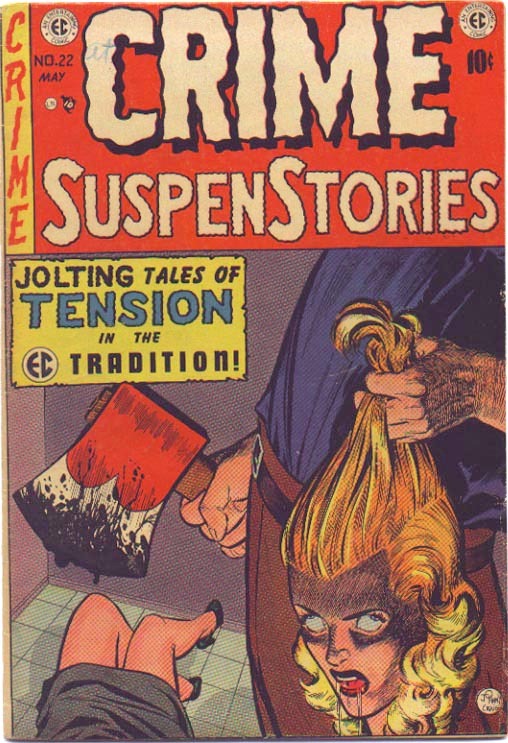
I listened to The Ten-Cent Plague, so I had no idea what these comics looked like.  I’m not even sure if the hardcover book had photos.  However, the comic book history is well documented on the web.  Here is the cover used in a senate hearing described in the book.  William Gaines, the publisher of EC Comics was asked by Senator Estes Kefauver if he thought this cover was in good taste, and Gaines shocked everyone by saying he did think it was in good taste.  I do have to wonder about this being reading material for children though, but then people wonder the same thing about kids and video games.  Gaines said this cover was in good taste because the artist didn’t show the severed neck on the head or body.  Since they do show those parts now in movies, I guess our movies are in bad taste.

crime_suspenstories22

I found this cover and many others at Classic Crime & Horror Covers.  That site linked me to Crimeboss, with an extensive collection of covers.  I wanted to see what the interiors looked like and found The Horror of it All.  I quickly discovered that the history of comics, and especially the pre-code era, is well documented on the internet.  Comic books are a sub-culture I know little of, and would probably be satisfied with reading one good coffee table book about its history to catch up.  The sub-culture is gigantic, and I wonder what Fredric Wertham, the author of  Seduction of the Innocent, and his disciples would make of the huge success comics have in our society today.

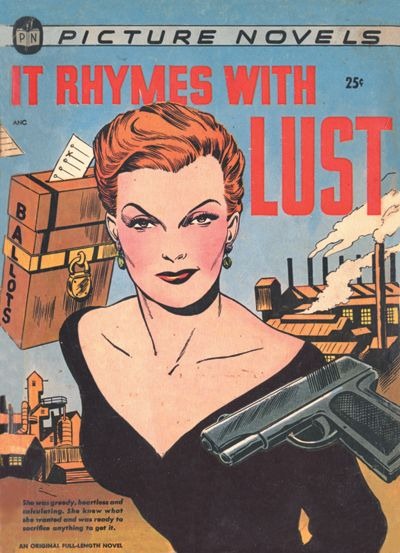
I’m an outsider to the fandom of comics, and I have little interest in reading comics.  I don’t mean to put them down, but they are like opera or ballet or polka music, I just never got into them.  However, there was one story Hajdu told about that I might seek out – It Rhymes with Lust, a comic book that some consider the first graphic novel.

ItRhymesWithLust

From what I can tell, the story is probably like a movie Joan Crawford or Barbara Stanwyck would have been in the 1940s, so why all the fuss?  Were ten year old kids really reading these film noir comic books?  And if comics were so pervasive in society in the 1940s and 1950s, why don’t we see characters in the movies from those times reading them?  From David Hajdu’s account, the history of the comics and their downfall was obviously more than a tempest in a teapot because many states and cities took the time to criminalize the sale of comics, and schools and PTA groups took the time to buy thousand and thousands of comics so they could burn them in PR events.  Evidently millions of people were buying comics then, so why hasn’t literature or film from those times featured stories about the sub-culture?  There were many films about early rock and roll fans, or jazz fans before that.

I found The Ten-Cent Plague a fascinating story, but I’d like to know more.  I wonder if my father or his brothers read the pre-code comics?  They never talked about them.  Except for these rare histories of the era, I wouldn’t have known these types of comic books even existed.  When the comics were banned many of the artists and writers had to hide their love of their art because they were treated like child molesters.  Is that why this sub-culture was so thoroughly forgotten?  Did America hate comics that much?

By the way, the 1988 documentary Comic Book Confidential makes a great visual supplement to The Ten-Cent Plague because they interview many of the people profiled in the book, and show some of the same court films that Hajdu described. Plus the documentary continues the history of comics after the code was enforced, which is where the book ends.  This film is available at Netflix and segments from it are at YouTube.

JWH – 6/23/11

Fans Wanted!

We live in a world where fans are in high demand.  There is so much neglected art that needs to be discovered, and your duty as a fan is to discover new work and share it.  It’s how social networking works.

I was looking at the new album releases in Rdio and I noticed that many of the albums had not been listened to all all.  They had 0 plays, and thus no fans.  That made me feel sad for those artists.  Lady Gaga has legions of fans, and I’m not saying she doesn’t deserve her fans, but I think some of her devoted following should spend some of their time listening to new artists who have none.  Consider it a form of artistic charity.  It takes so little to become a patron of the arts, just love and attention.

It’s amazing how many new albums come out every week.  And if you subscribe to a subscription music service you can listen to them all for just $4.99 a month.  So, it would cost you almost nothing to be generous and play a few albums that are going without listeners.  We are all too addicted to success.  We want to hear the top albums of the week – but what if some of those CDs that never make it even to the bottom of a chart have good tunes on them?  Don’t they deserve to be heard?

And think about all those selfish baby boomers who play the same old hits from the sixties over and over again.  Wouldn’t they benefit from hearing something new?  So I say to you, become a fan of some up-and-coming band or singer.  I’m listening to Costello Music by The Fratellis who’ve gotten 11,664 plays on Rdio.  They really don’t seem all that different from a British Invasion band in the 60s.  But eleven thousand plays means they have a lot of fans.  There are 50+ pages of new CDs on Rdio and most of them have no plays at all.

It used to be you had to buy albums to become a fan, but that’s no longer true.  For $4.99 a month you can listen to dozens of new albums every week from one of many subscription music services.  And you might be surprised by the rewards of becoming a fan and discovering a new group.  I’m listening to The Naked and Famous new album, Passive Me, Aggressive You, and it makes me feel young again.  It has a wonderful 80s pop feel to it, so it’s both nostalgic and energetic.  It’s more popular than the last album, with 132,155 plays.  They are famous by Rdio standards, but they should become more famous.

I’m now listening to a very nice song now, “One Hand Loves the Other” by Bodies of Water off of Twist Again.  It reminds me of Judy Collins.  It’s only had 256 listeners.  It deserves way more fans than that.  As I page through the new releases I find albums with fewer and fewer listeners.  Natalie Walker only has 113 for her album Spark.  If you’re an old fart baby boomer and don’t like modern pop like Lady Gaga you might find Walker worthy of your fan attention.

With little effort I found three very enjoyable albums tonight by people I never heard before.  In the old days of CDs that would have cost me $45-55, but it’s just part of my $4.99 monthly fee on Rdio.  I figure if I’m going to get such a bargain I have to do my part and try several new CDs every week and help promote new artists.  Because Rdio is built around social networking, playing an album encourages other people to play it too.  Playing a song produces ripples.  If I play an album enough other people in my network will see it and maybe give it a try too.  And then people in their network will see them playing, and hopefully we help the artist find more fans.

I like myself better when I’m discovering new music.  I still love my old favorites songs that I’ve been playing for almost fifty years, but I don’t want to be trapped in my past.  Finding new music makes me feel younger.  I know I’m not, but my mind feels younger as long as I’m still discover new art.  There are rewards to be a new music fan.

JWH – 6/21/11

Can a New Science Fiction Inspire a New Space Program?

Many people firmly believe that science fiction was the original inspiration for sending men into space and going to the Moon.  I don’t know if that could ever be proven, but there’s a certain logic in thinking dreams come even before the horse or the cart.

The space program has lost its way.  The Shuttles are being mothballed, and we’ve never left LEO for four decades now.  If we’re honest, we’ll admit it was the cold war politics that got us to spend billions on NASA, and  I’m afraid real science has made space a far less appealing destination than the fanciful vistas of old pulp fiction.  Robotic probes have toured the solar system and we have a very realistic view of off Earth real estate, and the sites are far from the exotic locales described by our cherished space opera.

Yet, I have to ask:  Can a new kind of realistic science fiction, incorporating the latest scientific knowledge about space, make the final frontier sexy again?  I remember talking many years ago with a young woman about space exploration.  She said unless we had spaceships like the Enterprise in Star Trek: The  Next Generation then it wasn’t worth traveling in space.  I have a feeling most people think that too. 

I told her it was unlikely we’d ever have spaceships like NCC-1701-D and she acted like I had told her there was no Santa Claus.  She had assumed such luxury space travel would be available soon, or at least well within her lifetime.  Her attitude was, if we can’t travel in comfort, why go into space at all.

And there’s the rub.  The final frontier will be rougher than any frontier a pioneer has experienced in the history of our species.  Science fiction originally sold space exploration as an colorful adventure vacation.  Now we know it’s going to be more like years of reconstructive surgery and physical rehabilitation with little hope of full recovery.

There are only two destinations for people in our solar system: the Moon and Mars.  Forget the satellites of Jupiter and Saturn, they are much too cold and those systems have tremendous radiation levels.  The Moon and Mars are far from habitable, but with determination we might colonize them.  But we can’t oversell those two worlds like Kim Stanley Robinson did in his Red, Green, Blue Mars series.  That trilogy was among the best “realistic” science fiction in recent decades, but it had way too much fantasy for the kind of science fiction I’m suggesting here.

Can a new generation of science fiction writers envision practical human life on the Moon and Mars in such a way as to sell the idea to the tax paying public?  So far a majority of the public refuse to believe in evolution, so I find it hard to imagine such scientific science fiction selling, but it’s still a possibility.

JWH – 6/21/11