
by James Wallace Harris, Thursday, April 27, 2017
Last night on the PBS Newshour Judy Woodruff interviewed Mick Mulvaney, Donald Trump’s Director of the Office of Management and Budget. When Woodruff pointed out that Reagan’s tax cuts didn’t lead to big economic growth Mulvaney looks at Woodruff and pauses. In that moment we see why we’re politically divided. Mulvaney stares at Woodruff as if she had just said the world was flat. Then Mulvaney says she was wrong and quotes figures about GDP growth. Woodruff doesn’t press the point and goes on to other questions.
Who is right? Both views can’t be right. Did Reagan’s tax cuts help the economy or not? Is it a matter of seeing two sides of a coin? Didn’t Reagan’s tax cuts have countless impacts and each side is now using figures from specific impacts to support their political beliefs? Can any one indicator predict future complexity?
Our reality is infinitely complex. The economy is not that complex, but the number of variables is so great that it’s hard to grasp. Liberals are focused on social equality, conservatives are focused on the freedom to get ahead. They each use evidence to support their beliefs assuming reality works the way they want to see it.
For us to ever solve our political polarization problem will require both sides studying the evidence in new ways. Think of understanding the economy like a science experiment. Any scientific journal that ran studies by current liberals and conservatives would be deemed biased. You can’t go into an experiment looking for an outcome. You can’t cherry pick the results to meet your hypothesis. But that’s what polarized politics does all the time.
If you watch the video closely, you can see that Mulvaney’s conviction that the tax cuts will work is equal to any pope’s conviction that God exists. He’s also confident that GDP growth will pay for the tax cuts in the same way liberals are convinced they will only grow the budget deficit.
Basically, conservatives will embrace what Mulvaney says, while liberals will question it. Is there any evidence to support or deny his claims? This is where it gets hard. One of Mulvaney’s basic assertion is we want a 3% GDP growth rate, and under Obama that never happened. Here’s an article from CBS News that supports his claim. That article included this graph:

And if you look at GDP growth rate after 1982 when Reagan’s tax cuts took effect, GDP growth rates did eventually grow above the 3% rate. The Reagan-Bush era ran from 1/81 through 1/93, and before it was over growth rates had fallen below 3%. We had 3% plus growth rates under Clinton, and briefly under the second Bush administration. Isn’t this evidence that growth rates aren’t tied to taxes?
But can you explain the economy with such simple numbers? I’m not trying to explain economics here, I’m trying to explain belief systems. We all suffer the Dunning-Kruger effect when it comes to economics, even economists with PhDs. The above chart might have been all Mick Mulvaney needed to support his faith in tax cuts. But it’s not enough.
Look at these charts that break down GDP in various ways. Instead of looking at one number, overall growth rates, we’re looking at several numbers. And this approach is still incredibly simple. To really understand the problem we need to be an economist working with several supercomputers analyzing trillions of numbers.


Source: http://www.thoughtofferings.com/2010/08/real-gdp-growth-in-us-and-japan-closer.html
Here’s a comparison to world GDP, which shows GDP growth is related to world GDP growth. In other words, there are many outside factors we have to consider.
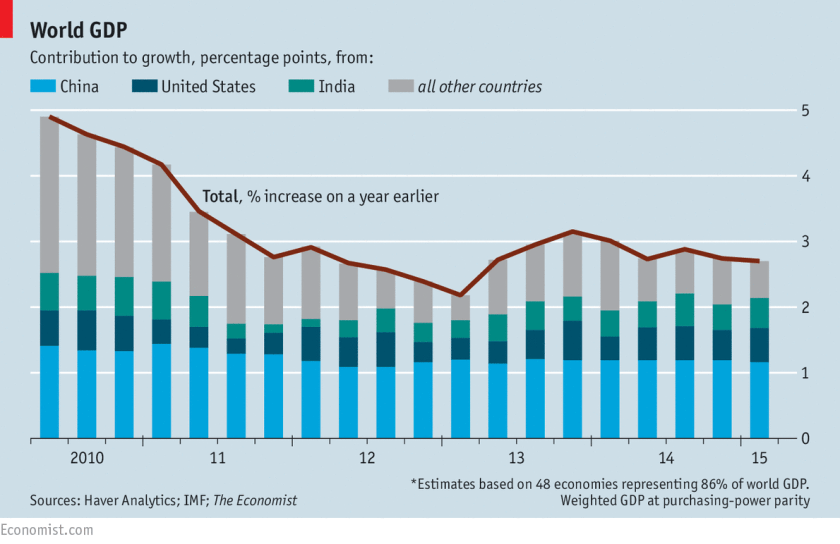
Source: http://www.economist.com/news/economic-and-financial-indicators/21654018-world-gdp
This is enough charts to make my point that the issue is more complex than one number. Mulvaney has an undergraduate degree in international economics, but his graduate degree is in law. Then he became a politician. I don’t think he can know what the tax cuts will do. But then, neither will liberal politicians. We’re literally gambling.
I would have trusted Mulvaney more if he had presented 20 factors and charts to make his case. But how many citizens want to sit through such a presentation?
If the average citizen tried to understand the economic evidence they would be quickly overwhelmed. When Mulvaney replies “That’s not true,” when Judy Woodruff tells him the Reagan tax cuts didn’t work I believe he believes that. But I don’t think he knows. I’m not sure anyone knows.
Watch the above video closely. Is it ever about facts and evidence? Isn’t it about one ideology versus another? We tweak the economy every new administration, but how much does that really do? Isn’t the economy really a pinball machine with a quadrillion balls and bumpers? Aren’t major changes dangerous?
I’m tired of meaningless evidence. We need AI minds and armies of supercomputers to analyze the economy. I might trust them, but I don’t think I can trust humans anymore. I can’t even trust my own beliefs. I don’t think humans are smart enough. I’m quite confident that conservatives are wrong, but I can’t prove it. And I’m tired of people with absolute faith in their superiority running the country. Such vain egotism is scary.
What divides us politically is how we react to what we think we know, even though we don’t.
JWH






 Auxiliary Memory
.png)