All the Birds in the Sky by Charlie Jane Anders

by James Wallace Harris, Tuesday, May 9, 2017 (reprinted from SF Signal)

[Because All the Birds in the Sky is up for a Hugo award I thought I’d reprint my review from last year.]

“Too late, too late” the birds chorused.

Our futures are different in every generation. Back in 1966, my generation, the Baby Boomers, feared nuclear annihilation, hoped for colonies on Mars among other dreams, but nothing was certain, and we were surprised by the Internet and the Hubble Telescope. In 2016, I am concerned for the current generation, because their futures of climate catastrophe and mass extinctions do seem inevitable. How do young science fiction readers find hope in their futures? And what unexpected amazements awaits them?

Is science fiction ever about the future? Isn’t it always about the present? Science fiction represents the hopes and anxieties of each generation about their future. Science fiction set in the far future, like stories about interstellar travel, represents a kind of extreme optimism, whereas science fiction set in a middling distance of interplanetary travel, represents another kind of hope, a hope that we can build that future today if we only would. Science fiction set in the near future, often explores our fears more than our dreams. Writing near future SF requires juggling the hard cold facts of today against dreams for better tomorrows. Science fiction is each generation’s barometer measuring its faith in their futures.
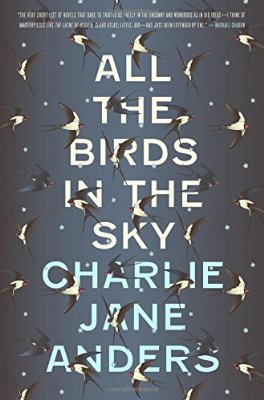
All the Birds in the Sky by Charlie Jane AndersAll the Birds in the Sky by Charlie Jane Anders walks the razor’s edge of a very near future science fiction, confronting the obvious dooms while still offering hopes. Anders impressed me with her faith in our future. She accomplishes her task with a light touch, producing a novel that is a joy to read, yet is as deep as you’re willing to dig. I expect many to speed along in this story because of its shiny science fiction bits, but those who read slower, analyzing its fantasy and literary symbolism will find deeper concerns to contemplate.

At the surface of this novel is a love story between Patricia Delfine and Laurence Armstead that begins in their troubled childhood. Patricia survives by discovering the old religion of magic, while Laurence endures by mastering technology and science. They cope emotionally by sharing their misery, until outside forces split them up. Years later they rediscover one another only to find they have taken radically divergent philosophical paths. Their beginning reminds me a of Among Others by Jo Walton, and how children of genre find themselves by finding people like themselves.

All the Birds in the Sky is getting great reviews and buzz. How you read this book will determine how you label it, fantasy or science fiction, because the story apparently asks us to take sides. All the Birds in the Sky is a horse of many different colors, making it hard to categorize.

At first, I thought All the Birds in the Sky as three weddings: a marriage of science fiction and fantasy, a marriage of YA and adult, and a marriage of genre and literary. The novel makes us feel Cory Doctorow and J.K. Rowling should have tied the knot long ago. It also feels quite natural to bolt a YA section onto the beginning of a novel that’s meant for adults.

All the Birds in the Sky is a fast, fun read, but it’s about children being bullied by their parents and peers, who become adults during the climate apocalypse. How fun can that be? It is. The story does have talking animals and intelligent computers that are enchanting, and a serial killer assassin that feels like someone from The Grand Budapest Hotel, which for me was the only weird thing in the story that didn’t work (but I might change my mind in later readings).

Because All the Birds in the Sky is set in San Francisco, it makes me wonder if it’s a counter-culture novel too, but not the counter-cultures I knew, of Beatniks and Hippies, but Geek counter-culture from Silicon Valley startups and Maker subcultures. I also wonder if the novel isn’t a jab at Silicon Valley, who some San Franciscans believe is destroying their city. (Watch San Francisco 2.0 on HBO to see what I mean.)

All the Birds in the Sky are about two forces at war: magic and science. The novel begins with Patricia as a small child learning she can converse with birds. This is a very strange way to begin a science fiction novel, but Anders eventually makes it work for me. I totally get the Wired-Maker-SF side of this story because of my background. I just didn’t understand Patricia’s story at first, of talking animals, magic and secret covens of witches and wizards. I never played Dungeons and Dragons or read The Lord of the Rings. My only knowledge of magic comes from reading the Harry Potter books. The whole magic angle didn’t work for me until I reread some chapters. Then it clicked. I don’t believe Anders added magic to her story just to have a genre mashup, its integral to her message.

Good writers make their stories ambiguous, which allows readers to find their own meaning. However, that leaves us never knowing if we found the meaning, if there truly is one. But once I found a symbolic way to interpret the magic in All the Birds in the Sky, I was quite satisfied with this novel. I’d love to read how others interpreted the magic, but to do so in public would create spoilers.

I believe Anders is offering philosophical inspiration to young people. She knows they face grim futures. She wants young people to have faith they can solve the problems they’ve inherited. To understand how we must save ourselves is to understand how we must change ourselves. Any current science fiction written about the near future needs to involve ideas from books like This Changes Everything by Naomi Klein. Not only is mankind the cause of our future doom, but so are our intellectual approaches to politics, economics, sociology, spirituality, psychology and self-expression.

Climate change is such a large bump in the road to the future that I’m not sure science fiction can ignore it. Anders knows that. To stop climate change requires changing ourselves, and how we interact with reality. There will be no wizards or scientists that can work that kind of magic, but Anders does offer hope in her ending. At least in the way I’ve read her story. I wonder what younger readers make of it. Birds and animals do have a say in Anders’ novel. Has Anders read The Sixth Extinction by Elizabeth Kolbert? Not only is human society altering the biosphere and climate, but we’re killing off all our fellow species. If animals could talk, what would they say? My guess is Anders knows about such books, but doesn’t feel the need to weave their heaviness into her story. Both rising seas and dying animals are on the perimeters of her plot. The real conflict is between two people who love each other but embrace opposing philosophies. So the story becomes fantasy v. science fiction, but not really. Isn’t it nature v. science?

“Almost too late,” the pigeon said.

I Was Wrong

by James Wallace Harris, Monday, May 8, 2017

Yesterday I wrote, “Are Republicans the Party of Darwin?” accusing conservatives of applying their understanding of Darwin’s observations on nature to justify the laws they were creating. Their laws always seem to back the strong against the weak. But I had a revelation in the middle of the night.

Everyone acts on their instincts, and those instincts are Darwinian by nature. Duh! Darwin’s theory is the most widely accepted explanation for our behavior. I was crediting Republicans for consciously using Darwin’s ideas in the formulation of their political philosophy, and this is where I’m wrong. It wasn’t a conscious decision. My essay was based on the irony that conservatives profess to be Christians but enact laws that reflect Darwin’s theory rather than Jesus’ teachings.

heaven and earth

My point being there’s no compassion in nature or Darwin’s observations about how nature works, and there’s no compassion in the laws Republicans want to support. You’d think people who follow a personal philosophy based on compassion would enact compassionate laws. This conflict of action and belief troubles me and I keep trying to figure out what causes it.

My revelation last night is everyone acts Darwinianly, despite what they profess philosophically. I am an atheist, but I give Christianity credit for inventing many compassionate philosophical concepts. I attribute those ideas to Jesus like we attribute other philosophical ideas to Plato or Aristotle, but I’m not sure they came from the man we historical think of as Jesus. Many of the ideas were developed by his followers and attributed to him in the first few centuries after his death.

Organized compassion for the weak is a relatively new idea in history. Limited forms of compassion have been around in evolutionary terms for a very long time, even in plants and lower animals, but to develop a religion, philosophy, or political system to protect the weak wholesale is relatively new.

I just think it’s ironic that the political party that claims to be the most Christian reflects it least in their laws, and the party that folks general assume is least Christian reflects compassion the most in their laws.

Our political divide really comes down to how much we want to support the common welfare over the freedom of the individual. The more socialistic we are, the more we want everyone to contribute to improving society, the less socialistic we are, the more we want to give the maximum freedom to individuals and ignore the suffering of the masses. Such socialism counters Darwin’s observations on animal behavior.

Thus Christianity is inherently anti-Darwinian. For twenty centuries it seemed like Christianity was catching on, especially in the Western world. But that’s probably an illusion. What really caught on was a belief in life after death via easy salvation. The idea of heaven on Earth hasn’t.

In other words, conservatives are Darwinian on Earth, but Christian in their hopes about an afterlife. Which might explain why liberals are more socialistic. Many of them doubt the afterlife, and thus they’d want to create heaven on Earth. The conservatives are more pragmatically Darwinian, they want all they can get while living, and then assume things will magically go great after they die despite what they do while living. Liberals evidently feel this is all there is so we better make the best of it.

This is a huge problem for liberals. To get more people to vote for social welfare might require convincing people to think less about an afterlife. In other words, the concept of heaven has corrupted people’s attitude towards Earth. This might also explain climate change deniers. They might unconsciously realize to think more about Earth means to think less about an afterlife.

JWH


Are Republicans the Party of Darwin?

by James Wallace Harris, Sunday, May 7, 2017

As a lifelong atheist, I find most of my political convictions comes from the words printed in red in The New Testament. Shouldn’t unbelievers use Charles Darwin’s scientific insights to model how society should be governed? Yet, as I study Republicans, the party I oppose, I wonder why they act the way the do. I can only conclude they base their philosophy on the survival of the fittest.

Darwin-Jesus

I hate Republicans for not carrying about suffering, whether it’s the suffering of people, animals, plants, or the biosphere. If you study Darwin’s observations you realize that nature ignores suffering too. The Republicans work with all their might to create a political system that helps the strong while ignoring the weak. In fact, Republicans are the strong feeding off the weak. Yet, publically Republicans claim to be Christians. Shouldn’t a Christian political party promote the way of life Jesus taught? And wouldn’t that be anti-Darwinian?

If you study the Sermon on the Mount, you know it’s impossible for a Christian to own an AR-15. The meek will not be carrying Glocks when they inherited the Earth. Darwin’s red tooth and claw philosophy would embrace such weapons. Darwin would be pro-gun, but not Jesus. Yet, typically Republicans express a hatred for Darwin and a love of Christ.

The Democratic party which wants to feed the poor and heal the sick is labeled the Godless party. However, if the beliefs in The New Testament were converted into a political system it would be socialistic, and look much like the political goals of the DNC.

Is it possible to create a political system that reduces suffering while still encouraging all its citizens to become stronger? If Republicans were honest they’d admit they believe far more in Darwin than Christ. Yes, helping people can make them weak, but ignoring their suffering also makes you heartless.

Isn’t there some kind of compromise we could make? Can’t we start the competition for survival on an equal playing ground? Wealth inequality shows the competition isn’t equal like what Darwin saw in nature. Human intelligence allows us to multiply and horde our strengths, which is why we’re destroying all the other species, and why those humans on the receiving end of wealth inequality can so easily destroy those on the losing end.

Republicans appear to totally embrace Darwinism, including ignoring suffering. Democrats want to create a political system that eliminates some sufferings. I would think any political system that ethically allows for some members to become billionaires should allow for universal healthcare. How can any system that allows for some players to have everything and others nothing be Christian?

Isn’t Christianity about compassion? I can understand why conservatives embrace Darwinian actions. Republican ideals are very close to nature. And don’t Christian beliefs defy the natural? Isn’t The New Testament all about protecting the weak?

JWH

Aging, Changing, Technology, and Music

by James Wallace Harris, Wednesday, May 3, 2017

For someone whose childhood began in 1951, the year 2017 is the far fucking future. Sorry about the inappropriate word, but hey, that’s part of the relentless pace of change. We’re now allowed to use “bad words” in print.

I don’t think young people today can even imagine what a horrendous social offense it was to say fuck in the 1950s, much less write it down. If you could understand you might know what this essay is all about.

It Happened One Night

Last night I watch It Happened One Night with my friend Annie. I told her this 1934 picture was considered very risqué when it came out in 1934. After watching a while she asked why? By modern standards its so squeaky-clean it’s hard to spot the naughty bits. Even as a kid seeing it for the first time in the early 1960s, that old film still had its titillating parts. That changed after Midnight Cowboy.

I started listening to music in the 1950s on my father’s car radio when me and my sister could still stand in the front seat. This was before seat belts. It was his car and his music, but that’s how the times were back then.

For Christmas 1962 I got a AM clock radio. I played my music on that radio from 1962-1968. I turned it on when I got home from school and turned it off each morning when I left for school. I listened rock and roll while I slept, burning songs like “Rhythm of the Rain” into my unconscious mind. I grew up in Miami and loved WQAM and WFUN – the two competing AM Top 40 stations that played rock and roll.

My father had a second job bartending and would bring me and my sister 45rpm records that were pulled from the jukeboxes. In 1962 when I got the clock radio my sister had gotten a portable record player. I envied her that. (I might have stolen it.)

In 1963 an airman left his console stereo and LPs with my father was he was stationed overseas. That was my first introduction to LP albums. The airman left mostly folk music.

Our Man Flint soundtrack 

Eventually I got a little transistor radio to carry around. Then I got my own portable stereo record player when I started buying LPs in 1966. My first LP was the soundtrack to Our Man Flint. I would join the Columbia and Capital music clubs to mass collect albums. Joining, completing my fulfillments, quitting, and rejoining to keep getting those intro bundles.

When I started driving in 1967 I had a car radio. In 1968 I bought a console stereo system. It was my first use of credit, and I was only 16. The console introduced me to FM radio.

Just in the 1960s I went from AM to FM, and from mono to stereo. From tubes to solid state. In the 1970s I got a much larger console, started seriously collecting records, stopped listening to commercial radio, and eventually got into component stereo systems.

In the 1980s I switched to compact discs. I also tried different tape systems. As the decades past I used MP3 players and iPods, and even got into SACD audio for a while. For the last decade I’ve mostly been listening to subscription streaming music. I never got into Napster thievery. I guess I was too old fashioned to steal.

So in the course of half a century I went from listening to music on various physical media to listening to invisible streams of ones and zeros. In 1970 we were warned about Future Shock. Reading about what the future will do to us and living into the future are two different things. The future is both dazzling and tiring.

My point is the technology keeps changing. So does the music. So do the genres of music. I’ve bought some of my favorite albums many times, on LP, CD, cassette, SACD, and digital file (I was briefly into 24bit lossless).

The long playing (LP) record album came out in 1948, but it took a while to catch on. Because of streaming music, the concept of an album is fading. Not only have I outlived many technological changes, I’ve outlived an artistic concept.

And you know what? I’m tired. I’m fucking tired of change. I’m weary of the constant barrage of new technology. And I was a computer geek starting in 1971. Just read all those changes in computer tools I’ve used.

I’m happy with streaming music. Can’t we stick with it for a while? At least a quarter century, I hope. Give me 25 years and I’ll die on you, and the world can change as much and as fast as it wants after that.

ItsAMadPoster

JWH

621 Ways To Be Happier

by James Wallace Harris, Saturday, April 29, 2017

Each day, the Internet now offers me more lists on how-to-be-happier than funny-cat-videos. That’s ironic since funny-cat-videos make me happy.

In recent years it seems that “12 Ways To …” is the lowest common denominator of journalistic seduction, whether its for newspaper, magazine, webpage, blog, or social networking readers. Evidently the quickest way to grab someone’s attention is to entice them with a list.

Life is Good

I wish I had a computer program that would collect advice lists on various topics and statistically analyze them for the most popular pieces of wisdom. Then I could ignore this whole category of journalism. I’ve theorized that if I stopped reading about Donald Trump and self-improvement lists I’d have time to read two quality novels each week instead.

How many people actually follow self-improvement advice? And if we did, would that advice work? I use a program called Instapaper to track what I read online and have collected 35 essays with 621 pieces of advice. It’s fascinating how many recommendations overlap. You’d think everyone would be 100% happy by now, and very productive.

I’m naturally a happy person, but I have several friends that suffer from depression. I sometimes forward these articles, but I’m not sure if they are helpful. Can willpower overcome genes and hormones? As I read more of them I realized some of the advice did apply to me. I never feel depressed, but I do feel regrets. Emotionally, I’m as happy as a drooling pug reading, writing, listening to music and watching TV. However, I have lingering regrets about not doing more. That’s why I tell people I’m a Puritanical Atheist – I feel guilty if I don’t spend a portion of each day accomplishing something, no matter how small.

Many of these lists appear to equate success, productivity, and creativity with happiness. I’ve often thought my natural state of contentedness keeps me from working harder at my ambitions. So I started reading these lists for tips on improving my productivity. I assume I’d be happier if I got more done, and regret less about not finishing all the projects I fantasize about doing. However, some advice is geared towards unhappy productive people. They are told to relax and do less. That makes me wonder if I did more would I be unhappier?

I could have gathered lists for any area of self-help that I wanted. Such lists are overly abundant on the net. I wonder when the trend will collapse? At some point I think everyone will get tired reading about Donald Trump and numbered advice lists.

I realize that by gathering this meta-list of lists I’m only playing into the trend. Gotcha! Well, I hope you find some good advice. My takeaway is I need to go to sleep earlier, get up earlier, focus, avoid distractions, and reduce my goals to as few as possible. I’m not sure, but I did’t Benjamin Franklin make that list over 200 years ago?

The Wisdom of Happiness

JWH