Spring Cleaning Fever

by James Wallace Harris, 3/24/25

I woke up at 3:02am thinking about all the things I wanted to throw away. I’m only a moderately tidy person. For most of my life I let cleaning slide until I’m expecting company forcing me to clean up. But as I’ve gotten older I’m slowly becoming more anxious over disorder. For years I’ve tried to put everything in its place, but only after a certain amount of things have gotten out of place. Aging has caused that trigger number to grow smaller.

Something is possessing me. Since last September I’ve become obsessed over how untidy the yard has gotten. I spend an hour a day collecting leaves, limbs, logs, brush, rocks, and yard junk, puttig it out by the street. The pile grows and grows for weeks until the city comes by with a huge truck and giant claw carry it away. This photo is one fourth of my last pile.

My current pile is still small. I’ve got most of the big stuff cut down. I’m down to a thousand square feet of weeds I need to pull or dig up. But I’ve also unearthed an old brick floor of a greenhouse that’s been torn down and an old patio made from paving stones that I will need to dig up. Also, I’ve left the yard full of stumps that I need to dig up or have ground down.

Since I started all this yardwork I’ve begun dreaming of the day when I’ll have everything in the yard cleaned off and I can start designing the new yard. It’s caused me to develop a compulsion about clutter that’s now infecting how I feel when I’m in the house. I fantasize about getting a white fence to enclose the backyard. I crave a simple uncluttered landscape. That fantasy is now affecting how I feel about the house too. I want to declutter inside and make our decor a soothing simplicity. Of course, I have no landscaping or decorating skills, and neither does Susan. It’s just an urge that gnaws at me.

I feel like I’m becoming unhinged – like a character in a Philip K. Dick novel. In Do Androids Dream of Electric Sheep? one character describes Kipple to another:

Mother nature makes Kipple in the yard, Susan and I make Kipple in the house. If you ignore it, it reproduces, and we’ve ignored it for far too long. It’s time to battle the Kipple.

Last night during my period of insomnia I thought about all the Kipple I wanted to attack. I thought of all the ancient underwear in my chest of drawers that need to be thrown away, all the original boxes I’ve been saving in closets in case I need to ship something back that need to go into the recycle bin, all the old medicines that clog up the cabinet, all the machines I no longer use, the books I’ll never read, the bottles of cleaners that haven’t been used to clean anything this century, the clothes that have been on the same hanger for decades, and I realize I’ve got a case of spring cleaning fever.

But then I think about my computer and all my hard drives and the tens of thousands of files that clutter up my life. And all those photos on my iPhone that I never want to see again, and my bulging file drawers with paperwork that goes back forty-seven years of marriage.

Once you start thinking about clutter you see it everywhere. I think about that old joke about a guy who bought a new car whenever the ashtray got full. I fantasize about moving to a 55+ community and leaving all my Kipple behind.

Is this anxious state of mind caused by aging? I didn’t worry about an overgrown yard or a cluttered house when I was younger. Did I cause this when I decided to work in the yard? Does wanting to create order in one location cause you to want to create order everywhere? Susan is quite comfortable with clutter, so why am I so uptight about it lately?

Maybe my problem is psychological. Because the country is going down the drain and I can’t do anything about it, I’m compensating by trying to control a smaller territory, one within my power? That means aging wouldn’t be a factor. But then is that happening with everyone else? Do big crazy chaotic times inspire people to organize their little lives?

I don’t know what’s happening other than I get up every morning with an urge to throw things away. But there’s always so much more to throw away.

JWH

I’ve Been Craving the Kind of Great Science Fiction I Discovered When I Was Twelve and Thirteen

by James Wallace Harris, 3/17/25

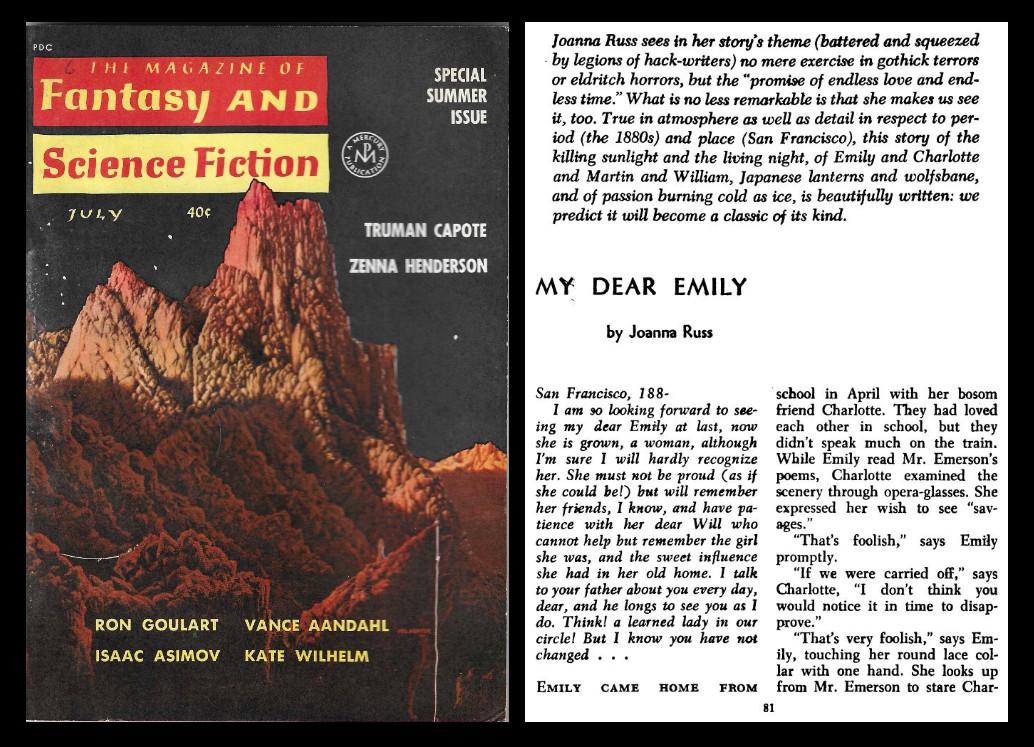
When I get sick, or I’m bummed out over politics or economics, I get the urge to read a type of science fiction I discovered when I was twelve and thirteen (1964-1965). This isn’t nostalgia, but a proven method of stress reduction. We all have our own forms of escapism, mine is a kind of science fiction originally published in the 1950s. Old science fiction is my comfort reading.

When I was twelve, my main sources of science fiction were the twelve Heinlein juveniles and the Winston Science Fiction series of SF for juveniles. The term juvenile was the old way of saying Young Adult novel. At thirteen I discovered a treasure trove of old science fiction at the Homestead AFB Library. Those books were mainly published by Gnome, Fantasy Press, and Doubleday.

I loved stories about teens colonizing other worlds, which is what Heinlein did best. One of the first science fiction books I read was Red Planet by Robert A. Heinlein, about two boys living in rural Mars going off to college. When I was young I was convinced I wanted to go to Mars too, but after I got older, I realized Mars is no place for humans.

Reading science fiction at twelve made me feel important. I thought science fiction was preparing humanity for the future. At thirteen, I thought colonizing Mars was a way to back up our species. It was humanity’s manifest destiny to colonize the galaxy. When Elon Musk said he would colonize Mars I was all for it. But when the world’s richest man takes away the food and medicine from millions of the poorest, it only reminded me that Homo sapiens are a cancer that shouldn’t be allowed to spread across the universe.

Science fiction has always been about our hopes and fears of the future, but in the sixty years since 1965, I feel science fiction has lost touch with any possible realistic future that we would desire.

The urge to reread old science fiction from the 1950s comes from a deeper need to reconnect with my old hopes for the future. What’s strange, is when I do reread old science fiction, I often find pessimism where I once found hope.

For example, The Stars Are Ours by Andre Norton. When I was young, I focused on the teen hero traveling on a spaceship to colonize a planet in another solar system. I didn’t focus on the reason why they left Earth. On rereading, I see they fled because the U.S. had been taken over by a totalitarian society that was repressing science.

On rereading my beloved Heinlein juveniles, I see Heinlein often portrayed Earth as being overpopulated, over-regulated, or having some kind of society that inspired the characters to leave.

When I was twelve and thirteen, I went to three different seventh grade schools, and two different eighth grade schools. Those were the years when I realized my parents were alcoholics. Those were the years they began to fight. And those were the years when my dad had his first heart attack. Is it any wonder that I identified with characters who left a bad world hoping to find a better one?

I loved stories like Ray Bradbury’s “The Million-Year Picnic.” I always remember the ending, where the father shows the three boys the Martians, and I always forget that the father had taken his family to Mars because Earth had destroyed itself in a nuclear war. But rereading Bradbury’s classic short story reveals that its power is a love of family and an appreciation basic human goodness.

Was science fiction back then really about escaping 1950s reality? And today, do I crave reading 1950s to escape from 2025? Is science fiction just another fantasy portal to leave here and now?

Science fiction grew up in the 1960s and 1970s. Stand on Zanzibar by John Brunner and Camp Concentration by Thomas Disch, both from 1968, were explicitly about how reality sucked. Reading them made me feel grown up. By then, even though I was still in high school, I was nostalgic for 1950s science fiction. But it wasn’t the 1950s themselves that I craved. It was the escapist fantasies of that decade.

I need to think deeper about that.

Could I be in a time loop?

JWH

My War With Mother Nature

by James Wallace Harris, 3/13/25

Before I began the battle of my backyard, it looked like the photo on the left. After weeks of hard work, the photo on the right shows how it looks now. And that’s only one section.

Nature is better looking, isn’t it? I let things go for fifteen years. I told myself I was creating a nature preserve. Last fall, when it was time to pay to have the leaves raked, I raked them myself. I thought it would be good exercise. At first, it hurt my back, and I almost gave up. But then I decided that at 73, I wasn’t ready to give in. So I stuck with it. Eventually, I discovered that raking leaves made my back stronger. In fact, if I went a few days without working in the yard, my back would hurt.

That’s when I decided I needed to work in the yard all year round. My goal is to clear out all the overgrowth and get grass growing. Then put in a privacy fence. And after that, decide how to landscape. That should give me years of work.

I have spinal stenosis, so I can only work about an hour before my legs go numb. When it’s not raining or snowing, I go out and work in the morning for 30-60 minutes. It feels good and makes me healthier, but also wears me out for the rest of the day.

I tore out all the dead azaleas in the front flower beds. I’m trying to figure out the best way to remove large patches of old ivy. I’ve been pulling that stuff up by the roots, but it seems endless and difficult. I’m thinking of buying a tiller to churn up the ground, and see if I can just rake out that ivy.

What’s weird is I don’t even like working in the yard. I accept that it’s good exercise and it needs to be done. It’s a good hobby but I’m not a true believer.

Philosophically, I believe nature should just take over. However, I don’t think my neighbors share my philosophy. There seems to be a social contract that if you live in a suburb, your yard should conform with all the others.

I feel like Sisyphus. Working in the yard is the rock that I roll up the hill daily. I take a certain satisfaction that it hasn’t killed me. Hopefully, it will make me stronger.

JWH

The Limits of Memory

by James Wallace Harris, 3/3/25

It annoys me more and more that I can’t recall names and nouns. I don’t worry yet that it’s dementia because most of my friends have the same problem. But I’ve been thinking about my ability to remember and realized that I’ve never been good at remembering things.

I know I have aphantasia, which means I can’t visualize mental images in my head. I wonder if there’s a connection between not visualizing images and poor memory? People with astounding memory often use mental images as mnemonics.

The ability to remember is on a spectrum. On one end of this range, are rare individuals with photographic memories, while at the other end, are a tiny group with no short-term memories.

My new theory. One possible reason I have poor memory is my education. More precisely, how my personality approached learning as a kid. I considered K-12 a thirteen-year prison sentence. I paid just enough attention to pass tests. I mostly got Cs and Bs, with a rare A and D. I remembered things just long enough to pass a test.

I was never motivated to remember for the long haul.

I do like to learn. I’ve read thousands of books. Of course, most of them have been science fiction, but I also love nonfiction. However, information leaves me as fast as I consume it.

I’m starting to wonder if I would have a better memory if I had developed a different approach to school and learning. Primary and secondary education aim to give kids a well-rounded education. And in college, over half the courses are required.

The idea is we should learn as much as possible about the world. Is that a valid approach? After school and college, we specialize in whatever our work requires, and become selective about what we study for fun. Those subjects are what we remember best.

Reality is too big to know everything. What we need to learn is how to coexist with reality. We need the knowledge to fit in and survive. Would knowing more about fewer subjects help? Or would memorizing the deep dynamics of how things work better yet?

I do believe the more we know, the wiser we are. But there are limits to what we can understand and memorize.

I’m currently reading Nexus by Yuval Noah Harari. In chapter 2, Harari shows how fiction drives our societies, not truth. We live by stories we want to believe. It’s much easier to vaguely understand fiction than to learn the details of reality. For example, more people accept The Bible than biology. That suggests a natural tendency to minimize how much we know.

That would be okay if the Earth were sparsely populated. But we live in dense, complex societies racing at the speed of computer networks and artificial intelligence. Living by fiction is fine if the year is 500 BCE, but we live in 2025. CE.

Let me give one example of what I mean by learning less to know more. I’ve been reading American history books to understand how our society got to now. That gives me a certain level of wisdom about our problems. However, I’m also reading about French history, especially the French Revolution and 19th century history. Seeing the parallels ups my level of understanding. But do I need to read the history of every country now and then? What I see is common dynamics. Reading more histories will give me more examples of the same dynamics.

The same is true of religion. I like studying the history of the Bible. I’ve also studied Buddhism and Hinduism. As I do, I see common dynamics at work. Harari’s new book Nexus points out the common dynamics of society and history.

The educational philosophy I experienced growing up pushed me to memorize a million details. What I needed to understand and remember is the fewer dynamics of reality.

People like to live by fiction because it’s easier. Politics is currently overwhelmed by fiction. Read Nexus to understand why I say that. The question we have to answer is if we can reject fiction.

Real information is seeing patterns in reality. Wisdom is seeing patterns in the patterns. The only real cognitive tool we’ve ever developed to understand reality is science. However, it’s statistical, and hard to learn and understand. We live in a time of simplex thinking. People see or are told about one pattern and they accept that as a complete explanation of reality. All too often, that pattern is based on a cherished story.

We can’t live by memes alone. Nor can we live by infinite piles of memorized details. The only way to understand is to observe consistent patterns. But it has to be more than two or three. That can lead to delusions. Even anecdotal evidence of ten occurrences could still deceive. How can this lead to learning more from less? It’s a paradox.

Last year, I read a three-volume world history. It provided hundreds of examples of strong man rule over thousands. of years. But how many kids, or citizens can we get to read a three-volume world history? Would a listing of these leaders, including the wars they started, and the numbers of people who died because of their leadership be just as effective? Would all the common traits they shared help too? Such as wanting to acquire more territory, or appeals to nationalism?

Could we create a better educational system with infographics and statistics? I don’t know. I do know I tried to process too much information. I also know that I only vaguely remember things. Memory has limits. As does wisdom.

JWH

Could You Give a One Hour Lecture On One of Your Favorite Subjects?

by James Wallace Harris, 2/19/25

I’ve read several books on Impressionism. I’ve completed a 24-lecture series on The Great Courses on the topic. I’ve seen several exhibits of paintings by Impressionists. Yet, if someone asked me about Impressionism at a party, all I could say was “Oh, I love their paintings.” I vaguely remember their struggles to be accepted into the annual Salon in Paris in the 1860s and 1870s. I can’t tell Manet from Monat, or Gauguin from Van Gogh. If I saw pictures of water lilies I’d guess Monat, and if I saw ballet dancers I’d guess Degas. I have a stack of books on Impressionism that I want to read, but I doubt if I’ll retain much from reading them.

I’m a lifelong bookworm who loves reading nonfiction, but the information in those books seldom sticks. That’s always been disappointing to me.

I could give a pretty good lecture on the history of science fiction. I could give a decent talk on Robert A. Heinlein, the man and his work. I could get up and give a half-ass talk on Philip K. Dick. But that’s about all.

But there are so many other subjects that fascinate me. Ones I regularly read about. I worked with computers for decades and had a serious computer book/magazine addiction, but I couldn’t teach anyone anything reliable about programming anymore.

Most of us believe we know far more than we do, but isn’t that a delusion? News and information are usually how we divert ourselves. We don’t learn, we consume.

I’ve been thinking about how I could remember more. One method would be to research a subject, condense the facts, and then write and memorize a lecture. Certain people can talk at length at parties on their favorite subjects. My guess is they’ve memorized their routines like memorizing jokes. I’m not sure you could extensively grill them on the depths of their subject. I might be wrong though.

Other people are trivia buffs. They’ve memorized a lot of details. I’ve wondered if I could store enough facts about the Impressionists to have a good conversation with another fan of that art movement?

Have you ever thought about all the information they stuffed into you while attending K-12 and college? And then consider how much you’ve forgotten? A good education has always been based on exposure to a wide range of knowledge. And then we specialized in learning what’s needed to make a living.

I’ve been thinking about another kind of education. Call it the know-it-all approach to learning. Most know-it-alls are usually full of bullshit. Often they are mansplainers who annoy women. However, there is nothing wrong with loving to know a lot about little. We need an accreditation body for every subject and a way to test and rank people who want to be know-it-alls in their favorite subjects. Something like chess rankings.

I’ve wondered if I would retain more knowledge of Impressionism if I took regular tests and quizzes on the subject. Let’s imagine that scholars at universities teaching about Impressionism designed a database system that covered everything they’ve ever learned about the topic. They could create an international body that ranked knowledge of Impressionism by giving standardized tests.

I picture them putting the exams online allowing anyone to take them as often as they liked for practice. But to get an official ranking score, you’d have to take a paid supervised test. People who wanted to be ranked in this subject would attend lectures, join study groups, read books, subscribe to online study programs, etc. Learning would be any way you like to learn. That’s the problem with schools, it’s one size fits all.

I believe that the act of competing for a ranking would inspire people to remember their subject. Right now, I have no incentive to remember what I read. Of course, this is just a theory. I do know when I realized I’d forgotten all my math knowledge, studying at the Khan Academy encouraged me to keep going. Even though I had Calculus in college, I had to start over with second-grade math. I worked my way back to the 5th grade. That felt good. I’ve been meaning to keep going.

JWH