I’m hitting a new cognitive barrier that stops me cold. It’s making me doubt myself. I’ve been watching several YouTubers report on the latest news in artificial intelligence and I’ve been amazed by their ability to understand and summarize a great amount complex information. I want to understand the same information and summarize it too, but I can’t. Struggling to do so wounds my ego.
This experience is forcing me to contemplate my decaying cognitive abilities. I had a similar shock ten years ago when I retired. I was sixty-two and training a woman in her twenties to take over my job. She blew my mind by absorbing the information I gave her as fast as I could tell her. One reason I chose to retire early is because I couldn’t learn the new programming language, framework, and IDE that our IT department was making standard. That young woman was learning my servers and old programs in a language she didn’t know at a speed that shocked and awed me. My ego figured something was up, even then, when it was obvious this young woman could think several times faster than I could. I realized that’s what getting old meant.
I feel like a little aquarium fish that keeps bumping into an invisible barrier. My Zen realization is I’ve been put in a smaller tank. I need to map the territory and learn how to live with my new limitations. Of course, my ego still wants to maximize what I can do within those limits.
I remember as my mother got older, my sister and I had to decide when and where she could drive because she wouldn’t limit herself for her own safety. Eventually, my sister and I had to take her car away. I’m starting to realize that I can’t write about certain ideas because I can’t comprehend them. Will I always have the self-awareness to know what I can comprehend and what I can’t?
This makes me think of Joe Biden and Donald Trump. Both are older than I am. Does Biden realize what he’s forgotten? Does Trump even understand he can’t possibly know everything he thinks he knows? Neither guy wants to give up because of their egos.
So, what am I not seeing about myself? I’m reminded of Charlie Gordon in the story “Flowers for Algernon,” when Charlie was in his intellectual decline phase.
Are there tools we could use to measure our own decline? Well, that’s a topic for another essay, but I believe blogging might be one such tool.
When I first read Slaughterhouse-Five by Kurt Vonnegut back in 1970 I thought of it as an antiwar novel. The Vietnam War overshadowed everything back then, and I was old enough to be drafted. 1970 was the year M.A.S.H. and Catch-22 came out in the movie theaters. I went to see Catch-22 and was so blown away that I bought the book, read it in a day, and then went to see the movie version again. I didn’t read the book version of M.A.S.H. for another year but saw the film in 1970 too. Ever since I’ve thought of Slaughterhouse-Five, Catch-22, and M.A.S.H. as the trilogy of anti-war novels of my generation. The books were all about hating war.
When I read Slaughterhouse-Five again, in 2006 when I was 55, I listened it on audio. That time it was a completely different novel. That time it was hilarious. It was over-the-top silly, slapstick, and viciously satirical. At that time I focused on the Tralfamadorians and Kilgore Trout, and Vonnegut’s commentary on science fiction. In 2006 I noticed the antiwar parts, but they didn’t seem to be the primary point of the novel. They were still horrifying, but I found it hard to take Slaughterhouse-Five as a serious novel about WWII. That happened to me last year when I tried to reread Catch-22.
Now in 2024, when I’m 72, I listened to the book again. This time the story was bittersweet, heavy on the bitter, gentle on the sweet, and deeply philosophical. This time Slaughterhouse-Five was a condemnation of humanity. It was dark, very dark, but strangely not depressing. Both Billy Pilgrim, the protagonist, and Vonnegut were accepting that humans do horrible things and there is nothing we could do about it. This time it was obvious that Vonnegut believes we have no free will, and the best we can do in life is enjoy those moments when life is pleasant. This time around Slaughterhouse-Five was incredibly stoic.
When I read Slaughterhouse-Five the first time I thought the main goal of the novel was to horrify readers that we bombed Dresden in 1945 and make them outraged. I thought Vonnegut was testifying to an Allied war crime. This time around I realized Vonnegut wasn’t doing that at all. He was completely accepting that we had to bomb Dresden.
I think both times before, I thought Billy Pilgrim was a stand-in for Vonnegut. However, this time it was quite explicit that Billy Pilgrim and Vonnegut were distinctly two different characters in the book. At the end of the audiobook, there was a ten-minute conversation between Vonnegut and another unnamed WWII vet. In that conversation Vonnegut even tells us the name of the man he based Billy Pilgrim on.
The vet Vonnegut was talking to kept trying to praise Vonnegut, and Vonnegut kept deflecting the compliments. But one thing the other guy said stood out. He said that all of Vonnegut’s books were in print because they have multigenerational appeal. Since I have read the book when I was young, middle aged, and old, I can attest to that.
When I read Slaughterhouse-Five back in 1970, I thought the book was a protest. It was Vonnegut telling his readers that we need to change. And back then I thought humans could change. When I read it in 2006, I still had hope that humanity could evolve into something better. But in 2024, I didn’t find Vonnegut protesting at all. Vonnegut advised acceptance. Why didn’t I see that at 18?
Slaughterhouse-Five is neither an antiwar novel, nor even a misanthropic novel. In 2024 it seems obvious that Vonnegut was saying we have no choice but to accept the life we’re given, both as an individual and as a species.
Vonnegut was around 42 when Slaughterhouse-Five was published in 1969. How is it he now seems like a wise old man when I read it at 72 in 2024? Every time I read Slaughterhouse-Five I thought of Kurt Vonnegut as a modern-day Mark Twain. I was very into Twain when I was young, but I pictured him as a bitter old man from his later fiction and autobiography.
I wonder now if Vonnegut eventually turned bitter like Twain. Even though for the 2024 reading many scenes felt bitter, now that I write this, I’m not even sure that’s what Vonnegut intended. Could he have intended a total beatific point of view? I need to rewatch the 2021 documentary about Vonnegut called Unstuck in Time. And I need to read And So It Goes: Kurt Vonnegut: A Life by Charles J. Shields.
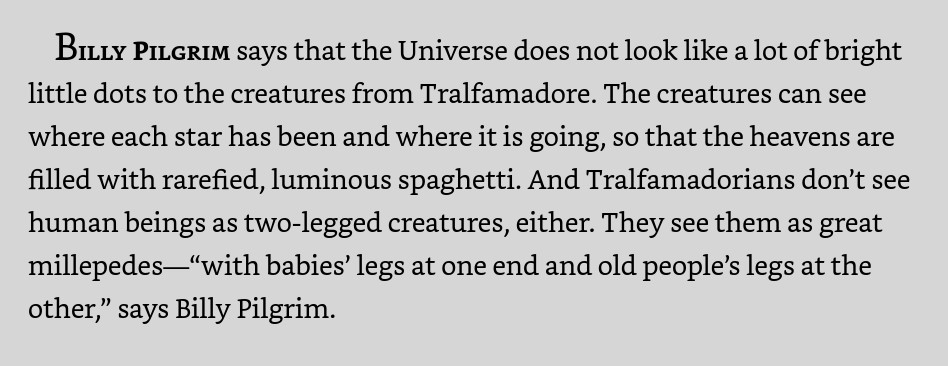
This time around I’ve been thinking more about the Tralfamadorians, the alien race who kidnaps Billy Pilgrim in a flying saucer and takes him to their home world where they exhibit him in a zoo. The Tralfamadorians don’t see time like we do. Existence is all of one piece.
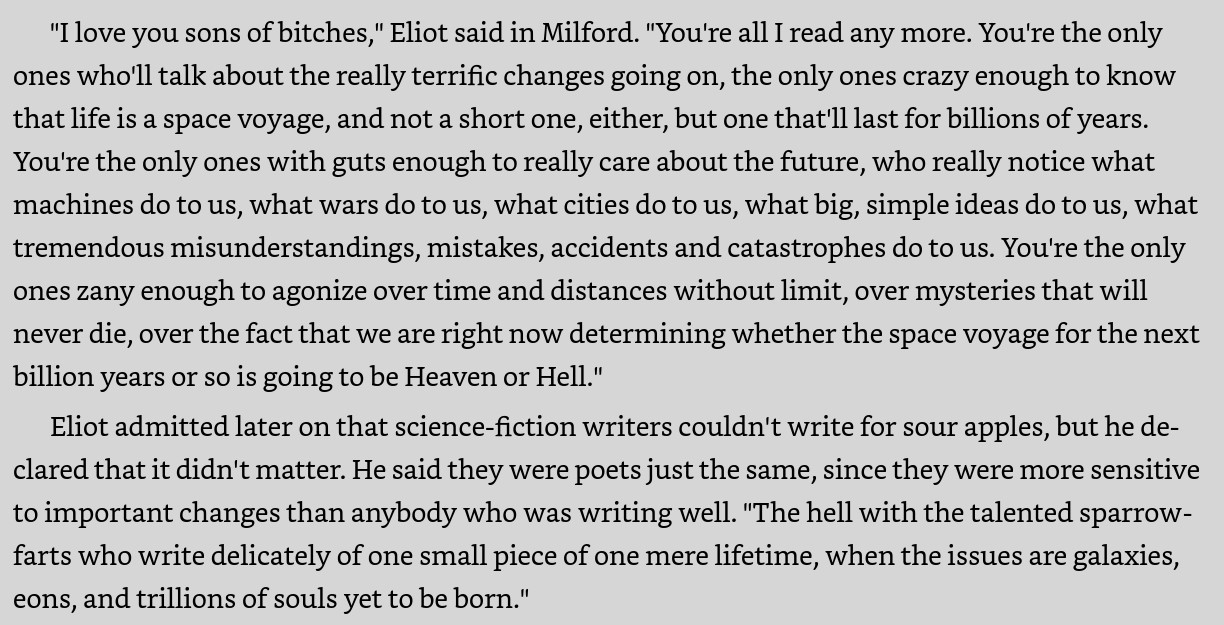
These aliens are like Zen Masters. Vonnegut uses them as enlightened teachers. But then, he gives a rather pitiful assessment of science fiction with his portrayal of Kilgore Trout. However, in a later novel, God Bless You, Mr. Rosewater, where Kilgore Trout is again featured, its hero, Elliot Rosewater attends a science fiction convention and gives this speech.
Science fiction didn’t come across so positively in Slaughterhouse-Five. Kilgore Trout wrote dozens of books that never sell. He’s a surly old man who makes his living by managing paperboys. Billy Pilgrim finds Kilgore Trout’s books only by accident. One time he finds four of them in a porn bookstore used as window dressing.
Wikipedia has an illuminating entry on Kilgore Trout. It says Vonnegut based Kilgore on Theodore Sturgeon. I’ve always wanted to know more about Theodore Sturgeon. Sturgeon’s fiction suggests he’s both eccentric and beat.
There are certain writers that haunt me. I think Vonnegut is becoming one of the ghosts that I need to get to know a whole lot better. And I might need to give Catch-22 and M.A.S.H. another read too.
I crashed into a cognitive barrier trying to write my reactions to The Trouble with Harry and To Catch a Thief, two Alfred Hitchcock movies from 1955. After two drafts I realized I wasn’t getting where I wanted to go. I know I don’t want to write movie reviews — the perfect place to find them is Rotten Tomatoes. Nor did I want to describe a film — just go to Wikipedia or IMDB. I wanted to write an essay that captured what I got out of watching those films at age 71.
Time is running out, so I need to make the most of every experience. That involves understanding myself at a deeper cognitive level. One I’m finding harder to reach as I age. On the other hand, aging is giving me more wisdom. The cognitive barrier is being able to express what I’m learning by getting older. But aging is also wearing down my brain. What one hand giveth, another takes away.
Writing is thinking outside of the head. Thoughts are generated inside the head from emotional reactions. Thoughts are fleeting. Thoughts are like cream stirred into coffee, creating little patterns that quickly dissipate. Writing is about capturing that initial pattern and making sense of it by showing how it relates to the memories of millions of past patterns.
Very few people can describe exactly how they feel, and few of those people can explain why they feel the way they do. There are rare individuals that can compose their thoughts inside their heads and eloquently convey the results in speech. Most of us need to think outside our minds via writing and editing.
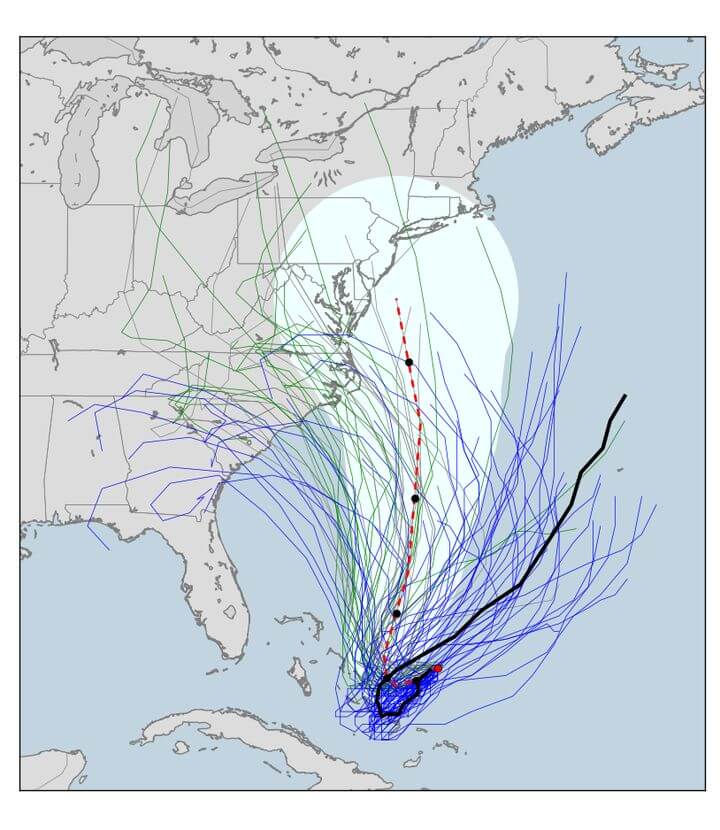
Even when we feel our written words are clear, readers seldom find clarity. Communicating with words is difficult at best and often impossible. What we think we’re expressing can often take a different path to each reader like those spaghetti strings we see in hurricane reports. I might believe I’m writing about Jacksonville, while some readers think I’m writing about Bermuda while others Miami and Charleston.
I enjoyed The Trouble with Harry better than all the other Hitchcock films we’ve watched this month, including Rebecca, Notorious, To Catch a Thief, and Strangers on a Train, films most critics admire a great deal more. However, I thought The Trouble with Harry had many flaws, but then Hitchcock is a flawed filmmaker.
How can I admire a movie that doesn’t measure well against the best movies I’ve seen over a lifetime? This gets into complexity and even multiplexity. I need to relate several reactions that contradict each other. The three films I admired and enjoyed the most this month have been The Trouble with Harry, Twelve O’Clock High, and Mr. Belvedere Rings the Bell. All three were feel-good movies to me, but they each made me feel good in a unique way. Is the word “feel-good” even useful? Many moviegoers might interpret the term “feel-good” so differently that these three movies would not fit their definition.
Should I even use the term? Shouldn’t I just describe exactly what I felt? Will that be clearer?
In my second draft I had a breakthrough. I realized to understand how I react to films I’d need to understand what I expected from them. But my expectations have changed widely over the years. And will my readers have the same expectations? It was then I realized that what I’m expecting from movies at 71 is different from my younger self. Even describing my own emotional experiences is a moving target. But explaining why that’s so hits another cognitive barrier.
I need to think about that.
Putting everything into words precisely is so difficult. Should I even try? I believe most people don’t because all they value is personal experience. Why tell anyone about our perceptions when they have their own?
Do you see why writing that essay became such a black hole?
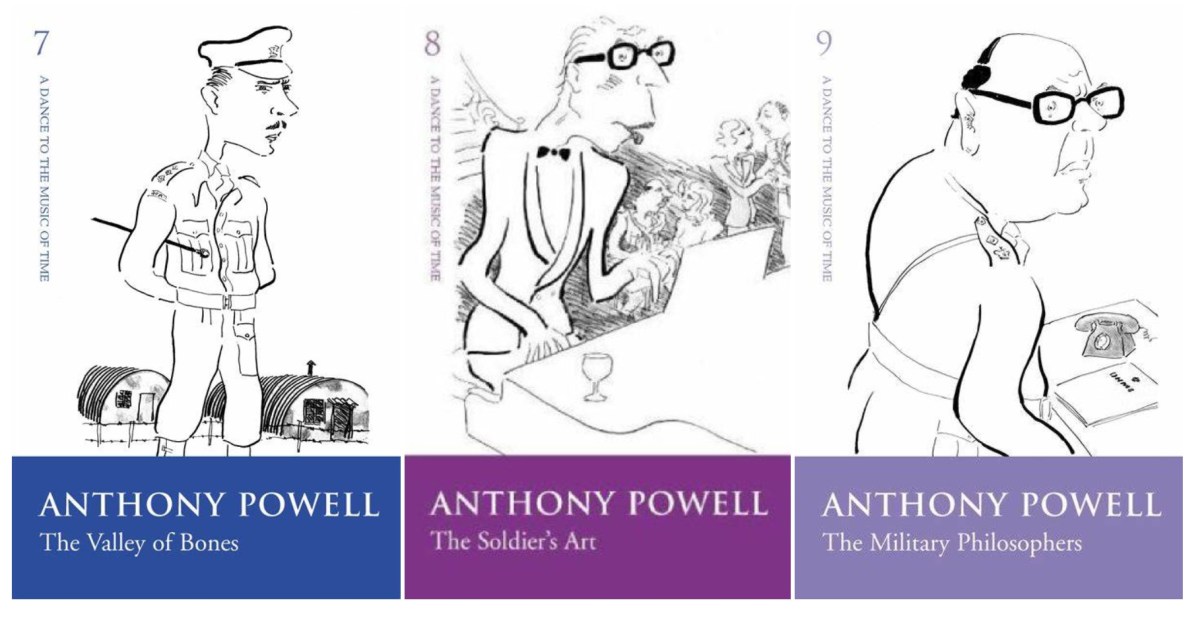
The Valley of Bones, The Soldier’s Art, and The Military Philosophers are books seven, eight, nine in a twelve-volume series called A Dance to the Music of Time by Anthony Powell. The twelve books are about Nick Jenkins, written between 1951 and 1975, covering Jenkin’s fictional life from 1921 through 1971. The twelve volumes are sometimes published in four volumes named after the seasons. Books 7-9 are called Autumn, or the Third Movement. The series takes its name and theme from a 1640 painting by Nicolas Poussin.
The three books of the third movement cover the war years 1940-1945 and give a rather unique view of England during WWII. Nick Jenkins’ life somewhat resembles Anthony Powell’s life (1905-2000) and some of the characters are based on people he knew. Here is a description of Powell’s military career during WWII from Wikipedia. It is very much like what we read in the three novels. Although we aren’t told Nick won any awards or medals, but then he is a modest character that doesn’t like attention.
Upon the outbreak of the Second World War, Powell, at age 34, joined the British Army as a second lieutenant, making him more than 10 years older than most of his fellow subalterns, not at all well prepared for military life, and lacking in experience. Powell joined the Welch Regiment and was stationed in Northern Ireland at the time of air raids in Belfast. His superiors found uses for his talents, resulting in a series of transfers that brought him to special training courses designed to produce a nucleus of officers to deal with the problems of military government after the Allies had defeated the Axis powers. He eventually secured an assignment with the Intelligence Corps and additional training. His military career continued with a posting to the War Office in Whitehall, where he was attached to the section known as Military Intelligence (Liaison) overseeing relations with, and the basic material needs of, foreign troops in exile, specifically the Czechs, later with the Belgians and Luxembourgers, and later still the French. Later, for a short time, he was posted to the Cabinet Office, to serve on the Secretariat of the Joint Intelligence Committee, securing promotions along the way.

For his service in the Army, he received two General Service medals as well as the 1944 France and Germany Star for escorting a group of Allied military attaches from Normandy to Montgomery's 21st Army Group Tactical HQ in November 1944 three miles from Roermond, Holland then held by the Germans. For representing the interests of foreign armies in exile as a liaison officer he received the following decorations: the Order of the White Lion (Czechoslovakia), Oaken Crown (Luxembourg), Order of Leopold II (Belgium), and Luxembourg War Cross (Croix de Guerre -Luxembourg).[19]

After his demobilization at the end of the war, writing became his sole career.
I find Nick’s story of military training and life on the London home front quite fascinating since the last book I read was about a British bomber squadron and all the books work like a jigsaw puzzle to create one vast image. The most action Nick sees are air raids. In one sequence he describes how several of his friends were killed in a bombing raid, and in another he gives a description of living with V-1 attacks. I was particularly moved by Nick’s observations and contemplations when he attended the VE Day Thanksgiving Service at St. Paul’s Cathedral.
But you don’t read these books for military history. Powell was an observer of people, and so was Nick. Powell’s A Dance to the Music of Time is often compared to Marcel Proust’s seven-novel sequence In Search of Lost Time. However, Proust was very inward looking, and Powell was not. We learn little about Nick Jenkins in these novels because he likes to look outward. He is an observer of people, places, and society.
I love Powell’s books because there are so many characters that come and go. I am delighted whenever one returns. Powell’s characters are like real life people, reminding me of people I know who have come into my life and left, but sometimes I run into them again, or hear stories about them years later. That essentially describes the books in this series. It’s sad that in the third sequence, many of the characters I loved reading about die in the war. I was especially saddened by Charles Stringham story. Peter Templer tale ends too, in The Military Philosophers, but it is offstage and mysterious. and there’s plenty of Kenneth Widmerpool anecdotes. He’s everyone’s favorite, getting his own entry in Wikipedia.
The notable new character that enters in these three books is Pamela Flitton, a femme fatale of the first order. She’s a real piece of work and was based on Barbara Skelton, wife of Cyril Connolly. Skelton also wrote novels and memoirs, so now I must read her. Powell’s vicious portrayal of her makes me wonder if he got sued. Her character continues into the final three novels.
Powell’s reputation is on the decline, which is disappointing. He was friends with Evelyn Waugh, Henry Green, and other British writers of the 20th century, which means my TBR pile is growing. I’ve also discovered several articles about Powell and his friends on Google, but I can’t read those articles until I resubscribe to The New York Review of Books and The New Yorker. That could become a black hole that could capture me forever.
20th century British literature is gently pulling me away from science fiction. Part of that tugging comes from reading A Dance to the Music of Time. Science fiction is known for its world building and the vast fictional landscape created by English writers is becoming far richer and real than the sci-fi alien worlds I’ve lived with for six decades.
For the first six novels, I only rated them four stars in Goodreads, but these last three are five-star novels. I expect if I go back and reread the first six, I will bump up their ratings to five-stars too. And this is a series that I will need to reread. It has over three hundred named characters, and the web of interconnections they make is rich and baroque. It will draw me back in again.
I believe recent developments in artificial intelligence prove that many of the creative processes we thought came from conscious actions come from unconscious mechanisms in our minds. What we are learning is computer techniques used to generate prose or images are like unconscious processes in the human brain.
The older I get, the more I believe that most of my thinking comes from my subconscious. The more I pay attention to both dreams and my waking thoughts, the more I realize that I’m very rarely making conscious decisions.
I might think “I am going to walk across the street and visit Paul,” but I have no idea how to make my body walk anywhere. But then, I’ve always assumed muscle actions were automatic. It was mental actions I believed were conscious actions. I used to believe “I am writing this essay,” but I no longer believe that. This has led me to ask:
Just what activities do we perform with our conscious minds?
Before the advent of writing, we did all our thinking inside our heads. Homer had to memorize the Iliad to recite it. Prehistory was oral. How much of thought then was conscious or unconscious? Have you ever read The Origins of Consciousness in the Breakdown of the Bicameral Mind by Julian Jaynes? I know his theories have lots of problems, but they do imagine what I’m thinking about.
How often have you worried over a problem, say a math problem, or a programming problem, and gave up, but then later, usually after a nap or sleep, the solution came to you? That’s the classic view of unconscious thinking. But even when we’re thinking we’re solving a calculus problem is it really being done at a conscious level? Are you consciously recalling all your math lessons over a lifetime to solve the problem?
How often when working on a Wordle or Crossword does the word magically come to you? But sometimes, we are aware of the steps involved.
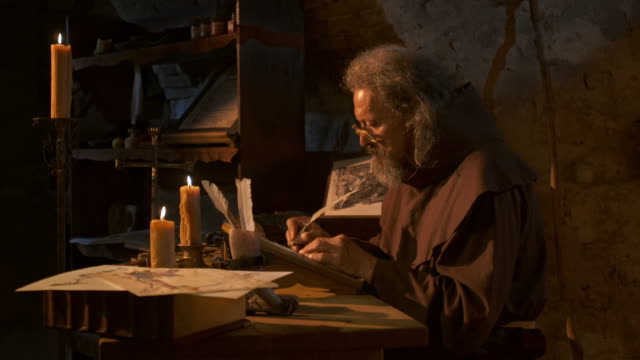
In recent years I’ve developed a theory that when we work with pen and paper, or word processor or spreadsheet, or any tool outside our body, we’re closer to thinking consciously. Sure, our unconscious minds are helping us, but making a list is more willful than just trying to remember what we need at the store.
Writing an essay is more willful than woolgathering in the La-Z-Boy. Authoring a book is far more willful still. Engineering a submarine by a vast team of people is an even more conscious effort. Sure, it involves a collective of unconscious activity too, but a vast amount documentation must be worked out consciously.
I’ve written before about this idea. See “Thinking Outside Your Head.” That’s where I reviewed different techniques and applications we use to think outside of our heads.
Many people want to deny the recent successes with AI because they want to believe machines can’t do what we do. That humans are special. If you scroll through the images at Midjourney Showcase, it’s almost impossible to deny that some of the images are stunningly beautiful. Some people will claim they are just stolen from human creativity. I don’t think that’s true.
I think AI developers have found ways to train computer programs to act like the human mind. That these programs have stumbled upon the same tricks that the brain evolved. Many great writers and artists often talk about their Muse. I think that’s just a recognition of their unconscious minds at work. What those creative people have learned is how to work consciously with the unconscious.
What some creative people are doing now is consciously working with two unconscious minds – their own and an AI. There is still a conscious component, the act of working with tools outside of our head. Where the action is, is that vague territory between the unconscious mind and the conscious one.



 Auxiliary Memory