Is there one question you’d love to know the answer to before you die? For me, it’s always been “Why is there something rather than nothing?” Religious people want to believe God created everything, but there’s always that one smart kid who asks: What created God? We get into the problem of infinite regression. Of course, there’s the famous story by a scientist where the punchline is: “Turtles all the way down.”
Science has been trying to answer this question forever. At the small end, we have elementary particles in the Standard Model, with scientists and mathematicians speculating they came about because of strings or other concepts. At the large scale, cosmologists think the universe might be part of a multiverse. But don’t we have the same problem? What creates strings and multiverses? It’s something tinier or larger all the way down or up.
I must assume I will never know the answer to the question that gives me the most existential angst. I used to think as a kid, when we die, we’re finally told the answer to all our questions. But if I find myself in another dimension after death, I’m just going to ask: “What created this place?”
Maybe the answer that leads to happiness is to ask questions that can be answered. To focus on a smaller domain of existence. If I reduce the domain to planet Earth, I’d ask: “What happens to humans after runaway climate change?” It’s possible to speculate with some possibilities of getting the answer close to what might happen. But is such speculation useful?
If I reduce the domain to the United States. I guess the question right now that most people are asking: “Who will be elected president in November?” Until the debate Thursday night, we assumed it would be one of two possibilities. But have things changed? Don’t things always change?
I think I need to reduce the domain again. On a very personal level I’d like to know: “What is time.” And I don’t mean where in the Earth’s rotation, or orbit about the sun. No, I want to know: “What makes reality grow from one moment to the next?” Nothing stays the same. So, what is the smallest degree of change perceptible? Is it the vibration of subatomic particles? Is it the fields and forces that make up those particles? What is one tick of reality’s clock?
This is why I’m currently reading books like The Order of Time by Carlo Ravelli and On the Origin of Time by Thomas Hertog. I struggle to understand what these books are telling me. Is it possible to understand physics without understanding mathematics and science at the graduate level? I can vaguely sense what I think they’re talking about, but I might be deluding myself.
I do think time might be the key to why there’s something and not nothing, but I’m not sure we can ever grasp the reality of spacetime. I’m certainly no Einstein or Hawking. I don’t even understand science at an eighth-grade general science teaching level. To me, comprehending time is closer to being a meditating Buddhist.
What question would you love to know the answer to?
Since the 1960s I’ve fantasized about writing a science fiction novel. Since the 1990s, I’ve fantasized about writing a science fiction novel about artificial intelligence. The likelihood of me ever writing this novel is nil, but I still imagine and refine it in my head. The trouble is, artificial intelligence has gotten real, making writing a novel about AI more difficult.
Yesterday OpenAI announced ChatGPT 4o. (That’s a little o – pronounced four oh.) If you haven’t seen any of the news stories or demoes, watch this video.
I first encountered the concept of artificial intelligent back in 1967 when I read The Moon is a Harsh Mistress by Robert A. Heinlein. That novel featured a sentient mainframe computer named Mike. He was my favorite character. Heinlein didn’t use the term AI. I wouldn’t encounter it for a few more years when I went to a two-year technical school to study computers. Along the way I read two other books that featured a sentient computer, When H.A.R.L.I.E. Was One (1972) by David Gerrold and Galatea 2.2 (1995) by Richard Powers. There were plenty of other novels and movies about intelligent computers, but these three were my favorites.
In other words, I’ve been waiting a long time for science to catch up with science fiction. It’s funny though, when reality finally caught up and surpassed fiction, it’s been kind of anticlimactic. Most AI science fiction today has more in common with 1960s science fiction than it does with 2020s computer science. I’m currently reading a 1983 story by Poul Anderson, “Vulcan’s Forge” that has a sentient computer, but not much different from Mike in Heinlein’s 1967 story, or the female AI in the 2013 film Her. It seems now that science fiction writers never pushed their imaginations enough.
ChatGPT 4o is way cooler than anything I’ve ever encountered in science fiction. For one thing, I’ve always assumed an AI computer would talk like a person, capable of holding only one conversation at a time. Real AIs now converse like real people, but with thousands, if not millions of people at once. Never imagined that. And ChatGPT 4o sounds like a real person. I’ve always assumed they would sound like a computer.
I also thought intelligent AIs would have to be sentient beings. Evidently, massive amounts of intelligence can still be unaware even while coming across like people. We’ve always assumed that the growth of intelligence paralleled the growth of consciousness. That might not be true. Of course, there are philosophers who claim that consciousness is an illusion. Maybe they were right. But where does that leave us?
Computer scientists are quick to point out that ChatGPT 4o isn’t real AGI (artificial general intelligence). Critics constantly point to the factual mistakes that even the best of current AIs make. The old Turing Test concept only required a human not to be able to tell the difference between a machine and human when communicating through a teletype. Humans make factual mistakes all the time. Both presidential candidates frequently misspeak, but we don’t accuse them of hallucinating. That’s the term computer scientists use when AIs make up shit. If we applied the same term to humans, humans hallucinate their asses off. I’m not sure the average person can tell the difference between a computer and a person anymore in a Turing test. And neither can we tell the difference between AI and AGI.
For many measurable areas of information, current AIs are far smarter than humans, and are getting smarter all the time. They may not be perfect at any single discipline, but they are far better than average at most subjects they are tested on. When computer scientists talk of AGI, I get the feeling they are expecting the machines to know absolutely all about everything. Haven’t they up the ante to AO (artificial omniscience)?
Here’s the thing. I always thought the world would go nuts when AI singularity happened. And it may have happened or may not. But that’s my point. I think it has happened and we’re just not smart enough to recognize it — yet.
People are embracing artificial intelligence in the same way they embraced smartphones and the internet. They just incorporate recent technology in whatever way they find useful or advantageous. They don’t philosophize about it. They might bitch they’re losing their jobs, but not because AI is a science fiction sense of wonder come true.
Why did talking computers evoke a sense of wonder in science fiction, but not in real life? How come I haven’t seen one person’s mind blown? Not even a, “Dang! I’m talking to a dang computer!” Instead, people are whining about AIs making math mistakes or getting dates wrong. Every human I know does that, so why not cut the machines some slack?
Why isn’t the current state of AI development a boom time for philosophers and science fiction writers? People treat ChatGPT 4o like an iPhone 15, just enother gadget. The only speculation seems to be when will we get ChatGPT 5 or the iPhone 16?
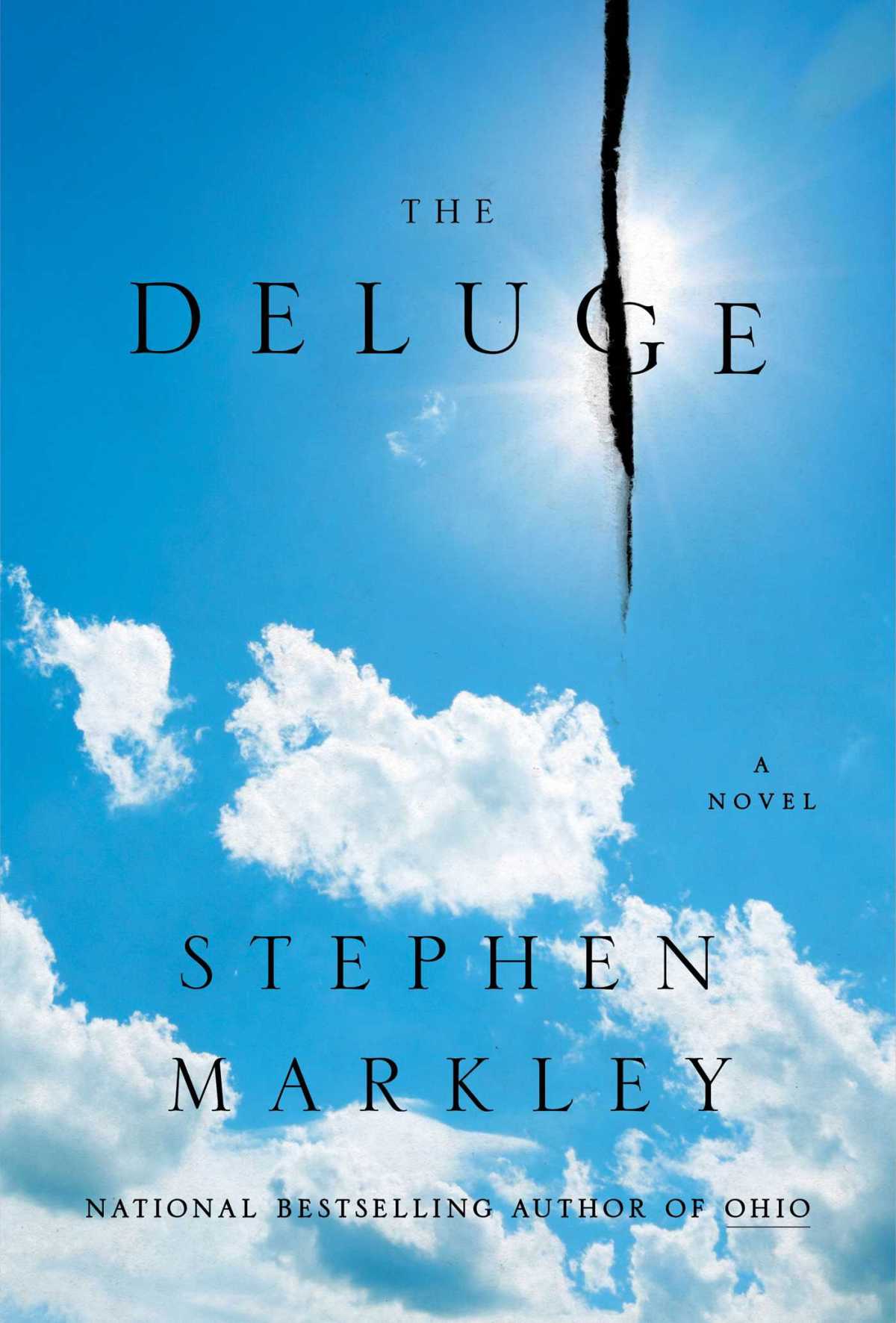
I just finished listening to The Deluge by Stephen Markley, a book that speculates on what the next sixteen years could be like. The book is almost nine hundred pages in print, and over forty hours on audio. Reading this book feels like it’s compressed the last twenty years of polarized political conflict into a forty-hour long disaster film. It’s intense.
Markley uses a large cast of characters to dramatize how people on the left and right will battle for control over the next five U.S. presidential election cycles. Most of the story involves two groups of characters, those working within the political system, and those who decidedly don’t. Markley portrays an ultrasecret ecoterrorist group that works to force change by violent acts versus a dedicated group of political wonks that labor in Washington to influence both parties. Dynamic women characters lead both groups. (By the way, I disliked both women. The only character I cared about was a drug addict in Ohio, who Markley uses as a kind of everyman.)
To further spice up the story, Markley explores the growing power of computer surveillance, artificial intelligence, privacy, and how everyone can be tracked.
I’m not going to review the details of The Deluge because I want to use my reading experience to talk about a specific response to reading the book. I’ll link major book reviews at the end in case you’re considering reading the book. I can say liberals will be terrified by the conservatives in this story, and conservatives will by horrified by these fictional liberals.
The Deluge is about climate change. We could have solved that problem by now if we had acted promptly twenty years ago. The government could have added a tax on all fossil fuels and then raised it slowly month by month. For example, by adding ten cents to the federal tax on gasoline each month. If we had started this in the year 2000, gasoline would be approaching $30 a gallon today. That would have forced people and corporations to make the changes needed.
That tax revenue could have been used to overhaul the power grid and for developing renewable energy technologies. If we had taxed carbon properly, we wouldn’t be fighting over climate change today. That didn’t happen. It didn’t happen because the people who owned trillions of dollars in fossil fuel reserves made sure it didn’t happen. They built a political and religious coalition to fight with them to protect that wealth.
All that’s beside the point now. What Markley envisions is the breakdown of the United States over the next sixteen years so it’s obvious to all we need to do something. The Deluge includes dramatic scenes of a massive fire that destroys Los Angeles, a massive flood that overwhelms the Midwest, and a massive hurricane that devastates east coast states. These events caused the insurance industry to collapse, leading to economic chaos. Markley doesn’t overplay all this. His fictional disasters are realistic, only somewhat larger than what we’ve already experienced, killing just hundreds or a few thousand people in each event, but having an enormous impact on politics and the economy.
Reading The Deluge makes readers ask themselves: Will American change soon? But I ask: Can people change at all?
Before reading this novel, I had seen two insightful videos about climate change that ask the same questions. The first video makes a careful case saying people don’t change and if there is a solution for avoiding climate change it must work with the psychology of how people act. The second video summarizes the first video with impressive summations of it and this tweet. (I wish I could summarize what I watch and read this well.)
Over the two hundred thousand years that our species have existed on this planet, we haven’t changed. Our societies and technologies change, but not us. Over those two hundred thousand years we have developed four major cognitive tools to understand reality: religion, philosophy, mathematics, and science. Only science using mathematics has consistently proven it can consistently describe reality. If you don’t believe that I wouldn’t fly in an airplane.
Science is not black and white. It’s statistical and hard to understand. But science has overwhelmingly shown that adding more CO2 to the atmosphere is turning up the temperature. The parts per million of CO2 in the air acts like a thermostat. Add more CO2 turns up the temperature. The only way to return to the weather we liked in the past is to return to the CO2 levels of the 1960s, but we keep adding more. The only way to stop adding CO2 is to completely stop using fossil fuels. And if we want to turn down the thermostat, we need to remove CO2, which isn’t easy. That’s why taxing carbon is the only way to force us to change, but we won’t do that, because it’s not in our psychology.
However, The Deluge suggests when things get bad enough, we’ll change. It ends hopefully. People even have hope for their children and grandchildren.
Personally, I don’t think we will change. If you want to know what the next sixteen years could be like, read The Deluge. If you believe people can change, and we’ll do the right thing eventually, read The Deluge. If you don’t believe we’ll change, I wouldn’t bother with the book unless you like looking at train wrecks. And if you suffer from depression, I suggest avoiding reading this novel at all costs. I seldom get even the slightest depressed, but this book bummed me out.
Americans have general thought of America as a democracy, although it’s never been a true democracy. When the United States of America was first created a limited number of white males could vote. As time progressed more white males were allowed to vote. As liberals and radicals influenced politics, they advocated for wider suffrage state by state. See this timeline for details, but the Fifteenth Amendment in 1870 gave black men the vote, and in 1920 the Nineteenth amendment was passed that gave women the vote in all states. Whites have always suppressed black voters, and even some men still resent women voting. And political parties have always tried to control who could vote and how, and even suppressing voting.
A true democracy would allow every citizen over a certain age to vote, or universal suffrage. Before the 21st century most Americans didn’t see that as a problem, but as ethnic demographics have changed it has turned some Americans against democracy.
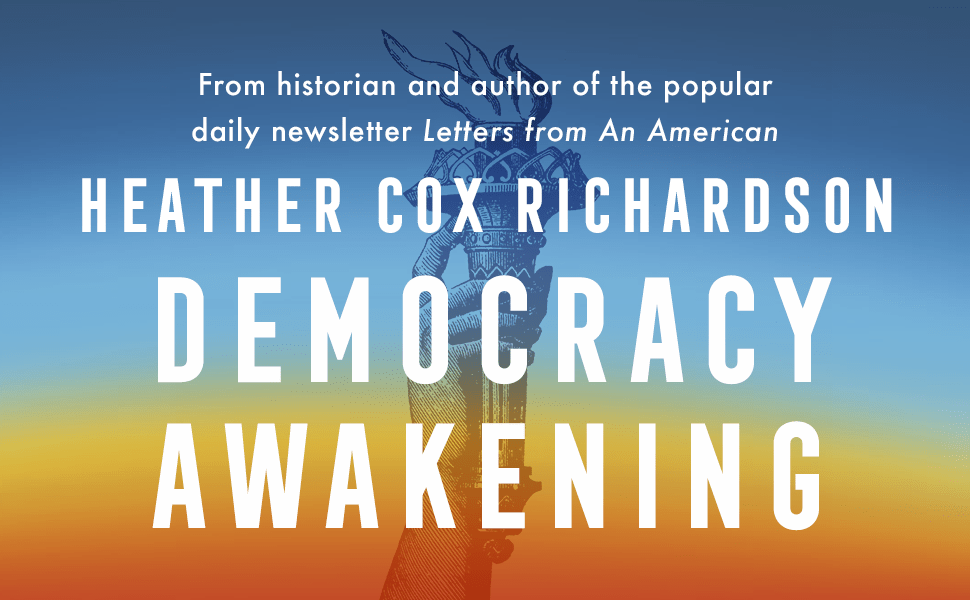
America is supposed to have a representative democracy, but it inspired the formation of political parties supported by various special interest groups fighting for power. In America Awakening Heather Cox Richardson describes how we’ve reached the current state where liberals advocate more democracy and conservatives push for less, apparently wanting authoritarian rule instead. Authoritarians general promote some ideal in the past as the authority of how things should be govern. Most modern American authoritarians look to either the Founding Fathers and the Constitution or to God and The Bible, or a combination of both. Modern American authoritarian leaders tend to be white and paternalistic, and their followers tend to want a strong man, or strong father figure, although more women are wanting to be Republican leaders too.
Richardson says it’s important to understand that many terms like conservative, liberal, radical, Republican, and Democrat have changed over the centuries. In the 19th century Republicans were for African Americans voting, and for gun laws, and in the early 20th century, for regulations on corporations. In the 19th century and through the first half of the 20th century, Democrats tried to keep African Americans from having the vote. The Republican and Democratic parties went through a polarity change in the 1960s. Richardson says its important understand how words have changed meaning because authoritarians often abuse them and justify their abuse by claiming history supports their new definitions. In other words, history gets distorted and abused.
I’m reviewing Democracy Awakening because I think it’s an important book everyone should read for the 2024 U.S. presidential election, but also to push my ability to remember. I love reading nonfiction books, but their information often feels like it goes in one ear and out the other. I can only retain what I learn in the vaguest way. Since I’m also reading about memory and aging, I’ve decided to read Democracy Awakening differently. I’m going to distill what Richardson is saying into my own words but in some concise form that I hope I can remember. I’ll do that in a series of blog posts, outlines, tables, etc.
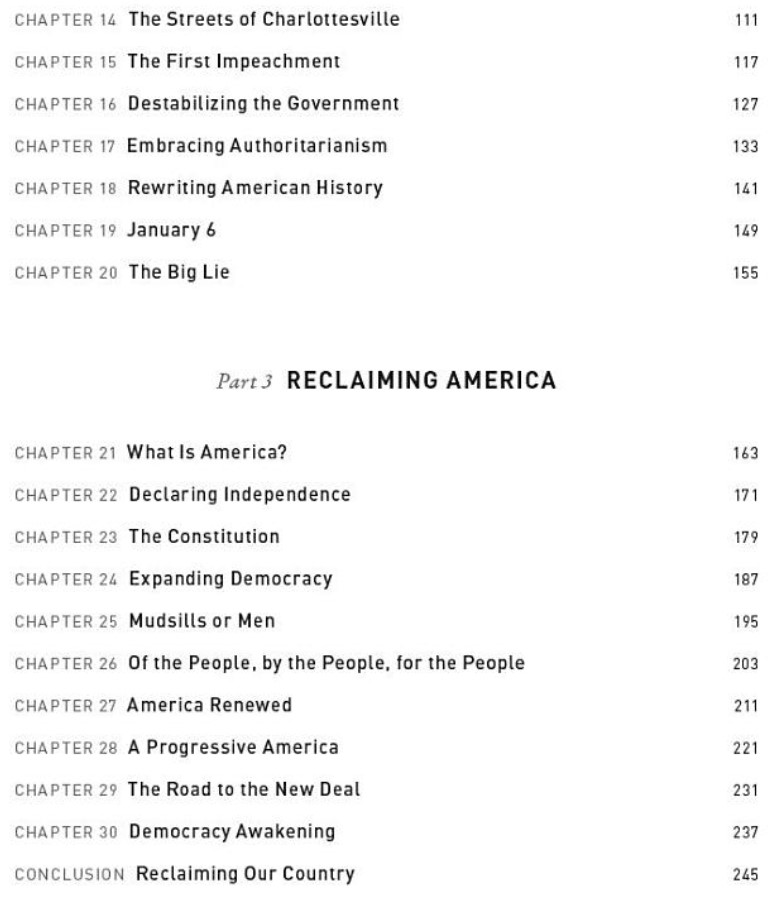
My friend Linda and I are reading Democracy Awakening together and for our first discussion we are covering Part 1, Chapters 1-10, which I hope to cover today. Here is the Table of Contents.
Because I’ve also read other books on this subject already, including watching related documentaries and YouTube videos, I’m going to reference them in this series to show how there’s a synergy in my reading.
Heather Cox Richardson is a history professor who has specialized on the history of the Republican Party through a series of books. I have not read these books, but I have read some about each and it gives me confidence that Richardson is an expert on this subject. On the internet there are zillions of people claiming to be knowledgable on specific subjects but when you check into their creditials, you find little to back their claim of authority.
Richardson makes her points by citing historical events. I wish I could remember all the cited dates and important changes in history because they show an evolution of how we got to today. The first ten chapters progress mostly in a linear fashion, so I hope to eventually create a timeline.
Richardson also quotes significant papers, speeches, books, and other sources to reveal how concepts emerged that cause people to seek political change. Just the history of African Americans seeking Civil Rights reveals many connections to how conservatives and liberals changed their parties and political goals. I’d like to make a list of the most significant quotes to remember. And I’d like to read the books Richardson references, including books by conservative writers. But this will take a lot of time.
And there’s another problem, both conservatives and liberals use the Founding Fathers as historical authority even though members of both political parties distort history for their cause. Republicans like to cite the past, both the Founding Fathers, and The Bible, as how to create or interpret laws. This is rediculous. 2023 isn’t 1776, or 800 BCE. Yet, reading Richardson’s book Democracy Awakening shows the democracy we have today is constantly changing, and how those changes comes from actions in the past.
It is well documented that Republicans feel the United States took a wrong turn in the 1930s when FDR’s administration created the New Deal. They’ve been trying to undo it ever since. And their methods and philosophy of why and how have evolved over the decades. Part of that evolution is moving away from democracy, which is what Richardson’s book is about.
Richardson believes we didn’t fall into fascism in the 1930s because the United States has a long history of various groups fighting for suffrage. That the history of United States is one of a ruling class struggling to keep power from various groups of people wanting to vote. This includes poor whites, African Americans, women, and immigrants. The current Republicans know they cannot win with universal suffrage and fair elections and so they have to do an end run around democracy.
Republicans formed coalitions with special interest groups that the leaders of the party have no interest in supporting. What has changed is the special interest groups have taken over the power from the old Republican elites. Neither the Republicans nor Democrats have a clear majority with voters, and depend on Independents who swing their votes.
The main problem revealed in the first part of Democracy Awakening is the country is dividing itself into two camps. Those who want an authoritarian government based on their version of the Founding Fathers and their version of Christianity, and those people who want universal suffrage and a true democracy.
The authoritarians cannot get what they want by existing voting laws and population demographics. That’s why they are undermining the election process. Since majority rule is 50%, these two groups are polarized. Neither Republicans or Democrats have a majority. They depend on swing votes from Independents.
What I’m hoping to see in the next two parts is whether or not Richardson thinks democracy can survive. I was recently terrified by a New York Times essay, “Trump Has a Master Plan for Destroying the ‘Deep State’” by Donald P. Moynihan. In it Moynihan says Trump has three goals which I’ll take out of context and quote here:
The first is to put Trump loyalists into appointment positions. Mr. Trump believed that “the resistance” to his presidency included his own appointees. Unlike in 2016, he now has a deep bench of loyalists. The Heritage Foundation and dozens of other Trump-aligned organizations are screening candidates to create 20,000 potential MAGA appointees. They will be placed in every agency across government, including the agencies responsible for protecting the environment, regulating workplace safety, collecting taxes, determining immigration policy, maintaining safety net programs, representing American interests overseas and ensuring the impartial rule of law.

...

The second part of the Trump plan is to terrify career civil servants into submission. To do so, he would reimpose an executive order that he signed but never implemented at the end of his first administration. The Schedule F order would allow him to convert many of these officials into political appointees.


Schedule F would be the most profound change to the civil service system since its creation in 1883. Presidents can currently fill about 4,000 political appointment positions at the federal level. This already makes the United States an outlier among similar democracies, in terms of the degree of politicization of the government. The authors of Schedule F have suggested it would be used to turn another 50,000 officials — with deep experience of how to run every major federal program we rely on — into appointees. Other Republican presidential candidates have also pledged to use Schedule F aggressively. Ron DeSantis, for example, promised that as president he would “start slitting throats on Day 1.”

...

The third part of Mr. Trump’s authoritarian blueprint is to create a legal framework that would allow him to use government resources to protect himself, attack his political enemies and force through his policy goals without congressional approval. Internal government lawyers can block illegal or unconstitutional actions. Reporters for The New York Times have uncovered a plan to place Trump loyalists in those key positions.


This is not about conservatism. Mr. Trump grew disillusioned with conservative Federalist Society lawyers, despite drawing on them to stock his judicial nominations. It is about finding lawyers willing to create a legal rationale for his authoritarian impulses. Examples from Mr. Trump’s time in office include Mark Paoletta, the former general counsel of the Office of Management and Budget, who approved Mr. Trump’s illegal withholding of aid to Ukraine. Or Jeffrey Clark, who almost became Mr. Trump’s acting attorney general when his superiors refused to advance Mr. Trump’s false claims of election fraud.
This is why I believe everyone should be reading Democracy Awakening. I believe Richardson’s book is defining what the 2024 election will truly mean at the deepest level.
This month, several of my friends have separately expressed doubt about the future. I don’t hold much hope either. Our current world civilization seems to be falling apart. Capitalism is consuming the planet, but capitalism is the only economic system that creates enough jobs to end poverty. The only alternative to free market capitalism I can imagine is if we adapt capitalism to an ethical system. So, I’ve been keeping my eye open for signs of emerging ethical capitalism.
Here’s one: “The Workers Behind AI Rarely See Its Rewards. This Indian Startup Wants to Fix That” from Time Magazine (8/14/23). The article describes how AI startups need vast amounts of sample data from other languages for their large language models. In India, many data companies are exploiting poor people for their unique language data and keeping the profit, but one company, Karya, is giving the poor people they employ a larger share of the profits. This helps lift them out of poverty.
Capitalism has two dangerous side effects. It destroys the environment and creates inequality. For capitalism to become ethical it will need to be environmentally friendly, or at least neutral, and it will need to be more equitable. If we want to have hope for the future, we need to see more signs of that happening.
Right now, profits drive capitalism. Profits are used to expand a corporation’s ability to grow profits, and to make management and investors rich. Labor and environmental controls are seen as expenses that reduce profits. For a corporation to be ethical it will have to have a neutral or positive impact on the environment, and it will need to share more of its profits with labor.
Since the pandemic hourly wages have been going up, and so has inflation. If capitalism becomes more ethical, costs for environmentalism and labor will go up, thus ethical capitalism will be inflationary. Some people have gotten extraordinarily rich by making things cheap, but it’s also shifted labor and environmental costs away from corporations onto the government and the public. The price at the store does not reflect the actual cost of making what you buy. You pay the difference in taxes.
For ethical capitalism to come about things will need to be sold for what they cost to make. That will involve getting rid of governmental and corporate corruption. It will involve political change. And it will be inflationary until the new system stabilizes.
My guess is ethical capitalism will never come about. If I were writing a science fiction novel that envisioned life in the 2060s it would be very bleak. Life in America will be like what we see in failed states today. Back in the 1960s we often heard of the domino theory regarding communism. Failed states are falling like dominoes now. Environmental catastrophes, political unrest, dwindling natural resources, and viral inequality will homogenize our current world civilization. Either we work together to make it something good, or we’ll all just tear everything apart.
Civilization is something we should all shape by conscious design and not a byproduct of capitalistic greed.
We have all the knowledge we need to fix our problems, but we lack the self-control to apply it. I have some friends who think I’m a dope for even holding out a smidgen of hope. Maybe my belief that we could theoretically solve our problems is Pollyannish.
I have two theories that support that sliver of hope. One theory says humans have always been the same psychological for two hundred thousand years. In other words, our habits and passions don’t change. The other theory says we create cultures, languages, technologies, systems that can organize us into diverse kinds of social systems that control our behavior.
We could choose better systems to manage ourselves. However, we always vote by greed and self-interest. We need to vote for preserving all.
In other words, we don’t change on the inside, but we do change how we live on the outside. My sliver of hope is we’ll make laws and invent technology that will create a society based on ethical capitalism and we’ll adapt our personalities to it.
I know that’s a long shot, but it’s the only one I have.
I’m working to develop a new habit of reading one substantial article a day and breaking my bad habit of consuming dozens of useless tidbits of data that catch my eye as clickbait. In other words, one healthy meal of wisdom versus snacking all day on junk ideas. Wisdom doesn’t come packaged like cookies or chips.


 Auxiliary Memory