What Gives Me A Sense of Accomplishment at Age 71

by James Wallace Harris

When we were little kids grownups would ask: “What do you want to be when you grow up?” That plants a seed in us that we should have a goal for the future, to plan to do something and accomplish things. When we were little, we’d tell the grownups we wanted to be astronauts or rock stars, because those were the exciting glamourous occupations we knew about.

As we got older, we learned that becoming an astronaut requires getting advanced science degrees, and becoming a rock star means learning how to play the guitar and sing which takes ten thousand hours of practice, neither of which we really want to do.

As we got older we learned that just finishing doing anything had its own rewards. The trouble was learning what we like to do. I had to work at many shit jobs before I was 25 to learn what I actually liked doing, which was working in a nice office, messing with computers, and having coworkers who would become friends. Helping someone else accomplish their goals by programming a computer was what I eventually discovered I like doing. I found working at a university that helped other people to become what they wanted to be fulfilling to me.

Before we retire we think about all kinds of big things we want to do after we quit work. I thought about moving to New York City or living in England, or moving to a retirement community with a lot of social activities. But those things were like dreaming of becoming an astronaut when I was a kid. The reality of retirement was quite different. Susan and I decided to stay in the home we had. And my health problems made me not want to travel.

However, the urge to do something is still there. And even as I get older and can do less physically, I still have this desire that I should have a goal for the future, and to accomplish something. What’s rather fascinating is where and how I get my sense of accomplishment every day.

Nowadays, the future isn’t so far off. It’s either, “What am I going to do tomorrow,” or “What will I do today.”

My goals have become smaller and smaller too. A big one recently was cleaning out the attic. Our friends Anne and Tony came over and helped us get everything down, and now Susan and I are going through all the boxes and suitcases stacked up in the dining room to get rid of that stuff. When that task is done it will give me a reasonably big sense of accomplishment.

But I don’t need big things to accomplish to find satisfaction. Even going to the grocery store provides a satisfying sense of getting something done. It involves Susan and I planning our meals for the week, making a list, going shopping, and putting things away. All of that might take just a couple hours, but it wears me out and leaves me feeling I did do something worthwhile. Me and my old friends joke about how doing one thing like going to the grocery store makes us feel like we’ve gotten something done for the day. And the common joke is, “How did we ever have time for a job?”

If I look at my ToDoist app on my phone, I see a list of things to do that will make me feel good when I get to remove them from my To Do list. And most of those little goals are rather mundane: clean out the file drawers, find a new dermatologist, hire an electrician to install the new Blink security camera and light, cull out DVDs I’ll never watch again, get my eyes checked, and so on.

This is a long way from becoming an astronaut. We never hear people ask: “What do you want to do when you get old?” Theoretically, my retirement years could be longer than my work years. At one time I had big ambitions about what I would do with them, but like a kid growing up and discovering the reality of the work years, the reality of the retirement years is very different too.

A lot of what you can accomplish in retirement depends on money and health, and health really becomes the defining factor. I no longer have a bucket list of things I want to do because at some point the scope of life changes. My sister Becky once told me, “You start out life by living mostly in one room with someone changing your diaper and end up living mostly in one room with someone changing your diaper.” At the time that was funny, scary, and depressing. But as you get older, it becomes, “I can see that.”

I could still have a decade or two, or even three. That’s a lot of time. Unfortunately, it’s time when I’ll have dwindling energy and health. But I don’t think I’ll lose a sense of wanting to accomplish things.

I’m reminded of a short story by R. A. Lafferty called “Nine Hundred Grandmothers.” In it, a space explorer visits another planet and learns the beings there are immortal. However, they get smaller and smaller as they age. He is taken to a cave where the ancestors live on shelves in the wall. The further back he goes the tinier they get. That’s what life is like getting older. The scope of every day slowly gets smaller and smaller. You live with it.

Right now I measure accomplishments by how many books I read or essays I write. I like waking up in the morning and thinking of a goal and then achieving it during the course of the day. At 5:55am this morning I imagine writing this essay. It’s now 7:53am and I’ve almost got a first draft. I hope to finish it soon and eat breakfast. It’s great to start the day having completed a goal early.

Before I got up I also pictured cleaning up the house so our friend Leigh Ann could come over and Susan, Leigh Ann and I can spend the afternoon playing Rummikub. It’s not much of a goal, but it is satisfying.

And I look forward to tonight when Suan and I will watch another episode of Call the Midwife and A Place to Call Home. This might be silly, but I find watching complete series from pilot to finale gives me a sense of accomplishment. So each night I feel like we’ve done something by watching another episode from those two series.

Sometimes I even give myself big goals, ones that are daunting to me now. Ones that I have to push myself to finish. Like cleaning out and organizing my email and computer files on my hard drive. You might laugh, but I have thousands of emails and tens of thousands of computer files waiting to be examined.

Finally, there’s a weird symmetry to getting old. Susan and I have collected a lot of stuff in 45 years of marriage, and now we’re getting rid of all that stuff a little bit at a time. I have thousands of books that I still haven’t read. Ones I bought thinking that one day I’ll get to read. Well, that one day is here and I’ve got to get busy reading them. Finishing each one gives me a sense of accomplishment.

JWH (another thing done – 8:35am)

Jim and Susan’s TV Watching Update

by James Wallace Harris, 4/21/23

Back in December, I wrote about how Susan and I needed a new TV show to binge on. We were wrapping up Downton Abby having rewatched it from the first to the last episode and the two movies. I asked for recommendations and figured I might update that post and let y’all know what we ended up watching.

Here are the series we’ve binged on so far, watching two episodes a night starting at 9 pm.

Time Period Series
1912-1926Downton Abby
1903-1930Upstairs, Downstairs (1971)
1936-1939Upstairs, Downstairs (2010)
1937-1953All Creatures Great and Small (1978)
1938-1939All Creatures Great and Small (2020)

We tried Northern Exposure but it didn’t hook us. I guess we weren’t ready to leave England because we ended up watching Upstairs, Downstairs – both the 1971 and 2010 versions. It wasn’t nearly as good as Downton Abby but we got so we liked it well enough. The contrast in TV production in the 1970s and 2010s was striking. Upstairs, Downstairs (1971) never had elaborate sets, and the costumes weren’t as elegant either. The storytelling in the older show was simple too. Most of the early 1970s episodes only featured one plot line, whereas Downton Abby and Upstairs, Downstairs (2010) switched between several. That’s something that become standard in 21st-century television.

All three shows had an ensemble cast, but Downton Abby’s was much larger. Plus, Downton Abby had lots of exterior shots, which made the period setting far more realistic and enjoyable. The newer Upstairs, Downstairs was quite well done, it just didn’t last long enough for us to get attached to the show.

After Upstairs, Downstairs (2010) we started watching both the new and old versions of All Creatures Great and Small. We watched one episode of each starting at 9pm. This was fascinating for about ten days seeing how they each presented the same material from the book. Episodes of the 1970s All Creatures Great and Small tended to be choppy and episodic, often jumping days between scenes.

The newer show made each episode a solid coherent story. But this meant they’d stretch out some anecdotes from the book and skimp quickly over others. Overall, the storytelling, production, and cinematography were superior in the new version. Of course, widescreen high-definition made a huge difference too. On the other hand, I think we liked the characters better in the older show, although we like both sets of actors a lot. However, I was slightly more taken with the newer Helen. Susan, I think liked the looks of the newer actors, but found the characters in the older show more developed.

After ten days of this dual viewing, we switched to just watching the newest version to finish it off and focused on the old version. All Creatures Great and Small ran for three seasons in the late 1970s and then stopped around 1980. It had 90-minute one-shot Christmas specials in 1983 and 1985. Then in 1988 it started back up and ran another four seasons. The first three seasons covered 1937-1939. The fourth season picked up again in 1949 and the story ended in 1953. The first three seasons of the new show covered 1937-1939. I don’t know if there will be more or not.

We watched Upstairs, Downstairs – and the older version of All Creatures Great and Small on Britbox.

Again, a contrast between TV production in the 1970s and 2020s. Of course, in this show, the exterior shots were important in both productions. I’ve got to say, the old series seems to have spent far more time on the gritty details of being a large animal vet. We see all kinds of animals being born, often with Herriot’s or Farnon’s arm up to their shoulder in a cow’s vagina. And these scenes look very realistic. So realistic I have to wonder if they weren’t assisting in real animal births. They did fake it in the new series, but it’s hard to find out information about the making of the original series. That’s because Google only wants to show me articles about the new series.

I did find this one article that suggests the older version did work with real animals, and the actors did have their arms inside cows. What dedication to method acting. (If you know of any links that describe the details of how they produced these scenes in the older show, leave a comment.)

Now that we’ve finished the 91 episodes of the old version of All Creatures Great and Small, we’ve started rewatching The Marvelous Mrs. Maisel so we can be well prepared to view the final season, season 5 which is appearing weekly now. We want to time things so we finish season 4 when all the episodes of season 5 have been released.

Last night, it occurred to me this is our first show set in America. I think we’ve both seen the Mrs. Maisel series twice, but not by watching it together. Susan was working out of town for its first three seasons and I watched it with different friends.

Susan and I have come to really enjoy our 9pm to 11pm TV time. Looking at the shows and the time periods they cover suggests that Susan and I share a love of period stories that feature a large cast centered around a family or family-like structure. We’ve never been into mysteries, thrillers, or cop shows.

It’s a shame that’s not our only TV viewing. It would be great if we were busy and active with other hobbies and only spent two hours a day on television.

However, we’re both TV addicts, and we watch a lot of television that the other doesn’t like by ourselves. Susan in the living room, me in the den. That means we subscribe to a bunch of TV services, all of which are raising their prices. We probably spent less money before we cut the cord on cable. When we had one TV using one cable box, we watched a lot more TV together. I think it was the invention of the DVR that started us watching shows separately.

I prefer watching TV with somebody else. That’s how I grew up. TV was a family social activity. Of course, we only had one TV, and if you wanted to watch it, you generally had to watch it with others. I’d also go to school and talk about the TV I watched with my family with my friends at school, making it even more social. In the 1950s and 1960s there just weren’t that many shows to talk about, so most everyone was familiar with what was shown on TV. Nowadays, TV watching has become almost a solitary activity as masturbation. Plus, there are hundreds of choices customized for every taste that divide us. I think that’s kind of weird.

JWH

What I Learned Cataloging My Books, Ebooks, and Audiobooks on Goodreads

by James Wallace Harris, 3/21/23

I learned several things this week while entering over fifteen hundred books into my Goodreads database. The books I added were mainly acquired since I retired in 2013. One insight that impressed me the most was I was specializing in a limited number of topics. On one hand, I was disappointed by my narrow range of interests, but on the other hand, I was annoyed at myself for being scattered in my intellectual pursuits. You can’t get good at something if you try to get good at too many things.

If I judged my reading as a leisure activity it wouldn’t matter what I read. However, if I judged my reading as an education, then I was majoring in too many subjects. But here’s the kicker to this revelation. Before I started cataloging my books I assumed I was reading for fun and randomly exploring any subject that caught my fancy. It was only as I entered all the titles into the database did I realize that I have been specializing in several areas. And my immediate impulse was to read deeper into those topics and to go out and buy more books on those subjects.

Why was I chasing so many subjects when I’ve always wanted to be a master of one? Why would I want to do that? Yet, focusing on one would mean ignoring many things I want to know more about. That thought has started me to do a lot of naval gazing this week.

My original goal was to put all my books into my Goodreads database so I’ll know what I own to keep from buying duplicates when I’m at the used bookstore. So far I’ve found a shopping bag of duplicates which I gave to my buddy Mike. I entered all my books into Goodreads many years ago but didn’t update the database when I bought books or gave them away, so my Goodreads database was badly out of date. I had been putting this task off for years because I couldn’t figure out which books to add or delete from the system to catch up again.

My solution was to create a “shelf” called “2023 inventory” and reenter all my books linking them to that shelf. Then delete all the books in the system that wasn’t in the 2023 inventory.

After entering 1,506 books, which were all the physical books in the house, I had 3,159 total books in the database. That implied I could have given away 1,653 books, but then I realized that some of those might be Kindle or Audible books I own. Now I must go down the list of 3,159 books, and if they aren’t in the 2023 inventory, see if they are in my Kindle or Audible libraries. If they aren’t, I can delete them.

Doing all this librarian work has been rewarding in several ways. The work is revealing how my reading has shifted away from physical books to ebooks and audiobooks. This process has also revealed other insights about myself. For certain titles, and subjects I tend to buy both the audiobook and the ebook edition because that’s how I like to study them. And for some titles, I have the ebook, audiobook, and physical book. If I really like the book and subject, or if it’s fiction, and I really enjoy the story, I like getting into the book through all three formats.

I can spot my favorite authors because with some writers I’ve collected their books in all three formats. That also reflects a consolidation of interests, focus, and specialization.

When I used to go to parties I noticed that people tend to talk about things they loved most. The most interesting people were the ones who could expound deeply on a subject. Like most people, I just chatted about what little I knew about a zillion subjects.

I eventually observed that some people like to specialize and that some people even feel they are experts on their favorite subjects. It’s even fun to see two fans of the same subject argue over who knows more. I see from my data entry the subjects I’ve unintentionally tried to master. What’s funny is I seldom meet people interested in the subjects I’m interested in. Which is why I seldom talked much at parties. (This blog is my way of nattering about what I like.)

Thinking about people who know a lot about a little has led me to ask why I’d want to specialize in certain topics anyway? It’s not like I’m at a university trying to pass courses and get a major. I never go to parties anymore. I think it’s like my urge to catalog my books, which is a kind of anal pursuit, I also want to organize what I know.

There is a certain satisfaction in getting the biggest picture on the tiniest of topics. There is also satisfaction in collecting everything of a certain type. For example, I like westerns, so I collected my favorite western movies on DVDs. Then I started buying books about movie westerns. But after that, I started buying books about the history of the American West. I’ve done the same thing for classic rock and jazz music. While cataloging my books I realize I was gathering novels written in England between the wars, and books about their authors. That interest is also reflected in the TV shows I’m watching. Susan and I have recently watched all of Downton Abbey, Upstairs, Downstairs, and we’re currently going through the seven seasons of the first television version of All Creatures Great and Small.

The upshot of all these cataloging revelations is I want to focus more on my best subjects. And abandon some lesser interests to put more time into my majors. After I finish this project I could write my tombstone epitaph – “Here lies Jim Harris, this is what he liked to read:” I mean, isn’t what we focus on one of the best descriptions of our personality?

I only have nine bookcases. And they are all full. I don’t want to buy more bookcases. Nine’s my limit. I feel that’s also an analogy for my brain. It can only hold so much, so if I want to get better at one subject I have to forget about another.

If I want to buy more books I have to get rid of existing books to make room for the new ones on the shelves. This tends to distill my collection even further into specialized subjects. It also means I cull crappy books for better books.

But there is something else to consider. I’m getting older. I’m running out of time. My mental abilities are declining, which limits how much information I can process. And my physical abilities are declining, which also influences my book collecting. I can imagine a future where I can only handle six bookcases, or even three, and maybe down to just one.

I put every book I own onto a Rubbermaid rolling cart one shelf at a time to take them to my computer to enter their data. That physically wore me out. I’m thinking of getting rid of the heavy coffee table books in my collection just because in the near future I won’t be able to handle their weight. And there’s another reason I need to start shrinking my collection. If I should die I don’t want to burden my wife with having to get rid of a couple of tons of books. And if I ever need to move to a retirement apartment or assisted living I wouldn’t want to deal with all of them either.

This week of cataloging my books has reminded me of which subjects I’ve studied over the last forty years, which subjects are my favorite topics, and that I want to thin out my collection.

Currently, Goodreads says I have a total of 3,150 books but I haven’t finished entering all my Kindle and Audible books. Amazon says I have 1,608 Kindle books and 1,544 Audible titles, however, many are already in Goodreads. I’ve just got to figure out which ones aren’t. Luckily, Kindle and Audible books don’t weigh much, or take up much space.

I’ve always wanted to make a list of everything I own because I assume it would tell me a lot about myself. This Goodreads list is a good start toward that.

JWH

Visualizing My Discontent

by James Wallace Harris, 2/28/23

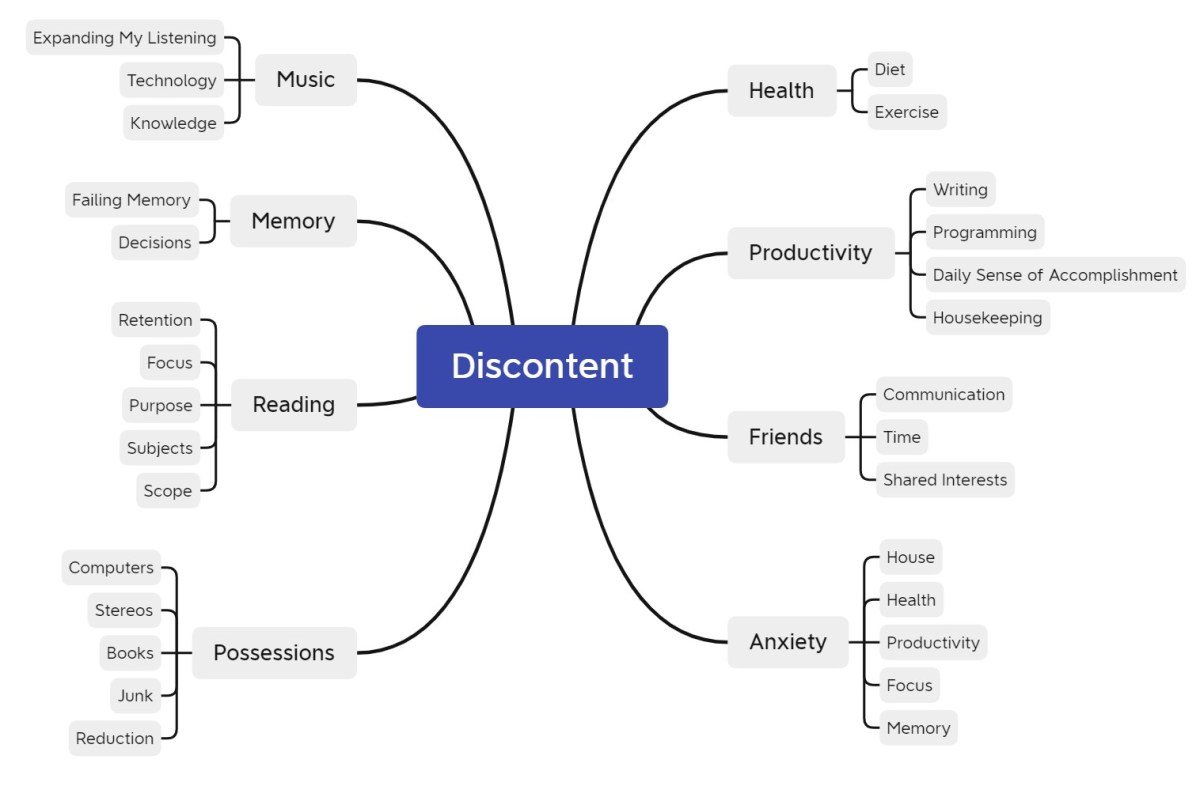
Yesterday I watched a YouTube video about writing morning pages. The idea is to get up and hand-write three pages of stream-of-conscious thoughts. So, I tried it this morning and I realized I have a number of things that make me discontent. And one of the things that make me dissatisfied with my life is not being able to see the big picture of what’s going on with myself. This brings me to this blog. I went to Xmind and created a quick mind map of my discontents hoping to see an overview of what was gnawing at me. You can see the results above.

The seed of discontent that inspired all of this comes from the way I feel each night before I go to bed — about how I spent my day. If I did something that felt productive, I feel satisfied with my day. If I didn’t I feel restless. I like when I have an ongoing project that inspires me to get up and get back to working on it. I haven’t had one of those in a while. My next level of satisfaction comes when I write a blog that I’ve put some good work into creating.

Of course, everything depends on health. Over the past few years, I’ve had to deal with a number of health issues. The walls of my life, my aquarium you might say, are the limitations of my health. When I was younger, that aquarium felt like the ocean itself, but as I grew older it shrank. As an adult, I began to realize my limitations, but the possibilities still felt huge, like I was living in the Atlanta aquarium. In my fifties, it felt more like a fancy 50-gallon deluxe home aquarium. In my sixties an ordinary 20-gallon job. Now when I feel bad it feels like I’m living in one of those bowls people keep goldfish in. When I’m feeling better, I’m back in a basic 10-gallon tank. My health goal is to do as much as I can within the boundaries set by my body. That means a lot of my daily anxiety deals with staying healthy. If I can maintain a certain level of health I feel like it minimizes my discontent. And the more I do, the less discontent I feel.

However, staying healthy juggles so many goddamn variables that it’s stressful to think about what to do to stay healthy. For instance, I watched a video, “7 Foods That Ruin Your Liver” this morning — two of which are among the top ingredients of the protein supplements I eat. Since I have a fatty liver, and sometimes have pains in my liver area, this is another worry. I also have a cyst on my liver. And I have gallstones. Eating carefully has become a very big deal for me.

Luckily, my health problems don’t cause me much discontent, or even anxiety. I’m used to dealing with them. My discontent comes from worrying over what to eat and how to exercise. I want to eat what I like and dislike making myself exercise. What would eliminate that anxiety would be finding a diet that I just stick with all the time, and finding a way to integrate just enough exercise to the minimum needed. Both really come down to discipline, but discipline is a major area of discontent for me.

I’ve been lucky lately, and have been feeling better. Last year wasn’t so good because of health problems and a hernia operation. Because I’m feeling better I feel like I should be doing more. Because I’m not doing more I’m feeling restless and discontent. That’s what came out in my morning pages.

Reducing that discontent and getting back on track will require finding a project to work on. I want something that will take me several days or weeks. Something that will make me feel like getting out of bed in the morning. The one I’ve picked to start on, but I don’t know if I’ll stick with, involves creating a new way to learn, memorize, and visualize a subject. My memory is deteriorating, but it’s never been very good for studying a subject deeply. I read nonfiction books and news articles all the time. But that information goes in and out of my brain almost instantly.

I recently read and reviewed a book about the German romantics. Supposedly, they found a lot of insights that have trickled down to us today. I want to create some kind of visual representation of their ideas and how they connected to other influential people over the last two hundred years. I figure this will kill several birds with one stone. It will touch on four branches of the mind map above: memory, reading, productivity, and anxiety. It might even touch on possessions because I will enjoy using more of my computer equipment, and it might touch on friends because it will give me something to talk about with them.

What I want to do is develop a way to visualize what I read to help me remember the information and convey what I’ve learned to other people.

All of this was inspired by scribbling out three handwritten pages this morning when I got up. Watch the video above, you might find it useful too.

By the way, the level of discontent I feel right now isn’t very high. I have a very contented personality. I find it very easy to just hang out and putter around in life. My greatest discontent has always been not being more ambitious. All I’m doing now is pushing myself to do just a little more.

JWH

Dang, I Broke My TV Watcher

by James Wallace Harris, 11/5/22

I seem to be losing my ability to watch television. In the past year or two, when I try to watch TV by myself, I have the hardest time getting into a TV show or movie. If I’m watching television with Susan or a friend I have no trouble settling into the show, but if I’m alone, I often abandon a show after five or ten minutes. Because I’m a lifelong TV addict used to filling my evenings with the boob tube, this is disturbing.

I’ve got sixty-seven years of solid practice watching TV, so why am I losing this skill now? Some of my earliest memories are of watching TV when I was four. I started watching television with the 1955-1956 season, but sometime in 2021, I began noticing I had a problem, maybe even earlier, but it’s painfully obvious in 2022.

The TV watcher part of my brain has broken. And it’s not for trying. Every evening I try getting into several movies and TV shows. Every once in a while, I find one that my mind will latch onto, but it’s getting rarer. So I’m developing some theories about why my brain is broken.

The Gilligan Island Effect

I loved Gilligan’s Island back in 1964 when it first aired. But as I got older I could no longer watch it. My friend Connell and I use Gilligan Island as our example of being young and stupid. Whenever I catch it on TV now I cringe and wonder how could I ever been so easily amused. That feeling is also true for The Monkees. It embarrasses me to recall those were once among my favorite shows. Now I understand why my dad used to pitch a fit when they were on, telling me and my sister we were morons.

As we age we become more sophisticated in our pop culture consumption. I assumed that development stopped when I got into my twenties because I pretty much watched the same kind of shows for the next several decades. However, with The Sopranos, TV jumped a level in sophistication, and for most of the 21st century, I’ve been consuming ever more sophisticated TV content.

What if my TV-watching mind has gotten jaded with all TV? So everything now feels stupid like Gilligan’s Island did when I got a couple years past twelve?

The TV Buddy Effect

As I said, I can watch all kinds of TV shows and movies if I’m watching them with other people. And looking back over my life I realized I watched a lot of TV with other people. With my family growing up. With friends when I was single. With Susan for most of my married life. With my friend Janis when Susan was working out of town Mondays through Fridays.

When Susan retired and Janis moved to Mexico, things changed. Susan now wants to watch her favorite TV shows from the 20th century and I don’t. So she sits in the living room with her TV and cross-stitches while watching endless reruns of her favorite shows. She likes old shows because she doesn’t have to look at them while she sews. I sit in the den and try to find something to watch on my own. Over the last few years, I’ve had less and less luck until I’m starting to wonder if I can’t watch TV alone at all anymore.

Susan and I do watch some TV together. Around 5:30 we watch Jeopardy and the NBC Nightly News that we record. It’s a family habit and the cats sleep in our laps. On Wednesdays we watch Survivor.

This year I was able to binge-watch Game of Thrones. I had watched it as it came out, and when two of my friends living in other cities each expressed a desire to rewatch the entire series I joined them. I discussed each episode with Linda and Connell in separate phone calls.

The YouTube Effect

Let me clarify something. I can watch about an hour of YouTube a day, and I can channel surf trying to find something to watch for another hour. (By the way, that drives Susan crazy. Another reason she likes watching TV by herself.)

My dwindling ability to watch TV has coincided with my growing love of watching YouTube TV. I have to wonder if watching endless short videos and constantly clicking from one subject to another has broken the TV watcher in my brain, so I can’t stick with longer shows.

The Relevance Effect

Last week I binge-watched A Dance to the Music of Time, a four-part miniseries based on the twelve-novel series by Anthony Powell. I had seen it before, but because I was now reading the books I wanted to watch it again. That seems to suggest if I have a good reason to watch television that I have no problem sticking to a show. My mind isn’t completely defective. I’m now on the fourth book in the series, and I’ve bought a biography of Powell and a character concordance to supplement my reading. The series has over 300 characters.

Knowing the Magician’s Tricks Effect

Another theory I’ve developed deals with my studies in fiction. As I read and think about how fiction works, I’ve paid more attention to how movies and television shows are constructed too. I’ve noticed that I often quit a movie or TV show when I spot the puppeteer. I can hardly stand to watch a mystery or thriller nowadays because they seem so obviously manipulated.

Male Aging Effect

I remember now how my uncles as they got older stopped watching TV except for sports, and even then, still not often. My male friends stopped going to the movies years ago, and I’ve finally stopped myself. I’m now doing what Susan and I used to laugh about her father – going to sleep in his den chair after dinner. Since we bought Susan’s parent’s house when they died, I’m going to sleep in the very same den, around the very same time – 7:30.

Conclusion

Because I sometimes find shows that hook me, I figure my TV watcher isn’t completely broken. I do worry that it will conk out completely. Right now I spend my evenings listening to books or music, and I worry that those abilities might break if I overuse them. I’m thinking my TV watcher needs new kinds of TV content to watch, but I have no idea what that would be.

With so many premium channels cranking out so many kinds of quality shows for the last two decades, I worry that they’ve done everything to death. One reason my mind responded so well to YouTube is the content is very different from regular streaming TV content. But I feel like I’m about to reach the end of YouTube too. I’m starting to think TV shows and movies are like clickbait, that once you’re used to all the variety of bait, you become jaded and stop clicking.

JWH

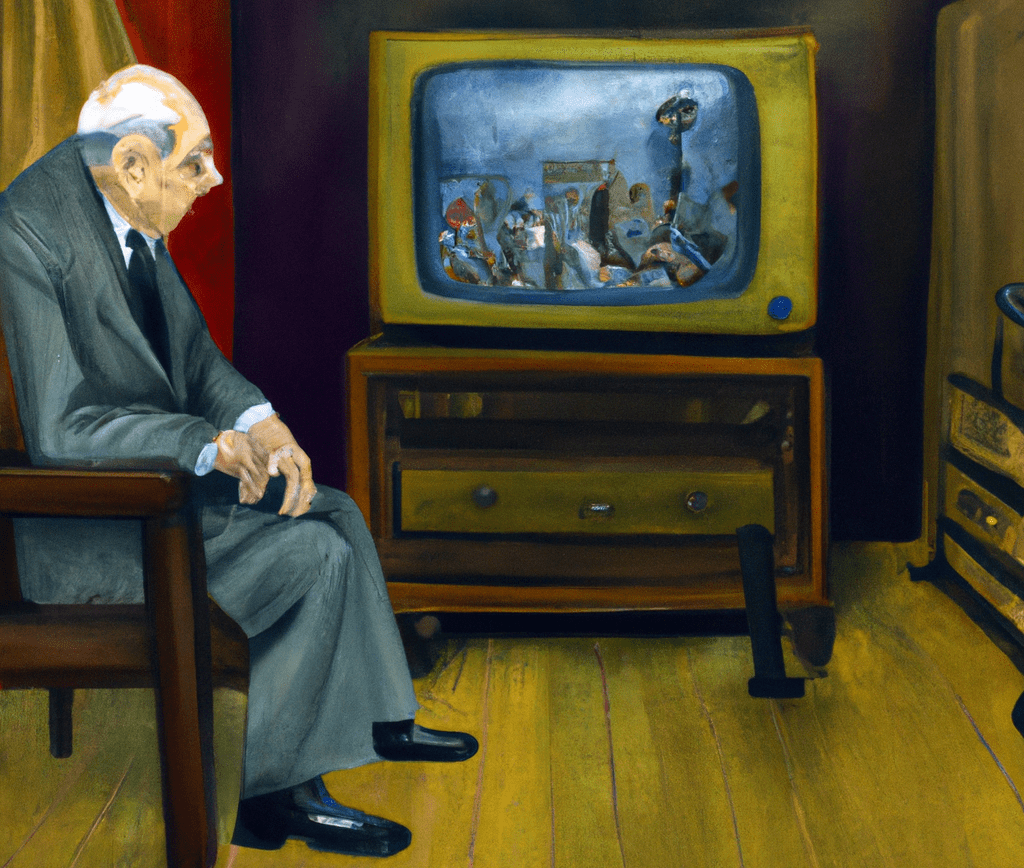
p.s. I’m using DALL-E 2 to generate the art for my blog.