Fiction v. History

by James Wallace Harris, 9/25/22

Ken Burns’s new documentary, The U.S. and the Holocaust, punched me in the soul. No documentary has ever moved me as much, and I’ve seen a lot of them. And it’s not because it’s about the Holocaust. I’ve even read about most of the painful facts it presents before. No, the gestalt of this film, which is well over six hours, is to set off an epiphany about our relationship with history.

At the highest level, the documentary asks: What did Americans know about the treatment of the Jews under the Nazis from 1932 to 1945 and when and how did they learn it? But to answer that question Ken Burns and company have to describe what Americans were like during those years. The U.S. and the Holocaust give a different history of America for those years from any I’ve ever encountered from people, in school, reading, at the movies, or on television.

Maybe the best way I can describe it is to say: Everything that has horrified me about living through the years 2016 to 2022 existed in the 1920s, 1930s, and 1940s. The documentary cements a theory that I’ve been developing in recent decades – that people don’t change and even the percentages of the population that hold specific opinions don’t really change either.

The documentary set off this existential conundrum: Why didn’t I already know what the documentary revealed? Or did I just filter it out? Republicans are in an uproar over Critical Race Theory and other curricula that they’re afraid will upset their children. I imagine they will be just as upset at The U.S. and the Holocaust. I knew about the wide popularity of the KKK and eugenics in the 1920s. I knew Americans were mostly isolationists and anti-immigration in the late 1930s. But the documentary gives us a different take on history than what I was taught.

I have to wonder since FDR was president from 1932-1935, have we always gotten the Democratic party’s view of that history? I wonder if Ken Burns has rounded out the historical period by adding the Republican party’s take on those years? I do know the documentary feels very synergistic with today’s politics.

I love old movies from the 1930s and 1940s, and none of the hundreds of movies I’ve seen from that era convey what I learned from The U.S. and the Holocaust. My grandparents, parents, aunts, and uncles, all lived through those years, and none of them ever described the mood of the country revealed in the documentary. I’m a bookworm that has read countless works of both fiction and nonfiction about America in those decades, giving me some of the details from in the documentary, but not in the same gestalt. Two books that come to mind are One Summer: America, 1927 by Bill Bryson and In the Garden of Beasts by Erik Larson.

After I watched the Ken Burns documentary I read The Plot Against America by Philip Roth. It’s a kind of science fiction novel, an alternative history where Charles Lindbergh wins the 1938 presidential election and for many of the reasons described in the documentary. Roth was born in 1933, and he makes himself the point-of-view character in his novel. Young Phil is only 8 when it begins and 10 when it ends, but his viewpoint is mature. It’s about the anti-Semitism of those years.

I thought The Plot Against America was a well-told story about Jewish life in Newark, New Jersey 1938-1942. I thought Roth’s alternate history speculation was well done, deriving from the kind of knowledge I got watching The U.S. and the Holocaust. But the story is mainly a personal one, and its gestalt is different from the documentary.

Last night Susan and I watched Radio Days for the umpteenth time. It’s Woody Allen’s nostalgic look back at those same years. It completely ignores all the political history of The U.S. and the Holocaust. Radio Days is like both movies from that period and later films that worked to recall that era. They all filter out the nastiness of racism and xenophobia that existed in America back then. Although some of it came through in the film The Way We Were, and the book version of Breakfast at Tiffany’s.

And just before I watched the three episodes of The U.S. and the Holocaust I read Revolt in 2100 which contains a 1940 short novel by Robert A. Heinlein called “If This Goes On….” Heinlein imagined America would go through decades of The Crazy Years, before undergoing a second American revolution that created an American theocracy. I was disappointed that Heinlein didn’t do more world-building for his novel, but after seeing the Ken Burns documentary I understand his inspiration for writing it. It’s obvious that many Americans back then wanted a Protestant theocracy. Consisting of only white people from England, Germany, and some Scandanavian countries.

I think it’s important to distinguish fascism as a political philosophy from the Nazis, who were also fascists. What many Americans wanted then and now is basic fascism, and the Philip Roth novel shows how America could have turned fascist.

The other day I saw a quote on Facebook that went something like this: If you get warm and fuzzy feelings reading history then you’re not studying history. I’m on the third volume of world history by Susan Wise Bauer, and it’s brutal. Most people want to romanticize history, which is what we get from novels and movies. The Republicans don’t want CRT taught because they want their kids to feel all warm and fuzzy studying American History. The new Ken Burns documentary will not leave you feeling warm and fuzzy.

My current theory is humans can’t handle reality. That we develop all kinds of psychological delusions to filter reality out. We prefer our fantasies. And popular history along with pop culture gives us nice takes on the past that allows us to cope. It’s also why most people’s theory of how reality works is no more complex than a comic book. It’s why we’ve always clung to religion. It’s why I have a life-long love of science fiction.

We just can’t handle complexity. There are plenty of real history books that document the reality of the times they cover, but they aren’t widely read. Maybe the Republicans are right, and history is too brutal for children. But maybe we keep repeating history because we’re all too wimpy to handle history.

I’m getting so I can’t stomach the historical lies of Hollywood, but I don’t know if I can handle all that much real history either. I used to think that maybe four percent of the population was mentally ill. In recent years, I’ve upped that to forty percent. But lately, I’m thinking there’s an entry for all of us in the DSM-5.

JWH
Getting Too Close to Helpless

by James Wallace Harris, July 14, 2022

For this essay, I’m defining helpless as being in a situation where we can’t help ourselves or get help from someone else. As I get older I worry that someday my wife Susan or I will find ourselves in a completely helpless situation. This weekend it almost happened. Our hot water heater in the attic broke and water was pooling on the sheetrock of the ceiling above my computer room. A seam then spread open and water was draining onto the floor. Susan and I had to find a solution fast and several times I wasn’t sure we would.

First, we were lucky I discovered it so soon. I have an overactive bladder so I’m frequently going back to the bathroom which is annoying. But in this one instance, it put me Johnny-on-the-spot as I went down the hall to the bathroom. The pool of water was only in the middle of the floor.

I yelled to Susan and ran into the kitchen and pulled the filled garbage bag out of the tall kitchen trash can and ran back and put that under the water flow. I saw that it would fill pretty fast so I ran back to the kitchen and got the recycle bin and dumped the contents out on the floor and took it back to the room. By then Susan was there with a pile of towels.

I then went out into the hall, pulled down the attic stairs, and rushed up into the attic. The hot water tank is right next to the stairs and I could see the overflow pan was full and not draining. Damn. I went back down the stairs and ran outside and unscrewed the hose from the outside faucet and dragged it back into the house and up the stairs and connected it to the flush drain. It didn’t have a faucet handle but a slot so I yelled for Susan to get me a large screwdriver. I tried to turn off the hot water heater but it would only let me shut it down to pilot light. For some reason, I couldn’t make the button turn to the off position. I looked at the pipes and saw a red handle so I turned it all the way to what I hoped was an off position. When I had the screwdriver I opened the flush faucet and water started spraying everywhere from a leak in the hose connection. I turned it off.

Two weeks ago my back was hurting so much, that I could barely walk, so I was thankful I was able to be going up and down the stairs. I was moving at a frantic pace but I was calm. I wondered what would have happened if I couldn’t go up the stairs. I don’t trust Susan on the attic stairs. It was then I realized I could be helpless. If I couldn’t fix this problem I had to get someone else. Help means either doing it yourself or finding someone who could. I was suddenly scared I couldn’t, and we’d be helpless. I know this is a minor emergency, but it was enlightening.

Then I went back down the stairs and called our regular plumber. I told them immediately I had an emergency of running water but they made me give me my information first before they told me they couldn’t have someone out until Monday. It was Saturday afternoon, but I thought it was Friday. So I called another plumber thinking I might catch someone still there. The same thing happened. Wanted my information before telling me the soonest would be Monday.

I got some duck tape and went back upstairs and wrapped the hose. I turned on the drain again. It didn’t shoot water. I went outside and saw that water was coming out of the hose. I then went back to the computer room and dragged the first bucket to the front door and emptied it on the front porch. I took the empty bucket and swapped it for the full and emptied it.

I felt I had a bit of breathing room. Then Susan said she still heard running water.

I went to the computer and looked up emergency plumbers. I found one that claimed 24/7 service and called them. Same thing. Can’t come until Monday. I then ran to the hall closet and got my T-wrench and went outside to the street to turn off the water to the house. However, I couldn’t get the valve to budge. I figured I had to call MLG&W to come shut off the water. I didn’t want to do that because I didn’t know how long they would take to get here, and I didn’t want to go days without water.

I went back upstairs and realized that I had shut off the gas, not the water. I started looking around. This time I looked at the top of the water tank, which almost goes to the ceiling of the attic. There I saw water spraying from around the intake pipe, but I also saw another turn-off handle. I gave it a quarter turn and the water stopped running.

That gave me a sense of release. The flow of water from the computer room ceiling slowed, and in about fifteen minutes it stopped. I called the plumber and made an appointment for Monday.

However, I kept wondering what would have happened if I hadn’t been able to shut off the water. What would we have done? What would Susan have done if I wasn’t home? She probably would have called a neighbor, her brother, or MLG&W. I pictured us taking turns swapping filled buckets all weekend, even taking sleeping shifts at night.

It’s incidents like this when I want more control. I should have been prepared. I should have known where the water shut-off to the tank was located. I thought I was prepared by buying the tool to shut off the water at the street. When the plumber came Monday I ordered a new tank and ordered an automatic shut-off device that works with a water sensor in the overflow pan. I also ordered a new overflow pan and all new drainage pipes. But is that enough? I prefer not to deal with another computer room flood. This was the second. Years ago the HVAC installers made the mistake of putting in the condensation pan at a tilt – a tilt away from the drainage outlet.

We don’t have complete control of our lives. On the news that night there were stories about flooding in the east that ruined entire homes. Our flooding was nothing, so I was thankful. However, knowing we can’t control everything doesn’t stop me from worrying about becoming helpless. One sight that always scares me when I see it on the news is when first responders have to rescue old helpless people.

I know I’m worrying about the inevitable, but that doesn’t stop me from worrying. It doesn’t stop me from thinking of ways to be prepared. If I designed houses I wouldn’t put the HVAC and hot water heater in the attic. Every house should have a little machine room on the ground floor, with a floor drain and sensors for flooding. This house has had a hot water heater in the attic since 1952 and things have been mostly good 99.9999% of the time.

Getting old has made me worry about my body breaking down or my house breaking down. I realize there are things I can do to help myself. I also realize there are things I depend on Susan to help me do. And I know there will be other things I will have to depend on friends or hired help. This flooding incident has made me think about the times I might not find any kind of help. Generally, that’s never a problem because we have each other. But it’s a thought.

JWH

Just Who Slept With the Pods?

by James Wallace Harris, 5/14/22

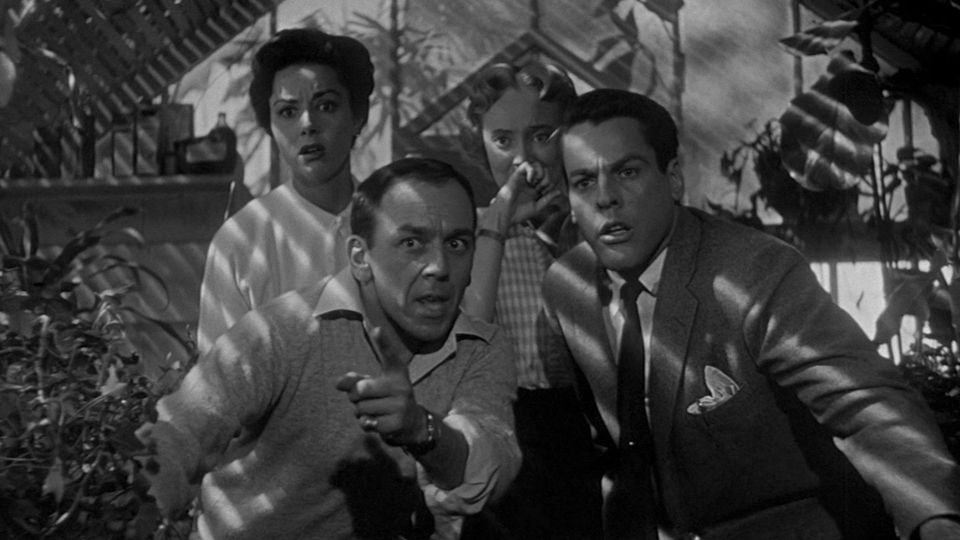
In the 1956 film, The Invasion of the Body Snatchers, Dr. Miles Bennel (Kevin McCarthy) realizes his friends and neighbors are changing. One by one they all start thinking alike and that worries him. If you haven’t seen this famous film about the pod people you should. It’s based on a 1954 Collier’s serial by Jack Finney called The Body Snatchers, which was then published as a book in 1955.

The story is about an invasion of pods from outer space that transform people if they sleep in the same room with one. Back in the 1950s, the story was seen as an allegory about communism. Finney has said he didn’t target communism specifically when he wrote the book, but most readers and moviegoers did back then.

In 1951, Robert Heinlein had published a similarly themed novel called The Puppet Masters. In that story, flying saucers land with creatures that attach to our backs, and take over our bodies and minds. Heinlein was an arch anti-communist, and his story was intended to imply the evils of a commie takeover.

In 1953 Robert Sheckley’s story, “Keep Your Shape” reflected a liberal’s paranoia. It appeared in the November issue of Galaxy Science Fiction. Sheckley rewrote the story for his collection Untouched by Human Hands and gave the story a much more elegant ending and a different title, “Shape.” It’s a humorous story told from the aliens’ point of view, about how they invaded the Earth twenty-something times and always failed. The aliens come from a rigid society of shape-shifting creatures whose God dictates that everyone has to maintain a certain shape. On Earth, the aliens are corrupted by our freedom when they see that we take so many different shapes. Sheckley’s story was anti-establishment and anti-conforming.

My point in mentioning all these stories is I feel like the conservatives have been sleeping with pods or have an alien riding on their backs. I feel this because they all seem to speak the same way. It’s kind of creepy to see political ads for Republicans because they all claim to toe the party line better than any other Republican. They all claim to hold the same beliefs. And their followers all repeat the same soundbites. I’m sure conservatives feel the same way about us liberals.

A couple days ago The New York Times ran a book review called “Where Have All the Liberals Gone?” The conservatives have made the term liberal such a dirty word that liberals are now calling themselves progressives. Conservatives have aligned themselves so tightly with Donald Trump that it reminds me of the fanatics who follow Putin and everything he says.

It makes me feel like the Kevin McCarthy character wondering when I will fall asleep and wake up a pod person. I no longer think of communism when I watch Invasion of the Body Snatchers, I think of everyone following one leader, one strong man’s view. If you look at history, the dangerous horrors of the past didn’t come from ideologies, but from single men pushing their view of reality onto everyone else.

I no longer understand what conservative or liberal philosophies means, even if they ever had a consistent description of their goals. I’m now thinking it’s always been individual men pushing their own philosophy onto other people. (I use the word men because I can’t think of any women dictators in history. I hope women won’t mind me being sexist in this instance.) That’s why Trump is so popular – people resonate and relate to him. He is their political philosophy, no matter how you label it.

I want a true democracy. But I don’t think it will ever work when winning is defined as a 50% majority. I think it needs to be at least 60%, and better yet, a winning majority should be defined at 75%. I want to live in a society where we work to compromise and create laws that attempt to make 100% of the population happy. It will always fail to reach 100% agreement, but if we could work out compromises where 60-75% of the population come to some kind of agreement, then I think we could escape our never-ending political polarization.

Right now we vote for our self-interests. And we vote for candidates that come closest to those self-interests. I have to accept that Trump is a beacon shining on what a lot of people want. But as long as half the country wants something different we’re going to have a miserable society.

When 50% is the finish line for any political agenda, we’re going to be ruled by pod people. I think real democracy begins when 75% of the population hammers out good compromises. I don’t think one politician with one point of view could ever find that many followers. Maybe we should move away from politicians and have referendums on everything. If we can’t find ways to get three-fourths of us to agree, then we should do anything.

It doesn’t matter which side of the political spectrum you live on, if we have minority rule, or even 50% majority rule, half the country will always feel they are living with pod people.

JWH

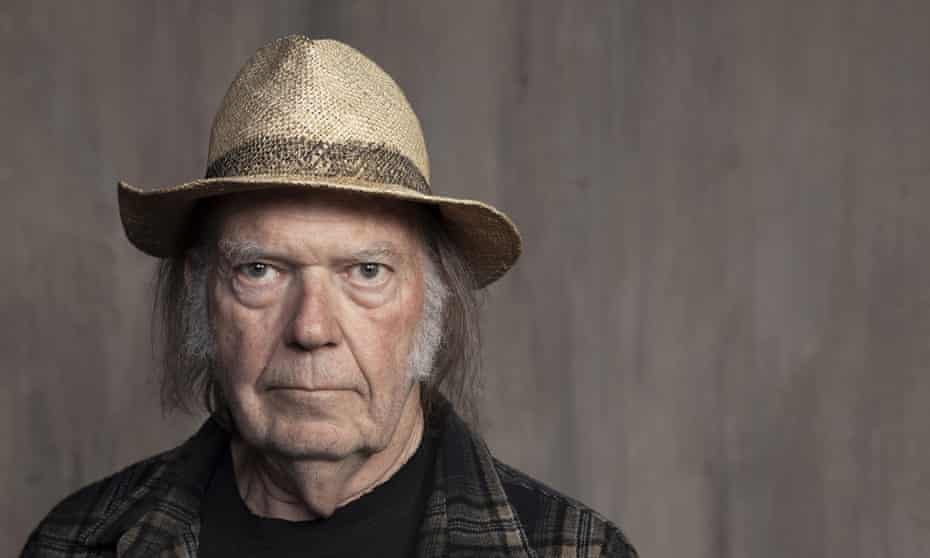
Is Neil Young’s Spotify Protest Censorship?

by James Wallace Harris, 2/2/22

I’ve noticed an interesting overlap in two news stories over the past week. One was Neil Young’s demand that Spotify removes Joe Rogan’s podcast, and the other was about parents demanding books be removed from Texas schools. Since I’m against banning books should I also be against banning podcasts? Just because I love Neil Young’s music should I follow his protests?

I know next to nothing about Joe Rogan other than he said healthy young people shouldn’t need to get the Covid vaccine. That’s truly bad advice that could get some young people killed. But is censoring Joe Rogan the answer? I find controversy-driven talk show hosts to be repugnant. I just ignore them. But what if we did live in a world where we could shut up everyone we didn’t want to hear?

The problem is people on the right want to suppress certain ideas, and people on the left want to suppress other ideas. In both cases, those folks think they are doing good. I believe ideas should battle it out in the open. If a talk show host or book author says something that upsets people, should we censor them? Or should we evaluate what they have to say and decide for ourselves what we want to believe?

We do have certain kinds of censorship. We put the kibosh on false advertising, libel, slander, or any action that leads to provable damaging results.

Are there cases where young people have died, and their parents could bring a class action suit against Joe Rogan? With all the social media evidence, I suppose documentation where young people left evidence saying they didn’t get vaccinated because of Joe Rogan. But isn’t that for the courts to decide?

What Neil Young, Joni Mitchell, et al have done is assume this danger is true and are fighting against it. That seems honorable. But I’m sure the parents and supporters of banning books feel they are equally honorable. I admire people wanting to do good, but I often feel they aren’t

On the other hand, I had a completely different take on the Young-Spotify issue. I was offended by Spotify regarding Joe Rogan for an entirely different reason. I love Spotify but I’ve always felt guilty when I hear claims that it doesn’t pay music creators fairly. To pay some blowhard $100 million for a podcast when Spotify is accused of paying musicians $50 royalty checks is hard to accept. Why isn’t Neil Young protesting that? However, I have heard other musicians say they are paid well by streaming services, and those complaining performers have never been given proper royalties. Evidently, dividing the pie has always been unfair in the music business.

It’s mind-boggling to me that talking heads get more money than musicians.

If recording artists pulled their music catalogs to protest bad pay, I could understand their attack on Spotify. Is Joe Rogan getting more pay per play than hit songwriters? That would be disturbing. Does society really value the opinionated over artists who gave us songs we’ve loved an entire lifetime? To me, Carol Kaye deserves $100 million far more than Joe Rogan.

I also must wonder if Neil Young and his musician friends are only hurting their fans. Spotify now skips their songs when they come up in my playlists. I never wanted to listen to Joe Rogan, but now I can’t hear Neal Young on Spotify.

I bought all of Neil Young’s albums and CDs for decades, and I could go back to listening to them now, but streaming is how I listen to music nowadays. I hardly ever use my turntable or CD player. Luckily, I subscribe to more than one music streaming service.

My protest to Spotify is they should pay the musicians more, even the ones that originally got bad contracts. I love the idea of a universal listening library for rent. It’s too damn convenient. That’s why I subscribe. I want access to all music. I don’t care about anything but the music.

JWH

Identifying the Best Books from 2021 to Read in 2022

by James Wallace Harris, 12/18/21

December is the time when we get loads of best-books-of-the-year lists. I enjoy looking at all those lists because I love finding the books that are the most recommended. I can’t read everything. I can’t even read everything that’s great.

I’m lucky to read 4-6 new books as they come out during the year, and sometimes they are among the ones critics have loved. That’s satisfying. For any given year I probably read 10-12 of its best books, that’s including fiction and nonfiction. That’s out of thousands of books published each year, so I get a microscopic sampling of books published. That’s why I work to find the best books, and by best, I mean the most talked about, the most recommended, the most newsworthy books.

I read on average one book a week, or 52 books a year. Most of them are older books, usually from the 20th century, sometimes from the 19th, and on rare occasions even older. I don’t want my head stuck completely in the past, so I try to read 10-12 books each year from the most recent two years. I usually discover a handful of books as they appear during the year, and then identify several more to read in the following year from the end-of-the-year lists.

Over time I’m discovering the most useful best-of-the-year lists. Here are the lists I’m using this year:

Books We Love – NPR. NPR lists over 2,800 books, but they provide a filtering system to help you zero in on the ones you might prefer. Their site has yearly lists back through 2013. Just the button for Staff Picks lists 179 books, that’s way too many. What I do is study the covers. And then go on to other best-of-the-year lists. It’s like the old TV quiz show Concentration, I try to spot covers again from memory. But instead of finding the pair, I try to find covers that are shown on the most lists.

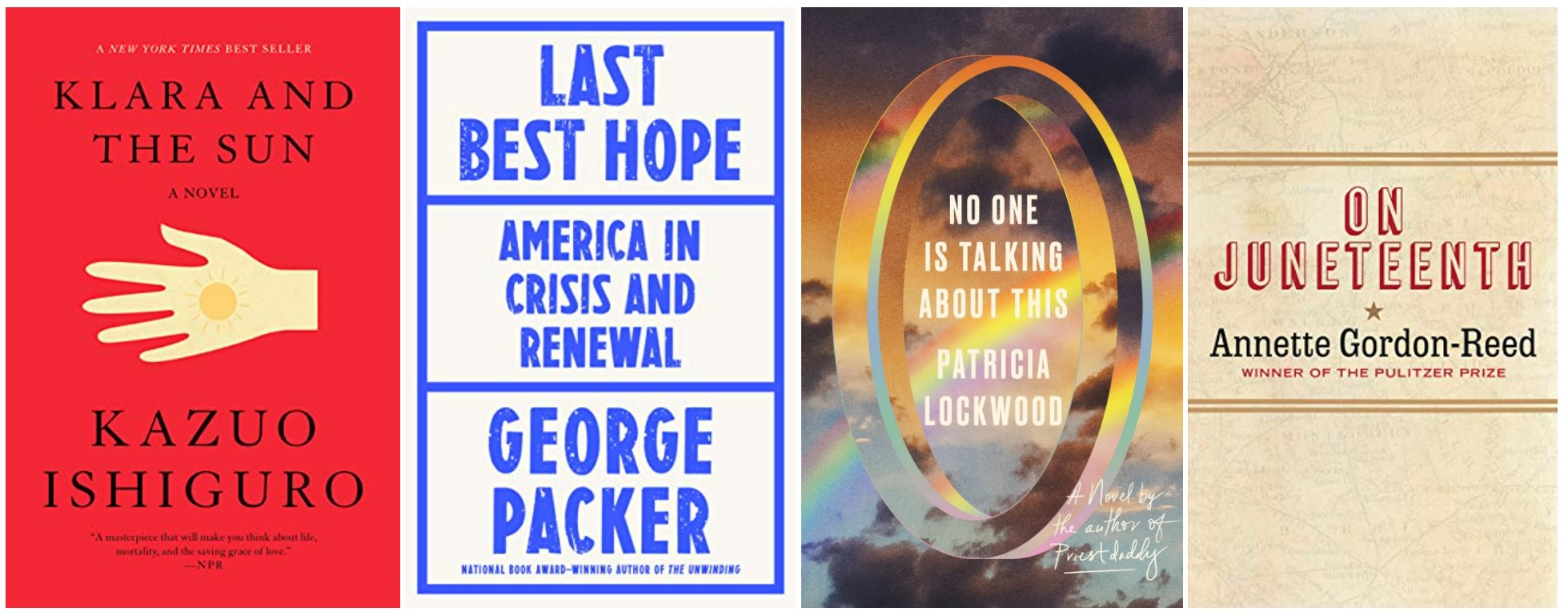
Of their Staff Picks I’ve already discovered the following during 2021:

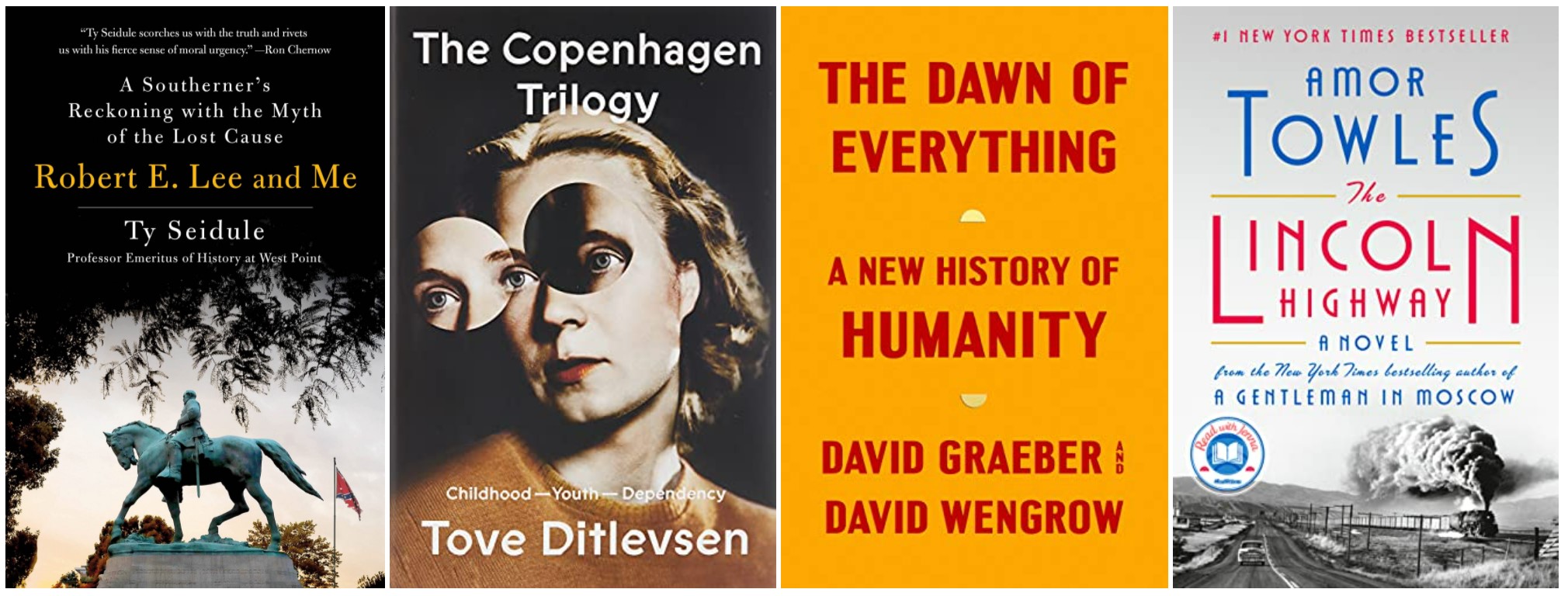
New York Times Critics’ Top Books of 2021. This is another very long list. But they also offer another shorter list, The 10 Best Books of 2021. Sadly, the long list doesn’t include cover photos, so it’s harder to play my Concentration cover game, so reading the short paragraphs about them is important. And The New York Times even offers an even longer list, 100 Notable Books of 2021, this time with covers. The critics at the Times picked many of the books the NPR critics picked, and many books I’ve already heard some word of mouth. These are the ones I want to try so far:

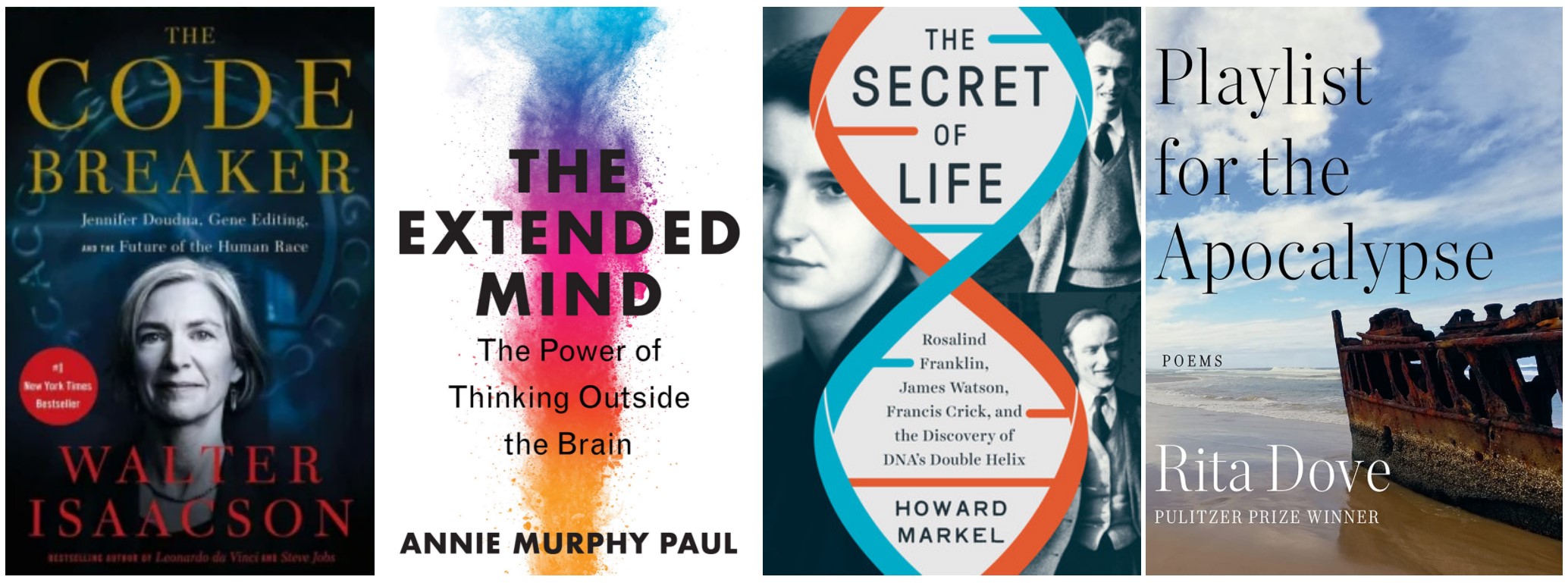
Vogue, Vulture, and Time have recommendations that are often similar to NPR and The New York Times. Time also recommends another book I’ve already read: The Code Breaker by Walter Isaacson. That makes me feel I did pretty good finding books coming out during 2021. And they recommend Empire of Pain: The Secret History of the Sackler Dynasty by Patrick Radden Keefe that’s been on most of these lists. I’m just not interested in that subject, but with so many recommendations I feel maybe I should try it. These lists also reinforce the books I list above that I already want to read.

Publishers Weekly has a website system like NPR that recommends way too many books to consider but has a filter system to narrow things down by genre and interest. Their database goes back to 2010, and their lists have links to the original reviews. Once again I’m seeing the same covers of books I’ve been wanting to read, but I’ve spotted two additional books to add to my list from their Top Ten List: All That She Carried: The Journey of Ashley’s Sack, A Black Family Keepsake by Tiya Miles and The War For Gloria by Atticus Lish. I’ve been remembering those two covers from the lists I’ve been seeing, and their descriptions are enticing.

I believe I’ve found a total of 23 books from 2021 that interested me most, and I’ve already read 7 of them. That leaves 16. I doubt I’ll get all 23 books read in the coming year. It depends on how many 2022 books attract my attention first, or how mired in the past I become. If I read all 23 that will double my normal current book consumption habit.

There is one last list to mention, Goodreads Choice Awards 2021. These are voted by members of Goodreads. Sometimes the bookworms pick the same books as the critics, and sometimes not. However, this list at Goodreads uncovers a lot more fun genre titles.

Lastly, I’ve discovered that if I keep these recommended novels in mind, sometimes they appear in sales at Bookbub, or in the Kindle Daily Deal, or on Audible. Also, many of them come to Scribd, a book subscription library. I think of Scridb as Netflix for books. Five of the sixteen books I want to read are already available at Scribd. It’s a bargain at $9.99 a month.

JWH