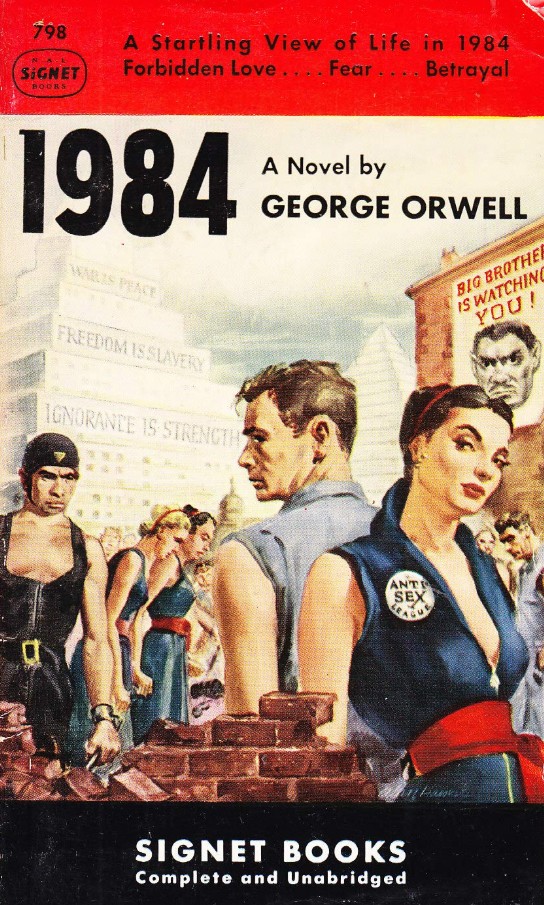
Do You Trust What You Read?

by James Wallace Harris, 8/4/25

Yesterday I tried to remember what I thought about as a young kid. I recall a few incidents when I was three, but I don’t start having many memories until I was around twelve or thirteen. The earliest age I can recall being philosophical is from that same period. Before twelve, I can’t remember thinking about things. I probably did. Very young kids are notorious for asking why.

But then I thought of something. It was around age eleven or twelve that I started reading books. The first books I chose were nonfiction about airplanes, space travel, dinosaurs, submarines, cars, and other things that boys like in the fourth and fifth grades. Fourth grade was 1960-1961. I turned ten in late 1961. In the fifth grade (1961-1962), I discovered fiction. Especially, the Oz books by L. Frank Baum and the Tom Swift, Jr. series. In the sixth grade (1962-1963), I got hooked on biographies and a few science fiction books.

It seems obvious that reading inspires thinking.

It was around the sixth grade, or the beginning of the seventh grade, that I can remember thinking about the world. During the seventh grade, and into the eighth, I became an atheist. I remember agonizing over that issue. What I heard in church and from my mother didn’t match what I was experiencing. Nor did it match what I was learning in school or what I was reading. I didn’t read any books on religion or against religion. All the ideas I consumed, especially from books, made me think.

Here’s the kicker. I read a lot of crappy books with crappy ideas, and they infected me. Ideas about flying saucers, reincarnation, ESP, and remembering past lives, like in Bridie Murphy. Most of this came from my uncles, my father’s two brothers.

After rejecting religion, I eventually rejected the occult, spiritualism, and psychic abilities. I rejected them because I read more science books and science fiction. I was skeptical of what was in the science fiction books, but I wanted to believe many of SF’s stupid speculations about the future. The genre promised a more exciting reality that competed with religion.

I didn’t become truly skeptical until many years later. Maybe when I encountered the magazine, The Skeptical Inquirer.

The point I’m trying to make, with this long introduction, is to explain how I was overwhelmingly influenced by what I read. Even after a lifetime of skepticism, I’m easily swayed by concepts I got through books and magazines.

Of course, I’m also susceptible to ideas from my peers, television, and the Internet. Whenever I hear about a neat concept, one that sounds like it helps explain reality, I want to embrace it. I’m easily persuaded by intellectuals and studies that claim to be scientific.

Decades ago, I decided that science was the only cognitive tool humans had developed to explain reality in any consistent fashion. Science is statistical. It doesn’t offer conclusive answers. To truly understand science requires a great deal of science and mathematics. I don’t have those skills. I depend on popular science, and that isn’t the same thing. Accepting an idea based on popular science is similar to being religious and taking a theological concept on faith.

The only way to be scientifically minded without being a scientist is to look for the most consensus among scientific authorities. And this is true for understanding everything that doesn’t fit under the scientific microscope, such as politics, law, ethics, and creating a sustainable society.

Since 2016, I’ve decided that humans are all delusional, including myself. There are dozens, if not hundreds, of ways to be deluded. I decided I couldn’t trust the Internet or television. That I would only trust quality periodicals that had solid editorial policies. Unfortunately, such magazines and newspapers are going out of business.

People no longer want to pay for information. Television and the Internet have conditioned Americans to consume free information. And if you can’t see how that is destroying us, then that’s another delusion you are suffering from.

Humans eagerly embrace untrue concepts that support their desires. We even have labels for that delusion: confirmation bias, wishful thinking, motivated reasoning, and cognitive dissonance reduction.

I’m reminded of what the Jeff Goldblum character said in the movie, The Big Chill. “I don’t know anyone who could get through the day without two or three juicy rationalizations. They’re more important than sex.”

I want to separate myself from my rationalizations. The only way I can think to do that is by reading significant research. What I think depends on what I read. That means being extra careful with selecting my reading.

It also means I need to support the periodicals doing the best job of explaining reality.

JWH
Pop Culture vs. Social Media

by James Wallace Harris, 1/1/25

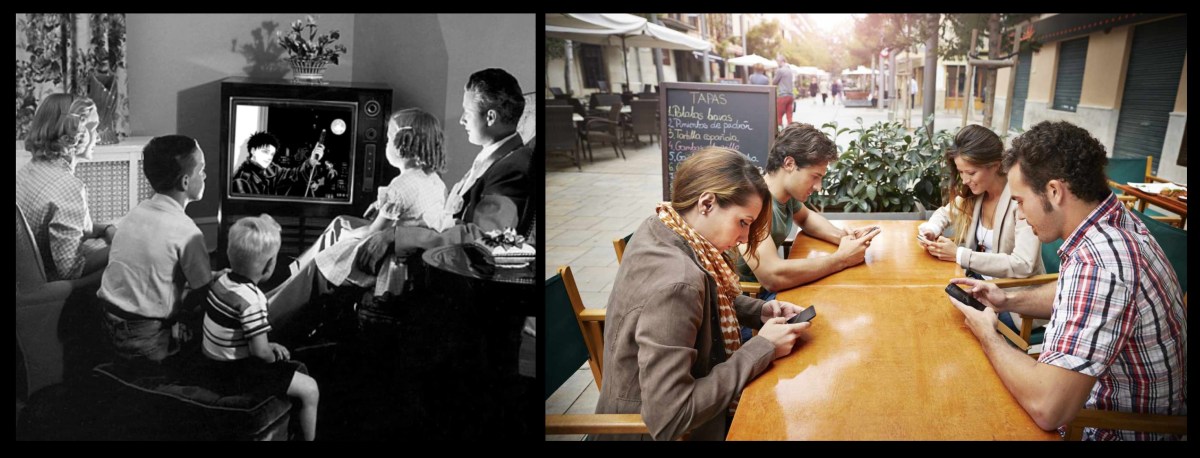
I began pondering the differences between generations that grew up with pop culture versus generations that grew up with social media when playing Trivia Pursuit. I then noticed the same differences while watching Jeopardy. Pop culture is about what most people know, while social media is about knowing the details of subcultures.

I’m often surprised by how much young contestants on Jeopardy know about the 1960s and older pop culture, but old and young players are very selective in their knowledge of 21st-century trivia. For years, I thought people my age just couldn’t keep up with popular music after 1990 because of changing mental conditions. But now I wonder if it’s because popular music shattered into countless genres appealing to various subcultures. In other words, there became too many art forms to remember their trivia.

I was born in 1951 and my personality was shaped by the pop culture of the 1950s and 1960s. Pop culture was primarily television, AM radio, movies, books, newspapers, magazines, and comics. People watched the same three television networks, CBS, NBC, and ABC. They often saw the same hit films and listened to the same Top 40 songs. They usually read a single daily paper. Some people read books, usually, paperbacks bought off twirling racks which sold in the hundreds of thousands, if not millions. The most common magazines seen in people’s homes were National Geographic, Reader’s Digest, Saturday Evening Post, Life, and Time.

The by-product of that limited array of pop culture was people within a generation shared a common awareness of what each other liked. You might not watch Leave It to Beaver or Perry Mason, but you knew what those shows were about.

People growing up since the Internet, especially since the explosion of social media, didn’t have popular culture, they had social media that focused on subcultures. Social media might be all about sharing, but people’s shared interests have broken down into thousands of special interests. People on the internet crave contact with others who share their interests, but no one group, not even Swifties, makes up a popular culture.

There are songs on Spotify with billions of plays that are completely unknown to the average American. The Academy Awards now nominate ten pictures for the Best Picture category, but most Americans have seldom seen them before they were announced. Hundreds of scripted TV shows are produced yearly yet it’s quite easy for all your friends and family to have a different favorite. My wife and I struggle to find shows we’re willing to watch together.

Mass media has broken down into specialized media devoted to subcultures.

Pop culture was a product of mass media. It inspired group identity through common knowledge. I’m not sure it exists anymore.

Social media is a byproduct of individuals trying to find others sharing similar interests. It isolates people into smaller groups. It promotes individual interests that limit people’s ability to overlap with other people’s interests. It makes people specialize. You become obsessed with one subculture.

I wonder if the MAGA movement is unconsciously countering that trend. They think they want to return to the past, but what they want is to be part of a large group. Their delusion is believing that if everyone looked alike and thought alike, it would create a happier society. I’m not sure that’s the case. The 1950s were not Happy Days, and the 1960s wasn’t The Age of Aquarius.

I’m not sure that happiness comes from the size of the group you join. Some happiness does come from interacting with others and sharing a common interest. I also think people might be happier knowing less about subcultures, and more about pop culture. But that’s just a theory.

Could people withdraw some from the internet to become more physically social? I don’t think we can give up on the internet, but do we need to use it as much as we do?

I liked it when my friends watched the same TV shows or movies. I also loved that my friends knew about the same albums, and would play them together, or go to the same concerts. Pop culture was popular culture. Will we ever see that again? And is that a delusion on my part. Am I only remembering a more social time from youth that naturally disappears after we marry?

JWH

Meditating on a Meme

by James Wallace Harris, 11/28/24

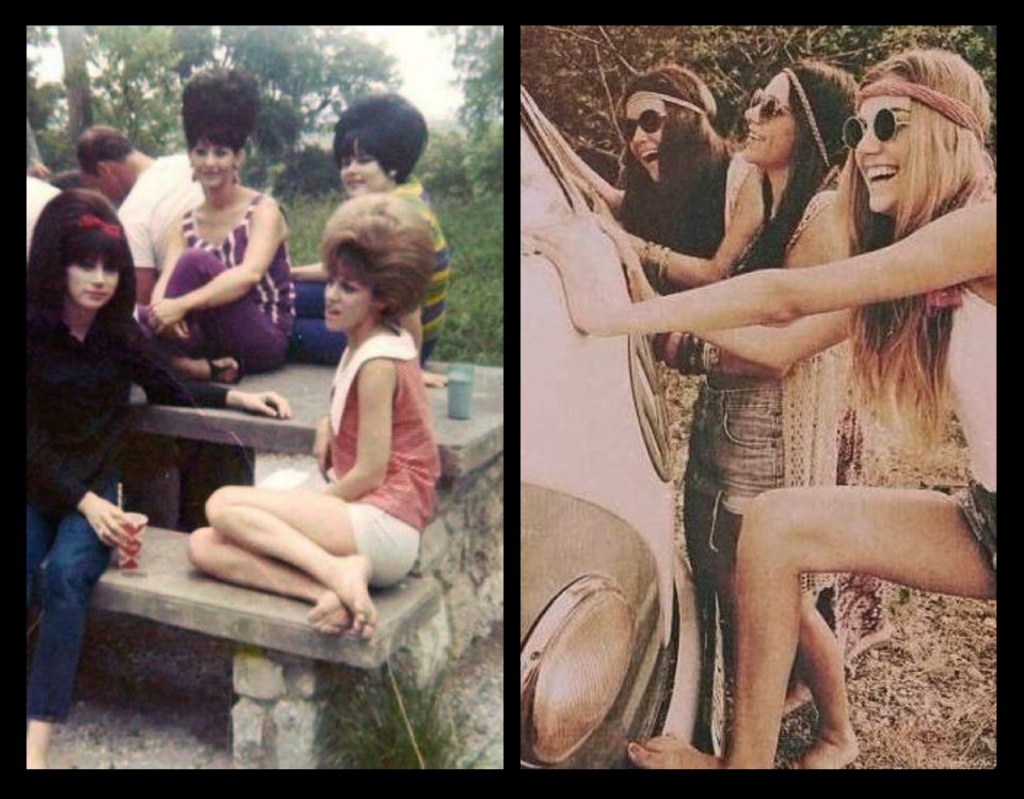
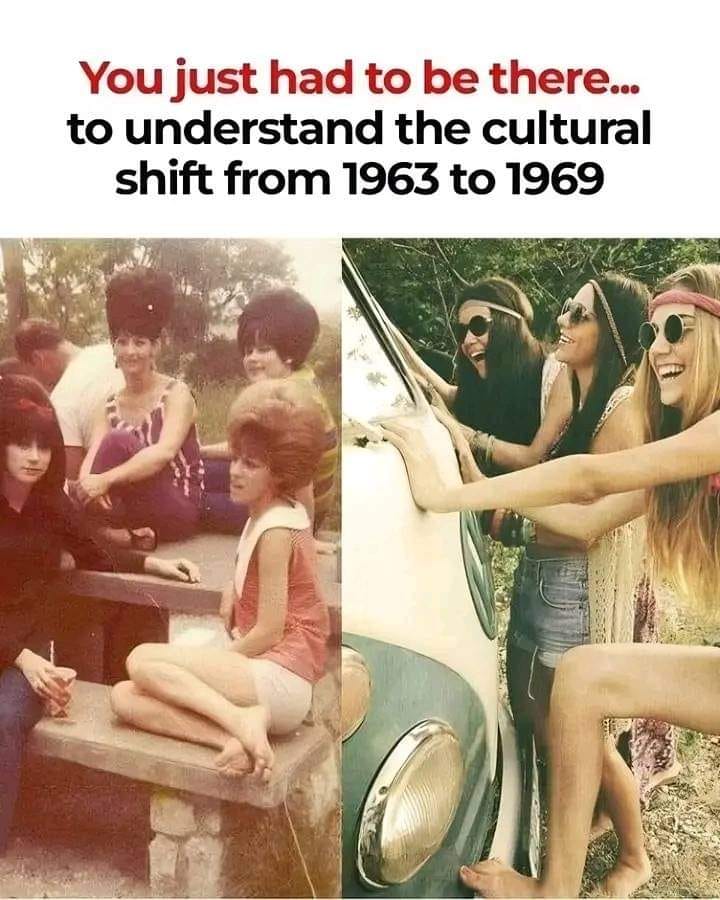
Seeing the above photos as a meme on Facebook made me think about how much people, society, and pop culture changed in the 1960s.

If a picture is worth 1,000 words, then are two pictures only worth 2,000 words? I don’t think so, I think it’s 1,000 words times 1,000 words, or 1,000,000 words. I could easily write that many from all the ideas my mind has generated since I began meditating on those photos.

Here’s the original meme from Facebook:

I was eight on 1/1/60 and eighteen on 12/31/69. I have always thought the longest years of my life were from 1963 to 1969 because so much happened to me and the world I lived in during that time. For folks who didn’t grow up in the sixties, it was much more than what you can learn from watching Grease or American Graffiti and contrasting it with Hair or Woodstock.

When I first saw the meme above I instantly thought about how rock and roll music of the 1950s ended up becoming the rock music of Woodstock. I’ve tried several times just to write an essay about that, but after typing over 5,000 words, I realize I’ve barely hinted at what I could say. That’s too long for a blog post.

I recommend that you find two photos that bracket your adolescent years or the decade you identify with the most and meditate on them. Start with remembering every place you lived and what you did each year. Remember your family and friends, your pets, your homes, your schools and workplaces, the clothes you wore, all the activities you pursued, everything you wanted to buy. Then write the shortest essay that makes it all coherent. You will then feel the mental anguish I am feeling right now.

Then branch out in your meditations. The easy and fun things to contemplate are the changes in pop culture — how music, movies, books, TV shows, games, and technology evolved over ten years. But then move on to the political and social changes. That’s when things get heavy. Can you connect your firsthand experiences with all those external events? Have you ever compared the life you lived to what you saw on the TV news every night?

Every one of us has the life experience to write a Proust-size novel and has lived through enough social change to write a series of history books about the formative decade of our lives. If you don’t think so, meditate more on the two photos you have selected.

I turned seventy-three on Monday, and getting old has made me more susceptible to memes about the past. My memories are fading away so I desperately want to cling to them. Emotions gnaw at me to make sense of everything I’ve experienced. The urge is to put it all down in words, but I don’t have what it takes to do the job and do it precisely.

There is an undefinable mental barrier that keeps me from organizing my thoughts into coherent histories. And I’m not talking about writing something worthy of publication for others to read, but just producing a narrative that makes sense of things for myself about myself and what I’ve learned. The older I get, the more I want to understand.

This essay started out about when rock and roll music became rock music. After several drafts and much contemplation, I narrowed it down to the summer of 1965 when I first heard Bob Dylan’s “Like a Rolling Stone” on the radio. As I kept trying to document my theory, I realized I could write a whole book on it.

Then as I was researching the subject, I found that Andrew Grant Jackson had already published the book I wish I had written, 1965: The Most Revolutionary Year in Music. His book is what I wanted to write in this essay when I first saw the meme above.

The Kindle edition is currently $2.99, and it’s a perfect example of what I’m talking about when I suggest we should chronicle our lives. Even if you don’t buy the book, read the sample at Amazon. I feel the format of organizing the narrative around a month-by-month description of what was happening is a great template to use for writing about memories.

JWH

Tell Me Everything by Elizabeth Strout

by James Wallace Harris, 9/24/24

I’m a huge fan of Elizabeth Strout. I just finished her new book that came out just a couple of weeks ago, Tell Me Everything. It was wonderful. Now I could just say to you, “Go out and read it,” but that’s problematic. This is Elizabeth Strout’s tenth book, and it includes characters that have been in eight of her other novels.

Tell Me Everything is mostly about Bob Burgess, and it includes his brother Jim. They were featured in The Burgess Boys (2013). Bob was also in Lucy by the Sea (2022). Lucy Barton’s first book is My Name is Lucy Barton (2016), and her story continued in Anything is Possible (2017), Oh William! (2021) and Lucy by the Sea, and she’s one of the main characters in Tell Me Everything. Elizabeth Strout’s most famous character is Olive Kitteridge who first appeared in Olive Kitteridge (2008), and her story continued in Olive, Again (2019), but she’s also a minor character in Lucy by the Sea and Tell Me Everything.

One of the exciting things about reading Tell Me Everything is Lucy and Olive meet and become friends. Olive is 90 when the story starts and 91 at the end, but we’ve known her since she was in her fifties, working as a teacher. She’s now in assistant living facility. We’ve followed Lucy for most of her life, and she’s now in her mid-sixities in Tell Me Everything.

I believe the title of the new novel comes from Lucy’s and Olive’s relationship where they tell each other stories about people who have unrecorded lives. But also, because Strout tells her novels by having characters tell their stories to each other. (I must wonder if Strout makes up all these stories, or are they based on stories from people she has known?)

Tell Me Everything is a fine novel to read without having read all the other novels, but you won’t get the full Elizabeth Strout impact unless you’ve read her novels in order. Tell Me Everything reiterates many of the major details of the previous novels but I’m not sure the characters will have the same impact. Bob, Lucy, and Olive in the new book are like the tips of icebergs, very impressive, but you don’t get to see them below the waterline.

The two Olive Kitteridge books are collections of thirteen short stories each, twenty-six stories in all. Sometimes Olive is the point-of-view character, and sometimes she just makes a cameo in other people’s stories. She’s not a featured character in Lucy by the Sea or Tell Me Everything. And she’s a lot more than the character people get from wonderful Frances McDormand’s portrayal of her in the HBO miniseries. Olive is immensely multidimensional. But to understand her requires experiencing all those layers. Many people, the other characters in the novels, and readers who read Strout’s books, hate Olive because she’s so abrasive. I love Olive.

We met Lucy in My Name is Lucy Barton which is a fictional memoir told in first person. It sounds like a monologue by Lucy in audiobook. But in Anything is Possible, we hear about Lucy’s childhood through a series of stories told by people who knew Lucy growing up. Oh William! returns to the fictional memoir style, with Lucy telling her story like a long monologue again. That style continues in Lucy by the Sea. In Tell Me Everything, Strout returns to third person, and Lucy is being observed again, especially by Bob Burgess.

Strout is not an omniscient narrator. We learn about characters from the opinions of other characters, and the opinions we form. It would be interesting if Strout wrote a book about her characters using the 19th century style god view of characters.

Lucy is also a complex character who is an observer of other people. And although Olive observes other people, she isn’t as insightful as Lucy. In Tell Me Everything, Lucy teaches Olive about learning and telling other people’s stories, and we see Olive become a much better observer. Lucy is also very philosophical, but not in a deep intellectual sense. Lucy works to make sense of reality through understanding the emotional experiences of others. Bob often thinks Lucy is naive and childlike, but is she?

We got to know Bob in The Burgess Boys, a third person novel. However, this approach doesn’t move far away from Strout’s basic writing technique of writing novels by collecting anecdotes about other people.

Most novels are about something big. Something dramatic. Strout’s books are about ordinary people who have suffered or are suffering ordinary kinds of experiences and emotions that we all suffer. Most of her characters had troubled childhoods. Some of her characters like Lucy, were quite poor growing up. But other characters are well-to-do or become successful. This makes Strout’s novels feel they are about class. Some reviewers make a lot out of the class angle, but I don’t.

Tell Me Everything is about unrequited love, death, murder, child abuse, jealousy, marriage, infidelity, friendships, aging, careers, art, counseling, fashion, resentment, feelings, emotions, alcoholism, understanding the past, reading other people, nude pregnant women, and much more. As Bob Burgess says, of Lucy’s stories about other people, they are about life.

I know some readers don’t like Strout because her books are about ordinary aspects of life. They don’t involve exciting page turning plots. I find them quite thrilling because they make me think about people and myself.

I’m about to start the third of the Neapolitan novels by Elena Ferrante, which began with the international bestseller, My Brilliant Friend. They are also about ordinary people involving a lot of characters. I find both series appealing because of what might be considered a sexist take on them. I feel they give me women’s insight into reading emotions. Me, and my guy friends don’t read emotions like the women characters in these novels. I don’t know if this ability is a common trait of all women, or just women writers. But it’s why I like both writers.

JWH

I Finally Finished All 271 Episodes of Perry Mason

by James Wallace Harris, 2/18/24

Back in 2018 I wrote “Why Am I Binge Watching Perry Mason?” I started out watching the series on MeTV, but decided I wanted to watch the series from the first to the last episode. After printing a listing of all the episodes to act as a checklist, I then subscribed to CBS All Access to stream the episodes in order. I soon discovered they skipped some episodes. That annoyed me, so I got on eBay and found a bargain on a used copy of the complete series on DVD. I watched Perry Mason at a steady pace through the seventh season, when I completely burned out on the show. This year, I went back and with my wife’s help, finished the series.

Last night we watched season 9, episode 30, “The Case of the Final Fade-Out.” It was a fun way to end the series because that story was about a murder on the set of a television show. That episode used the Perry Mason crew as actors portraying a television crew, plus Erle Stanley Gardner played the judge. And there was one in-joke I particularly loved. We overhear an actress telling someone, “Who wants to be on a show that goes up against Bonanza.” Perry Mason was being canceled partly because it couldn’t compete with that popular western.

Even though I enjoyed watching episode after episode of Perry Mason, I can’t say it’s a great show. My love for the series was mainly due to nostalgia. My favorite aspect of each episode was seeing the guest stars, the sets, cars, and costumes. Perry Mason was filmed in black and white, except for one episode. I love black and white movies and television shows but seeing that one episode of Perry Mason in color made me wish the entire series had been filmed in color. The guest stars, old cars, and sets looked great in that one episode. It shows why color TVs became so popular. I can remember our family getting one in 1965.

I loved the characters Perry Mason (Raymond Burr), Della Street (Barbara Hale), Paul Drake (William Hopper) and Hamilton Burger (William Talman). However, they seldom ventured from their one-dimensional characterizations. In one episode Raymond Burr got to play an old English seadog who looked like Perry Mason. That revealed Burr’s missing acting potential. I’ve read that Burr got a big kick out of playing that crusty old sailor with an accent. It’s a shame that Burr played Perry Mason so woodenly so damn consistently.

We never got to see the private lives of Perry, Della, and Paul. The show followed a rigid formula. I’ve read that in the books that Perry and Della were a couple, but I can’t even say that’s even hinted at in the TV show. It would have been great having Della being involved with both Perry and Paul over the nine seasons. That would have added so many character dimensions and plots to the show.

Another missed potential the show should have added, was having Perry Mason lose a case now and then. Poor old Hamilton Burger must lose all his. Having Perry always win, always right, always infallible, made his character cardboard.

It sounds like I’m complaining, but I’m not. For television shows coming out from 1957 to 1966, Perry Mason‘s formula was on par. I wrote an essay, “Does Merry mason Follow the Rules for Detective Fiction?” that dealt with its mystery plots. When you watch 271 of them, it gets painful that every client of Perry Mason saw the victim just before they were killed. Sometimes, just minutes or seconds from the murder event. You’d think the writers would have been more creative in producing plots.

Yet, even with such a rigid formula, it was hard to guess whodunit. I seldom did. Often the plots were so confusing that even when we’re told what happened, it’s hard to understand what happened. I know HBO has a new Perry Mason that addresses my complaints, and I’ve seen the first season of that series. It’s excellent, but it’s not the same Perry Mason. The HBO series might be closer to the original books, and it’s set when the original books were written, making it more authentic to them, but still, I’d like a better Raymond Burr Perry Mason.

I know this is a bizarre and an impossible wish to grant, but I wish someone would remake the 1957-1966 television series set in the 1950s and 1960s, with actors much like Burr, Hale, Hopper, and Talman, but with 2024 television production values. Like Once Upon a Time in Hollywood (2019) recreates 1969.

The old Perry Mason sometimes plotted stories based on current news events. One episode was obviously inspired by the Kitty Genovese case. It’s a shame they bungled that episode. Having one of the bystanders who didn’t want to get involved be the murderer detracts from the moral lesson of the real-life murder.

Another episode was about computer dating. I assume that the 1965 episode was inspired by Operation Match, which was in the news in 1965. Wikipedia has an interesting history of computer dating, and the idea goes back further than I imagined. Again, I thought the writers mangled the inspiration. Because they shoehorned it into their formula, the implications of matching couples by computer was just a novel idea they threw out but didn’t explore.

I’d love to see a new Perry Mason series that explores the reality of Ameria from 1957 through 1966. We changed so much in those years. It’s a shame that an artistic artifact from that period reveals so little about the times, mostly giving a false impression of the past. We humans prefer consuming fantasy over reality.

I know all of this sounds like I’m complaining, but I did enjoy watching the series. It’s just knowing what’s happened to the world in the last sixty years, and knowing the potential of what television can be that makes me fantasize about watching a much better Perry Mason based on the old series. It had so much potential.

Given the times could Perry Mason have been better? I thought Route 66 (1960-1964) proved Perry Mason could have taken more chances and been truer to the times. I must assume that the writers and producers of Perry Mason calculated what American TV watchers wanted to see at the time, and that’s what they gave them.

Could 1950s America have accepted Perry Mason if he lost cases, made mistakes, had personal flaws, was screwing Della, was jealous that sometimes Della might have been screwing Paul, and had to deal with the real years of 1957 through 1966?

I love watching old TV shows, shows from the years I was growing up. That’s mostly because of nostalgia, but it’s also because I like analyzing the past. I can remember the real, edgier, darker, 1950s, even though I was a kid. I wonder why television was so unreal. I often think that back then, we wanted real life to be like television. Now that I’m older, I’m wishing that old television had been more like real life. What does that say about me?

Perry Mason witnessed at least 271 dead bodies, murdered in all kinds of ways. Why didn’t that have a cumulative effect on his psyche? You’d think Perry would have become cynical and bitter as the show progressed over nine years. I think that’s the substantial difference between old television and new. The characters grow and change.

America changed dramatically from 1957 to 1966, but we don’t see that in Perry Mason, except for cars. Watching Perry Mason is escaping into a fantasy we all had a lifetime ago.

But I’ve got to wonder, will people growing up now believe television accurately captures life during their adolescent years when they rewatch their old favorite shows in retirement while looking back over their life?

Even with these complaints, I’m already thinking about starting the series over.

JWH