The Soul v. Evolved Consciousness

by James Wallace Harris, Saturday, August 19, 2017

I keep trying to understand the core cause of our polarized political conflict that’s pushing us to destroy our current civilization. We have the knowledge and technology needed to solve our problems but we don’t apply them. We choose to viciously fight among ourselves instead. Self-interest is winning over group survival. Decade after decade I keep wondering why. I keep refining my theories, and the current one says this conflict originates in a divide between theology and philosophy.
Most people don’t think in terms of theology or philosophy, so how could cognitive tools be the cause of so much hatred? People act on beliefs without being aware of their beliefs or the origins of their actions. My current theory explores if we’re divided by a fundamental sense of self: either assuming we have an immortal soul or an evolving consciousness.

Because science cannot explain why we’re conscious animals the origins of consciousness remain open to interpretation from theology and philosophy. Of course, even when science can overwhelmingly explain such mechanisms as evolution, many people refuse to accept science because of their innate theology, even when they can’t explain that theology in words or logic. But where does theology come from? Why do some people process reality with a theological perspective and other people with a philosophical or scientific perspective?

Humans are not rational creatures. We are rationalizing animals. Our thoughts are not logical, but seek to reinforce our desires. The perfect lab animal for studying this irrationality of humanness is Donald Trump. From my perspective, humans are the product of billions of years of evolution and we’re currently at a paradigm shift of consciousness, where half of us perceive reality in the old paradigm and half in the new.

The old paradigm assumes God created us, giving us immortal souls with time in this existence being temporary because there’s a greater existence after death. The new paradigm is reality is constantly evolving. I use the word “reality” to mean everything. We used to say, “the universe” to mean everything, but it now appears our universe is part of a multiverse, and even that might not be everything. So, I call everything by the term “reality.” It includes all space, time, dimensions, and everything we’ve yet to discover or imagine.

Humans are bubbles of conscious self-awareness popping into this reality that eventual burst. I believe our consciousness minds evolved out of brain evolution, which evolved out of biology, and biology evolved out chemistry, and chemistry evolved out of physics, and physics evolved out of cosmology. Other people believe a superior being called God using the magical power of the Word created us.

It comes down to the soul v. evolved consciousness. Humans whose thoughts arise out of a belief foundation of the soul perceive reality differently from humans whose thoughts arise out of the belief we’re a product of evolution. I don’t think it’s a matter of conscious choice either. I’m guessing our unconscious minds work based on how each paradigm has wired our brains. Obviously, only one paradigm explains our true existence, but individuals live their lives perceiving reality from one or the other paradigm. That perceptual different makes all the cultural, social and political differences.

The people who act like they have souls want to shape reality based on their beliefs, and the people who act like they are evolved consciousnesses want to shape reality according to their beliefs. This causes our political/social/cultural divide. People with souls don’t care what happens to this planet, people with evolving consciousness think this planet is vital.

I Was Wrong

by James Wallace Harris, Monday, May 8, 2017

Yesterday I wrote, “Are Republicans the Party of Darwin?” accusing conservatives of applying their understanding of Darwin’s observations on nature to justify the laws they were creating. Their laws always seem to back the strong against the weak. But I had a revelation in the middle of the night.

Everyone acts on their instincts, and those instincts are Darwinian by nature. Duh! Darwin’s theory is the most widely accepted explanation for our behavior. I was crediting Republicans for consciously using Darwin’s ideas in the formulation of their political philosophy, and this is where I’m wrong. It wasn’t a conscious decision. My essay was based on the irony that conservatives profess to be Christians but enact laws that reflect Darwin’s theory rather than Jesus’ teachings.

heaven and earth

My point being there’s no compassion in nature or Darwin’s observations about how nature works, and there’s no compassion in the laws Republicans want to support. You’d think people who follow a personal philosophy based on compassion would enact compassionate laws. This conflict of action and belief troubles me and I keep trying to figure out what causes it.

My revelation last night is everyone acts Darwinianly, despite what they profess philosophically. I am an atheist, but I give Christianity credit for inventing many compassionate philosophical concepts. I attribute those ideas to Jesus like we attribute other philosophical ideas to Plato or Aristotle, but I’m not sure they came from the man we historical think of as Jesus. Many of the ideas were developed by his followers and attributed to him in the first few centuries after his death.

Organized compassion for the weak is a relatively new idea in history. Limited forms of compassion have been around in evolutionary terms for a very long time, even in plants and lower animals, but to develop a religion, philosophy, or political system to protect the weak wholesale is relatively new.

I just think it’s ironic that the political party that claims to be the most Christian reflects it least in their laws, and the party that folks general assume is least Christian reflects compassion the most in their laws.

Our political divide really comes down to how much we want to support the common welfare over the freedom of the individual. The more socialistic we are, the more we want everyone to contribute to improving society, the less socialistic we are, the more we want to give the maximum freedom to individuals and ignore the suffering of the masses. Such socialism counters Darwin’s observations on animal behavior.

Thus Christianity is inherently anti-Darwinian. For twenty centuries it seemed like Christianity was catching on, especially in the Western world. But that’s probably an illusion. What really caught on was a belief in life after death via easy salvation. The idea of heaven on Earth hasn’t.

In other words, conservatives are Darwinian on Earth, but Christian in their hopes about an afterlife. Which might explain why liberals are more socialistic. Many of them doubt the afterlife, and thus they’d want to create heaven on Earth. The conservatives are more pragmatically Darwinian, they want all they can get while living, and then assume things will magically go great after they die despite what they do while living. Liberals evidently feel this is all there is so we better make the best of it.

This is a huge problem for liberals. To get more people to vote for social welfare might require convincing people to think less about an afterlife. In other words, the concept of heaven has corrupted people’s attitude towards Earth. This might also explain climate change deniers. They might unconsciously realize to think more about Earth means to think less about an afterlife.

JWH


Are You An Auto-Brainwasher?

by James Wallace Harris, Saturday, April 22, 2017

There is an extreme condition known as the Anton-Babinski syndrome where blind people believe they can see. It’s a visual variation of Anosognosia, where a person with a disability is unaware of their disability. Anosognosia covers a range of delusions dealing with the body, senses, memory, and language. There is a cognitive related syndrome called the Dunning-Kruger Effect, where low-ability individuals suffer from superiority illusions. (I can’t help think of Donald Trump when reading that article.) Quoting Wikipedia, here are the essential qualities of the D-K effect:

  • fail to recognize their own lack of skill
  • fail to recognize the extent of their inadequacy
  • fail to accurately gauge skill in others
  • recognize and acknowledge their own lack of skill only after they are exposed to training for that skill

I believe we all fool ourselves. But how far do we go? Are some people auto-brainwashers? Anyone who has read books by Oliver Sacks knows how powerful a brain is at fooling its own mind. I highly recommend you read the articles linked to above, and then ask yourself: Am I fooling myself?

brainwashing

This has very powerful implications. What if you think another person is in love with you and they are not? What if you think you are great at your job and you are not? What if you believe you’re writing the world’s greatest novel and you’re not? What if you think you are brilliant, sexy, funny, and compassionate and you are not? Many people are crushed by self-doubts, but maybe just as many people are brainwashed by over-confidence and delusions.

Take climate change deniers. They believe they know the truth, even though they oppose armies of scientists with PhDs, using trillions of dollars worth of supercomputers, space satellites, rockets, airplanes, drones, ships, submarines, monitoring stations, balloons, and other scientific resources. Are they any less deluded than blind people claiming they can see?

Any individual who thinks they can solve any of the world’s major problems is absolutely deluded. Our reality is intensely complicated. To assume we understand anything clearly is delusional. A reasonable amount of self-doubt is healthy. Too much can be crippling, yet we need enough for humility.

The trouble with being human is we make up stories to explain a limited set of facts. This is called the narrative fallacy. I can’t find a single article that explains it, but the book, The Black Swan by Nassim Nicholas Taleb is where I first heard the concept. If a noise wakes you in the middle of a night you can’t stop yourself from imagining scenarios for what caused that noise. From burglars, falling tree limbs, to raccoons, you have to think of something to explain the noise, even if the explanation is wrong. And generally, it is.

This is how we brainwash ourselves. Narrative fallacies lead to the Dunning-Kruger effect if you don’t do a lot of fact-checking. The reason why fake news is so successful is it often fits into people’s narrative fallacy storylines.

Science is our cognitive tool where we statistically study reality to look for consistency. We can only trust evidence when it’s overwhelming. We can only trust evidence when a majority of other people collaborate that evidence with further scientific research. But we are easily fooled by masses who have fooled themselves with auto-brainwashing. Their claims appear to be consistent evidence – but consistent opinions do not equal consistent evidence.

One of the purposes of Zen Buddhism is to deprogram our auto-brainwashing. If you can get your inner observer to back away from its attachments to thoughts it is possible to see how we auto-brainwash ourselves.

My old friend Connell and I have been talking about auto-brainwashing lately. Terms like Dunning-Kruger aren’t very effective, or memorable, so I’ve started using the phrase auto-brainwashing. Once we accept that a concept exists and have a good label for it, it’s possible to see it in action. With the idea of auto-brainwashing in mind, study yourself and your friends.

What do we see that’s not there. What’s there that we don’t see?

JWH

What If Science Fiction Is Wrong About Space Travel?

Science fiction is about speculation and the topic it has speculated on most is space travel. What if science fiction is wrong? What if it turns out that humans aren’t suited for living in space or colonizing other worlds? What if homo sapiens need to live on Earth? How will such knowledge affect your philosophy?

Decades ago I realized that science fiction was my substitute for religion. I didn’t believe in God, heaven, or an afterlife, but I did believe in humanity spreading across the galaxy. I don’t know why that brought meaning to my life, but it did. I grew up reading and watching science fiction during the Project Mercury, Gemini and Apollo year of the 1960s. As I covered in my last essay at Worlds Without End, “A Distance Too Far,” new research is showing the biological limitations of humans living in space. Space scientists hope to overcome those limitations but what if they can’t? What if humanity is condemned to living on Earth until we go extinct? What if we have to watch robots and AI machines live out our Star Trek dreams?

I assume most science fiction fans will react the same way the faithful react when they encounter an atheist. It’s really hard to give up a core value which gives our minds meaning. I have no idea how adaptable humans are to space but I’m wondering what it will mean if we can’t. If you’re a hardcore science fiction fan could you give up your faith in the final frontier?

What happens to us when we no longer believe in getting to heaven or other planets? Will we find meaning living vicariously through the eyes of our robots who leave Earth and become immortal among the stars? What kind of science fiction will be written in fifty years if we have tried to colonize Mars and failed? If we discover galactic radiation fries our brains and it requires 1-G to reproduce normally – will we give up on human space travel?

Or think about this. What if we do colonize Mars and adapt but discover everyone hates living there? There are thousands of people who would volunteer for a one-way mission to Mars. Have you ever wondered why? What motivates people to want to live on a barren rock, that’s bathed in solar and galactic radiation, that’s colder than anyplace on Earth, and its atmosphere is unbreathable? Is it a powerful fantasy implanted in childhood like theology? Is it a deep drive to spread our genes to new worlds? Or is it a psychological desire to escape an unhappy life here?

What if we discover that many of the hopes of science fiction won’t come true for us? Think a moment about our other science fiction dreams. What if we can only push our bodies so far before longevity research peters out and we realize immortality is impossible? What if we can’t download our minds into machines or clones? What happens when we discover that being homo sapiens comes with limits that can’t be surpassed? I’m sure we’re far from discovering those limits but what if someday we know those limits with certainty?

Science fiction has always given us hope for unlimited potential. Yet, reality suggests we’ll eventually bang into the glass walls of our aquarium. I wonder what science fiction will speculate on then.

JWH

The Memory Gym—Exercising Our Words

by James Wallace Harris, Thursday, January 26, 2017

I don’t believe I have Alzheimer’s or any other form of dementia – yet, but I am having memory problems, ones that are common to getting old. All my friends are having this problem. We especially have trouble recalling names, titles or proper nouns. Quite often we say things like, “Oh, you know, what’s her name, you know, who was in what’s that film, the one about, you know, that thing …” Everything is on the tip of our tongue. Often the word or name we’re looking for will pop up in our head hours later, which implies an access problem and not a storage issue. It’s like having a junk drawer with all kinds of stuff, and we know a 1/4 teaspoon measurer is in there somewhere, but we can’t find it. We can usually find the 1 tablespoon measurer because we use it more often.

Is that the key – using our words more often?

Brain-Fitness

I had an idea in the shower. What if I made a list of all the subjects I want to retrain mastery of as I get old, and then for each topic make a list of key words and names that associate with that idea, and then study those lists regularly, would that help? Or does it matter? I have to consider I might be forgetting these words because they aren’t worth remembering. On the other hand, maybe I’m becoming forgetful because I’m not exercising those words enough. What if language is like muscles and could be exercised? We go to gyms to keep our bodies in shape, why not have a gym for pumping words?

Yesterday’s experience of “What Was Her Name?” left me feeling slightly despondent. I have two natures, ones I call Western and Eastern, for their philosophies. My Buddha natures allows me to graciously accept the fate of getting old. It’s natural and inevitable. On the other hand, my Puritanical heritage tells me I should fight till the bitter end – to conquer nature, to stomp it in the ground. If I had been on the Titanic the western side would make a raft out of deck chairs. My Eastern side would sit in a deck chair cherishing the experience.

What’s fascinating about this morning idea of a memory gym is realizing there are cognitive areas I want to maintain and those that I would abandon. That I’d be willing to commit triage on my memories. I’m also fascinating by which topics I’d pick to study. Would I study jazz or politics? Science fiction or science? History or current events?

When they attacked what’s his name for not knowing any world leaders I thought, “Well, shit, I can’t think of any either.” Actually, as time passed I thought of a few. Should I waste time learning the names of Trump’s cabinet? Or would those memory cells be better used memorizing the best jazz albums of the 1950s?

I had a friend who told me before he died, and it was probably suicide, that he had gotten down to loving  only two things in life – Benny Goodman and Duane Allman. I thought that very sad, because I loved countless things at the time. I thought his depression had limited his interests, but now I wonder if it was memory. I can’t remember all those things I loved when I had that last phone call with John.

Growing up we chase after many interests, but as we get older, it gets harder to keep up with all our passions. Our brains get stuffed, and then they start to leak. Do we need to consciously make an effort to retain what we love most?

I’m learning there’s a relationship between words and what we love. Without words to define our memories, everything fades into the background chaos of reality. I have had two experiences of losing my ability to use words. Once in the sixties when I took too much acid, and once when I had a mini-stroke. In each case, as my ability to use words returned I realized their power. I can’t tell you what that feels like, but I can give you something to contemplate. Think of you, your dog and a ball. Both of you see the ball, but what does words give you?

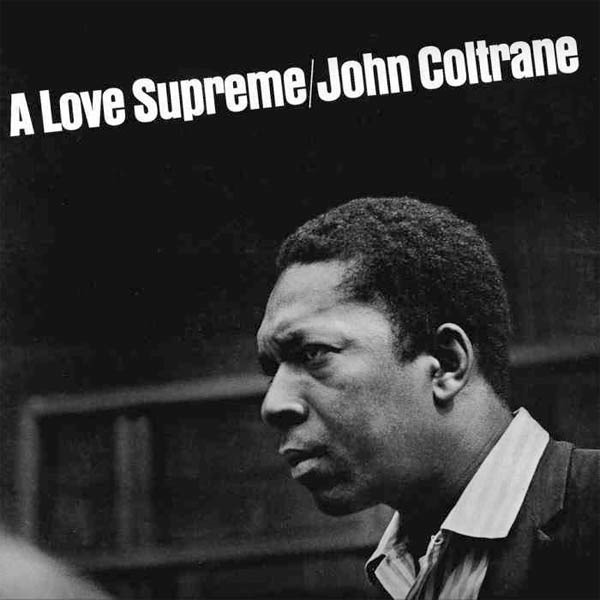
For a Zen master, collie dog, baby, and old person without words, a ball is just a ball. Now think about a football player and fan, and how words let them make so much more of a ball. Right now I love listening to jazz and knowing its history. When my words are gone I’ll still love listening, but I’ll miss the history. What is “A Love Supreme” without the words of the title or the words John Coltrane? Without words it will only exist when playing, like a tree falling in the forest. With words it can exist as part of my personality.

A Love Supreme

JWH