What the Hell Were Humans Doing in Prehistory?

by James Wallace Harris, 3/8/22

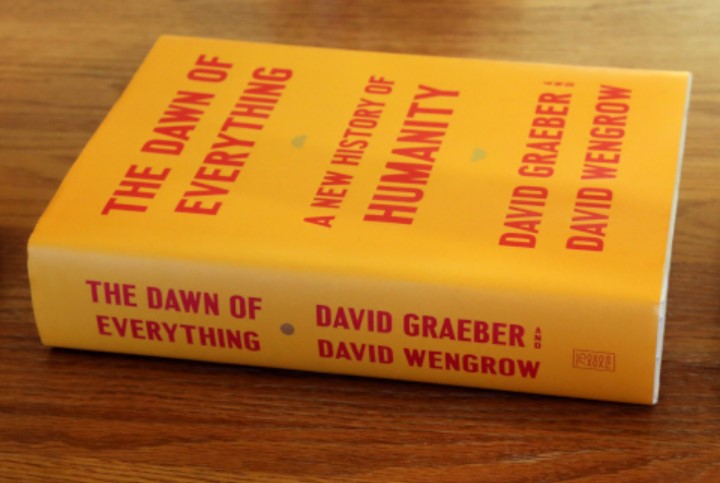
I’m still reading The Dawn of Everything: A New History of Humanity by David Graeber and David Wengrow. I’m a member of an online book club that will be discussing the book all during the month of March, so I’ll be discussing it here piece by piece, whenever a particular topic intrigues me.

Here’s the setup for the book. Humans have been around in their present form for about 200,000 years, but recorded history only covers around the last three thousand years — what were we doing for those other 197,000 years? Anthropology and archeology help answer that question to a degree. The Dawn of Everything works to say to what degree is possible. However, most of what anyone can say about those 197,000 years is speculation, and that can cause controversy.
For most people, prehistory is a mixture of the Garden of Eden imagery and fantasies about cave people. Anthropologists study the evidence provided by archaeologists then speculate about that evidence by comparing it to what we learned from ethnographic research on various indigenous societies from the last few hundred years. Unfortunately, what most Americans know about the pre-20th century indigenous people of North America comes from watching westerns. In other words, unless you read a lot of books on anthropology it’s doubtful you think about prehistory at all, and what you do think you know is pop culture deceptions.

David Graeber and David Wengrow, an anthropologist and an archeologist, have caused some political shit storms by angering some of their readers with their discussion of freedom and inequality while analyzing what we know about prehistory. These brouhahas are caused partly because Graeber was an anarchist and was a leader in the Occupy Wall Street movement, and, partly because they challenge the established Western views that speculate on humans in prehistory, and tie ideas about various forms of inequality and freedom to their speculation. They seem to imply humanity made a wrong turn, but I’m not so sure we did, but don’t care to argue it. Graeber and Wengrow do review a lot of speculation that claimed we made a wrong turn when we switched from hunting and gathering to farming, but I’m not sure they believe that idea either, but merely review it too.

First off, there is no introduction, so the first chapter works as an introduction, but I don’t think it’s a good one. So far, I’ve felt every chapter has been self-contained, so it’s hard to assess the book as a whole. They title their first chapter, “Farewell to Humanity’s Childhood: Or why this is not a book about the origins of inequality.” I don’t think some readers took that to heart and feel The Dawn of Everything is harping about inequality. I wonder if conservatives dislike the book for the same reason they don’t like Critical Race Theory, that it smells of liberal thinking, and it asks them to relearn a history they’ve already embraced and memorized.

Here’s the thing about speculating about prehistory — speculation is only speculation. We’ve found some human bones, lots of animal bones, we have some pots and graves, some old cave paintings, remnants of housing, stone monuments, figurines, lots of rock tools, but not much of anything else. Most speculation about prehistory rests on ethnographic studies of primitive cultures that have survived into historical times. What Graeber and Wengrow challenge are generalized ideas we’ve developed about those cultures over the last couple of centuries.

Most of The Dawn of Everything is about the limits of speculation. What we really want to know is what were the people like? What did they think? How did they relate to each other? What kind of societies did they form? How much did they know about nature and reality? It’s one thing to look at old bones and relics and guess what people did, it’s entirely another thing to extrapolate what they thought and believed.

Here’s what I want to ask: Can ideal concepts exist before they are defined? Take inequality? That’s a concept that’s been emerging for a few centuries and a concept that modern society is working on. Even something like freedom is a concept been around for a long time, but has it always existed? What about science? Graeber and Wengrow have a whole chapter dealing with the origin of scientific thinking. Our ancestors might have observed nature and put two and two together but was that really science? I believe a concept like fairness might be very ancient, but I don’t know about inequality. I believe inequality is an emerging concept. There might have been societies in history and prehistory that had more equality but I don’t think they thought about it as a concept.

I think it’s completely insane to suggest humanity took a wrong turn because we don’t like aspects of our present society. The old saying, “the only constant is change” applies here. The variety of ways humans can organize their societies is infinite, and that comes across in this book. I think Graeber and Wengrow are right to say we can’t generalize about the past like Rousseau or Hobbes.

The best we can do is study all the ethnographic studies, examine all the archeological evidence and review all the speculation, and then create our own inner map of what prehistory was like with the jigsaw pieces we have. We also must be willing to constantly update that map as we gather new puzzle pieces.

We must resist philosophers and psychologists who try to characterize humans now or in the past in broad general terms. I believe what Graeber and Wengrow are telling us is not to lump together various stages of human development or societies into convenient pigeonholes. For example, there was no one shift from hunting and gathering to agriculture. Nor was there one type of nomads or hunting and gatherers. For example, North America had hundreds of different types of Native American cultures, so there is no way to generalize about what they thought about gender or money, or politics.

The trouble is there are places in the first chapter of this book (and I’m only on chapter six) that seem to imply that Graeber and Wengrow are advocating that we should be working towards all the various forms of equality. We can judge modern societies on inequality and even ethnographic studies of primitive societies we have studied, but I believe speculation on inequality in prehistory societies will be based only on our biases, and I think Graeber and Wengrow make that clear even though they keep trying.

Personally, I wonder if Graeber and Wengrow haven’t spoiled the rest of their book with chapter one. Most of the reviews I’ve seen focus on that first chapter. That might be due to the reviewers only reading that chapter, or it might be because it’s the one that pushes buttons. The other chapters I’ve read deal more with what we know, and I’m finding them quite fascinating. It makes me want to read more ethnographic studies — although, as Graeber and Wengrow show, those studies are often colored by their observer’s speculations. If anything, this book shows us time and again how we distort the evidence.

For me, the key to enjoying learning about prehistory is to avoid speculation and focus just on the evidence. The trouble is a certain amount of speculation is good. Nowadays generalizations are considered evil. But we make useful generalizations all the time — it’s called pattern recognition. We just can’t go overboard. Every archeological dig is like a crime scene. You only find so much evidence. Science never knows anything for sure, but works with statistics, looking for a preponderance of convincing evidence.

Most people don’t spend time studying history, much less prehistory. And it’s hard to make a case to get people to care about history and prehistory. For most people, it’s about as useful as studying geometry, cosmology, or particle physics. But consider this. All of us are deluded. We constantly fool ourselves in countless ways that make us see reality distorted by our cultural upbringing. Studying other societies that adapted to our shared external reality in different ways can break us out of the brainwashing of that upbringing. If the book is doing its job it should be stirring things up.

It’s not about whether or not we made a wrong turn, but knowing about all the possible turns we took and could have taken. I think this is scary for some people. If you want to believe the Bible is literally true, then learning about all the societies that existed at the same time as the Bible was being written could be disturbing. If you’re a scholar of Western culture that backed a particular view of history and prehistory, considering what Graeber and Wengrow are saying could also be disturbing. But aren’t all paradigm shifts uncomfortable?

Humans think we’re the crown of creation. And people raised in western culture believe we’re the pinnacle of human intellectual development. Maybe Graeber and Wengrow believe we took a wrong turn because our global society is sailing into an iceberg and they want us to change course. Personally, I don’t think our species has any control over its evolution. It’s not a matter of choice, but playing out all the anti-entropic possibilities. I believe studying history and prehistory shows us some of the many things we’ve already tried.

Knowing where we’ve been might help us know how we can adapt to climate change. Here’s one example. Graeber and Wengrow consider that prehistory societies made the choice between being hunting and gatherers and settling down and that they often chose to stay on the move because it offered more advantages. This video, it shows one modern reason why nomadic people choose to settle down and pursue year-round agriculture. It allows them to build wealth and stability in their lives. This is a very inspiring video.

JWH
Schismogenesis, Cultural Appropriation, Conformity, and Identity

James Wallace Harris, 3/4/22

I’m reading The Dawn of Everything: A New History of Humanity by David Graeber and David Wengrow but I can’t review it as a whole because it features hundreds of interesting ideas and I have no way to assess them all in a small essay. So, I’m going to review some of its ideas in a series of blog posts. Each one will deal with a unique concept that I think is useful.

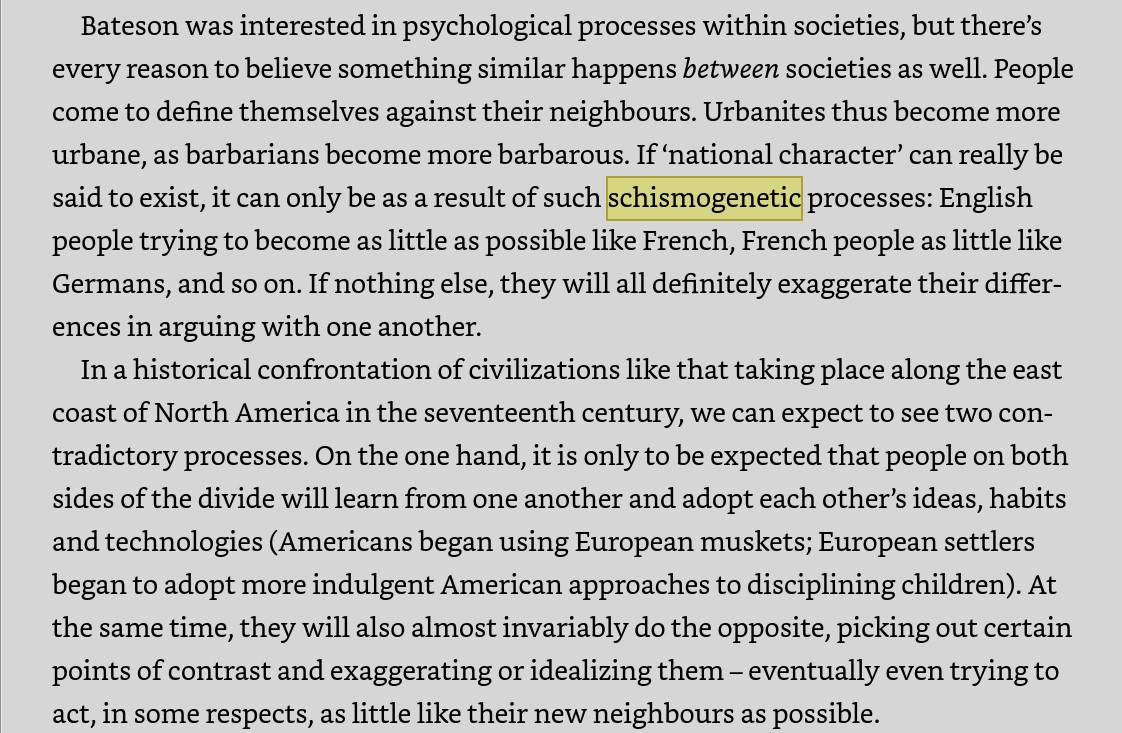
Overall, the book speculates about societies in prehistory and in three places uses the word “schismogenetic” referring to the term schismogenesis, a word coined by anthropologist Gregory Bateson. This is not a common word, but one that I had to look up, and it’s used in various ways in the social sciences that isn’t exactly how Graeber and Wengrow use it.

Graeber and Wengrow use the concept of schismogenetic to identify a human trait that is very worth recognizing — the urge to belong to a group by defining distinctive wanted traits. This explains children and adolescents who like to conform, to subcultures and hobbyists who love sharing a common interest, to ethnic, cultural, and nationalistic groups who fight cultural appropriation to preserve their unique identity, to political groups who want to maintain unity, and so on.

Schismogenesis can be seen as the cause of xenophobia, but it could also be seen as the inverse of xenophobia. Xenophobia rejects others by traits we don’t like or want, and the schismogenetic urge defines our group identity by specific traits we embrace. This is just me speculating and I’m no expert. I want to embrace this concept because I feel it’s very useful. I see examples of it everywhere. If the term became popular it might help us understand ourselves.

Take conservatives and Republicans. It seems in recent decades they are defining themselves more and more exactly. They have generated a schism by clearly defining who they want to be issue by issue. Take mask-wearing. They’re against it. They see mask wearers as a liberal trait. Ditto for vaccinations. If liberals and Democrats had been against masks and vaccinations, the people on the right would have been for them. If the left is for Critical Race Theory, then the right is against it. If the left believes in climate change, then they don’t. And the details don’t matter to most people.

I use this political example not to be political, but I think it’s obvious that the schismogenetic urge is stronger in conservatives. They really enjoy defining themselves and being part of their group, and it seems they fear being seen as not conforming. For example, being called a RINO is a terrible insult. And this has worked out well for conservatives because they are better at organizing and defining themselves than the liberals.

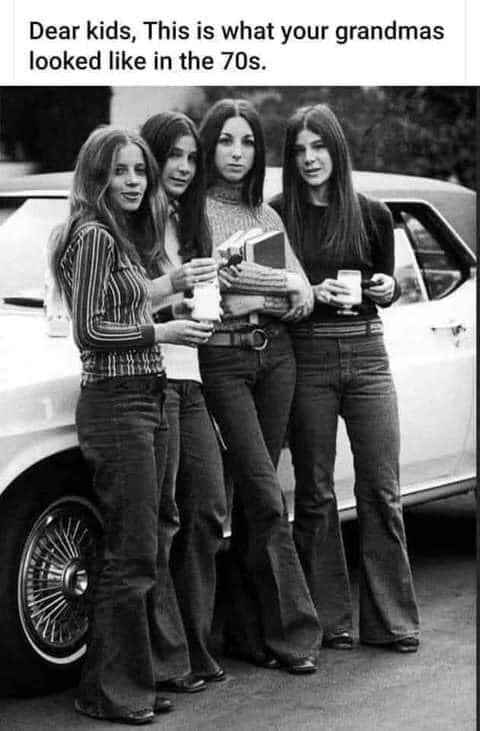
But I believe we all have schismogenetic urges. I saw this photo on Facebook and it reminded me of how back in the 1960s we all wanted to be individual free spirits, but in reality, the hippie counter-culture was very conforming.

Graeber and Wengrow used the concept of schismogenetic to explain why the hundreds of Native American tribes created very distinctive and diverse societies. I think everyone uses the trait to join the groups and subcultures they want to embrace as their identity. I believe this is why the concept of cultural appropriation has developed in recent years — subcultures want to protect their identity, their brand. And that’s cool. I’m not necessarily saying this is a bad trait, but it can lead to schisms divided by hate.

Some of the reviews that are deeply critical of The Dawn of Everything attack it because they consider Graeber and Wengrow of being historical revisionists. And I see this as a schismogenetic trait too. There are those who define themselves by the histories they embrace and they really don’t like the idea that what they’ve learned and accepted is being revised. It challenges their identity.

Science and history are constantly revising their disciplines with new data. The social sciences aren’t as exact as classical physics, so they go through more upheavals. Those upheavals cause new schisms and threaten old ones. Trying to fully grok The Dawn of Everything is difficult. Graeber and Wengrow keep bringing in politics by using studies of prehistory societies. I think this clouds what they are trying to do. At one point they say, “Since this book is mainly about freedom…” but is that true? I thought it was about prehistory. That makes me wonder if the goal of this book is to be schismogenetic.

JWH

We Can Build You by Philip K. Dick

by James Wallace Harris, 2/9/22

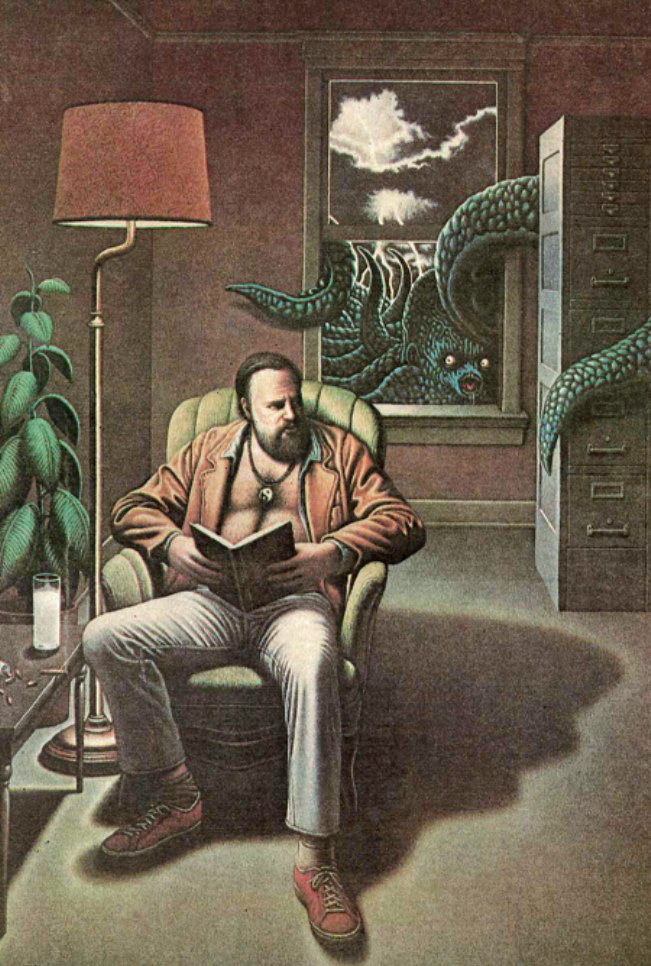
My intended fifth book to read for 2022 was Humankind, a hopeful reappraisal of humanity by Rutger Bregman. However, during the ice storm, I didn’t feel like reading serious nonfiction while the power was out. For some strange reason I was in the mood for Philip K. Dick (PKD) and I randomly picked We Can Build You. I listened to it on audio, and it was wonderfully narrated by Dan Jon Miller.

PKD wrote We Can Build You in 1962 calling it The First in Our Family while it was a working manuscript. It was rejected by his publisher, G. P. Putnam’s Sons, who had just put out The Man in the High Castle, and by several other publishers until Ted White bought it for Amazing Stories in 1969. White claimed the novel needed an ending, which White wrote with Dick’s permission. It was retitled A. Lincoln, Simulacrum and ran in the November 1969 and January 1970 issues. This is when I first read this novel. After that Donald Wollheim, who had rejected it for Ace Paperbacks, reconsidered the novel and published it for his new company DAW in 1972, but without the Ted White final chapter.

Before I digress, and I will digress all over the place, just let me say that Philip K. Dick is one of a handful of writers I obsess over. I’ve written about these writers before in my essay “The Ghosts That Haunt Me.” I’ve read many biographies about PKD, and even reviewed them as a group. And I’ve recently started reading his collected letters (I have 5 of the 6 volumes). I’m not the only one obsessed with PKD. Dick is known for writing science fiction, and he’s probably one of the most filmed of all science fiction authors. However, PKD was a troubled soul, and he often used his books and stories to explore his own psychological problems. We Can Build You is one such book.

Readers will find many stories to follow within We Can Build You. One is about Louis Rosen, a partner in a firm that sells organs and spinet pianos. Louis falls in love with his partner’s daughter, Pris Frauenzimmer, who is schizophrenic, and only 18. Louis is 33. Over the course of the novel, Louis also becomes schizophrenic. In 1962, PKD was around 33. At the time PKD wrote this novel he was married to his third wife, Anne. There is evidence that We Can Build You is somewhat biographical to PKD’s life in 1962 and is a reaction to a troubled marriage with Anne and his own psychological problems. Was there another woman? Or is Pris modeled on Anne?

Anne was an atypical PDK wife (he had five in all). Anne was a year older than Phil, and she was blonde. Dick had a neurotic obsession with dark-haired young women, and Pris Frauenzimmer, the love interest in We Can Build You is eighteen and dark-haired. Makes you wonder.

I’m giving all this information as a kind of warning. We Can Build You can be read without knowing anything about Philip K. Dick’s life. For some, especially readers who enjoy outre science fiction but don’t know PKD’s work, it will be a reasonably entertaining story, although one that will strike them as quite odd even for the outre. For fans of PKD who only read his fiction, it will even be one of the better novels, but far from his best. But, if you happen to be a Dickhead, this book offers all kinds of delicious mysteries about the bizarre and tragic life of Philip K. Dick.

Some Dickheads consider We Can Build You as a trial run for Do Androids Dream of Electric Sheep? It certainly focuses on two of PKD’s favorite themes: What is human? and What is Real? It’s also about insanity, a theme that runs throughout many of his stories. But it’s mainly about Dick’s obsession with young dark-haired girls, one that’s gotten its own nonfiction book. Dick was born with a twin sister who didn’t live long, and he claimed that affected him for the rest of his life.

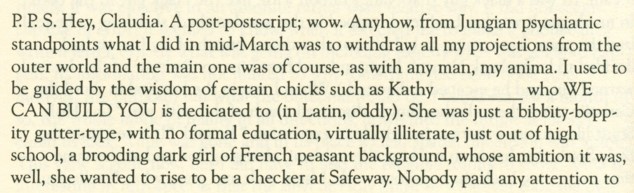
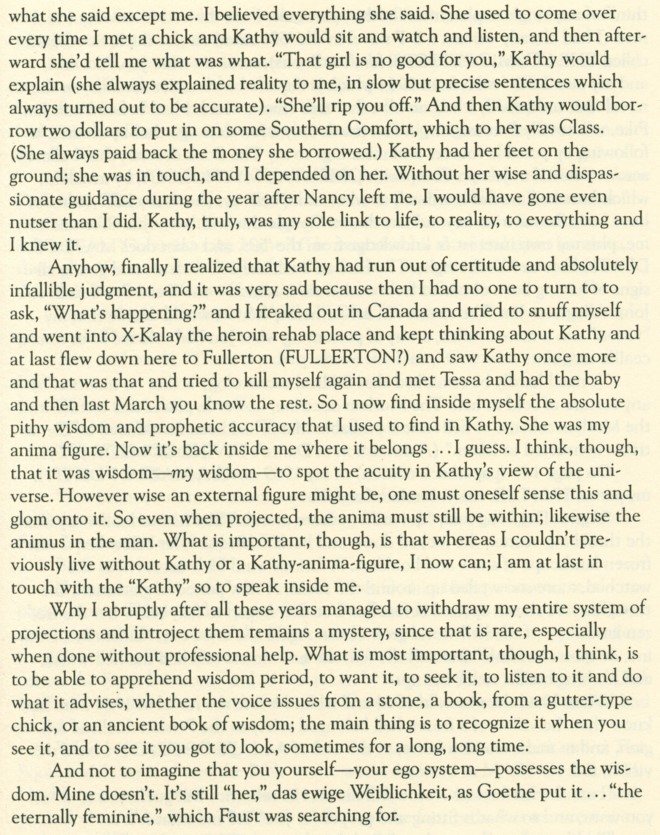
The first edition of We Can Build You in 1972 has a dedication that reads: “For Kathy Demuelle, my best friend, Mea voluptas, meae deliciae, mea vita, mea amoenitas …” Google translated that Latin for me as: “my pleasure, my darling, my life, my attractions.” This was written at the end of his marriage to his fourth wife Nancy and before he married Tessa, his fifth and final wife. These wives were barely legal for a man in his forties to marry. Dick’s published collected letters do contain letters to Kathy, and she is described in a letter to another young woman in this 1974 letter:

Kathy sounds just like Pris. But I don’t think Pris is based on Kathy. I don’t know when he met her. I need the first volume of the collected letters which I don’t have, and they are now sky high to buy used. The above letter does give us many clues as why PKD wrote We Can Build You.

However, after We Can Build You was published, Kathy evidently ghosted Phil, and he wrote Donald Wollheim asking for the dedication to be changed to Robert and Ginny Heinlein, which it is in later editions. Heinlein had out of the blue sent PKD money for medical expenses, and PKD was very moved. The early 1970s were a particularly bad time for Dick, who had suicide attempts, an escape to Canada, and had spent time in rehabs. PKD was agoraphobic but hated living alone, and often invited anyone who would, to live with him. And sometimes these were not very nice people, and sometimes they were very young dark-haired girls.

Knowing all of this should help us understand the protagonist of We Can Build You, Louis Rosen. But it’s also important to understand the major theme of mental illness and psychiatry in We Can Build You comes from a 1962 PKD, and not the 1972 PKD. Knowing the difference helps us to realize that the novel is about PKD then, but it prophesied the PKD to come.

Here’s the thing. Most readers think stories by Philip K. Dick are science fiction, but if you’re a Dickhead you realize they’re about PKD. Phil started out writing science fiction, but after he married Anne he wrote almost a dozen mainstream novels he couldn’t sell. Dick wanted to become an important writer and to support a wife that wanted that kind of success. At the beginning of the 1960s, PKD understood that wasn’t going to happen and returned his focus to writing science fiction. That’s when he published his masterpiece The Man in the High Castle in 1962. It was then PKD got the idea to blend mainstream fiction and science fiction and wrote We Can Build You.

The science-fictional elements of We Can Build You deal with building androids. The two main ones are Abraham Lincoln and his secretary of war, Edwin M. Stanton. Each android is programmed with all the biographical knowledge we have for each man. They look completely human and act like they have been reincarnated. Although they become fascinating characters integral to the story, they aren’t the important part of the story.

The novel is really a bizarre love story. Louis loves Pris, but she doesn’t love him. She is cold, cruel, and indifferent. Pris is ambitious and convives to get Sam Burrows a tech billionaire that reminded me of Elon Musk. Pris doesn’t love anyone but knows Burrows can get her what she wants. This drives Louis insane and he goes to extreme measures to take Pris from Burrows. The last third of the book is Louis undergoing therapy after having a psychotic breakdown. PKD was not the kind of man women would want, and it’s surprising he found five wives. I believe this novel conveys PKD’s frustration with his search for a woman that could make him sane and whole.

The published novel has a mainstream novel ending. Ted White wrote a science fictional ending for the magazine serialization. You can read it here, starting with the heading “nineteen.” I actually like White’s ending, but not as an ending for We Can Build You. I like it because it encapsulates how many science fiction fans think of PKD’s stories. I think they are wrong. Of course, I think I’m right in seeing PKD differently, but then I could be wrong. Reading PKD always makes you doubt everything.

Ted White’s final chapter is written knowing all of Dick’s novels from the 1960s, and White completely misses the mainstream aspects of the We Can Build You and writes a bogus PKD ending. It’s an ending that science fiction fans expect, one that falsely assumes what they think PKD is saying in the book. The ending is as different as the theatrical release of Blade Runner and Riddley’s Scott’s ending in the director’s cut. I hate Scott’s interpretation, and it’s funny that Ted White wants to use the same twist. It only goes to show you how wrong both were about Philip K. Dick.

The funny thing is I remembered White’s ending from reading it in 1970, so all the while I was listening to We Can Build You I was expecting that ending. However, I never once found any support for it.

In an April 18, 1974 letter to Claudia K. Bush, PKD tells her his favorite of his own novels are:

  • Martian Time Slip
  • We Can Build You
  • Flow My Tears
  • Doctor Bloodmoney
  • The Man in the High Castle
  • The Three Stigmata of Palmer Eldritch
  • The Simulcra
  • The Penultimate Truth

I don’t know if he intended that list to be in order, but We Can Build You came second to mind. He even mentions in the same letter that he wasn’t sure he liked Ubik. Nor does he mention any of his unpublished mainstream novels.

Additional Reading and References

Within We Can Build You Pris works on bathroom mosaic. It turns out Anne, Dick’s third wife, created such a mosaic, while he was writing the novel.

JWH

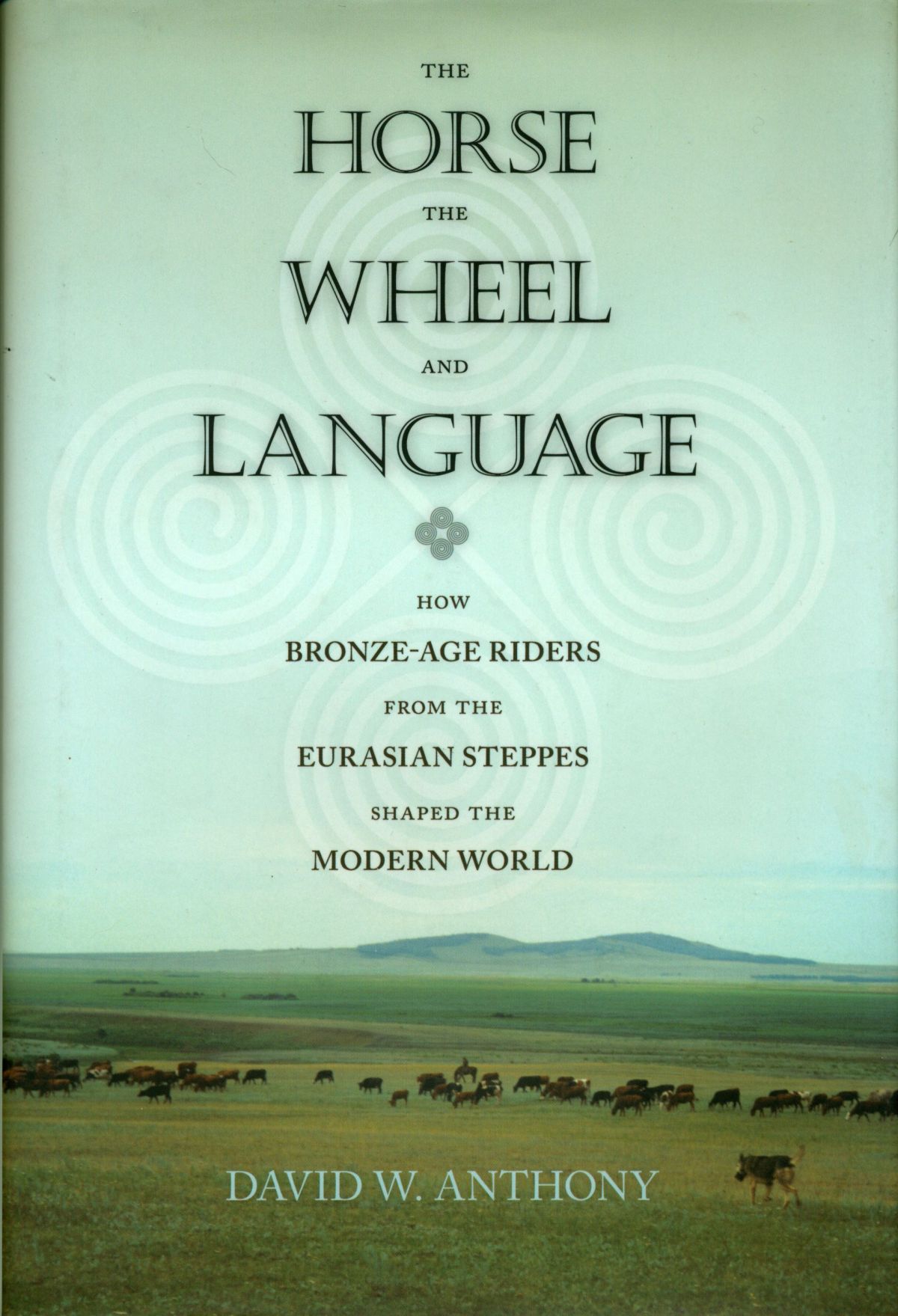
2022 Book #4 – The Horse The Wheel and Language by David W. Anthony

by James Wallace Harris, 1/26/22

Reading about the past is calming my anxieties about the future. The Horse The Wheel and Language: How Bronze-Age Riders from the Eurasian Steppes Shaped the Modern World by David W. Anthony is not a book I recommend to the casual reader. I expected it to be a popular science book about archaeology, but it turned out to be something much heavier. It’s a scientific work, probably used as a supplemental textbook. I found listening and reading the book to be rewarding and inspiring but it’s not fun. However, it has caused me to do a lot of philosophical pondering.

I won’t try to describe the book, Wikipedia has done an extremely detailed job with hyperlinks. If you want to know what the book is like, here is Anthony giving a lecture. This is exactly like listening to the audiobook.

I bought this book years ago and never read it and gave it to the library book sale. Then I read a popular article about linguistic anthology and decided I wanted to try it again and found a used copy. Still, I didn’t read it. Finally, I found an audiobook version that made it more accessible. I’m glad I had the physical book to refer to, because of its many complex charts and illustrations. This was a rewarding read, but I just want people to know it’s real science, not even popular science, and the going is tough. It took me weeks to listen to it all. Mainly, I want to talk about how I reacted to the book.

For years I’ve been troubled, even disturbed that our species lack real effort to combat climate change. For almost thirty years I’ve been waiting for governments and citizens to change their ways. I now realize that was naive of me. People don’t change. Not that I’ve given up complete hope, but all the evidence tells me our global civilization will never do anything significant about climate change.

That has inspired some existential insights. I expected humanity to grab control of reality and do everything it could to freeze the environment to its 1850-1950 weather patterns and maintain that as a steady-state forever. Once I started studying archaeology I realized that weather has always been changing over our species lifetime, and even for the whole lifetime of the Earth. Humans have always adapted to new weather patterns. It’s probably too fantastic to think we’ll control the weather.

Reading The Horse The Wheel and Language showed that humans have never stayed the same either. We’re constantly changing. Civilizations come and go all the time. Reading and watching documentaries about history and archaeology is teaching me that change is constant. That old saying, “the only thing constant is death and taxes” is true.

On its own specific subject The Horse The Wheel and Language is fascinating, but like I said, I not going to recommend you run out and buy it. Most of it is one giant infodump describing several societies around the Russian Steppes from about 4000-1200 BCE. The most interesting chapters were the early ones about the Indo-European languages and how linguists infer what the Proto-Indo-European language was like, and more specifically to this book, where in the world did the speakers of the Proto-Indo-European language lived.

Anthony claims by looking at the array of words in an ancient language and comparing it to the array of objects that archeologists have unearthed, we might pinpoint where those people could have lived. For example, if a language has the word for a wagon, but no wagons are ever found, it’s a not likely match. Or if a language has a lot of words for raising sheep, and lots of sheep bones were found, we might be getting warm. Of course, it’s much more complicated than that. For example, linguists can show how words from adjacent civilizations have passed into a language. I found all this fascinating, but overwhelming.

This is why the words Horse and Wheel are in the title. Only certain early civilizations had horses and wheels. For a long time, horses were only hunted for food. Then they were domesticated for food. Then came riding horses, and finally using horses to pull carts, then wagons. This made me think about how we’ll adapt to climate change. We’ll invent housing, clothing, lifestyles, jobs, political parties, etc. to adapt.

One thing I was amazed to learn was just how many different groups of people existed in a small area in prehistory that we know about. Most people when they think of ancient civilizations think of Egyptians, Babylonians, Greeks, Persians, and a few others. To me, the Russian Steppes and nearby lands sounded like North America before Columbus with countless tribes of nomadic and agrarian peoples.

For a while when reading the book I thought of making a timeline/list of civilizations to memorize but I soon realized that could become a lifetime project. I’ve ordered an archaeology textbook to help me get a bigger picture, but I’m not sure how big of a picture I can manage. Reading this book also made me crave maps, so I ordered a couple of atlases.

Many of these early civilizations lasted hundreds or even thousands of years. That made me think about how often world maps have changed in my lifetime. If the United States of America doesn’t make it to its 300th birthday it won’t be alone. All the descriptions of past changes of civilizations due to climate change, war, technology, disease, etc., make me wonder about what America might be like in the 22nd century. I now understand we can’t keep the weather of the 1950s forever, or the politics of the 1790s, or the technology of the 2020s.

About 85 million people died in the decade before I was born due to WWII, or about 3% of the world’s population. We’ve already put enough CO2 in the atmosphere to kill that many or more by the end of this century. Since we’re not going to stop adding CO2 anytime soon, billions will probably die in the 22nd century. Percentage-wise, civilizations have seen that kind of population reduction before.

I believe conservatives wanted to preserve the social climate of the 1950s, while liberals wanted to keep the weather environment of the 1950s. Neither will get what they want. All the demographics on Americans and America will be so much different in the 22nd century that we wouldn’t recognize either.

I need to stop speculating or worrying so about the future. Studying the past is philosophical liberating for me, but I’m not sure how much I should pursue it either, but I will. Living in the now is what’s important. And that’s why most people don’t worry about the future. I doubt for most of humanity’s existence the future was even a concept. I also assume the reason why so many people embrace various forms of denial is they don’t want to know the future because deep down they fear change. But change is coming. We can’t stop it.

JWH

Once Upon a Time the Future was So Bright We Had to Wear Shades

by James Wallace Harris

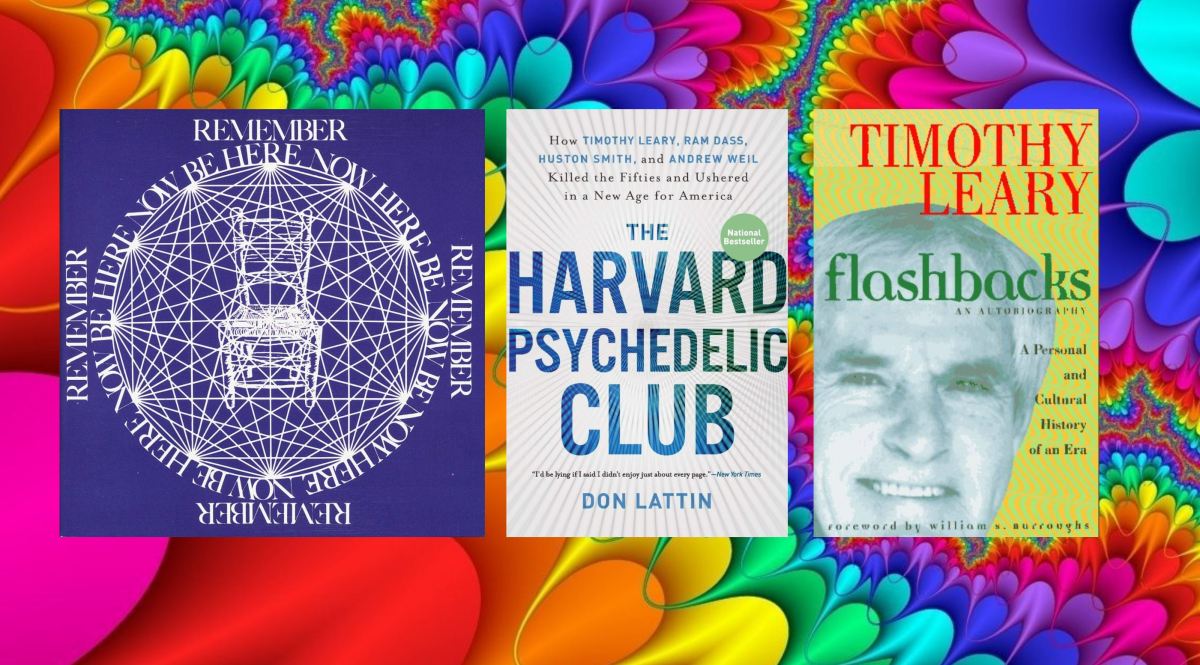
Between Camelot and Reaganomics existed the counterculture. For a very short while we thought we were entering the Age of Aquarius. Of course, it was a childish utopian dream, but a very positive hope. What happened to that dream? Reading The Harvard Psychedelic Club: How Timothy Leary, Ram Dass, Huston Smith, and Andrew Weil Killed the Fifties and Ushered in a New Age for America by Don Lattin reminded me of those hopes and dreams. Lattin explains what happened to four of the people who sold us some of that hope. Of course, those four weren’t the only ones. Back then, there was an entire army of John the Baptists promising heaven on Earth if we only believed.

In the sixties many of us thought by the 21st-century we’d have conquered war, disease, poverty, injustice, prejudice, inequality, and be living in a society where everyone had equal opportunity to achieve both spiritual and material wealth. We expected to create a world civilization that would make Jesus, Buddha, and all the past prophets and philosophers proud. We expected science to answer all our questions, and for technology to build ecological sustainable lifeboat Earth before we launched our spiritually-wise selves across the galaxy. Some of us called this anticipated transformation the Age of Aquarius, then The New Age, while hoping for the age of The Final Frontier.

Space travel never went beyond low Earth orbit after 1972. After three days of love, peace, and happiness it’s been Altamont every day since. And the doors of perception only led to tragedy and heartache. All our planned communities failed.

Just look at us now. You’d think the second coming had happened and no one was chosen, and we’re begun a thousand year streak of doom. There are damn few Pollyannas left on Earth that can see rays of hope for the future. Unlike Christians who have waited two thousand years without giving up their faith, the counterculture gave up theirs rather quickly. I read where psychedelic drugs are trying to make a comeback. And there are embers of spirituality still trying to rekindle the world but never do. What made us dream such big dreams in the sixties?

Before the dawning of the Age of Aquarius I was a straight-lace kid. I was gullible and believed what I was told. The U.S. Air Force guided my father and the Southern Baptist Church guided my mother. They had expectations for what I should believe, and I had no objections to those expectations. Well, not until 1963 or 1964. During my 12th and 13th year I changed. Looking back I could say it was merely puberty, but the whole country began changing at the same time.

Reading The Harvard Psychedelic Club got me to thinking about those years and changes. Changes that had began much sooner than 1969 or 1970 when I first tried psilocybin and LSD. The making of my counterculture had begun before the drugs, with rock and roll and science fiction. Reading The Harvard Psychedelic Club referenced many books I had read back then that shaped my thoughts. I began wondering about all the influences that had reprogrammed me during the sixties and seventies that gave me utopian ideals.

I remember in 11th grade sometime after the 1967 protest at the Pentagon, when a group of us kids waiting for the school bus discussed the coming revolution as if it was a certainty. Even as a dumbass high school kid I thought it weird that we expected such a huge social transformation. But those hopes kept building. Then in 1968 and 1969 Hair and its music was all the rage and people began talking about The Age of Aquarius. The hope became more than a political transformation, the counterculture began to expect a whole new age, which became the focus of the 1970s. I think all our foolish fantasies ended when Reagan was elected in 1980. By then I was married and working at the job I’d stay at until I retired.

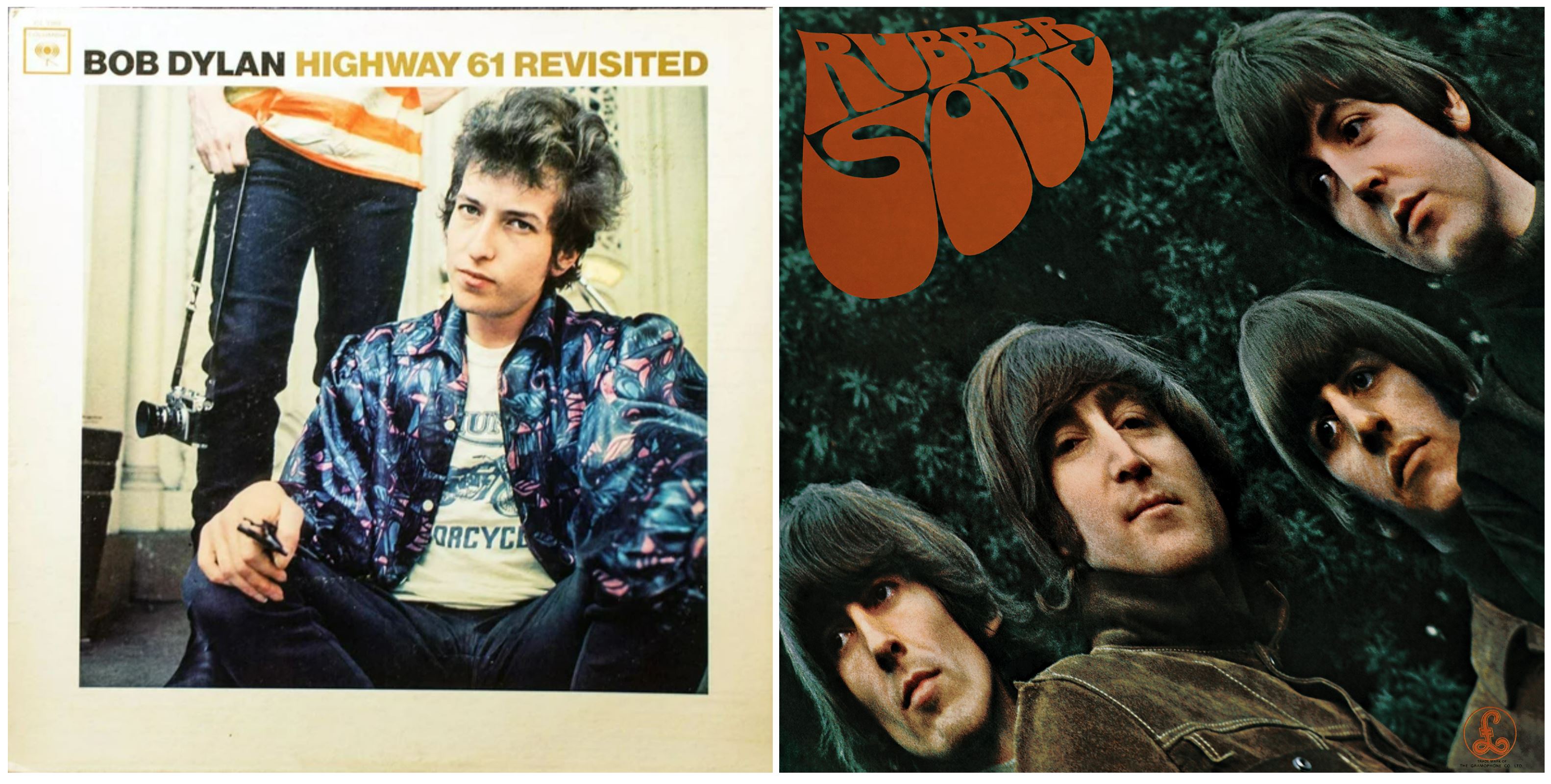
My transformation was really an intersection of countless ideas that came from books, magazines, newspapers, television, movies, songs. We think everything comes from the internet today, but before the world wide web we had plenty of informational input. Reading The Harvard Psychedelic Club reminded me of those books and other information sources, and all the prophets behind those words. For example, I don’t know if people today have any idea of the impact The Beatles and Bob Dylan had on their fans. Rock music was our gospel.

In 1962, when I was eleven, I got hooked rock and roll and science fiction. In 1963 I began rejecting religion when I started noticing that the people at church did not follow what was preached. A Joycean year of doubt ended in 1964 when I realized I was an atheist. I was just 13. My mother still tried to make me go to church but I felt like I was a spy, a pretender, a fraud. I didn’t have a new philosophy yet, but I was open, and about to try many.

Then in 1965 I read Stranger in a Strange Land by Robert Heinlein and got into Bob Dylan because of “Like a Rolling Stone.” I was still very straight-laced. I remember watching anti-drug and anti-smoking films at school and I was positive I’d never be stupid enough to do drugs or smoke cigarettes.

But only two years later, in early 1967, I read an article in Popular Science about LSD. Instead of sensationalizing the drug with fear and loathing like the news did on TV, the article described LSD as a tool for medical research and exploring the mind. That sounded science fiction. That sounded like something for me.

I can’t remember when I first heard about Timothy Leary. I’m pretty sure I heard about LSD well before I heard about Leary and his famous “Tune In, Turn On, and Drop Out” saying. In late 1968, or maybe early 1969, I read The Electric Kool-Aid Acid Test by Tom Wolfe. That book didn’t turn me onto Timothy Leary either, but The Beats. I knew about Leary in the sixties, but he always seemed like some kind of media clown. Around this same time I began reading The Rolling Stone magazine. It became my main source of counterculture propaganda.

But remember, I was also mass consuming science fiction, which was changing too with its own New Wave revolution. I remember Stand on Zanzibar by John Brunner had a huge impact on me, as did Ellison’s anthology Dangerous Visions.

I wish I knew when I first bought Stewart Brand’s Whole Earth Catalog. It was probably the early 1970s, but it might have been sooner. The 1970s brought a flood of influential books and magazines. Isaac Asimov and Arthur C. Clarke had made me aware of overpopulation in the mid-1960s, but by the late 1960s and early 1970s, the environmental movement was giving us plenty of reasons to change our ways.

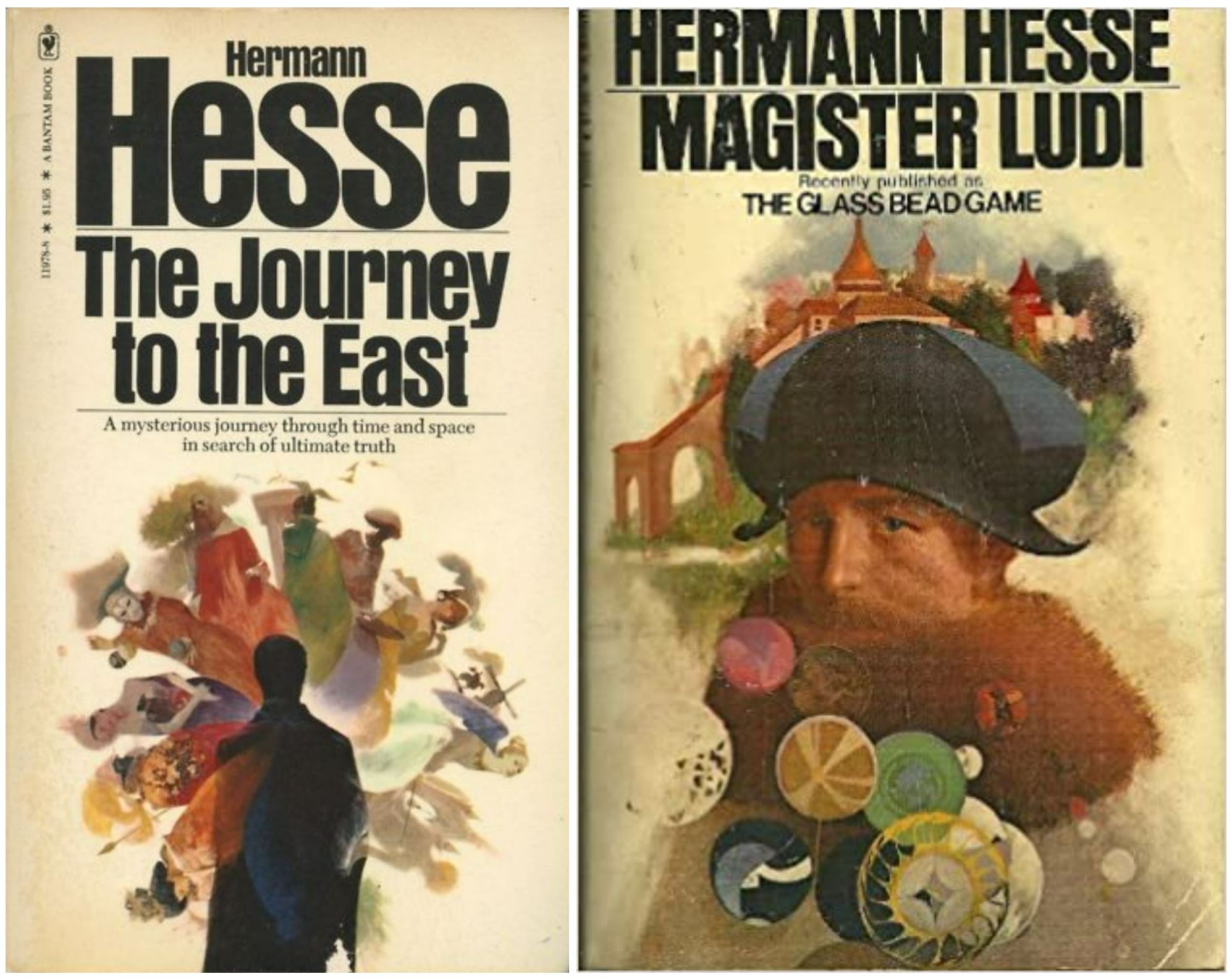
By the mid-1970s I became open to trying religion again, but mainly Eastern religions. Be Here Now by Ram Das (Richard Albert), books by Alan Watts, Aldous Huxley, and Herman Hesse, and New Age Magazine made me think that spiritualism and mysticism had some answers.

I wasn’t stupid, I knew the dreams were doomed. Books like The Population Bomb, The Limits of Growth, and Future Shock, among many others like them, kept me grounded. Plus, the science fiction books I was reading became more realistic and pessimistic about the future.

Still, we had a great deal of hope about the future. We thought we could solve all our problems. We had the knowledge, we had the technology, we knew the solutions, it was only a matter of getting everyone to work together. That’s when the dream ended. We never could work together. We all separated into our own personal trips. No matter how much visionaries preached, we never could agree.

Reading The Harvard Psychedelic Club also covered the decades of falling apart. Alpert, Weil, and Smith were able to rebuild their lives and become constructive, but not Leary. Their lives parallelled my life and I’m sure all other counterculture true believers. We found ways to be here now. To make do with reality. To give up on our utopian fantasies.

Looking back I also remember what life was like when we were chasing those dreams in the 1960s and 1970s. Things were bleak. The war, the riots, the prejudices, the inequalities, the crime, the bombings, the protests, the generation gap, the oil crisis, the burning rivers, the pollution, the urban decay.

Drug taking and believing in utopian futures were symptoms of the disease, not cures. Much like similar symptoms today. The right-wing countercultures of today have their parallels with the left-wing countercultures of the 1960s and 1970s. But there’s one big difference. We no longer need to wear shades when looking towards the future. That’s rather sad. No, that’s depressingly tragic.

JWH