
Writing Lessons from Envy

by James Wallace Harris

Basically, my blog is where I write what I think. I polish my essays to be more readable, but I’m too lazy to be more ambitious. Blogging is piano practice for writing but seldom produces professional-level writing. Blogging improves writing skills, exercises the brain to think clearer, but is too casual to produce art. Lately, whenever I read an exceptional essay I feel both envy and regret. Envy for craft, and regret for laziness. It’s time to up my ante.

I recently wrote about rereading Brave New World fifty years after first reading it in high school. Then I read “BRAVE NEW WORLD Revisited Once Again” by the science fiction writer Thomas M. Disch in On SF. I was amazed by how much better Disch had done with the exact topic. He opens with:

Just fifty years ago, at the dawn of the new era that dates from the death of Henry Ford, a young, half-blind, upper-class Englishman published a novel destined to become—along with Orwell’s 1984—one of the two most enduring prophetic visions of the future ever to clatter from the typewriter of man. The novel was Brave New World, its author Aldous Huxley, and the vision was of the Jazz Age gone to heaven. Anything goes in A.F. (After Ford) 632, but what goes particularly well are those two pillars of the affluent society, sex and drugs. What has been eliminated from that society as being subversive and destabilizing is: family life, passionate love, social nobility, and any art but the “feelies, ” fashion design, and dance music. Here’s a sample of the song lyrics and the lifestyle of A.F. 632:

Orgy—porgy, Ford and fun,
Kiss the girls and make them One.
Boys at one with girls at peace;
Orgy—porgy gives release.

I realized this was a complete lesson in writing. Here’s my opening paragraph:

I first read Brave New World in high school back in the sixties. Rereading it again in 2020 reveals that it was entirely over my teenage head. I doubt I got even 5-10% of Aldous Huxley’s satire. Although I expect high school and college students of today have both the education and pop-culture savvy to understand it better than I did, it’s really a novel to read after acquiring a lifetime of experience. When I first read Brave New World I was already mass consuming science fiction so it was competing with shiny gosh-wow sense-of-wonder science fiction. I remember liking Brave New World in places, especially the free sex and Soma, but I thought the story somewhat boring and clunky.

My paragraph was more about me than Brave New World. I feel Disch and I are both trying to get people to reread Brave New World but his lead-in is a better salesman. His paragraph is dense with details about the book, while mine has too many details about myself. Should I even be the subject? My intent was to convince people the book deserves a second reading by my experience, but I could have done that without talking about myself.

Do visitors to this blog want to know about me or the topic of my discussion? Blogging is intended to be personal, and I have a number of followers for this blog, but the essays with the most hits are from people searching Google on a specific subject. Those readers aren’t interested in me. I could have written my first paragraph without any mention of myself and still provided the same data.

I consider this blog, Auxiliary Memory, to be my personal blog and Classics of Science Fiction to be a reference site. Maybe I should use a different style of writing for each.

Information is the key. When people read, people either want specific information or entertaining information. And web readers want quick information. I’m a wordy bastard. This essay is already longer than what the 99% want to read. But I haven’t covered my topic. I could describe a dozen insights I’ve learned from Disch’s essay and make this post 3,000 words long. Or I could put each insight into a different post.

If information is the key, then information density is the essence of great writing. I’m still impressed by how much Disch conveys about Brave New World in his first paragraph. I believe his summary says even more in fewer words.

My final quarrel with the book is one of emphasis from my first reading. I’ve always had a sneaking fondness for the world Huxley invented. I know I’m supposed to disapprove. But I would like to try soma just once, and I wouldn’t say no to a night at the Westminster Abbey Cabaret dancing to the music of Calvin Stopes and his Sixteen Sexophonists. The lyrics of the songs may be sappy, but I’ll bet they’ve got a good beat. As for the feelies, I suppose the plots are pretty simpleminded, but any more so than Raiders of the Lost Ark?

This is not to endorse all the sinister theories of Mustapha Mond, only to suggest that fun’s fun, and that some of the targets of Huxley’s satire are mean-spirited, insofar as he is making a case against pop culture, sexual candor, and the consumption of alcoholic beverages.

Relax, Huxley. You worry too much. Have a gram of Tylenol. Things could be worse. This might be 1984.

Disch’s reading reaction that Huxley’s dystopia is alluring is close to mine. Disch combines story description with story reaction into the same sentence where I separated them into different paragraphs.

My envy of Disch’s writing inspires me to work harder, but it also makes me ask myself a lot of psychological questions about why I want to write. Blogging and other social media appeal to our urge to express ourselves. On many levels, I worry that’s appealing to our ego and vanity. Of course, we also call our activities on social media sharing. But what exactly are we sharing? Ourselves, information, promotion of cool things, memories, passions — the list goes on and on. When a writer produces a work to be read, they are also asking readers to use up some of their time.

The best thing I learned from my six weeks at the Clarion West writers’ workshop was “Great writing is the accumulation of significant detail.” I believe what I learned from my recursive reflection between these two pieces is: “Great writing is the accumulation of significant detail that wastes the least time for the reader.”

That’s a single lesson at one recursive turn. With another cycle, Disch’s prose sparkles for me because I just reread Brave New World and all his allusions resonated. That wouldn’t be true for people who haven’t read the book. That insight reflects back again, and I see I admire Disch’s essay because we both reread Brave New World late in life after first reading it when young. Seeing that lets me know great writing isn’t always in the prose but in the sharing. But that reveals the limits of finding the right reader.

I could keep going, but after the 1,178th word, I believe I spent enough of your time.

JWH


YouTube – the Last Refuge of the Mansplainers

by James Wallace Harris, Friday, December 13, 2019

So many of my women friends have gleefully embraced the term “mansplaining” that I’m wary of saying anything at all anymore. One lady friend told me two of her book clubs have decided not to allow men because they hog all the conversation. Can’t say that’s not true. Recently on Facebook, I saw a quote “My wife is using the term mansplaining incorrectly and I don’t know what to do!” We can’t help ourselves.

I wonder if women understand how much we love details, especially abstract, philosophical, statistical, and scientific. I love to hear the nitty-gritty on a teeny-tiny aspect of reality. Lately, I’ve been enjoying YouTube videos more than watching Netflix, Hulu, HBO, or Amazon Prime.

And I realized something. YouTube is the last refuge of the mansplainer. A guy with a video camera can talk to his heart’s content on the most esoteric of topics. And some of these guys are good. I mean really good. They know their stuff, and they’re terrific at producing polished films that present their explanations.  Here’s one of my favorites, a guy, Mr. Carlson, spending two hours explaining how he restored a 1947 radio. I don’t even like listening to the radio anymore, not since the early 1970s, but this guy has me wanting to buy an old radio to restore.

I’m finding more and more topics that I just love to listen to because guys explain them so well. Here’s a cartoon I found about mansplainers that fits these YouTubers very well (even considering the misspellings).

mansplainers

Yes, the YouTubers I watched are male, educated, hyper-confident but I don’t feel they are condescending or smirk. Well, some do get a bit condescending and smirky, but those guys are trying to be funny. Most of these explainers are so uber-confident that they aren’t even the least bit egotistical. Their goal is to explain something technical as clearly as possible, and they are comfortably sure of their knowledge.

Here’s a guy reviewing a pair of $3000 headphones. Notice how careful and humble he is about his opinion while striving to be exact and even-handed.

The thing about mansplaining is you want to go on and on about something you love with a passion. What’s wrong with that? Here’s John Darko telling about the best places to buy electronic music in Berlin. I won’t get to Berlin, but I will play these albums on Spotify.

Steven Guttenberg has a daily video about audiophile music and equipment. He mainly covers stuff I could never afford but I enjoy listening to his opinions because he’s so knowledgable and technical.

The 8-Bit Guy is my favorite YouTuber. He also talks about the equipment I won’t ever own or techniques for restoring it that I’ll never use. Here he is explaining how to restore plastic cases to their original color and create new manufacturer badges so these ancient disk drives will look like they did when they were new. I love this stuff.

What’s funny about all these YouTubers is they’d probably bore the crap out of both women and men at parties, but they get hundreds of thousands of people listening to them on YouTube.

I understand us guys can pontificate at length when we’re trying to hit on women, but I’ve patiently listened to countless explanations about epic shopping adventures or tales of being slighted at work – that took forever. It’s funny but some of my women friends have complained about my long-winded blogs, but I am quite certain their wordage is far greater when they explain what they are excited about than my verbose blogs.

Ever consider that us mansplainers are just weeding out the women who have the patience to let us express ourselves? And we’re picking women by the length of lady-chatter we can handle? I have a male friend who told me his goal was to find a woman that let him talk at least 40% of the time. He’s quit dating.

I believe one reason why the internet has been so wildly successful is that we can find people who love the same tedious topics we do. I love old science fiction anthologies. I found two friends who like them too, one in England and one in South Africa. I thought we were it until we formed a group on Facebook and found 65 more. It’s hilarious, but 68 might be the total fans for old SF anthologies. But now I don’t have to bore my women friends about this topic.

I don’t tell my wife or lady friends about my love of old science fiction anthologies, or about any of my other esoteric loves. I was conditioned long ago, way before the invention of the term mansplaining that they just don’t give a shit. But it did take a lot of eye-rolling before I was clued in.

mansplainers 2

I do my mansplaining on my blog. I really don’t care who doesn’t want to read it, but I do enjoy finding people who do.

JWH

Deception, Self-Deception, Confabulation, Bullshit, Narrative Fallacy, Dunning-Kruger Effect, and Fiction

by James Wallace Harris, Saturday, November 23, 2019

I’ve been studying Plato. Plato is good for the soul but hard on the ego. Humans often lack the ability to distinguish fact from fiction. Our superpower is self-deception. As children, we are told stories that we desperately cling to for the rest of our lives. We adapt to reality by making up explanations that usually end up being fictional. And when our stories clash with reality, the odds are we embrace the story. We aren’t rational. We are rationalizing creatures. We seek what we want by lying to ourselves and the people around us.

Anyone who follows the news knows this.

If a noise wakes us up in the middle of the night we don’t rush outside to investigate it. We start making up explanations trying to imagine what the noise could be. We tell ourselves its a burglar. Or if we’ve seen a raccoon lately, we’ll say to ourselves that Rocky is in the garbage can. Or its the wind, or a fallen tree limb. We can’t help ourselves. Instead of saying we don’t know we imagine that we do. Generally, we imagine wrong.

Nassim Nicholas Taleb called this tendency the narrative fallacy in his book The Black Swan. Neuroscientists call it confabulation. As children, we ask how the world was created and our parents tell us answers to the best of their abilities. How we are raised determines a lot of what we believe. If you were brought up a Southern Baptist more than likely their ideas about God are what you’ll believe for the rest of your life. However, if you were kidnapped at birth and given to a Muslim family in Saudi Arabia you’d grow up believing their local variation of the origin story.

Psychologists and philosophers talk about deception and self-deception. We like to think this problem belongs to other people. Our intuition tells us we’re right. We feel right. But are we?

We want to believe what we learn growing up is the truth. Few people are intellectual rebels that reject their upbringing. Not only will you maintain your beliefs, but you will also rationalize and lie to defend those beliefs.

A good percentage of humans learn to lie to get what they want. Conscious lying sometimes involves knowing the truth but working to suppress it. Liars are different from bullshitters. To a degree, liars are conscious of their lying. Bullshitters, as defined by Harry G. Frankfurt in his philosophical essay “On Bullshit” often don’t know they are lying, or even know what is true. Their grasp of reality is usually tenuous. They have told so many lies they don’t know what’s true anymore, but they have learned they can say anything to get what they want. Their concept of reality is so fluid that it changes from moment to moment.

The trouble is we bullshit ourselves all the time. We are especially dangerous to ourselves and others when we think we know more than we do. This is called the Dunning-Kruger Effect. People who suffer from this cognitive ailment are clueless about their own lack of knowledge. They firmly believe they are smart and wise.

We have so many built-in brain functions for fooling ourselves that I have to wonder if it’s even possible to know the truth if it came up and tapped us on the shoulder.

Most people dismiss philosophy as abstract useless wordplay. I just finished reading Plato in the Googleplex by Rebecca Goldstein and I’ve developed a new respect for Plato and philosophy. Goldstein came up with a very clever gimmick for presenting Plato’s philosophy. She imagines him alive today going on a book tour in America. She has his ancient words respond to our modern conundrums by fictionalizing Plato in different settings arguing with people of varying beliefs. I really recommend listening to this book on audio because these discussions are quite dramatic and effective. When Plato goes on a conservative talk radio show it’s hilarious. But I think my favorite encounter was between Plato and a neuroscientist who was going to scan his brain. The section where he’s on a panel with two opposing authors dealing with education was also quite brilliant.

However, the gist of Plato at the Googleplex is to question what we know and think we know. I’ve been lucky to be the kind of person that’s usually gone against the current, but I realized in later years my skepticism has not always protected me from bullshit. I’m acquiring new levels of doubt as I age realizing my own persistent gullibility.

For example, as a life-long science fiction fan, I’ve had high hopes for the future. I realize now that many of my cherished science-fictional beliefs are no better than what the faithful believe about God, Heaven, angels, and life-after-death.

And there is one cherished concept I have to reevaluate. I’ve always believed that humans would one day overcome their problems with confabulation. 2,400 years ago Plato concluded that only a small percentage of humans would ever be able to tell shit from Shinola.  He felt only a few could ever understand what philosophy teaches. I’ve always wanted to assume that we’re evolving, our knowledge is growing, and our abilities to educate are improving, so eventually, that percentage would be much greater.

That belief might be self-deception. But it might not.

We have to honestly ask ourselves can philosophy be integrated into the PreK-12 educational system so the majority of the population understands their problem with confabulation? This is to assume we can be totally different from who we are now as a species. Are we hardwired so we can’t change, or are we adaptable to change if we can find the right educational path?

This experiment would require raising a generation without fiction. That includes both God and Harry Potter. No Easter Bunny, Tooth Fairy, or Santa Claus. We’d have to stop lying to our children, or letting them play with lies and fiction. They’d have to grow up on nonfiction and documentaries instead of fiction, television, and movies.

Children’s entertainment would be limited to sports, games without a fictional narrative component, arts, crafts, and other hobbies. When kids ask why we can only give them answers that we know. For example, if they ask why everything is here we can only answer we don’t know. If they ask who made the world, we can only answer what we know from observable cosmology and geology.

It’s too late for me. I can’t give up fiction. I love it too much. I too addicted. I should be building my own robots and programming them instead of reading science fiction about robots. I wish I was, but it’s so much easier just to dwell in fictional worlds where intelligent robots exist, or we’re colonizing the solar system, or we’re creating utopias.

Fiction offers an infinity of virtual realities we prefer over actual reality. I believe our chronic confabulation is caused by wanting reality to be different from what it is. Buddhists call that desire. Eastern religions teach we should accept reality, whereas western philosophes promote shaping reality to our needs and wants. Western thought is active, it’s all about conquering reality. When we fail we lie to ourselves. Probably we suffer from such great confabulation because we seldom get what we want. It’s easier to have romantic fantasies or watch porn than date than to actually seek out our perfect match.

I think the path lies between the East and West. We shouldn’t be completely passive in our acceptance, but we shouldn’t want absolute control either. It would be interesting to know how people think a thousand years from now. Will they have a more honest relationship with reality? There could be a good science fiction story in that, but then it would be fiction. Maybe there’s another kind of acceptance too. Maybe we have to accept that we are amazing confabulating creatures. It will be a shame when such an imaginative species goes extinct.

And I’m not excusing myself from self-delusion either. My liberal friends and I believe Republicans are only out to reduce taxes and regulations at any cost. That they are either deluded about Trump, consciously lying to get what they want, or they are confabulated by his bullshit. Anyway, they ware willing to back Trump at any cost because Trump gets them what they want.

Like I said, I’m willing to consider this a liberal narrative fallacy. I believe its possible Republicans could be seeing a truth we liberals don’t. However, their stance on climate change suggests they are blind to science. I believe scientific consensus is as close as we ever get to the truth, and I could be wrong about that too. I also know that even though I accept what science says about climate change I don’t act on their conclusions. Oh, I do a token amount, what’s convenient for my consciousness. But if climate change is real, then none of us are doing what it takes to avoid it.

Looking in the mirror and seeing who we really are is hard. That’s what Plato was all about.

JWH


Talking to Strangers by Malcolm Gladwell

by James Wallace Harris, Sunday, November 3, 2019

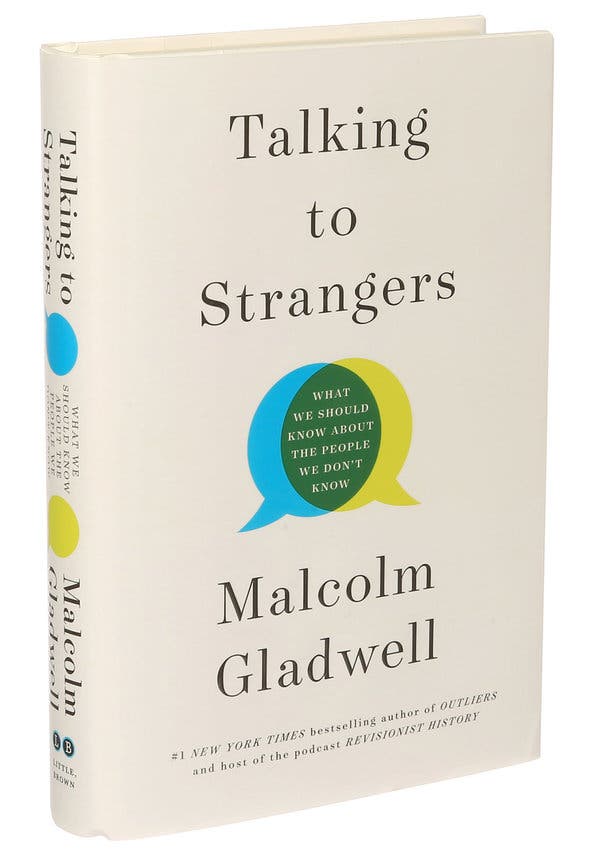
Talking to Strangers: What We Should Know About The People We Don’t Know is Malcolm Gladwell’s sixth book. I’m a big fan ever since his first book, The Tipping Point. Gladwell is an explainer, but he’s not straight forward in how he explains things. He enlightens by having the reader go step-by-step through the data he’s gathered to reach the same conclusion he has carefully discovered himself. He doesn’t just try to tell us the answer. Gladwell sees the world multidimensionally, so simple explanations won’t do.

In Talking to Strangers Gladwell wants us to understand what happened to Sandra Bland. Bland was pulled over for not using her turn signal when changing lanes, ended up being arrested, and committing suicide while in jail. The story was in all the news in the summer of 2015, and there was even an HBO documentary about the incidence. Gladwell became quite angry by the event and feels the media has failed to explain what happened and why.

It’s such a complicated story that Gladwell doesn’t even get to Bland’s story until page 313, but when he does, it all comes together perfectly.

Many people feel society is coming apart. That politics is disintegrating our culture. That everyone is on a short fuse, overly sensitive, and too easy to take offense. That there is little honesty in the world, and too many people want to carry guns. Our society is being overrun by mistrust and resentment. I am reminded of an experiment I heard about in school back in the 1960s. It involved cramming rats into a cage to simulate overpopulation. The stress of being forced to interact made them go mad and attack each other. Gladwell doesn’t mention this, but I was reminded of it constantly as I read his book.

Gladwell says we don’t know how to talk to strangers. He then goes on using various famous historical and news events to explain how miscommunication created extreme problems, often resulting in lethal consequences. His examples are quite fascinating. The first goes all the way back to Hernán Cortés meeting the Aztec ruler Montezuma, an extreme case of strangers meeting. Then he deals with Cuban spies and the CIA. This chapter is a mind-blower because Gladwell presents several historical cases where the CIA were completely fooled by double-agents. This is impressive because we assume CIA agents are highly trained at observing and understanding people.

After covering the CIA’s failure to detect traitors, Gladwell goes into detail about how Neville Chamberlain totally misread Adolph Hitler. These are fascinating cases of how we misread strangers, but they are so varied that you have to wonder what they mean to Sandra Bland’s case. Gladwell reminds us occasionally that Bland is his real goal, but he also tells us we’re not ready yet. He was right. You really want to stick close to Gladwell’s examples and explanations, because they do pay off big.

The problem is most people default to the truth, which is Gladwell’s way of saying we tend to believe other people are telling the truth. After reading his studies you feel like you should distrust everyone. Gladwell then gives cases of people who are always wary, and this is actually a worse way to live. To complicate matters, he gives several cases, such as Amanda Knox’s and Bernie Madoff’s where people act contrary to how they should act, which makes them even harder to read. I’ve seen a lot of news stories and documentaries about both of these cases and they don’t get to the details and insights that Gladwell does. I get the feeling that Gladwell wrote Talking to Strangers to show us how we’re all thinking too simplistically.

I’m not going to reiterate all of Gladwell’s arguments and cases. Besides not being able to tell when people are lying, and for many reasons, Gladwell gets to two other important insights. Coupling and location. He uses Sylvia Plath’s suicide and various studies on crime reduction methods to explain them. This is where Gladwell’s insights get more subtle. We want problems explained with one answer. Gladwell teaches us that sometimes a problem requires multiple datasets to understand what’s really going on. All too often we jump to what we think is the obvious conclusion when were missing whole areas of evidence. Evidence that sometimes appears to have no connection to the case.

Talking to Strangers is not a book you want to read casually, although it is very easy and entertaining to read. In essence, Gladwell is being a Zen master trying to explain the sound of one hand clapping. His examples bring us to the point where we have to have our own “I see!” moment. He can’t tell us. When Gladwell finally gets down to explaining what happened with Sandra Bland you should come to the conclusion that our present-day problems can’t be explained with the kind of logic we ordinary use with our friends or the kind of thinking we hear from pundits on TV. We’re too quick to lap up easy answers.

The trouble is most people will never understand what Gladwell is teaching. Most of us will continue to act on instinct using very limited instinctive thinking. Humans can’t handle the truth. This is my conclusion, not Gladwell’s. We think we know when we don’t. In fact, too many people are absolutely certain of their conclusions because their own explanations feel so right. We all live in the film Rashomon, each thinking we see the truth, but can’t understand the multiplex view we’d get from watching our lives from an outside vantage point.

Talking to Strangers, like other Gladwell books, are ones we should reread periodically. It’s so easy to fall back into simplex thinking. One of my favorite novels is Empire Star by Samuel R. Delany. It’s a science fiction novel about a farm boy from a backward planet traveling to other worlds and cultures. Before he leaves a wise person tells him that there are three kinds of thinking: simplex, complex, and multiplex. What this kid learns is most people are stuck in simplex and maybe complex thinking, and very few achieve multiplex thought. The story is about the kid evolving through the three stages of thinking.

Talking to Strangers is Gladwell’s attempt to get us to think in multiplexity.

JWH


Maybe Common Assumptions Are Wrong

by James Wallace Harris, Thursday, October 10, 2019

We make a lot of assumptions that we believe are true. That life will get better. That our children will have more than we did. That every kid should go to college and achieve all their dreams. That technology will solve our ecological problems. That humanity is destined to spread across space and colonize the galaxy. Overall, we think positive and assume we have unlimited potential. But what if these are false assumptions?

Today on Mike Brotherton’s Facebook page he linked to “Humans will not ‘migrate’ to other planets, Nobel winner says.” Brotherton is a professor of science and a science fiction author and he didn’t like what Michel Mayor said about our chances of interstellar travel. Whenever scientists, including some science fiction fans, question our final frontier destiny, many science fiction fans will quote Arthur C. Clarke’s famous Three Laws:

  1. When a distinguished but elderly scientist states that something is possible, he is almost certainly right. When he states that something is impossible, he is very probably wrong.
  2. The only way of discovering the limits of the possible is to venture a little way past them into the impossible.
  3. Any sufficiently advanced technology is indistinguishable from magic.

It’s their trump card to play against any skepticism about an unlimited future. The common assumption among science fiction fans is we’re destined to colonize the galaxy and we’ll overcome all the obstacles of physics to do so. There are no limits to our hubris. I had faith in that space travel destiny when I was young but I’m losing it in my old age.

What if belief in a Star Trek destiny is delusional? What if our species is destined to always live on Earth, or maybe colonize Mars, a few moons, and build some space habitats? Why is it so important to believe we’ll eventually create a galactic civilization? Why is it so important to believe humans have unlimited potential when everything in this reality has limitations? Are science fiction fans behaving like the faithful believing in miracles?

The more we study the problems of space travel the more it seems an unlikely enterprise for biological creatures. However, space seems perfect for robots with artificial intelligence. Maybe our children won’t colonize space, but our digital descendants will.

If you study history it’s obvious that things constantly change. Even in my life much has changed. It’s hard to predict anything. I replied to Brotherton that I thought the odds are 99.99999% we won’t colonize exoplanets. He said, show my work. I wish I could. I’m not like Mayor, I’m not saying it won’t happen, but my hunch is it’s very unlikely. I’m not good at math, but I think my reply suggests 1 chance in 100,000,000. One in a hundred million events happen. It’s like winning a big lottery. So maybe, I was being overly optimistic. I probably should have added two or three more nines. All I can say is after a lifetime of reading about how hard interstellar travel will be, and how hard it is for the human body to adapt to an environment that it wasn’t designed for, my gut hunch is our species is destined to live out its entire existence on Earth. That means most space opera is no more scientific than Tolkien.

I feel that’s a crushing thought to science fiction fans. I assume it’s like Christians hearing from atheists that God and heaven don’t exist. I didn’t take to Christianity when growing up but embraced science fiction as my religion. I’m now becoming an atheist to my religion. However, I am getting old, and skepticism clouds my thoughts. I no longer believe free-market capitalism is sustainable. I no longer believe every kid should go to college. I no longer believe our children should be bigger consumers than we were. Our species is very adaptable. I think whatever changes increased CO2 brings we’ll adapt. I also believe our human nature doesn’t change, so I also expect we’ll keep consuming everything in sight even though it will lead to our self-destruction.

We’re about to reach the limits of growth by our current methods of growing. That doesn’t mean we won’t adapt to a new way of growing. If the world doesn’t need seven billion people with college degrees we’ll find out what it does need. If Earth can’t handle seven billion people all living the American standard of living, we’ll adapt to something new too. Humans might even adapt to living in microgravity or in lower and higher 1G gravity. We might even create life extension or cold sleep allowing for slow travel to the stars. It’s technically possible to get humans to another star system, but the odds are going to be tremendous. It’s not a given. I don’t think Mike Brotherton realized a 99.99999% chance is like a person winning a billion-dollar Lotto jackpot. It has happened.

Quoting Clarke’s Third law is no more valid than saying “Believing in Jesus will get you to heaven.” Faith does not change reality. Clarke’s laws aren’t science, but hunches, like my figure of doubt. From everything we know now, migrating to other planets is an extreme long shot. We can’t calculate the odds, but any figure we give should be daunting. Anyone assuming it’s 100% to happen is in just as much scientific statistical trouble as saying it’s a 100% chance it won’t happen.

I’m just a doubter. In my old age, I realize now that if science fiction wanted to be more positive, more enlightened, and more encouraging, it should imagine how our species could live on Earth without going anywhere. Even if a few of us go to the stars, most of us will stay here. Dreaming of greener pastures on the far side of Orion might not be our ultimate destiny. Maybe our final frontier is figuring out how to live on Earth.

JWH